Showing posts with label Affordable Urbanism. Show all posts

Tuesday, March 13, 2012

The Urbanology Show

We've finally gone and done it. Kevin Buchanon of FortWorthology and I have started a podcast. The first episode is here and as Kevin describes it:
Episode 1′s topics include: designing streets for people vs. designing them for traffic movement, a brief introduction to Fort Worth’s Near Southside revitalization district, how the Internet and social media is affecting urban revitalization, the polycentric nature of cities, lack of transportation choice, building lighting, demand-driven urbanism vs. supply-driven urbanism, Deconstructivism, the revitalization of Bilbao, Woody Allen, the Enlightenment, and inappropriate Winston Churchill quotes.
Kevin has podcasted before so for me I suppose it was about getting the hang of it. We had been getting together about once a month over beers to talk about the very same things so we decided to start recording and putting those convos on blast, y'all. Though we both tangent trip by nature, the wide variety of topics listed above was surely caffeine induced, as the show was recorded at Avoca Coffee in the Near Southside area of Fort Worth. Next time, it will be over beers, meaning it may be more jovial and/or sanguine.

Friday, April 30, 2010

Know Your City Better, Look at it thru a Scientist's Eyes

It has always seemed to me that many defenders of sprawl, aren't really defending the actual everyday world that is defined by sprawl. Sometimes it stems from property rights (although any property owner NOT thinking about their neighbor is shooting themselves in the foot).

For others it is a misplaced anxiety about losing their home, their abode, the stuff they love inside the house. Rarely, do they really love what is outside the walls of their house. This is why home selling so often veered into pedaling improved niceties for the petty bourgeois: granite counter tops, a jacuzzi tub, a game room, etc. etc. All nice things sure. But, more often, in order to afford that place, the house ends up being constructed about as well as a bird's nest with paper, sticks, and spit. (Maybe THAT's what Herzog and DeMeuron were saying?)

But is life really better when you don't want to leave the house? When their is no amenity a few steps from the front door?

My guess is that the majority of sprawl defenders and attackers of "urbanism" are really those just afraid of change. Evolutionally (sic) speaking, these people have a purpose. They are wired to ensure that change has to prove itself. That we don't keep wandering down wrong roads and dead ends of false progress (see anything designed recently by Steven Holl).

With that, I bring up one of the first two rules of science:
Look at things right under your nose as if you've never seen them before, then proceed from there.
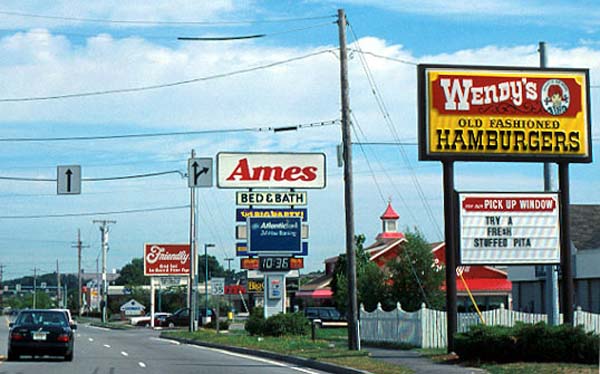
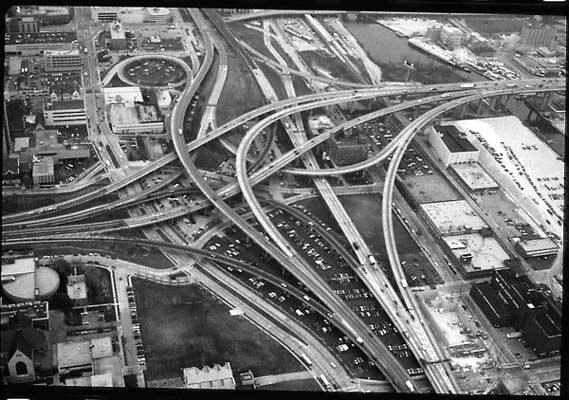
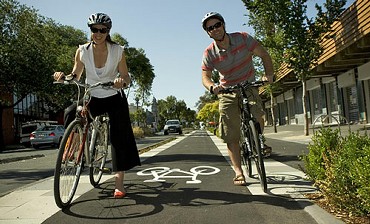
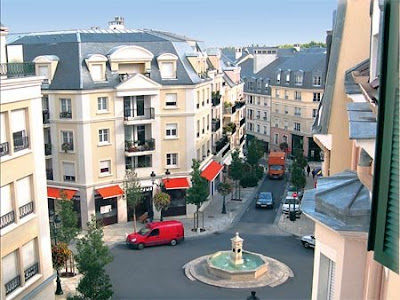
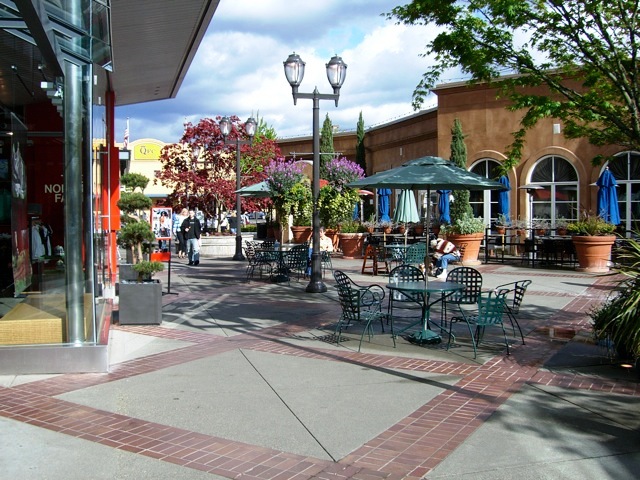
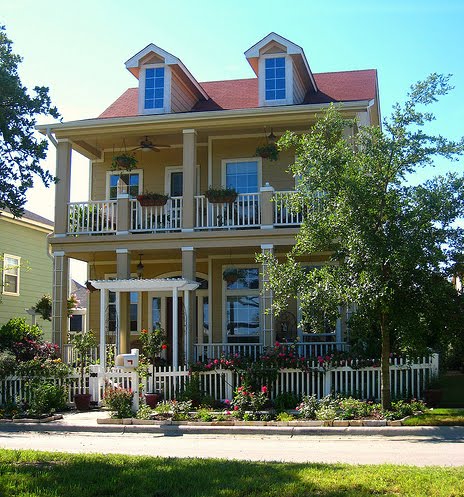
Which looks like a better place to Work? To Shop? To Play? To Converse? To Laugh? To Live? To Love?

The following photo-sets represent two distinctly different "genotypes" of place: the tax, zoning, and transportation policies shaping the physical form, the phenotype, of cities.

http://www.dkolb.org/sprawlingplaces/images/fullsize/spr.strip.pei.jpg


http://www.lightrailnow.org/images/mil-hwy-fwy-sprawl_cnu.jpg

Set 2:
http://www.bv.com.au/file/cecil_DaveMcCaf_web.jpg

http://3.bp.blogspot.com/_D5kx0bUGx_c/SHeJvxKmKPI/AAAAAAAAAa8/j3hvXB7m4r0/s400/plessis%2Brob4.bmp


http://www.myurbanist.com/wp-content/uploads/2010/02/CIMG0065.jpg
Image from MyUrbanist.

Thursday, November 19, 2009

Prefab = Predetermined Fate?

The originators of the Prefab movement are tossing their idea, formed on the basis (presumably, since it was the strongest message) of simplified production process, reduced waste, and recycling of materials from other industries into attractive housing, as if it were nothing more than an empty bag of cheetos. Or perhaps, that is how they saw the idea which was its fundamental failing. Another throw away. Oh, irony.

The greatest weakness of many architects, particularly the more (in)famous ones, is often one and the same with their particular greatest strength: the desire to be different. You can see it in how they defeat their own purpose. My understanding of the architecture and design professions is, to put it as simply as possible, to make life better: more efficient, more affordable, more profitable (in the triple bottom line sense), more elegant.

Yet, in the examples they hail (and here I'm referring both directly to this particular case of the pre-fabists, but also to any of the architectural "fashion trends" that lack purpose or fundamental grounding beyond self indulgence), you can see how they defeat their own purpose. The buildings are off in the middle of nowhere. There is nothing around. A blank canvas for which nothing can interrupt the glamour shot of their baby with a proverbial finger on the lens.

Hence, there is nothing else for the building to converse with, no dialogue with other buildings, no synergies, no humanizing effect on the city. The more ingredients in an equation, the richer and more complete, complex, diverse, and resilient is the elaboration of life. Biology has something to teach us about architecture and city building.

Furthermore, and more specifically, we are facing overwhelming needs to relocalize; to reorganize where and how we inhabit cities, particularly in the Sun Belt and more importantly, in this age of decreased wealth and need of affordable, yet quality, housing that contributes in a positive manner to the City without stigmatizing those who live within it. Not urbanizing the poster children of a movement immediately makes it irrelevant when its fundamental strength is the cost and mass production capabilities.

I, for one, KNOW there is still opportunity in prefab housing. It just now has to be stacked from reused (and prefabricated to be livable) "capsules" of bygone industries, similar to some of the container housing that has gotten some publicity. One challenge, like any new idea, is beautifying the concept. Ya know, the job of architects if all they plan on being is style guides.

One of the beauties of such housing, is the potential for flexibility. It has always bothered me that contemporary apartment and mixed use buildings engrain an inflexibility to their unit counts, i.e. 50% 1-bedrooms, 30% 2-BRs, 20% studios, etc. They lack a fluidity where unit leasing rates are often held hostage by guesstimated market research.

This fluidity and constant evolution and flexibility to the market's needs (aggh, by "market" I mean by the local community's needs) can be had in modular housing. If one module is 400 sq.ft., roughly studio size, it can be expanded to two modules for large 1-BRs or small 2-BR units. Add three modules together, you can have small 3's and large 2's. Each module comes with a specific cost increment. Furthermore, these can be segmented or arranged by tenent vertically or horizontally.

They prefab heroes claimed accessibility and affordability, but by locating and designing the product in the middle of nowhere you are in car culture, enslaving any potential "poor" that might be able to afford your "high design" to their car, or effectively isolating and alienating them from participating in the economy. This is THE fundamental failing of a City designed entirely by the car. Putting everyone in cars, having tax rates to afford the excessive infrastructure, carving off disposable income, it creates undue barriers to the local economy.

Once again a lack of economic fluidity as expressed through design without the fluidity of adaptability; effectively bankrupting cities as well as States. Read: California.

Friday, June 26, 2009

Affordable Housing errr, Hire Me!

Here is Michael Pyatok's recent presentation regarding workforce housing for Downtown Dallas. Unfortunately, there is very little in the way of deep analysis and recommendations and, unfortunately more "look at my projects!" While there are a number of creative solutions here, these are mostly the types of infill densities we should be looking at (and are currently) in other inner ring infill areas, not downtown.

Also, the types of affordable housing done in San Francisco, due to subsidy and land prices resembles more the market rate developments here in Dallas. Can we do quality affordable housing? I believe so, but we have to do better than the inclusionary component currently in downtown where on a per square foot basis the price point is the exact same as the market rate housing. Meaning that the affordable units (legal definition) are about 500 sq.ft. Hardly appropriate for families. These units ALWAYS seem to be vacant by the way. Go figure.

That, of course, is not to say that affordable and workforce housing as a component in downtown shouldn't be encouraged. I, for one, agree with Alex Krieger who said, "the folks populating the W hotel are not the ones that will create a vibrant street presence in downtown Dallas."

Friday, April 10, 2009

Downsizing

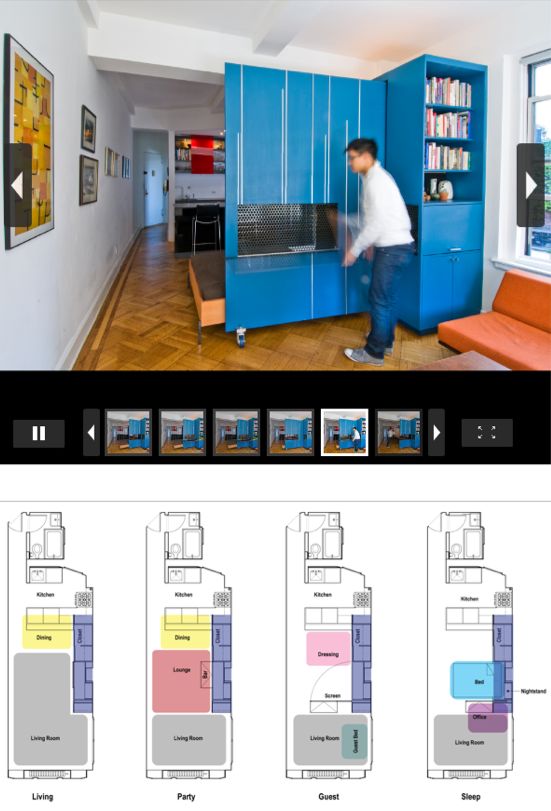
TreeHugger: Small Apartments w/ Big Impact.

Based on my Millennial presentation, we've been doing a lot of work developing a prototype for Millennial housing, a generation that can't afford to live in the City but desire to do so. So how do we make it affordable? Well, one way is to shrink the unit size and maximize spatial efficiency. The residential architects have been taking clues/inspiration from Cruise Liners and First class cabins.

TreeHugger here is focused more on specific unit types, whether it be pre-fab or standardized layout for maximum flexibility. My favorite for immediate practicality and use of the swing out screen and murphy bed:


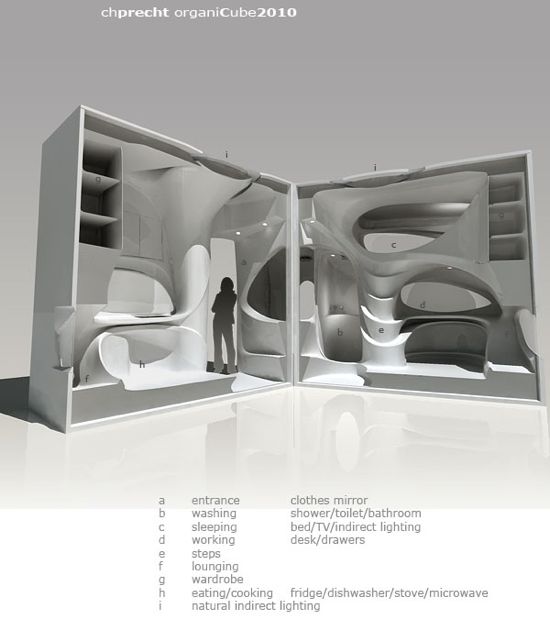
My WTF moment for, sure you devised a foldout living space, but where the hell am I going to put it, how do other units relate to it, where are the utility hookups, and WHY THE EFF IS IT ALL BLOBBY AND SWIRLY?! Give it up already.

Friday, February 20, 2009

OpEd to the DMN

We'll see if it gets published:

It is true that it is a sad time for the economy and all of us these days, but I see reason for optimism around the corner. It’s just going to take some introspection, some creative thinking, and good old fashioned elbow grease.

As an urban design professional in Dallas, I get a chance to interact daily with business leaders from architects to brokers, developers and lenders; all of whom are feeling the pinch in the current economic stasis. It seems that the prevailing opinion is that if we wait awhile, everything will spring back to “normal” like previous burst bubbles that DFW has endured in the last thirty years.

And why not, there are merely going by experience and it is true that Dallas is one of the ‘boomier’ and ‘bustiest’ [sic] cities that I have known. I like to joke that this trend is represented by the current iteration of the city skyline, with high highs, low lows, and very little in between.

I am writing to tell you that we will come out the other side completely different. I expect a tidal shift on the scale of the industrial revolution driven by necessity and changing demographics. The magnitude of the tectonic shift is evidenced by the current intensity of the growing pains.

The last 80 years have been a great ride for this country, but what has made it great is our ability to adapt to changing times. The growth witnessed during this period was one based entirely on cheap energy, sun baked for millennia and fossilized underground and the real estate development directly associated with it.

However, we know that we can not grow outwardly forever given the finite nature of this energy source. And perhaps more importantly, based on the recent Pew Research Center study, we don’t even like the end results of this development: Americans are unhappy with their cities.

We need to recalibrate our thinking from quantitative growth to a model of qualitative growth, improving what we already have. What this means for Dallas is that we must begin to focus on quality of life improvements, reinvestment in the core (the “face” of any city), selective infill in and around downtown and within walkable distances from transit.

The market is there. The two largest population bubbles in American history, the Baby Boomers and the Millennials (approximately ranging in ages from 8-30) are both looking for quality in-town housing and interesting urban places.

Boomers are retiring and desire the type of freedom found in ideal “retirement communities” like the Upper East Side or Key West rather than being “warehoused” in an actual retirement village. Millennials want to escape similar confines of suburbia for more authentic and diverse (yet affordable) experiences and ways of life.

I often say that cities progress from being Viable to Livable and finally to Memorable. To the City’s credit, they are undergoing several projects that would register as “memorable,” in some cases admirably so, but we still have not yet achieved livability (the hard part) in downtown (and this coming from a downtown resident).

At RTKL, we are working to develop a multi-family prototype geared to the needs of Millennials. It generally consists of smaller units, but more embellished common areas and amenities to accommodate their highly social nature and attract talented college graduates to Dallas.

A focus on urban infill housing and creating a more livable city will provide the foundation for getting out of this rut. The will is there, even if it is subcutaneous, but we also need leadership to guide us there through the darkness.

Wednesday, January 7, 2009

FORWARD Article

I hope that I'm not jumping the gun, but here is the rough cut of the article (with some later minor tweaks that occurred after editing...well, just because I was unhappy with a few phrases) that will be published on Jan. 22, 2009 in The AIA National Associates Committee's Quarterly Editorial Online-Journal, found here [Link]:

Full disclosure: I am not an architect. But, I did stay at a Holiday Inn Express last night. Actually, I just work for an architecture firm, in the Urban Design and Planning Group. I am writing because I have shared interests in sustainability and generational studies and believe these topics to be interdependent and intertwined. The point of this article is to discuss how the Millennial Generation will drive the architecture and sustainable urbanism of the 21st century and how the real estate market is failing them and architects and designers must deliver it for them.

Before moving forward with this thesis, it is critical to understand a few things about generational studies. First, generations are cyclical. Characteristics cannot be linearly extrapolated from one generation to the next. Rather, they are mostly reactive to previous generations. Next, there are always outliers and anomalies. The key is to focus on trends and find the statistical mean or center of gravity of the cultural shift.

Now, who exactly is a Millennial? Academics like to assign specific age brackets and birth years to define and identify generations. They bicker over whether they were born in 1977 or ‘82; 1994 or ‘96. I prefer to focus on epochal shifts - moments in history that define them - as people - as a group. So I will define this cohort as individuals graduating college post 9/11 at the oldest extreme and those involved in the historic 2008 presidential election at the youngest. Anecdotally, I have heard too many stories of eleven, twelve, or thirteen year old volunteers. They are active, involved, informed, and the largest generational cohort in American history.

If there is one word to best describe the Millennials, it is that they are communitarians. Millennials are team players, working better in groups than individually. They have redefined the internet’s networking capabilities while maturing along side of it, with the creation of YouTube, Facebook, Flickr, etc. proving the internet would not replace community leading to a world of plugged-in shut-ins, but serve as a tool to build and maintain relationships.
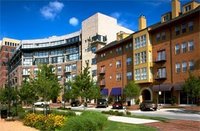
[Common areas and public spaces take precedence when designing for Millennials. Pictured: Addison Circle where each building faces a park. Image courtesy of RTKL.]

Their chosen fashion is about subtlety, details that give a hint of individuality without shock or rebellion. As Nadira Hira writes in Fortune, “this isn't a group you'll catch in flannel. They're all about quiet kitsch - a funky T-shirt under a blazer, artsy jewelry, silly socks - small statements that won't cause trouble. The most important decorations, though, are electronic - iPods, BlackBerrys, laptops - and they're like extra limbs.”

You have heard of Generation Me, say hello to Generation We.

In Millennial Makeover, Morley Winograd and Michael D. Hais describe the two types of realignments -"idealist" and "civic"- that have alternated throughout the nation's history. From pop culture, to fashion, to the historic turnout of 18-29 year old voters this election suggests that Millennials are beginning to come of age; seizing the mantle from the Baby Boomers, defining the collective consciousness.

The tidal shifts are not isolated to politics or pop culture. Our cities, the places that house us, provide platform to live, learn, love, interact, and transact, are also at the tipping point. They are lacking real urbanity. The real estate community is supposed to deliver what the market demands. But, according to Chris Leinberger, only 3% of Americans live in walkable urban communities, while 30% said they would like to join them. That is some serious pent up demand.

Millennials grew up in suburbia; bland environments dependent on others for mobility. They are entering the adulthood seeking lifestyle: vitality, diversity, and community. But, Millennials are not the only ones who will be driving this sea change from suburban to high quality urban environments. Baby Boomers will be retiring by the boat load. Retirement communities in their current form resemble warehouses more than they do the most desirable of retirement “villages”: real communities where retirees can be independent and empowered, such as the Upper East Side and Key West.

[Millennials meeting at a "Third Place." Stock image courtesy of RTKL.]

The paradigmatic issue is that the world constructed between 1950 and 2000 is one of planned obsolescence, of consumption. We have overspent, so retailers (and similarly, homebuilders) over provide products. Combined with a more frugal younger generation, a vast shift in urban form is required; scaling back and relocalizing in conjunction with relocation of the “market” where transactions occur in places that fulfill the social needs of the new generation. Driving to the mall is no longer as convenient (or desirable) as heading to third places: the corner store, the coffee shop, the local pub.

I recall the overly simplistic, undergraduate argument whether Architecture was an art or a science. Certainly, it is both, but art reflects its place in time. Architecture in the 21st century will be as different as the Millennials are from the Boomers. They are doing whatever it takes to get into interesting, urban environs at a time when it is hardly affordable for them. They are moving into “micro” units, taking on roommates, and more willing to live in multi-generational households.

Like society, the architecture profession is at a similar transitional stage as Generation We, the communitarians, and sustainable urbanism struggle to take center stage from the attention seeking, entirely self-referential architecture and high tech gadgetry posing as sustainability as if it is some sort of fleeting fashion, temporarily en vogue. These are postcards, nothing more.

We have to all become less specialized in our individual professions, under one umbrella, each as city builders with a common cause focused on placemaking, which becomes more than series of stills, greater than the sum of its parts. It becomes drama. Only through Architecture of the We, not the Me, can we design and begin to rebuild our cities as stimulating places for the next generation and achieve real sustainability.


Recommended Reading:

Farr, Douglas. 2008. Sustainable Urbanism: Urban Design With Nature. Hoboken, NJ: Wiley.

Greenberg, Eric, and Karl Weber. 2008. Generation We: How Millennial Youth are Taking Over America and Changing Our World Forever. Emeryville, CA: Pachatusan.

Hais, Michael D and Morley Winograd. 2008. Millennial Makeover: MySpace, YouTube, and the Future of American Politics. New Brunswick, NJ: Rutgers University Press.

Hira, Nadira A. “Attracting the twentysomething worker. The baby-boomers' kids are marching into the workplace, and look out: this crop of twentysomethings really is different.” Fortune, May 15, 2007. http://money.cnn.com/magazines/fortune/fortune_archive/2007/05/28/100033934/

Howe, Neil and William Strauss. 1997. The Fourth Turning : an American Prophecy. New York: Broadway Books.

Howe, Neil and William Strauss. 2000. Millennials Rising: The Next Great Generation. New York: Vintage Books.

Leinberger, Christopher. 2008. The Option of Urbanism: Investing in a New American Dream. Washington, DC: Island Press.

Nasser, Haya El. “Less is More in New Housing: Young Renters and Buyers Seek Small Spaces with Big Appeal—and Luxury at a Lower Cost.” USA TODAY, December 5, 2008. http://www.usatoday.com/printedition/news/20081205/tinypads05_st.art.htm

Zogby, John. 2008. The Way We’ll Be: The Zogby Report on the Transformation of the American Dream. New York: Random House.

Tuesday, January 6, 2009

WSJ: "Give Up Your Car"

Linky.

Trading down to the cheapest car possible is one move. Dumping one vehicle from a two-car household is tougher to do, but offers real savings. Moving into a city with a downtown, and getting rid of your cars completely, can save you even more. When you factor in the savings, city real estate might actually work out in your favor.

Residents of inner-ring and upscale suburbs, as well as everyone in car-dependent cities like Dallas and Atlanta, are in the worst of all possible worlds on this. They're paying plenty for real estate - and then paying even more on top of that to run a car for each adult in the home.