




Showing posts with label Anthropocentrism. Show all posts

Thursday, November 5, 2009

Ratcheting Down Roads to Crank Up Density

This post begins with the assumption, which I would call observed fact, that all development is a direct response to the primary mode of transportation serving the site (primary mode can also include multi-modal). When specifically applying a mode of transportation and accommodating it on a site, this assumption makes logical sense. It is the single most important determinant

For example, if everybody is travelling by car, the parking necessary takes up valuable FAR. Similarly, ports/docks are low density b/c everybody is on a boat b!tch. People arriving via transit are all on foot, pedestrians are on foot, and don't exactly need a place to put their shoes. And if they did, the foot lockers wouldn't exactly take up much space. That extra room for parking is either immediate for access (ie in front) or hidden to ameliorate the effect parking has on a building's ability to engage the public realm and participate in the multiplier effect of the "urban buzz."
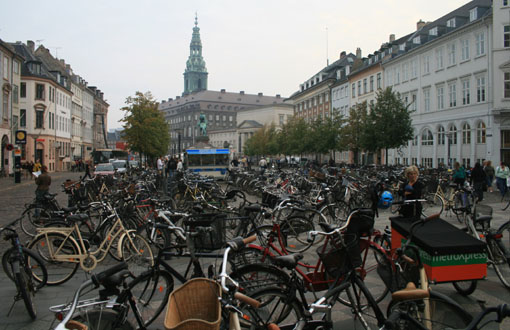
http://www.streetsblog.org/wp-content/uploads/2006/10/IMG_0283_bike_parking.jpg
Copenhagen bike parking, compact and not sociofugal like a car park.

The two solutions are various shades of bad: very bad and less bad, because as I said it takes up valuable building/leasable space and it disconnects a building from its context thereby turning the building into a "non-sequitur" building, meaning it does not participate in the synergies that create a whole that is greater than the sum of the parts. Furthermore, the parking provision (and in cities where land and development is more expensive) has become a barrier to development, often accounting for upwards of 20% of a project cost.

To further the linguistic metaphor, in syntax, there are certain rules for things to come together to make sense (in cities these would be livable places). Once the rules are satisfied art can be applied to create poetry or prose and invoke even greater meaning. In cities, these become lovable places.

We obviously can't just start building without parking, as everybody (but me) is still stuck in a car on the road. But, we can alter the transportation network that informs the development density (and quality). I don't mean removing roads altogether, but slowly and incrementally ratcheting down the scale of many of the roads in the city and pinpointing any road designs that negatively affect urban tissue, creating places less than the sum of the parts.

Dallas is in the top five in the country in constructed freeway miles per capita. Extrapolated, it is probably pretty safe to assume that American cities dominate in the world list for this statistic as well, meaning that D/FW has nearly as many freeway miles per capita as any city in the world. Top Five WooHoo! Time to celebrate? No sir. And we're gonna drive from Dallas to Darmstadt, Germany to see how much money we're wasting.
---------------------------
As I posted the other day, Prof. Bill Hillier discussed development density, how it is created and defined by the density of the local grid network. The combination of the two components combine to create "urban buzz," or as I would describe as the facilitation of synergistic economic activity.

Obviously, economic factors have to exist to have demand for population to be there in the first place, the grid is then the application of a platform for increasing economic activity. The economic purpose makes for a VIABLE city. The grid allows for a LIVABLE CITY. And, as I said earlier, applying CIVIC ART then creates for MEMORABLE or LOVABLE cities.

You can't just start laying out a grid in the middle of nowhere and expect "urban buzz," but that won't stop people from trying apparently:
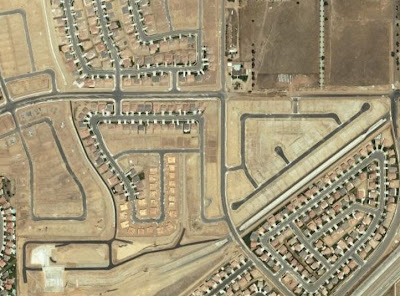
The visual mind virus of Bizarro Keynesian Meme. Build roads, expect development = stupid supply side urban development, rather than incrementally allowing demand for new development and expansion of the grid to accommodate it. This is what we mean by not overextending yourself financially by way of infrastructure.

Looking further into why Cities have roads and what purpose they serve, Hillier also talks of the necessity of local and global connections. Let me refine this dichotomy to include a greater range of: local, city, metropolitan, regional, global. Extracting Jane Jacobs, highways are essentially global connections b/c they link global hubs ie airports to cities (as macro destination), as well as cities to cities - for example Houston area to Dallas area. The grid then allows the connections from microdestination to microdestination, or intermideate destination (such as a transpo hub) to microdestination (your house, your job, third places, etc.). As Hillier suggests, the local grid connects everywhere to everywhere and allows the necessary flexibility of choice to get there without all traffic funneled to overly hierarchical dendritic arterial systems.

So we have our five road "connections, which I'll number by intensity or volume:
1. Local
2. City
3. Metropolitan
4. Regional
5. Global

Each of these connective "purposes" has an appropriate design solution that either can engender high quality, dense urban development or do just the opposite. This post will show examples of both.
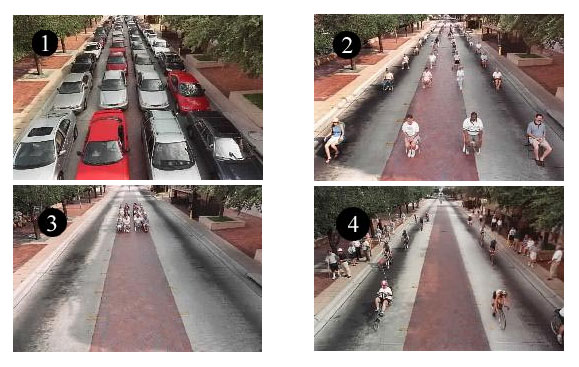
http://pedshed.net/blog/wp-content/uploads/2009/02/tampa_capacity.jpg
Oft repeated schematic illustrating spatial relationship and densities of people by mode of transpo. As you can see accommodating modes other than cars allows for greater capacity. Moving greater capacity is supposed to be any transpo engineers job. Greater capacity moving by a site, equates to a higher "highest and best use," meaning more predictably successful commercial enterprises, more "urban buzz." Oh, and as we'll see, it just looks nicer, feels nicer.

Looking specifically at Dallas, anyone that approaches downtown from the North via the Dallas Tollway arrives into the City experiencing a descension of hierarchy from road type 5 all the way down to 1. This is what we mean when we say context sensitive design. The street capacity is reduced as the road descends further into the City. However, as we'll see, Context Sensitive Design can be poorly sensitive or misinterpreted as the roads are all poorly designed, strictly for the maximum amount of cars and little else (like a DART bus or two) meaning not operating to full capacity as the picture above shows.
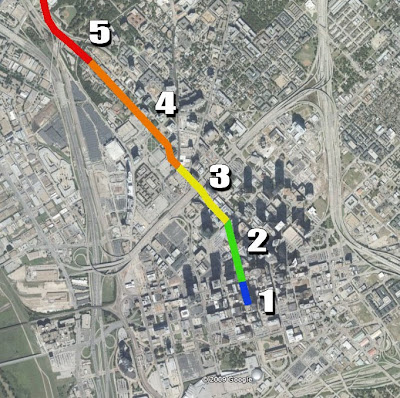

This entry experience will follow a 2-mile stretch of roadway as the Tollway as it merges with and becomes Harry Hines, until it turns into Akard St. until it terminates at AT&T and Golden Boy!
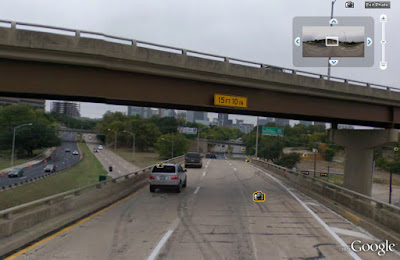

Category 5 (failed autocentric version): Characterized by flyovers, overpasses, cloverleafs, and related over-engineering. Notice that no development wants to engage with roads like this in any way and some futile attempts to "green" it up is made to make it barely palatable, ie more sunk costs.
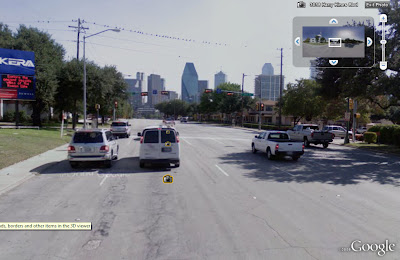

Category 4 (failed autocentric version): I believe we are near Harry Hines and Wolf here. The street now has traffic lights, six! lanes (all each too wide as well), and a pointless sidewalk right up to the curb. Often has surface parking in front to provide "access" and the only thing noticeable is a KERA billboard for drivers b/c nobody is expected to be on this road on foot. You'll also note that this is one-way here, meaning it has a mirrored overly wide, poorly design street running parallel one block to the East.
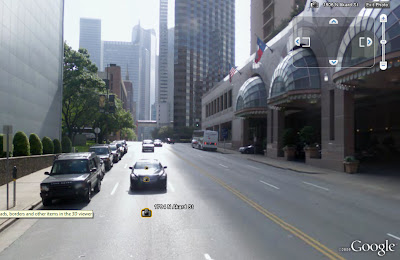

Category 3 (failed autocentric version): It's actually two-way with some on-street parking here, yet it isn't exactly helping business, except that we're greeted by a porte cochere and two curb cuts. Prime example of a building relating to the form of transportation. You're obviously arriving by car, we'll design our entry to greet cars. Oh, and a blank wall.
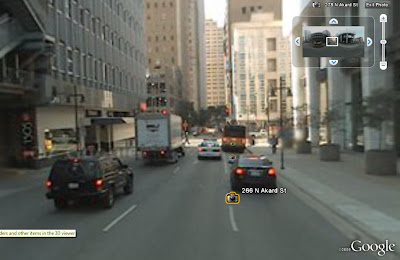

Category 2 (failed autocentric version): Back to one-way. Apparently, we have yet to learn that businesses need two-way streets to maximize predictable visibility and locational choices. As we said earlier, commercial success (and urban buzz) requires as many people moving by as possible (a focusing of the energy of human movement). Two-ways is better than one. Also, on-street parking is available at points along this street but it is spotty. We see another covered porte cochere and a sidewalk with no buffer from moving vehicles.
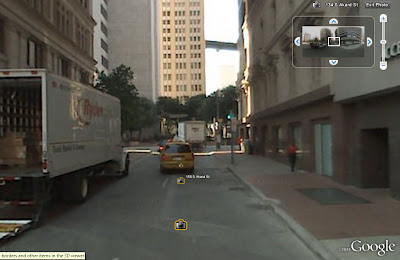

Category 1 (failed autocentric version): Given that this is at the intersection of Main Street (the one area of successful urbanism in downtown) and the Harry Hines/Tollway funnel, this should one of the most important and successful streets in Dallas. Main Street works, but as of yet, the "buzz" hasn't spilled southward toward the poor, imprisoned Golden Boy. This is partially due to the design of the street which doesn't convey its importance (and I don't mean widening). It feels like a back alley.

So what have these roads bought us? Well, because they are design to be sociofugal (and repel people), they become escape routes. As I suggested earlier this week, countering the argument that big roads deliver people to a city, it's a zero-sum game in terms of people coming and going on those roads, but when you factor in what they have done to the real estate, the extra cost of widened (virtually) car-only roads has decimated real estate development and urban density.

The density WE DO have is designed to be entirely auto-centric as well, with large parking garages as well as front doors that are little more than car drop-offs/porte cocheres.
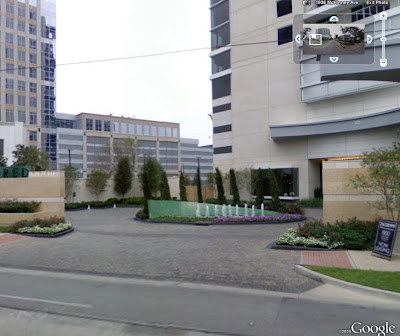

The street edge is even defined by walls. agggh, more tree lawns!!! kill me!!!!

Furthermore, all of this high-rise residential/condominium development dotting lower McKinney is entirely a by-product of the falsely created, irrational housing exuberance of the past ten years. If it had to do with actual demand (one, it would be filled), it wouldn't be so poorly designed in how it engages the public realm.

So what are examples of roads that these should look like? Well, I'm glad you asked.
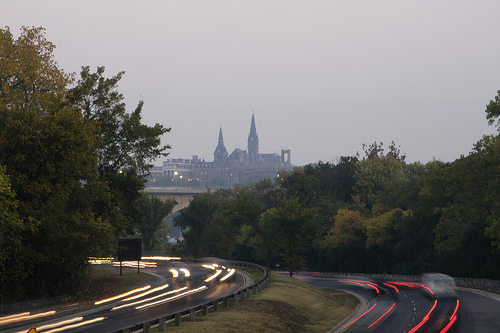
http://farm3.static.flickr.com/2214/1640881747_3d9de56482.jpg?v=0
A better #5 - limited to the outskirts of the city. Very few $750 Million overpasses/interchanges, because highway to highway interaction is rarely four-way and they don't intersect every two miles. Lined mostly by natural buffers, development is rare except at the highway to boulevard hubs. There are no frontage roads, which bleed the "movement economy" energy from the lower level streets, which can better accommodate development.


A better #4 - ignore that this is the Champs Elysees which acts as a "main street" of Paris. 4's should be the primary vehicle traffic movers of any metropolitan region and can accommodate development directly interfacing with and benefitting from the energy moving by on the street because of the buffers created by the allees of trees, a browsing/parking parallel "slip" lane, and ample sidewalks. These streets still require a development coding maintaining a linear street wall to maximize use to use adjacency/synergy.
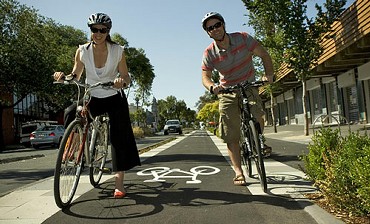
http://www.bv.com.au/file/cecil_DaveMcCaf_web.jpg
A better #3 - a lesser version, or lower scaled "complete street" from #4.
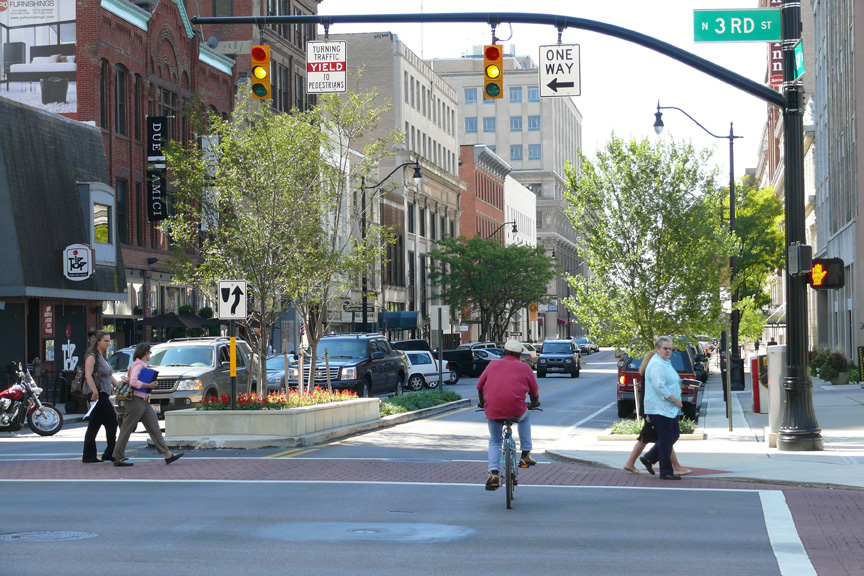
http://publichealth.columbus.gov/uploadedImages/Public_Health/Content_Editors/Planning_and_Performance/Institute_for_Active_Living/gaystreetfix2tomail.jpg
A better #2 - Main Street in downtown Dallas would be a good number 2. However, I would categorize it in the Dallas hierarchy as a 1, the lowest capacity because the road hierarchy is on steroids. The theme of this post is that in Dallas, all of the roads, need to go on "road diets" and scale from bad 2's to good 1's. Bad 4's to good 3's.
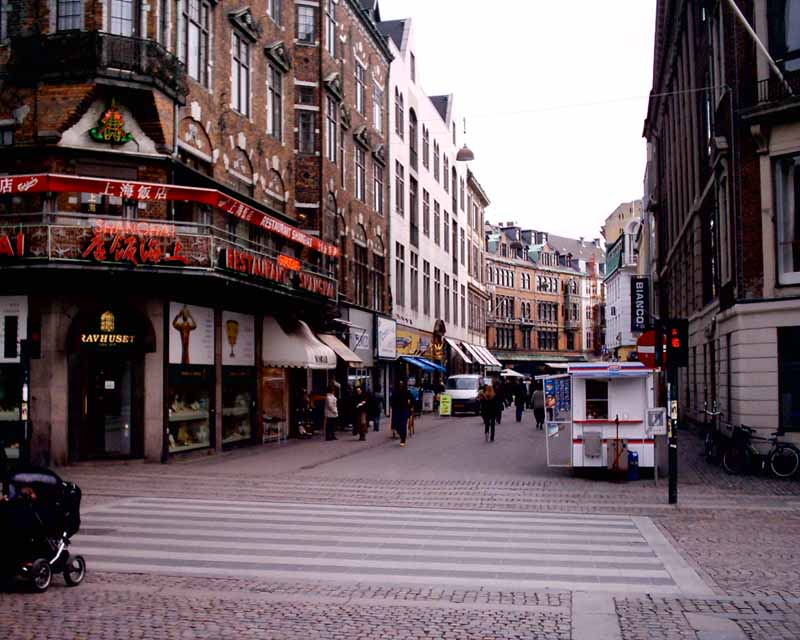
http://www.e-architect.co.uk/copenhagen/jpgs/nytorv_stroget_54.jpg
A better #1 - Rather than alleys, we start using terms like woonerf or mews. Examples include Stroget (the carfree area in Copenhagen) or even the small side streets with cars near Stroget that will probably go carfree soon anyway. Point being, cars can still get through as you see above, but it's primarily only delivery vehicles. Who else would want to try to drive through there? Curbs aren't necessary b/c bikes, pedestrians, strollers, pedicabs, you name it all have equal right-of-way to the space. This is the epitome of street as space.

So what does all of this mean for Dallas? Dude, you're full of something, not sure if it's questions.

I thought we were driving to Darmstadt. Are we there yet?
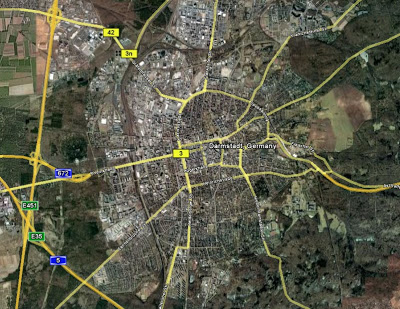

Yes. This is Darmstadt, Germany. When placed over Dallas at a similar scale, we get this:
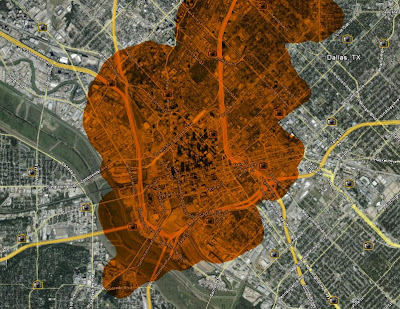

Darmstadt is a city of 142,000 people. The orange shows all of Darmstadt minus the "boroughs" of Eberstadt, Arheilgen, and Wixhausen (all compact suburban satellites off the map, but still within city proper) taking the total population of the orange area down to approximately 100,000.

It should be noted that Darmstadt also barely has any buildings over ten stories, other than the middle finger building (shown below), of course. Most of which are steeples or various other associated vertical elements with civic/cultural edifices.


I wonder where or towards whom it is facing? Probably Munchen.

While not entirely accurate, the orange area covers the equivalent of Dallas zip codes 75201, 75202 (downtown) and 75204 (uptown), meaning we're probably looking at a max residential population of about 25,000, or one-fourth of Darmstadt's density.

As you can see from the aerial, its compact nature allows for preservation of nearby agricultural land for food production as well as natural forests/habitat. The freeways are all exterior to the actual city preventing them from having the corrosive, deleterious effect upon the urban fabric which we know all too well. The city is then accessed by roads lower on the hierarchy.

If as the saying goes, "density buys amenity," apparently in Dallas we just buy entirely too much car infrastructure which means that much less in the way of amenity and livability.

P.S. I have a much more in depth post looking at Darmstadt that has been about half-way done for about a year. I'll try to get that finished within the next week.

Monday, April 13, 2009


GOOD Mag on Streets of the Future. And that future is complete.

But, where is the on-street parking? And why the one-way roads? Not to sound like a street-design fundamentalist myself, but the storefront businesses AND the pedestrians need that on-street parking. We also know (via studies + empirical evidence) that one-way roads kill business, not to mention make it difficult to get around in cities.

All roads need to go everywhere...and not everywhere. Everything in moderation, even moderation.

HT: CoolTown Studios.

Tuesday, March 10, 2009

End of the Auto

...and all of those commercials where everybody is so happy driving their new hummer around. Not so coincidentally my own mother was just hit at a light by some maniac going 60 mph. Fortunately, she was ok. But, is this what life is? Sitting around in metal boxes, playing bumper cars, if only to have some human to human contact.

Harvey Wasserman on the end of the era of the automobile:
But the larger transition is epic and global, based on a simple structural reality: the passenger car is obsolete. Auto sales have plummeted not merely because of a bad economy, but because the technology no longer makes sense.

Franklin Roosevelt took GM over in 1943-5 to make the hardware to beat the Nazis. Barack Obama should now do the same to beat climate chaos.

Make streetcars, not passenger cars.

Hybrids are too little, too late, with problems of their own. Solar-powered electric cars will help phase out the gas guzzlers.

But in the long run, the automobile itself needs to be dismantled and re-cycled, not retooled or rebuilt.
The fact of the matter is that Car companies are broke because they can't run their business profitably, cities are broke because they over extended infrastructure and the costs to support car culture, people spend roughly 20% of their income to operate and maintain this machinery to get us around, and urban development is crippled by the cost of constructing parking. All barriers to progress.

And all of this BEFORE energy costs really start to cripple this energy-absurdly intense economy. Just wait to some real disruptions in the energy markets. How about we just rid ourselves of these burdens now???

Time Machine with Guy Pearce was a pretty shitty movie, but to this day I still have with me the scene from the near future in NYC where everyone is moving around via bicycle.

More from Wasserman:
We need to dig up roads, not build more. We need rails and coaches, bio-diesel buses and self-propelled trolleys, Solartopian super-trains and in-town people movers, not to mention windmills, solar panels, wave generators and geothermal piping.

In America's corporate-conceived “love affair with the automobile,” our first spouse---mass transit---was murdered. Now the unsustainable obsolescence of the private passenger car is collapsing a global financial system built on the illusion of its constant growth.

If the automobile and its attendant freeways continue to metastasize in India, China and Africa as they did in the 20th Century United States, we are doomed.

Thursday, February 26, 2009

Links

DMN: Spanish company wins job to rebuild LBJ Freeway. Unfortunately, though to not DEconstruct it. I have a friend that works for that company.

Wired gets on board the (pedestrian) Luv Train: It's Time to Favor People over Cars.

Papandreou called for an end to "state, federal, and local land use policies that are literally forcing people to have to drive" and told Wired.com we're on the cusp of an inevitable "mode shift" away from individual car ownership toward a greater reliance on mass transit and sustainable transport.

"We're already at that crossroads," he said.

------

Car-friendly policies have created a "carbon shadow" that vehicles can't escape -- the result of "all of the regional consequences of all these policies and collective actions," he says. Instead of the "manufactured value" of personal car ownership, we should adopt "demand management" by creating disincentives for driving that will, in turn, encourage people to walk, ride mass transit, carpool and use other means of getting around.

In Papandreou's eyes, freeways are wasted space. Consider this: 200 people can jam the I-405 riding along in 177 cars (the average ratio). Or they could use just two lanes in three city buses, or have plenty of personal space around them if they rode bikes.

"All that road space could become something else," he said, stressing that the only way to achieve that vision is with a total "eco rehab" that avoids the sort of ineffective piecemeal programs that only survive due to their political popularity. The Obama Administration's economic stimulus package could be a first step toward that future.

"It's a down payment to a massive mortgage," Papandreou said. "I'm hoping that the stimulus gets the ball rolling."

Transit is essential during big events.
In case no one has noticed, there's a pretty good stadium in Anaheim where no professional football has been played in 15 years, even though there's a train station in the parking lot that accommodates about 40 Amtrak and Metrolink trains a day. It's no coincidence that the two big-city downtowns we at CP&DR decided were the best in California - San Diego and San Francisco - have great ballparks downtown right near transit stops.
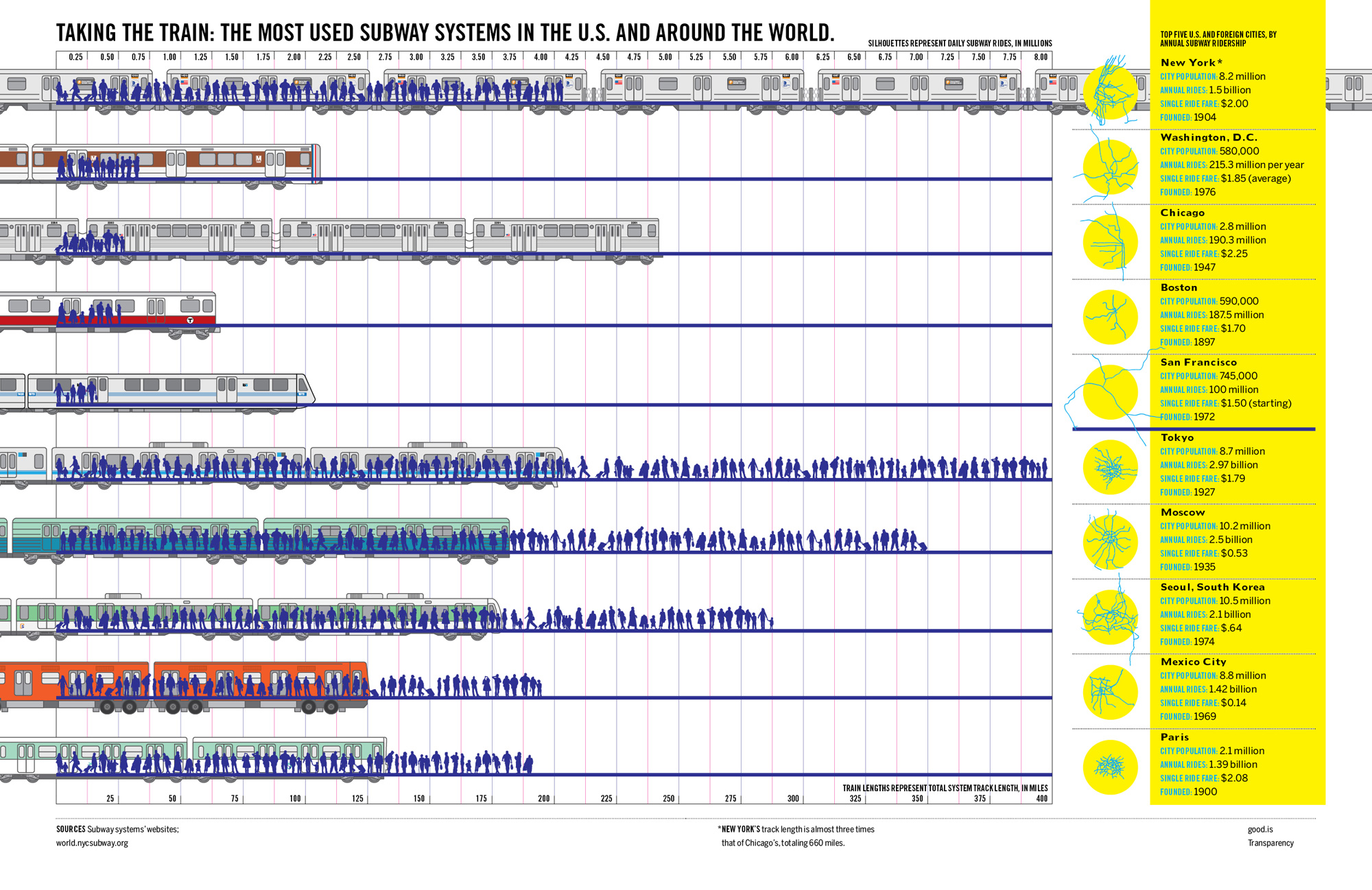
GOOD Magazine compares subways and ridership, click on graphic or link to see full image (firefox is killing me this week) and notice the graphic to the right comparing the network of each image and how tightly-knit (or not) each system is...then notice the correlated ridership.

NYC to Close Broadway thru Times Square

Linky (NYT).

Last summer, the city narrowed Broadway from 42nd Street to 35th Street by setting aside two lanes on the east side of the street for a bike lane and promenade with tables, chairs and planters.

That project, called Broadway Boulevard, met with some skepticism at first but quickly became a popular lunch spot for office workers and tourists. Under the new plan, officials are considering creating a similar promenade from 47th Street north to the vicinity of Columbus Circle.

Sort of what always happens when quality of life decisions are made, right? People are skeptical and resistant to change at first, and then in practice it becomes popular. See: Stroget, Copenhagen. People said the businesses would die. In fact, they thrived.

BUT (big but), the city has to be primed for such measures. i.e. the density and form to accommodate density has to be in place. Ped malls in the states failed in the 60s (the same time Stroget was going car-free) because people were moving OUT of cities. We need to get people back INTO cities by "de-car-ing" [sic] the city.

Lesson 2: Paris, Champs Elysees
A 1994 restoration helped the boulevard regain some of its charm as a promenade. New street furniture was added, cars were diverted to side roads, the sidewalks were widened and improved, bollards were installed, parking problems were appeased by an underground garage, and the street's general appearance was improved with granite paving and double rows of trees.
What this quote doesn't mention, is that lanes were removed in order to accomplish the above. The ground floor businesses had all died, prompting such drastic action. It is now some of the most, if not THE most, valuable real estate in the world.

I predict this area of Manhattan to become similarly treasured. A whopping 9.5 babies to Bloomberg and Manhattan.

Wednesday, February 11, 2009

The Challenge of Downtown Dallas


From an old interview transcribed in full on New Urban News that has never left me since:
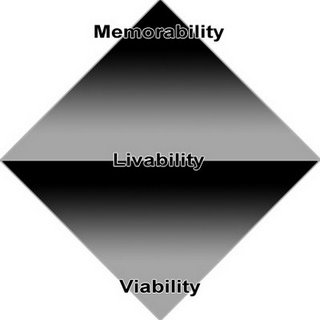
Cities and towns go through cycles, or different stages of a cycle. Some cities are in a “viability” cycle. They’re just trying to survive and create a sustainable economic base. Many of these issues are really regional in scope. A sustainable economic base, good infrastructure, and regional facilities are some of the issues. Other cities are in a “livability” cycle or a “memorability” cycle. Livability issues tend to revolve around how to make a city a good place to live: housing, schools, parks, and open space. Memorability issues tend to organize around how cities can do things in a way that is unique and idiosyncratic to the people and influences of that time and place.

Much unsuccessful planning in America has been due to using strategies that do not align with a city’s current phase of issues, often fighting the last war or the one that people wish to fight.

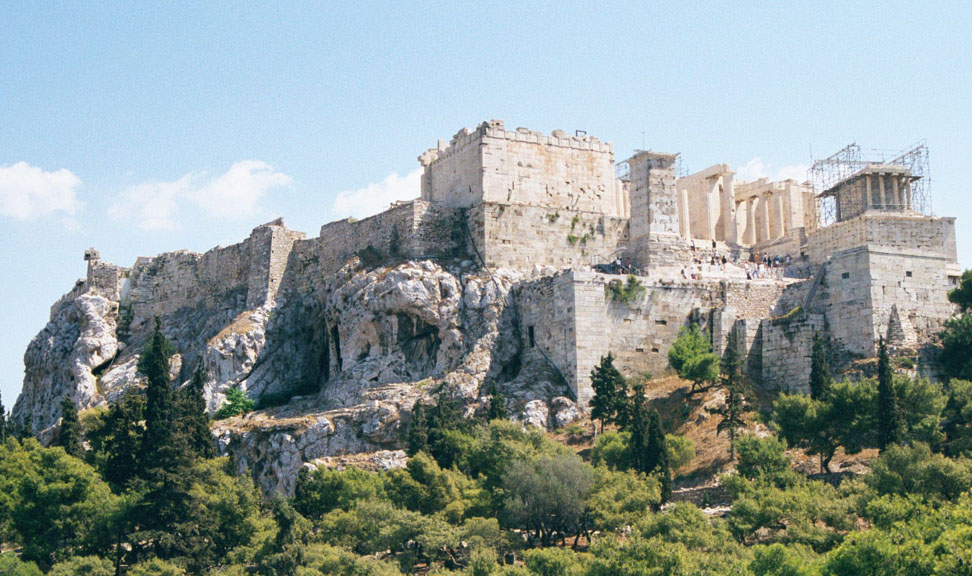
The interviewee referred to these stages as cyclical, which in some ways within the competitive nature of cities can be, but do you really see a place like Copenhagen falling from Memorable to something below livable any time soon? Furthermore, economic issues are certainly at play, but they can only be viewed along a much longer time line than pinpointing what stage a given City is at a fixed point, i.e. Detroit in 1920's "The Paris of the States" vs. today, where it is more like the Acropolis of the States.


Obviously, today Detroit is trying to stay viable after its auto industry has floundered helplessly despite all efforts otherwise. Dallas, on the other hand, is certainly viable from an economic standpoint as a banking and corporate center.

It is also livable in many places depending upon what you are looking for, but this continuum can also be pinpointed on certain places. Why else would 5 million people (and growing) be in the metroplex? In this case, I'm referring to Downtown Dallas. Once again, it is viable currently as an office park and a modicum of individuals like myself who choose to live near to where they work and want something a little different than the Ken and Barbie world of uptown (despite how nice the view might be).

As Heapes points out in the interview, during any planning or design process, one has to accurately assess where a City (or place) stands along this axis. Downtown Dallas in my estimation is in between Viability and Livability. No matter how positive I attempt to be, it is impossible for me to call it Livable currently, and it needs to be. I think all of the dark units in the Mercantile Complex illuminate that point for us.

I have been saying since I moved here in 2002 that developers were going after the wrong market in downtown. They were chasing uptown rents/demographics without all the twenty years of Livability creation that went into State Thomas, McKinney Avenue and CityPlace/West Village. But, as Alex Krieger recently said, vibrant, urban streets aren't populated by the patrons of the W hotel.

The mistake the City has made thus far in attempting to stimulate downtown is that it is trying to skip the hard part. Through big, high profile projects like the Arts District, the Calatrava Bridges, the Trinity River, and last and most certainly least the Convention Center Hotel, the City is trying to jump directly from Viability to Memorability.

It is easy to just throw money at a city in the form of glitzy projects. What is difficult is being honest with yourself and accurately addressing the critical issues preventing a City from becoming Livable. I question how honest Dallas is prepared to be with itself (and by "Dallas" I don't mean any particular group, class, or profession, but simply my perception of the collective consciousness).

[I like to equate that process of critical self analysis to that of a dentist drilling down to the heart of the problem (without novocaine) rather than simply applying a veneer.]


I've gotten into several arguments with people (on this blog no less) accusing me of "not supporting the arts." As I have tried to say, I do, but not at this time or to the extent or expense quite yet when it comes to their effectiveness at stimulating any sort of real revitalization of downtown. All efforts should be made to make Downtown Dallas LIVABLE first, and then the special projects can really have an impact (and a tax base to support them).

If for no other reason, do it for all those visitors they expect to the Arts District (for that proposed subterranean garage) and to save the Arts District itself. You really think Dallas Socialites will enjoy visiting the Arts District when Downtown Dallas is crime ridden, blighted, vacant, and covered in surface parking lots????

---------------------------------------------------
I think I'll create a "Part 2" addressing all the physical design issues hindering the Livability of Downtown Dallas.