Showing posts with label Subsidizing Sprawl. Show all posts

Monday, March 15, 2010

Conservatives Against Sprawl

It is starting to pick up steam, as our endless ranting apparently has now apparently migrated rearward from the explicit memory of our collective frontal lobe to the implicit regions of the hemisphere. Personally, I think this is one issue that can be agreed upon by both right and left, possibly for differing reasons, and we can certainly disagree on the best way out of the mess. Here is E.D. Kain at True/Slant citing Kunstler and requesting Andrew Sullivan take up the mantle (which he has in the past):
Sprawl is a result of massive statist interventions into our culture and society, and its symptoms are equally enormous. Everything that conservatism has historically stood for is undermined by sprawl. It is not only the physical manifestation of our decline, it is a poison which continues to contribute to that decline. Its repercussions can be felt in our discourse, in our speech, in our way of thinking. This is not merely a matter of aesthetically pleasing communities, but of communities which allow individuals to be a part of the whole. I doubt this is sustainable, this suburban maze - in any way: fiscally, socially, spiritually. It is, as James Howard Kunstler called it, “a peculiar blip in human experience.”
I can't disagree with anything he states. He doesn't really offer any solutions, but that really isn't his job. Frankly, he gets at the fundamental and logical disconnect in the modern conservative mind that peripherally suggests limited government then gleefully spends on highway projects, forming an endless rhetorical loop that people want their house an hour from their job and the road that caused that to be the only choice must be expanded to allow for "free choice."

Perhaps this tipping point suggests a potential coalescence of common purpose, which will be the only way out of this mess.

Friday, March 12, 2010

So You're a Libertarian

"I believe that no discovery of fact, however trivial, can be wholly useless to the race, and that no trumpeting of falsehood, however virtuous in intent, can be anything but vicious." HL Mencken, Living Philosophies.
I have a long post outlined in the myriad of drafts (some of which are actually on-going), detailing the type of people, demographic categories or psychographic segments who, logically would/should support walkable communities. The reality of it, and the point of that eventual argument, is to show that pretty much anybody with a brain or a pulse should be in favor of walkable communities. I do have a special category for those who do not. Whether Pew adds it into their psychographic segments is another story.

One of the segments of the population who would/should logically support walkable communities is any/all who identify themselves as fiscal conservatives and it turns out that even enlightend conservatives agree. The American Conservative:
For the 101st time: sprawl — an umbrella term for the pattern of development seen virtually everywhere in the United States — is not caused by the free market. It is, rather, mandated by a vast and seemingly intractable network of government regulations, from zoning laws and building codes to street design regulations. If Stossel wants to expand Americans’ lifestyle choices, he should attack the very thing he was defending, namely, suburban sprawl.
In short, top down standards, tax policy, zoning, and subsidies have made for a generic world of limited (or no) choice:
Perhaps, choice isn't the preferred word than variety, because they are different but the choice is irrelevant. Housing choice is for the most part is the equivalent of cocoa puffs and fruity pebbles...all made of the same crap underneath: corn starch, artificial coloring, flavoring, and some bran flour. Flip the formula around a little bit and you get a two-car garage, a pool, and a third half-bathroom and an hour commute.
Other conservative cases for transit, urbanism, and more transit.

Full disclosure: I consider myself a leftist libertarian. Whatever that means, right? While we are putting all of our cards on the table, I think any rational person could support the idea that any public spending towards the commonwealth should be thoughtful and generate a return of value, whether that value is monetary, social, ecological, or in general quality of life improvements.

One of our key challenges is monetizing, properly assessing the value of, those often overlooked "externalized" factors. Some things like clean water, clean air, healthy food, quality of life. How do you put a number on those things? Some might consider them subjective, which works exactly in favor of "business as usual." It's subjective. Can not value. Can not put into the equation.

The scary thing is that the bill for those costs ALL eventually come due. This is (and will be) the fundamental undoing of neo-classical economics which attempted to add critical scientific objectivity to our decision-making processes. Sounded good in theory.

Our biggest flaw is that we base these decisions on raw numbers. I am "leftist" libertarian because in my mind return-on-investment extends to cockamamie notions like an educated and healthy citizenry. Utilization of the commonwealth covers things that the "free market" has been unable to properly value, nor deliver to everyone. I can't arrive at the statistics showing investment in education or health, but using the blink method I know that investing in people, empowering them to contribute to the economy and society rather than drain from it, is fundamentally a good thing for all of us.

But the gray area of healthcare (or sickcare as is more aptly named) nor education is not what this post is about. Recently, I was asked what I thought of an idea found here of charging a toll to traffic passing through Dallas on highways without stopping of $20. This comes at a time when California recently passed an increase on gas taxes of $.18/gallon. TxDOT is struggling for cash. The Trinity River Toll Boondoggle is on the ropes. And the Federal highway trust fund is running on fumes. Also, two weeks ago, Mayor Moncrief of Fort Worth, made the absolutely true but refreshingly honest statement that car oriented development was a colossal mistake.

This has all come about at the same time, as we are coming to the realization that car-oriented design can't pay for itself. Lobbyist shills like Wendell Cox, posing as crusaders for free markets, often use the argument against public transit initiatives, that public transit doesn't pay for itself. I have news for you. No form of transportation pays for itself. Walking burns energy that isn't replaced without access to new forms of energy in the way of food/calories.

Where we can begin to differentiate between forms of transportation is the type of development that occurs in, around, and because of the form of, or multiple forms of transportation. Development and transportation are inextricably linked, and must be thought of that way. Transportation networks designed strictly for the car are ugly and unsafe. It is not a leap of logic to assume that things "ugly and unsafe" are literally repellent, forcing all real estate investment away from, but gas stations and drive-throughs. This creates a tension within real estate development. It wants to agglomerate near density of movement, ie traffic, but not car traffic.

Without adequate wealth, which has essentially been underwritten for decades with debt, a fantasy of wealth, a lack of density can not afford the amount of infrastructure and amenity of cities, of proper urban design. Suburban development as we know it is wrecking school systems, the environment, and even our physical health and now we collectively and despondently are staring straight into the reality of that bill arriving in the mail.

Of course, the kind of suburbia I am referring to, isn't the good kind of suburbia: the self-sufficient satellites of major cities - often of about 25,000 or so people, only about a square mile, and including a range of housing types, a jobs to housing balance, adequate public spaces and public services, and an agricultural belt coating the voids between celestial nodes of development.

This is about the corrosive form of suburbia that has no future in its current form. Fortunately, for us, this provides ample opportunity for rebuilding. The way out of recession is the qualitative improvement of our cities and interconnected network of suburbs into a new built form that increases quality of life, access to amenity, cuts waste through travel time and inefficient use of public infrastructure. It creates for more interconnected economies, that eliminates the unspoken tax that is the distance between things and the cost of energy to traverse that distance.

To do so, however we have to pay for it. There are no free lunches. The irony is that this suburbia, hailed as the brave new world of freedom and choice is often filled with those who hypocritically excoriate others for the threat of possibly taking advantage of the system and "living off the state." Well, call me H.L. Mencken 'cause I also have news for you. You are going to have to start paying for that lifestyle. (I'll refrain from calling anyone part of the 'booboisie' as Mencken did.)

Stepping back a second, the city (in its abstract form) is a manifestation of local economics. Its form defined by various related economic inputs, all mentioned above: Design standards, tax policies, zoning, myriad of subsidies, and the implementation of transportation networks are all components of a cities genetic code, its "urban genotype."

Despite what some will have you believe, the phenomenon of this particular brand of suburbia is quite young in relation to the evolution of human settlement patterns. And how could it not be. The car was an entirely new phenomenon, fundamentally changing the way we perceived space and time. However, time, as always, has allowed us to see the error in our ways. If the output, city form (urban phenotype), is no longer useful, the inputs have to change. In the absence of a complete overhaul of zoning/coding, the quickest way towards profound change is the implementation of some or many policies designed to make the luxury of individual (auto)mobility pay for itself.
  • Does this mean increases in property taxes under a certain density threshold?
  • Is it a singular, large toll, such as mentioned above for pass-through traffic?
  • Or is it many smaller tolls?
  • Is it a slow, gradual increase in gasoline taxes?
Each of these is a form of a pigovian tax. A punitive policy constructed to limit behavior that negatively affects society. The question becomes what is politically implementable?

A singular, large toll on a new road like the Trinity River Toll Road (or any other) could effectively eliminate the need for the road in the first place. So why build it? It would also potentially reduce inter-city commerce.

Gas taxes and more road conversions to tolls could possibly and unfairly punish only the middle- and lower-classes. But, they are precisely the ones who would benefit most from relocation to new development areas, walkable communities, near transit.

What can we stomach and how much at a time? Complex systems often react poorly, convulsing under pressure of quick, dramatic change. When immediate, reactive adaptation occurs, sometimes the next evolutionary iteration isn't an improvement, which is why steady, incremental change is always preferred.

My personal preference is to slowly but firmly increase gas taxes by year (say a dime/gallon each year), add tolls to all highways priced to regulate capacity, AND market-based parking. The key is to not limit choice, but to charge for the cost driving and its related infrastructure places on society.

The next question is where does that revenue go? I would roll all of it into an appropriate hierarchy and provision of alternative transit (but done efficiently and intelligently so as to not overbuild), street re-design into complete street/context-sensitive design, and housing programs to increase affordability and variety of housing types near transit-stations as well as the improved walkability and interconnectivity of those areas.

Or just remember my new catch-phrase: Walkability is a tax cut.
Monday, October 12, 2009

Saving the Suburbs

"On a long enough time line, the survival rate for everything drops to zero."


A cautionary tale: no outlet in the fourth dimension.

The Radical Honesty? There is no saving them, but there is a future.

I know I've written about and cited studies of the trend towards increased crime in the suburbs, but alas I can't find those articles despite blogger's supposed search capabilities, so instead, today's article re: suburban decay du jour comes from MSN Real Estate, "Is Your Suburb the Next Slum?" (special bonus points for the title of the video on the sidebar "Has Housing Finally Turned" - no need for editorializing which way it's turning):
That's already happening in places such as Elk Grove, Calif., a community 15 minutes outside Sacramento. Here, builders rushed to build subdivision after subdivision — putting up 10,000 tract homes in just four years at the height of the boom — confident that buyers from all over the Bay Area would trade up to these larger homes.

They were wrong.
Succinct. I admire traits I lack.

I've probably written it before, I know I've spoke of it many times to friends, colleagues, clients, etc., but I'm always struck by the irony of the city's with the most laissez-faire attitude toward development (ie allowing sprawl) never fail to end up having some of the highest tax rates simply b/c they have to in order to pay for the amount of infrastructure per capita that is required for what the easiest possible development model entails.

Many suburban Dallas cities (and even the City itself) are feeling the pinch. Some b/c of the spread out nature, others due to the "drive til you qualify" nature of their outlying housing; in either case the tax base simply can't afford it. Paraphrasing a quote from Green Metropolis (the book is sitting next to me, but when I came across this quote I failed to dog ear the page nor highlight the passage as I typically do ruining all books I've ever owned), the author talked about the stigma of the countryside around times of the French Revolution where only Aristicrats and Rubes lived out there despite the City having undrinkable water, poor sanitation, and worse air.

The Aristocrats' (not the joke) streets were paved in gold, while the country bumpkins were dirt roads at best (b/c both had to pay for themselves in times where classical economics (read: sanity) still ruled the day). It is no different in today's times as we're seeing the bottom drop out of the American Dream and the Middle Class standard of living.

But, that standard of living can be molded. It can be shaped. I'm living proof that you can manipulate your costs to still live like a king. Of course, I don't have kids. But, the underlying point is that the suburban way of life is no longer the ideal model, particularly for the largest generation in American history that are rewriting the rules of the American Dream as they march thru their lives like Sherman from Atlanta to the Sea. Hopefully however, we will be rebuilding railroad tracks rather than mutilating them.

Suburbs are chosen these days for a variety of reasons, none of which are the same as when they were a new creation. They were strictly a reaction to the plagues of what Cities had become and were an embodiment of a democratic ideal that every man was his own king, in charge of his own life.

But, all of that is changing as suburbanites find themselves trapped in traffic jams, chained to their car keys (and the costs associated), stuck in Generica because for the most part there were no other choices. That is hardly free. Today, people leave the cities for schools (which I'm a firm believer that they can be as good as we want them to be once ideology is stripped from the conversation) and for the perception of crime or safety, whichever way you want to think about it.

Turns out that yeah, well, the school thing is still a major (nay, GARGANTUAN) issue not just for a return to urbanity, but for society and this country as well. But, as for the rest of suburbia, we are learning that it's not safe, it's not healthy, it's not sociable, it's not enjoyable, and it certainly isn't lovable. Hat tip to Steve Mouzon on this one, it's his point that for things to be sustainable, they must first be lovable, or they'll just get bulldozed for the next thing, whatever that might be.


The issue about safety is the indefensible nature of suburban design. For lack of a better word, they are unpoliceable. There is too much space.

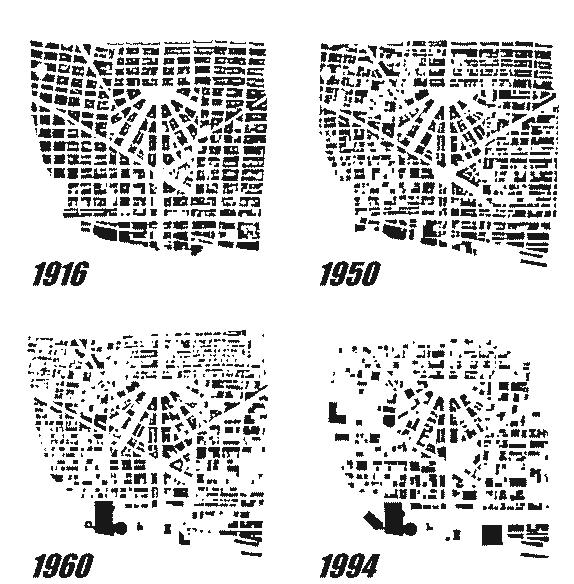
Watch the time lapse of Detroit's decay. Take a close look at the 1916 years and how little "white" space there is (black is buildings obviously). What this does is minimize the public realm, which means less space per capita, which means higher affordability for high quality spaces and less to maintain, a focus on convergence points forming key public gathering spaces, creating a natural hierarchy where important civic or public buildings can be placed celebrating accomplishments of art, culture, or self-governance.
http://www.buildingsrus.co.uk/detroit/figure_ground.gif

The beauty of good urban design is the focused nature of the open space...if illicit activity is happening in the privacy of a home, it doesn't affect the public realm unless it is so concentrated as to plague entire districts and overwhelm any efforts at policement and regulation. Furthermore, when Bill Lucy was speaking here, he pointed out data showing that when calculating per capita safety numbers and removing all violent crimes that are committed by friends or relatives, haphazard mortality rates are much higher in suburbs than cities.

The flip side of the ZOMG suburbs are awful commentary is that we've pushed all of our chips into the center of the table. We're pot committed vis a vis that shear amount of infrastructure that I've just been bitching about. So we have to work to save them, but how?

I see two choices and mentioned this in the Transect post from a while back that seems to have quickly become the most clicked post I've ever written. As the rough graphic shows we have an over supply of T2 - what we know as suburbia - and this has to either densify or de-densify.

[supply.jpg]

Jane Jacobs, in Dark Age Ahead, wrote:
Sprawl can become less wasteful only by being used still more intensively. If that happens, suburban sprawl will turn out to have been an interim stage, a transition between land in agricultural use and land densely enough occupied to support mass transit, to form functional and inclusive communities, to reduce car dependency, and to alleviate shortages of affordable housing.
We are already seeing densification occuring in strategic locations, Las Colinas, Addison Circle, Legacy Town Center, Downtown Plano, etc. in some cases these are defined by new transit lines, in other cases the density formed with the idea to be served by transit sometime in the future. This densification allows the outlying communities to become more dense, livable communities with a greater variety of housing product and affordability levels, as well as increased tax base, which we will need to support and fund schools.

Those that densify will have to have a reason for doing so, and will need a certain measure of a real, supportable economy themselves. This entails an infusion of new uses into all single use districts, whether they be retail strips, light industrial parks, suburban office campuses, or single family neighborhoods. But, for the most part, these communities still act as bedrooms for downtown and nearby workers, which is fine for the most part as it still allows for transit use, and the opportunity for choice.

But, what of the further outlying suburbs that will never have any forms of mass transit?

If we're not careful (or if we intentionally allow to do so for environmental reasons) some of the lesser positioned and poorly constructed neighborhoods may turn to dust, or reclaimed by nature as some killer shelters with two car garages and walk-in closets for whatever furry creatures decide on Mulberry Lane to raise their roost.

As Jacobs writes, the way for these areas to maintain themselves as productive members of their metropolitan area, is to intensify their use. And that means import replacement. The way to de-densify is either go back to nature (which for all it does with water and air, IS productive) or replacement of things we truck, pipe, train, ship, or wire in from further locations via local food and energy production.

With giant agribusiness depleting arable soil at an alarming rate, there may just be a plentiful amount of food giving earth still remaining in suburbs that were sold by small farmers, who cared for their land family's b/c their livelihood depended upon the perpetuation of its production value. Often, they were forced to sell their land to developers for a retirement nest egg as their children moved city-ward and/or plummeting commodity prices made it impossible to make a living and compete with said earth rapers corporate agri-business.

The other potential option is as energy production - solar or wind farms, or hell even nuclear - go here to see treehugger's debate on nukes, which might just be a necessary evil as we transition into a post-carbon world, allowing time for technology to fully take advantage of all the Sun's potential.

As I've said, the suburbs to have a future, must have an economy to do so, beyond being strictly bedroom communities, however many industries will learn that they need the synergies of urbanism and will move back to the city following the demographic shift center-ward (being near employees was one of the major reasons for the move of businesses out of cities). Suburban communities have two choices, and neither is the status quo: 1)Densify or 2) start thinking about what kind of imports they can replace with local production - I'm of the opinion that it's food or energy - or maybe it's even water as areas return to nature's natural cleansing ways.

Tuesday, June 30, 2009

Fun with Numbers/Dallas Budget

So in light of the City of Dallas experiencing a nearly $200 million dollar budget deficit, I thought I would have a little fun with numbers while we watch education, police, fire, and presumably every other necessary service get slashed while road maintenance and upkeep retain highest priority.

First of all, I should say that compared to many other cities that I have been to and worked in, Dallas is getting off light. The city is both lucky and unlucky given its defined boundaries. Many smaller cities are experiencing much more severe budgetary constraints. For example, one city of approximately 100,000 had a projected shortfall of $250,000,000 equalling $2,688 per person. And THAT number was strictly for infrastructural upkeep and maintenance (and upgrades. Can't forget upgrayddes. That's how I will spell it from now on whenever an engineer uses the term road improvements or upgrayddes because it is such a bastardization of terminology), meaning no new construction. Compare that number to $146 per person in Dallas. That's nearly 20x.

Building low density sprawl had come home to roost. We simply can't afford the level of infrastructure that sprawl expects. The primary issue is that logically and throughout history level of services and amenities increased with greater density. It makes sense, more people sharing burdens and costs, the more can be achieved with that pooled wealth. The countryside couldn't afford sewer and roads and power, etc.

This is why I state over and over that Deep Sustainability comes in two forms, self-sufficient and very sparse (the Jeffersonian Ideal) or the very dense cities (but I expect due to material constraints this means lower scaled, but still dense building in the model of Florence, for example). As we know, the very necessitation of human settlement patterns (and community) is shared common hardships and then, in turn, quality of life improvements through gains in standard of living brought about by the economics of sharing, trading, cooperation, markets, etc.

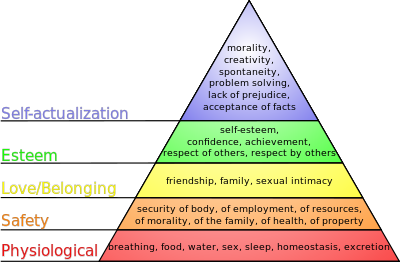
This pattern can be traced directly to Maslow's hierarchy of needs. Imagine ourselves as lonely neanderthals at the bottom of the pyramid, rising to the highest of levels during times such as the Renaissance, or the Enlightenment, or the even the technological revolution of today leading to increased levels of interconnectivity. And then crash back down to the yellow in our fractured and disconnected society via the car, the television, etc.


With out new found wealth and suburban explosion, we expected the best schools and similar level of infrastructural support to follow. For a time it worked, but upkeep has proven to be the problem. The infrastructure and population density are spread so thin that we put so much pressure on such brittle apparatus that it begins to collapse due to overuse often caused by our dendritic arterial system versus a more choice-laden, adaptable and dispersive grid network and underfunding.

So getting back to why the City of Dallas's budget shortfall is 20x less than that of smaller cities as discussed earlier, Dallas is lucky in that it is landlocked by its suburban neighbors. Dallas proper can do very little in the way of new growth, which has mostly happened in areas like Rockwall, Mansfield, and Frisco, meaning less no roads (despite everyone from the City to the State, to COG, and to TxDOT's best efforts). So we can ideally focus our efforts on QUALITATIVE over QUANTITATIVE growth.

This is unlike Houston which annexes all of its growth. The future of these two cities can go either way from this tipping point we have reached due to their nature. Houston could become much more responsible with its growth, spending, inertia, and annexation or Dallas could be more successful as it can focus on a much smaller land area.

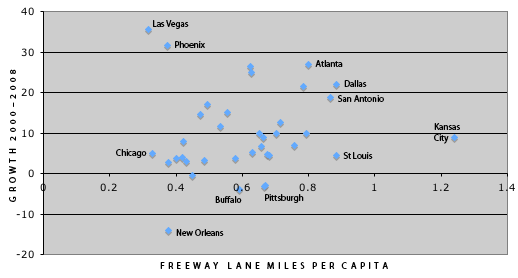
Where this bites Dallas in the butt, is that there are so many commuters coming in from Richardson, Plano, Arlington, Mesquite, et al., this means Dallas ends up with a very high freeway miles per capita number. Essentially because commuters' trips to Dallas are subsidized at the expense of state and federal taxpayers, but the real cost is the burden on the well-being of the City itself.


Often when the argument of mass transit comes up, I'm both dumbfounded and frustration by the simplicity of the dollar values and supposed wastefulness that is bandied about. Such things as revenue generation, long-term maintenance, real estate values, etc. are always ignored in favor of startup costs strictly against Mass Transit. Well, how about we take a look at how much embedded wealth we have sunk into all of our roads in Dallas.

**Disclaimer: Very rough numbers.

The chart above shows the City of Dallas at .88 freeway miles per 1,000. This chart from 1999 shows freeway equivalent miles at 1.291. I'll use this number because freeway equivalent sounds an awful lot like freeway. Call me crazy, but I'll assume it costs something similar. Also, note how many Texas cities in the top ten. And we wanna build another one as part of the Trinity River Project? Sounds like a good plan (or a racket).

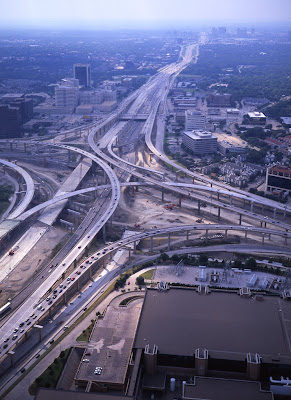
So we know that we have the freeway equivalent of 1.291 lane miles per 1,000 people, approximately 1.3 million people at a density of 3,605 per square mile. And a land area of 385 total square miles. This suggests that 1 freeway lane mile in a congested urban area can cost upwards of a $100 million multiply that over the 1678 freeway lane miles in the city and we get a cost of $167 billion or a cost of $130,000 per person.

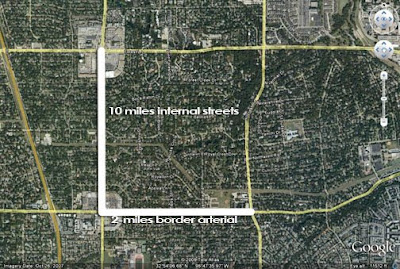
But, what about the other roads? Since Dallas was built on mile-square arterial grids we're going to apply this pattern to get a sense of how many overall road miles there are per capita in this city. As you can see in the graphic below, each super block is bound by 1 mile length arterials and further broken up into blocks by internal collectors or residential streets. The total perimeter equals four miles, but I'll go with half that or 2 miles because each arterial is shared by another 1-square mile super block.


Internal to this superblock, I will estimate approximately 10 miles worth of neighborhood streets cross this block. This is more difficult to get a sense for as each superblock is subdivided differently due to geography, density, or whim. But, to assume the equivalent of five N-S and five E-W streets is pretty conservative considering that leads to about 800' x 800' blocks, not unusual for the 'burbs.

At 3,605 people per square mile in the city that means that these blocks then have .00277 of residential street per capita (not unreasonable as that equals 14' of street frontage) and .00055 arterials per capita. I'll cost the residential streets and infrastructure at $5 million per mile (which assumes NOT a very nice streetscape) and $10 million per arterial.

If we are to extrapolate these superblock numbers over the entire city that means we have spent $7.2 billion on arterials, and $1.8 billion on residential streets and infrastructure. Add in the freeway equivalent costs and we are at $176 billion dollars JUST for construction, or $135,384.62 per Dallas resident. Did we realize we can't afford that?

Next time somebody complains about a transit line costing X amount of dollars throw some similar numbers like that at them. We already know the difference in quality of place the two create.

Maybe to save our budget and essential city services, we can stop building or "upgraydding" roads and start building for people, not for cars.
Better caption? Money Well Spent or Return THAT Investment?

Thursday, June 4, 2009

Not Unlike My Stockholm Syndrome of Cars

A new book, Cul-De-Sac Syndrome.

And excerpt of the excerpt:
The American home became the embodiment of generations of aspirations. First came the land, then came the emblem that you owned and lorded over the landscape—the manor home. In a uniquely American way, homeowners were echoing the class-climbing impulses of their forebears. Cathedral ceilings bespoke of sanctified self-improvement. Bathroom suites implied middle-class barony. Homes got bigger and more expensive because we wanted them to portray nobility. We had made it. We’d achieved the American dream! This was what we had to show for generations of effort. The fact that this striving also became a
mania for investment and speculation is also painfully American.

Wednesday, March 18, 2009

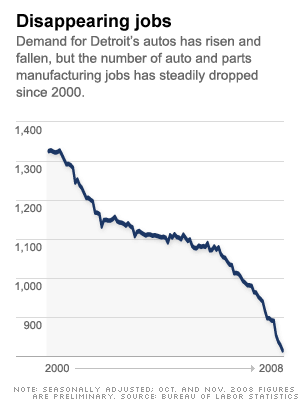
Is This an Industry Worth Saving?


An addendum to yesterday's post:

From Culture Change: "Cars were a bubble." ~GM

Monday, March 16, 2009

Bizzy Day

So more Monday Afternoon Links...

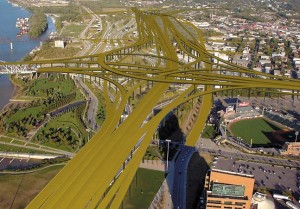
The Infrastructurist on the 7 Most Ridiculous Roads as part of the stimulus:

Check out number 1, Louisville's doozy in downtown...


TIME, on the big ideas of 2009: #2 Recycling the Suburbs.

These words look like they're directly from my mouth:
Not every suburb will make it. The fringes of a suburb like Riverside in Southern California, where housing prices have fallen more than 20% since the bust began, could be too diffuse to thrive in a future where density is no longer taboo. It'll be the older inner suburbs like Tysons Corner, Va., that will have the mass transit, public space and economic gravity to thrive postrecession. Though creative cities will grow more attractive for empty-nest -retirees and young graduates alike, we won't all be moving to New York.
As I have said many times, hard times will flush the chumps (unfortunately, the undertow is pulling a lot of good people down with it). In this case, Fast Company says that Urbanists are the big winners as sprawl's fatal flaws have indeed been, uh, fatal.
A study by the Metropolitan Institute at Virginia Tech predicts that by 2025 there will be as many as 22 million unwanted large-lot homes in suburban areas.

The suburb has been a costly experiment. Thirty-five percent of the nation's wealth has been invested in building a drivable suburban landscape, according to Christopher Leinberger, an urban planning professor at the University of Michigan and visiting fellow at the Brookings Institution. James Howard Kunstler, author of "The Geography of Nowhere," has been saying for years that we can no longer afford suburbs. "If Americans think they've been grifted by Goldman Sachs and Bernie Madoff, wait until they find out what a swindle the so-called 'American Dream' of suburban life turns out to be," he wrote on his blog this week.

Thursday, March 5, 2009

GM is done

...err Toast, according to Megan McArdle.

I previously suggested that they need a visionary plan to save them by reconfiguring their shop to build things we might need. You know, perhaps like the trains to go on the high speed rails that apparently we will be building.

Now? Since they clearly lack the leadership to do anything but "stay the course," it's time to let them go under and liquidate. Allow a new company to build those trains.

Here is where I would suggest that all the boomers should think about retiring and let us take a crack at running this thing we call society...but wouldn't you know if they ruined those retirement plans as well.

Thursday, February 19, 2009

Sullivan on the Housing Plan

Many liberals think that the plan is too small. Many conservatives and libertarians think it will prove wasteful, ultimately ineffective, and that we shouldn't be trying to prop up housing values anyway. And this is surely the fear behind the gist of what Obama has done so far: it avoids the brutal re-balancing of the right while lacking the full metal Krugmanism of the left. Maybe this is a pragmatic sweet spot. Or maybe it's falling into some kind of ghastly, protracted abyss. I do not pretend to know.
Amazingly, I tend to fall slightly to the right of Andrew here - if only because I was wary enough to steer clear of that nonsense (which reminds me to figure out where I was reading that too much home ownership (as seen in the states, 70%) is bad in a macro-sense on top of being illogical at the micro level, for a similar reason: that it is too much wealth AND people being illiquid). Housing prices have to fall back in line with fundamentals, otherwise they shall remain UNaffordable, and frankly NOT at market rate. We have to find the true value of homes to allow the homes/properties in the right places to survive, the rest? To whither.

My optimistic guess is that the Obama team is merely applying a parachute to the prices because it is economically wrong to improperly inflate the prices and amoral if not downright toxic to many neighborhoods/communities to toss people on the street.

Personally, I like the plan put forward by the woman interviewed on Dan Rather Reports the other night suggesting that if refinancing can't be achieved that home owners are given the option to rent the place at fair market rental value.