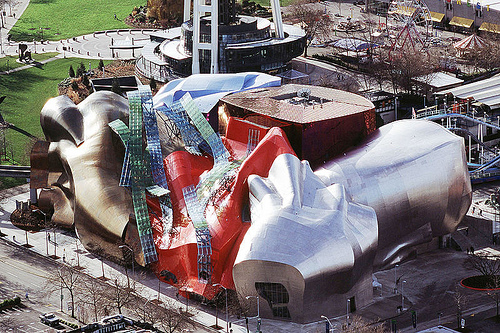
Good ol' Frank. Littering the world with his crumplestiltskins.







Residents made it clear that they don't want Garland Road widened, but they want it to flow better.Let me translate: The residents deep down know better, but are resigned to the fact that some "expert" in traffic flow (and nothing else relevant to actual urban design, economic development, or city building) made the call beforehand that this was a site for road widening with a single section and are convinced by his traffic bible and technical jargon.
His 1999 book, Devil Take the Hindmost: A History of Financial Speculation, examined past speculative manias. Perhaps you've read articles comparing the tech boom and 1990s' bull market to tulipmania in 1630s' Holland.
The difference is that Chancellor was making that comparison before the tech bubble burst, some years before Alan Greenspan claimed it was futile trying to predict bubbles at all.
Chancellor's timing may have been fortuitous. To accurately predict something once might mean little. To repeat the feat perhaps means something more.
His next major piece - Crunch time for credit: An enquiry into the state of the credit system in the United States and Great Britain - included this prescient paragraph:
''The growth of credit has created an illusory prosperity while producing profound imbalances in the British and American economies...When credit ceases to grow, the weakened state of these economies will become apparent.''
That report was written in 2005, years before the credit bubble burst. Chalk two up to Chancellor.
Third time lucky?
He's now turned his attention to China, a fertile ground for his fertile mind. Released last week on the GMO website, China's Red Flags is split into two parts.
Crisis checklist
Section one identifies speculative manias and financial crises, offering a checklist for those trying to identify bubbles in advance of their bursting. Chancellor offers 10 criteria for what he calls ''great investment debacles'' over the past 300 years (the report explains each in far more detail);
1. A compelling growth story;
2. A blind faith in the competence of authorities;
3. A general increase in investment;
4. A surge in corruption;
5. Strong growth in money supply;
6. Fixed currency regimes, often producing inappropriately low interest rates;
7. Rampant credit growth;
8. Moral hazard;
9. Precarious financial structures;
10. Rapidly rising property prices;Although all these criteria need not be present in order for a bubble to be present, you can see where Chancellor's heading: not-so-subtly steering readers towards his own conclusion. In section two he takes each factor and applies it to the case of China.
Invest locally in places that are ripe. Like X+ and Bishop Arts. Of course, then my next piece of advice to residents of Oak Cliff is to be sure to pay attention to any and all zoning cases (particularly Davis Street) and be sure to fight for everything retaining a human/pedestrian scale. Everything between Davis and Jefferson is solid gold right about now and then in 10 to 15 years, look towards the Zang Triangle.
--------------------------------------------
And lastly, and perhaps most importantly is the dual-purpose post from the Guardian supporting the fact that we have to look beyond our borders for news as important to us as THE US MILITARY AND LARGEST GASOLINE CONSUMER IN THE WORLD IS WARNING OF PEAK OIL and major shortages worldwide in 2015. Of course, we'll go all willy nilly about this and do things as stupid as the king of stupid supply-side city thinking, the Detroit Convention Bureau trying to prop up economic development with more supply side factors like increasing their convention center, such as digging through Canadian Tar Sands and widening Garland Road.

 Posts
All Comments
Posts
All Comments