I am a professional Urban Planner and Designer. I treat this as my thought laboratory exploring how bionomics relate to self-organizing, emergent urbanism.
As a professional urban designer and partner of the Planning and Design Firm Space Between Design Studio, I am a trained urbanist who specializes in creating walkable urban developments and analyzing existing places to find the barriers preventing livable, walkable urbanism. I can be reached at patrick [at] spacebtw.com
Showing that the science and democracy of computer networking is a treasure trove of information and understanding for cities, UrbanOmnibus writes of an emerging new kind of participatory, "read-write" urbanism, citing new websites such as FixMyStreet and SeeClickFix as a connecting, feedback medium between users and the managers of places and the associated infrastructure:
But what if we took a single step further out? What if we imagined that the citizen-responsiveness system we’ve designed lives in a dense mesh of active, communicating public objects? Then the framework we’ve already deployed becomes something very different. To use another metaphor from the world of information technology, it begins to look a whole lot like an operating system for cities.
Then we can begin to treat the things we encounter in urban environments as system resources, rather than a mute collection of disarticulated buildings, vehicles, sewers and sidewalks. One prospect that seems fairly straightforward is letting these resources report on their own status. Information about failures would propagate not merely to other objects on the network but reach you and me as well, in terms we can relate to, via the provisions we’ve made for issue-tracking.
Of course, this also implies that those managers and appointed stewards of districts, neighborhoods, and cities must also care enough to WANT direct feedback and interface with the area users. ----------------------- Kevin Walker, of CultureLab, writing for DallasSouthNews asks whether Dallas can ever attract Creatives:
There is hope however, and it is evident in the budding creative class businesses of the Southside Lofts, the Cedars area, and Deep Ellum. What is needed to make it a bigger magnet of more creative class workers and young urbanites is more attention paid to and active civic promotion of the creative class areas and businesses.
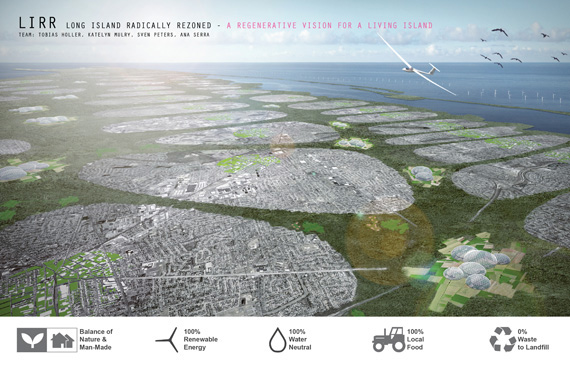
The What is fairly straight-forward, as is the Where. The How is where it gets a little more complex, or at least, with greater potential for apple-cart upsetting. Change can represent a relinquishing of control that might upset various fossilized technocrats closed to not just new ideas, but necessary and proven ones just because they might differ from the familiar. ---------------------- The Long Island Build a Better Burb competition has received all of its submittals. You can see a summary here or check out all of the entries here, where the hosts are inviting crowd-sourced feedback.
The Long Island Index invited architects, urban designers, planners, and students to submit forward-thinking design proposals for capitalizing on the potential of the “underperforming asphalt” found in dozens of downtowns in New York’s Nassau and Suffolk counties. The competition solicited innovative design ideas for retrofitting 8,300 acres in 156 downtowns and train station-adjacent areas on the island. It also invited designers to consider island-wide challenges that could be addressed by their design strategies.
The submissions I have examined thus far range from the practical and market-oriented to the great idea, thoughtful, but completely disconnected from reality, which is sometimes the purpose of competitions, to bend our minds, mine for utility, and then assimilate the other-worldly into the useful march of progress.
By far the greatest challenge of suburban poverty, though, is geography. In a sprawling suburban community, where poor residents might be a dozen miles from a social service agency, it can be almost impossible for them to get the help they need. "It's the geography first and foremost," says George Searcy, executive director of the Hope Through Housing Foundation, an agency based in suburban Los Angeles that helps provide housing for low-income families. In urban centers, he says, "not only do you have a more dense population, you have a more dense concentration of services." In suburban communities, it's just the opposite. "Everything is so geographically dispersed, you could spend hours just trying to get to the places you need for help. And if you don't drive, you're getting on a bus. And it's difficult to even get there on a bus."
Transportation is a major issue for the people Marquez works with in Virginia. "It's a vicious circle," she says. "It costs a lot of money to own and maintain a car, but if you give it up, you limit yourself even further."
I received this email from my college roommate today:
listening to public radio this morning they kept talking about a decline in the amount of new homes being built as a bad sign. isn't this going to happen eventually anyway since the amount of open land gets smaller with every house?
I didn't hear it myself. I'm wondering if this was national public radio, or a local DC show, so that I can look up who the interviewer/interviewees were. That always has to be the first question to ask yourself, "what is this guy's angle?" Without knowing that I can't pinpoint why he might be saying that lack of new housing starts is bad, because...well, what is bad?
Is it bad because he is in the real estate industry and knows no other way to operate his business than the status quo that has utterly failed and bankrupted us? Is it because he's an economist and worried about losing jobs in the housing construction industry? Was it bad that the horse and buggy industry is no longer a thriving job growth industry?
Want to stop bailing out banks for bad loans on single family houses people couldn't afford? Want to stop wasting money on overextended infrastructure and unnecessary and poorly planned highways? WALKABILITY IS A TAX CUT.
Unfortunately, we built a structural inertia upon zoning, bank loans, tax incentives, and road construction that carried us WAYYYY past equilibrium for those industries. We are now experiencing the pain of this overshoot, like any druggie experiencing withdrawal. Any institutions we establish have to be flexible and adaptable enough to change when we change and learn as we learn, or else it becomes a starship in ludicrous speed with no breaks.
It is the cause of every recession. The severity of which is determined by how far we went off in one direction and how long it takes until we reverse the inertia. I've been howling about the impending housing doom since 2002, but that apparently was steering the Titanic with flippers and scuba gear whilst hanging onto the rudder. I was just too naive and broke having just graduated from school to know how to wager against it.
So no more housing starts may or may not be a bad thing, but we have to look deeper. Where are those housing starts occurring or not occurring? If they are no longer occurring at the edge, in exurbia, that is a good thing. We can't afford more single family homes at the edge nor the infrastructure to them. All the people who CAN afford to be out there, either already are or they choose not to be.
We KNOW we have at least a surplus of 4 million large lot single family homes. We're pretty sure that banks are sitting on x2 that number to inflate the prices on the previous 4 million. With the ARM resets about to happen this year and next, we might be looking at another x2. Some estimates have a surplus of 22 million by 2025.
Building new houses is insane, at least in the way we've been doing it, on land in exurbia that the highest and best use of is probably agricultural production or nature. The housing industry keeps trying to prop up the myth that everybody needs their single family house in BFE, as some sort of sign of independence or surge in middle class choice or prosperity. All marketing BS. They do so, because it is easy on them. Land is cheap, so they externalize transportation costs on the consumer.
Cities, particularly young cities that know no better are eager for the tax base. That is, until they get the bill to maintain that infrastructure at such a low density. But the unfortunate reality is that you can't unbundle transpo from housing without having a lot of poor people stuck in the middle of nowhere.
If it is because there is no new housing where we badly need it, where it is tied to cheap, effective, optional choice of transportation then it is a bad thing. And we need to loosen up the credit markets for locational efficient housing starts for rental, ownership, and affordable housing. This should be job one at the federal and state level.
The other key is utter and complete overhaul of all state and federal standards for transportation planning and design, land use and zoning, and affordable housing standards. Some of these are already happening. As I have said before, with all of the press that healthcare and bank bailout get, the best thing that any administration has done in thirty years is the effective merger of HUD, EPA, and DOT under one roof, with the exact right person in charge.
This will be the way out of this uber-recession. We just have to make sure we don't cement this particular direction so we can provide some steering or breaking at a later date. Railroads were once as corrupt if not more so than the highway industry is now. It is the nature of the beast.
The beauty of having a multi-screen setup for your home computer is that you can watch movies while you work. As a child of the internet, if itunes, a movie, four browser windows, photoshop, CAD, InDesign, and various folders aren't all open, some things just don't seem right with the world. I happened to have Hurt Locker on today, when this shot washed across screen #2. How serendipitous.
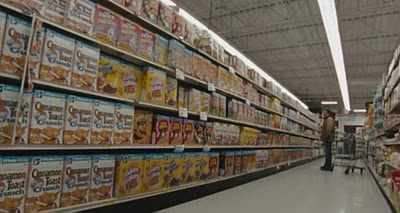
This post started as a tweet I made a month or two ago from the cereal aisle in a grocery store a few weeks back, which then turned into a series of tweets as I tangent tripped:
The myth of variety in the American marketplace. There may seem like a million kinds of cereal but they're all made of the same stuff
Myth of variety 2. There may seem like a million suburban tract homes. But they're also made of the same lousy stuff.
Myth of American marketplace 3. Those low costs where you think ur saving. U r paying for it thru all the costs that were "externalized"
Perhaps, choice is the preferred word than variety, because they are different but the choice is irrelevant. Housing choice is for the most part is the equivalent of cocoa puffs and fruity pebbles...all made of the same crap underneath: corn starch, artificial coloring, flavoring, and some bran flour. Flip the formula around a little bit and you get a two-car garage, a pool, and a third half-bathroom.
A house should always be first thought of as a home. It is first shelter, then a place of comfort. Unless you happen to catch a bubble at the right time, which is difficult especially when the power of positive thinking irrational exuberance kicks in housing, thinking of it as an investment is typically not a good idea. Despite what conventional wisdom might tell you. Conventional wisdom has a short memory...and it is often manipulated by the National Ass. of Realtors.
Housing costs are always pegged to income. There is always x amount of people in the world, y amount of housing units, and z amount of money. All of which are interrelated. When you start adding distance between housing and jobs, markets, etc you start raising the cost of that housing in an externalized fashion because of the energy exerted traversing those distances, over and over and over.
The noughties saw rising home values and falling incomes as we leveraged ourselves to the hilt. Cities will be contracting in the "great reset" of the unnecessary complexity that was once considered "modernity." The brand new house you just bought out in BFE, that you thought was a great value, could very well have as much value in twenty years as the nutritional value from those honey smacks.
It really was a steal...from you...and all of the taxpayers supporting the infrastructural costs that were externalized (onto you) perpetuating what you thought the American dream is.
In fact, the only way for housing to be "sustainable" or a valuable investment beyond a shelter is for one generation to pass it on to another free and clear allowing them to focus money and energy on other pursuits, like bettering themselves. THAT is the American dream. And for that to happen that home has to be in a location as well as designed and constructed in a way that is suitable (or at least adaptable) to those future generations.
The problem is that so many of the houses built in the last twenty years have a shelf life no longer than twenty more years under the ruse of the NAR that is their simulated version of the "American Dream." Considering that suburban housing really didn't become prevalent until the Serviceman's Readjustment Act for returning soldiers in 1944 and the National Highway Investment act of 1956 did suburban housing really explode, building off of the various Levittowns and Americanized Garden Cities. Somehow I think the American Revolution, the Civil War, and either World War were fought for suburbia.
Point is, that if the American Dream is older than suburbia, how can suburbia be the definition of what the American Dream is? The short answer is that it, of course, is not.
Many of the negative comments in the various media outlets that have recently begun to pick up articles from this here blog, typically all come from the same angle: that in some way I'm trying to force them to live the way that I do when I'm merely offering the eulogy for the trivial things that they apparently hold so dear. What this is called, is transference. These are people that want everybody to live their way, where I'm suggesting that choice is necessary.
I blog here because I am showing how difficult (yet possible) it is to live the way of my choice. I blog because of the antiquated zoning regulations, highway funding, and state and federal street standards that force a suburbanized way of life and mandated car ownership onto all of its citizens. As Chris Leinberger has shown, the facts support me.
Suburbia offered an escape from the poverty, despair, and particularly the pollution and soot of industrialized cities. Highways were built as a conduit for people in and out of cities under the illusion that your own house and car were symbols of prosperity. Furthermore, highways became a centripetal force themselves - scattering people across the countryside into was is the anti-city.
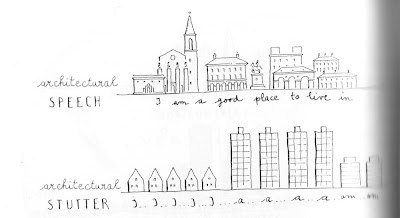
Sketch by Leon Krier
The illusion of choice in the market dictating a suburban world is as innaccurate as the misunderstanding of the American dream, and libertarianism for that matter. The cities we've constructed has created a homogenous world that forces elderly and children to be at the mercy of the car, whereas in more walkable communities all are empowered.
My interpretation of the American Dream is one of opportunity. Opportunity requires choice, as does a functioning market economy. The housing market has and will continue to fail as long as we build housing as "product," not livable, walkable places. Livable, walkable places allow for all to participate in community and the economy.
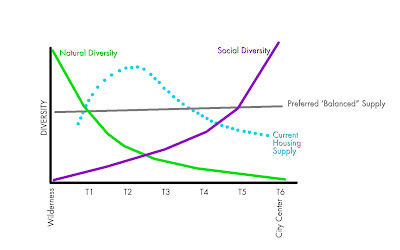
The tool typically used to show a greater range in housing choice is the transect. As I've crudely shown on the diagram above, the blue dotted line represents a rough estimation of housing supply. I've often written about Valencia, Spain as it is constructed in a way that is transferrable from one generation to another, thereby instilling value for future generations. We on the other hand will be completely reconstructing and reorganizing our cities.
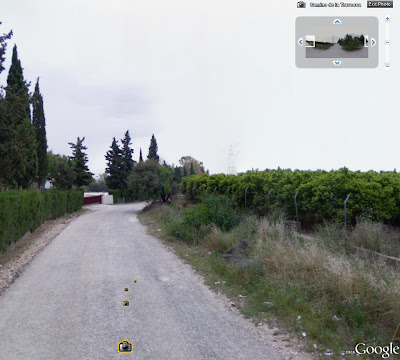
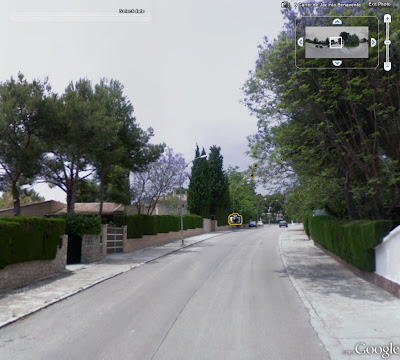
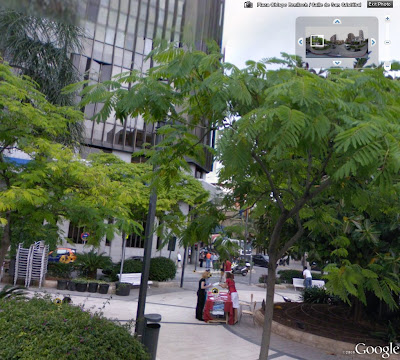
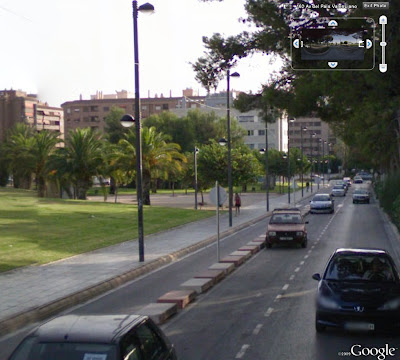
A quick tour to show the transect as it fully built out well before the idea was even codified (or given name for that matter) as it emerged by creating variety, only allowed by a robust and flexible transportation network.
Nearby agriculture.
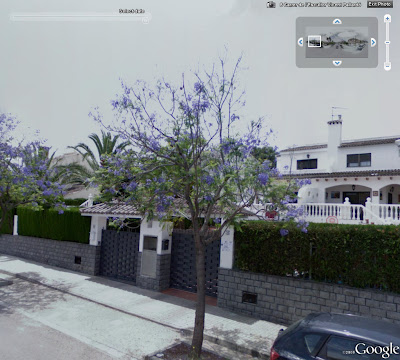
Want to live in a mansion? If you can afford it, they're back there.
Small lot, single-family housing.
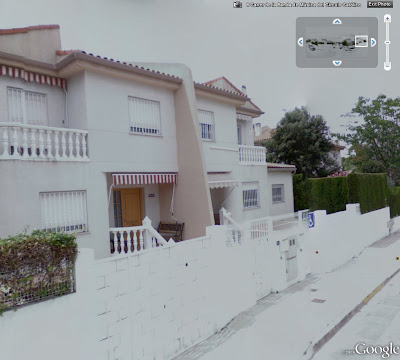
Attached housing.
Multi-family.
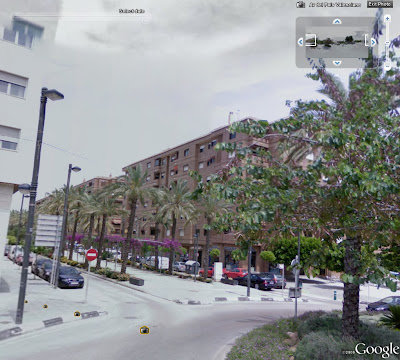
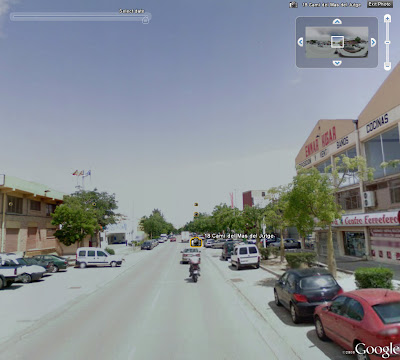
Want more action, try the City Center.
Except, this isn't Valencia. HaHA! I pulled a fast one like I was a realtor.
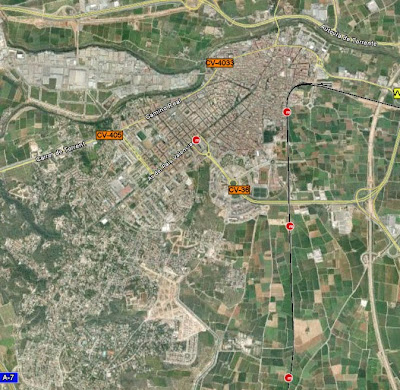
This is actually a suburb of Valencia called Torrent, which is home to 78,000 people. Below you can see it's form with minimal highway intrusion. The urban core is near the metro station to the Northeast. The rest of the community extends to the Southwest as density diminishes. The industrial area is the peninsula like form between a waterway and the highway to the North. In other similar suburban Valencia communities, the railroad is usually the demarcating line between the living area and the industrial zone, station serving as the dissemination point for goods and people.
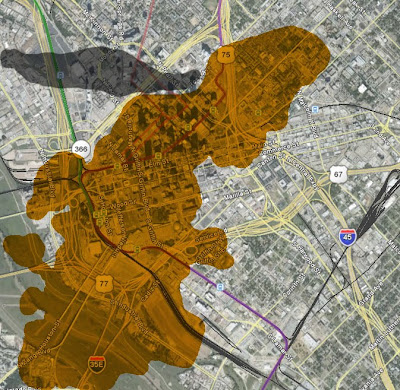
Below is the same 78,000 person community applied at the same scale to Downtown Dallas, if to only show how efficiently the land is used, while providing all of the housing choices shown above, and designed in a people-friendly manner.
The gray represents the industrial zone, what is typically known in the states as LULUs, or locally undesireable land use. Ya know, much like freeways are, except these are even designed for people:
And one going away shot of one of the central squares. Notice the divided bike lane:
In order to survive, our suburban municipalities, are going to have to prove their worth for future generations. Nearly all will be unable to continue functioning solely as bedroom communities and will have to look to places like Torrent for how to redesign their communities; to densify, to be usable, functional, productive, and livable in the 21st century.
If our economy is to get off the ground again, we must focus efforts on the provision of choice, in transportation, housing, and places. A polychromatic variety of experiences and densities (designed livably) creates for, in essence, competition, thus allowing for positive feedback and better, more productive places.
All "stimulus" efforts should be focused on building livable (and walkable) cities allowing for choice in housing and transportation, not only for the few, but for all. Choice, it is the foundation of the American Dream and a prosperous economy.
First, from Kaid Benfield's blog at NRDC, where he discusses ULI/PriceWaterhouseCooper's newly released emerging trends in real estate, and wouldn't ya know it. They got it right.
In the near term, the report advises investors to "buy or hold multifamily" as "the only place with a hint of hope, because of demographic demand" as a large contingent of echo boomers seek their first homes.
I've talked for some time about the demand of the "communitarian" generation, eschewing the conventional factors for relocation (jobs) for things like diversity, sense of place, URBANITY. Clearly, they are the demand driver that will pull us out of this mess. As I previously wrote:
Boomers are retiring and desire the type of freedom found in ideal “retirement communities” like the Upper East Side or Key West rather than being “warehoused” in an actual retirement village.Millennials want to escape similar confines of suburbia for more authentic and diverse (yet affordable) experiences and ways of life.
I often say that cities progress from being Viable to Livable and finally to Memorable.To the City’s credit, they are undergoing several projects that would register as “memorable,” in some cases admirably so, but we still have not yet achieved livability (the hard part) in downtown (and this coming from a downtown resident).
We just need to put our brains together to make the numbers work for smaller residential space per resident (efficiencies or roommates) while getting land values and expected returns by current land owners back into the realm of practicality.
Interestingly, the report even arrived at conclusions that I had expected but not yet seen evidence of, at least locally, :
The report even questions the continuing supremacy of suburban school systems, noting that increasing numbers of them will start to falter as their supporting tax bases decline.
This is, of course, completely logical, as suburban schools are forced to compete for municipal dollars for their own student transportation infrastructure necessitated by the very thing they're competing against, the upkeep of overextended infrastructure for a too sparse (and increasingly less rich) tax base.
Conclusion, not everybody can afford all of those suburban houses that we've built. And, we're seeing that reality played out before us. As mentioned before, the demand for positive urbanity, which will create more localized and efficient economies, is there. We just have to define and overcome all of the barriers to the delivery of the supply to meet the demand.
"On a long enough time line, the survival rate for everything drops to zero."
A cautionary tale: no outlet in the fourth dimension.
The Radical Honesty? There is no saving them, but there is a future.
I know I've written about and cited studies of the trend towards increased crime in the suburbs, but alas I can't find those articles despite blogger's supposed search capabilities, so instead, today's article re: suburban decay du jour comes from MSN Real Estate, "Is Your Suburb the Next Slum?" (special bonus points for the title of the video on the sidebar "Has Housing Finally Turned" - no need for editorializing which way it's turning):
That's already happening in places such as Elk Grove, Calif., a community 15 minutes outside Sacramento. Here, builders rushed to build subdivision after subdivision — putting up 10,000 tract homes in just four years at the height of the boom — confident that buyers from all over the Bay Area would trade up to these larger homes.
They were wrong.
Succinct. I admire traits I lack.
I've probably written it before, I know I've spoke of it many times to friends, colleagues, clients, etc., but I'm always struck by the irony of the city's with the most laissez-faire attitude toward development (ie allowing sprawl) never fail to end up having some of the highest tax rates simply b/c they have to in order to pay for the amount of infrastructure per capita that is required for what the easiest possible development model entails.
Many suburban Dallas cities (and even the City itself) are feeling the pinch. Some b/c of the spread out nature, others due to the "drive til you qualify" nature of their outlying housing; in either case the tax base simply can't afford it. Paraphrasing a quote from Green Metropolis (the book is sitting next to me, but when I came across this quote I failed to dog ear the page nor highlight the passage as I typically do ruining all books I've ever owned), the author talked about the stigma of the countryside around times of the French Revolution where only Aristicrats and Rubes lived out there despite the City having undrinkable water, poor sanitation, and worse air.
The Aristocrats' (not the joke) streets were paved in gold, while the country bumpkins were dirt roads at best (b/c both had to pay for themselves in times where classical economics (read: sanity) still ruled the day). It is no different in today's times as we're seeing the bottom drop out of the American Dream and the Middle Class standard of living.
But, that standard of living can be molded. It can be shaped. I'm living proof that you can manipulate your costs to still live like a king. Of course, I don't have kids. But, the underlying point is that the suburban way of life is no longer the ideal model, particularly for the largest generation in American history that are rewriting the rules of the American Dream as they march thru their lives like Sherman from Atlanta to the Sea. Hopefully however, we will be rebuilding railroad tracks rather than mutilating them.
Suburbs are chosen these days for a variety of reasons, none of which are the same as when they were a new creation. They were strictly a reaction to the plagues of what Cities had become and were an embodiment of a democratic ideal that every man was his own king, in charge of his own life.
But, all of that is changing as suburbanites find themselves trapped in traffic jams, chained to their car keys (and the costs associated), stuck in Generica because for the most part there were no other choices. That is hardly free. Today, people leave the cities for schools (which I'm a firm believer that they can be as good as we want them to be once ideology is stripped from the conversation) and for the perception of crime or safety, whichever way you want to think about it.
Turns out that yeah, well, the school thing is still a major (nay, GARGANTUAN) issue not just for a return to urbanity, but for society and this country as well. But, as for the rest of suburbia, we are learning that it's not safe, it's not healthy, it's not sociable, it's not enjoyable, and it certainly isn't lovable. Hat tip to Steve Mouzon on this one, it's his point that for things to be sustainable, they must first be lovable, or they'll just get bulldozed for the next thing, whatever that might be.
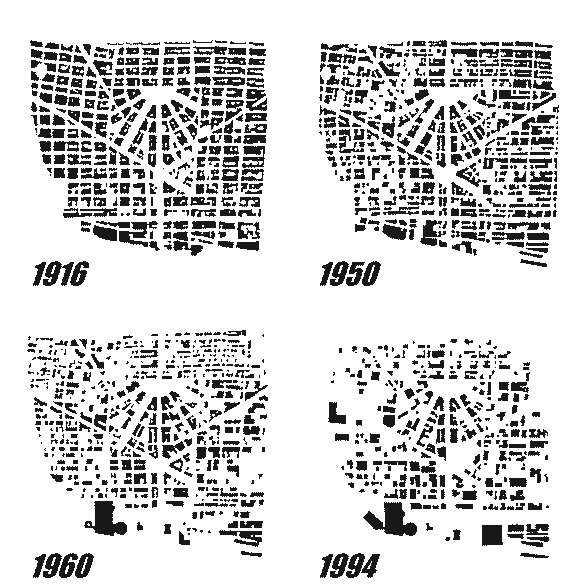
Watch the time lapse of Detroit's decay. Take a close look at the 1916 years and how little "white" space there is (black is buildings obviously). What this does is minimize the public realm, which means less space per capita, which means higher affordability for high quality spaces and less to maintain, a focus on convergence points forming key public gathering spaces, creating a natural hierarchy where important civic or public buildings can be placed celebrating accomplishments of art, culture, or self-governance.
The beauty of good urban design is the focused nature of the open space...if illicit activity is happening in the privacy of a home, it doesn't affect the public realm unless it is so concentrated as to plague entire districts and overwhelm any efforts at policement and regulation. Furthermore, when Bill Lucy was speaking here, he pointed out data showing that when calculating per capita safety numbers and removing all violent crimes that are committed by friends or relatives, haphazard mortality rates are much higher in suburbs than cities.
The flip side of the ZOMG suburbs are awful commentary is that we've pushed all of our chips into the center of the table. We're pot committed vis a vis that shear amount of infrastructure that I've just been bitching about. So we have to work to save them, but how?
I see two choices and mentioned this in the Transect post from a while back that seems to have quickly become the most clicked post I've ever written. As the rough graphic shows we have an over supply of T2 - what we know as suburbia - and this has to either densify or de-densify.
Jane Jacobs, in Dark Age Ahead, wrote:
Sprawl can become less wasteful only by being used still more intensively. If that happens, suburban sprawl will turn out to have been an interim stage, a transition between land in agricultural use and land densely enough occupied to support mass transit, to form functional and inclusive communities, to reduce car dependency, and to alleviate shortages of affordable housing.
We are already seeing densification occuring in strategic locations, Las Colinas, Addison Circle, Legacy Town Center, Downtown Plano, etc. in some cases these are defined by new transit lines, in other cases the density formed with the idea to be served by transit sometime in the future. This densification allows the outlying communities to become more dense, livable communities with a greater variety of housing product and affordability levels, as well as increased tax base, which we will need to support and fund schools.
Those that densify will have to have a reason for doing so, and will need a certain measure of a real, supportable economy themselves. This entails an infusion of new uses into all single use districts, whether they be retail strips, light industrial parks, suburban office campuses, or single family neighborhoods. But, for the most part, these communities still act as bedrooms for downtown and nearby workers, which is fine for the most part as it still allows for transit use, and the opportunity for choice.
But, what of the further outlying suburbs that will never have any forms of mass transit?
If we're not careful (or if we intentionally allow to do so for environmental reasons) some of the lesser positioned and poorly constructed neighborhoods may turn to dust, or reclaimed by nature as some killer shelters with two car garages and walk-in closets for whatever furry creatures decide on Mulberry Lane to raise their roost.
As Jacobs writes, the way for these areas to maintain themselves as productive members of their metropolitan area, is to intensify their use. And that means import replacement. The way to de-densify is either go back to nature (which for all it does with water and air, IS productive) or replacement of things we truck, pipe, train, ship, or wire in from further locations via local food and energy production.
With giant agribusiness depleting arable soil at an alarming rate, there may just be a plentiful amount of food giving earth still remaining in suburbs that were sold by small farmers, who cared for their land family's b/c their livelihood depended upon the perpetuation of its production value. Often, they were forced to sell their land to developers for a retirement nest egg as their children moved city-ward and/or plummeting commodity prices made it impossible to make a living and compete with said earth rapers corporate agri-business.
The other potential option is as energy production - solar or wind farms, or hell even nuclear - go here to see treehugger's debate on nukes, which might just be a necessary evil as we transition into a post-carbon world, allowing time for technology to fully take advantage of all the Sun's potential.
As I've said, the suburbs to have a future, must have an economy to do so, beyond being strictly bedroom communities, however many industries will learn that they need the synergies of urbanism and will move back to the city following the demographic shift center-ward (being near employees was one of the major reasons for the move of businesses out of cities). Suburban communities have two choices, and neither is the status quo: 1)Densify or 2) start thinking about what kind of imports they can replace with local production - I'm of the opinion that it's food or energy - or maybe it's even water as areas return to nature's natural cleansing ways.
Pretty sure I posted part 1 of this "Saving the Suburbs" series in the NYT blog, but here is part 2.
I have to admit, I didn't find anything of real substance in part 2. Here is my comment referencing the super happy save the world suburb (of like twenty houses in car-friendly Austin):
The Sol project is as net energy zero as the cars are that access the development. Not to say there is anything particular wrong with that, but to say this particular project in a sea of tract houses doesn’t actually prove anybody right or wrong.
The real issue is that American cities grew in size/land area, but not in the requisite population, i.e. they didn’t grow organically, aggregating new development with all the services and community infrastructure to be successful in addition to existing development. Rather, we robbed Peter to pay Paul, leaving our downtowns and cities to rot while we all moved into suburban neighborhoods that were principally bankrupt and were only about delivering product to the market place, not making real places with lasting value, socially, environmentally, or ecologically.
See my post on Valencia, ESP for a city and suburbs that work and grew organically to do so:
The primary issue is that there is an appropriate choice for housing types and living environments and that is represented by the current city form in Valencia. In the US, you generally have one place to live, trapped on your cul-de-sac and behind the wheel.
I’m sure the car, road building, oil/gas industries love having a captive market.
Link to a new website that catalogs Freeway Teardowns. But, the real gem is this article pasted on the site, from Induced Demand to Reduced Demand, which is exactly the issue incapsulated into one neat and tidy heading.
This is what transportation planners call "induced demand." Building freeways encourages people to drive longer distances: in the short run, people begin to drive to regional malls rather than local stores, and in the longer run, they move to lower density neighborhoods where they have to drive further for all their trips.
The convenience of driving has become our [and its] own worst enemy.
Road construction, in the attempt to alleviate the pressure further spreads people out and thus creates its own demand to fill the newly created supply, so we're back to square one...only amplified. The real answer is demand side solutions that reduce the need for trips and driving for every facet of life. As my post yesterday suggests, our happiness and well-being depends upon it.
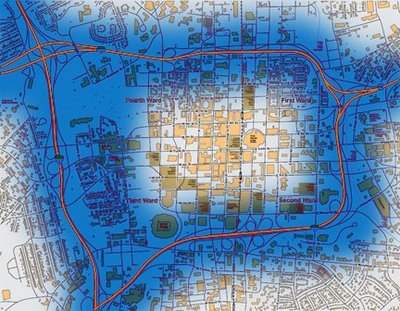
If you're tired of me b!tching about the highway problem affecting downtown Dallas, move to Charlotte...no, wait a minute. Don't do that. Check this figure ground of downtown Charlotte and how it has essentially been wiped out except for the very center that is in itself buffered by distance and an eroding urban fabric (much like the four blocks of Main Street that work in Dallas):
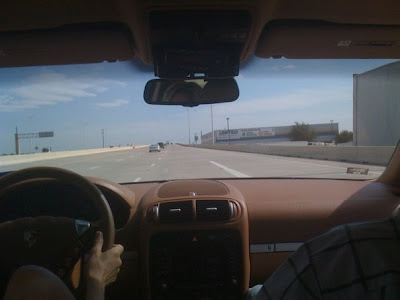
"The American love affair with the car...it's an awful lot like Stockholm Syndrome." ~ Me. In the Sixties the philosopher Ivan Illich showed that the amount of energy invested into cars and road infrastructure would be sufficient to cover the distance by foot - and in a considerably more beautiful and peaceful environment.









![[supply.jpg]](../../_D5kx0bUGx_c/SdooXpYbvKI/AAAAAAAABUE/PpQ3HasPu44/s1600/supply.jpg)

 Posts
Posts