




Showing posts with label Green Wash. Show all posts

Wednesday, January 20, 2010

ArchRecord on Dallas ReVision

I've made my snarky comments here. Now, that the competition seems to have been finalized (we'll see if it ever gets realized), Architecture Record has an article about it.

Frankly, I found the comments much more insightful:

Reader Comments:
Anonymous}
Anonymous wrote:
These buildings are for Architects, not people.
1/20/2010 11:42 AM CST


Anonymous}
Anonymous wrote:
You've really gotta be kidding...
1/20/2010 11:36 AM CST

Anonymous}
Anonymous wrote:
This is one of the most anti-urban project I have seen in a long time, and Dallas seems to be attracting the worst of the worst. There is zero attention to the pedestrian scale or to context, which ultimately determines whether a project performs well urbanistically. The building frontage design is especially poor. Pedestrians need a lively exchange between the facades and sidewalk to feel comfortable, and to make retail work. This means articulation and permeability at the street level. What else can I say, except overall it reminds me of a prison with barbed wire on top, and the high tech nature is sure to lead to inefficiencies if not downright failures. Sorry, Dallas, thumbs down.
1/20/2010 10:52 AM CST


Anonymous}
Anonymous wrote:
Hideous

Friday, October 16, 2009

Like Least Fat American?

World's greenest skyscraper*, kinda like the world's greenest highway**?

*Being in NYC helps for transportation sustainability, the usual to and fro, but of course there is no mention of how far the material has traveled to build it, or the processes to make the steel and glass and the harvesting of the sources of those structural components. As we linked here before, many LEED buildings aren't nearly as "green" as we think they are. But, that isn't the point. It's an attractive, responsible building that fits in NYC. Does it need to be more than that or is this more marketing drivel run amok? What are our goals?

**First mistake, anything "green" is gonna have to be affordable and secondly, I recommend it doesn't involve cars or anything other leftover residue from the wreckage of the planned obsolescence economy.

Monday, August 31, 2009

LEED not doing a whole lot of leading, apparently

From the NYT: Some LEED certified buildings aren't who we thought they were.
The council’s own research suggests that a quarter of the new buildings that have been certified do not save as much energy as their designs predicted and that most do not track energy consumption once in use. And the program has been under attack from architects, engineers and energy experts who argue that because building performance is not tracked, the certification may be falling short in reducing emissions tied to global warming.

Friday, June 26, 2009

Couple Us Designers Wondering We Could Go Family Style on Yer Competition

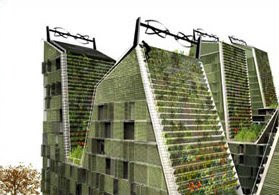
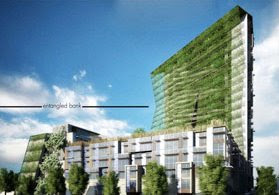
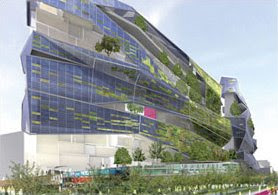
So, we have our winning entries for the Re:Vision Dallas competition. And the results are as predictable, superficial, and cliche as the competition title itself.

Behold:


(Of note: Not one of the three finalists were from Dallas.)

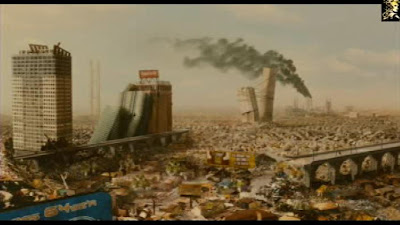
From simply a graphic rendering and architectural standpoint, all of these remind me more of this than anything I would really like to see happen in the city:

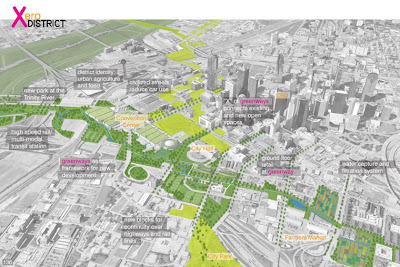
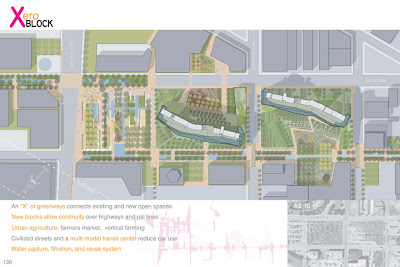
So every team engaged in some serious green washing and green gadget sustainability, which was not to be wholly unexpected. I was actually intrigued at first by this "X" district because a team actually started looking at their site contextually to deal with this site. Until I got a closer look at it. They basically just took the google earth axon view into photoshop and literally added a green connection from the project site to the Trinity River. How novel.
Of course, this would be nice, but they did nothing substantive to address the real issues affecting this site. A green blanket was laid over a fallen city, covering the highways, clover leafs, rail lines and vacant properties so that no one can see its dying eyes. Of course, this is an easy slight of hand with photoshop and a few snappy design catch phrases. No mention or apparently thought was given to how to address all of the grade changes, elevated and sub-grade highways, etc. that provide these impassable barriers.

I advised two groups that competed for this, suggesting to both that the constraints of this site were ALL beyond the boundaries of the actual project, not all of which are physical. No developer would look at this area. It had(has) no context. The freeway has gutted and bombed out both sides of it.

While in the mean time, the country is in deep and transformative recession. Rather than seeing something that addresses in an economically and physically sustainable manner a solution for job losses and failing industries, I still see highways and clover leafs. The two teams I consulted with ended up with solutions looking at how to reuse plain fuselages and the concrete road building industry as structural elements for prefab housing units. Taking one dying industry void of demand and repositioning them into areas of need, in town affordable housing.

Along these lines, I suggested carrying the theme further and restitching the fabric, grid, and parcels, that I-30 ripped to shreds in a methodical, phased, and context sensitive manner. Break down the dying industry of roads and cars, for one of the 21st century, the new American city.

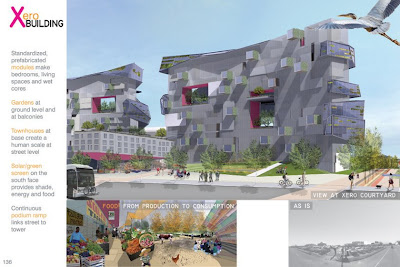
Instead, we get a correlated level of depth and duplicity that puts a blue heron flying across the page:


But how does this building fit within its site you ask?

Towers in the park: We don't want to frame the public realm, those areas critical for vital street life and local commerce, the areas that belong to all of us and make us love and be proud of our cities. We want to make self-referential buildings. In the words of a friend of mine, "IT'S ALLLLLL ME."

Which, in the end, I guess is a fitting eulogy for outside architects embodying globalist architecture where everything is nameless, placeless, and anonymous. It's all on a computer screen.

From the results shown on the website, I felt that "Commonwealth" did the best job of capturing this wholistic view of community healing and rebuilding.

Tuesday, March 3, 2009

Oh Starchitects, How You Just Don't Get It.

First of all, haven't we been over this? Who has the money anymore to build these frivolous monuments to excess? Second, those of us in the real world are trying to make sustainability more attainable, more common, and most importantly, CHEAPER. Just yesterday, we posted about the sustainable nature of slums.

Here is Curbed presenting Stephen Holl's new whatever complex in Shenzhen. HT: my friend Mike in KC, a landscape architect who specializes in green roofs, who added accurately:
A blending of greenwash and Corbusier. This is not a good direction.
But, this is the only way the self-absorbed dinosaur architects representing all that just failed know. And my firm can be part of the problem as well. Check out our website: nothing but flashy, hard to build object buildings. There is nothing more complicated ingrained into the DNA of these places than trying to be different. That is it. They are the opposite of timeless. They are fashion. And, fashions go out of style. Place IS timeless.

And the sycophants of these new, shiny objects are no better than the high schooler wearing a hat with a pot leaf on it or the college kid away from his parents for the first time that keeps all the liquor bottles of peach schnapps and boone's farm that they finally finished and probably spent the rest of the evening praying to the porcelain Gawd. It is not cool. Get over it. It is juvenile.

There is no goal other than appealing to other architects. Other members of the cult. These are NOT our clients. Our clients are people. Our clients are cities. Our mission should be creating a better world to live and exist in. I fail to see how this is progress.

I was struck yesterday on a client tour of Addison Circle and Legacy Town Center, the moment the lay individuals "got it" when one said, "it's amazing how many things you don't know consciously when you're in a place like this, but you know they're there."

It is good to see the majority of people get it. In the comment section:
steven 'hole' just keeps getting worse.

the other building that rem did, and that holl did, as well as most of the new garbage built in china nowadays, should have burned with that fire last week

the chinese motto: if it doesn't suck, we won't do it

Towers-in-the-Park. Hello 1961. Jane Jacobs, never heard of her.

urban planning travesty

Assuming the sun can get through Chinese smog. [ed: LOL]

This is hideous. In the pretentiousness / ugliness stakes, Steven Holl is now giving long-time front-runners like Libeskind and Eisenman a run for their money. [amen]

Believe what you want. Be as optimistic as you like. What should we care if you want to go around fooling yourself that this is anything other than bullshit. It's your life to waste as you please.

Heavy, severe, anti-social, anti-human, scaleless, leaden, joyless, drab, prison-like, ..... these are the words that come to mind when I see this project.

And in their quasi-intellectual pretensions, these are the same words Holl's deluded staff of poseurs will try to say are the project's virtues. - Yes, I forgot cold, inhuman formalism has always been the stuff of great architecture ... right? [ed: This commenter gets my point that this is phony intellectualism. Their language makes no sense if you really break it down. There is no real depth to this other than being different.]

China seems to becoming the dumping ground for these pseudo-theoretical piss artists like Holl and Libeskind. They get suckered into buying ideas that failed in the US. - On the plus side, at least their crap doesn't get built here any more.
Also, when helping a friend search for a new TV, I was also struck by how the customer comments were far more helpful than the consumer reports or site editor's comments. Despite their expertise, there was a sense of uneasiness that it could easily be corrupted or bought off by a product manufacturer; that you could no longer trust their information.

We are leaving a place of mass centralization and control by the few, to a much more democratic and meritocratic place, where companies no longer compete against others, but cooperate and conspire against the customer.

This process is the crowdsourcing of knowledge, experience, and information. This is a good thing.

Monday, February 9, 2009

The Myth of the Efficient Car

Let’s get something straight about green industry: in its basic form it means we all have to buy new stuff … lots of it. As an industrial policy that will create jobs and increase spending, it’s pretty sound. As an environmental policy, it’s largely a fraud.
Bravo.

...and what you might not think about:
But there’s an even more profound problem with building more efficient cars. In 1865, English economist William Stanley Jevons discovered an efficiency paradox: the more efficient you make machines, the more energy they use. Why? Because the more efficient they are, the better they are, the cheaper they are and more people buy them, and the more they’ll use them. Now, that’s good for manufacturers and maybe good for consumers, but if the problem is energy consumption or pollution, it’s not good.

I See You Giiirrll, Lookin' at my Links

Derrick Jackson on Tax Rebates for New Cars:
Mikulski mustered all the Chicken Little she could. "My amendment is not about bailouts," she said in a prepared statement. "It's about jobs, jobs, jobs. Six million jobs are at stake in the American car industry . . . The only way to save the Big Three is to get people into showrooms, but 1,000 dealerships could close this year. That's 53,000 jobs that could be lost just at the dealerships."
Ugh..the stupidity of saving jobs of the 20th century at the expense of jobs of the 21st century.
-----------------------------------
On a day when the WSJ has an article that opens with, "It's tough to be green when money is tight," treehugger has an article on learning from the inherent sustainability from the world's poor (because it is actually easier, if not imperative to be more "green"):
...contains the attributes for environmentally and socially sustainable settlements for the world's increasingly urban population.... The district's use of local materials, its walkable neighbourhoods, and mix of employment and housing add up to "an underlying intuitive grammar of design that is totally absent from the faceless slab blocks that are still being built around the world to 'warehouse' the poor."
"I strongly believe that the west has much to learn from societies and places which, while sometimes poorer in material terms are infinitely richer in the ways in which they live and organise themselves as communities," Prince Charles said. "It may be the case that in a few years' time such communities will be perceived as best equipped to face the challenges that confront us because they have a built-in resilience and genuinely durable ways of living."
-----------------------------------
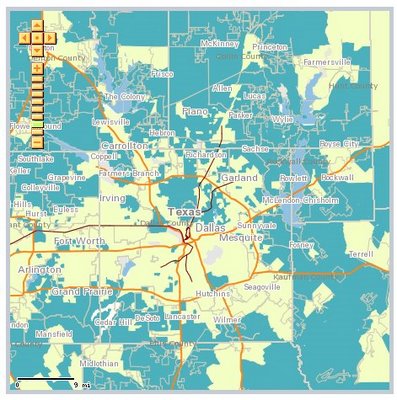
From the Center for Neighborhood Technology:

In turquoise, areas of the DFW metroplex where housing + transportation costs equal more than 48% of median household income:

-----------------------------------------

And finally, the best for last...Treehugger, which tends towards either of two extremes; the very granola low-tech or the super high-tech gadgetry, comes this article that ghasp, sustainability and tackling sprawl is about proper planning rather than new "eco-towns."
“Everyone gets seduced by the ‘green bling,’” Stephen Platt of Cambridge Architectural Research told me. “Making the houses energy-efficient is the easy bit. The key problem is making this a long-term socially acceptable place where people will want to live and prosper.”