





Showing posts with label Livability Indicator. Show all posts
Showing posts with label Livability Indicator. Show all posts
Thursday, September 16, 2010
Diane Rehm Show
On right now, Diane Rehm is discussing Livable Cities, including one of this blog's favorite people, Super Dane Jan Gehl.


Thursday, May 27, 2010
Livability Indicator: Diversity

Painting by artist Heather Hennick.
I have often heard or read of planners suggesting that areas need diversity as if that quality is something you can will into existence with a magic wand, also known as the architect's magic
Is diversity absolutely necessary for creating livable places? The short answer is no.
In this post, I will show that diversity is more of a by-product of livability than it is a producer of livable places, which points to it as a very clear indicator of livability (an outcome). While there are certain design measures that can allow for diversity (accessibility, mobility, diversity of housing type), it cannot be willed into existence. However, it does contribute in other ways, which we will also examine.
Therefore, in areas in need of revitalization aka those in need of a greater degree of livability (or desirability), diversity can be a performance measure by which livability is measured. People often mistake revitalization for commerce. But commerce cannot exist sustainably and predictably without people, meaning livability. On the other hand, diversity is an absolute necessity for achieving higher levels of lovability or memorability as it comprises a broader base, the foundation authentic, upon which memorable places are built.
A biologist would say the greater amount of species in an ecosystem (diversity) the more complete the elaboration of life. In terms of cities, this means a broader base and the potential for a higher plane for what a City can be.
A rain forest (home to a greater array of kingdoms, phylums, families, orders, genuses, and speciese) serves as a natural metaphor as the most complete known elaboration of life. Not uncoincidentally, in many ways it provides life to everywhere else on the globe b/c it is such an exporter (resources, oxygen, co2 sink, etc.). A rain forest is the actualized city. These are the global cities bubbling over with culture and new ideas of thinking and being that are then exported to the rest of the world.
However, this also implies that life exists in lesser diverse situations, ie places deemed livable by various species. So how do we find that point and how does it apply closer to home? In Mercer's recently released Global Livable Cities rankings, they aren't ranking global "rain forests," but places where the more basic needs of all are met the best.
Using Maslow's hierarchy of needs as I am fond of, helps to determine exactly where and how a place might fit within the vague notion of livability. The pyramid is widest at its base where the most amount of people have those needs. We all need food, water, and air to survive. At the top, we don't all need peak experiences of culture to survive. So livability isn't about being "world class." It is about other things.
Because livability is such an elusive concept and one that is difficult to define. The best way is to take the simplest, evidence-based approach. Are people living there? If not, why not? And because Livability can mean different things to different people, are different types of people living there?
Can an individual find a job and afford a residence nearby?
Are senior citizens able to get around? Do they have mobility?
Can children play in the streets or ride their bikes without the constant supervision of helicopter parents or be run over by maniacal valets?
Do women feel threatened or unsafe walking the streets alone or at night? Since women and children typically require a greater degree of safety than say me or Mac from Always Sunny in Philadelphia because we work our glamour muscles, can roundhouse kick and have made a collection of video tapes from Project Badass.

Totally.
If the answers to these and many other questions are yes, chances are diversity has been attracted for these various basic needs. Therefore the place is Viable, the foundation of Livability because all of the primal needs are met.
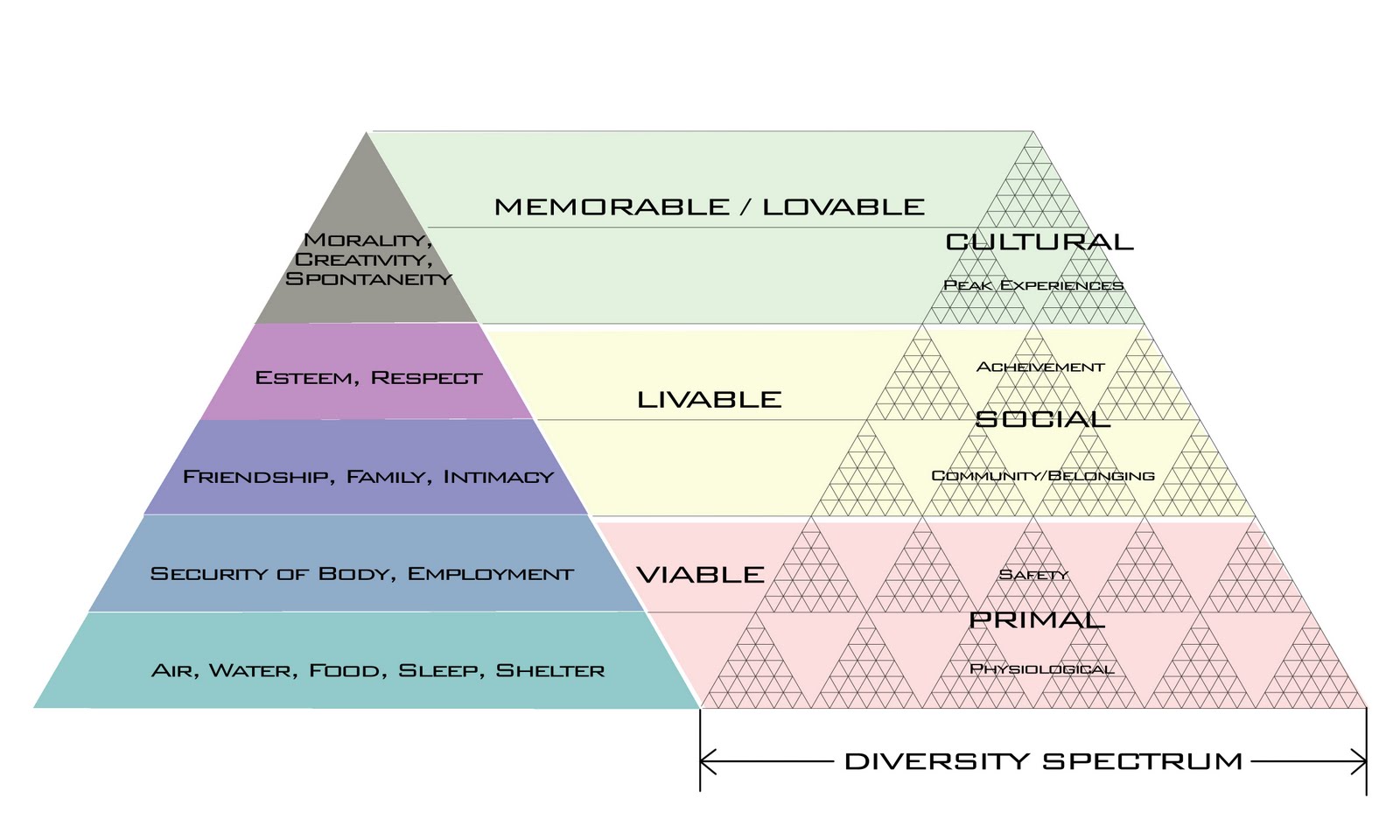
The next question to be asked and answered is what defines diversity? While diversity is often associated with race, it can mean a variety of age, gender, income, cultural heritage, background, etc.
As mentioned earlier, design can allow for certain amount of diversity but there are other mitigating factors at play beyond that of mere urban design. For example, nationality or race tend to congregate in areas for comfort, familiarity, or because of language barriers.
Uptown is a livable place, but is fairly narrow in its social makeup. This is reflected in its elaboration, particularly in its neighborhood services, the outgrowths of the residents. The commercial and social experience is similarly narrow, mostly alcohol induced at the many bars that while they may seem different are all as homogenous as its patrons.
However, uptown remains Livable because of its walkability and density. It achieves Social needs. This might be revealed in comparison to conventional drive-to suburban development where services are even more homogenous (greater reliance on chains).
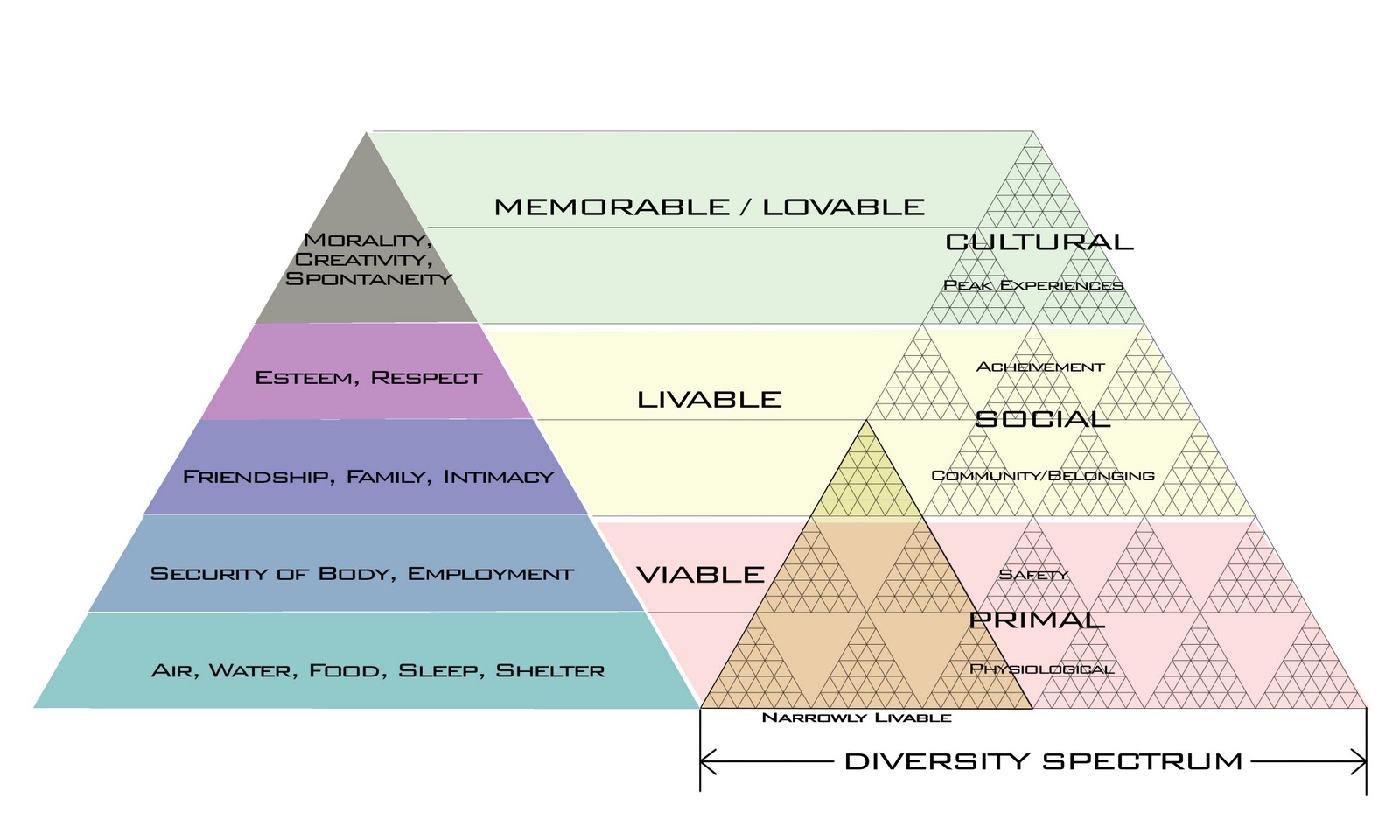
Since only a certain segment of the population are able to satisfy their more basic needs in uptown, shelter and the affordability thereof as the predominant factor, uptown is only livable for a few and the foundation of the neighborhood is quite narrow (at least in its current iteration) and its potential limited.
This can also apply to downtown Dallas. While it is probably more affordable (now that rental prices in downtown are finding their right value), a greater array of income levels are able to live in downtown, but less people find it safe or appealing (for a variety of reasons). So the foundation remains narrower than it needs or should be in order to be as successful as we want.
However, I find it suitable to my needs. Even without a car, I have mobility due to adequate transit and a willingness to erode shoe leather. I can afford space that I like and have a number of bars and restaurants nearby. In my particular subjective criteria, I find it livable.
For example, give me an Indian buffet, a soul food joint, a good sushi house, and a neighborhood bar and I'm a happy man. The proprietors of those establishments should have the ability to be a part of the neighborhood as well if they so choose. But not only the proprietors, but the various generations of their families and their workers should be able to find suitable homes there as well. This further embeds their stake in and stewardship of the community while making it all the more authentic, which I define as unique qualities or character as a direct outgrowth of an area's residents.
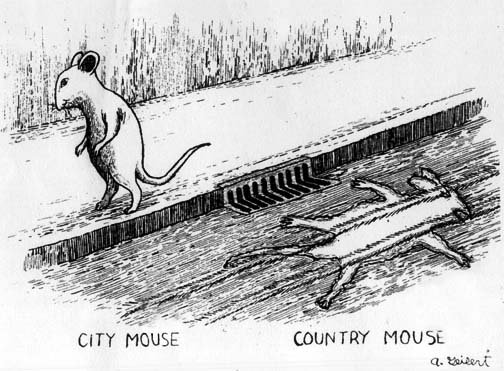
I once quipped that the only animals that existed in downtown Dallas were rats, carp, pigeons, and people. We're in good company. That was of course, over 5 years ago and the population has since doubled. You can compare us newcomers to the grackles. To get to the next level, we need our neighborhoods (of which downtown is one) to be a better habitat for more species, more types of people. Whether the diversity follows is irrelevant to livability, but it isn't to making Dallas a more memorable place and competing with the global "rain forests" of the world.
This City produces a preponderance of talent
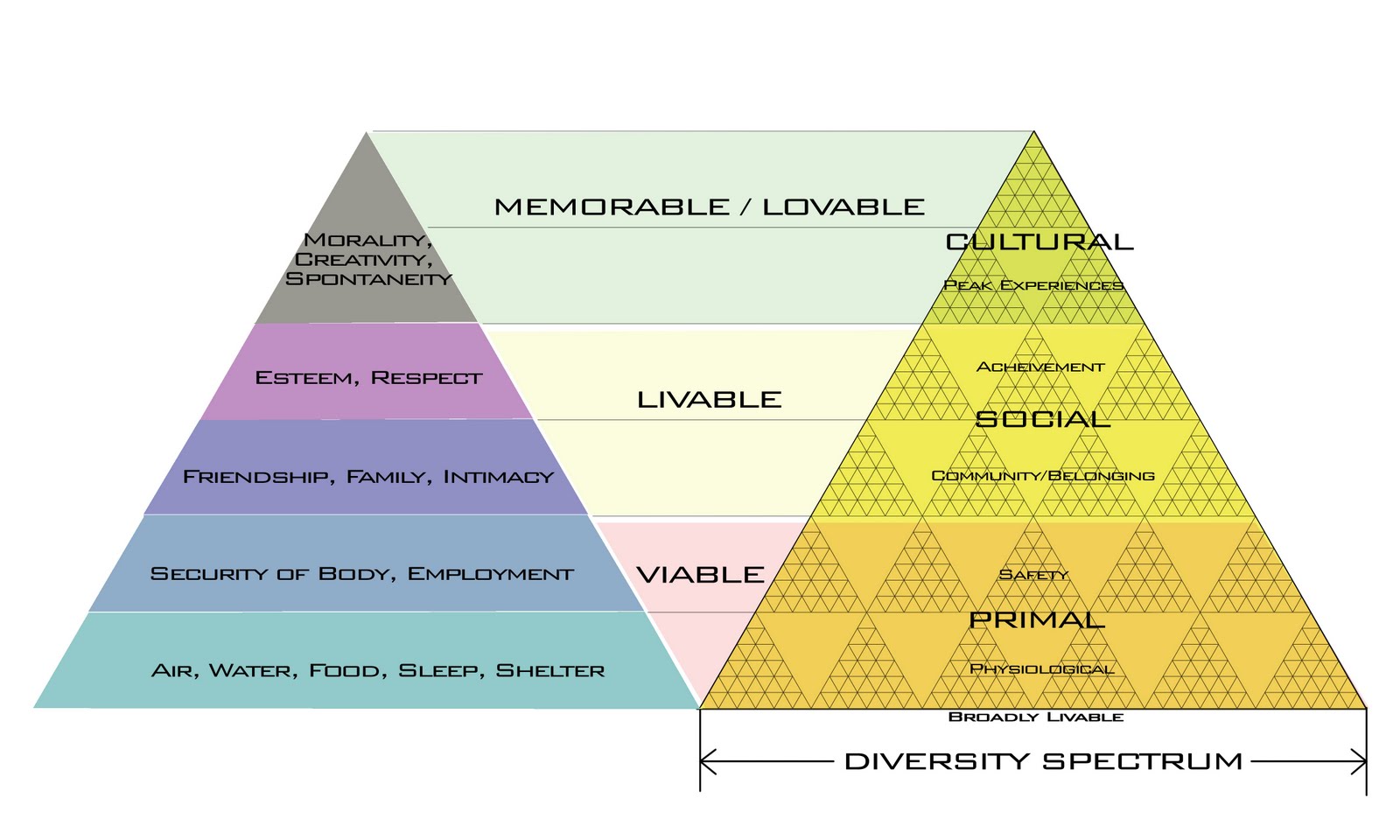
If we want our city and our neighborhoods to be "rain forests" known and mentioned on the global scale, or to move up in the myriad of Livable Cities rankings sure to grow in number, we have to focus all areas on being livable for the greatest range of residents and do so with high quality, creative urban design. Who can then choose to live in the neighborhood that most suits the character for which they are looking. Where they can feel a sense of belonging.
This means ranges of housing types and affordability (shelter). It means access to transit and walkable neighborhoods (mobility). It means clean air, water, and I suppose I should say clean food. It means a free and fair political environment. It means safety through design (CPTED) and enforcement without sacrificing justice. It means fostering diversity and the opportunity for all to contribute what they have to offer the world through livability building a positive feedback loop where diversity uplifts livable systems (attracting diversity) into a more lovable, memorable City.
Tuesday, May 4, 2010
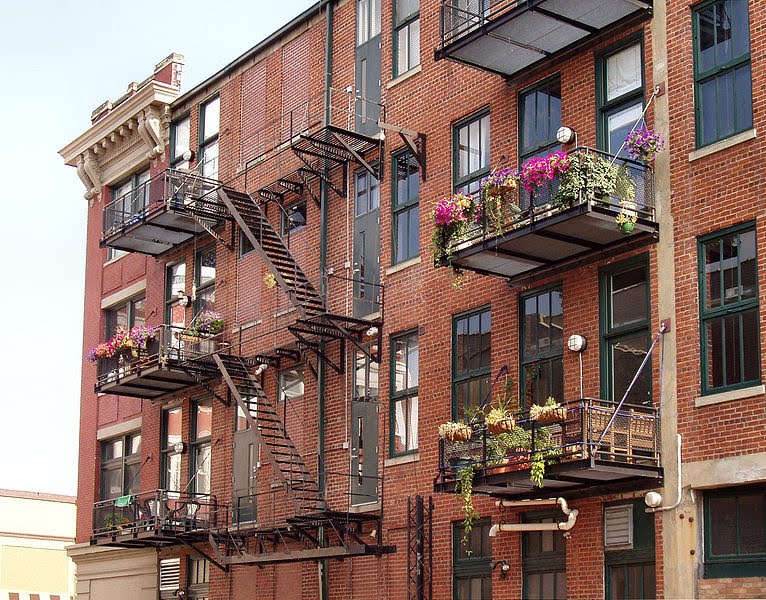
Livability Indicator #16: Fire Escapes
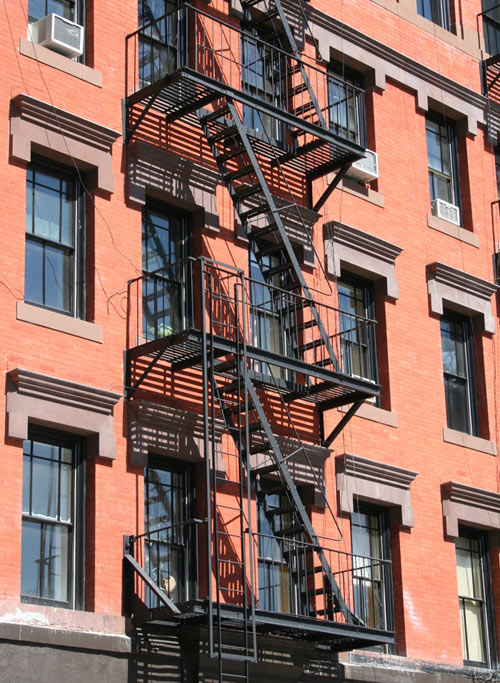
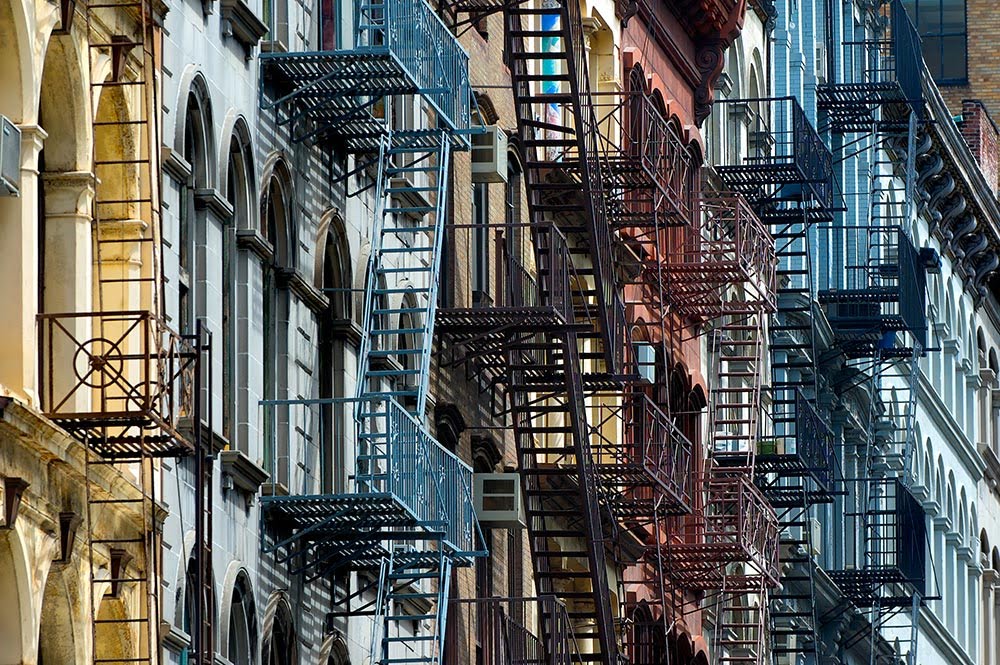
Fire escapes are a funny thing. Intended for safety, often proving to be anything but, are now little more than a vestige of a bygone era. They have been phased out of existence through increased fire safety and construction standards. Essentially, they were a cheap tack-on quick-fix. In other words, exactly the kind of thing you want in something intended to save your life, like a parachute stitched together out of tube socks.
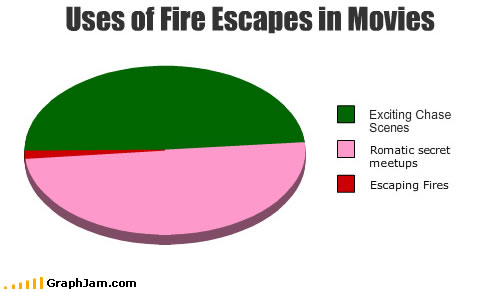
A construction boom triggered by what Richard Florida has taken to calling the 1st reset of American cities adapting to the new economy of the time, industrialization, responded to the influx of workers from the agrarian economy of the 18th and 19th centuries to the promise cities provided. However, this is not to say that the buildings or cities of the time were terribly livable. As we know livability is reached only after viability. And industrialization was about jobs and roofs over the heads of the workers. We'll figure out livability later.
Product was delivered so quickly that only after numerous disasters was a fire safety mechanism invented. That being the exterior, wrought iron stair case, aka fire escape. Many (buildings) were constructed with the kind of logic you would expect given that context. Most often there were no doors, only windows accessible to the escape. So, in a time sensitive moment of extreme panic, it was as difficult as possible to escape.
This was done because they were, well tacked-on; constructed so poorly that it was unsafe to have more than a handful of people on at a time. By their very nature, they weren't intended to communicate well with the architecture, to be one with the building.
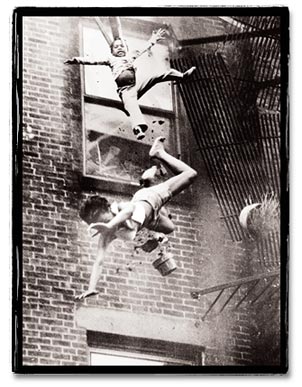
You know like when an entire building's occupants might want to escape a raging inferno, things like this happened, and a pulitzer prize for photographic journalism was awarded. Miraculously, the little girl survived having grabbed onto the swinging scaffolding of the collapsing fire escape. The woman sadly, did not.
On the other hand, merits of safety and sturdiness aside, they are not without their merits. Their nature was also intended to not avail themselves as accomplices to would be burglars. The main point of all of this is that they are a study in contrasts, in competing goals, purposes, flaws, and weaknesses.
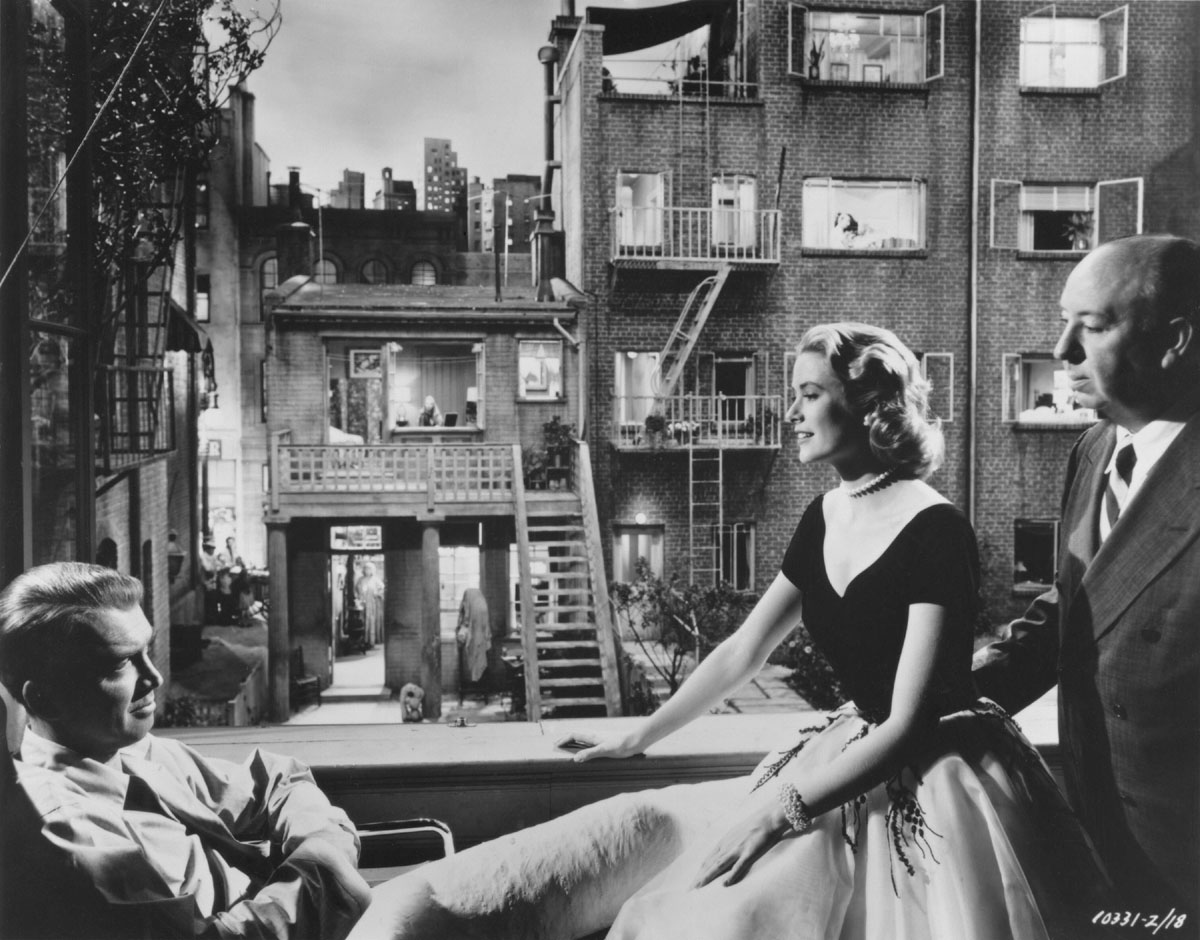
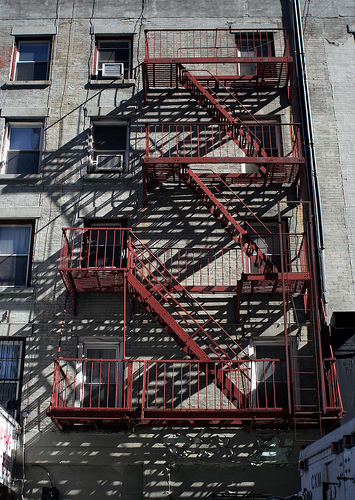
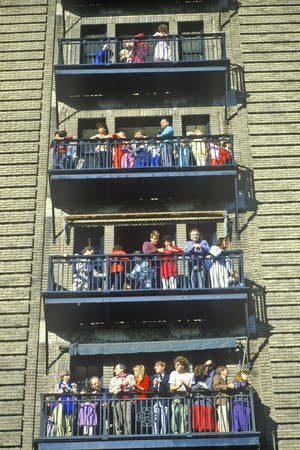
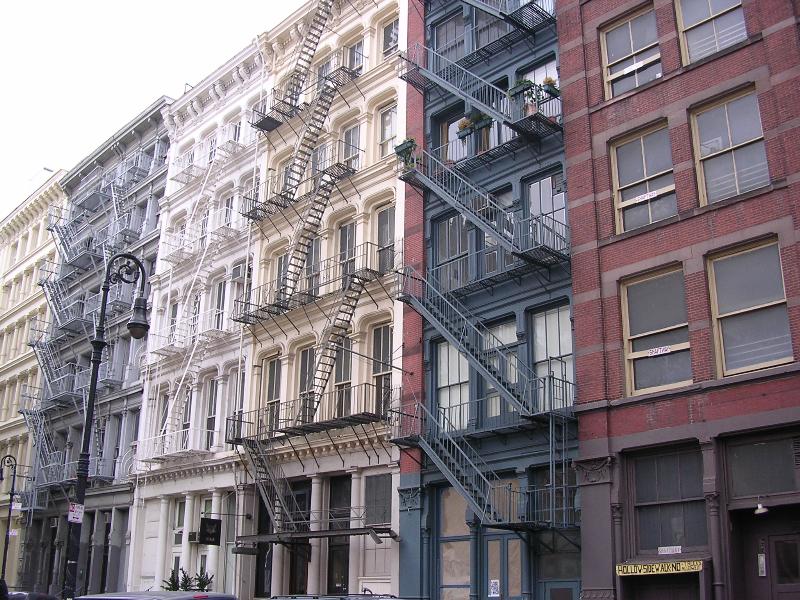
The primary reason I am attracted to the nostalgic presence of fire escapes is the rhythm of shadows and details they give to buildings, something that Hitchcock first played with in Rear Window. Some architects even skillfully incorporated them into the overall design and aesthetic of the building, utilizing their asymmetrical but rhythmic nature to balance a building yet provide texture that otherwise might not be apparent. See many residential buildings today, that either appear too flat or overly "dolled" up with planes as a reaction in the opposite extreme.
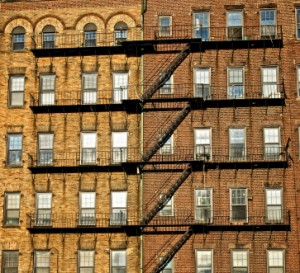
So if we're not evading the fuzz (click the link for an amazing story, btw) or fleeing from fiery infernos, how could they possibly be a livability indicator?
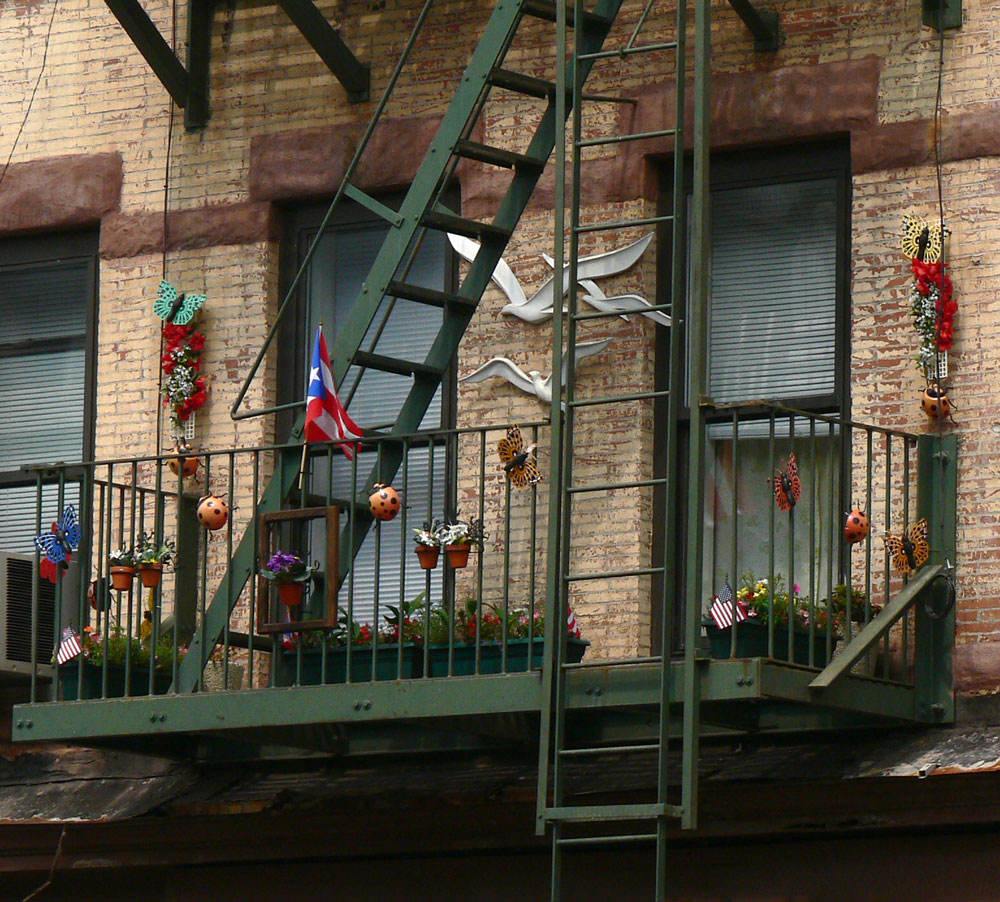
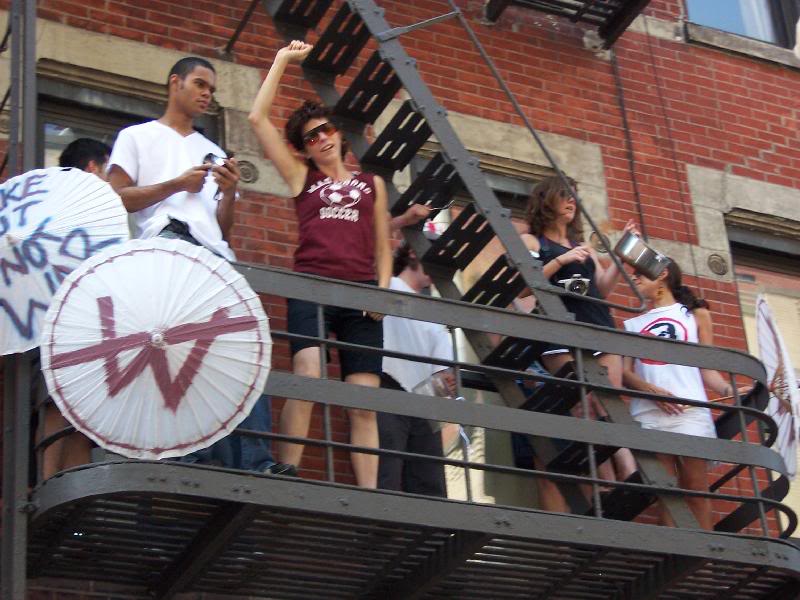
Today, they are primarily used as evidence of expression, of dueling human emotions. The desire to live in urban locations, amongst others, benefiting from the efficiency of shared resources of the many while maintaining a connection to the outdoors, to fresh air, and in some cases a platform for individual expression.
They represent something adapted. Like many things urban, intended for one thing that they are not even well suited for any longer. Perfectly willing to risk life and limb on potentially poor craftsmanship, people have found a use for them that responds to changing individual needs and emotions, providing the worn patina of a placed lived in, of desirability.
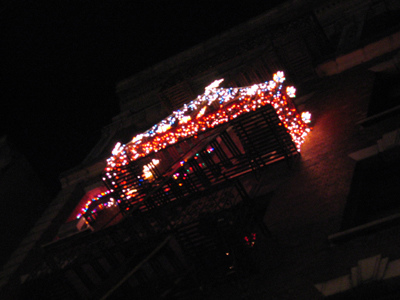
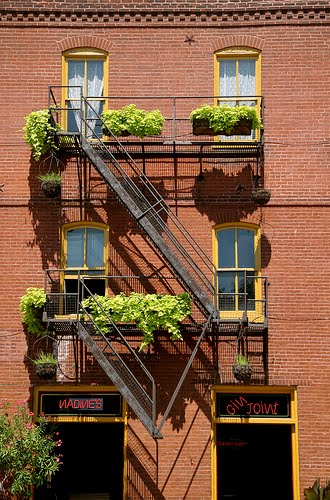
What were once fire escapes now exist as gardens, as balconies, as billboards of expression, as party platforms, , as smoke breaks, as roommate breaks (because in desirable cities people are more willing to take on roommates and put up with their sh!t to counter higher prices due to the demand of livable places), and most importantly, as a place to get away from the daily stresses of your daily city life but be relaxed by the machine-like processes of daily city life of others as viewed from the outside.
Are they cared for? Do they still have life, albeit in a transformed, repurposed manner? Or do they hang idly by rusting the days away loosely attached to a vacant building that cares not for its presence?
Monday, April 12, 2010
New York's Most Livable Neighborhoods
I've written in the past regarding my apprehension towards past attempts at objectively quantifying cities. In many ways, they were all oversimplifications that abstracted the notion of the city so thoroughly that it became difficult to determine whether all of the numbers were really just ways of confirming/making the author's preconceived notion or biases. Today, the disconnect is slowly but surely receding as we start to get our heads better around the more wholistic idea of livability as New York Magazine published their neighborhood rankings within the NYC boroughs.
A few weeks ago, I mentioned that Nate Silver, a statistician by trade, who runs the political polling and analysis website five-thirty-eight.com, issued a survey for helping to elicit proper valuations for weighing the various criteria that go into the somewhat nebulous idea of livability. He explains:
A few weeks ago, I mentioned that Nate Silver, a statistician by trade, who runs the political polling and analysis website five-thirty-eight.com, issued a survey for helping to elicit proper valuations for weighing the various criteria that go into the somewhat nebulous idea of livability. He explains:
Of course, not all of these categories are equally important: Most people would value safety over access to cool bars; public schools may be very important to some and not at all to others. The formula we finally devised weighted the categories based on a combination of objective and subjective approaches. On the one hand, we thought about what factors might be most important to five different types of New Yorkers, then averaged their answers together. On the other hand, we conducted an online survey of over 3,000 people nationwide and 700 in New York, asking respondents to rate the factors most important to them. Reassuringly, the two approaches produced very similar results, and we settled upon:
Housing Cost: 25 percent
Transit: 13 percent
Shopping and Services: 9 percent
Safety: 8 percent
Restaurants: 8 percent
Schools: 6 percent
Diversity: 6 percent
Creative Capital: 6 percent
Housing Quality: 5 percent
Green Space: 5 percent
Health and Environment: 5 percent
Nightlife: 4 percent
What is important to note that none of these by themselves is a cause, but also all of them are. They are also all effects. Thus, the complexity that is livability which is why I always say that if the solution to an urban problem isn't one of a chicken/egg issue it isn't interrelated enough to actually be the answer. For example, when thinking of downtown ten years ago, we knew that Downtown Dallas needed residential, but to get residential it also needed a grocery store. Which is more important? Which should come first? The reality is that it needed both and barriers were (and still have to) overcome to incent those new developments.
At least here, Silver's attempt at both some measure of objectivity, of crowdsourcing through survey's to determine actual weighting, and a wholistic approach is far above and beyond Joel Kotkin's ham handed use of housing cost as the be all and end all. We've already shown that if THAT was what people really wanted, the demand would be higher as would cost. The overabundance of housing shows that the relative low cost of suburban housing is a product of supply rather than of demand.
The results that Silver arrived at further this point. That affordability is a largely irrelevant statistic as highly rated neighborhoods score both high and low on the level of affordability. The most correlation appears to be between high cost of living by neighborhood and low diversity, which says nothing about neighborhood form or livability but more about historically institutionalized wealth and where certain neighborhoods are in the "gentrification" process.
Like the competition amongst various cities, neighborhoods are also competing against each other to be more livable. Some have greater resources or inherent advantages. What this study does effectively in my opinion is level the playing field to properly assess what areas generate the most livability given their place in time. Which is also important. Neighborhoods are constantly changing and evolving (or devolving), just like their cities. The results are only important today, but the process is what will continue to live on and evolve as our knowledge and understanding of how to properly assess neighborhoods grows.
Monday, December 14, 2009
Person without Veins?
Frankly, I don't know enough about the Vancouver Sun to tell whether or not it is a reputable rag. Articles like this one aren't helping however.
Some parts of their "Rethinking Green" series come off as purely contrarian (I too questioned recycling, focused on the dirtiness of the toxins in the materials getting recycled and the pretense of "doing something good,"), and then others like the linked above are just outright self-serving propaganda. I say that because of the singularity of opinion of those quoted in the article.
There are a million terrible definitions and interpretations of sustainability out there. What sustainability implies a system, one built upon a foundation of both economics and ecology, both of which are systems that are not fully understood. So therein, one can see the incredible difficulty in boiling down to what is sustainable and what isn't without a more wholistic view.
Not to take this into an ad hominem direction, but to only quote Cox and O'Toole is some shallow and self-serving "journalism." Neither are credible, on the payrolls of the road lobby, and are incredibly deceiving will their well-framed "statistics." Cox and O'Toole are notorious for taking incredibly narrow (and increasingly shrill) views of statistics that are intended to dumb down the debate into something little more than "OMG! Transit is so expensive!" So is caring for children, should we stop that?
My point isn't that transit is a magical panacea, nor that it is appropriate for cities of all shapes, sizes, and geographical contexts. It is that the debate is well beyond their, or this authors, scope. And to further narrow the stance to only include essentially two hucksters is to further drown the level of dialogue in the puddle beneath are feet (or tires if you wish). Why not include a real academic from your own neck of the woods like Tod Litman from VTPI?
------------------------------
The real issue that Cox, O'Toole and any other well-heeled faux libertarian simply cannot understand or argue with any sort of rigorous rhetoric effectively on their narrow view of statistics. Which is why you are seeing transit pick up steam the world over, and ironically generate more press for these two for anybody desperate for a sound bite in opposition.
"OMG, it's expensive!"
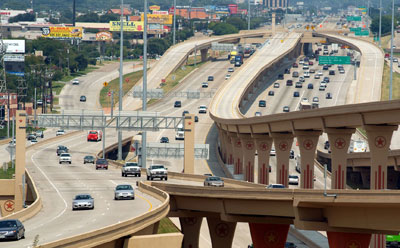
Simply put, car only subsidization has led to car only usage. Car only usage has led to incredibly wasteful projects like the high five in Dallas. While these types will argue that it improves economic development because it created jobs and improves connectivity and reduces traffic, , while it may temporarily reduce traffic (with nothing to say about the several years of construction and the resultant delays) the reduced traffic then has a negative effect by actually inducing more traffic b/c of the temporary gains, thus spreading people apart further. It also wrecks real estate values within any vicinity of it, because frankly, it is attrocious to be near (also, with nothing to say about the increased stress, birth defects, and respiratory issues by proximity to freeways).
Transportation can never be looked at in a bubble. You can't isolate any particular system and suggest definitively whether it is "green" or not, whatever that means. The reason is because transportation, of any form, is inextricably linked and largely responsible for the resulant built-form of the city. The built form then interprets how the city functions.
To isolate the pro forma of any transportation system is like removing the arteries, veins, and capillaries from a human being and then wondering why the blood discontinued to flow. A doctor has to examine the health of the entire patient, to determine the health of the cardiovascular system and vice versa. If the City is unhealthy, the cardiovascular system (its transportation system) has to become more healthy.
Second, no form of transportation has ever "paid for itself." What these biased takes fail to understand is that the more governments subsidize road construction and sprawl, the more they have to subsidize transit, b/c the excessive road construction leads to fragmented, sparse, and disconnected land use, unsuitable for transit use, and therefore a failing transit system.
Relatedly, as transportation has a direct effect on land use, density, and the interrelationship between land uses, forms of transportation have multiplier effects that are incalculable in terms of sustainability and economy. The way to measure the "greenness" of transport is not in the functionality of transit systems but the built form and the emergent operations of the city sprung from it.
Car only-based transport policy leads to low density development which is more energy-consumptive, generates incredible amounts of waste thru increased air pollution from the car use, reduced water quality and environmental degridation from runoff, waste of man-hours in traffic jams, as well as increased refuse from a low-density lifestyle, and waste in supply-chains having to diffuse the distribution of goods to sparse, low density development.
This is bad for the economy as well for a number of reasons. The government builds roads that creates a low density form of development that, in turn, can not pay for the upkeep of the over-extended infrastructure. Furthermore, because of the fractured and disconnected development that emerges based on car-dominated transport policy, people think they are getting cheaper goods.
But, the fact of the matter is, extra costs have been externalized to the consumer and siphoned off every single trip by way of car ownership/maintenance, road construction and upkeep, health and productivity losses due to traffic and collisions. While creating a highway that links the Houston area to the Dallas area is a good thing, forcing all trips throughout the day to the confines of a car is wasteful and exclusionary of proportions never seen on this earth.
(Once again, with nothing to say about the 1.3 million people killed per year in traffic related collisions.)
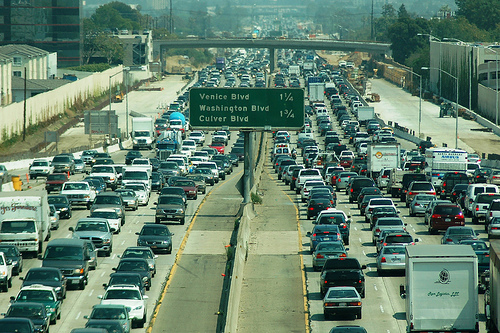
Lastly, and unfortunately for them, the ultimate decider in human decisions tends not to be an altruistic sense of right and wrong, and fortunately not even of $1 and 2$ but what makes life better? Would you rather live in a place like this?
or a place like this?
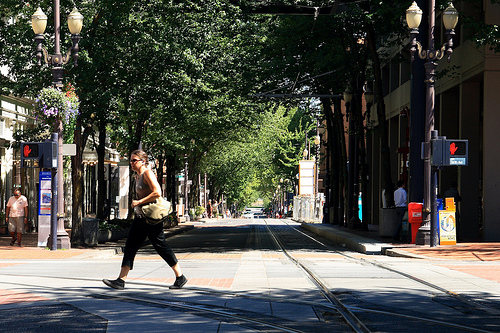
One could say, "how can you compare those two things? Of course, I'm going to pick the pretty picture!" The reason is because these are the two end states of the divergent policies being debated. Should we craft policy that supports only the car, oil, and gas industry or one that the end result is people places?
A complete street, equitable to all transportation types and attractive enough to be livable, and in turn, entice density. The density then reduces Vehicle Miles Traveled, which reduces pollution, reduces the need for context-coerced car ownership, and reduces traffic. The density also makes business and retail more successful because there is a customer-base within a short distance at all times. A business can easily market from its storefront to a hundred residents that live above, or 500 pedestrians that walk past each day.
That is why THIS will eventually win the debate, suggesting it is time to the afforementioned cast of characters on IGNORE.
Some parts of their "Rethinking Green" series come off as purely contrarian (I too questioned recycling, focused on the dirtiness of the toxins in the materials getting recycled and the pretense of "doing something good,"), and then others like the linked above are just outright self-serving propaganda. I say that because of the singularity of opinion of those quoted in the article.
There are a million terrible definitions and interpretations of sustainability out there. What sustainability implies a system, one built upon a foundation of both economics and ecology, both of which are systems that are not fully understood. So therein, one can see the incredible difficulty in boiling down to what is sustainable and what isn't without a more wholistic view.
Not to take this into an ad hominem direction, but to only quote Cox and O'Toole is some shallow and self-serving "journalism." Neither are credible, on the payrolls of the road lobby, and are incredibly deceiving will their well-framed "statistics." Cox and O'Toole are notorious for taking incredibly narrow (and increasingly shrill) views of statistics that are intended to dumb down the debate into something little more than "OMG! Transit is so expensive!" So is caring for children, should we stop that?
My point isn't that transit is a magical panacea, nor that it is appropriate for cities of all shapes, sizes, and geographical contexts. It is that the debate is well beyond their, or this authors, scope. And to further narrow the stance to only include essentially two hucksters is to further drown the level of dialogue in the puddle beneath are feet (or tires if you wish). Why not include a real academic from your own neck of the woods like Tod Litman from VTPI?
------------------------------
The real issue that Cox, O'Toole and any other well-heeled faux libertarian simply cannot understand or argue with any sort of rigorous rhetoric effectively on their narrow view of statistics. Which is why you are seeing transit pick up steam the world over, and ironically generate more press for these two for anybody desperate for a sound bite in opposition.
"OMG, it's expensive!"
Simply put, car only subsidization has led to car only usage. Car only usage has led to incredibly wasteful projects like the high five in Dallas. While these types will argue that it improves economic development because it created jobs and improves connectivity and reduces traffic, , while it may temporarily reduce traffic (with nothing to say about the several years of construction and the resultant delays) the reduced traffic then has a negative effect by actually inducing more traffic b/c of the temporary gains, thus spreading people apart further. It also wrecks real estate values within any vicinity of it, because frankly, it is attrocious to be near (also, with nothing to say about the increased stress, birth defects, and respiratory issues by proximity to freeways).
Transportation can never be looked at in a bubble. You can't isolate any particular system and suggest definitively whether it is "green" or not, whatever that means. The reason is because transportation, of any form, is inextricably linked and largely responsible for the resulant built-form of the city. The built form then interprets how the city functions.
To isolate the pro forma of any transportation system is like removing the arteries, veins, and capillaries from a human being and then wondering why the blood discontinued to flow. A doctor has to examine the health of the entire patient, to determine the health of the cardiovascular system and vice versa. If the City is unhealthy, the cardiovascular system (its transportation system) has to become more healthy.
Second, no form of transportation has ever "paid for itself." What these biased takes fail to understand is that the more governments subsidize road construction and sprawl, the more they have to subsidize transit, b/c the excessive road construction leads to fragmented, sparse, and disconnected land use, unsuitable for transit use, and therefore a failing transit system.
Relatedly, as transportation has a direct effect on land use, density, and the interrelationship between land uses, forms of transportation have multiplier effects that are incalculable in terms of sustainability and economy. The way to measure the "greenness" of transport is not in the functionality of transit systems but the built form and the emergent operations of the city sprung from it.
Car only-based transport policy leads to low density development which is more energy-consumptive, generates incredible amounts of waste thru increased air pollution from the car use, reduced water quality and environmental degridation from runoff, waste of man-hours in traffic jams, as well as increased refuse from a low-density lifestyle, and waste in supply-chains having to diffuse the distribution of goods to sparse, low density development.
This is bad for the economy as well for a number of reasons. The government builds roads that creates a low density form of development that, in turn, can not pay for the upkeep of the over-extended infrastructure. Furthermore, because of the fractured and disconnected development that emerges based on car-dominated transport policy, people think they are getting cheaper goods.
But, the fact of the matter is, extra costs have been externalized to the consumer and siphoned off every single trip by way of car ownership/maintenance, road construction and upkeep, health and productivity losses due to traffic and collisions. While creating a highway that links the Houston area to the Dallas area is a good thing, forcing all trips throughout the day to the confines of a car is wasteful and exclusionary of proportions never seen on this earth.
(Once again, with nothing to say about the 1.3 million people killed per year in traffic related collisions.)
Lastly, and unfortunately for them, the ultimate decider in human decisions tends not to be an altruistic sense of right and wrong, and fortunately not even of $1 and 2$ but what makes life better? Would you rather live in a place like this?
or a place like this?
One could say, "how can you compare those two things? Of course, I'm going to pick the pretty picture!" The reason is because these are the two end states of the divergent policies being debated. Should we craft policy that supports only the car, oil, and gas industry or one that the end result is people places?
A complete street, equitable to all transportation types and attractive enough to be livable, and in turn, entice density. The density then reduces Vehicle Miles Traveled, which reduces pollution, reduces the need for context-coerced car ownership, and reduces traffic. The density also makes business and retail more successful because there is a customer-base within a short distance at all times. A business can easily market from its storefront to a hundred residents that live above, or 500 pedestrians that walk past each day.
That is why THIS will eventually win the debate, suggesting it is time to the afforementioned cast of characters on IGNORE.
Monday, October 19, 2009
Livability Indicator #14 - Homeless
"May society be judged by how it treats its weakest and most vulnerable."
Well sort of. Perhaps, it might be better stated, as "homeless" by choice rather than by force. I've been contemplating this post for some time but couldnt find the right tone until it was inspired by a quote at Dallas Progress's downtown post:
A good friend of mine in real estate made an interesting statement about the homeless, which was "if you had more people downtown, you wouldn't notice the homeless because they would blend in with everyone else." When you compare Dallas to other cities, there are not a lot of homeless people. I have seen cities with a much higher population of homeless revitalize their downtown. What city lets 10-15 people walking around during the day asking for change affect what is going to happen in a given part of town? See how much sense that makes? The people that don't travel downtown because of the homeless folks probably will never come downtown anyway.It is very true. Of all the places that I've lived in, studied in, or spent any significant amount of time, every single one still had homeless, except for one - the suburbs of my upbringing. However, the fundamental problem with that is when you talk to someone who has bought a house in PHX, or DFW, or ATL in the nether reaches of the metropolitan area replete with brand new shiny roads (sometimes with stars on them, high five!), these people will tell you they love their homes, their two car garage, their yard, their 2.5 baths, then you ask them what they don't like? Well, there is nothing to do. Or, what they spend most of their time doing? Watching TV.
These are people who have, for the most part, unwittingly withdrawn from society. How is this any different than the homeless who have done similarly either consciously or have been thrown out for any number of reasons and are castigated, ridiculed, or spit upon?
They're effectively saying, "I'm taking my ball and i'm going home. I don't want to deal with all the messiness and realities of cities and humanity itself." All take but no give. One could respond, "well, if cities are so dreadful, why would I want to live there?" Or, "that is why people left cities in the first place." The problem is that cities offer the only opportunity for real wealth creation, economic development, AND staving off of potential environmental catastrophe. Cities are the greatest engine of wealth generation ever devised in human history by the agglomeration of collective human capacity.
Instead, I would like to order one super highway to deliver me to the office twenty miles away. Yes, I would like a side of entertainment district and a stadium on top, where I can go once a year. Yes, I want a new arts district. More on that later, but back to the original quote.
The most powerful word from the oft-attributed quote at the top is "its" b/c whether we like it or not, they belong to us, in the extended family that is our city, that are our neighbors. We're all in this thing together. Investing in people is the greatest investment there is (with the greatest return)...or else we end up spending on ways to warehouse people in prisons or shelters.
In my personal experience around town as a downtown Dallas resident for over 18 months, never have I had anyone be anything but polite to the point of deference - although I have heard stories to the contrary. This, of course, is not surprising given the ever increasing amount of people who are being put on the streets or even entered life without opportunity or the ability to pursue happiness, as Jefferson decreed. I shudder to think as more and more get backed into a the corner of survival. Do they react like the animals we are? Does the veil of culture and civilization that has failed them (and keeps our animalistic heart at bay) get dropped for tools of violence and striking back?) Or are they suitably conditioned enough to accept their fate like puppies on electrified flooring?
Personally, I'm almost ashamed to admit that I very rarely give out anything to those that ask. One, because I rarely carry change or small bills. Two, b/c its illegal (although illegality rarely has anything to do with behavior). But lastly and most notably, b/c I can't offer them shelter, nor treatment, nor training or whatever else is needed to get them on their feet, perhaps justifying in my own mind that it's a lost generation that society has cast down its corporate toilet and that I'm better suited to build a city more capable of paying for itself, building wealth, and being more just. Offering the ability to pursue happiness to its newest and youngest members.
As for those already on the street, collectively however we can afford to do so and there are people who possess the skills capable of doing so. This was the original point of congregating together in packs, forming the original cities; caring for the most basic of human needs: common necessities such as food, protection, shelter, and safety. If we can't even support the most basic of human needs, what are we doing spending a billion dollars on cultural components, at the top of Maslow's hierarchy of needs?
In much of scandinavia (thinking mostly of Sweden and Denmark) the WORST problem their societies face is people taking advantage of the free education and staying in school too long. They too have homeless. Some are refugees from the middle east, others are squatters who chose to do so, b/c you know what, a society that provided free healthcare and education just wasn't for them. They willingly "opted out" choosing instead to make a life at the edges of the economy.
Take the
The point is that homeless are everywhere and the issue comes down to that of fear. We certainly can't be fearful of those that are appropriately described as the weakest in our society. In actuality, what we are fearful of is directly addressing our societies inner problems; confronting the reality that our policies driven by whatever ideology are failing us. We'd prefer to spout off some spoon-fed dogma, because it's easier that way. Our conscience is clear when we redirect the blame.
A few weeks ago, I personified Dallas as a plastic surgerized divorcee. I'm starting to think that a better description might be that of Buffalo Bill...no, not the buffalo bill of Dallas's fantasized cowboy mythology, but the Buffalo Bill in Silence of the Lambs; a thoroughly corrupted individual that wants to dress himself in a literal epidermal veneer in order to feel 'pretty'.
So all of this brings me to the grand opening of the Arts District here in Downtown Dallas put on to much fanfare. And certainly it was quite the occasion, 30,000 people, fireworks, tours of the grand performing arts halls. Jewels each of them no doubt, of which Norman Foster has said about his own gem-shaped icon (of which I do think is a gorgeous individual building),
"This(winspear opera house) project is about the creation of a building that offers a truly democratic experience of opera for the 21st century,"
Is that so? Something bestowed by the kings of the city upon a people that turned down the bond package for the same project in an open election to be entirely privately financed? A gift to the people. Feels more like a gold plated, pre-reformation catholic church. Call me old fashioned, but I'd like to think that I would be able to come up with at least one hundred ways of better spending the hundreds upon hundred of millions of dollars that went into this rather hollow concoction.Maybe with goals like, building wealth from the ground up or restoring the middle class, rather than one dependent upon the gifts of the gods - a middle class is democratic. Norman, generally admire your work, but i wonder if working in a singular crowd for so long has distorted your notion of what democratic is. Patronizing paternalism isn't it, but providing opportunity is. Maybe it takes Thomas Jefferson to say it:
To my last breath I will argue that the Wyly is the uglier of the two buildings when accepted as a building of the cityscape, but perhaps it's prison cell like configuration is more fitting for the rats running in place, hoping to one day be that multi-billionaire on-stage cutting a ribbon. The unending nihilism of the twin-architects (who now despise each other, btw - perhaps their belief in themselves in fact trumps their nihilism?) doesn't make for attractive buildings, but it does make for the kind of deep objectivity necessary for critical analysis of its audience. In that way, the Wyly actually is a work of art."That liberty [is pure] which is to go to all, and not to the few or the rich alone."
Homeless, public school kids, to whom it may concern, et al. I have a message for you. "It puts the lotion in the basket or else it gets the hose again."
Tuesday, September 29, 2009
Livability Indicator #13 - Holes in the Wall
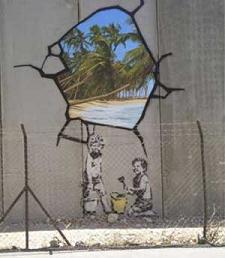
I recall sitting in the interview room for the Downtown Dallas Masterplan project when the question was asked, "how do we compete with the suburbs for retail?" This is the wrong question for a downtown, any downtown to ask.
I've talked a bit about the future of retail, and where it needs to be, but in a more livable downtown (one in which there is more people because of increased livability) retail can work almost anywhere, hence the existence of "holes in the wall" or those favorite third places or restaurants that can be found in many cities in the world.
Many cities that I've consulted with have followed up this question of "why doesn't retail work here?" with the worry over how to get the parking to work.
The answer to both is that you can't. You can't compete with what suburban retail does despite the best efforts to the contrary (and would you even want to?! It's failing everywhere if you haven't noticed).
First, malls throughout the country, of which exactly none are being built currently, are usually parked at between 4 and 5 spaces per square feet of leasable retail space. I'm guessing downtown at the moment has somewhere between 4 and 5 THOUSAND spaces per square foot of retail space. Hyperbole? I'm not even sure. That should tell you something.
There is TONS of available parking at nights and weekends, the times when conventional retail is busiest (b/c many people are working M-F/9-5, but people don't WANT to park in all of these parking spaces because they don't feel safe. They don't feel safe exactly because there is too much parking. There is that vicious circle again. More people, more eyes on the street, the more ownership and responsibility we take for our space, the more defensible the street, space, and city become (I've dealt with this same issue at many hospitals that surround themselves with surface (or even structured parking) only to find their neighborhood become blighted and unsafe to visitors).
Furthermore, have you ever found parking to be easy in NYC or any other place worthwhile? Sorry for the rhetorical question, but to be sure, the answer is no. The reason is because people want to be there. Moreso than you can ever account for in any parking metric. And that is a good thing. Once again, this is sociopetal space that is attractive to people and designing for cars and parking is never the answer.
I would like to elaborate briefly on competing with suburban retail. Just because we see investment in some new retail locations, that means we are seeing disinvestment and decay in others. I recall seeing a commercial strip in San Angelo, TX and it was pretty telling to see about every mile or so away from downtown was a retail cluster at an intersection, exactly as it should be.
The problem is that as you moved further away from downtown, you could literally date the retail development by the decade it was built based on form and style, the 50s retail, the 60s, the 70s, the 80s, the 90s and finally the 21st century big box power centers, each exceedingly less walkable than the one prior, all in decreasing stages of disrepair and occupancy (with the power center being under construction). The retail was essentially cannibalizing from the other retail leaving behind blight that, in turn, then affected the neighborhoods immediately adjacent.
This was the physical embodiment of our over-retailed landscape, stretched too thin within an increasingly more sparse residential landscape. None of it was embedded within its community, an emergence of local economic need and marketplace, and clearly unsustainable.
The common response might be, well people chose to live less densely to have more space, and drive to the store, that is there choice, which could be fine except for a couple of issues. First, it's creating a "market" that is solely reachable by car foisting car ownership on all socio-economic segments of a population. Second, as gas price fluctuations have shown it is an extremely brittle system that threatens our vary basic human needs of shelter and food security. Third, it creates a burden upon taxpayers thru the creation of such excess infrastructure. Lastly, the inertia created by the entropic cycles of decay and creations of new autocentric (sociofugal) places means creations of even newer retail centers would be in order, furthering the process.
Compare the taxpayer dollars to build all of that infrastructure on a per year and per capita vs. say, Campo dei Fiori, the daily market in Centro Storico of Rome.
So if competing with suburban retail is clearly the wrong direction, what is the right direction towards making not just retail work, but having little holes in the wall restaurants?
The answer to making Downtown more livable is by taking away car space and turning it into usable people space, which includes developing surface parking lots (at this point, by whatever means necessary), reverting one-way streets to two-way (this can be done incrementally, but is necessary for retail success), and removing lanes of traffic for both on-street parking AND more sidewalk space. (It is probably also necessary to do an audit of the width of every travel lane in and around downtown and cap the max width as well, but that is a detail).
The last point is the one I want to dwell on the most because the type of street a retail store or restaurant is on, determines whether it can be considered a "hole in the wall" or not. By definition these are hard to find places, NOT on the main streets.
In Dallas, we almost have to create the types of streets that would typically house "holes-in-the-wall" as the retail destinations because the streets that move the most traffic are such hostile streets that they ONLY work as retail space if there is a full football field of surface parking buffering the store from the street. = Sociofugal space, which as I've said, age incredibly quickly.
As I type this Dallas appears to applying "streetscape beautification" to Elm Street, in the form of new bricks. I'm generally of the opinion that if a pig is a pig, it is better to not spend the money on the lipstick as the fundamental issue with why retail doesn't work on Elm or Commerce is that they are bad streets.
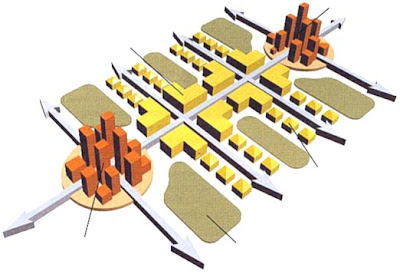
Retail wants to form at intersections. They are the highest visibility areas, with the most amount of movement happening in front of them.

As a place grows, it might link two retail "nodes" which then expand because of the increased synergy generated by the movement between the two (provided the distance is not too great).

This is how it might look in built form, with the most amount of density occuring where the most amount of activity would be, the busiest retail being at the ground floor of the orange buildings, and "holes-in-the-wall" finding their way into cheaper space somewhere in the yellow. They don't need the visibility because either quality is the determining factor in their business or they don't require the shear number of customers to support their business model (which generally means higher prices via higher quality).
This is taking advantage of the "movement economy". You can't just make this happen without designing appropriate streets however.
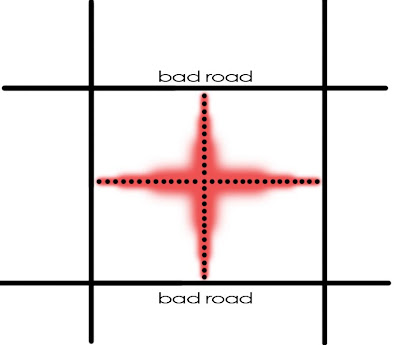
In Dallas, what we tend to to, is to create retail places off of the primary movement streets because, as I pointed out yesterday, we don't design streets to take advantage of all of the visibility and movement happening on them in a safe and beautiful manner because through some theology, an engineering text says what is up is down and what is left is right.
The fundamental problem is that this is limiting the success of the businesses and further limiting the potential quality of the neighborhoods, because commercial space wants to be on the busier streets with residential preferring the calmer, internal circulators.
For example, I give two of the currently more active places in Dallas: West Village and Main Street/Stone Street Gardens. I plan on talking more about the specific design detail flaws of West Village another time, but the point is clear. The developers/architects knew they were dealing with hostile roads so the turned inward.
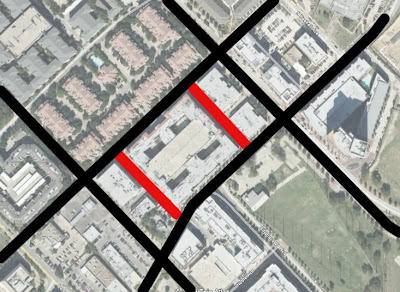
I've talked about Main Street before, but here is another diagram showing it between Elm and Commerce. Stone Street Gardens is a nice space now, but I would argue that despite Campisi's relative success, its vitality today is more due to its relationship to Main Street and that other than extremely nice lunch hours on weekdays that it can be pretty lonesome closer to Elm Street.
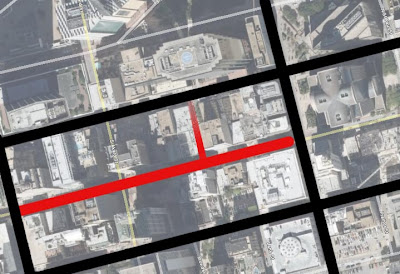
Nice days and the downtown daytime population provide the necessary density for a relative hole in the wall to work (as in a restaurant on a "street" with no vehicular traffic). But, for more retail success and downtown to work on the whole, it needs much greater density to support the night and weekend business as well. You know how frustrating it is to find an open restaurant on Sunday in Downtown Dallas?
But alas, this post isn't about what it takes to create that density (
One of which obviously is New York which has holes in the wall all over the place. Last time I was there, we even found one of Bobby Flay's restaurants on a street that was little more than a service alley for some of the nearby hotels. No matter, quality and brand covered for lack of locational identity or prominence.
Below is the best restaurant I ate at in Rome (and most expensive). It didn't need much traffic and for a while, I didn't even realize it was a restaurant until doing some investigatory work. It has density and a residential base proximate to support its business (and assuming these google street views are relatively recent, the business looks as though it is doing just fine 8 years hence).
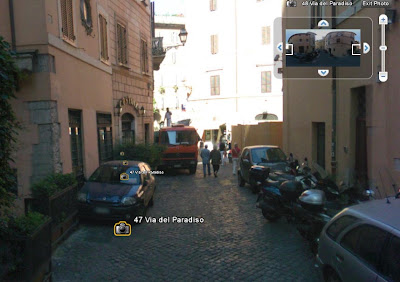
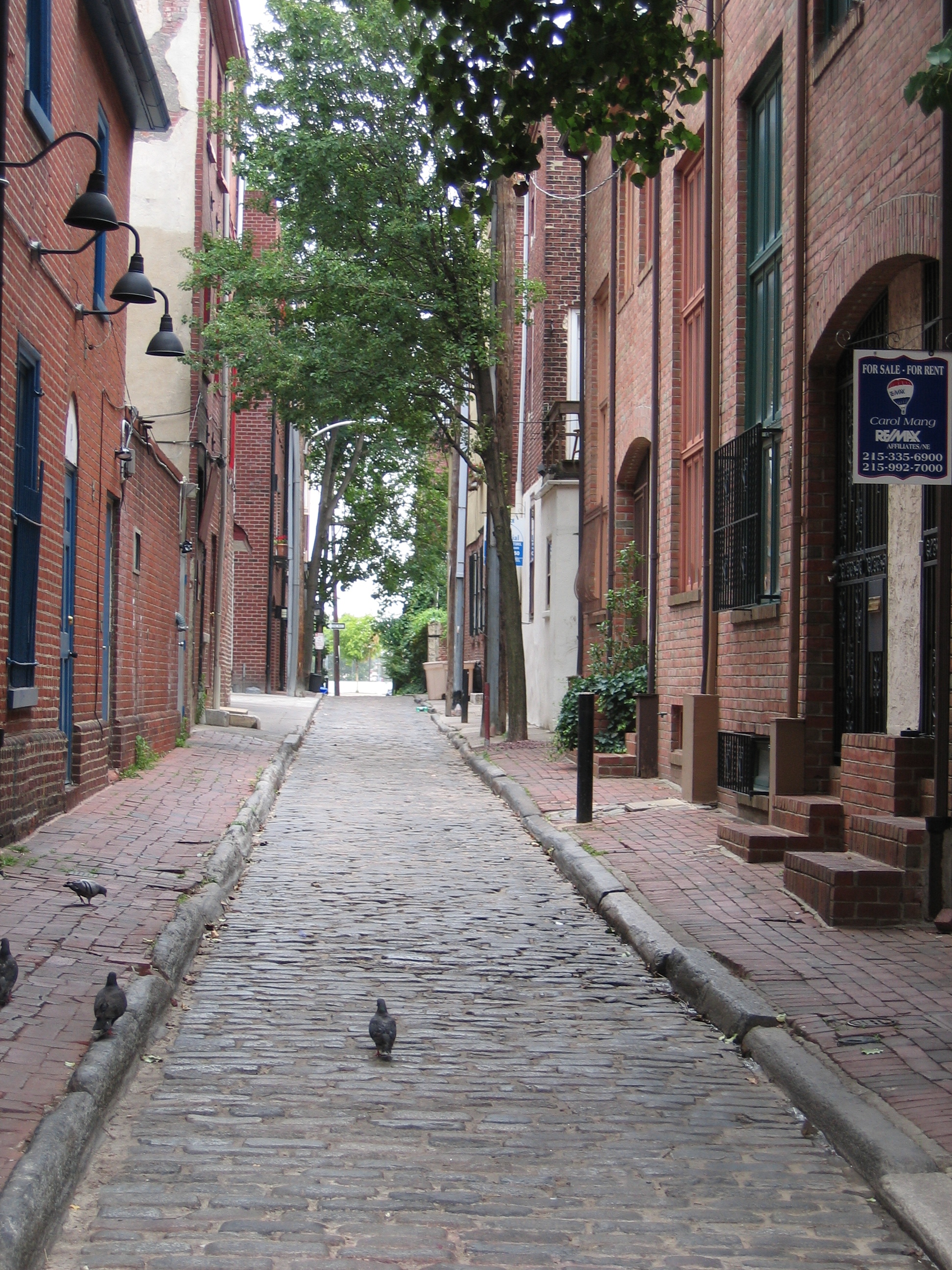
Lastly, is Old City Philadelphia. It is full of these little carriageways bifurcating city blocks defined by busier streets. Yes, the busier streets (particularly the intersections) attract the majority of bars, restaurants, and starbucks, but these tiny side streets are home to their fair share of businesses as well because their calm and attractive enough to house density to support such niche businesses in a manner that people want to be in.
Monday, April 6, 2009
A Canary in the Coal Mine Update
Some time ago, I posted about Creative Panhandling, as an indicator of some measure of vitality in a City. The theory was that because there were so many people attracted to a place, there would in turn be a number of panhandlers following, much like on a larger scale that retail and service industry (and then jobs) followed residents out of the city into the suburbs, but in a much different spatial pattern than the previous incarnation in the city. Because there were more people asking for money, there was increased competition for the loose change.
At the time of that posting, Downtown Dallas had virtually none of these to speak of. Now, with good weather having returned, over the last two months or so, I am happy to report that I have now counted 4 such creative panhandlers in Downtown. First, a couple where the woman plays the guitar and the guy plays the sax has popped up here and there in downtown. Next, I started seeing a guy out sketching portraits of patrons sitting at bars and cafes. And today, was another man playing a trombone on Main Street.
At the time of that posting, Downtown Dallas had virtually none of these to speak of. Now, with good weather having returned, over the last two months or so, I am happy to report that I have now counted 4 such creative panhandlers in Downtown. First, a couple where the woman plays the guitar and the guy plays the sax has popped up here and there in downtown. Next, I started seeing a guy out sketching portraits of patrons sitting at bars and cafes. And today, was another man playing a trombone on Main Street.
Friday, February 6, 2009
Livability Indicator #12 - Hailing a Cab
"Hey girl...wanna share a cab??"
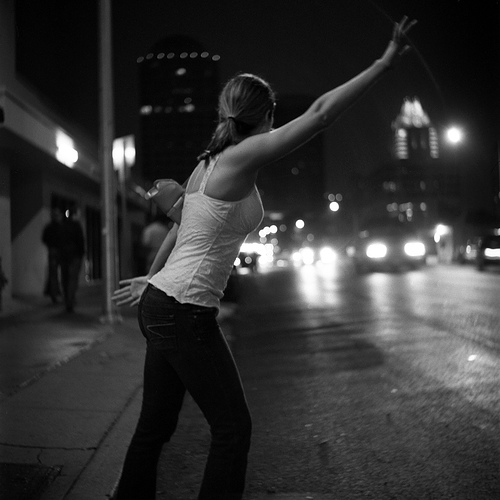
(I'd play guess the city with this one, but I'll ruin the suspense cuz I can. This is Austin as the Frost Tower, blurred and backgrounded suggests, and she probably scored a pedi-cab rather than a taxi cab to be location and culturally specific.)
To be perfectly honest, I didn't think of this one myself, but it was brought up in jest during a meeting today by the inimitable Alex Krieger (ahem, name drop) when we started joking about the ease and/or difficulty of finding cabs in various cities, which he so succinctly put, "a measure of great cities, the ease of finding a cab."
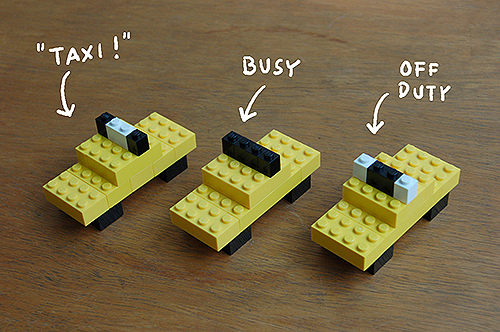
So when starting to think about this a little further, one feels compelled to ask, "where are cabs and why are they there?" In a time where LA and all of its absurdities, in a sort of Rube Goldberg machine of agglomerated decision making, is trying to limit (or not) the locations of cab stands (which admittedly can aid in predictability), contrast this with New York where they are everywhere.
In Dallas, we find them at the airport (where it will run you in the neighborhood of $50-60 w/ tip to go to/from downtown to the airport one-way or vice versa, at the downtown hotels at certain hours, and outside of some of the larger office buildings during the weekday. That is about it, unless you feel like calling yellow cab or cowboy cab and waiting 45 minutes to get picked up (if at all).
Me? I prefer Karaoke Cab, and yes, it is exactly as it sounds with disco ball and everything. I'd publish the number for advertising purposes, but I care not for having my rides delayed b/c of you might be wont to do. You people have cars. Leave the fun, chauffered commutes to the experts. That being me.You haven't lived until you have seen Baby Diego belting out "Like a Virgin" out the windows at 2 in the morning to stunned club-goers.
I take cabs quite a bit these days. Often anywhere between two and five times a month I would guess. Usually I just wander over to the Magnolia or Adolphus Hotels if I'm still downtown and have little trouble, although some more difficult cabbies might be looking for bigger fares than my 1.5 mile trip to the Loon. That all means less drunk driving. Care to compare where more DD occurs, NYC or Dallas?
It also means less need for car ownership. In a place where it is financially viable (if not advantageous) to use other means of transportation than private automobile for mobility, this means less land tied up by all the facilities constructed to support the car: garages, highway, arterials, etc. This is all land (particularly) when dealing with a downtown and its increased land costs, better suited for usable development. Car infrastructure has built-in structural inefficiencies.
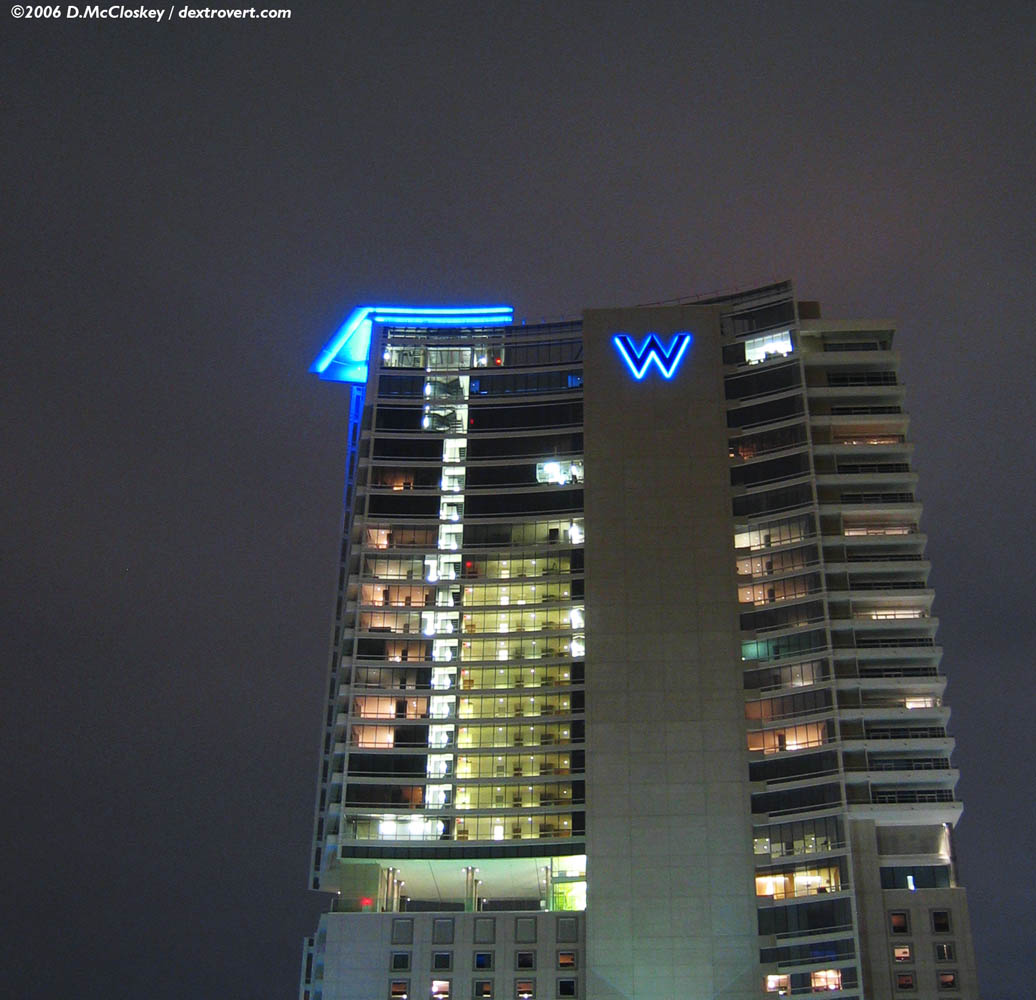
Also, it makes city living more affordable on both ends. The developer can cut cost by building less parking (sometimes as much as 20% of construction budget) and it allows a greater variety of demographics to afford urban living. As Mr. Krieger also put it today, "Vibrant streets aren't populated by the patrons of the W hotel [paraphrased from memory]."
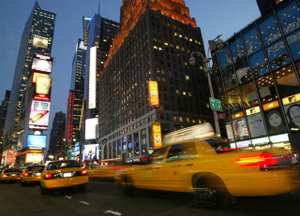
(I'd play guess the city with this one, but I'll ruin the suspense cuz I can. This is Austin as the Frost Tower, blurred and backgrounded suggests, and she probably scored a pedi-cab rather than a taxi cab to be location and culturally specific.)
To be perfectly honest, I didn't think of this one myself, but it was brought up in jest during a meeting today by the inimitable Alex Krieger (ahem, name drop) when we started joking about the ease and/or difficulty of finding cabs in various cities, which he so succinctly put, "a measure of great cities, the ease of finding a cab."
So when starting to think about this a little further, one feels compelled to ask, "where are cabs and why are they there?" In a time where LA and all of its absurdities, in a sort of Rube Goldberg machine of agglomerated decision making, is trying to limit (or not) the locations of cab stands (which admittedly can aid in predictability), contrast this with New York where they are everywhere.
In Dallas, we find them at the airport (where it will run you in the neighborhood of $50-60 w/ tip to go to/from downtown to the airport one-way or vice versa, at the downtown hotels at certain hours, and outside of some of the larger office buildings during the weekday. That is about it, unless you feel like calling yellow cab or cowboy cab and waiting 45 minutes to get picked up (if at all).
Me? I prefer Karaoke Cab, and yes, it is exactly as it sounds with disco ball and everything. I'd publish the number for advertising purposes, but I care not for having my rides delayed b/c of you might be wont to do. You people have cars. Leave the fun, chauffered commutes to the experts. That being me.
I take cabs quite a bit these days. Often anywhere between two and five times a month I would guess. Usually I just wander over to the Magnolia or Adolphus Hotels if I'm still downtown and have little trouble, although some more difficult cabbies might be looking for bigger fares than my 1.5 mile trip to the Loon. That all means less drunk driving. Care to compare where more DD occurs, NYC or Dallas?
It also means less need for car ownership. In a place where it is financially viable (if not advantageous) to use other means of transportation than private automobile for mobility, this means less land tied up by all the facilities constructed to support the car: garages, highway, arterials, etc. This is all land (particularly) when dealing with a downtown and its increased land costs, better suited for usable development. Car infrastructure has built-in structural inefficiencies.
Also, it makes city living more affordable on both ends. The developer can cut cost by building less parking (sometimes as much as 20% of construction budget) and it allows a greater variety of demographics to afford urban living. As Mr. Krieger also put it today, "Vibrant streets aren't populated by the patrons of the W hotel [paraphrased from memory]."
Tuesday, February 3, 2009
Livability Indicator #11 - Angry Cars
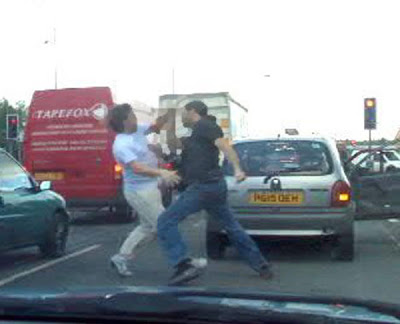
Road rage is too easy. People are angry on all roads and not always because of the road itself, perhaps it's the job, maybe some personal issues, but certainly the commute isn't exactly helping matters. Of course, car advertisements (and boy was the super bowl ever full of them) aren't exactly helping matters, as I've said before all car commercials seemingly are set within the beauty of nature or in cities, the two places auto-dependence can be the most destructive.
So we're all led to believe in this myth of a happy motoring society (as Kunstler likes to say) because as Le Corbusier will tell you car ownership and highways on buildings is PROGRESS!!!!! Yay!!!!! If loss of productivity is progress...
[Quality of life in mind]
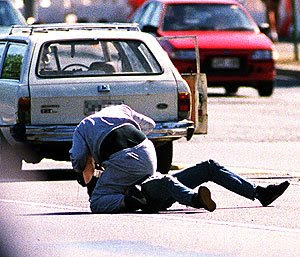

So, if the people are always angry, when are the cars most angry if the highway and arterial system are designed strictly with only the car's happiness and well-being (person inside be damned) in mind?
Well, I'm glad you asked, because cars are angry when their vessel's brain (the human) is operating the angry voice box mechanism that is the car horn. Typically that is when traffic is slow, cars are trying to switch lanes, making lots of turns, i.e. in the tightly-knit fabric of gridded urban streets with ubiquitous intersections and natural traffic calming in the form of on-street parking, generally narrower streets, things to look at, and [ghasp] presence of people/pedestrians.
Cars are beeping away when they can't speed down the streets (kind of like the drag racing that the valets in Dallas do on a nightly basis on downtown streets...no, exactly like that. Now those are some happy cars.) and perform snazzy s-turns and donuts, etc.; essentially all of the things once again, you see on car commercials or races. Ya know, the times when streets are closed off for private shooting or held on private tracks anyway.
As you can see here, pedestrians can really piss a car off.
Anecdotally, I walk to work. This should be well-known to any loyal reader of this blog, so what am I saying new? Well, I haven't driven to work in the six years that I have lived in Dallas and used to have a longer walk. On the way, it always struck me the vapid and emotionless looks on the commuters faces both before and after the work day (that is unless they were running late and then... woah, pedestrians beware - commuter on the war path).

Here is a list of irritated, awfully beepy pissed-off car places off the top of my head:
- NYC
- Rome
- Copenhagen - except the angry cars have taken MAO inhibitors and have been parked in favor of happy bikes and pedestrians. Don't believe me? Click here.

Dallas and its drag racing valets get scary, interrogation baby.

Monday, January 5, 2009
Livability Indicator #10 - Tradesmen
List of Trades from Wiki. Some still relevant, others not so much.
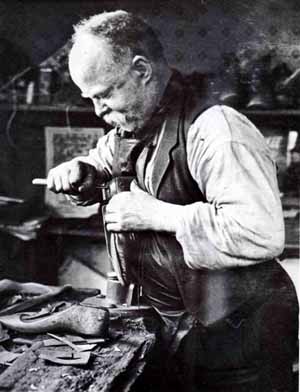
The idea for this, number 10 on the livability indicator list, struck me of all places when watching an episode of Curb Your Enthusiasm. I don't recall the specific scene, but as I remember Larry had something go wrong (as with every episode) and a friend or acquaintance was able to quickly fix the problem because of his families history in whatever trade, I think it might have been as Cobblers or Dry Cleaners or something similar.
The point is that these tradesmen (or women) are the small, independently owned businesses that provide the backbone for neighborhoods. They are often well-known individuals within their communities and form part of the strong middle-class that democratic republics require for existence.
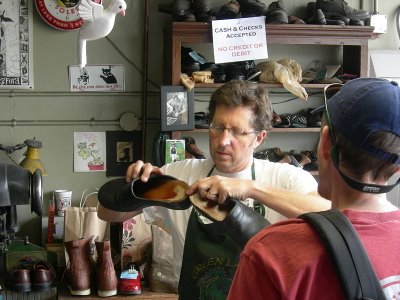
What got me thinking, was that we really don't know how to do anything ourselves anymore. We don't know how to fix our shoes (or have anyone in our neighborhoods to provide such a service), re-stitch our clothes, fix our toasters...as Prop Joe says in a particular powerfully subtle scene in Season 4 of The Wire [paraphrasing from memory]:
"you know the problem with these here toasters...there's no point in having them fixed. Why not just throw them out and get another."~Joe speaking metaphorically to a drug running, convenience store owning frontman.
The point is that the world of planned obsolescence and cheap, replaceable goods has cut out a significant stabilizing force in our society: the butcher, the baker, and the candlestick maker. These are often family trades, with acquired, and very specialized knowledge passed on throughout the generations, at least until recently. These middle class families began sending their kids to college where they could leave the family trade for supposed better lives pushing paper on Wall Street.
Many of these still exist in the denser cities along the coasts and overseas, which to Larry David's Brooklyn sensibilities seemed perfectly fine for the rest of the country to understand, which in actuality only exist on the big screen for them. How many go to the local deli or the chain grocery? How many people of our generation have ever heard of a haberdasher except as some funny sounding word that we heard in The Departed, not coincidentally set in Boston, a city in many ways still very much old world?
Well, guess what. We are too poor (or at least too in debt) as a people to keep throwing everything away (and we're running out of places to throw things! Next stop, Space!). It's time for us to relearn how to reuse and repair things rather than just replace them.
[The glee of replacing cultural amnesia with skilled knowledge]

As a side note, there is a lot of discussion about Dallas needing ground floor retail, as some sort of panacea. Well, obviously it doesn't work everywhere (usually only in the busiest areas of the movement economy - regardless of the dominant form of transportation). But, these are the types of ground floor uses that activate street life when their isn't the density or activity necessary for more vibrant retail users/tenants/commerce. Furthermore, these families and tradesmen are also the strong presences in the community of the Jacobsian tradition that bind and help form a collective stewardship for our neighborhoods and the people within them.
Once density begins to return to our cities, I foresee lots of opportunity for startup businesses along these lines.
-----------------------
edit: coincidentally, I just stumbled upon this article discussing the distressing future for retailers:
Experts expect thousands of stores to close in '09
This is a chance to flip those job losses around as job creation in the form of new startup businesses, adding durability to those crappy t-shirts, jeans, and sneakers.While it's something that she believes is "unavoidable" and will hit the economy in terms of more job losses, she hopes it will also change the consumers' buy-at-all-cost shopping mentality.
"Consumers are used to thinking about buying 50 T-shirts, 10 pairs of jeans and 6 sneakers," she said. "Do we really need all this stuff? Ultimately we will all be buying less."
-----------------------
edit 2: After a brief conversation with my colleague Gentleman George Guernsey, this article isn't meant in the detailed sense, as much as it is in the abstract. It is about material flows and the future economy. If you are an incredibly bored person, I highly recommend Natural Capitalism: Creating the Next Industrial Revolution by Amory Lovins and Paul Hawken - THE real brains behind this stuff who are wayyyy ahead of their time...or right on time as it were.
The point, generally, is that the future economy will be providing services that convert linear resource flows from take to waste to one of reuse: objects in the technosphere are free of pollutants and can easily and cleanly recycled. Materials as part of the biosphere are biodegradeable. For example, a car company provides a service to maintain cars and you merely lease an automobile or segway or vespa from them. If it breaks down or needs a new part, it is covered under that monthly service.
The individual object, let's say a car, could have a chassis that is part of the technosphere and will forever be a chassis for a car and can last forever (of course, it would be made of pure materials that can be recycled into other goods if the need for the chassis diminishes). The apholstery/insulation/etc of the seats might be biodegradeable. Herman Miller is already building chairs exactly like the car I'm describing above.
Same with cobblers and shoes, meaning this works at the large business scale as well as the small, independently-owned business scale as referenced above in storefronts.
Thursday, September 11, 2008
Livability Indicator #7 - Healthy Pigeons

Grackles. The unofficial City Bird of Dallas.
ATTACK!

It's not exactly appropriate to limit the topic merely to pigeons because they've adapted to living just about everywhere, particularly cities where these feral formerly cliff dwelling birds have found similar homes under the awnings of buildings, overpasses, and inside vacant buildings feeding off of scraps and trash from humans.
Honestly though, I don't know much about pigeons. But, these are the things I do know. They are supposed to look like this:

I know that I don't mind pigeons nearly as much as everyone else apparently, since they've been deemed rats with wings.
I do get annoyed with the cooing during the males' courting rituals.
And, I know that some of the best places/plazas/parks in the World are reknowned for their high pigeon populations. Why? I would presume because the amount of people there. And, what do people do? Produce waste. Pigeons are the true cradle-to-cradle. Waste = Food (said half tongue-in-cheek):
Plaça Catalunya — Barcelona
Kabootar Khana — Mumbai
Trafalgar Square — London
Imam Reza shrine — Mashad
Dam Square — Amsterdam
Martin Place — Sydney
Piazza San Marco — Venice
Piazza Duomo — Milan
George Square — Glasgow
Egyptian Bazaar — Istanbul
Rynek Główny — Kraków
Richard J. Daley Center — Chicago
Piccadilly Gardens — Manchester
Baščaršija - Sarajevo
Piaţa Victoriei - Timişoara
Stradun - Dubrovnik
Central Park - New York
Plaza De Bolivar — Bogota
We've got Peg Leg the Pirate Pigeon:
The Exxon Valdez Pigeon:

And lastly, the dead pigeon. I swear I see at least one dead pigeon per day and I would doubt strongly that downtown in its entirety even has as many pigeons as Piazza San Marco. Their lifespan is only three to five years apparently, but my first thought is always Bird Flu. Their goes the media scaring us again.
The Exxon Valdez Pigeon:
And lastly, the dead pigeon. I swear I see at least one dead pigeon per day and I would doubt strongly that downtown in its entirety even has as many pigeons as Piazza San Marco. Their lifespan is only three to five years apparently, but my first thought is always Bird Flu. Their goes the media scaring us again.
Subscribe to:
Posts (Atom)

 Posts
Posts