






And its true that many airlines are struggling with a litiny of factors from labor costs to operations and maintenance costs. Except they won't go anywhere. Save for complete collapse of the global economy, we'll need, want, and demand some form of air travel. Having experienced the comfort and convenience of high speed rail, I suspect airlines will eventually focus solely on longer distance travel and a rebirth of trains will cover the regional linkages, simply because trains are more efficient getting you from place to place without the time delays getting to and from the actual hubs (airport vs rail station).
Rail loses this competitiveness once you start getting over 500 miles or so, given current speeds. I actually did the math once (and I'll have to look it up again) and it shows that Dallas to St. Louis is about the cutoff point where you're better off flying than taking a hypothetical high speed train. Nonetheless, Dallas to Austin or Houston, city center to city center in an hour is pretty tempting. And far more comfortable than a plane. Because trains can be as long as they need to be without losing much efficiency.
I can't sleep on flights anymore. I don't know what happened to this former super power. My flight back from London, despite a bit sick (though not really hungover), turned into an opportunity to catch up on some reading. In this case, Greg Lindsay's Aerotropolis, perhaps inspired by Heathrow itself to scroll through my Kindle for Lindsay's book. Despite my trepidation towards John Kasarda's ideas that all cities will be aerotropoli, I found Lindsay's writing excellently measured, perhaps even approaching the subject matter as carefully as I did reading it.
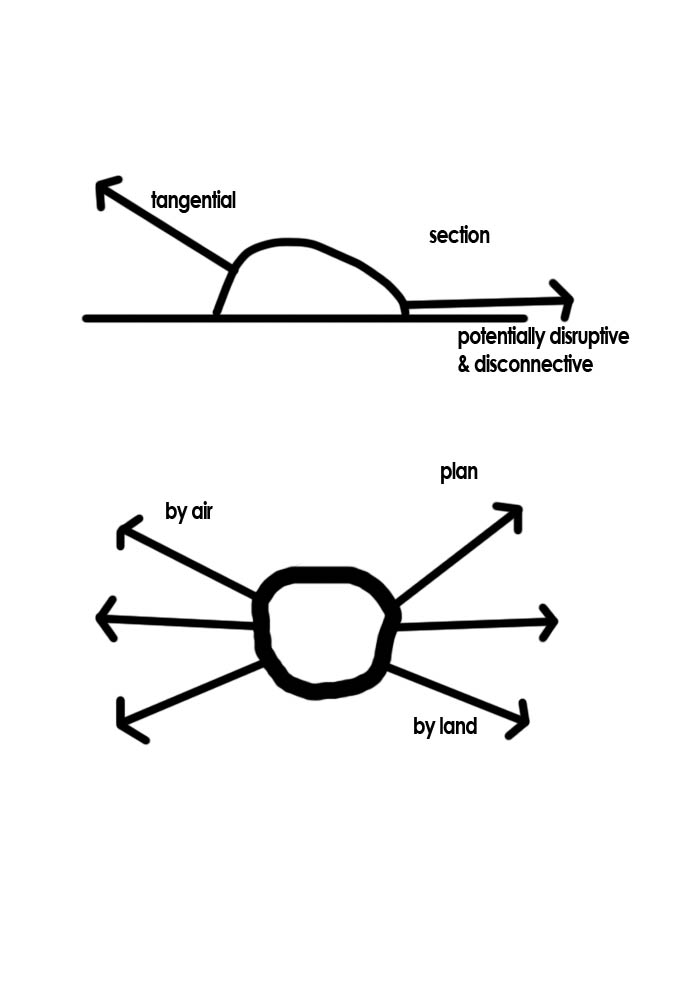
The idea of the aerotropolis is real. Airports are hubs. Value is created by hubs, be there mere intersections, rail stations, or airports. The challenge, like all global/regional hubs is the infrastructure is as much disruptive as it is connective, particularly to local networks.
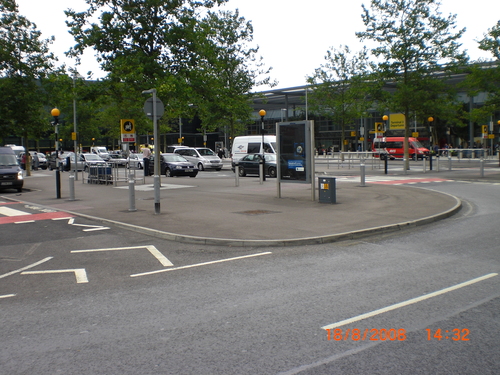
However, reading about the Heathrow controversy, its need to expand, and the general loathing by locals and frequent flyers alike towards the airport, I was struck by a singular moment. The dropoff. Heathrow Terminal 3 drop-off is surprisingly welcoming, a plaza lika space formed by the arms of the terminal.
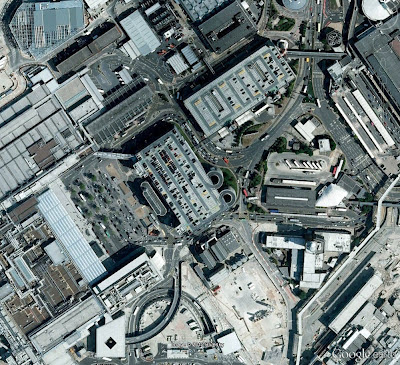
Except that was really the only nice part. Sure, the interiors have been redone to turn the airport into a shopping mall with for-pay wifi stations and the like, but I was most impressed with the drop-off. The real problem is everything surrounding the airport:
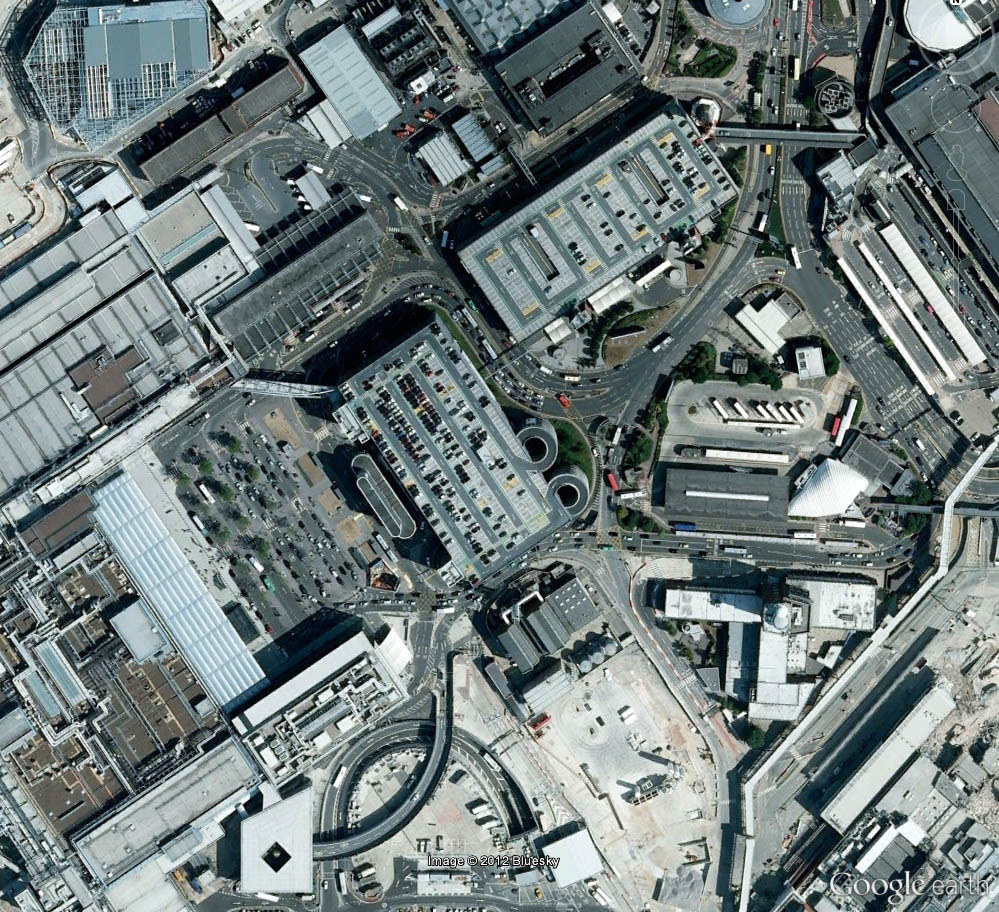
And that's when it hit me. The real problem with airports isn't the flight paths. Though, if you've ever golfed at Bear Creek golf course near DFW, you can smell the jet fuel in the morning. Not so pleasant. And a big portion of land value is about emotion, decreasing dissatisfaction and increasing satisfaction be that through social or economic exchange. I suspect airlines will eventually work out the issue of jet fuel, perhaps even sound, because it is in their financial interest long-term to move away from fossil fuels. I don't even mind the sound of jets taking off and landing. It reminds me of being in a city where things are happening. People are coming and going.
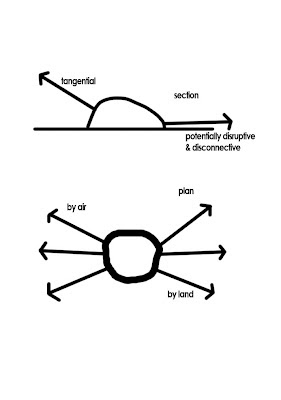
And that's when I realized the bigger issue facing the idea of "aerotropolis," or the city built around, by, and service of the airport. As I've written a number of times, regional/global infrastructure has to be tangential to the local fabric and functions of the city, less those connections become disruptive. It isn't the flight paths that prevent the idea of the aerotropolis, and I don't even really like that term, it's really just about land value responding to interconnected networks, ie city, but the ground connections to/from the airport that are far more disruptive:
Outside of DFW has become this basically:
So the real question becomes, how can we maximize the value of an airport to a city via minimizing the disruption it has upon that city and decreasing "dissatisfaction" through the inconvenience of getting to/from the airport to our actual destinations within the city?
So in this sense, any airport has three primary barriers preventing a maximization of its convenience and value to the city:
1. Flight Paths - as we've discussed, this is already minimal.
2. Land Mass / Security:
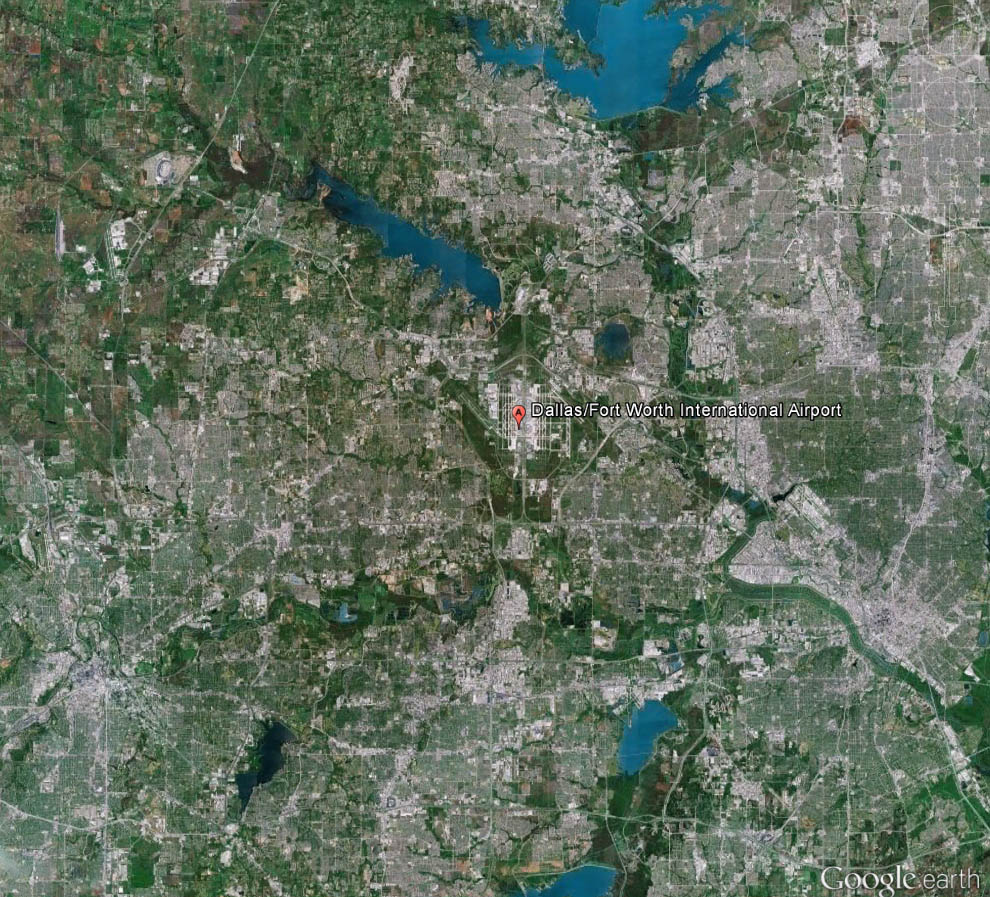
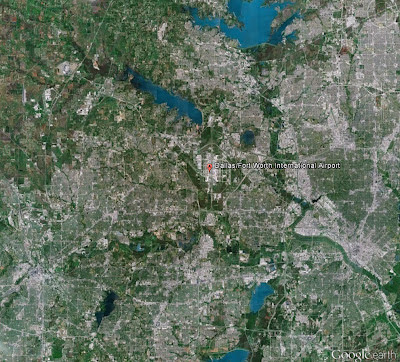
As you can see in any map of the DFW area, DFW airport is more identifiable from satellite than either downtown FW or Dallas. Larger in area too. The massive land mass limits the amount of value that can cluster near the airport.
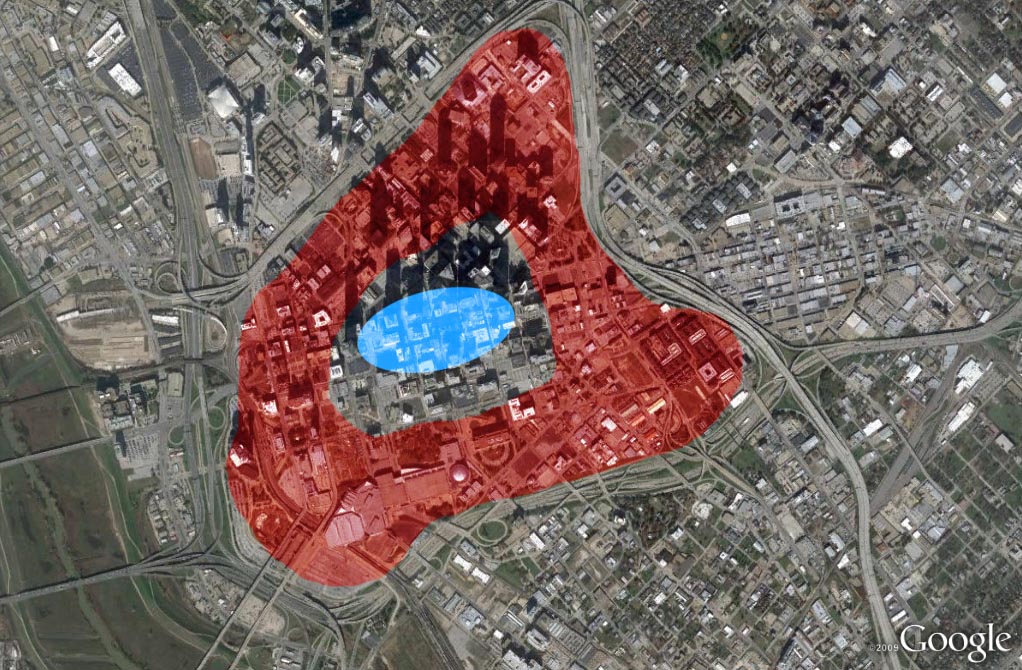
Furthermore, the rigid boundary creates a vast perimeter "border vaccuum," in Jane Jacobs' words. What she intuited by this is that the value is at the center of places and centers are impossible at edges of places. Think of downtown Dallas. The value is on Main Street, not along the perimeter of the highway loop:
And,
3. Disruptive nature of the regional connectivity, mostly car access and infrastructure.
---------------------
The question becomes, can we limit the effect on city fabric of an airports inevitable appetite for land, decrease the regional infrastructural disconnectivity, while maximizing the convenience of the airport?
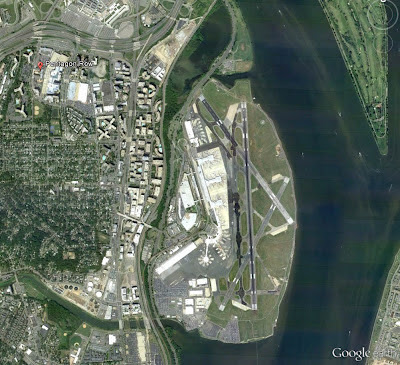
Reagan National in DC is one I'm most familiar with that comes close. The airport is built out into the Potomac on new and otherwise worthless land. In other words, nice and flat space, out on what would otherwise be a barrier itself, the river.
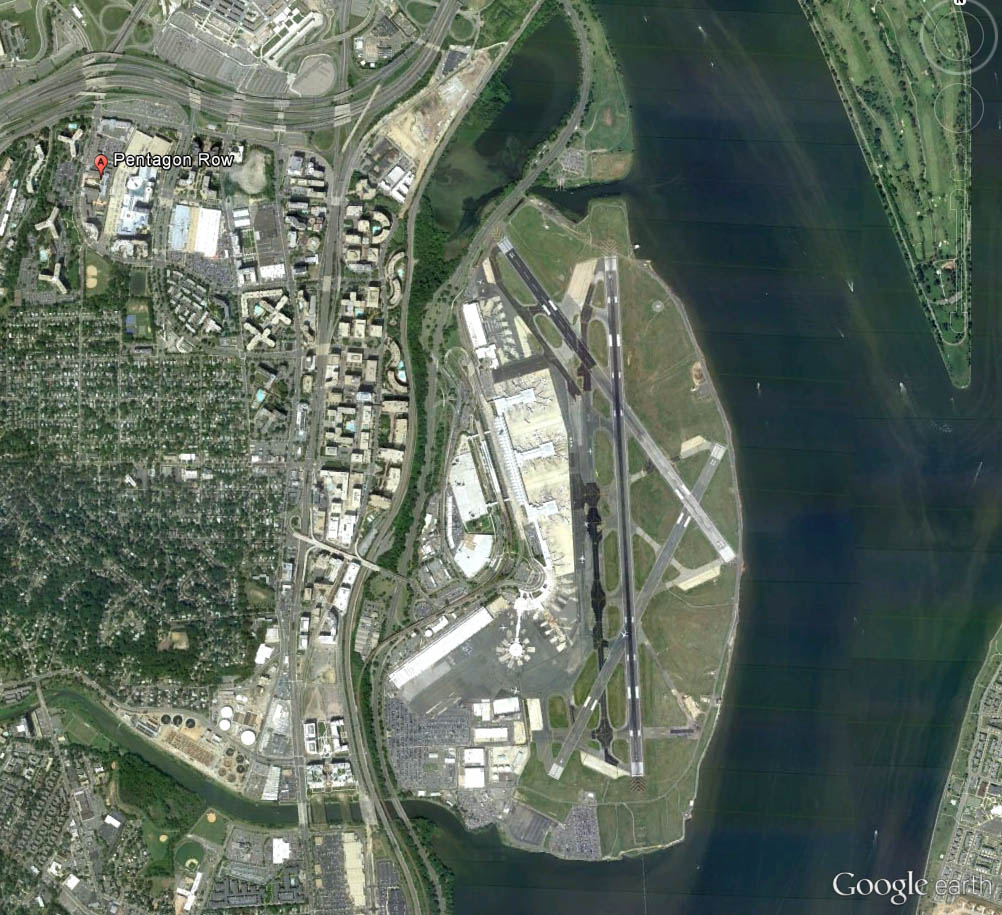
The Arlington, VA/Pentagon City area isn't the world's most urban place, but it is steadily improving, be it in isolated bubbles of pseudo-urbanism fragmented by overly wide/fast roads. What other examples are there like this? LaGuardia too, is set out on the water, but isn't connected by rail and is disconnected by highway. Aerotropolis discusses the project in South Korea, New Songdo, where the airport is built off the coast on an island and the "aerotropolis" is a new city from scratch connected via ferry.
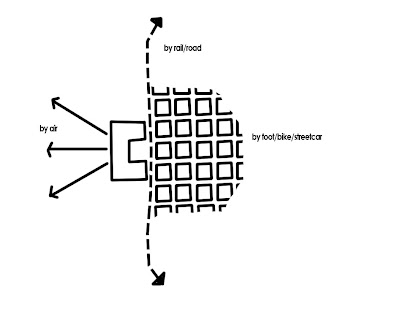
It makes sense, being that it is between Seoul and the airport. However, it isn't immediately adjacent. The question remains, can an airport immediately interface with a city, much the way Reagan does in terms of proximity, but better? Can we apply the welcoming plaza of Heathrow T3, except without the rest of Heathrow's spaghetti and parking garages around it?
Something like this:
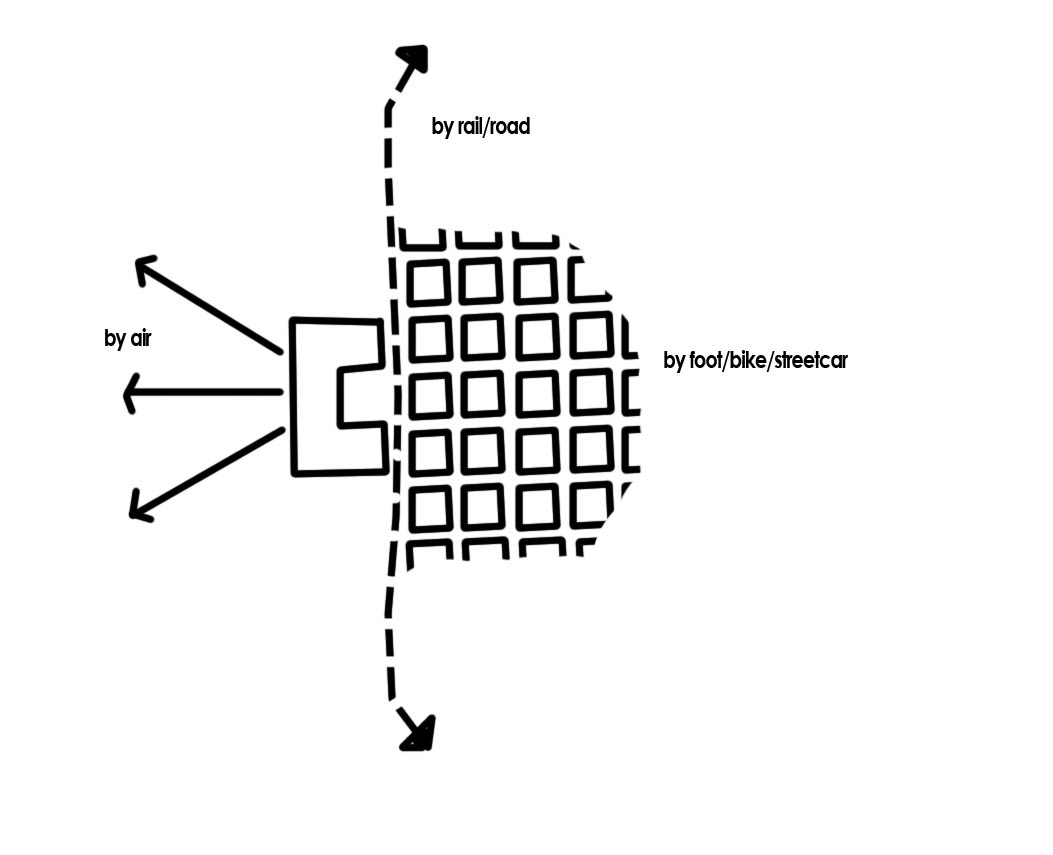
The regional road/rail connection could even be decked to further minimize the disruption and connection. As for our local airports, Love Field is pretty well landlocked, but small and convenient enough that the city is pretty close to the terminals. Except, it is still a mile away. Hardly adjacent. Also, the new DART line has a stop, but it too is nearly a mile away. We can't really infill between without removing runways.
Would there be value to infilling the oodles of land within DFW proper? Quite possibly. Even with the assortment of new rail lines scheduled to deliver people to the airport, none of which will be more convenient than driving (though less costly given parking costs). DFW suffers by being far away. As airports inherently serve regions, its regional infrastructure is quite bad upon its surroundings. Can we then build closer? Can there be express trains to the airport?
There is also the necessary point that all of the surrounding land uses around airports are fairly undesirable. This is at the heart of my early trepidation towards overvaluing land near airports. It is mostly cheap motels, used car lots, and the like. The areas immediately around airports are about as desirable as around many of the train stations in Europe, ie not the nicest parts of town. Is that because of its nature as a hub? Is it because of the logistical network of global economic exchange? Is it because of that border vaccuum effect? I suspect it is all of the above.
In other words, the efforts to build aerotropoli are pure experiments in speculation. However, it is also equally certain that they could be built far better than they are if they follow the simple rules:
1. Minimize disruption to the physical surroundings
and
2. Maximize convenience getting to and from Gates to micro-destinations within the cities themselves.
The best places are always governed by the simplest and most elegant of rules.


 Posts
Posts