




Showing posts with label Dinosaurs. Show all posts

Tuesday, April 13, 2010

Not Monday So Much Anymore Linkages

Links and articles of the day that I thought were particularly relevant or interesting for you to peruse and ponder while I realize that Twitter has become my fully customizable morning newspaper:

"Sometimes Life Just Gives You a Moment." ~ Lester Freeman.

I told you that I'm going to start reintroducing The Wire references into as many posts as possible, particularly now with Treme garnering the kind of early buzz that the greatest show in the history of television never got.

With that said, here is my moment. Yesterday, I talked about juxtaposed contrasts in the example of street art as expressed by the community in they way of a guerrilla not-so-hostile takeover of a street into a complete street. Ironically and coincidentally, the DMN covers the polar opposite, the Garland Road plan:
Residents made it clear that they don't want Garland Road widened, but they want it to flow better.
Let me translate: The residents deep down know better, but are resigned to the fact that some "expert" in traffic flow (and nothing else relevant to actual urban design, economic development, or city building) made the call beforehand that this was a site for road widening with a single section and are convinced by his traffic bible and technical jargon.

This is 90s and early 2000s style urban planning and economic development, not unlike the Trinity River Tollway, adding more supply of traffic volume, telling people its going to make their lives better, improve traffic (as we know only temporarily), improve economic development (when we know road widenings do the opposite), then have some anonymous "urban planner" come in and dress it up with some pointless landscaping, sidewalks, and "catalyst projects" aka road side attractions that have to be heavily subsidized by the City in order to make them work and overcome the barriers imposed by the problem they are futilely trying to solve with another problem; the core project, the road widening.

Since the article never actually says, I am being quite liberal with my interpretation, but a little birdie told me a while ago this project was a ruse to widen Garland Road and dress it up with lots of rainbows and unicorns, all costs and no bang for the buck. If it isn't a widening the point still stands that the street section should be context-sensitive and respond to place rather than formula.

On the otherhand, with some cheap and creative efforts, X+ is stimulating bottom-up economic development and readying and otherwise erstwhile area for increased investment from outsiders formerly afraid of crossing the Trinity River with their dollaz.
------------------------------------------
Speaking of Ponzi schemes and suggestive that I've been right all along (or its just another confirmation bias) to avoid the moral hazards of doing work in Dubai and (this time) China, is an article with some of the worst formatting, but best content you'll find:

His 1999 book, Devil Take the Hindmost: A History of Financial Speculation, examined past speculative manias. Perhaps you've read articles comparing the tech boom and 1990s' bull market to tulipmania in 1630s' Holland.

The difference is that Chancellor was making that comparison before the tech bubble burst, some years before Alan Greenspan claimed it was futile trying to predict bubbles at all.

Chancellor's timing may have been fortuitous. To accurately predict something once might mean little. To repeat the feat perhaps means something more.

His next major piece - Crunch time for credit: An enquiry into the state of the credit system in the United States and Great Britain - included this prescient paragraph:

''The growth of credit has created an illusory prosperity while producing profound imbalances in the British and American economies...When credit ceases to grow, the weakened state of these economies will become apparent.''

That report was written in 2005, years before the credit bubble burst. Chalk two up to Chancellor.

Third time lucky?

He's now turned his attention to China, a fertile ground for his fertile mind. Released last week on the GMO website, China's Red Flags is split into two parts.

Crisis checklist

Section one identifies speculative manias and financial crises, offering a checklist for those trying to identify bubbles in advance of their bursting. Chancellor offers 10 criteria for what he calls ''great investment debacles'' over the past 300 years (the report explains each in far more detail);
1. A compelling growth story;
2. A blind faith in the competence of authorities;
3. A general increase in investment;
4. A surge in corruption;
5. Strong growth in money supply;
6. Fixed currency regimes, often producing inappropriately low interest rates;
7. Rampant credit growth;
8. Moral hazard;
9. Precarious financial structures;
10. Rapidly rising property prices;

Although all these criteria need not be present in order for a bubble to be present, you can see where Chancellor's heading: not-so-subtly steering readers towards his own conclusion. In section two he takes each factor and applies it to the case of China.

Invest locally in places that are ripe. Like X+ and Bishop Arts. Of course, then my next piece of advice to residents of Oak Cliff is to be sure to pay attention to any and all zoning cases (particularly Davis Street) and be sure to fight for everything retaining a human/pedestrian scale. Everything between Davis and Jefferson is solid gold right about now and then in 10 to 15 years, look towards the Zang Triangle.

--------------------------------------------

And lastly, and perhaps most importantly is the dual-purpose post from the Guardian supporting the fact that we have to look beyond our borders for news as important to us as THE US MILITARY AND LARGEST GASOLINE CONSUMER IN THE WORLD IS WARNING OF PEAK OIL and major shortages worldwide in 2015. Of course, we'll go all willy nilly about this and do things as stupid as the king of stupid supply-side city thinking, the Detroit Convention Bureau trying to prop up economic development with more supply side factors like increasing their convention center, such as digging through Canadian Tar Sands and widening Garland Road.


Monday, March 9, 2009

Speaking of Timely

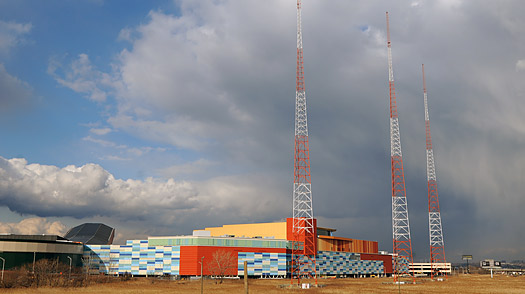
Newsweek on "The Last Shopping Mall" - sounds a bit Mad Max-ish, no?


...and jumpin' jeezus on a dinosaur is it perfectly and as appropriately ugly as the circumstances and motivations to build the thing.

"Xanadu is the epic discretionary story," says Davidowitz. "It's the epicenter of 'not needed.' How can you have this when the consumer is completely decimated? It's already one of the world's biggest nightmares."

The Real Issue with Wall Street (and your 401K)


On HuffPuff, Ann Pettitfor writes about Wall Street holding the U.S. for ransom.

JHK suggests something similar regarding the "too big to fail" myth.

The "ahha" moment I had this weekend whilst walking the mutt on another warm but blustery Downtown Dallas day, was what Wall Street's deeper issue is, beyond the credit default swaps, the ARM loans, greed, etc. All of the companies on the DOW or S&P 500 are huge corporations. They can't physically or economically get any bigger, which is what Wall Street, investors, and your 401K demand, so in turn, they all need to, and are currently shrinking (my publicly traded company included - love those stock options!)

This is the problem with growth. It was touched upon on this week's Bill Maher show with guest Cory Booker. Except that nobody really put 2 and 2 together to realize that there are different types of growth. I have mentioned exhaustively qualitative over quantitative models of growth, but I also touched upon it here:
Let me be the first to say (with thoughts for the other side of this bottoming), that instead of saving dinosaurs, how about we start thinking about saving that money to help startups on the other side of this bottoming that will be smaller, nimble, and more able to meet the needs of the 21st century.
Harvard economist Howard Glaeser echoed my sentiment:
That is how innovation works: small companies competing like crazy and trying out new things. Across cities, there is a strong connection between an abundance of small firms and local growth. The last thing that the government should be doing is propping up big declining firms. Real innovations are far more likely to come from someone’s garage, which is where Chester Carlson came up with the Xerox machine during the Great Depression.
The advantage of Wall Street and Globalization (and I'm one to point out its failings as well) is to deliver capital to companies in need of it for their own growth and economic development for all of us. Nay, this is the POINT.

Instead, it has devolved into a guessing game of who is gonna buy out whom, who will report the best 4Q sales figures, or simply who is the best at hiding their illegal ponzi schemes. Another dinosaur, a construct built entirely to pick the horse that will be standing at the end when only the biggest corporate fish is left. What then? How will our 401K improve at that point?

Well, we're essentially there already. We know that in order to maintain "growth" figures, that these corporations can now only cut costs while trying to provide the same or similar product, which has had disastrous effects on the health of our economies and our physical health.

Wall Street to have a real purpose and contribute to the rebuilding of a real economy is to find a way to deliver the engine of capital that only they can provide to the innovators of the 21st century, the inventors, the biologists, the "green" technicians.

Only then will your 401K begin to shed its sickly sallow look.

Monday, March 2, 2009

Another Bad Day on the Market

Let me be the first to say (with thoughts for the other side), that instead of saving dinosaurs, how about we start thinking about saving that money to help startups on the other side of this bottoming that will be smaller, nimble, and more able to meet the needs of the 21st century.

It is time to fossilize the AIGs of the world and hang them their bones up in a museum. We'll dedicate it to decadence and an unrelenting belief system to the religion of greed. As I once heard somebody say, Greed makes for a useful agent in democratic free market economies, but also makes for a horrible master.

Monday, January 26, 2009

Monday Link Impound

Is it just me or is the current debate over the stimulus dominated on both sides by a return to a previous status quo, either the Bush years pre-complete collapse of the illusory house of cards, or as Kunstler put it today:
hallucinated "wealth" rushing into the cosmic worm-hole of oblivion
...or the 90s Clinton-era as some sort of perceived Valhalla. Neither of which is possible and any attempts at returning to such a place (which as it seems to me, the infusion of cash seems intent on maintaining that status quo) will only exacerbate the problems. In poor times, you need to be smarter than ever about where spending goes.
------------------

On to today's links:

A most excellent pictorial case study from Vancouver showing the disastrous effects of a clover leaf/highway and the positive efforts to return it towards a more context-sensitive solution:
One Last Loop

Starting to get scared that I'm agreeing with David Brooks more and more or maybe it is a good thing that there is a growing voice for sanity:
The committee staff took the kernel of President Obama’s vision — infrastructure programs to create jobs — and surrounded it with an undisciplined sprawl of health, education, entitlement and other spending. There’s money for nurse training, Medicare, Head Start, boatyard support, home weatherization and so on. Eleven of the programs in the bill account for the vast majority of the actual job creation. The rest may be worthy or not, but they have little to do with stimulus. The total package is so diffuse, it costs $223,000 to create a single job.
I admire Obama's willingness to bring everyone under his umbrella, but this is what happens when they're nothing but dinosaurs, relics with their mind on the past system that "worked"...for a while.

TreeHugger on the holocaust occuring every year on the World's highways. And no, I'm not hyperbolizing:
In one year, it is estimated that 1.2 million people are killed in auto-related accidents around the globe. That equates to slightly more than 3200 traffic deaths EVERY DAY. These mostly preventable deaths, in casualties alone, exponentially surpasses the number of casualties from higher profile, more newsworthy, less common tragedies. Yet, the horrific daily toll receives little attention by political leaders and the media .

["The driver must've been huge. Notice the seared fat that burned into the seat. Very modern art." ~ movie quote.]

And now for the email FWD that I received today, didn't laugh at it, but simply knowingly nodded:

Subject: Important info on the Stimulus Payment


"This year, taxpayers will receive an Economic Stimulus Payment. This is a very exciting new program that I will explain using the Q and A format."

"Q. What is an Economic Stimulus Payment?
"A. It is money that the federal government will send to taxpayers.

"Q. Where will the government get this money?
"A. From taxpayers.

"Q. So the government is giving me back my own money?
"A. No, they are borrowing it from China. You children are expected to repay the Chinese.

"Q. What is the purpose of this payment?
"A. The plan is that you will use the money to purchase a high-definition TV set, thus stimulating the economy.

"Q. But isn't that stimulating the economy of China?
"A. Shut up."


Below is some helpful advice on how to best help the US economy by spending your stimulus check wisely:

If you spend that money at Wal-Mart, all the money will go to China.

If you spend it on gasoline it will go to Hugo Chavez, the Arabs and Al Queda

If you purchase a computer it will go to Taiwan.

If you purchase fruit and vegetables it will go to Mexico, Honduras, and Guatemala (unless you buy organic).

If you buy a car it will go to Japan and Korea.

If you purchase prescription drugs it will go to India.

If you purchase heroin it will go to the Taliban in Afghanistan.

If you give it to a charitable cause, it will go to Nigeria.

And none of it will help the American economy.

We need to keep that money here in America. You can keep the money in America by spending it at yard sales, going to athletic events, or spend it on prostitutes, beer (domestic ONLY, note: Budweiser is foreign owned) or tattoos, since those are the only businesses still in the US.