





Showing posts with label Density. Show all posts

Friday, February 11, 2011

Linkages with the Quickness

Shh, don't tell anybody I'm taking a quick break...

First, wouldn't you like to know that TxDOT is now 50% more efficient! Or at least the environmental review process is getting a kick in the ol' expedite. Check the slideshow for the gobblety-gook:


This would be nice, say if it was only say, for road diets, complete streets, and downgrading of streets. Instead, here comes a road widening "improvement" coming right up your alley. But hey, the Nazis were praised for their efficiency as well. Let pernicious forms of efficiency be damned.
-----------------------------------------

Wilonsky at the Observer links to a study that makes you wonder if it was even necessary when 75% of respondents have "no impression." On the other hand, that IS about as fitting a description for insert anti-city here Arlington as one can imagine. How do you have an impression of nothingness? Do you like nothingness? Do you have a favorable or unfavorable opinion of nothingness? If nothingness were to kick a puppy would you have a more or less favorable opinion of nothingness? If nothingness had a baby out of wedlock and then punched that baby repeatedly would you be more or less likely to vote for nothingness?

Keep in mind that I have no problem with suburbs, in their truest, functional form, which is why I reference Valencia, Spain so often. Their suburbs are perfect in my opinion: 1) Linked to each other and the primary body (Valencia), 2) possess a variety of transportation options, 3) are walkable, organized around the train station, 4) are isolated from "anti-bodies" or LULUs (Locally Undesirable Land Uses, i.e. heavy industry, highways), 5) have a range of housing choices with a clear, organized hierarchy based on desirability, centrality, and transit options (interrelated), 6) set within a backdrop of local agriculture for resilient, predictable food production.

There is a critical difference between functional suburbs and sprawl. Sprawl (anti-city) is disconnected and centerless. Connectivity and hierarchy of centers are the foundation for all networks (your brain, these here interwebs, cities, etc.). Without those two things, a place is dysfunctional. It might as well not exist...which means, if it doesn't find those things, it WON'T exist. Sounds crazy to say (since we live day-to-day and cities exist century by century), but this is a fundamental fact of cities throughout history.
-------------------------------
Lastly, I like Ed Glaeser. We agree on a lot of things. In fact, sometimes I feel like he gets his ideas from my blog (which he surely doesn't - but he has a knack for writing about things I've already written about. Of course, the flipside could be said for me and Jonah Lehrer when he writes about cities.).

Eddie money has a new book out today, which I will pick up as soon as possible. A couple of tangent trips:


* The user review of his book at the Amazon link above is hilarious. I'll paraphrase. "I really like the first two parts of the book where he's being all fiscally conservative and criticizing all the ways cities went wrong with zoning and all that big gub'ment hoogily moogily! Then that final act isn't worthy my toilet paper! How dare he criticize conservative policy as well! What a jerk! He really upset the confirmation bias I had going with the first two sections! Me and confirmation bias were going steady for a while there. But I dumped it like a sack of potatoes. Burn this book!"

* Second, an excerpted study of his new book that David Brooks references in his latest column blows the doors off of any relevance Joel Kotkin ever had:

This is a point Edward Glaeser fleshes out in his terrific new book, “Triumph of the City.” Glaeser points out that far from withering in the age of instant global information flows, cities have only become more important.

That’s because humans communicate best when they are physically brought together. Two University of Michigan researchers brought groups of people together face to face and asked them to play a difficult cooperation game. Then they organized other groups and had them communicate electronically. The face-to-face groups thrived. The electronic groups fractured and struggled.

Kotkin believes that telecommuting will allow us all to work from home and live how we want. And since we all want to live exactly how he wants, suburbs will live forever. The logic is that easy (or ridiculous). I, of course, counter that certain policies prevent us from all living truly how we want and skew the market. And these policies must be rewritten or scrapped to allow for greater choice in both housing and transportation.

Unfortunately for Kotkin's relevance and book sales, the science (and any personal empirical evidence) shows that working with and being around other people is far more productive than me and you interacting through these two screens and satellites.

The internet evolved into social media, not because it allows us to be further apart, but it allows us to be closer together. We are now better connected globally, sharing information and knowledge, but web 2.0 evolved to help us connect face-to-face, and generate real productivity/creativity/etc.


* Lastly, here is where I disagree with Glaeser in his appeal to more (and better!) skyscrapers as a panacea. Better sounds cool right? The only problem is that vertical sprawl is also problematic. One, for financial reasons. Know of many new high-rises doing well financially? These high-rises often deliver too much product at one-time for the market to absorb and adapt to, trusting our reptilian instinct for new shiny things to pay off the debts.

I think Glaeser might be suffering from his own version of availability/confirmation bias as a New Yorker/Bostonian. His personal bane is historic preservation. Smaller buildings are pending up demand preventing from more supply arriving in the form of replacement high-rises. Couldn't those lower-scaled historic buildings have more value than just their F.A.R. (floor area ratio)? Couldn't they be part of the reason why their is so much demand and value we find in those cities? Isn't their some extra value in connecting with the past via flexible, adaptable buildings that each generation repurposes (without completely tearing down and rebuilding) to suit their needs?

The global nature of the internet creates certain local discontinuities. Does his paean to skyscrapers make sense outside of NYC where land is cheap and demand is low (for now) like in Dallas? What about for the local geography? If Dallas were built to its climate (sunny and windy) would we have all of these glass(!) high-rises that take on heat (requiring greater cooling) reflect heat like a magnifying glass frying the people ants down below, and catch and then redirect the wind down to the sidewalk?

Furthermore, when he calls for high-rises to deliver density, what they end up doing is removing density from the street. First, high-rises either loom over the street forebodingly, they create windshear and a blustery environment at street level, and they block the sun from the street and surrounding buildings.

Second, they foundation of these buildings must be so large and the infrastructure (such as parking garages or all the transportation to bring people from all over a region to this singular point) that it breaks down the desirability of the public space around it because the blocks are too big or the density of movement in and out of this one object is too great to allow for more lingering.

Third, stacking so many people 100-stories into the air (assuming the building has 24-usefulness, meaning a mix of uses) creates demand for services up closer to where the people are. If there are 10,000 people above the 50th floor, there will likely need to be public amenities such as a food court or vertical gardens at various levels, further pulling people off the street level and removing a level of predictability for commercial businesses dependent upon the movement economy. The High Line works in NYC (and perhaps ONLY NYC) for precisely this 3-dimensional density.

High-rises often don't create real density, but an adolescent, clichéd view of density, an illusion of density as skyscrapers (and too many of them) create a repellent experience. It lacks nuance. So I ask you, which is a better version of density? Rome and Paris? Or Shanghai, Dubai, and Hong Kong? (The base of the Burj Dubai is about a 1/4-mile around. Its super block is over a mile around and its super, super-block (which includes a mall) is over 3-miles in circumference. I rest my case.)

When I think of New York and Vancouver, two cities often lauded for their skyscrapers, the best spaces and most successful areas are often of a lower-scale than we typically imagine those cities. See my post on visiting Vancouver for more about this.

Wednesday, June 2, 2010

Thought Provoking Density and Dallas' Schizophrenia

This blog has certainly spent its fair share of time discussing density, however it has never had the primacy for me that it does with other planning-type blogs. I've always felt it to be a bit of a fools gold and that design of cities is more important. While density of interactions, aka propinquity or proximity of all things needed for the daily exchange routine that occurs, is important for the efficiency of cities, in my opinion density can either be good or bad. If density is merely a way to warehouse people with little other concern, particularly to how the building relates to the rest of the city then it is deleterious to the city fabric. At its best, it should be merely a response to desirability. Demand-based rather than supply-based.

I thought this article at The Midwesterner was particularly thought-provoking for how it may relate to Dallas-Fort Worth and its identity. The basis of the article is the basic question of whether density was a good thing. The final thesis arrived at was that for global cities, those that compete as world class exporting centers of cultural foment, density is absolutely critical. This makes sense in the Creative Cities, Density of the Educated discussion. Smart people interacting in a participatory manner with each other energizes the creative process.

However, the flip side is that more regionally based cities are precisely that way because the lack of density is desirable for those that live there. The Urbanophile misguidedly alleges this is due to the nature of being able to drive anywhere in the the particular town in fifteen minutes. So those in cities of lower wages should be more dependent on potentially volatile gas prices and spend a greater percentage of their income, ie greater tax burden on making their daily connections?

In my estimation, this probably has more to do with Zipf's Law and a more natural cultural and personal predilection to various population densities (and the local and cultural amenities inherent) than anything as mundane or prosaic as "they like driving and the ease at which they do so." As the Midwesterner and Bruce Katz point out, they probably just haven't yet realized the price of expanding outward faster than population growth can support (particularly in rust belt cities).

As far as Dallas is concerned this raises a question that I can't answer. Dallas likes to see itself as a global city errr "world class," perhaps masking its own insecurities with false bravado. But, there also seems to be a perception (and one that I enjoy as well), of Dallas being a collection of smaller towns, loosely interconnected. Of course, the less dense, loosely connected does not a global or world class city make, but it is very much the perfect embodiment of the modern polycentric of satellite city form.

Are the two even as mutually exclusive as they seem?

My guess is that indeed density is necessary for the cauldron of creativity bubbling over in World Class Cities (and the draw that creates in importing talented people), but not necessary at all for livable places.

So which is it Dallas, which do you want to be? A global player or a looked down upon wild west podunk town on steroids? Do we want to compete with OKC and Austin (which are rapidly urbanizing themselves, catching up?) or NYC, London, Vancouver, Paris, Hong Kong, et al?

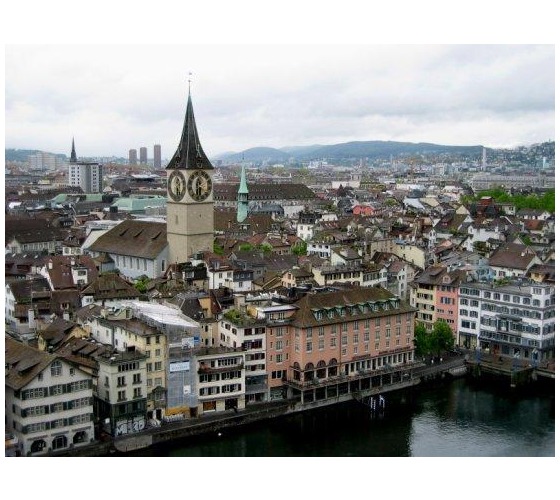
Of course, if we focus strictly on livability, we could be competing with Zurich and Copenhagen, which wouldn't be a bad thing at all.

Thursday, November 5, 2009

Ratcheting Down Roads to Crank Up Density

This post begins with the assumption, which I would call observed fact, that all development is a direct response to the primary mode of transportation serving the site (primary mode can also include multi-modal). When specifically applying a mode of transportation and accommodating it on a site, this assumption makes logical sense. It is the single most important determinant

For example, if everybody is travelling by car, the parking necessary takes up valuable FAR. Similarly, ports/docks are low density b/c everybody is on a boat b!tch. People arriving via transit are all on foot, pedestrians are on foot, and don't exactly need a place to put their shoes. And if they did, the foot lockers wouldn't exactly take up much space. That extra room for parking is either immediate for access (ie in front) or hidden to ameliorate the effect parking has on a building's ability to engage the public realm and participate in the multiplier effect of the "urban buzz."

http://www.streetsblog.org/wp-content/uploads/2006/10/IMG_0283_bike_parking.jpg
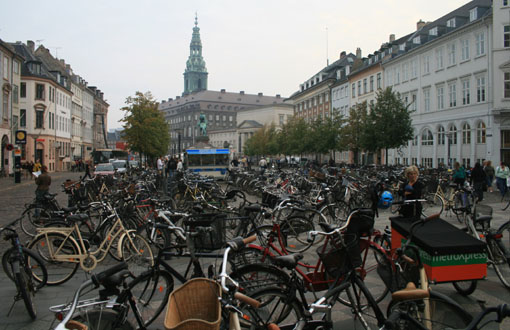
Copenhagen bike parking, compact and not sociofugal like a car park.

The two solutions are various shades of bad: very bad and less bad, because as I said it takes up valuable building/leasable space and it disconnects a building from its context thereby turning the building into a "non-sequitur" building, meaning it does not participate in the synergies that create a whole that is greater than the sum of the parts. Furthermore, the parking provision (and in cities where land and development is more expensive) has become a barrier to development, often accounting for upwards of 20% of a project cost.

To further the linguistic metaphor, in syntax, there are certain rules for things to come together to make sense (in cities these would be livable places). Once the rules are satisfied art can be applied to create poetry or prose and invoke even greater meaning. In cities, these become lovable places.

We obviously can't just start building without parking, as everybody (but me) is still stuck in a car on the road. But, we can alter the transportation network that informs the development density (and quality). I don't mean removing roads altogether, but slowly and incrementally ratcheting down the scale of many of the roads in the city and pinpointing any road designs that negatively affect urban tissue, creating places less than the sum of the parts.

Dallas is in the top five in the country in constructed freeway miles per capita. Extrapolated, it is probably pretty safe to assume that American cities dominate in the world list for this statistic as well, meaning that D/FW has nearly as many freeway miles per capita as any city in the world. Top Five WooHoo! Time to celebrate? No sir. And we're gonna drive from Dallas to Darmstadt, Germany to see how much money we're wasting.
---------------------------
As I posted the other day, Prof. Bill Hillier discussed development density, how it is created and defined by the density of the local grid network. The combination of the two components combine to create "urban buzz," or as I would describe as the facilitation of synergistic economic activity.

Obviously, economic factors have to exist to have demand for population to be there in the first place, the grid is then the application of a platform for increasing economic activity. The economic purpose makes for a VIABLE city. The grid allows for a LIVABLE CITY. And, as I said earlier, applying CIVIC ART then creates for MEMORABLE or LOVABLE cities.

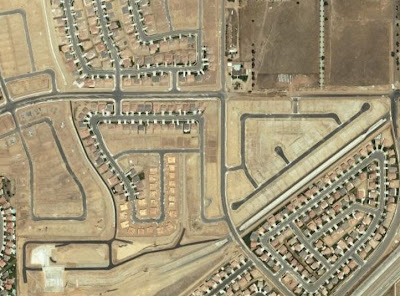
You can't just start laying out a grid in the middle of nowhere and expect "urban buzz," but that won't stop people from trying apparently:

The visual mind virus of Bizarro Keynesian Meme. Build roads, expect development = stupid supply side urban development, rather than incrementally allowing demand for new development and expansion of the grid to accommodate it. This is what we mean by not overextending yourself financially by way of infrastructure.

Looking further into why Cities have roads and what purpose they serve, Hillier also talks of the necessity of local and global connections. Let me refine this dichotomy to include a greater range of: local, city, metropolitan, regional, global. Extracting Jane Jacobs, highways are essentially global connections b/c they link global hubs ie airports to cities (as macro destination), as well as cities to cities - for example Houston area to Dallas area. The grid then allows the connections from microdestination to microdestination, or intermideate destination (such as a transpo hub) to microdestination (your house, your job, third places, etc.). As Hillier suggests, the local grid connects everywhere to everywhere and allows the necessary flexibility of choice to get there without all traffic funneled to overly hierarchical dendritic arterial systems.

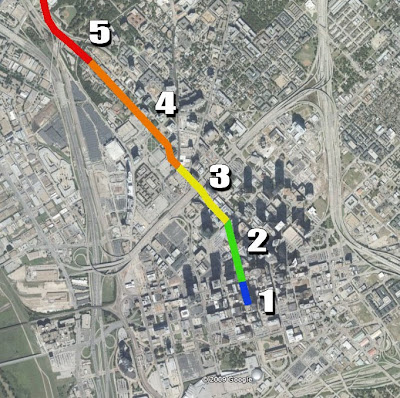
So we have our five road "connections, which I'll number by intensity or volume:
1. Local
2. City
3. Metropolitan
4. Regional
5. Global

Each of these connective "purposes" has an appropriate design solution that either can engender high quality, dense urban development or do just the opposite. This post will show examples of both.
http://pedshed.net/blog/wp-content/uploads/2009/02/tampa_capacity.jpg
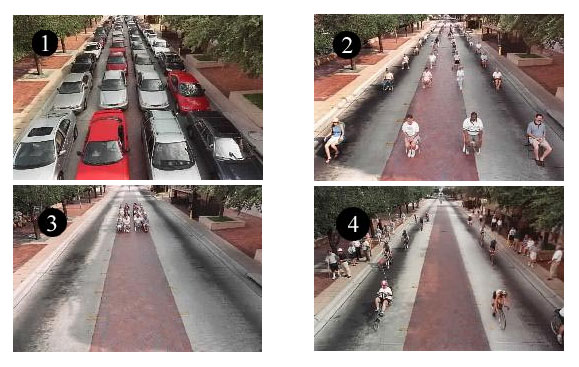
Oft repeated schematic illustrating spatial relationship and densities of people by mode of transpo. As you can see accommodating modes other than cars allows for greater capacity. Moving greater capacity is supposed to be any transpo engineers job. Greater capacity moving by a site, equates to a higher "highest and best use," meaning more predictably successful commercial enterprises, more "urban buzz." Oh, and as we'll see, it just looks nicer, feels nicer.

Looking specifically at Dallas, anyone that approaches downtown from the North via the Dallas Tollway arrives into the City experiencing a descension of hierarchy from road type 5 all the way down to 1. This is what we mean when we say context sensitive design. The street capacity is reduced as the road descends further into the City. However, as we'll see, Context Sensitive Design can be poorly sensitive or misinterpreted as the roads are all poorly designed, strictly for the maximum amount of cars and little else (like a DART bus or two) meaning not operating to full capacity as the picture above shows.


This entry experience will follow a 2-mile stretch of roadway as the Tollway as it merges with and becomes Harry Hines, until it turns into Akard St. until it terminates at AT&T and Golden Boy!


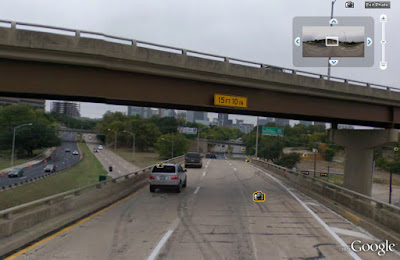
Category 5 (failed autocentric version): Characterized by flyovers, overpasses, cloverleafs, and related over-engineering. Notice that no development wants to engage with roads like this in any way and some futile attempts to "green" it up is made to make it barely palatable, ie more sunk costs.


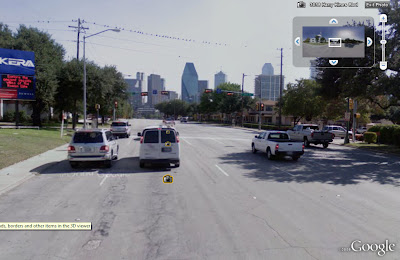
Category 4 (failed autocentric version): I believe we are near Harry Hines and Wolf here. The street now has traffic lights, six! lanes (all each too wide as well), and a pointless sidewalk right up to the curb. Often has surface parking in front to provide "access" and the only thing noticeable is a KERA billboard for drivers b/c nobody is expected to be on this road on foot. You'll also note that this is one-way here, meaning it has a mirrored overly wide, poorly design street running parallel one block to the East.


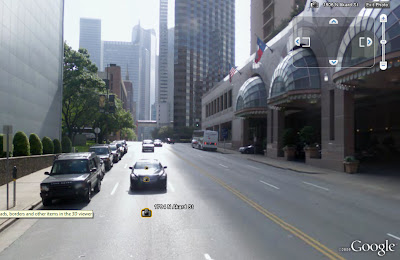
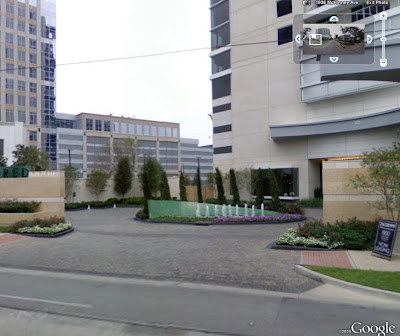
Category 3 (failed autocentric version): It's actually two-way with some on-street parking here, yet it isn't exactly helping business, except that we're greeted by a porte cochere and two curb cuts. Prime example of a building relating to the form of transportation. You're obviously arriving by car, we'll design our entry to greet cars. Oh, and a blank wall.


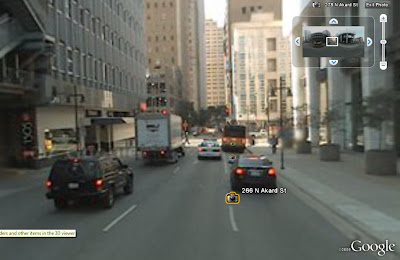
Category 2 (failed autocentric version): Back to one-way. Apparently, we have yet to learn that businesses need two-way streets to maximize predictable visibility and locational choices. As we said earlier, commercial success (and urban buzz) requires as many people moving by as possible (a focusing of the energy of human movement). Two-ways is better than one. Also, on-street parking is available at points along this street but it is spotty. We see another covered porte cochere and a sidewalk with no buffer from moving vehicles.


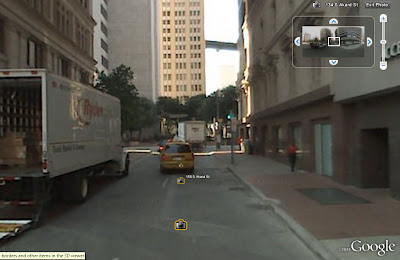
Category 1 (failed autocentric version): Given that this is at the intersection of Main Street (the one area of successful urbanism in downtown) and the Harry Hines/Tollway funnel, this should one of the most important and successful streets in Dallas. Main Street works, but as of yet, the "buzz" hasn't spilled southward toward the poor, imprisoned Golden Boy. This is partially due to the design of the street which doesn't convey its importance (and I don't mean widening). It feels like a back alley.

So what have these roads bought us? Well, because they are design to be sociofugal (and repel people), they become escape routes. As I suggested earlier this week, countering the argument that big roads deliver people to a city, it's a zero-sum game in terms of people coming and going on those roads, but when you factor in what they have done to the real estate, the extra cost of widened (virtually) car-only roads has decimated real estate development and urban density.

The density WE DO have is designed to be entirely auto-centric as well, with large parking garages as well as front doors that are little more than car drop-offs/porte cocheres.


The street edge is even defined by walls. agggh, more tree lawns!!! kill me!!!!

Furthermore, all of this high-rise residential/condominium development dotting lower McKinney is entirely a by-product of the falsely created, irrational housing exuberance of the past ten years. If it had to do with actual demand (one, it would be filled), it wouldn't be so poorly designed in how it engages the public realm.

So what are examples of roads that these should look like? Well, I'm glad you asked.

http://farm3.static.flickr.com/2214/1640881747_3d9de56482.jpg?v=0
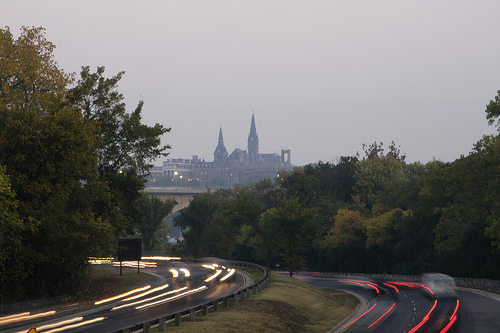
A better #5 - limited to the outskirts of the city. Very few $750 Million overpasses/interchanges, because highway to highway interaction is rarely four-way and they don't intersect every two miles. Lined mostly by natural buffers, development is rare except at the highway to boulevard hubs. There are no frontage roads, which bleed the "movement economy" energy from the lower level streets, which can better accommodate development.


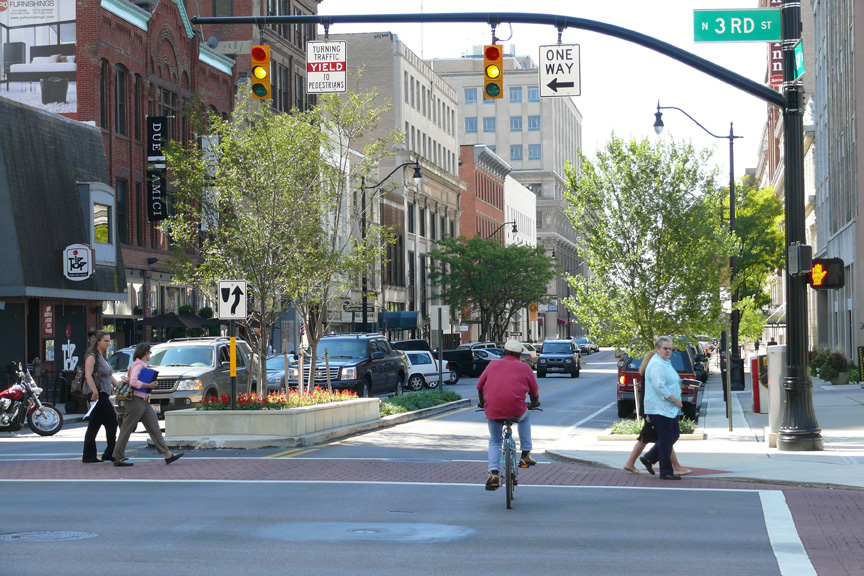
A better #4 - ignore that this is the Champs Elysees which acts as a "main street" of Paris. 4's should be the primary vehicle traffic movers of any metropolitan region and can accommodate development directly interfacing with and benefitting from the energy moving by on the street because of the buffers created by the allees of trees, a browsing/parking parallel "slip" lane, and ample sidewalks. These streets still require a development coding maintaining a linear street wall to maximize use to use adjacency/synergy.

http://www.bv.com.au/file/cecil_DaveMcCaf_web.jpg
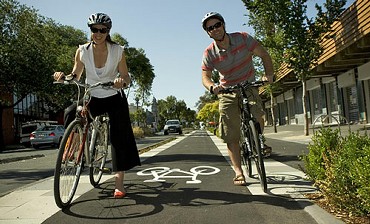
A better #3 - a lesser version, or lower scaled "complete street" from #4.

http://publichealth.columbus.gov/uploadedImages/Public_Health/Content_Editors/Planning_and_Performance/Institute_for_Active_Living/gaystreetfix2tomail.jpg
A better #2 - Main Street in downtown Dallas would be a good number 2. However, I would categorize it in the Dallas hierarchy as a 1, the lowest capacity because the road hierarchy is on steroids. The theme of this post is that in Dallas, all of the roads, need to go on "road diets" and scale from bad 2's to good 1's. Bad 4's to good 3's.

http://www.e-architect.co.uk/copenhagen/jpgs/nytorv_stroget_54.jpg
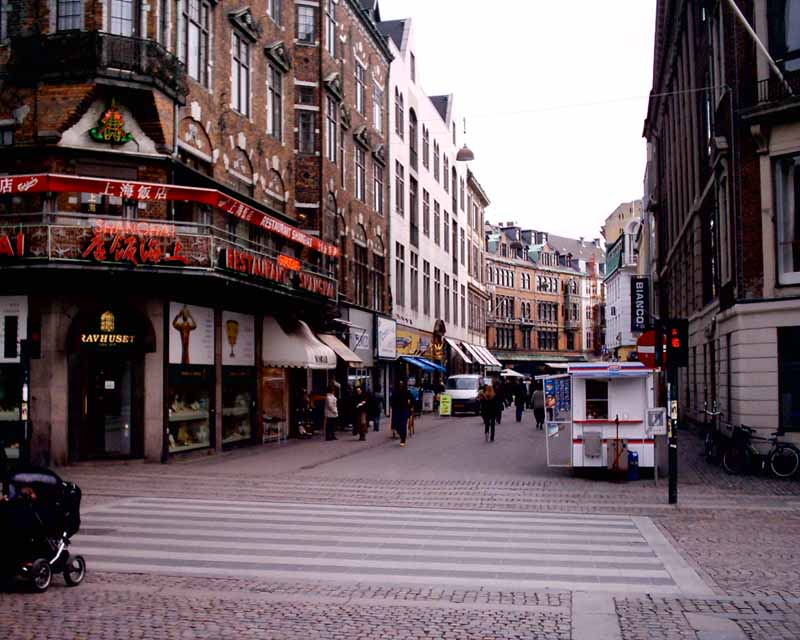
A better #1 - Rather than alleys, we start using terms like woonerf or mews. Examples include Stroget (the carfree area in Copenhagen) or even the small side streets with cars near Stroget that will probably go carfree soon anyway. Point being, cars can still get through as you see above, but it's primarily only delivery vehicles. Who else would want to try to drive through there? Curbs aren't necessary b/c bikes, pedestrians, strollers, pedicabs, you name it all have equal right-of-way to the space. This is the epitome of street as space.

So what does all of this mean for Dallas? Dude, you're full of something, not sure if it's questions.

I thought we were driving to Darmstadt. Are we there yet?


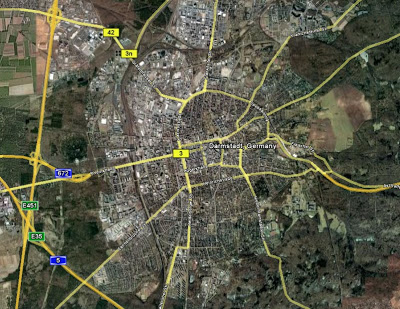
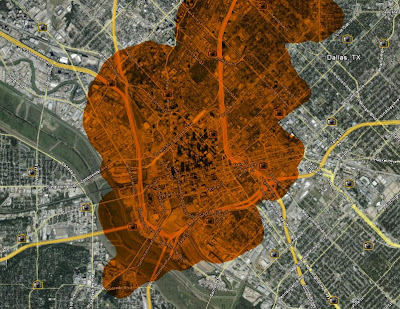
Yes. This is Darmstadt, Germany. When placed over Dallas at a similar scale, we get this:


Darmstadt is a city of 142,000 people. The orange shows all of Darmstadt minus the "boroughs" of Eberstadt, Arheilgen, and Wixhausen (all compact suburban satellites off the map, but still within city proper) taking the total population of the orange area down to approximately 100,000.

It should be noted that Darmstadt also barely has any buildings over ten stories, other than the middle finger building (shown below), of course. Most of which are steeples or various other associated vertical elements with civic/cultural edifices.


I wonder where or towards whom it is facing? Probably Munchen.

While not entirely accurate, the orange area covers the equivalent of Dallas zip codes 75201, 75202 (downtown) and 75204 (uptown), meaning we're probably looking at a max residential population of about 25,000, or one-fourth of Darmstadt's density.

As you can see from the aerial, its compact nature allows for preservation of nearby agricultural land for food production as well as natural forests/habitat. The freeways are all exterior to the actual city preventing them from having the corrosive, deleterious effect upon the urban fabric which we know all too well. The city is then accessed by roads lower on the hierarchy.

If as the saying goes, "density buys amenity," apparently in Dallas we just buy entirely too much car infrastructure which means that much less in the way of amenity and livability.

P.S. I have a much more in depth post looking at Darmstadt that has been about half-way done for about a year. I'll try to get that finished within the next week.

Monday, July 6, 2009

Density and It's Role in Civilizing Man

A new paper in Science makes the argument and Jonah Lehrer from Wired discusses:
The larger implication is that the birth of human culture was triggered by a new kind of connectedness. For the first time, humans lived in dense clusters, and occasionally interacted with other clusters, which allowed their fragile innovations to persist and propagate. The end result was a positive feedback loop of new ideas.
WE are smarter than ME. S-M-R-T.

-------and------------

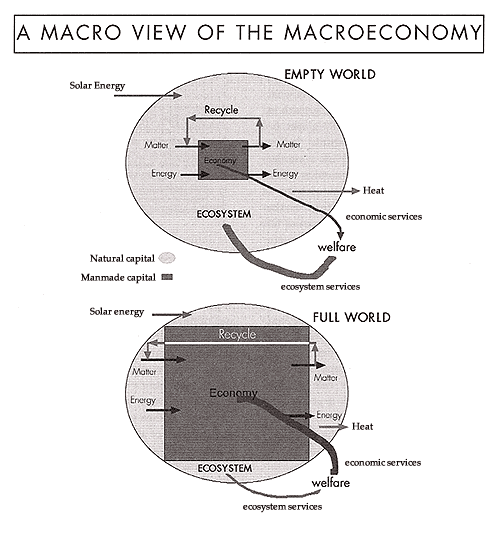
Grist puts statistics to Herman Daly:
It’s almost like the economy is embedded in an environment, and degrading the latter ultimately degrades the former.
Please tell me that line was written facetiously.

Monday, April 6, 2009

Hyper-reactionary?


City-Journal has an article up entitled Green Cities, Brown Suburbs with the tagline "To save the planet, build more skyscrapers," by Harvard economist Edward Glaeser who has been cited repeatedly in this blog, most recently here and here, as he and I came to the same conclusion regarding the bailouts. That real growth will come from the bottom and we should be saving our bailouts for real stimulus and that is to stimulate startups and small, more agile businesses, which is where innovation and progress comes from.

Here is what he says regarding how humans should be building:

Similarly, limiting the height or growth of New York City skyscrapers incurs environmental costs. Building more apartments in Gotham will not only make the city more affordable; it will also reduce global warming.

Thoreau was wrong. Living in the country is not the right way to care for the Earth. The best thing that we can do for the planet is build more skyscrapers.

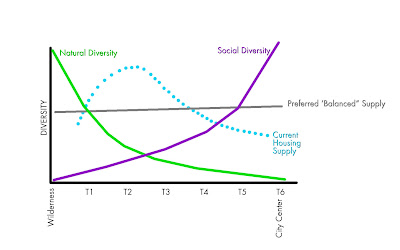
However, I will be disagreeing with him here and at the end of the day, it is really a very simple thesis and the issue is one of semantics. We all know density is one way towards sustainability because of shared resources, effective synergies created via spatial relationships, lower per capita carbon footprint, less VMTs and car dependence, etc. The other is total self-sufficiency from a site standpoint, aka the farm that generates all of its own food and energy on-site. This is the least dense option.

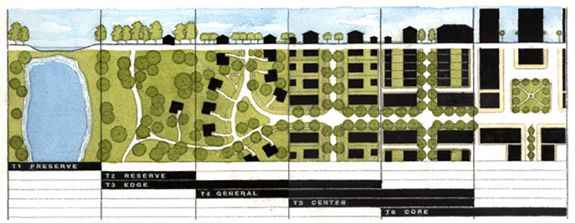
If we take the transect for example, if only to establish a gradation in densities from city core to the most rural of land and development we get the following graph:

[click to see it larger - since it posted so small]

But, at the end of the day, skyscrapers are energy and material intensive. Furthermore, they degrade the public realm, the street life and ambience that makes cities. Vancouver has been able to get around this by creating a lower-story base to sit their towers on, but this doesn't change the fact that the buildings are still importing material from wherever and people to occupy those buildings often from the suburb. (Think about how many people commute into lower manhattan from NJ, CT, and Long Island.)

Here is what I said in a previous post:
Here is the problem. This study takes the Amero-centric view that only through tall buildings can one achieve density. Skyscrapers are not a necessity for density. Paris, Florence, Madrid, Rome, Copenhagen, are wonderfully dense. Now, here are the potential CONS of skyscrapers:

1. Even if a platinu
m-certified tower is constructed, the building is still immensely energy intense in its construction phase.
2. They are materially intense, with materials typically travelling much farther than with low- and mid-rise buildings.

3. Skys
crapers privatize sunlight and views. Then, amazingly when another tower is built next door, the tenants of building 1 flip out that they lost their view...despite doing the exact same thing.
4. Tight-knit, often medieval form urban fabric generates protective microclimate from
weather extremes. Skyscrapers often exacerbate the problem with the intensity of the wind shear and down draft created by the building.
5. Skyscrapers adverse
ly affect the street aka the public realm by 1) removing people from the street and putting them in elevators and 2) overpowering the scale of the space created by the buildings.
6. These buildings tend to be glass and steel. Two energy intensive materials, often not created locally. I like the elegance of glass bui
ldings, but then the issue becomes one of active vs. passive heating and cooling. AND, reflective glass is often pretty ugly.
7. C
OST. They are expensive to build. In summary, I'm not saying that I'm against skyscrapers. I like the pyramidal form of skylines of cities, emblematic of the greater synergies driving up values in the center-city, and thus manifested by taller buildings, aka greater real estate and F.A.R. in those places as a natural result. But, simply calculating that more dense places are greener doesn't say a damn thing and it certainly doesn't necessitate skyscrapers.
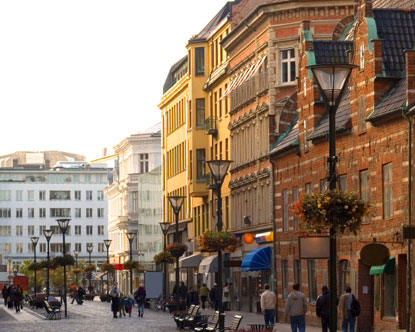
Now, think about the most pleasant cities that you have been in (and I'm not talking favorite b/c that brings into play potential for hedonistic behavior, i.e. Vegas), I mean most pleasant. For me (of cities that I have spent a reasonable enough time there), the list includes:

1. Malmo, Sweden - The cleaner, less busy version of Copenhagen.

2. Siena, Italy - need I say more?


3. Zurich, Switzerland - combination of modern/contemporary and traditional/historical.


4. Verona, Italy/Vicenza, Italy (tie) - if only because I confuse my memories of the two like I do with the Italian and Spanish languages.


5. Malaga, Spain. - something about the palm trees and coast line.


The spaces created by these buildings, AND in turn, the buildings themselves create spaces the citizens love, and revere, and are proud of, and therefore will not allow the natural inclination to densify to ruin their cities. This is the underlying cause of high-rises at the fringe of European cities, a market-driven logic to deliver as much "product," in this case, housing units to an area of high demand. Only that the new product is so undesireable it is relegated to the fringe and over time, relegated to the impoverished, becoming a slum and potentially areas of high volatility and/or crime.

The consistency is that these are all medium-sized cities, not so disconnected from nearby nature, nor overwhelmed by cars and/or people, with low to medium sized buildings but still with much higher density than most (all) American cities because of the compact form of development.

In the States, I would say that D.C. would be very high on the list for similar issues, despite being a much larger city. Of the cities the authors cite, most of the residents aren't living in high-rises, they are in the neighborhoods adjacent to the high-rises which house mostly commercial enterprises.

It is possible to build they type of density that Glaeser is looking for in a way that makes for cities more livable than Hong Kong, that are close to nature, close to food production, and don't house people in vertical filing cabinets, so that they are so disconnected from the ground and the street life that makes cities interesting and vibrant.

Plus, we are just too damned poor and in debt to be building high rises all over the place, when we need cost effective solutions and those will be in the form of three- and four-story buildings that frame streets and public places and provide for a flexibility of use that gives the buildings a much longer life than we would typically allow.

Tuesday, March 24, 2009

Reduce yer Carbon Emissions

Move to the City, and then get rid of your car.
"There are density-related advantages for both travel and heating," says Dodman. "When you have a critical mass of people like in London or New York, public transport becomes a feasible option for many, while people in more rural areas rely more on cars. And a flat that is surrounded by others is more efficient to heat than a free-standing house."
DC is dirty, but still only 82% of the American average.

Monday, March 16, 2009

Monday Morning and Weekend Links

Green-ness of Skyscrapers? including the prescient Dr.Seuss tale:
Over the protests of the environmentally sensitive Lorax, the Once-ler builds a great industrial town that despoils the environment, because he “had to grow bigger.” Eventually, the Once-ler overdoes it, and he chops down the last Truffula tree, destroying the source of his income. Chastened, Dr. Seuss’s industrialist turns green, urging a young listener to take the last Truffula seed and plant a new forest.
This tells me more about the cancer stage of capitalism than it does environmentalism: forever growth!...Now for the important calculations:
Matthew Kahn, a U.C.L.A. environmental economist, and I looked across America’s metropolitan areas and calculated the carbon emissions associated with a new home in different parts of the country. We estimated expected energy use from driving and public transportation, for a family of fixed size and income. We added in carbon emissions from home electricity and home heating. We didn’t try to take on the far thornier issues related to commercial or industrial energy use...

In almost every metropolitan area, we found the central city residents emitted less carbon than the suburban counterparts. In New York and San Francisco, the average urban family emits more than two tons less carbon annually because it drives less. In Nashville, the city-suburb carbon gap due to driving is more than three tons. After all, density is the defining characteristic of cities. All that closeness means that people need to travel shorter distances, and that shows up clearly in the data.
Here is the problem. This study takes the Amero-centric view that only through tall buildings can one achieve density. Skyscrapers are not a necessity for density. Paris, Florence, Madrid, Rome, Copenhagen, are wonderfully dense. Now, here are the potential CONS of skyscrapers:

1. Even if a platinum-certified tower is constructed, the building is still immensely energy intense in its construction phase.
2. They are materially intense, with materials typically travelling much farther than with low- and mid-rise buildings.
3. Skyscrapers privatize sunlight and views. Then, amazingly when another tower is built next door, the tenants of building 1 flip out that they lost their view...despite doing the exact same thing.
4. Tight-knit, often medieval form urban fabric generates protective microclimate from weather extremes. Skyscrapers often exacerbate the problem with the intensity of the wind shear and down draft created by the building.
5. Skyscrapers adversely affect the street aka the public realm by 1) removing people from the street and putting them in elevators and 2) overpowering the scale of the space created by the buildings.
6. These buildings tend to be glass and steel. Two energy intensive materials, often not created locally. I like the elegance of glass buildings, but then the issue becomes one of active vs. passive heating and cooling. AND, reflective glass is often pretty ugly.
7. COST. They are expensive to build.

In summary, I'm not saying that I'm against skyscrapers. I like the pyramidal form of skylines of cities, emblematic of the greater synergies driving up values in the center-city, and thus manifested by taller buildings, aka greater real estate and F.A.R. in those places as a natural result. But, simply calculating that more dense places are greener doesn't say a damn thing and it certainly doesn't necessitate skyscrapers.

Brookings on the economic engine and (should-be) haven for investment of cities:
Yet here is the problem: While America is more metropolitan than ever, the nation’s policies and structures rarely match economic reality. As a nation, we remain fixed in old arrangements, established decades ago and kept in place by bureaucratic inertia and entrenched political interests. Such a misunderstanding of contemporary urban structures inevitably leads to bad public policy decisions. Take as an example the nation’s crumbling infrastructure, now finally in the public eye. We should be spending money on metropolitan infrastructure, such as new transit lines or the maintenance and upgrade of existing roads and bridges, because it gives the best return on investment, the most bang for the buck. And yet the federal government sends the overwhelming bulk of national infrastructure funds to states, not metros. Given the vagaries of state politics, state departments of transportation in turn tend to scant metro investments in favor of building brand-new roads in far-flung places. Money that could be fueling the metro economic engine ends up widening a rural highway.
And lastly, a fascinating take on the death of newspapers as compared to the revolution that was the printing press:

Round and round this goes, with the people committed to saving newspapers demanding to know “If the old model is broken, what will work in its place?” To which the answer is: Nothing. Nothing will work. There is no general model for newspapers to replace the one the internet just broke.

With the old economics destroyed, organizational forms perfected for industrial production have to be replaced with structures optimized for digital data. It makes increasingly less sense even to talk about a publishing industry, because the core problem publishing solves — the incredible difficulty, complexity, and expense of making something available to the public — has stopped being a problem.

Wednesday, March 11, 2009

Prepare for Higher Taxes...

...or, if your community, town, borough, township, etc. out in Generica, i.e. suburbia lacks the will or ability to pass higher tax rates, prepare to get nickle and dimed on every little fee, registration, parking meters, wherever they can hide little costs to meet the overwhelming costs of overextended infrastructure.

I can't tell you how many typical "conservative" communities, i.e. the ones that allowed conventional suburban developers and strip centers run amok over their city, that I have worked in that are so under water just for upkeep and maintenance of their current infrastructure. These communities often, ironically, end up having some of the highest tax rates to accommodate the land raping that has been done.

Suburbs simply lack the density to pay for themselves and it's time to start paying the piper:

Florida prepares for higher taxes despite dropping property values:

Wednesday, February 4, 2009

Links

Pretty sure I posted part 1 of this "Saving the Suburbs" series in the NYT blog, but here is part 2.

I have to admit, I didn't find anything of real substance in part 2. Here is my comment referencing the super happy save the world suburb (of like twenty houses in car-friendly Austin):

The Sol project is as net energy zero as the cars are that access the development. Not to say there is anything particular wrong with that, but to say this particular project in a sea of tract houses doesn’t actually prove anybody right or wrong.

The real issue is that American cities grew in size/land area, but not in the requisite population, i.e. they didn’t grow organically, aggregating new development with all the services and community infrastructure to be successful in addition to existing development. Rather, we robbed Peter to pay Paul, leaving our downtowns and cities to rot while we all moved into suburban neighborhoods that were principally bankrupt and were only about delivering product to the market place, not making real places with lasting value, socially, environmentally, or ecologically.

See my post on Valencia, ESP for a city and suburbs that work and grew organically to do so:

http://carfreeinbigd.blogspot.com/2008/06/valencia-spain.html

The primary issue is that there is an appropriate choice for housing types and living environments and that is represented by the current city form in Valencia. In the US, you generally have one place to live, trapped on your cul-de-sac and behind the wheel.

I’m sure the car, road building, oil/gas industries love having a captive market.
Link to a new website that catalogs Freeway Teardowns. But, the real gem is this article pasted on the site, from Induced Demand to Reduced Demand, which is exactly the issue incapsulated into one neat and tidy heading.
This is what transportation planners call "induced demand." Building freeways encourages people to drive longer distances: in the short run, people begin to drive to regional malls rather than local stores, and in the longer run, they move to lower density neighborhoods where they have to drive further for all their trips.
The convenience of driving has become our [and its] own worst enemy.

Road construction, in the attempt to alleviate the pressure further spreads people out and thus creates its own demand to fill the newly created supply, so we're back to square one...only amplified. The real answer is demand side solutions that reduce the need for trips and driving for every facet of life. As my post yesterday suggests, our happiness and well-being depends upon it.

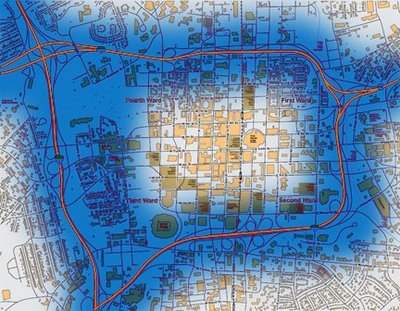
If you're tired of me b!tching about the highway problem affecting downtown Dallas, move to Charlotte...no, wait a minute. Don't do that. Check this figure ground of downtown Charlotte and how it has essentially been wiped out except for the very center that is in itself buffered by distance and an eroding urban fabric (much like the four blocks of Main Street that work in Dallas):