





One of the tragic things working in Dallas is the amount of people and effort trying to make things work, make the city more urban, ultimately giving it a longer shelf life, is that there are many smart people trying to make little changes within a fundamentally broken ship. Sardonically, we might call this rearranging deck chairs on the Titanic. However, we tide ourselves over with the comforting thought that a million (or only a dozen) small actions can lead to a tidal wave of change. The big changes to the underlying DNA of a place are just too difficult, too politically charged to even bother with, instead we'll just set the table, the linen, the silver, and the china on this one little dining table. So what the boat is headed for the iceberg of inevitability?
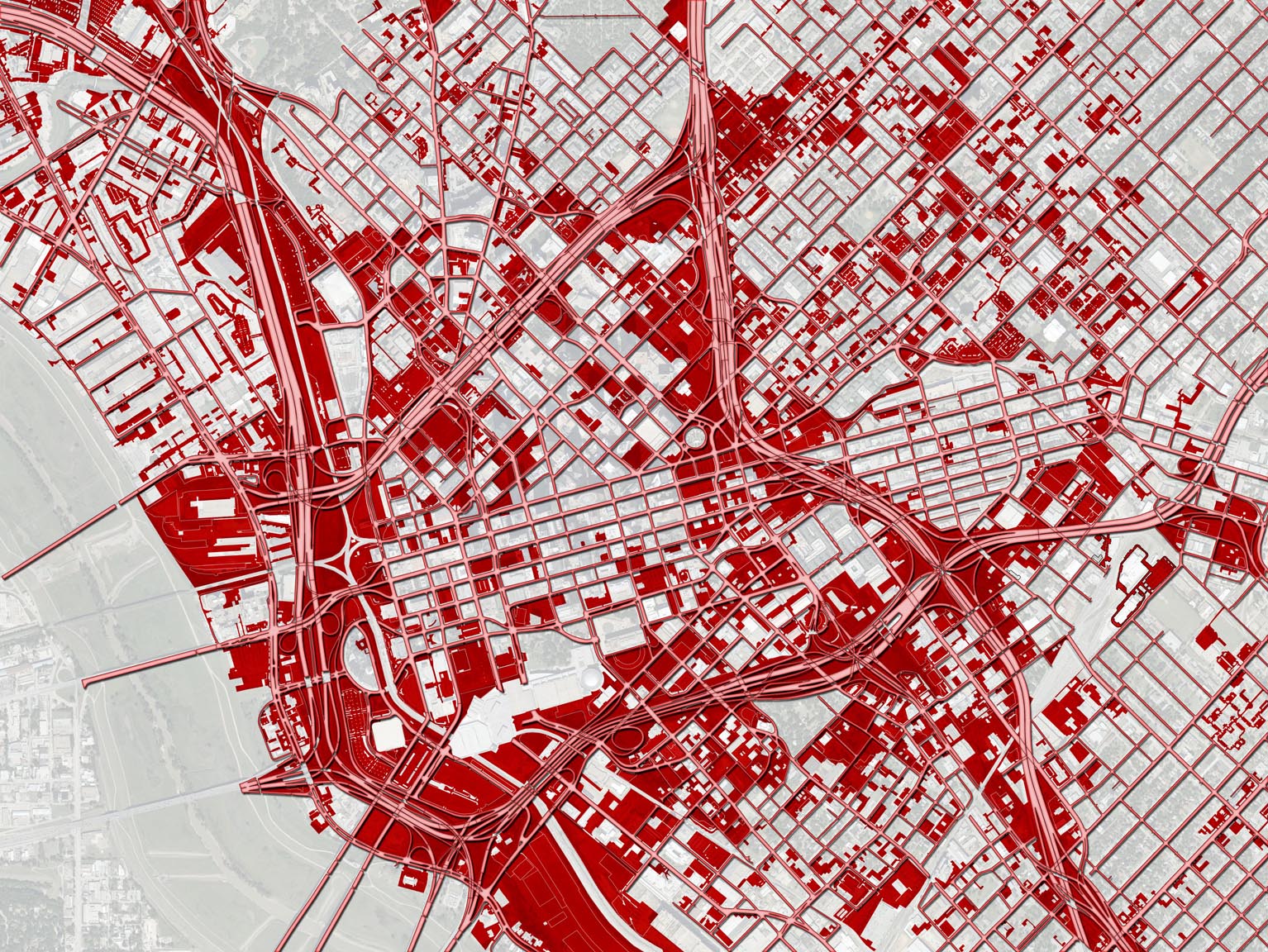
Perhaps neatly and accidentally summing this up is the news from the weekend that the City of Dallas, and in particular the parks department, is going to update the downtown parks masterplan. Buried within the subtext is a brief mention of two high-rises that are coming down to make room for new parks? New something. Probably not buildings. And if they are, they likely won't make money. Such is the state of downtown Dallas. Things happen by charity and subsidy because the transportation framework is stacked against downtown.
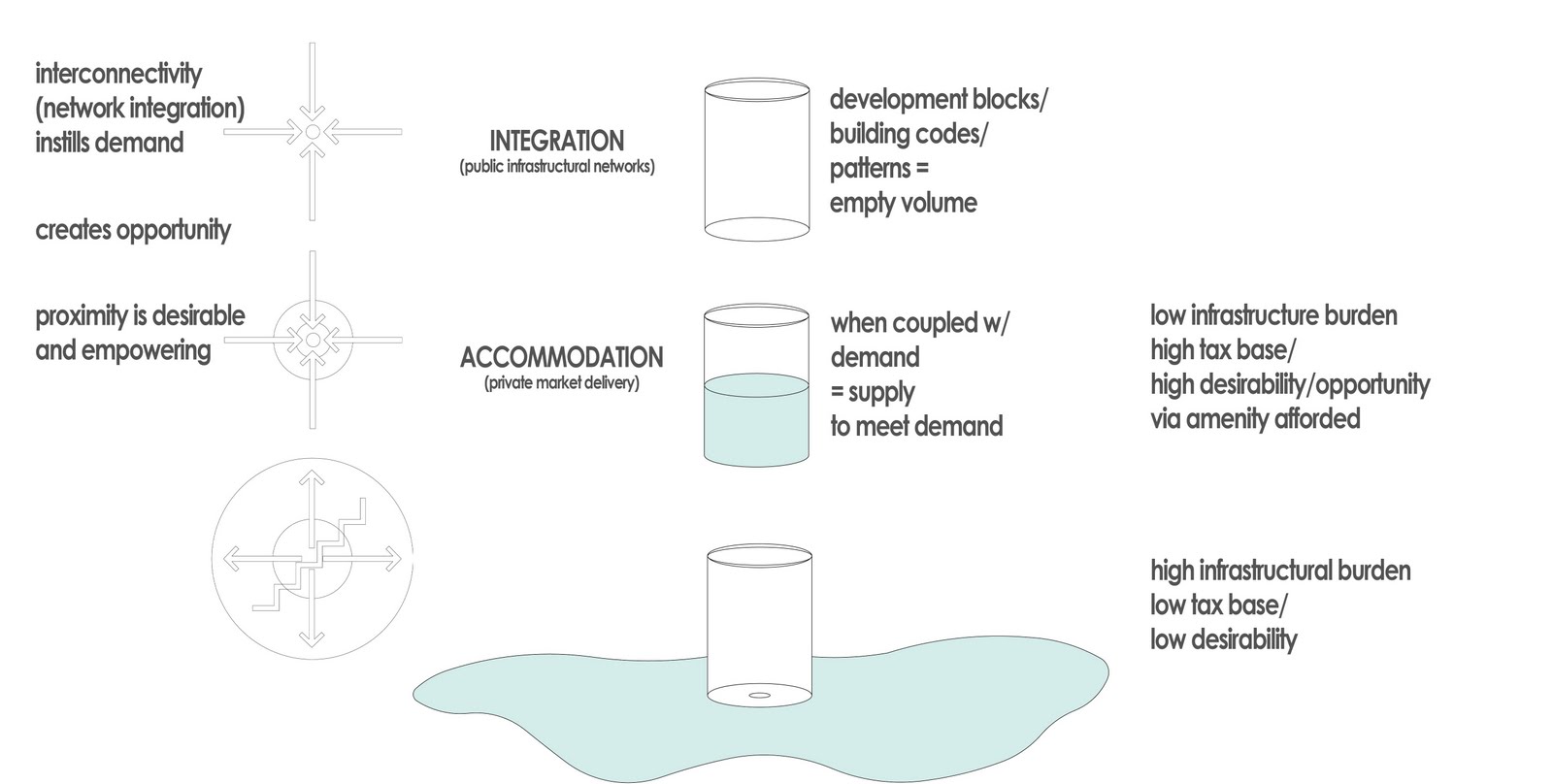
The glass is empty, so throw out the glass. Sure, the numbers don't work to fill that glass, but that isn't necessarily the fault of the glass, but the infrastructural network creating the hole in it instead.
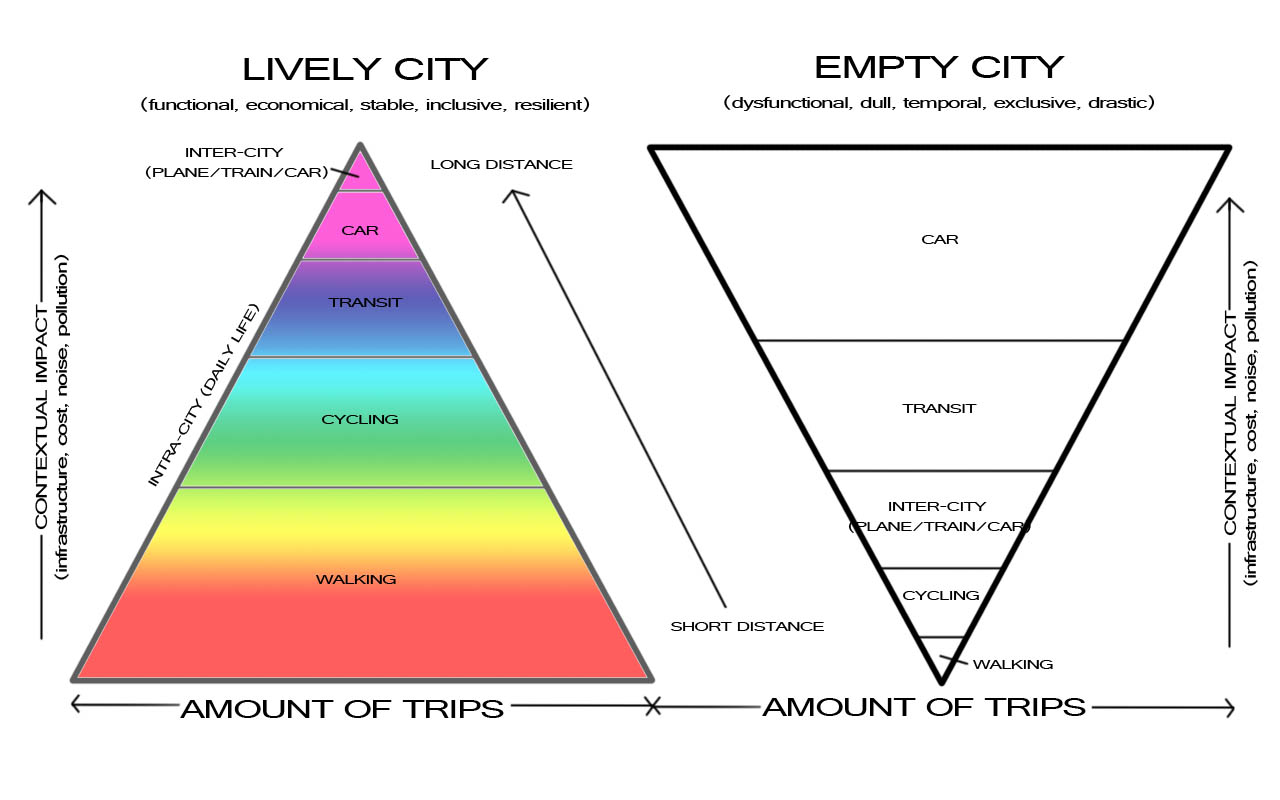
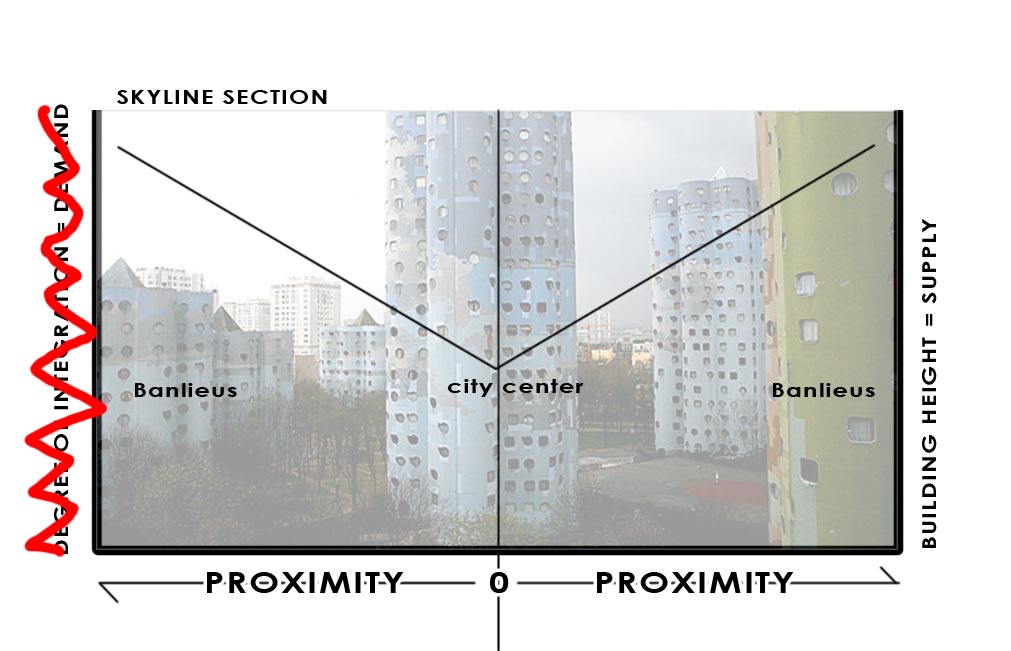
I've been saying this for a while now, but the highest and best use for downtown land is nothing. Sad to say and sorry to challenge your world view, but this is inevitable within the broken system. Thus, within that system, we rationally think that nothing or a park is better than a building. That building is empty, so take it down, of course! Demand is too low to make anything work within that building. So instead of instilling demand, we reduce supply.
I forwarded this story to someone over the weekend who responded derisively, "let's just tear down all the buildings and make a wildlife safari." Or maybe move the zoo and let jungle cats roam the streets. Highest and best use: parks and parking. Perhaps it is time to admit we're doing it wrong and systemic reform is necessary to how we think about our city, cities in general, and the underlying processes behind urbanization (or in this case, anti-urbanization).
-------------
Along these lines, Robert Wilonsky, formerly of the Observer and now mainstream at the DMN -- but still working 24/7, sent along the news that the city is seeking an operator for their first 'glass box' retail space. The glass box semi-'popup' retail space is something born of the downtown 360 plan. It creates retail space in places that currently lack it. In essence, it is giving an interface to blank walls. However, there is a catch. There must be demand before supply.
It's not a terrible idea. In fact, it is a good one. But there is a slippery slope. Again. And that is if they are used willy nilly, then they are supply side urbanism and thus doomed to fail. For the city to erect these glass box buildings is good in a few ways: (1) it eliminates some startup costs (and barriers) for a small, local business to locate in downtown Dallas. (2) It provides an interface for a buildings currently lacking one, ie a front door engaging the public realm where currently there is none, a blank wall.
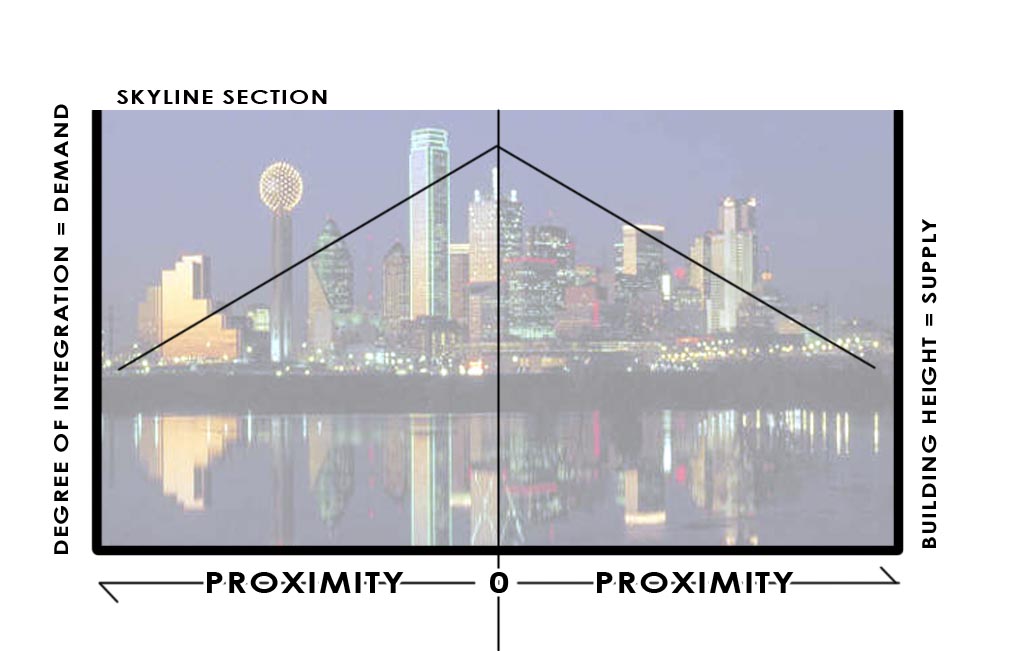
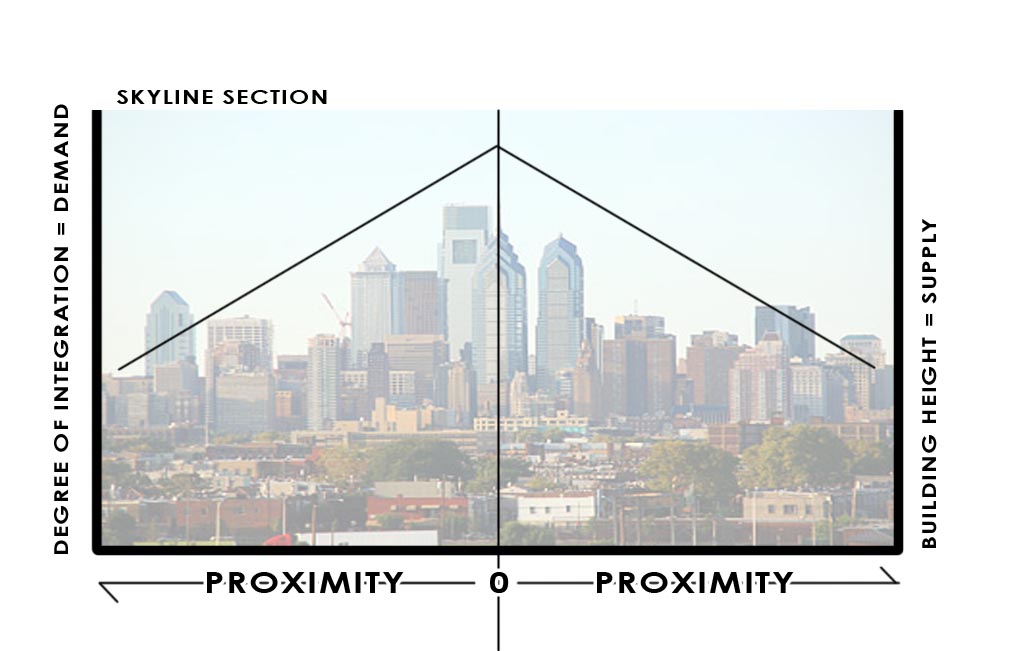
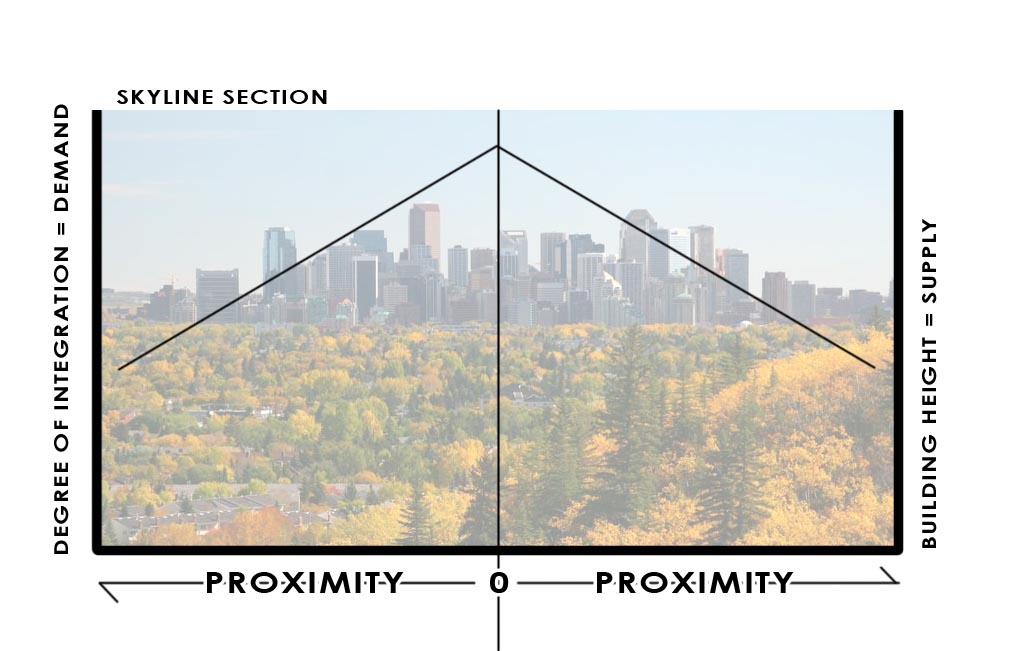
It is potentially bad if these are established in places where they won't succeed, in areas of low spatial integration. Spatial integration = demand = greater chance of success, the quick wins the city and the downtown 360 plan are looking for.
So, if we're looking for a quick win for the idea of the "glass box" in micro and downtown success in macro, you'd think we'd locate the first glass box in the location where it has the highest chance of success. Since there are several potential locations for the idea of laminated retail space on a current building facade, we have to pick the place that has the highest spatial integration value. Unfortunately, that isn't Browder Plaza. Yes, it needs it, but making this phase one is the right place at the wrong time. Or wrong place at the right time. Both suffice.
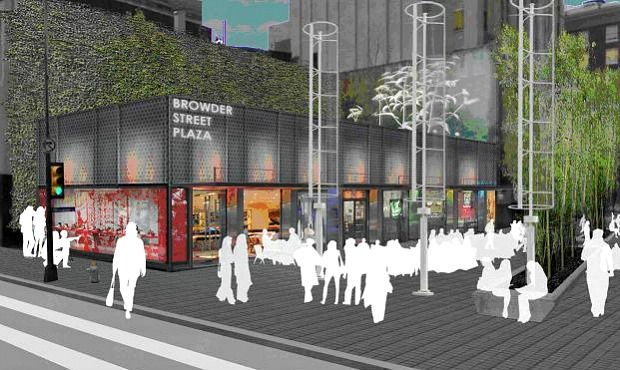
I too love theoretical people in renderings. But where do they keep their wallets? Is this how we visualize tourists? As apparitions, floating amongst us, the real and true Downtowners?
These people have to come from somewhere and that somewhere is through spatial integration. As I wrote about the McKinney Avenue Trolley last week, through movement is not nearly as important as cross movement because the people that cross the street are from the neighborhood, the street serves the neighborhood, and those are the people that populate the sidewalk and thus patronize businesses that interface with the street. Furthermore, these are return customers who keep businesses afloat.
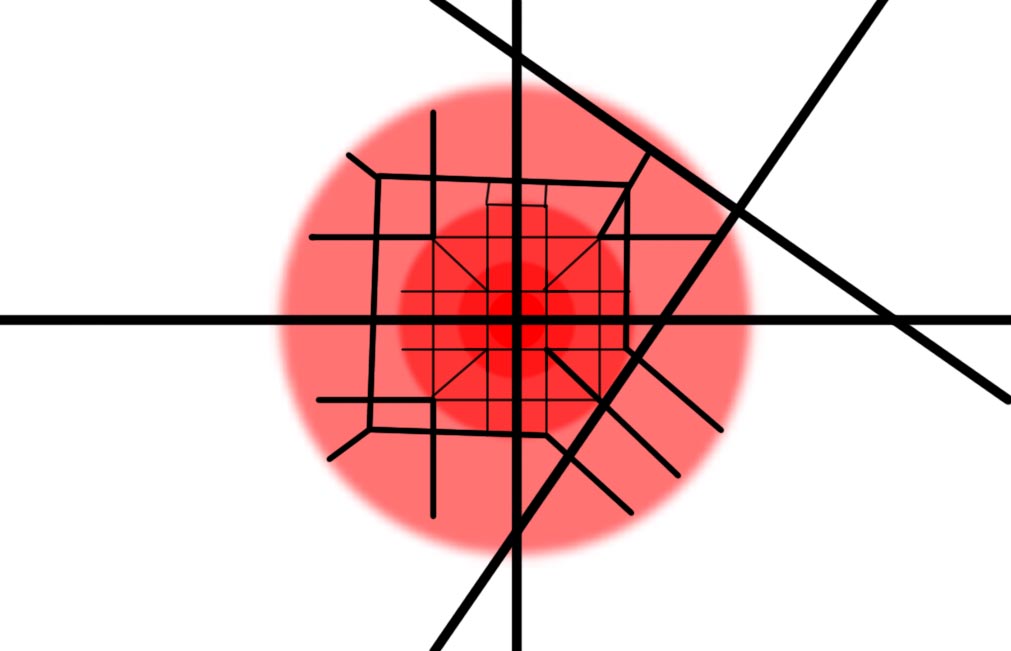
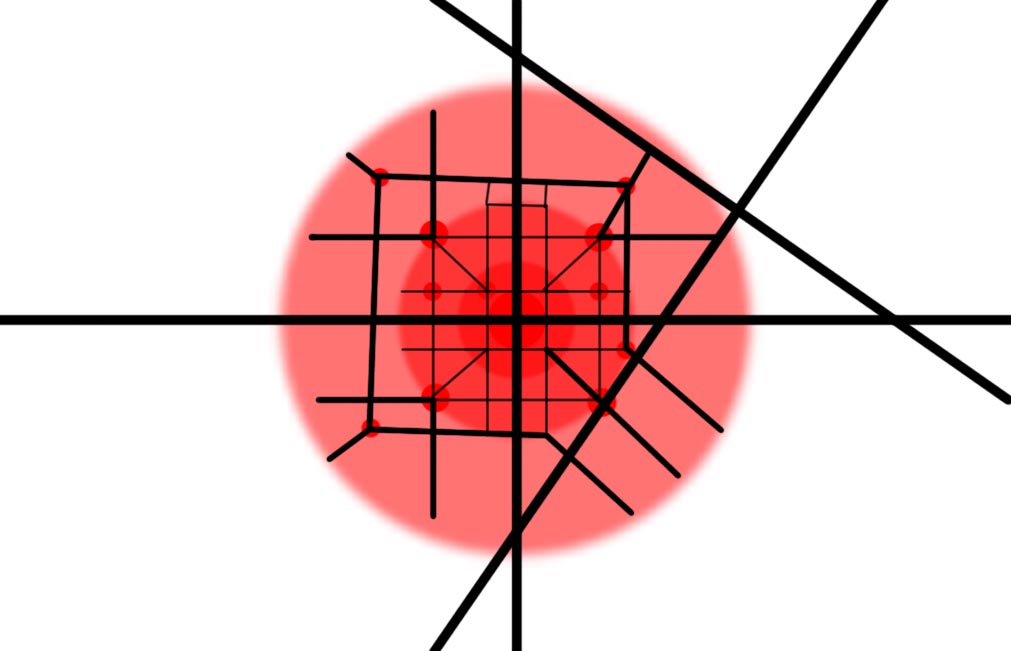
I don't know all the decisions behind establishing the first glass box on Browder Street, a pedestrian plaza closed to car traffic, linking Elm and Jackson Streets. It very well could be that the city is trying to make retail work on Elm Street since it hasn't on its own. But that is part of the problem. It works on Main Street for a reason. There is a higher degree of integration on Main Street. Where Main and Akard meet at Pegasus Plaza is the crossroads of downtown. It is the single point of highest integration in all of downtown, its "Main & Main" corner.
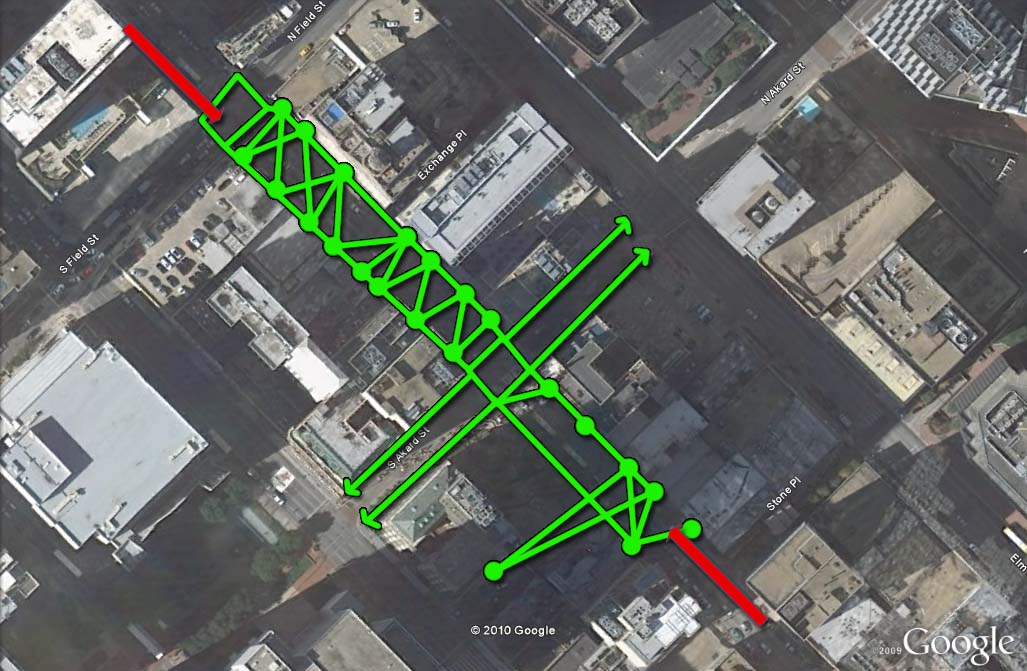
There just so happens to be a perfect place on Pegasus Plaza as well:
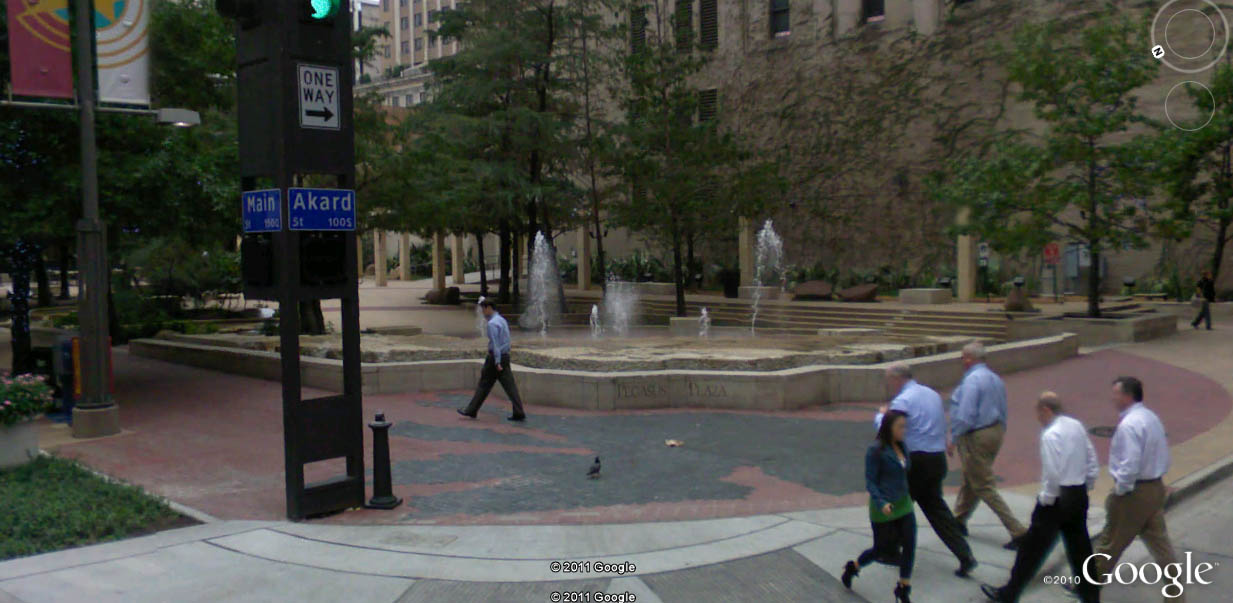
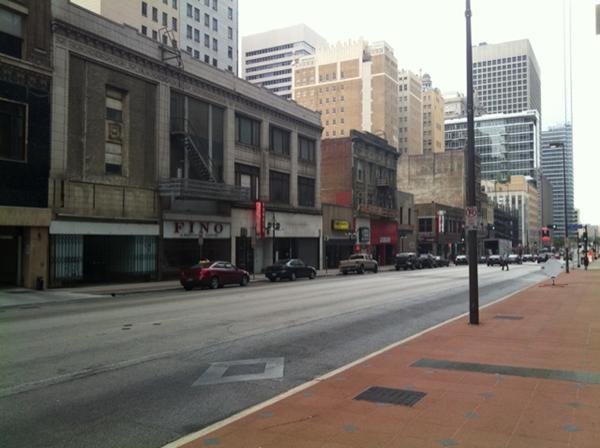
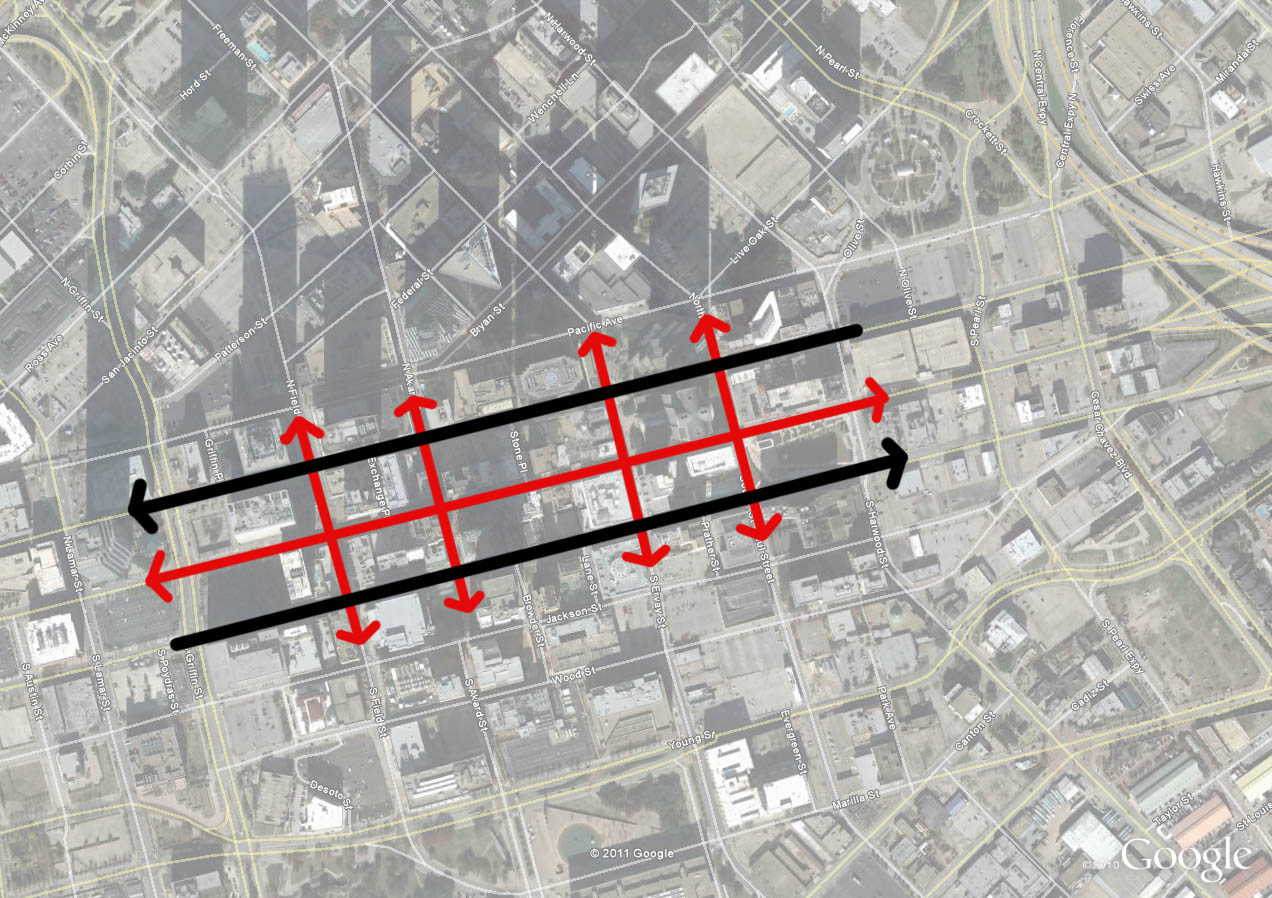
As you can see above, the back of the Magnolia hotel fronts on Pegasus Plaza. Currently, this is a doggie dumping ground. I believe this is even a location picked out by the downtown 360 plan for retail lamination. Placing phase 1 here would build on the success already of Main Street rather than trying to expand that success beyond its natural boundaries. Those boundaries are Elm, Commerce, Field, and Ervay currently.
I'm the first to say we have to build outwards upon Main's success, but that can't be done without addressing Elm and Commerce's natural barrier effect. Much like rivers can't be crossed without fords or bridges, a river of cars is also a barrier to crossing, thus decreasing spatial integration. Meaning less pedestrians, less value.
City has added brick to the sidewalks on Commerce, but has spent nor done anything to actually change the functionality, the integration, of the street. The street is not narrowed, calmed, nor slowed. A center of gravity is not made. It is simply an aesthetic treatment, ie the least important thing you can do if you're really, really trying to catalyze change. Along those lines with the RFQ, the city is spending $500K to pretty up the concrete heavy Browder Plaza. Again, as with all superficial treatments, without first upping the degree of integration, cost significantly outweighs returns.
Now it could be that Commerce is ready for something there, but it is a gamble. Not the sure thing, nor quick win it is being espoused as. This may be a timing issue in conjunction with Forest City delivering more units further down Commerce, however the gravitational pull will remain Main Street as long as Elm and Commerce exist as they do, as escape routes. Places to save time rather than spend time.
The second problem here, is that there is a good chance this is the city picking and choosing winners. I'm no fundamentalist libertarian, but it is rarely a good thing. The public agency is better off focusing on instilling demand through the establishment of a transportation network that is about clustering. That is about demand, rather than about moving people out. Rather than instilling demand, the city is adding supply of new restaurants by funding the startup costs in essence within an area that is likely maxed out on restaurant/entertainment/retail space.
I have no data, just experience living in downtown, but I get the sense that the integration increment DART added to downtown has maxed out. Downtown is what it is now, rather than what it was nearly dead in 2000, because of DART. If we are indeed maxed out, new retail space cannibalizes from existing retail space. From living and being in downtown every day, and experiencing the evolution, it certainly seems like what is happening. One new place opens, another closes.
All of these issues, point towards an economic development program that is better aligned with urban design, and vice versa. I get the sense that they are aligned, just misguided currently. Integration begets accommodation (and decoration). Merely adding accommodation (and decoration) via a variety of incentive packages is spending to get minor successes. The solution is right in many ways, but the superficiality, the supply-sidedness of it, undermines the effort towards quick wins.
Alas, the glass slipper is still just a pumpkin.
Post Script:
Big Jon Daniel asked on twitter if this is a shot by the city "across the bow of food trucks." I don't think that is it at all. In fact, one of the food truck operators would probably be an ideal operator for the first (or any subsequent) glass boxes. Food trucks started because of the reduced startup costs in conjunction with the poor locational efficiency of the majority of the city. Simply put, entrepreneurs couldn't locate in the appropriate spots due to a variety of cost barriers, both real estate and operational.
Speaking for the food trucks, I would expect some would like to grow and expand their business. Many would like to grow up and have ambitions of a permanent establishment. If one of the food trucks moved in to the glass box, that would allow the laminated retail space to operate as a supply depot for the truck. At night, it could even park adjacent along the street and create a little cluster effect between the restaurant and the truck (particularly if the two filled separate culinary niches). Of course, that would mean parking on Commerce Street, altering its traffic flow patterns (God forbid!) and thus, another good idea dies a premature death.






 Posts
Posts