




Showing posts with label Future Economies. Show all posts

Tuesday, February 14, 2012

Linkage

If you read one thing today make it this. Alternet cites a number of economists and economic theorists who are increasingly moving towards the massive structural shift side of the see-saw. Two key quotes:
Austerity and debt reduction will get us nowhere, in this view. In particular: it won't change the fact that we have too many manufacturing workers and too few information workers. Stiglitz argues forcefully that this gap is likely to remain open until our governments make a long-term commitment to do what they did in the 1940s -- that is, fund the kind of aggressive education, research, and infrastructure investments that will finally get us fully transitioned to the new phase. The current economic crisis is doomed to last exactly as long as we delay put off building that necessary to the new information economy. When we come out the other side, there will still be farmers and manufacturers — but even they will be leveraging the power of the Internet to create new wealth. Everybody will.
In other words the stimulus already spent was exactly what we thought it was. Not a stimulus at all in the sense that it would bring it back to life. More like a reanimation in the zombie sense, dead economy walking. We shoveled money into "shovel-ready" projects because city, metro, and state transportation agencies had plans on the books for new highway construction projects, entirely clueless about the massive shift underway economically and needed structurally. We spent to increase disconnectivity when we need to spend to increase connectivity and spatial integration: not more of the same, dendritic transportation patterns but replacing them with legitimate interconnected complex grids. Just like the internet, being connected means opportunity. If everyone is connected (physically and digitally) that empowers all of us to restructure the economy from the ground up.

And with that said, quote 2:

Another one is Thomas Homer-Dixon, a Canadian economist who wrote The Upside of Down. Homer-Dixon marshals evidence that all great empires rise and fall by controlling the dominant energy supply of their age. The Romans used roads and aqueducts to harness solar energy (in the form of food) from around the Mediterranean basin, and used that surplus to fund the most complex society of its time. The Dutch empire rose on its superior ability to master wind technologies — the windmill and the ship — to extend its land holdings, run early manufacturing industries, and extend its trading reach around the globe. The British empire rose on coal-powered steam engines, which gave it more productive industries, railroads, electrical generators, and faster ships. The US eclipsed the Brits due to its vast wealth in oil — a far more concentrated and fungible fuel — and inventions from cars and planes to plastics and fertilizers that allowed it to make the most of its advantages. And the Chinese are now making huge investments in renewable energy and safer, more efficient second-generation nuclear power, which they can use to fuel their ascent to global primacy.

The bottom line in Homer-Dixon’s theory is this: Everything that Americans understand as “wealth” under the current paradigm comes from oil. It’s the foundation of our entire economy, and the ground our superpower status stands on. Our cities are built on the assumption of cheap, plentiful oil. Our consuming patterns are made possible by a fleet of oil-burning trucks, ships, and planes that bring us goods made in oil-driven factories. Our warmaking machine, which is largely tasked with protecting our oil interests around the world, is the single largest consumer of energy on the planet. Even our food is created with vast oil-based inputs of fertilizer and pesticides; and we enjoy a year-round variety of foods (bananas! chocolate! coffee!) that is unprecedented in human history because oil makes cheap transport and refrigeration possible.

And the pain and fear caused when we're forced to face this fundamental fact explains quite a bit about why ideas like climate change and peak oil are so viscerally terrifying to so many Americans. (In many right-wing circles, denial about the American oil addiction is now a core piece of their political identity. It’s considered anti-American to even suggest that getting off oil is necessary or possible.) We are so deeply invested in oil, in so many ways, that it’s almost impossible for us to envision a world beyond it. We stand to lose so much that it’s hard to fathom it all.

And this, says Homer-Dixon, is why no empire has ever survived an energy-related phase shift with its full power intact: the reigning hegemons are always too deeply invested in the current system to recognize the change, let alone respond to it in time. And so they are always superceded by some upstart that’s motivated to put more resources and risk into aggressively developing the next source. The decline of oil as the energy reality of the world has deep implications for every aspect of American life in the coming century. It’s a phase shift at the deepest level.

Buckle up...your bike helmet.


Sunday, June 6, 2010

READER FEEDBACK: Dallas Might Be Gaining People But Losing the Creatives

From long-time loyal reader and regular commenter Himanshu gets bumped from the comments section on Diversity as Livability Indicator to the headline cuz, like woah:
Well, you have an uncanny way or writing down things that I have been thinking. After having worked in downtown Dallas for the better part of the past decade, and having seen the areas of downtown and uptown get better, they still don't seem to catch the essense of what I'm looking for in my neighborhood. So, I'm moving to Center City Philadelphia--Society Hill, specifically. I look forward to ditching my car and walking to work and home, walking to all the bars and pubs and grocery stores, enjoying picnic lunches at Washington Square or Rittenhouse Square or Fitler Square, etc. Shopping on Walnut Street and Market Street and Reading Terminal Market. And doing all this in a place that has a sense of place, has livability, and walkability galore. Your old town, I suppose. But I will continue reading your blog from time to time. Keep it up! And perhaps you'll move (back) to Philly sometime in the future...
Unlike some other regular readers, I have never met Himanshu personally (unless I'm unaware). While this blog doesn't get the kind of traffic that generates the kind of traffic to turn it into a giant money maker itself, it does get a loyal following, and an engaged, intelligent one focused on improving Dallas or general urban issues at that.

Over the last few years however, I have seen scores of talented people move away from Dallas to cities like Portland, Seattle, DC, Boston, and New York being the most common destinations. Given that this particular reader has the means to be able to live in and move from downtown Dallas to center city Philadelphia, these are the kinds of people that we don't want to be losing.

When we look at population figures stating that Dallas is gaining people and that the economy is holding steady or adding jobs, they never tell us what kind of jobs or who these new residents are. These are the definition of dumb statistics. Anecdotally, it feels like we are losing talented people and replacing them with people just looking for a job, any job. The difference between what we're gaining and what we're losing is the difference between a steady current economy and a strong future one.

If we are adding jobs, they are mostly towards the status quo businesses and the "Great Reset" (Richard Florida's term) is a repurposing (evolutionary biologist term) of the economy where the genotype (new generations) shed the phenotype (the past economy) in favor of a new and more serviceable one. Point being that the economy, and our cities in turn, will be very different in 20 or 30 years.

Those we seem to be losing on the negative end of the import/export equation are what Richard Florida might refer to as the Creative Class. While people might interpret Florida here suggesting that the term "creative" implies artisans such as musicians or sculptors or what not, my interpretation is that Florida, the demographer, only uses those as a measuring stick. Professions whereby improving the lives of those who have the means and ability to locate where they choose based on Quality of Life of a particular city meeting their particular needs. The more livable the place, the greater number of these types of people's needs will be met there, the more likely they are to relocate there.

These are the people we MUST be attracting and retaining. While I despise Ayn Rand for missing her own point (or being able to temper it within reality) and dreadfully long soliloquies, these people are the true fountainheads. They are the Structure Builders of the pillars of the future economy by which real, sustainable job growth and long-term prosperity can be founded upon.

They are the measuring stick for where our City will be in 20 years in relation to those where they are choosing to relocate. And we are losing them.

Himanshu mentioned Livability. Washington Post writer Neal Pierce discusses it as well today where he expresses frustration at the vague nature of the umbrella term but the necessity of the concept.

I will help him out. Livability, what people are looking for and where they are moving to are places where choice is in abundance; where people can live the way they want without fear of persecution; where people can find quality housing of the size and type suitable to their needs in neighborhoods of the character matching their desires. Multiple modes of transportation are available allowing for the universal access of all to their destinations. Then there are other kinds of access such as, to education for personal advancement and the CHOICE of careers and to healthcare and justice for well-being of body, mind, and soul.

This is precisely why I am driven crazy by "pro-business" policies. There is nothing about them that is about advancing business or the economy, but rather to protect the status quo. But, the status quo doesn't freeze happiness, comfort, rainbows and unicorns in place. You either progress or get left behind and the status quo ensures falling behind. Sometimes this can mean that a country's industry falls behind another or it can mean the country's people fall behind and are stuck with the bill. See: BP.

To bring this closer to home and back to the focus of this blog, I'm reminded of the new Tarrant County College "campus" in downtown Fort Worth (and one of FortWorthology's personal obsessions) where Kevin was told the anti-urban design was "just being realistic" about Fort Worth's car-orientedness. Status-quo. And here I thought, educational institutions were supposed to be thought leaders, shaping the future and the minds thereof.

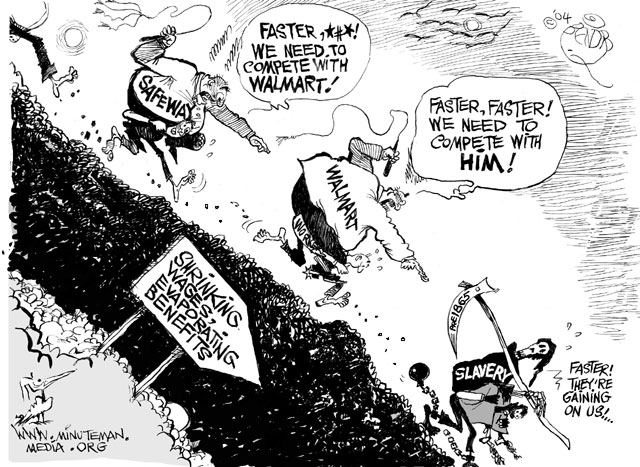
This is the race to the bottom and it is time to start investing in people. It is people that create the economy and our cities not the other way around and our future depends upon it.

http://www.bendib.com/newones/2004/february/small/2-2-Race-to-the-Bottom.jpg