





USA Today has a story on what cities are doing to combat congestion, including a video of a few Minneapolis commuters taking the road less traveled:
What is important here, is the transportation official interacting directly with various downtown employers, which can get discounted transit passes in bulk whereas an individual without said agency-company agreement ends up paying the full fare. The transit agency gets the kind of ridership they need for a variety of reasons, the City gets reduced congestion, and we all get less CO2 spitting internal combustion, overproduced "freedom-making" contraptions.
What many companies end up doing however, is to roll the amount of a monthly transit pass into the salaries of their employees under a misguided attempt at providing "choice." What ends up happening though, we end up pocketing what amounts to little more than a couple of dozen dollars per month and spend several times more money on gas, parking, and car ownership/maintenance than we would otherwise. Perhaps we think it is more convenient, but in the end it wastes our own money, time-saved is often a wash, and the entire city loses money due to man-hours lost in congestion as idling cars belch and fart poison into the air you and I breathe.
Point being, we don't always make the choice that is in our own best interest despite theorists' attempts to suggest we always do/would/should/could in some imaginary perfect world. Sometimes we do need a little softly paternalistic "nudge" of an opt-out system. If companies participated in a program where instead of providing parking for their employees as well as travel stipends of say, $100 a month, they could save on both and buy passes for all of their employees at $50 a month (hypothetical), thereby giving all of their employees essentially a free transit pass to use at their discretion.
If nothing else, the excuse "my car broke down" would no longer be valid for showing up late to a meeting or shift.
Showing posts with label Good Public Transit. Show all posts
Showing posts with label Good Public Transit. Show all posts
Monday, July 26, 2010


Thursday, July 8, 2010
Toot Toot!
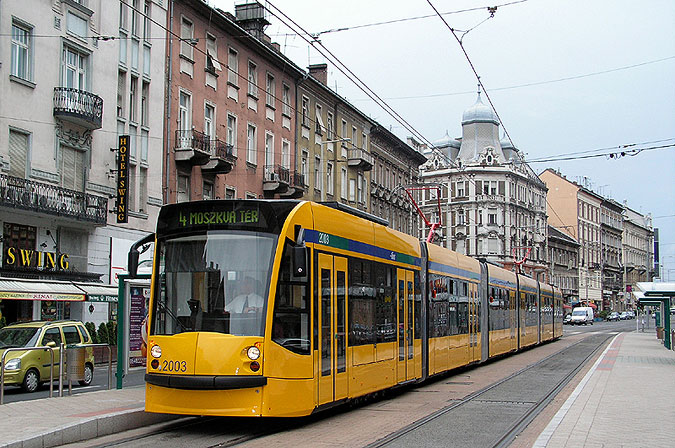
It looks like Fort Worth is one of the big winners for more hot stinky federal cash money for new transit lines. From the FTA announcement website:
Project: Fort Worth Streetcar Loop (Urban Circulator)
Sponsor: The City of Fort Worth and the Fort Worth Transportation Authority
Amount: $24,990,000The City of Fort Worth and the Fort Worth Transportation Authority will construct a 2.5-mile one-way streetcar loop with between 20 and 25 stops and three vehicles to connect a Trinity Railway Express commuter rail station and Intermodal Transportation Center with the central business district. This will be the hub of a planned streetcar network connecting six designated “urban villages” targeted for redevelopment to the city’s major employment centers, such as downtown and the Near Southside Medical District. Ultimately, the streetcar system will connect residents in four economically disadvantaged areas to job opportunities in major employment centers, while stimulating the redevelopment of walkable urban neighborhoods with a variety of housing choices.
Dallas also gets a hand in the pocket to extend the MATA to St. Paul DART station and loop back on Olive:
That is about it for Texas projects except for some chump change to Brownsville. Just kidding. Brownsville is probably doing backflips over a $4 million grant for intermodal station. But the question is, what the heck are Austin and Houston up to???Project: Olive/St. Paul Street Loop (Urban Circulator)
Sponsor: Dallas Area Rapid Transit Authority (DART)
Amount: $4,900,000The Dallas Area Rapid Transit Authority (DART) will build a 0.65-mile urban streetcar track extension to an existing system. This project would link the current McKinney Trolley to the existing DART light rail St. Paul Station and to the McKinney Trolley Olive Street Extension in the heart of Downtown Dallas. The connection to the Olive Street extension would form an entire reversing loop for the trolley, making operations safer and more efficient, while connecting downtown destinations such as the Dallas Museum of Art and the Nasher Sculpture Center to Uptown Dallas.
Friday, April 9, 2010
What Did I Just Say
I wasn't exactly going out on a limb or exploring any new ground outside of logic and common sense, but today the DMN has an article on NCTCOG's own explorations into private funds in support of the Cottonbelt line. The basics:
Perhaps, we should look back at the history of rail (heavy rail and streetcars) in order to locate private investors. Rail and streetcars were originally funded by landowners with the most to gain, speculators looking to unlock the potential of their newly acquired property for residents seeking to escape the squalor and poverty of 19th and early 20th century industrial cities. Other investors were new industries created outside of cities. They wanted to either deliver workers to the job site or in the case of company towns, deliver their mined material back to cities.
It was an exploratory phase, not unlike the motivations and mechanisms propelling the latest exploratory phase, as we know as, sprawl. On the timeline of city evolution, which is longer and therefore slower than most humans can comprehend, it is our way of testing out the real value of land. For example, we are finding that some areas of sprawl will still have value and will see reinvestment in the form of increased density and walkability, while others fade back to nature or agricultural production, etc.
Like then, those that have the most to gain from investing in new transit lines within the amorphous post-modern city are (possibly but not definitely in order of magnitude):
With transportation funds running short at every level, regional planners for the North Central Texas Council of Governments are seeking permission to lead an unusual partnership with private investors so they can fast-track a 62-mile rail line known as the Cotton Belt corridor...This is what I said just a few days ago:
As with toll road deals, private partners who invest in rail lines would insist that every service decision - from ticket costs, to station locations, to schedules and parking fees - be examined with an eye on how much revenue they could produce.
Now the real brain damage can start: how to pay for the construction of something that, like all transportation, rarely pays for itself, has high initial startup costs, and a return that is disconnected from its investment. Because it does generate returns for landowners near to lines, increased tax base for cities, development opportunities for private investment, and eventually increased mobility due to the associated high density development that accompanies new streetcar lines, we are confident that it will take creative public-private partnerships to see the vision through.Here is where it gets sticky. The investors would be looking at conventional revenue generation, i.e. fares and fees to generate their return. I suppose that could work, but in a world where all transportation is essentially a sunk cost in the name of commerce and interconnectivity (and in this case increased land value), that could raise fares to a rate that might be a barrier to utilization, driving down ridership, and in turn, rate/date of return on investment. That, or the public agencies must dig really deep to pay back investors first and take all operations at a heavy loss. The structure of this deal can work in that those with the most long-term benefit, the cities/public agencies, are essentially taking a loan from private investors in order to raise enough upfront capital to build the line.
Perhaps, we should look back at the history of rail (heavy rail and streetcars) in order to locate private investors. Rail and streetcars were originally funded by landowners with the most to gain, speculators looking to unlock the potential of their newly acquired property for residents seeking to escape the squalor and poverty of 19th and early 20th century industrial cities. Other investors were new industries created outside of cities. They wanted to either deliver workers to the job site or in the case of company towns, deliver their mined material back to cities.
It was an exploratory phase, not unlike the motivations and mechanisms propelling the latest exploratory phase, as we know as, sprawl. On the timeline of city evolution, which is longer and therefore slower than most humans can comprehend, it is our way of testing out the real value of land. For example, we are finding that some areas of sprawl will still have value and will see reinvestment in the form of increased density and walkability, while others fade back to nature or agricultural production, etc.
Like then, those that have the most to gain from investing in new transit lines within the amorphous post-modern city are (possibly but not definitely in order of magnitude):
- the landowners in an around the stations where their potential value would be increased (increment to be determined),
- businesses nearby to stations who would benefit from employees/customers within walking distances,
- the prior two combined with the potential decrease in parking demand thus allowing for reduced parking land area, parking fees, and infill opportunities,
- the transit agency (obvious stake in the game) who could build a parking facility with revenue generation to support transit station and reduce the amount of surface parking mentioned previously. Remember: parking should rarely if ever be free,
- cities. more long-term benefit through reduced traffic capacity, improved intracity connectivity, more dense development, and increased tax base.
- the riders. Obviously, they will be paying the fares. Unless we were able to get to a free fare system due to enough investors above that see the value in the above and can guarantee their returns indirectly by way of something other than fares.
Wednesday, April 7, 2010
Fort Worth to Proceed with Streetcar Study
Old news by now, but the vote was indeed unanimous. Major kudos to Fortworthology on this one, who instead of gloating wisely decided to bite their tongue (this time). See their post on the proceedings:
I look forward to tracking HDR's progress on this project.
We’ll save the analysis, and the correcting of certain council members, for another time. For now, we’ll just say “thank you” to the supporters who spent a long night in council chambers and a “thank you” to all those in the public and private sectors who have worked to get us this far. All your support had a very real impact on how this vote went.Now the real brain damage can start: how to pay for the construction of something that, like all transportation, rarely pays for itself, has high initial startup costs, and a return that is disconnected from its investment. Because it does generate returns for landowners near to lines, increased tax base for cities, development opportunities for private investment, and eventually increased mobility due to the associated high density development that accompanies new streetcar lines, we are confident that it will take creative public-private partnerships to see the vision through.
I look forward to tracking HDR's progress on this project.
Monday, December 14, 2009
Person without Veins?
Frankly, I don't know enough about the Vancouver Sun to tell whether or not it is a reputable rag. Articles like this one aren't helping however.
Some parts of their "Rethinking Green" series come off as purely contrarian (I too questioned recycling, focused on the dirtiness of the toxins in the materials getting recycled and the pretense of "doing something good,"), and then others like the linked above are just outright self-serving propaganda. I say that because of the singularity of opinion of those quoted in the article.
There are a million terrible definitions and interpretations of sustainability out there. What sustainability implies a system, one built upon a foundation of both economics and ecology, both of which are systems that are not fully understood. So therein, one can see the incredible difficulty in boiling down to what is sustainable and what isn't without a more wholistic view.
Not to take this into an ad hominem direction, but to only quote Cox and O'Toole is some shallow and self-serving "journalism." Neither are credible, on the payrolls of the road lobby, and are incredibly deceiving will their well-framed "statistics." Cox and O'Toole are notorious for taking incredibly narrow (and increasingly shrill) views of statistics that are intended to dumb down the debate into something little more than "OMG! Transit is so expensive!" So is caring for children, should we stop that?
My point isn't that transit is a magical panacea, nor that it is appropriate for cities of all shapes, sizes, and geographical contexts. It is that the debate is well beyond their, or this authors, scope. And to further narrow the stance to only include essentially two hucksters is to further drown the level of dialogue in the puddle beneath are feet (or tires if you wish). Why not include a real academic from your own neck of the woods like Tod Litman from VTPI?
------------------------------
The real issue that Cox, O'Toole and any other well-heeled faux libertarian simply cannot understand or argue with any sort of rigorous rhetoric effectively on their narrow view of statistics. Which is why you are seeing transit pick up steam the world over, and ironically generate more press for these two for anybody desperate for a sound bite in opposition.
"OMG, it's expensive!"
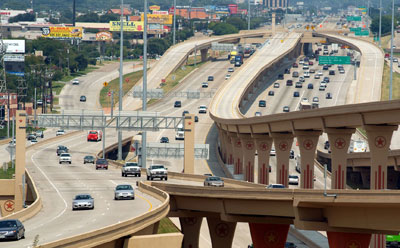
Simply put, car only subsidization has led to car only usage. Car only usage has led to incredibly wasteful projects like the high five in Dallas. While these types will argue that it improves economic development because it created jobs and improves connectivity and reduces traffic, , while it may temporarily reduce traffic (with nothing to say about the several years of construction and the resultant delays) the reduced traffic then has a negative effect by actually inducing more traffic b/c of the temporary gains, thus spreading people apart further. It also wrecks real estate values within any vicinity of it, because frankly, it is attrocious to be near (also, with nothing to say about the increased stress, birth defects, and respiratory issues by proximity to freeways).
Transportation can never be looked at in a bubble. You can't isolate any particular system and suggest definitively whether it is "green" or not, whatever that means. The reason is because transportation, of any form, is inextricably linked and largely responsible for the resulant built-form of the city. The built form then interprets how the city functions.
To isolate the pro forma of any transportation system is like removing the arteries, veins, and capillaries from a human being and then wondering why the blood discontinued to flow. A doctor has to examine the health of the entire patient, to determine the health of the cardiovascular system and vice versa. If the City is unhealthy, the cardiovascular system (its transportation system) has to become more healthy.
Second, no form of transportation has ever "paid for itself." What these biased takes fail to understand is that the more governments subsidize road construction and sprawl, the more they have to subsidize transit, b/c the excessive road construction leads to fragmented, sparse, and disconnected land use, unsuitable for transit use, and therefore a failing transit system.
Relatedly, as transportation has a direct effect on land use, density, and the interrelationship between land uses, forms of transportation have multiplier effects that are incalculable in terms of sustainability and economy. The way to measure the "greenness" of transport is not in the functionality of transit systems but the built form and the emergent operations of the city sprung from it.
Car only-based transport policy leads to low density development which is more energy-consumptive, generates incredible amounts of waste thru increased air pollution from the car use, reduced water quality and environmental degridation from runoff, waste of man-hours in traffic jams, as well as increased refuse from a low-density lifestyle, and waste in supply-chains having to diffuse the distribution of goods to sparse, low density development.
This is bad for the economy as well for a number of reasons. The government builds roads that creates a low density form of development that, in turn, can not pay for the upkeep of the over-extended infrastructure. Furthermore, because of the fractured and disconnected development that emerges based on car-dominated transport policy, people think they are getting cheaper goods.
But, the fact of the matter is, extra costs have been externalized to the consumer and siphoned off every single trip by way of car ownership/maintenance, road construction and upkeep, health and productivity losses due to traffic and collisions. While creating a highway that links the Houston area to the Dallas area is a good thing, forcing all trips throughout the day to the confines of a car is wasteful and exclusionary of proportions never seen on this earth.
(Once again, with nothing to say about the 1.3 million people killed per year in traffic related collisions.)
Lastly, and unfortunately for them, the ultimate decider in human decisions tends not to be an altruistic sense of right and wrong, and fortunately not even of $1 and 2$ but what makes life better? Would you rather live in a place like this?
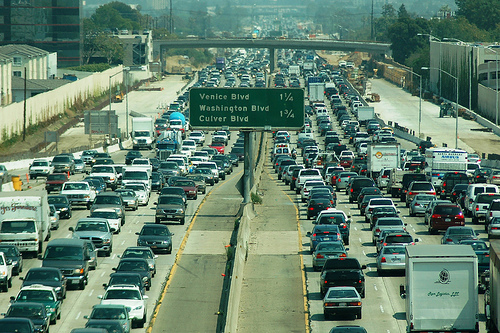
or a place like this?
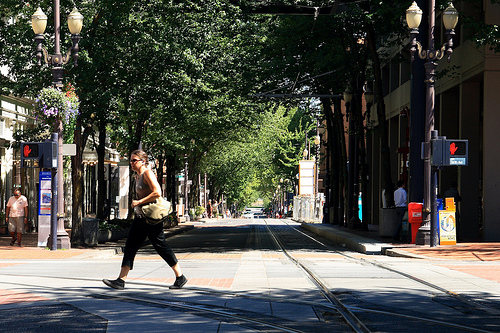
One could say, "how can you compare those two things? Of course, I'm going to pick the pretty picture!" The reason is because these are the two end states of the divergent policies being debated. Should we craft policy that supports only the car, oil, and gas industry or one that the end result is people places?
A complete street, equitable to all transportation types and attractive enough to be livable, and in turn, entice density. The density then reduces Vehicle Miles Traveled, which reduces pollution, reduces the need for context-coerced car ownership, and reduces traffic. The density also makes business and retail more successful because there is a customer-base within a short distance at all times. A business can easily market from its storefront to a hundred residents that live above, or 500 pedestrians that walk past each day.
That is why THIS will eventually win the debate, suggesting it is time to the afforementioned cast of characters on IGNORE.
Some parts of their "Rethinking Green" series come off as purely contrarian (I too questioned recycling, focused on the dirtiness of the toxins in the materials getting recycled and the pretense of "doing something good,"), and then others like the linked above are just outright self-serving propaganda. I say that because of the singularity of opinion of those quoted in the article.
There are a million terrible definitions and interpretations of sustainability out there. What sustainability implies a system, one built upon a foundation of both economics and ecology, both of which are systems that are not fully understood. So therein, one can see the incredible difficulty in boiling down to what is sustainable and what isn't without a more wholistic view.
Not to take this into an ad hominem direction, but to only quote Cox and O'Toole is some shallow and self-serving "journalism." Neither are credible, on the payrolls of the road lobby, and are incredibly deceiving will their well-framed "statistics." Cox and O'Toole are notorious for taking incredibly narrow (and increasingly shrill) views of statistics that are intended to dumb down the debate into something little more than "OMG! Transit is so expensive!" So is caring for children, should we stop that?
My point isn't that transit is a magical panacea, nor that it is appropriate for cities of all shapes, sizes, and geographical contexts. It is that the debate is well beyond their, or this authors, scope. And to further narrow the stance to only include essentially two hucksters is to further drown the level of dialogue in the puddle beneath are feet (or tires if you wish). Why not include a real academic from your own neck of the woods like Tod Litman from VTPI?
------------------------------
The real issue that Cox, O'Toole and any other well-heeled faux libertarian simply cannot understand or argue with any sort of rigorous rhetoric effectively on their narrow view of statistics. Which is why you are seeing transit pick up steam the world over, and ironically generate more press for these two for anybody desperate for a sound bite in opposition.
"OMG, it's expensive!"
Simply put, car only subsidization has led to car only usage. Car only usage has led to incredibly wasteful projects like the high five in Dallas. While these types will argue that it improves economic development because it created jobs and improves connectivity and reduces traffic, , while it may temporarily reduce traffic (with nothing to say about the several years of construction and the resultant delays) the reduced traffic then has a negative effect by actually inducing more traffic b/c of the temporary gains, thus spreading people apart further. It also wrecks real estate values within any vicinity of it, because frankly, it is attrocious to be near (also, with nothing to say about the increased stress, birth defects, and respiratory issues by proximity to freeways).
Transportation can never be looked at in a bubble. You can't isolate any particular system and suggest definitively whether it is "green" or not, whatever that means. The reason is because transportation, of any form, is inextricably linked and largely responsible for the resulant built-form of the city. The built form then interprets how the city functions.
To isolate the pro forma of any transportation system is like removing the arteries, veins, and capillaries from a human being and then wondering why the blood discontinued to flow. A doctor has to examine the health of the entire patient, to determine the health of the cardiovascular system and vice versa. If the City is unhealthy, the cardiovascular system (its transportation system) has to become more healthy.
Second, no form of transportation has ever "paid for itself." What these biased takes fail to understand is that the more governments subsidize road construction and sprawl, the more they have to subsidize transit, b/c the excessive road construction leads to fragmented, sparse, and disconnected land use, unsuitable for transit use, and therefore a failing transit system.
Relatedly, as transportation has a direct effect on land use, density, and the interrelationship between land uses, forms of transportation have multiplier effects that are incalculable in terms of sustainability and economy. The way to measure the "greenness" of transport is not in the functionality of transit systems but the built form and the emergent operations of the city sprung from it.
Car only-based transport policy leads to low density development which is more energy-consumptive, generates incredible amounts of waste thru increased air pollution from the car use, reduced water quality and environmental degridation from runoff, waste of man-hours in traffic jams, as well as increased refuse from a low-density lifestyle, and waste in supply-chains having to diffuse the distribution of goods to sparse, low density development.
This is bad for the economy as well for a number of reasons. The government builds roads that creates a low density form of development that, in turn, can not pay for the upkeep of the over-extended infrastructure. Furthermore, because of the fractured and disconnected development that emerges based on car-dominated transport policy, people think they are getting cheaper goods.
But, the fact of the matter is, extra costs have been externalized to the consumer and siphoned off every single trip by way of car ownership/maintenance, road construction and upkeep, health and productivity losses due to traffic and collisions. While creating a highway that links the Houston area to the Dallas area is a good thing, forcing all trips throughout the day to the confines of a car is wasteful and exclusionary of proportions never seen on this earth.
(Once again, with nothing to say about the 1.3 million people killed per year in traffic related collisions.)
Lastly, and unfortunately for them, the ultimate decider in human decisions tends not to be an altruistic sense of right and wrong, and fortunately not even of $1 and 2$ but what makes life better? Would you rather live in a place like this?
or a place like this?
One could say, "how can you compare those two things? Of course, I'm going to pick the pretty picture!" The reason is because these are the two end states of the divergent policies being debated. Should we craft policy that supports only the car, oil, and gas industry or one that the end result is people places?
A complete street, equitable to all transportation types and attractive enough to be livable, and in turn, entice density. The density then reduces Vehicle Miles Traveled, which reduces pollution, reduces the need for context-coerced car ownership, and reduces traffic. The density also makes business and retail more successful because there is a customer-base within a short distance at all times. A business can easily market from its storefront to a hundred residents that live above, or 500 pedestrians that walk past each day.
That is why THIS will eventually win the debate, suggesting it is time to the afforementioned cast of characters on IGNORE.
Monday, July 6, 2009
Cost of Transit
TreeHugger has an article up that ranges from NYC upping their subway fares to the various costs among international subway/transit lines to the differences between zone- or distance-based pricing to standardized fares:
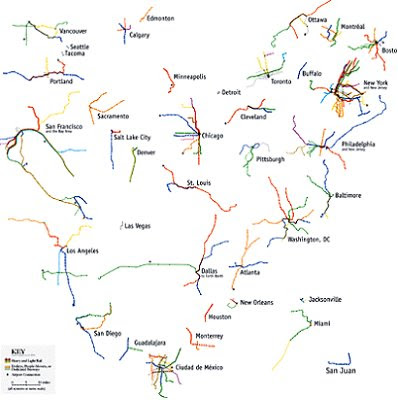
While I haven't shied away from the idea of fare-free transit, my trips on DART consist mostly of shorter trips from Downtown to American Airlines Center for events/games, to CityPlace for West Village or Target, or to Mockingbird Station for food and drinks.
Meanwhile, San Francisco's BART and DC's Metro -- two of the newest U.S. metro systems (1972 and 1976, respectively; LA's subway is the newest) -- are the only American networks listed here to rely on zone or distance-based pricing. The further you travel, the more expensive the fare.Dallas DART has a bit of a hybridized system where one purchases "premium" to travel between Dallas and Fort Worth, typically on the TRE. As you can see on the map, Dallas' system is pretty spread out suggesting the majority of trips would be pretty long in comparison with say a more dense system like Chicago.
Such a system potentially makes the per mile cost of those subways cheaper. In cities with fixed fares, meanwhile, riders who travel short distances are effectively helping to pay for the cost of those who travel longer distances.
Still, I tend to think the costs of zone-pricing outweigh the benefits. Not only can it make subway travel considerably more expensive than it might otherwise be, but it presumably adds more management costs for the subway and more complication (and okay, aggravation) for riders who don't want to get their ticket out every time they leave the subway. I'm not sure fast-paced New Yorkers could stand for the kind of turnstile gridlock that could ensue, in the way that Bay Area or DC riders might be able to.
While I haven't shied away from the idea of fare-free transit, my trips on DART consist mostly of shorter trips from Downtown to American Airlines Center for events/games, to CityPlace for West Village or Target, or to Mockingbird Station for food and drinks.
Much more rarely however, I do take the TRE to DFW or to the once a year trip to Fort Worth, which is eminently more enjoyable than the drive down 30. Apparently, there is WiFi on the TRE as well, but I didn't happen to bring the laptop or sync it with my Iphone. With either however, I can browse, listen to music, post on this blog...ALL more interesting than sitting on I-30.
Back to the point of the article, I tend to back a fare plan that is NOT distance based and more standardized fare. As the article suggests this makes short trips subsidize the long ones. But, in high quality cities, those short trips can be accomplished by cleaner means than what one Dallas City official refers to as "not light rail, but welter-weight rail," which is still cleaner and more efficient than personal automobile use AND produces better and more efficient land use and building patterns.
Rather than taking comparatively expensive short trips on the welterweight rail, one would take streetcar, walk, or bike (caveat: in cities where those forms of transportation are amenable, pleasurable, and safe). And, since long trips are now relatively cheap, it encourages long trips by welterweight rail rather than personal car.
The only problem I have with Dallas' system is that to go to the airport currently, which I have done exactly once now via TRE, is that it is a "premium" trip. I don't mind that Dallas to Fort Worth or vice versa is a step up in price scale for distance but shouldn't DFW be a sort of neutral ground for both cities rather than being more expensive for one city to get to than its sibling?
Friday, April 17, 2009
Transit = Healthy
UBC Researchers learn that transit riders are 3 times more likely to meet fitness guidelines.
"The idea of needing to go to the gym to get your daily dose of exercise is a misperception," says Frank, the J. Armand Bombardier Chairholder in Sustainable Transportation and a researcher at the UBC Institute for Resources, Environment and Sustainability. "These short walks throughout our day are historically how we have gotten our activity. Unfortunately, we've engineered this activity out of our daily lives."
The researchers conclude that making transit incentives more broadly available may produce indirect health benefits by getting people walking, even if it's just in short bouts.
"This should be appealing to policy makers because it's easier to promote transit incentives - such as employer-sponsored passes or discount fares - than to restructure existing neighbourhoods," says Frank.
The research could have major implications for urban planning and public transit development, Lachapelle says.
Monday, April 13, 2009
Something Magical
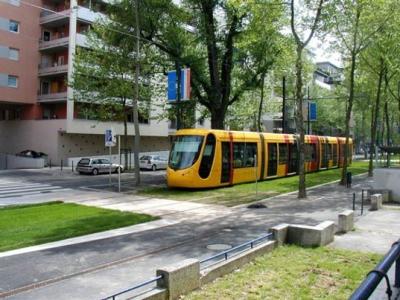
“There’s something quite magical about watching trams in Barcelona, Strasbourg or Frankfurt glide silently along beds of grass as they do their city circuit. Where possible, this attractive combination of efficient public transport and inspired landscaping should be standard as part of the urban fabric . . .”
Friday, March 27, 2009
BS. I'm Pissed They're Saving More Than Me.
B'more Transit Users Save Thousands. No word on whether Senator Clay Davis has ever rode MTA:

According to a new study based on gas prices and parking rates, transit riders in Baltimore can expect to save an average of $8,635 a year by riding MTA. That's almost $720 a month.Actually, this (along with the hassle of registration, insurance, and the like) is the primary reason I have not yet bought another car. When I got out of the CoolRolla after driving on I's-75,35,45,30 or 20, I was pissed off. I don't like being in a bad mood. Because when I'm in a bad mood, I ball my fists and things get messy.
"Traffic jams is another issue here we are forgetting. You don't get traffic jams on MTA," Barasa said.
Tuesday, March 3, 2009
The Rare Night Time Post
Ouch. My food is too hot.
See the fun you can have in a world built around trains and walkability:
I don't imagine the stand still traffic in the morning rush hour on I's 75, 35, 45, 30 or 20 sharing any people to people moments like this unless it involves this:

See the fun you can have in a world built around trains and walkability:
I don't imagine the stand still traffic in the morning rush hour on I's 75, 35, 45, 30 or 20 sharing any people to people moments like this unless it involves this:
Thursday, February 26, 2009
Links
DMN: Spanish company wins job to rebuild LBJ Freeway. Unfortunately, though to not DEconstruct it. I have a friend that works for that company.
Wired gets on board the (pedestrian) Luv Train: It's Time to Favor People over Cars.
Wired gets on board the (pedestrian) Luv Train: It's Time to Favor People over Cars.
Transit is essential during big events.Papandreou called for an end to "state, federal, and local land use policies that are literally forcing people to have to drive" and told Wired.com we're on the cusp of an inevitable "mode shift" away from individual car ownership toward a greater reliance on mass transit and sustainable transport.
"We're already at that crossroads," he said.
------
Car-friendly policies have created a "carbon shadow" that vehicles can't escape -- the result of "all of the regional consequences of all these policies and collective actions," he says. Instead of the "manufactured value" of personal car ownership, we should adopt "demand management" by creating disincentives for driving that will, in turn, encourage people to walk, ride mass transit, carpool and use other means of getting around.
In Papandreou's eyes, freeways are wasted space. Consider this: 200 people can jam the I-405 riding along in 177 cars (the average ratio). Or they could use just two lanes in three city buses, or have plenty of personal space around them if they rode bikes.
"All that road space could become something else," he said, stressing that the only way to achieve that vision is with a total "eco rehab" that avoids the sort of ineffective piecemeal programs that only survive due to their political popularity. The Obama Administration's economic stimulus package could be a first step toward that future.
"It's a down payment to a massive mortgage," Papandreou said. "I'm hoping that the stimulus gets the ball rolling."
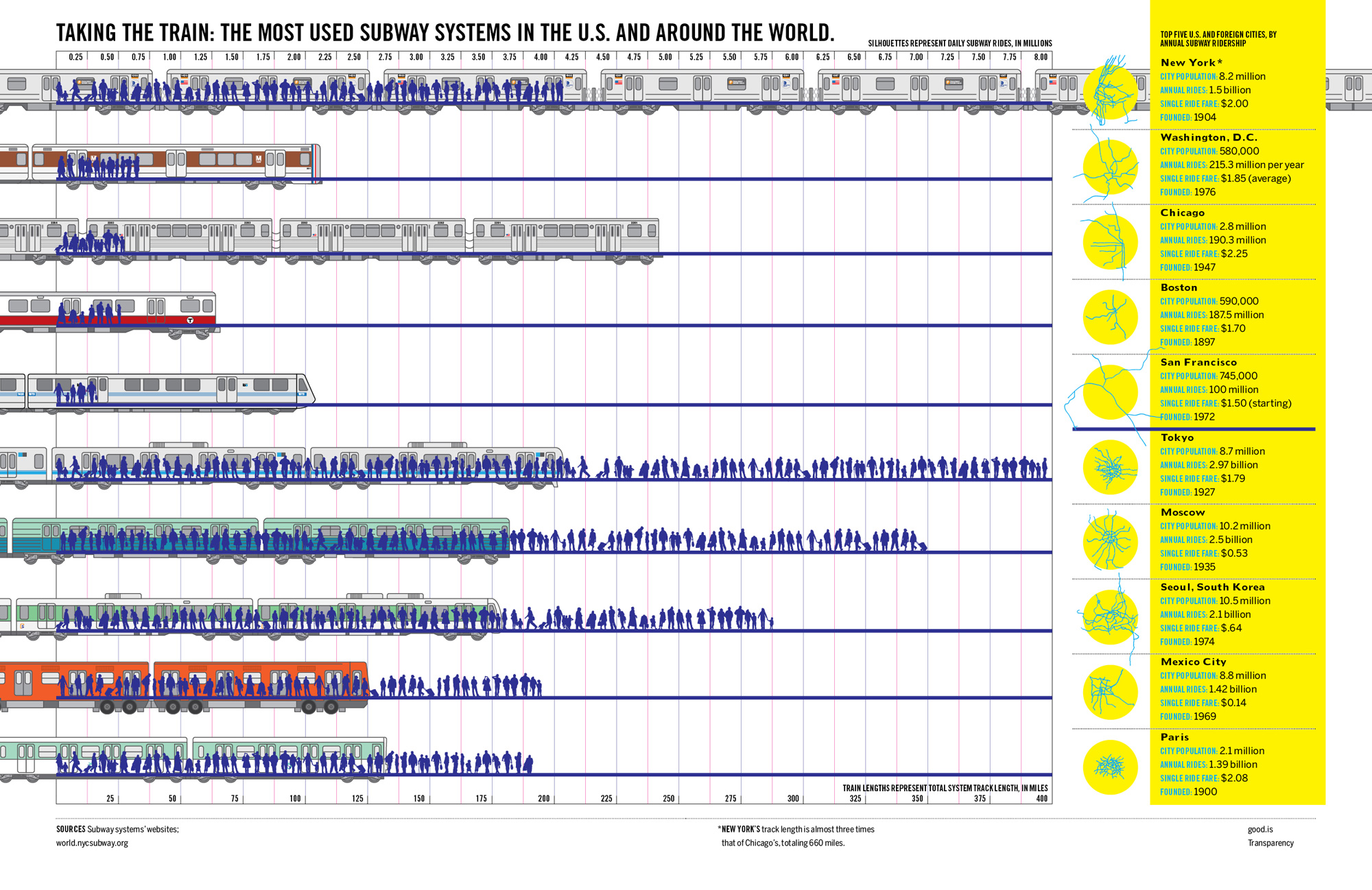
In case no one has noticed, there's a pretty good stadium in Anaheim where no professional football has been played in 15 years, even though there's a train station in the parking lot that accommodates about 40 Amtrak and Metrolink trains a day. It's no coincidence that the two big-city downtowns we at CP&DR decided were the best in California - San Diego and San Francisco - have great ballparks downtown right near transit stops.GOOD Magazine compares subways and ridership, click on graphic or link to see full image (firefox is killing me this week) and notice the graphic to the right comparing the network of each image and how tightly-knit (or not) each system is...then notice the correlated ridership.
Wednesday, February 25, 2009
The Case for Fare-Free Transit
At Alternet:
A major analysis of U.S. public transit systems found that for larger systems, fare collection costs can be as high as 22 percent of the revenue collected. Another study showed that New York City's Metropolitan Transportation Authority spends roughly $200 million a year just to collect money from transit riders. What about switching to "smart card" technology? Wouldn't that save money? In Toronto, the city's Transit Commission estimates the switch will cost almost $250 million (or about 520 new buses) for card readers, vending machines and retrofits, and over $10 million a year (22 new buses) after that, which has some transit authorities saying the money could be better used in improving service.While, the switch of convenience (ease of use vs. ease of private automobile use) creates greater ridership, which in turn means greater localization, or predictability of where travelers will be which promotes businesses along its routes, generally the types of cafes and shops, and restaurants that make for interesting places:
By making public transport free of charge, it became possible to guarantee the right to mobility for all residents in Hasselt. Their position was that an improved public transport system simply means a better use of the public space that will not only improve the quality of traffic, but the quality of life in general.
...[ed. more, since we've brought up the idea of VMTs]Imagine if a government tried to put a farebox into every car. Each time drivers took a trip, they would have to dig into their pockets to find a couple dollars -- in exact change.
And yet, we force the poorest among us to live this way. In British Columbia's Lower Mainland, one of the most expensive places to live in North America, a family traveled from a suburb to Vancouver by public transit during spring break. It cost the mother and her three sons $26 in day passes.
For those without well-paying jobs, a bus fare of any amount can be a barrier to finding work, making it to school, visiting friends and relatives or even getting food to eat.
Wouldn't it make more sense to treat public transit the way we treat most road infrastructure and pay for it all by some method of taxation?
Tuesday, February 24, 2009
NPR on High Speed Rail
Bear with me as it seems Firefox has developed some screwy formatting issues with regards to pictures...
On the fast track (link).
While it is good to see the hometown of Harrisburg, PA get on the list, it is interesting that a Texarkana to Little Rock connection is more important than Dallas to Houston. There is a full size map of the entire country and all lines at the link above. Here is a zoom in locally: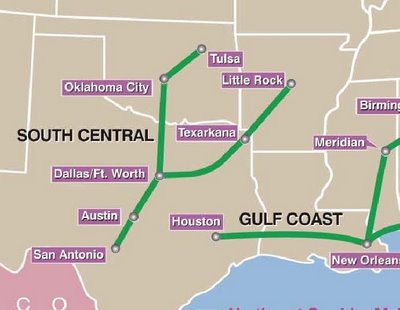
So what this is telling me is that if I could somehow get to Houston, greyhound of the skies or actual greyhound, I could hi-speed train it all the way back to mama's house. With the new green line, I would be able to DART to Love Field, Southwest it to Houston, somehow get to wherever their train station might be and then get on the 1500 mile trek home.
Meh, it would be easier to just fly. How about we focus on the Megalopoli [sic] as I mentioned previously and worry about linking them later (and to second/third tier cities). Bo-Wash, Charlotte-Richmond-Atlanta-RDU, DFW-Houston-Austin-San Antonio - California corridor, etc.
Here was my take from a couple of months back on a full hierarchy of new routes from Hi-speed, to commuter, to streetcar: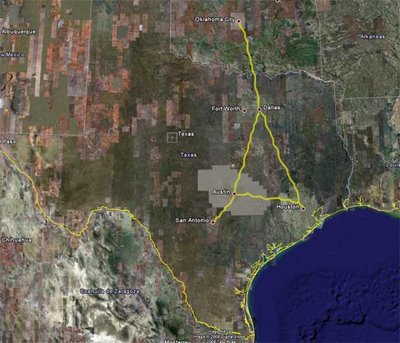
On the fast track (link).
LaHood has sent Obama a memo outlining a half-dozen rail corridors across the country that could be in line to get some of the high-speed rail money.Of all the things Obama has to face, this is the one opportunity for a real legacy project, perhaps not greater in significance, but more influential than the trans-continental railroad or Eisenhower's interstates. One that shapes the future of this country and stimulate increased investment in our left behind urban cores.
While it is good to see the hometown of Harrisburg, PA get on the list, it is interesting that a Texarkana to Little Rock connection is more important than Dallas to Houston. There is a full size map of the entire country and all lines at the link above. Here is a zoom in locally:
So what this is telling me is that if I could somehow get to Houston, greyhound of the skies or actual greyhound, I could hi-speed train it all the way back to mama's house. With the new green line, I would be able to DART to Love Field, Southwest it to Houston, somehow get to wherever their train station might be and then get on the 1500 mile trek home.
Meh, it would be easier to just fly. How about we focus on the Megalopoli [sic] as I mentioned previously and worry about linking them later (and to second/third tier cities). Bo-Wash, Charlotte-Richmond-Atlanta-RDU, DFW-Houston-Austin-San Antonio - California corridor, etc.
Here was my take from a couple of months back on a full hierarchy of new routes from Hi-speed, to commuter, to streetcar:
Wednesday, February 18, 2009
TreeHugger Touts Rail Investment
Link.
But, how far will $8 billion get us? Let's say a typical high speed rail line costs $80M per mile. Throw in another $20 for gubmint waste (or just to make nice round numbers). That is 80 miles. WooHoo, high speed rail to Waco!
Or at least it's enough to get started on planning and design throughout the country. Oh well.
But, how far will $8 billion get us? Let's say a typical high speed rail line costs $80M per mile. Throw in another $20 for gubmint waste (or just to make nice round numbers). That is 80 miles. WooHoo, high speed rail to Waco!
Or at least it's enough to get started on planning and design throughout the country. Oh well.
Tuesday, February 17, 2009
Back from the Desert
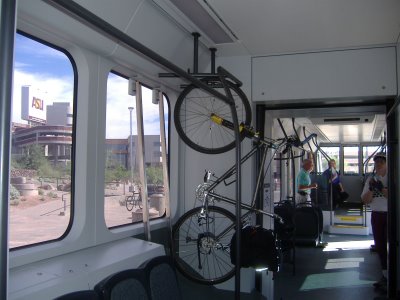
And riding PHX's new light rail into PHX from Tempe for the Dunk Contest and All-Star festivities. I didn't take this image, but found it appropriate since you can see ASU's Sun Devil Stadium, where we were most of the time...got into plenty of conversations about mass transit in general and was actually surprise at how little seating there is on the new trams (I say trams because the ride felt more like a tram than say DART's light rail trains with more seating, higher speed, etc. etc.).
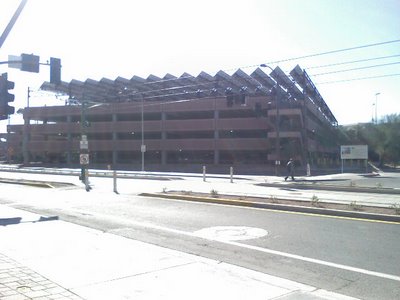
[I did take this pic however with my camera phone, literally across the street from the picture above of a parking garage with a rooftop solar array that rotates to point directly at the sun throughout the day -- If anybody finds info on how much power this generates, I would love to find out.]
I'm not surprised that much of the b!tching about the expense of the light rail has died down. It is tremendously convenient linking downtown Tempe and Arizona State to the airport (not a direct link but it gets there nonetheless) and eventually to downtown Phoenix, the baseball stadium, and the basketball arena. $2.50 for an all day pass which was nice as well.
On to the links for the day...
......................................................
Nothing outrageous here, but the Boston Herald asks Are McMansions McHistory?
A recent Better Homes and Gardens poll of 733 potential new-home buyers found that one in three wanted a house “somewhat smaller” or “much smaller” than their current places.
Builders are already responding to such a shift in demand.
You know what they also want? Complete communities.
--------------------------------------
Kunstler's Monday Morning Quarterbacking:
Americans drew the false conclusion that Ronald Reagan was an economic genius (a similar thing happened in Great Britain with Margaret Thatcherism). The price of oil went down steeply while they were in office. Britain could kick back and enjoy it's last remaining industry, banking, on a majestic cushion of energy resources. The USA resumed its major post-war industry: suburban sprawl building. Reaganism got elevated to the status of a religion, though it was little more than a twisted version of Eisenhower-on-steroids. Under Reagan, WalMart embarked on its campaign to destroy every main street economy in the nation. The Baby Boomers came back from the land, clipped their pony tails, discovered venture capital, real estate investment trusts, securitization of "consumer" debt, and the Hamptons. Greed was good. (No, really....)
--------------------------------------
Gotta put Richard Florida's Atlantic cover story on here:
How the Crash will Reshape America
Stratospheric real-estate prices have made New York less diverse over time, and arguably less stimulating. When I asked Jacobs some years ago about the effects of escalating real-estate prices on creativity, she told me, “When a place gets boring, even the rich people leave.” With the hegemony of the investment bankers over, New York now stands a better chance of avoiding that sterile fate...
...
Economic crises tend to reinforce and accelerate the underlying, long-term trends within an economy. Our economy is in the midst of a fundamental long-term transformation—similar to that of the late 19th century, when people streamed off farms and into new and rising industrial cities. In this case, the economy is shifting away from manufacturing and toward idea-driven creative industries—and that, too, favors America’s talent-rich, fast-metabolizing places.
Thursday, January 29, 2009
Nadler Amendment
$3 billion added to the stimulus plan specifically for transit:
The House also rejected an amendment by Rep. Jeff Flake (R-AZ) to remove all funding for Amtrak. "In 40 years, Amtrak has not turned a profit, and the federal government has continued to subsidize it." Flake, of course, didn't talk about all the federal subsidy to roads and airports, which he isn't trying to eliminate. Corinne Brown (D-FL), however, made that very point. "There is no form of transportation that pays for itself. None whatsoever. Whether we're talking about rail, airlines, cars, none of that. We subsidize all of that."
Wednesday, January 21, 2009
Investing in Rail Better Job Creation than Roads
From New America Media (link)
The relevent(s):
What I would spend per month if nothing in my current living situation were to change and I were to add a new shiny smoke gray auto to my family. Meaning, still living and working downtown; keeping most of my cavorting and social gallivanting contained within loop 12. I'll also assume that toll fares and parking meters work out to be negligible.
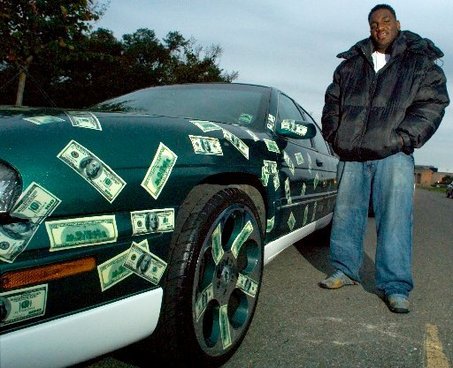
Oh, and I would be purchasing this car.
The relevent(s):
The figures make a lot of sense when you consider the difference in these endeavors: building new roads and expanding highways mostly involves paving over dirt, with some amount of construction of raised flyovers and interchanges. Extending a rail line means manufacturing the rail and the rail cars, then laying them, and after they are laid, on-going operation of the train. Similarly, new bus lines involve vehicle and parts manufacturing and long-term operations. Because most transit agencies also have Buy America policies, public transportation investment creates industry jobs in the United States, as well as construction jobs—on-going operating jobs are an added plus.Let's examine how much I save in transportation costs since loosing myself from the vexing finger-cuffs at the hands of Toyota, shall we:
For individuals struggling to reduce their personal expenses in this affordability crisis, being able to rely on buses and trains can free up money that would otherwise be spent on a car. In the United States, transportation is the second highest household expense, after housing. But people who live in a neighborhood well served by public transportation are able to reduce their spending on transportation from 25 percent of their household budget to just 9 percent. The money they save can go to ensuring that they pay their mortgage or rent on time or these dollars can go back into the economy through purchasing goods and services.
What I would spend per month if nothing in my current living situation were to change and I were to add a new shiny smoke gray auto to my family. Meaning, still living and working downtown; keeping most of my cavorting and social gallivanting contained within loop 12. I'll also assume that toll fares and parking meters work out to be negligible.
Oh, and I would be purchasing this car.
Cost .............................................................$$/mo.For comparison, the article referenced a savings of 64% on transportation. Mine came out to 64.92%.
Buying/Leasing a new car..........................................300
Down Payment prorated over 12 months.........................200
Insurance...............................................................150
Parking (at Interurban Building)..............................120 (wtf?!)
Gas (at the rate I used to of 1 fill-up/mo.).....................40
Airport parking (private travel)......................................15
~Taxes, Tags, & Fees...................................................30
TOTAL..............................................$855/mo
or $10,260 in the first year of ownership
Expense sans Auto.........................................$/mo.
Monthly DART pass (assuming I had one)....................50
~ Cab Fees (entertainment purposes).........................30
Non-expensed airport cabfare (ie not for work)...........15
Occasional rental car use & gas (prorated).................35
TOTAL..............................................$130/mo
or $1,560 for the next year
Except that I don't ride DART enough currently to warrant a monthly pass so let's knock those numbers down to more accurate levels:
TOTAL..............................................$90/mo
or $1,080 for the year
Now, it could be argued that I pay a premium to live downtown. I would guess that number is about $0.30/sq.ft. per month equating to an additional $210/mo. premium for walkability or an extra $2520/yr.
So that is a mobility cost of $3,600 (current state) vs. $10,260 via car ownership, meaning that I'm saving (or just spending in other ways) $6,660 per year.
Subscribe to:
Posts (Atom)

 Posts
Posts