






City-Journal has an article up entitled Green Cities, Brown Suburbs with the tagline "To save the planet, build more skyscrapers," by Harvard economist Edward Glaeser who has been cited repeatedly in this blog, most recently here and here, as he and I came to the same conclusion regarding the bailouts. That real growth will come from the bottom and we should be saving our bailouts for real stimulus and that is to stimulate startups and small, more agile businesses, which is where innovation and progress comes from.
Here is what he says regarding how humans should be building:
However, I will be disagreeing with him here and at the end of the day, it is really a very simple thesis and the issue is one of semantics. We all know density is one way towards sustainability because of shared resources, effective synergies created via spatial relationships, lower per capita carbon footprint, less VMTs and car dependence, etc. The other is total self-sufficiency from a site standpoint, aka the farm that generates all of its own food and energy on-site. This is the least dense option.Similarly, limiting the height or growth of New York City skyscrapers incurs environmental costs. Building more apartments in Gotham will not only make the city more affordable; it will also reduce global warming.
Thoreau was wrong. Living in the country is not the right way to care for the Earth. The best thing that we can do for the planet is build more skyscrapers.
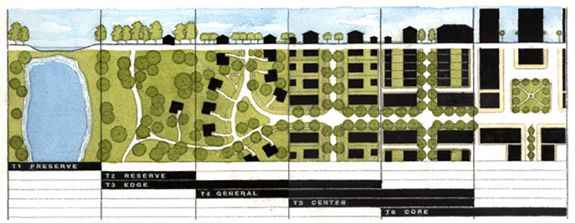
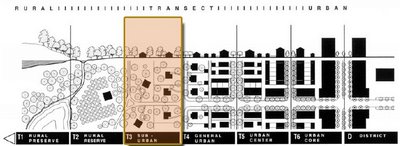
If we take the transect for example, if only to establish a gradation in densities from city core to the most rural of land and development we get the following graph:
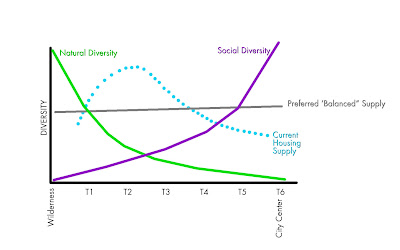
[click to see it larger - since it posted so small]
But, at the end of the day, skyscrapers are energy and material intensive. Furthermore, they degrade the public realm, the street life and ambience that makes cities. Vancouver has been able to get around this by creating a lower-story base to sit their towers on, but this doesn't change the fact that the buildings are still importing material from wherever and people to occupy those buildings often from the suburb. (Think about how many people commute into lower manhattan from NJ, CT, and Long Island.)
Here is what I said in a previous post:
Here is the problem. This study takes the Amero-centric view that only through tall buildings can one achieve density. Skyscrapers are not a necessity for density. Paris, Florence, Madrid, Rome, Copenhagen, are wonderfully dense. Now, here are the potential CONS of skyscrapers:Now, think about the most pleasant cities that you have been in (and I'm not talking favorite b/c that brings into play potential for hedonistic behavior, i.e. Vegas), I mean most pleasant. For me (of cities that I have spent a reasonable enough time there), the list includes:
1. Even if a platinum-certified tower is constructed, the building is still immensely energy intense in its construction phase.
2. They are materially intense, with materials typically travelling much farther than with low- and mid-rise buildings.
3. Skyscrapers privatize sunlight and views. Then, amazingly when another tower is built next door, the tenants of building 1 flip out that they lost their view...despite doing the exact same thing.
4. Tight-knit, often medieval form urban fabric generates protective microclimate from weather extremes. Skyscrapers often exacerbate the problem with the intensity of the wind shear and down draft created by the building.
5. Skyscrapers adversely affect the street aka the public realm by 1) removing people from the street and putting them in elevators and 2) overpowering the scale of the space created by the buildings.
6. These buildings tend to be glass and steel. Two energy intensive materials, often not created locally. I like the elegance of glass buildings, but then the issue becomes one of active vs. passive heating and cooling. AND, reflective glass is often pretty ugly.
7. COST. They are expensive to build. In summary, I'm not saying that I'm against skyscrapers. I like the pyramidal form of skylines of cities, emblematic of the greater synergies driving up values in the center-city, and thus manifested by taller buildings, aka greater real estate and F.A.R. in those places as a natural result. But, simply calculating that more dense places are greener doesn't say a damn thing and it certainly doesn't necessitate skyscrapers.
1. Malmo, Sweden - The cleaner, less busy version of Copenhagen.
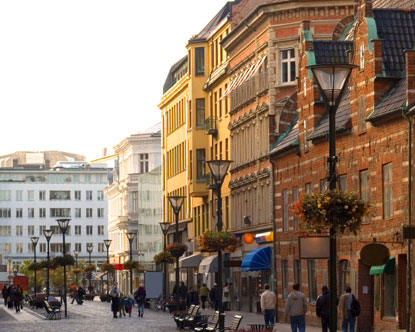
2. Siena, Italy - need I say more?
3. Zurich, Switzerland - combination of modern/contemporary and traditional/historical.
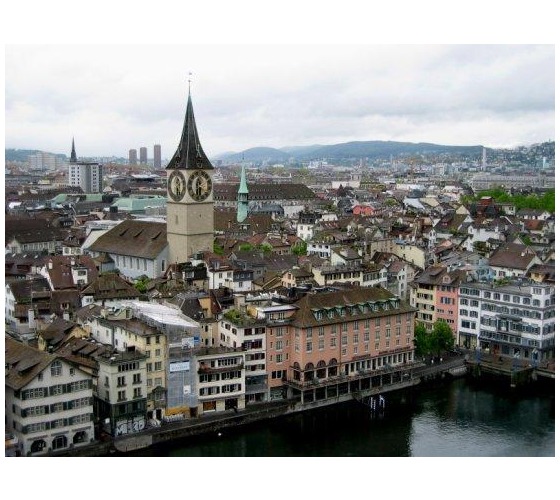
4. Verona, Italy/Vicenza, Italy (tie) - if only because I confuse my memories of the two like I do with the Italian and Spanish languages.
5. Malaga, Spain. - something about the palm trees and coast line.
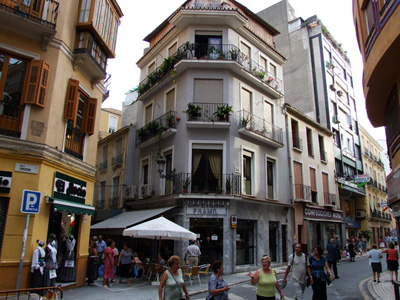
The spaces created by these buildings, AND in turn, the buildings themselves create spaces the citizens love, and revere, and are proud of, and therefore will not allow the natural inclination to densify to ruin their cities. This is the underlying cause of high-rises at the fringe of European cities, a market-driven logic to deliver as much "product," in this case, housing units to an area of high demand. Only that the new product is so undesireable it is relegated to the fringe and over time, relegated to the impoverished, becoming a slum and potentially areas of high volatility and/or crime.
The consistency is that these are all medium-sized cities, not so disconnected from nearby nature, nor overwhelmed by cars and/or people, with low to medium sized buildings but still with much higher density than most (all) American cities because of the compact form of development.
In the States, I would say that D.C. would be very high on the list for similar issues, despite being a much larger city. Of the cities the authors cite, most of the residents aren't living in high-rises, they are in the neighborhoods adjacent to the high-rises which house mostly commercial enterprises.
It is possible to build they type of density that Glaeser is looking for in a way that makes for cities more livable than Hong Kong, that are close to nature, close to food production, and don't house people in vertical filing cabinets, so that they are so disconnected from the ground and the street life that makes cities interesting and vibrant.
Plus, we are just too damned poor and in debt to be building high rises all over the place, when we need cost effective solutions and those will be in the form of three- and four-story buildings that frame streets and public places and provide for a flexibility of use that gives the buildings a much longer life than we would typically allow.



 Posts
Posts