Showing posts with label Life in DTD. Show all posts

Friday, March 26, 2010

Smell of Fresh Air


The infamous 'they' say that smell is the sense most closely wired with memory. Why should you believe 'they'? Because I said so. See how that works?

Like many past walks through downtown Dallas, I encountered a number of new and occasionally pleasant and occasionally wretched odors along the way. All of which reminded me that I need to resurrect a fun old post from the early days of this very blog: Olfactory Mapping!


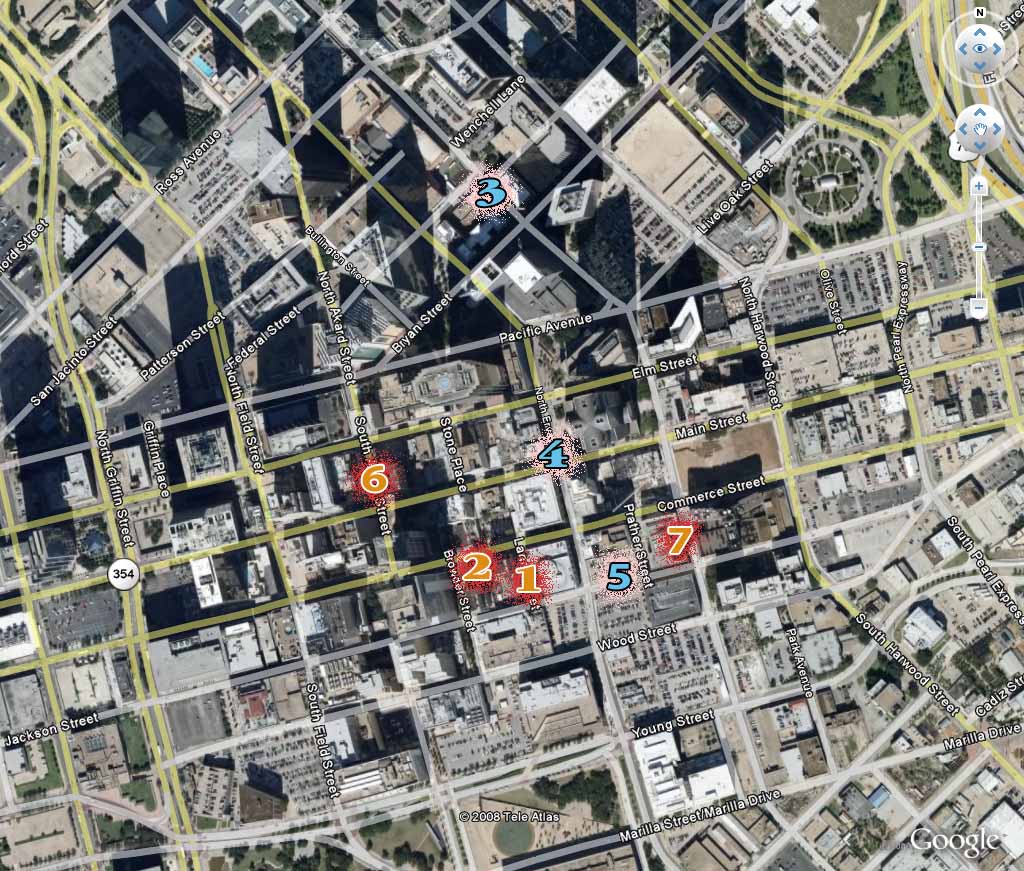
The intent of this is to correlate geo-location with the consistency of presence of certain smells. Previously recorded and still existent:

1 - Hot Trash - seasonal.
2 - Dog Urine - should now be expanded from the patch of grass by DP&L Lofts to the entire closed street pedestrian plaza.
3 - Bacon and Syrup - mmmm, breakfast.
4 - Garlic - mmmm, lunch and dinner.

New to the map:

5 - Gravy. Yes, the parking lot smelled like gravy. I think the prevailing winds were carrying whatever Hall's Chicken on Commerce was cookin' up.

6 - Bad Fish. Didn't walk past it this morning, but given that the smell is there every other day, I'll just run with it. I dare somebody to sit under the exhaust vent on Akard Street of Dallas Fish Market for 1 hour 5 minutes. There is a crisp $5 bill in it for you.

7 - Human Feces. In the City of Bruges, Belgium nooks and crannies can be useful places to stage an execution if that happens to be your chosen career path. In the panopticon like setting of dense city form, they are offer some of the few places to hide. In Dallas, they become places of defecation. Find a nook or cranny in downtown, you'll find a snickers bar. I recommend against including this in your next scavenger hunt.

Who has some more to include?

Thursday, March 4, 2010

Downtown 360 - 33 1/3

If I've been unnecessarily hard on the 360 plan thus far, it is only that I care. I also want others to care as well and be informed so we can better react to what is being presented.

What you should know is that we all should have thick skin; especially those with 500k contracts. Just shield yourself in stacks of benjamins. Further, I come from the world of ideas. Anybody who has been through design school, where the ad hominem attack critique is a daily occurrence, should know that in the world of ideas you have to disconnect yourself and your feelings from the work, and let ideas compete. The end user and the city (and its citizenry) involved are the client no matter the project, big or small

And actually, I'm quite happy that a lot of the issues I have mentioned are getting some TLC (RIP Left-eye). So my quibbles and concerns are shrinking.

Full review is after the jump (clicky on the read more).

Tuesday, March 2, 2010

Downtown Dallas Talks Millennials

http://2.bp.blogspot.com/_D5kx0bUGx_c/SDGdqXWxsCI/AAAAAAAAAEk/Y1eckZyKDeU/s400/houston.jpg
Not Dallas, but not far from it (geographically or rhetorically)

[Edit: I'm stupid. Only when I get a direct message from Richard Florida do I go back and carefully re-read the press release. They will talk abooooouuuuut Richard Florida's concepts. Of all sections of standardized aptitude tests, I always scored the lowest in reading comprehension.]

So the news of the day in Downtown Dallas (other than an old personal stomping ground burning to the ground) was the annual Downtown Dallas luncheon. This was supposed to include Richard Florida (jokes on me!), but perhaps he didn't make enough of an impression to garner mention in the summary over at FrontBurner. Perhaps everyone fell asleep for his portion of the show as one might through one of his books. (I kid. He's a data wonk which makes for brutal books, but he's actually a pretty good speaker, probably the reason why he is famous more than anything.) Also, hat tip to Tim at D Mag for giving me the heads up on their coverage, as I missed the event due to a meeting.

First thing is the most important thing, as Tim writes:
I will tell you that I went to this annual luncheon about five years ago, and I think about 150 people attended. Maybe 200. Today there were more than 1,000 folks gathered at the Sheraton. In short: it is happening.
The Downtown Dallas org needs to be given all the credit for the increase in attendance with their acceptance and utilization of viral media, in particular.

As I wrote yesterday, passion is the most important piece of the Downtown puzzle. If not enough people care, there isn't a market to cater to, nor build for, and there isn't a mass movement to provide the confidence or platform for elected leaders to make the tough decisions. To even begin talking about recruiting for the Creative Class or Millennials as this event was marketed is jumping the gun in my opinion. There are too many barriers in place that must be first addressed. Otherwise, they'll keep heading to Bishop Arts.

Now, to get to those tough decisions however, tough questions have to first be asked. From the tone of the FrontBurner article, it seemed like a lot of cheerleading and even some AT&T/Apple marketing going on. C'mon AT&T, you need to do your part and let Golden Boy out to play.

Cheerleading makes us all feel warm and fuzzy inside for a while, but does it really make much of a difference? That's not a rhetorical question, it is a legitimate one. But, in the end, I would like to see actionable items and I would like to see them address the difficult questions. With 1,000 people in the room, that is the perfect opportunity to start building a mass movement behind downtown. As Tim writes:
Toward that end, I suggest that at next year’s confab DowntownDallas throws down a discussion about what needs to happen next. Come up with 10 ideas. Tackle em. Have your smart people get up onstage and address em. Should we do away with all those damn one-way streets? Is there any way to widen the sidewalks? What about that proposed second set of DART tracks through downtown? Should we make parking more or less convenient? And so on.
As I've written before, we tend to get lost in minutiae. Dallasites like to feel good. Unfortunately, tough questions make people mad. But, if you ask any ex-junkie, they feel a million times better being clean and sober than they ever did from any short chemically-induced high. No city (nor person) can address the systemic issues without utter and brutal honesty. Could cheerleading be our drug?

Downtown needs a champion, one to get behind. However, a champion needs support, a mass movement to point to and rest his confidence in decision-making upon. That support was sitting in a room today.

Unless the tough questions are asked and key problems identified, particularly in front of a large group like that, then real identifiable goals can't be formed. The decisions affecting downtown will continue to be made by "specialists" (for lack of a nicer term) that are more concerned about how many cars move past a street than helping to create a lively downtown. They aren't elected to improve the livability of the City. They are hired to move cars.

Now, what are those tough questions. I've tackled the tunnels recently, but they aren't the biggest issue on my mind right now. Frankly, I think the transplanting of the tunnel businesses is really a catalyst to solve the larger issue.

The larger issue first stems from the highway loop. It could be argued that the 35,000 surface parking spaces in downtown Dallas ARE the highest and best use of land next to freeways. What other use really wants to be near what John Norquist called (and I'll paraphrase), "like passing gas in the elevator. They're noisy. They're smelly. And noone wants to be near them." He left out the part about killing people and destroying the economic vitality of cities, but that would be some ultra-potent flatulence.

Now, let's say for the sake of argument and urgency, given the 1,000 that showed up today, that the highways aren't going anywhere for the time being. I'm on record as saying they're the fundamental problem but it would require a fifty year plan (and an inordinate amount of legal wrangling) minimum to address. So if the highways are with those of us alive and kicking (or driving) in Dallas, what's next?

First, we have to have 1,000 people who matter, care, and can make a difference in a room. Then we have to point out the problems facing downtown Dallas with brutal honesty. Highways, surface parking, tunnels. Everything else is more symptom than malady. Veneers are Victory and they still hurt until you fix the real problem. To make downtown lively, we have to excavate the entire cavity.


Then we have to ask, what do we do about the surface parking lots. As I suggested, they're probably at their natural market conclusion and the lack of development of them suggests the same. Now let's drill into the issues of developing the surface parking lots:
  1. Owners, whether out of town or otherwise, are generating revenue.
  2. Conception of downtown development is mostly of high-rise, even some of what one might deign as "science-fiction." For the sake of argument, let's say that is fine as well.
  3. Downtown lots are going at high-rise residential on a per-square foot cost.
  4. Construction costs are too high for high-rise right now, and more importantly,
  5. There is minimal market for high-rise, high-end residential that isn't already over capacity in Dallas.
  6. This is mostly because there isn't enough amenity or (perceived) safety in Downtown currently for more residential.
What does all of this mean? It means several things:
  1. There is a significant gap between cost and profit to develop downtown lands that as it currently exists would require heavy subsidization by the City (or any other public entity that can kick in funding. Such as for affordable housing, sustainable development grants, etc.)
  2. There is still no guarantee that the surface parking lot owners will sell, and
  3. that there is still no guarantee that there is a market for residential, particularly when they're asking what do Millennials want (I'll pretend I never saw the press release that mistook Gen Y and Millennials as two separate groups. [pet peave] Is there enough action downtown for Millennials? Is there enough community? Are downtown buildings too overscaled?)
  4. Millennials are already making things happen elsewhere (see: Bishop Arts).
Option 1: overpay for land, continue to do heavily subsidized, splashy "bricks and mortar" projects and pretend, hope, pray that a market might form to support the project when in all likelihood they will sit mostly empty. Sorry, but this is the urban thinking of 1990 to 2008. Cities don't have that kind of scratch any more, unless they want to plunge their credit rating like Vancouver.

Option 2: condemn surface parking in Downtown Dallas. I know. It's a radical idea and probably not a realistic one. I'm just throwing it out there, that it is a way for the City to assemble land and put it into an RFP/RFQ for (re)development.

Option 3: Explore alternative carrot/stick type measures that will, in effect, drop the price of land for parking by incenting the surface lot owners to sell. From what I've experienced, creating a special district for Split-Tax or Land Value Taxes is both effective and popular with stakeholders that actually give a hoot about downtown. Ya know, like all downtown businesses other than surface parking lots.

Option 4: Think differently about Downtown. First, there should be no such thing as business districts. That is a mindset of the 20th century. All decisions should be about Living First, and there just so happens to be 70-story towers and all the transit modes imaginable nearby, ie amenity. Think of it as a neighborhood with unique amenities rather than a business district.

Furthermore, reconceptualize the size of Downtown in our minds. The inner-highway loop makes for a logical boundary, but the foundation of complex systems extend beyond the simple lines that our minds draw. Downtown is built on a foundation of adjacent areas. There is an argument to be made that LoMac (Lower McKinney) is more of an extension of downtown than it is part of uptown.

The cheapest and easiest way (politically) is to focus on all of the areas immediately adjacent and around downtown that are less afflicted with inhumane highways/roads and inhuman-scaled office buildings. Focus on Oak Cliff/Bishop Arts, Deep Ellum, Ross Avenue, the Cedars. A tasty ice cream sundae is built upon a foundation of plain vanilla ice cream.

Drive the value of these places to such extraordinary levels that it makes sense to develop the surface parking lots at market-rate and to environmentally remediate historic structures like the Statler or Old Dallas High. Create such a demand to be downtown that there is a market to live next to a highway because there is so much amenity in and near downtown.

Or, just start converting the highways to boulevards and we can reposition for development right now. It's your decision.

Wednesday, February 24, 2010

Paying for the Mansion and Getting Motel 6.

So, I've finally had the chance to review the latest (January) presentation from the downtown 360 plan and I'm a bit concerned that not much has changed. Once again, I feel compelled to state that everything presented are things that absolutely are necessary. They are fundamental improvements, particularly for a transportation system that undermines any efforts at livability, the ultimate necessity of revitalization in the 21st century.

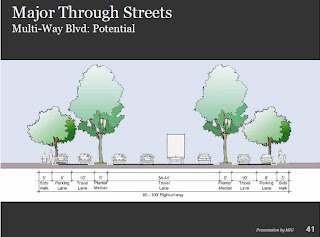
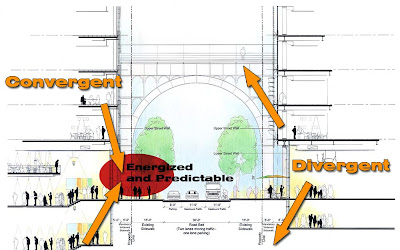
I am particularly enthused with the street sections that suggest potential real improvements are possible to some of the wider and more divisive streets through downtown with pedestrian refuges, divided "browsing lanes" (my term) for their "multi-way boulevard" street sections. What this does, is create a hierarchy of speed of movement moving outward from building face.


(Taken from MIG's presentation found at the link above)

For example, pedestrians are moving the slowest, their space is allocated closest to the storefronts, where they are going in and out. Next is the "browsing lanes" and the parking. These are divided from the lanes for movement. You drive in the browsing lanes when you are looking for parking. This configuration allows for both "place" the pedestrian realm buffered from high-speed movement, the parking and slow traffic, as well as "link" the primary travel lanes in the center of the street for those trying to get from somewhere to somewhere else and are merely passing through. This street section can potentially apply to 100'-ish rights-of-way in downtown like Pearl and Griffin.

However, my first concern might be the idea that one street section applies to an entire street and that rather than arriving at a design solution that maintains a 100' right-of-way perhaps the solution in downtown might be more significant narrowing curb-to-curb with more pedestrian (sidewalk) space, level of service be damned. I think this street section has a lot of value particularly when it comes to refining our arterials to allow for more density to begin to line up to the street rather than set back buffered by a field of parking, as more suburban models begin to consolidate and intensify.

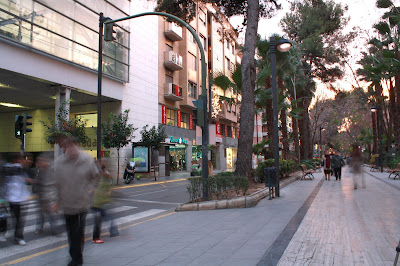
The other idea that I like is the Main Street section. Essentially eliminating the parallel parking currently on Main, moving the traffic flow to the edges, and recapturing the difference in a central pedestrian plaza. This could be construed as counter-intuitive, but the traffic flow would be so slow, that it presumably would have little effect on total parking count or spatial dynamic. Here is a picture of a similar situation where the pedestrian realm is centralized from Torrent, suburb of Valencia, Spain.


The reason that I like this, and I think it is probably only valid for a block or two, is that the parking on Main Street is mostly devoted to valet stands (although the image above shows parking), so it is not like we would be losing that much parking. If this is done however, Elm and Commerce badly need to be redesigned. If for no other reason than to slow down the valet drag race:

http://blogs.cars.com/photos/uncategorized/2007/06/28/winnipegjoyride.jpg

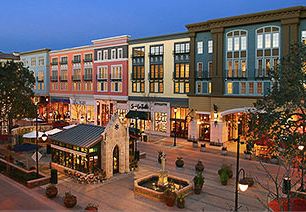
Below is mixed-use shopping district Santana Row in San Jose, CA, which has the same street section for one-block.


Also, the "green streets" suggestions are okay, but I think they are more appropriate in densifying suburban centers than they are in downtown. Downtowns are areas of extreme metabolism, which means (at least for now) lots of output, which means lots of waste, or trash. These things get caught up in bio-filtration systems and can just look like litter. Furthermore, we aren't the best at maintaining things right now, and if the streets come before the businesses (that might better care for their front step) perhaps these are even less of a good idea.

So, why am I in a bad mood? Well, first of all, these are all good design ideas, but this is also meant to be a strategic plan, and I think I'm more interested in creative solutions to the issues negatively effecting Downtown Dallas. While thus far there are some design ideas, but all of these seem to be off-the-shelf urban planning 101 boilerplate. I don't feel like a lot of it is customized for Dallas-specific issues.

I've written at length about the street network being a detriment to livability of downtown and thus hindering development, but while this is a factor, I don't think it is the MOST challenging one, or even a difficult one to address. There are three much more difficult issues hindering revitalization that require much more depth than simply design strategies, and perhaps they have yet to be identified as issues in need.

1) Obviously is the freeway loop. While I hold out a grain of hope that there might be movement towards the removal of these, I also realize the difficulties and that at best would require a 50 year plan. For the time being, I would be far more interested in the tightening up of the on/off-ramp system away from clover leaves and frontage roads, to a restoration of the street grid, where the highways and their interface essentially exist at a different plane.

2) Surface parking lots. Nobody likes the management of these lots and while we are big proponents of property rights, it might be time to take a hard stand against these guys, particularly when factoring in how much they are holding back downtown. If they are willing sellers, which they might not be since they're generating revenue, they are holding out for high-rise prices. I don't see the market bearing any kind of high-rises office, luxury, or otherwise.

Downtown revitalization will be driven by high density, but affordably constructed mid- and low-rise development. I don't mean to be a party pooper, but I see that as reality and four-stories makes for great urban fabric and filler between all of the high-rises and more glamorous structures.

As I've suggested before, if you don't want to condemn their properties, and you (private or public) can't pay for the asking prices, perhaps there are more creative solutions out there like setting a split-tax system which reduces the burden on performing properties (definition TBD) and pressures under-performing, ie non-contributive properties to sell, encouraging intensification of the site.

3) Tunnels. I have not yet seen any suggestions for how to deal with the tunnels or analysis that honestly suggests that they are a barrier to positive street life. I would be happy with the acknowledgement.

First point, is that retail needs the predictability of movement. This is why the best retail locations are on the busiest roads, where the traffic is. A Dendritic traffic network (2-dimensions) forces all cars onto collectors and arterials and the retail wants to be where it can be seen. Here is a dendritic drainage network as if abstracted from a hierarchical street system. Commerce occurs where it is predictable. Consumers need to know where to go, and the businesses need to know where to locate. In the drainage diagram, if water were people, commerce would occur in the darkest, blackest areas where the most water is.


I've used the term convergence several times before because it applies in different dimensions. Below is how it applies in three-dimensions. The tunnels (as do sky bridges) strip downtown streets of their vitality. This translates into reduced potential of all businesses, on-street or below.

Furthermore, this can be applied in four-dimensions. What times are the restaurants open in the tunnels? Most are typically only open around lunch time. Some a little earlier, some a little later, but the mystery and short-time frame is a problem.

Retail and restaurants need concentration, of people and typically, of each other (especially if they lack the former - see shopping malls, strip centers, etc. - to even exist). And cities need the livelihood that commerce brings, particularly those that engage the street because the street life is how a city is perceived. By its own citizens and visitors. Do you think it is a coincidence that all of the visitors for NBA All-star weekend loved Main Street? Because there were a lot of people there and it went off mostly without incident because it is also easier to police a raucous party atmosphere when it is mostly located in predictable locations.


What might I suggest? Well, off the top of my head, might be a carrot/stick program where the amount of incentive to relocate is amortized over a given amount of time until reaching a deadline for businesses to relocate. Let's say five years for the sake of argument. In year one, the City and Downtown Association might work to find/create/retrofit space in currently vacant buildings. They could also receive a rent subsidy and ability to break the lease if it doesn't work out for them in the new location.

In order to counteract the potential for failure of businesses at the street, we should work to conglomerate the first few daylighted pioneers in clusters together, and do it with fanfare. Celebrate their "return" to Downtown Dallas to instill a sense of awareness with downtown office workers or residents, so that they know where to go for their quizno's sub or whatever. Point being, that if you cluster them, you are one-step closer to achieving "place," and places are magnetic.

While the first businesses to "daylight" would get the most assistance, the longer the rest wait, slowly but surely the amount of "help" or subsidy they get (and the best locations) begin to evaporate until there is no more help and the doors get locked so that the tunnels are reserved for emergency shelter. (Or, there is always a colleague's idea for turning the tunnels into a red-light district.)

In my opinion the downtown plan should be thinking about where some of these "premier" spots might be to cluster retail and further, addressing some of the barriers to street retail in Dallas. One, is the street network which they are doing, but in a passive way, not an active one to stimulate business and entrepreneurship like Renew Newcastle. There is more to urban planning than streets and trees.

Evolutionary biologists often refer to periods of expansion to increase complexity while testing for resilience. Entities proven resilient are then ripe for "structure building" phase during periods of contraction after the species over-extended, intentionally. While we our cities are temporarily done expanding into new territories (suburbs/exurbs) and have begun the process of consolidation, this is precisely the time to aid in areas that we are determined to reinvigorate, like the most important center, downtown. To structure build.

These are relatively cheap when we are talking about some of the potential infrastructure dollars for all of the other things proposed in the City. Reduced rents, micro-leases, help in relocation or some start-up seed money for entrepreneurs. All of these should be considered small investments for a larger payout, a more interesting and vibrant downtown. Many won't survive and that is precisely why they need the flexibility to turnover those that don't for those that might. The energy alone of cluster new businesses can stir a turn-around. They are our new honey-bee drones in search of new territory, which will be a successful business or a few that can grow, add new employees. Structure build.

This is what I mean when I suggest we can no longer "grow" quantitatively, but our economy is ripe for qualitative growth, structure building (and by structure, this doesn't necessarily mean "buildings," but foundations of stability, resilience).


Another major barrier, however, is the relatively few amount of buildings that are suited for ground floor retail, or should I say, the amount of buildings that are not. Many are designed defensively, to not engage the street, or "communicate" with the streets and other buildings. Many of these are not suited for immediate adaptation so we have to suggest some creative ideas.

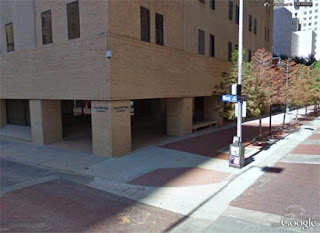
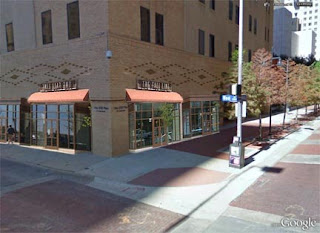
Take this building for example, rather dreary, also not terribly welcoming as the entrance is set back within the envelope (outer wall).


Pardon the crude photoshopping, but this is what you get when I do it in ten minutes. Also, this is meant to be conceptual, as I'm not suggesting this is the most appropriate location for relocation. Rather, merely to suggest that we should be thinking about retrofitting buildings to communicate with their surroundings, the streets, other buildings, and pedestrians.


I'm not a huge fan of awnings as little more than nostalgic mementos, but thought that this particular did need some of the color, variety, and visual interest that they can provide. Obviously, these are things that would have to be worked out with various building owners and the basic integrity of the buildings and their primary entrances would have to be maintained, but I'm sure there are a few that would like some extra income via new rental space.

Furthermore, many small retailers don't require the kind of depth or square footage that you find in the boxes in the 'burbs. In fact, see the liner retail at Mockingbird Station that can't be more than 10' deep.


If nothing else, I would like to commend the efforts thus far, because making downtown Dallas streets more "complete" or better designed for people is an important step. However, we also need to think more deeply about how to activate those new streets as well.

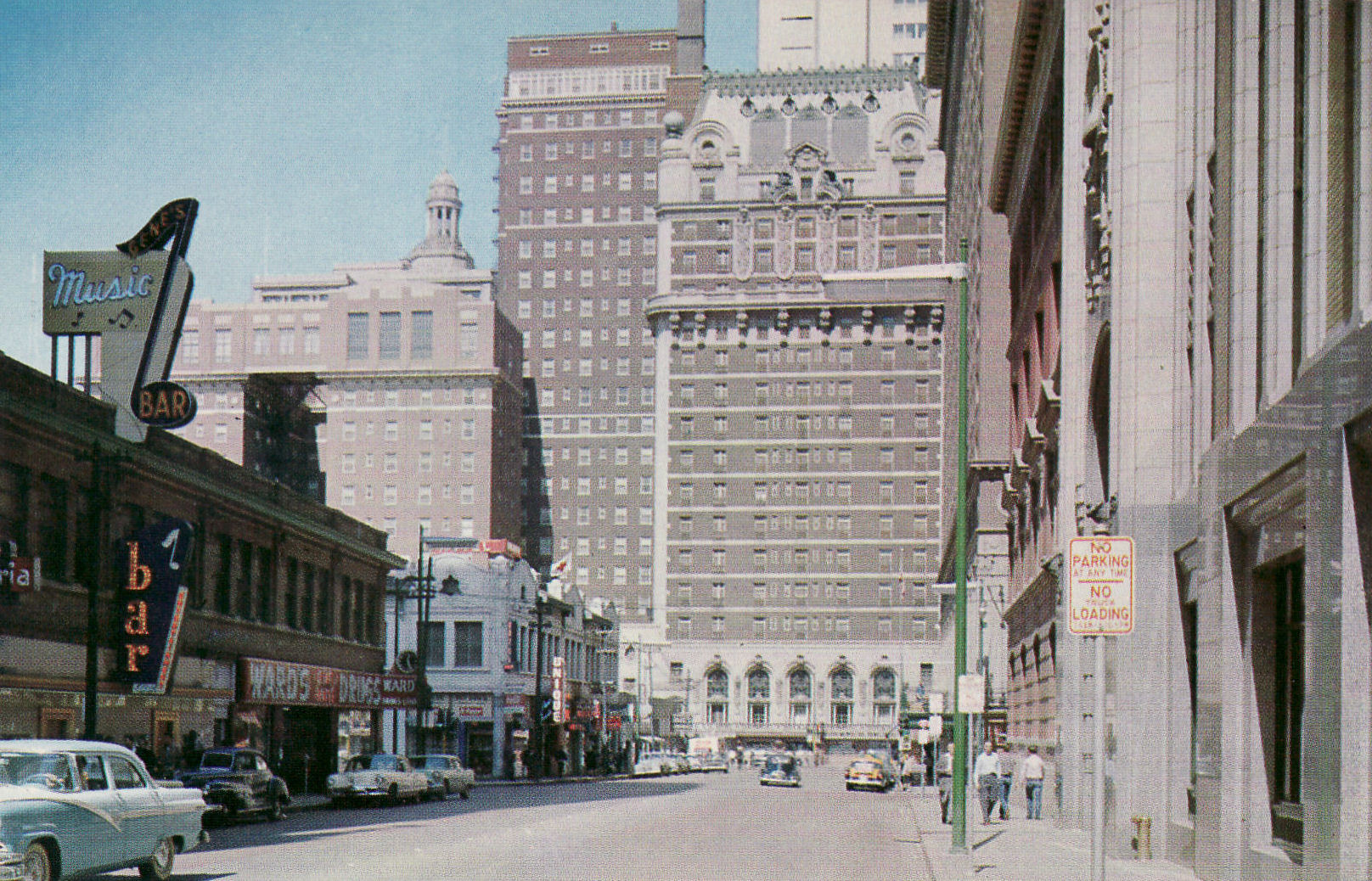
Apropos of nothing, check out a historic photo I found from the same spot:
Akard at Wood St., Dallas, TX.

Mmmmm. Bar. I could use a drink.

Monday, February 1, 2010

No No No No No No No No No No No No 1000x No


Pic from KERA article here.

How does the supposedly ancient Chinese saying go? "May you live in interesting times?" I'm going to expand that to may you live in interesting places, attribute it to myself, and call it a day. Dallas is an interesting place, if only for its bipolarity.

Saying two: "Everything in moderation, even moderation." At least we know who to attribute that one to, even if we only get half of it right. We boom and bust with the best of them don't we? A perfectly arched swan dive into a pool sans H2O or otherwise.

I've often talked and written about this phenomenon and that while Dallas possesses great energy and spirit it, sometimes it's gatling gun needs a little bit of direction so we stop killin' friendlies.

In this particular case, I'm actually talking about traffic, transportation, and street planning as I came across this news tweeted from the Observer, interrupting my perfectly happy workout:

Natinsky: Make Sure New Downtown Plan Remains Open to Closing Main Street to Cars

While I question how serious the City would really investigate this option, I think it would be a mistake. You might think, "hey, you're a carless guy. You should love it." Well, you would also be as wrong as TO on the Cowboys...again.

You would be wrong, because of the hundreds of pedestrian plazas attempted in the US, as Copenhagen successfully implemented the same idea, maybe three or four total were successful.

You would be wrong as William Whyte once said, "show me a pedestrian mall and I'll show you one that should be two blocks shorter."

You would be wrong because downtown Dallas already lacks as dense of a grid or street network as it needs. Density of intersections per area is proving to be a successful, valuable metric for both traffic and pedestrian safety, critical for anthropocentric places. Eliminating traffic on Main permanently would have the opposite effect than is intended.

You would be wrong because it requires density to support pedestrian-only streets or precincts. While based on percentage growth, Downtown Dallas going from 3,000 residents to 5,000 is impressive over the last decade. However, a smaller area of lower Manhattan went from 25,000 to 50,000 even after several of the buildings fell on the city and it was mostly young families with children.

You would be wrong as it violates the concept that I call convergence, necessary for economic development. It is necessary because it concentrates energy into clustered points, "nodes," or districts (depending on the size, scale, and intensity of the convergence). The highest value areas want to be in the highest traffic areas if and only if the design is humane and of quality (i.e. the traffic is comprehensive: foot, bike, car, bus, train, etc.).


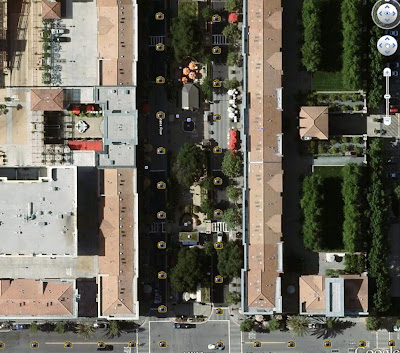
The above represents a map of Downtown Dallas. The green lines are two-way streets and the yellow are one-way. I'm of the opinion that two-way are generally preferred for walkable, pedestrian friendly areas. While it is not a singular either/or defining criteria, it also supports increased convergence as later diagrams will illustrate.


This is the overlay of the Downtown Portland grid (everybody's favorite these days) at the same scale; rotated to match the orientation of the Dallas grid. You will probably notice two things immediately:

1) it is much much more dense and intricate than is the Dallas grid. From a pedestrian point of view, more regular intersections creates for more visual interest, thus providing the perception of foreshortening distances between destinations. For the driver (and preferrably two-way), creates for increased flexibility to react to traffic interruptions or predictability for wayfinding (I can't tell you how many cars I have seen turn down the wrong way of one-way streets in Downtown Dallas).

2) That's an awful lot of one-way roads, I thought you said...

Yes, Portland contradicts two things I typically advise. And those are that two-way streets are generally preferred (but not required) and an overly regular grid can be a little too relentless and unpredictable. Eventually, people (aka "the market") will work out where the best locations for various uses are, but it takes time for a hierarchy to emerge as the city adapts to various amenities, high quality businesses, etc. As I pointed out in the West 7th post, some form of a regular grid hybridized with a more Baroque form pinpoint areas of strong convergence or monument.


It just makes intuitive sense that two two-ways will create more convergence than two one-ways.


Here is some serious convergence. This is DC. As I've written, this was the hybridization of L'Enfant's original plan and Jefferson's ideal grid as agent of Democracy (There is 2-D convergence in the grid, 3-D in the mix and proximity of uses, and 4-D with a Metro station below). I'm suggesting that an imposed hierarchy is ok, as it provides predictability for investment. Once again, those places of high concentration can only reach that "highest and best," i.e. private investment if the public realm is designed particularly well. Furthermore, the inefficient block sizes/shapes particularly close to the areas of convergence is often offset by location (near convergence) and unique if not curious building form. Think Flatiron building.
-------------------------------
In the case of Main Street in downtown Dallas, it has convergence for approximately a three-block stretch where all of its feeder roads are tamed into a pedestrian-scaled, two-way street. Even at its busiest, typically on a Friday or Saturday night, pedestrians own the street. This is a good thing, but it doesn't mean we need to completely turn the street over to pedestrians.

Cars are still contributive to convergence that helps make Main Street successful today. They move slowly. Narrowness of the street and the "friction" created by pedestrian activity, parking, valets, etc. force cars to move very slowly. There is nothing wrong with slow moving cars. As traffic engineer Hans Monderman once said:
They also found, in surveys, that residents, despite the measurable increase in safety, perceived the place to be more dangerous. This was music to Monderman’s ears. If they had not felt less secure, he said, he “would have changed it immediately.”
And, where would bachelor parties parade their limos???

If we can get the population of downtown up to 30K-plus, then it might be realistic to make a pedestrian only street work. Until the time, when there is enough density to provide day/night life to a car-free district, it would be a ghost town.

Lastly, we already close it down for special occasions. We should keep it that way. What's the point of closing it when no one is on it anyway (for the record, I just walked down Main Street immediately before writing this and I counted four pedestrians and two cars).

This isn't to say that the idea might not have merit down the road, but now is certainly not the time. By down the road, I'm guessing at least twenty years. Temporary closings for special events is still preferred. That is what Austin does on 6th street for weekend nights and special events and it is the right thing to continue to do.

Recommendation:
  • No need to rush. This is one of those things that will be demand driven. First, create the demand for a pedestrian-only district through increased density spurred by the following recommendations (and those in the parking post from last Thursday). Don't supply it and expect it to happen. This was why American cities failed the first time around..
  • Main Street is WORKING. It is the most authentically urban piece of all of Dallas (with apologies to McKinney, parts of Oak Lawn, Lakewood, and Jefferson, yes Jefferson). Focus on livability of downtown to create density. Think of downtown as a new model of neighborhood that just so happens to have a hundred thousand day time jobs.
  • Which brings me to the this (which the Downtown 360 plan is already focusing on to some extent), tame the streets that are causing the problems. Right now, as I said there is a three block stretch of Main Street that is functional. It is Livable. Incrementally and systematically expand outwards with what is working, narrow two-way streets with parking and adequate and attractive pedestrian space where drivers have to be smart. Treat drivers like they're stupid and they will turn their brains off. Works with people too, not just drivers. Yes, I distinguish between the two.
  • A better move than screwing with Main Street would be taming Elm and Commerce**. In an ideal world (even with the inner freeway loop), exactly none of the internal downtown streets would be feeder roads as Elm and Commerce function as for Main. The feeder roads should stop the moment they enter downtown. And by stop, I don't mean stop, but become Livable, ie Jaywalk friendly - the context-sensitive and complete streets movements offer plenty of guidance.
  • Needs more thought about where and to what extent, but one thing that might be fun would be to go full on Woonerf in some places rather than pedestrian-only with chicanes to slow traffic and create numerous little pocket parks or otherwise points of intrigue.
__________________________
** Last week I witnessed two cars drag racing on Commerce at 11 am on a Monday. I was amazed. Of course, this only occurs because of the street design. People will always drive the speed they feel comfortable. I informed a city official, and coincidentally or not, there was a cop stationed there this week at the same time of morning.


Tuesday, January 19, 2010

What the Downtown Plan Should Be; Won't

The Downtown Dallas 360 Plan is the right action at the right time, moving in the right direction, so why is it wrong?


Downtown 360 is a good news plan and one of good intentions - so what's the big problemo, man?

A good group was hired and from the first presentation (once they quoted Mumford and Whyte), I was aware of their competence. Unfortunately, competence does not overcome embedded political realities and either ignorance of, or the infacility to address, the biggest issue.

While still in the early, feel good stages of the plan, thus far they have covered most of the appropriate topics (except for an effective and believable strategy for the tunnels) which, like many urban realities, are predominantly symptomatic of deeper issues. The presentations are heavy on application of the complete streets initiative and context sensitive design (which I cannot stress the importance of enough). This alone would be a huge victory for Downtown Dallas.

It's the 2009 urban planning playbook, so why am I still frustrated?

Well, that is exactly the problem. It is hampered by its own intentions, an unfortunately (and possibly necessarily) narrow in its scope and its goals. Even if it does everything it possibly can, it will ideally improve the local street system, hopefully incent some new development, etc., but will still fall short of Dallas' full potential. A narrow scope leads to narrow results. Exactly the right results, but not broad enough for fundamental and actual change for the competition of 21st century cities.

My point? Once this is wrapped up, implemented in downtown, in ten years or so when its efficacy can properly be evaluated, I will tell you where we will have to look for new answers; where we can mine for new economic and community growth. It is right in front of our collective nose.

http://tti.tamu.edu/publications/researcher/v44n1/images/dallas_high_five_lg.jpg

Once again, the biggest problem is the inner ring highway loop. I feel certain that the design/planning team's hands are tied and if they tried anything like this they would be laughed out of the building and summarily dismissed from the project...

...which is why I can state it here.

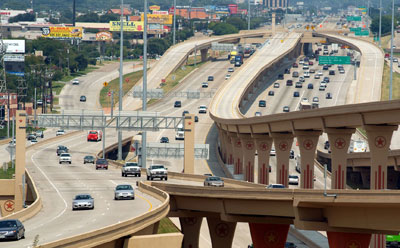
Hell, they even discussed it with diagrams - but with no solutions or ideas, potentially showing their reticence to bring up what could be controversial. The first presentation showed some simple decoration under the overpasses. The world has already tried that solution and it was not enough to rectify the damage done.

The second presentation included the following graphics, which I thought were great:

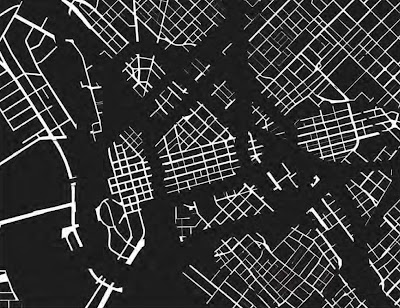
Highways as barriers, disconnecting the local street grid...

(from the Downtown 360 plan)

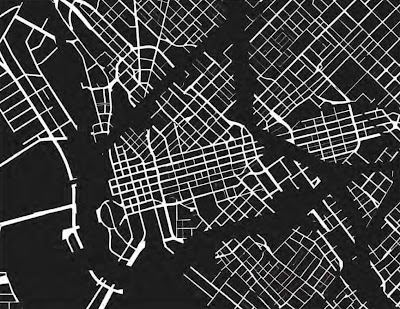
Here is the next level, blacking out the primary arterials that have the same effect, limiting pedestrian connectivity, and street level complexity. I would have included Elm and Commerce, which have the same barrier effect or as I call it negative magnetism, but I suppose that would be so much black on the graphic as to make it illegible.

(from the Downtown 360 plan)

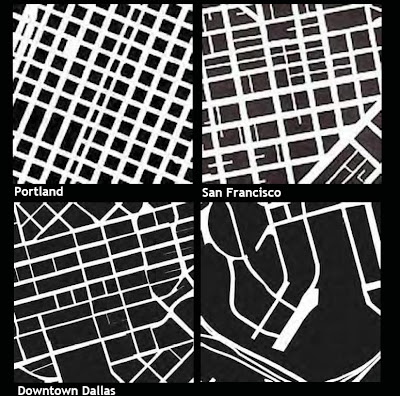
Comparing and contrasting the urban fabric and local street framework. One could call this an abstract representation of urban complexity, where density of network = complexity which means urbanity, and urbanity means induced value. Notice that Paris is not full of surface parking lots.

(from the Downtown 360 plan)

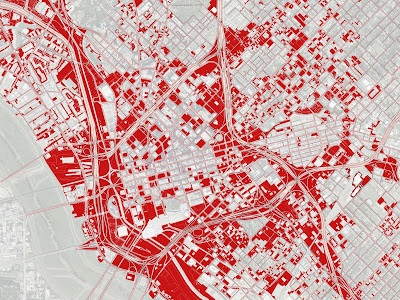
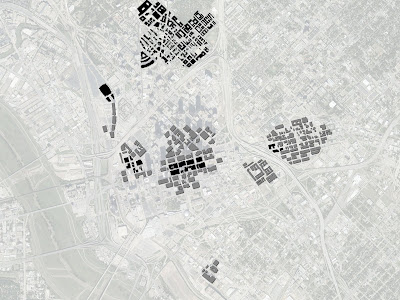
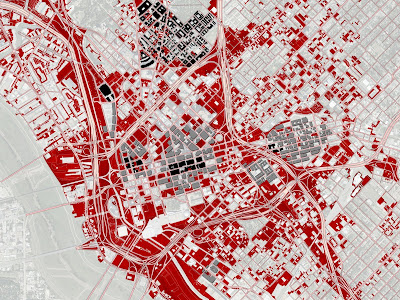
Of course, while effective, I prefer graphics that are much more rhetorically dramatic in their semiotic intent = RED!

...graphics highlighting and illustrating the effect, which is more tangible to the lay person - in this case, undeveloped or underperforming properties:


(My graphics)


(My graphics)


(My graphics)

I suppose you have already found the irony here, that I'm now griping about the solutions to my own complaints. The joke is on me. Because, many of the efforts designed to revitalize downtown Dallas over the last (pick one) 10, 20, 50 years have had the opposite effect, and were quite dramatic in their delivery, the solution has to be equally as ambitious and dramatic to counteract the effects; focused with proper urban design and economic development understanding and principles at work.

Meaning this is small scale and incremental effort, while positive, is short-term and needs an overarching, broader vision that is enormous in its impact, yet very simple at its core: incremental and continual reduction in the role of highways in the everyday lives of Dallas citizens and their negative impact on neighborhoods, communities, and businesses.

So why is this the solution? Dallas, as it has been shown, is a city of great ambition. It sets high goals and largely achieves them. However, ambition is a big gun wielded. One often pointed in the wrong direction - sometimes even with the toe on the trigger.

The primary weakness of this idea is the same as those incremental solutions
  1. On the surface, the result seems subtractive and one that undermines the environs that entire generations have known.
  2. There is not a single flashy image that one could print on the cover of the DMN to sell the idea, but it is absolutely the one that will have an impact so vast that it will support and enhance all the singular efforts like the Arts District.
Both are overly simplistic views which brings me to the point of this blog in its current iteration, which is to raise awareness and understanding for what makes for more livable, and in turn, how it creates for a more economically successful place, and the causal relationship between the former and the latter rather than vice versa.

The original intent was of Eisenhower’s interstate system was to connect economies, City to City, forming an interconnected constellation across this, and many other countries. All good. Except, because that government spending created positive benefit, it seemed like the solution to any downturn in the economy. When applied too liberally, it becomes deductive of the economy, a barrier, rather than a connector as I described.

And connections are what makes the world go round, it is why we're on Facebook and Twitter. It is why it is cheaper to walk to the store; why when local businesses can compete on a level playing field we prefer them to build a relationship with the staff or owner. It is simply the distance between us and what we need or want.
--------------------------------------

The solutional meme for highways arrived at in the 60s as Mumford, Jane Jacobs and others feared the fate of the positive aspects that highways swept clear. While cities were not perfect, they were already highly adapted, but had not yet come to terms with the physical and ethical dirtiness of 19th and 20th century industrialism. The car and highways were the way out.

The car had become ubiquitous and cities struggled to find balance (which is all that is necessary). Copenhagen started reversing its streets from cars only to pedestrians only. Amsterdam stated that all new development should adhere to a reasonable level of beauty. Paris flipped the parking and promenade portions of the Champs Elysees to traffic lanes and back again.

American cities drunk off the economic resource of excess land, half-heartily applied pedestrian malls to its cities. Here, we went balls to the wall, building highways full bore. This proved to be a short-fuse economic success story for politicians with relatively short election cycles.
"Downturn? Let's buildus a highway fellers! Tarrrrrnation! We seem to found us a magic eeeeelixir for recessions fellers!”
Sorry. The good ol' boy accent is not intended to be regionally pejorative as much as to convey the irrationally exuberant euphoria characterizing any meme at its most inertially robust, carrying it past equilibrium. Howard Bloom argues this is due to biological wiring causing for intentional overshoot, a trial by error pattern coloring human development patterns throughout history.

American cities are adolescent in comparison to cities we love to visit. European cities, proving their learned history through trial by error, and therefore further adapted and more resilient cities realized this mistake. These changes molded cities between generational upheavals categorized by crashes, like today. What we are seeing is not a recession, prolonged recession, downturn, or depression. Those are linguistic abstractions. This is a categorical shift in humanity’s direction, which means a new way of city building.

As Harvard Professor Ed Glaeser has said, cities with a dominant economic resource tend to act stupidly and therefore, experience a crash when the resource fails the city or no longer is useful. In Dallas, and much of the Sun Belt, that illusory happiness-in-a-bottle was land. Therefore, in order to unlock the potential of that excess land, highways were built for access. They became valuable. Except much of that land is not valuable as we see half-finished neighborhoods at the extreme ends of the Metroplex like brown leaves on autumn trees waiting to fall. It was not demand driven, or naturally incremental, but it offered the supply, more land with houses on it, then put a price tag on it with a promise of rising values. The test of time is showing that many of these foldout housing developments are more valuable is nearby agricultural production.

Dallas, unlike its metastasizing sister to the south, Houston, is now landlocked by other jurisdictions. It has no place to grow, so highways were built internally to deliver the outer residential to office high-rise downtown. As John Norquist, highway vanquisher as Mayor of Milwaukee, covers in his book Wealth of Cities, highways in cities (to summarize) are predominantly the fault of federal funding and their requisite federal standards. Either way, they are with us now. So what to do?

Fortunately, this means Dallas does not have to limit itself to the simple to do, quantitative growth, and can focus solely on qualitative growth.

Highways do serve a purpose of regional and global interconnectivity. They are miscast on the local level and downtown economies are built on local streets. They are for macro-conveyance designed to reach macro destinations - i.e. metro to metro. When applied at the neighborhood level, they do the opposite of building connectivity, but rather are subtractive of a city, where a local economy is defined by its interconnectivity.

The result is what Mumford and others have deemed the "anti-city." This is an appropriate term for the resultant overshoot towards car-dependence. Concerning downtown Dallas, the highways brought promise of economic development. What we are left with are surface parking lots, parking garages and vacant buildings. Cause and effect.

Cities, and downtowns are finely-grained, requiring fine-grained solutions and a plan such as downtown 360 can't function properly unless the inner loop of highways are addressed, structurally, not superficially.

In detail, highways have inverted the city. As I have discussed at length on my blog, the overshoot characterized by car-dependence has create a physical world that functions abnormally. Because the road networks to serve this overshoot are, in a word, inhumane, and rejected by the average pedestrian. The natural result is to build defense mechanisms, strip centers with parking in front to provide a buffer from the street, the typical internalized shopping mall - which would be this idea in its purest form, or the recent compromise, but nonetheless illustrative of progress, the "lifestyle centers."

The closest we have come in this area to a more pure "messy" urbanism that addresses a primary thoroughfare is the new development called (and at) West 7th in Fort Worth. It is on 7th, which is and will continue to be an important street linking downtown Fort Worth and the cultural district, but the majority of the experience and ground floor businesses are a block parallel. Contrast this effort to get away from the primary energy source (the "main street") with Michigan Ave, Fifth Ave, or a city with more in common - much of Wilshire Blvd.

The solution, like Copenhagen's while ambitious, has to be incremental. The following list is by no means finalized or conclusive, just brainstorming:
  • Step one is the fifty year vision - Identify and delineate all opportuny areas, constraints, potential political allies, funding sources, and economic projections
  • Step two is figuring out the legal ramifications, particularly how to deal with TxDOT. This is probably the biggest hurdle. IMO, this is one place of the most opportunity with budget difficulties at the state and city level - land value locked up in ROW - and then, see the amount of value negatively affected by that ROW, which brings me to...
  • Step three - secure funding for early phase "deconstruction.” There is plenty of federal money flowing right now towards livability initiatives, particularly those that are "shovel-ready" or in this case "wrecking crew" ready.
  • Step four - implement a plan to leverage future development in conjunction with the repurposing of highway land. This is what how it will pay off as ROI.
  • Step five - be incremental. Start with removing cloverleaf on/off ramps - creating more context sensitive and spatially efficient highway and ramping systems.
  • Step six - eventually start incrementally converting highways to boulevards working inside out from Downtown outwards. Oh, and rethink the entire I-30 plan.

House Party


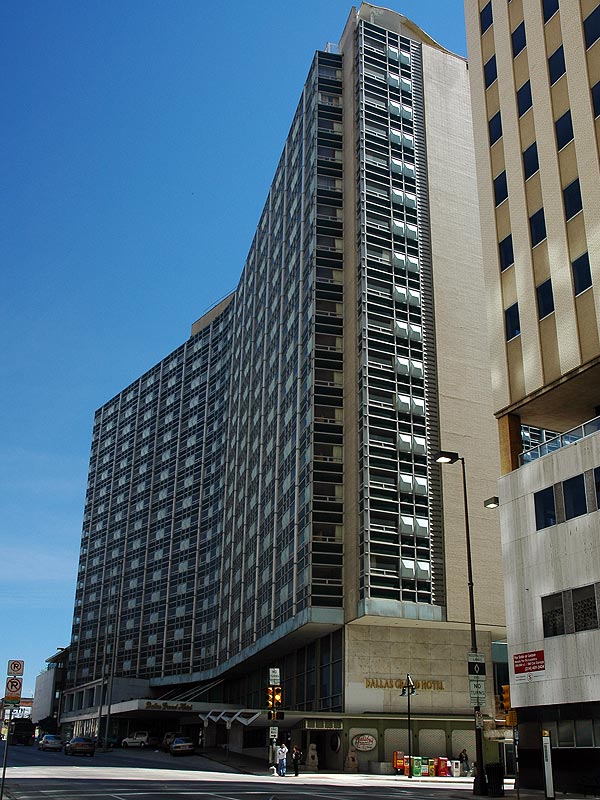
The Grand Hotel, aka the Statler Hilton, much like its nearby neighbor the Mercantile has been one of those on-again/off-again redevelopments, that promises so much but has yet to deliver. With the creation of the Main Street Garden Park, it is now situated as one of the most prominent buildings in the entire city, fitting for its history, and stately mid-century modern hi-rise aesthetic.

Despite its amazing interiors (do yourself a favor and click this link for a great photo-tour), no developer has yet to, as they say, "make the numbers work." Aside from the typical renovation/mitigation costs, the other primary difficulty is its short floor-to-floor heights, atypical for contemporary development.

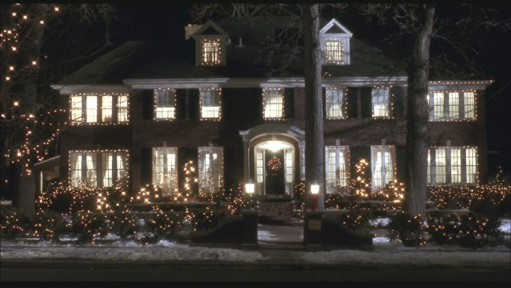
Without any tenants, the City of Dallas put forth a competition with a very narrow budget, in order to provide, or at least suggest, some sense of life rather than a dead building sit on its new park. When talking to a colleague and friend shortly after the competition was announced, he joked that it should reenact the christmas party scene from home alone with mannequins participating in the festivities in the windows as actual party-goers.

I loved the playful irony of it. It's a dead building. Everyone knows it is a dead building. Why run from it? The joke of it would generate far more interest than playing pretend.

The winning entry that has since been executed with backlit yellow paper lining the lower level windows and three uplights on the tower facade.


Frankly, I still prefer the playful entry (that was never submitted beyond jovial idea spitballing).


Home Alone house in lights 2

Friday, January 15, 2010

The Last Word on Main Street Garden...for now

Yes, it was heavy on rhetoric and bombast. But, the point of the post was to compare/contrast Main Street Garden with the similarly scaled Bryant Park.

The primary usefulness of Bryant Park is that it has evolved. One, we can learn lessons of why it failed and why it has become much more useful to its citizenry. It is useful now, because its underlying form has a rational hierarchy of outdoor spaces (or "rooms" if you will) allowing for a variety of evolving programmed activities, ie human lead activities to occur.

Bryant Park is not defined by its objects, but by its spaces. When a park is organized by spaces, we understand it. They are called "outdoor rooms" because biologically and psychologically it makes sense to us, reminding us to how we organize our own homes.

When the "stuff" or the ephemera is what defines the park is what makes it feel cluttered (and frankly, impermanent, which is probably the most critical issue to on a subconscious level) and not entirely comfortable space to be within. It just so happens that there aren't better options in Downtown Dallas until we 1) make more 2) incrementally evolve Main Street Garden. Perhaps the competition of other parks will drive that. I would recommend step one would be addressing the streets circumnavigating Main Street Garden.

That is the fundamental difference between the two.

Thursday, January 7, 2010

Main Street Garden - A Review and a Comparison

I've been promising a review of the new Downtown Dallas Park, Main Street Gardens for a while now, well eventually living up to my word, here it is. With visual aids! Now let's play show and tell:

To start, I will take a bit of advice from the policies of the Obama administration, which follows a general directive from the President offering the guidance, "that the perfect should not be the enemy of the good." So with that said, please remember my criticisms are not of the positive step that the actualization of this park is, but of the understanding of the malleable aspects of urban places and the desire for eventual improvement via direct identification of the potential flaws.

Main Street Garden's greatest strength is its very existence. The amount of effort against many odds is a tremendous acheivement in itself, especially when you realize that certain people wanted to put a parking garage below it. 1) downtown has TOO much parking and if you don't realize that, unfortunately, you shouldn't be making decisions regarding any downtown anywhere. 2) LA tried to put parking under Pershing Square and the curb cuts and ramping system off the entrances doomed the park in the same manner that AT&T plaza originally failed because of the bus shelters in front of it until its recent redesign. These elements created visual AND physical barriers. Cities are creations of interconnected webs creating positive synergistic effects. This is why a poorly constructed or rundown building in downtown is still more valuable per square foot than newer or better buildings that lack a synergistic "quilt."

As a bit of a history lesson, the Mercantile building sat empty for about fifteen years and the firm I used to work for (and the colleagues that in some cases still work with) had looked at this building and this portion of the city many, many times for various developers, all of which saw the iconic potential in redeveloping the "Merc." For various reasons all of these plans fell through, however the strongest idea remained.

An urban designer and landscape architect named Paul Shaw recognized the handsome buildings of this area forming a square around what was essentially rundown one and two-story junk. These buildings were the Merc, Titche-Goettinger aka 1900 Elm and the Indigo Hotel, the Statler Hilton, and the stately Old City Hall. Part of his redevelopment plan was addition by subtraction, revealing the historic architecture by removing the junk and creating a public square for each of these buildings to frame.

The moment these buildings were scraped you could see how important this decision was, it looked like a great park when it was nothing but dirt. However, I recommend the addition by subtraction method of urban design VERY rarely. Dallas has already done too much "urban dentistry," having pulled a few too many of its own teeth out sans anesthesia.


I came along after this particular plan for the park was created (which at the time was named Commerce Gardens - The name change is the one improvement.), but when Forest City came calling I put together the original presentation to sell them on the massive redevelopment before we were shown the door for the exorbitant international corporate firm fees.

When Forest City was given development rights, part of their hostage deal with the city was the creation of this park along with the gamble by the Miller mayorship of many tens of millions in subsidy to renovate several of the buildings in the area, with the hopeful payoff of an eastern portion of downtown that resembles something other than a parking lot...or Detroit.
---------------------------
While it is great to have a new and substantial green space in Downtown Dallas, that attempts to do something more than mask a freeway, unfortunately it's primary strength is simply that it is a park. However, the design of the park's greatest weakness, which is debatable as I'll get into, is that it is trying too hard. It is over-programmed, which is something that I, and every single person that I've talked to have commented. It looks as if somebody went on a supermarket sweep shopping spree through landscape architecture magazine, replete with a bizarrely placed, Martha Schwartz-y earthen mound (which I'll also discuss in a bit).

I want to first discuss some of the general issues before showing and discussing some of the more trivial design details which may or may not exist in twenty years as we adapt the park to better suit our needs.

Frankly and foremost, it has too much stuff in it. The best program of any urban public space is the people; letting people define how it can best put to use for their own needs. Many of the best urban squares and plazas in the world are actually quite barren, until they are full of people. This is why so many roman piazzas have become parking lots and why many of the piazzas turned parking lots have reverted seamlessly back to piazzas.

I find the root of such over-programming or over-designing stems from a self-conscious lack of confidence, from the designers or the city officials which are largely indicative of the collective feeling of the community they represent. It's a natural tendency. The fear is noone will use it, so the design and in turn, the park, end up with a cafe, a dog park, a hill?, child's play area, a fountain, a metal wire xmas tree (?!), doilies, doodads, and follies that will probably end up in a scrap heap or reused in a private garden someday.

Lesson: show some restraint. It's a park in a downtown of none.

As for some of the more worrisome elements of the park, these actually have less to do with what is inside the park itself (although that is not completely off the hook), but with its immediate adjacencies and connections.

As I've discussed many times, cities that work are a collection of many things, each contributing in the creation of a whole that is greater than the sum of the parts. This comes from the interface between buildings, uses, and conduits aka streets typically. When this machine that is "space" is orchestrated properly (purposefully or accidentally) it generates an energy, which induces what I call "urban magnetism." Notice the best places in the world can draw more people to them than it can physically support in terms of full-time residents.

Both building design and conduit or street design is critical in the creation of magnetic spaces, because if either is overly flawed they can each become barriers diminishing the multiplier effect of the regularities of urbanity. In the case of Main Street Garden, it unfortunately, has one terrible street, two bad streets, and one good street forming its boundary. Commerce would be the terrible street, with its five one-way lanes offering a quick escape. Yay for congestion relief!

My specific worry about the park, is that the interrelation between the adjacent buildings and streets to the park is only a visual one rather than also being a physical one. To improve this park, down the road, we will need to scale down each of the bad roads currently enveloping it by ensuring wide sidewalks protected by street trees and on-street parking as well as eventually converting the one-ways to two-way. Furthermore, I would specifically recommend that Harwood be bricked between Old City Hall and the park to create a "plaza" like feel and a physical connection between at least one of the buildings and the park. This would maintain bollards defining the traffic flow between building and park which could be shut down during special events.

As for the park itself, along the wide or north south sides of the square, I feel like the planting, the terracing, and the fencing create unnecessary buffering effect as well. I know the streets are bad, particularly commerce, but perhaps we shouldn't be so afraid of them to completely turn our back on them. This isn't the creation of Central Park at the height of industrialism and tenement housing. We're not trying to completely escape the city, nor create a central "lung." A good urban square should remind us what is so great about cities, about urban living. It must be welcoming and inviting on all sides. At the end of this post, we'll look at a similarly scaled park that redesigned itself to become one of the great urban squares in the country, if not the world.

Before getting to the photos and the details, I want to get one more petty, aesthetic difference off of my chest. Once in a while, can we please refrain from the arbitrary plan view geometries? Peter Walker does his concentric circles, as with the next downtown Dallas urban square Hargreaves does his faux alluvial patterns (even though there is no water), Martha Schwarz does her psychodelia, in Main Street Gardens we get very sharp angles, which could be fine, except for two things.

First, most of the great parks of this scale in the world have some symmetry to them. In the world of urban design, it is ok to copy. It's called empiricism and using what works, which has been proven through the ultimate of tests, time. Being different for the sake of being different is the sometimes scourge of both architects and landscape architects, as Bill Hillier writes, "sometimes with experimentation, you can be wrong." In this case, humans prefer order, symmetry. I'm all for some crazy shapes and experimentations in design occasionally, but those are best suited within the context of urban art. This is a public square. Design for the public, rather than littering the world with your own self-referential aesthetic. Very baby-boomerish.

Second, a lack of symmetry or the arbitrary selection of angles and axes can lead to oddball pieces and a general lack of cohesion. I'm sensing this is partially why the overall park feels disjointed, lacks cohesions, and is overprogrammed. As you'll see with the comparison at the end, a similarly sized park has a good deal of programmed elements but one finds them within the imposed order and hierarchy created by the formality. Taking a conventional hierarchy and arbitrarily skewing the angles is post-modern which is why Main Street Gardens feels cluttered. We left the 90s ten years ago along with our oversized blazers, shoulder pads, awful sweaters, flannel shirts, ripped jeans, doc martins and birkenstocks along with post-modernism behind. Now is the time for something more hopeful, more optimistic, more purposeful.

---------------------------
Sorry for the personal side trip into the world of pet peaves. On to the imagery and details:

Excuse the low quality. This is iphone imagery.
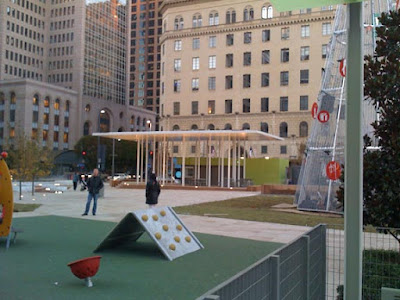

Okay. First of all, you might get a sense of the clutter here. And perhaps, the nature of child play areas and their acid-tripped designers lends to that. But, does the cafe area have to look like an abstract alien from War of the Worlds eviscerating all those who dare dine beneath it? What is with the thirty plastic support columns? This looks like it is from the scrap heap of rough drawings of patio furniture.
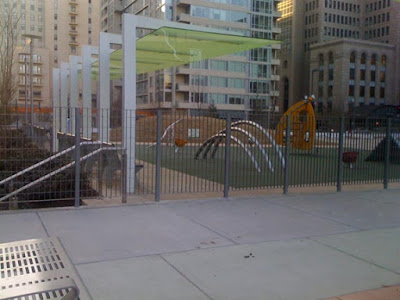

The earthen mound. Or as we like to call them in Dallas, Grassy knolls. Or it might be if the sod carpeted around it would ever take root. But it won't because the slope is too great as with Martha Schwartz's plaza in Minneapolis, which have never really grown grass well, and are, well...dirt mounds. But piles of dirt are fun for kids to roll around on, and we saw this in Landscape Architecture magazine, so let's throw one of them in here, even though it is completely contrived and arbitrary and has nothing to do with glacial formations.
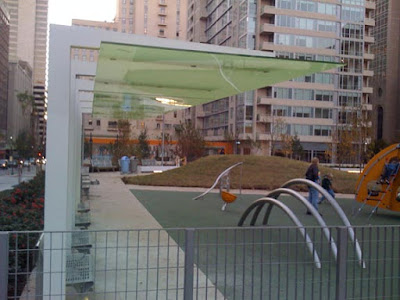

My favorite part. These green things, which I suppose are to keep parents dry while they force their kids to play in the rain and roll around on the mud hill. Only problem is these things don't cover the benches they are above, nor will the cast shade during the summer sun. oopsie. Play you stupid kids, PLAY! Or I'll lock you in the refrigerator again to give me some peace and quiet!
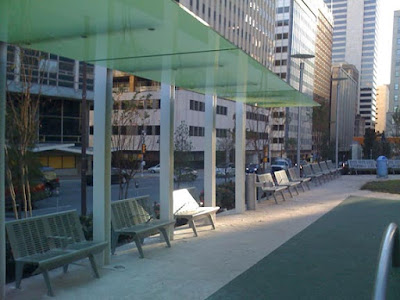
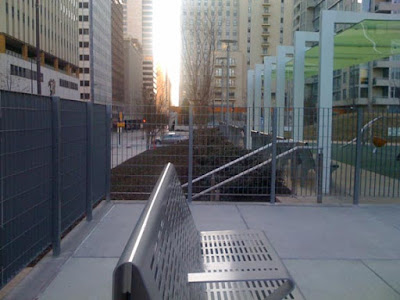


From inside the dog park. I don't care for the metal benches of choice, especially when we see some of the other benches in the park. Also, you get some disconnect between Commerce and the park in this image via elevation and fencing. Is a dog park really needed here? I've used it, but I can also easily go to the much larger one under the freeway where, like all dog areas in the City, never have any baggies.
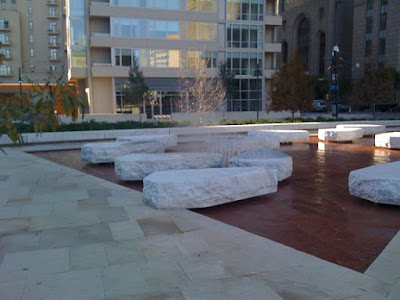

Fountain. Fine.
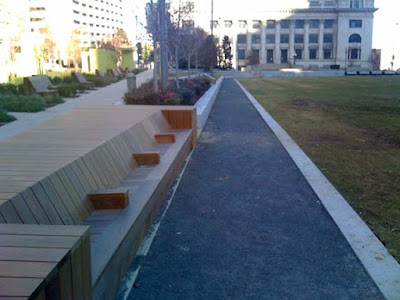

I love the hardwood benches and patio as well as the crushed gravel walk.
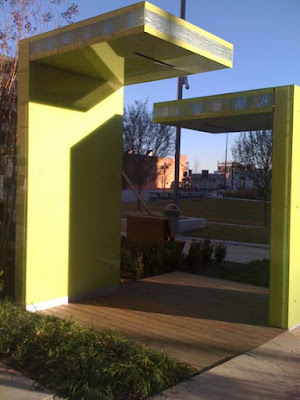

I'm all for follies in a park, but these? I have a hard time seeing people find usefulness in these.
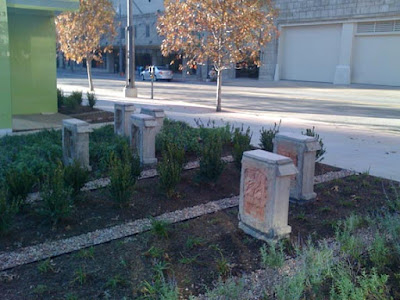

Your guess is as good as mine, but somebody sure is proud of that banding, I'm sure.
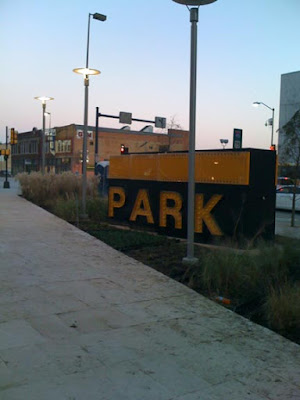

Two things. This sign has no place in the park. First, it is hideous. Second, do we really need a giant blinking sign stating "park" while looking like it is advertising a parking garage? Was the grass and trees not a hint to us mongoloids?
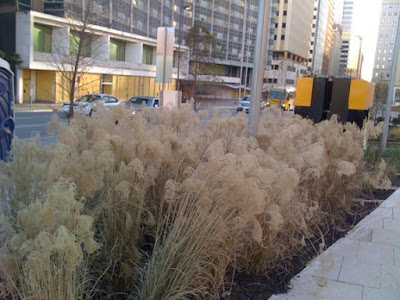

This is what I mean by the sharp angles and skewed lines. We get leftover pieces like this. What to do with it? Uh, I dunno boss, let's throw some stupid plants in and a big ol' blinky sign to distract'em with the bright lights and all.

---------------------------
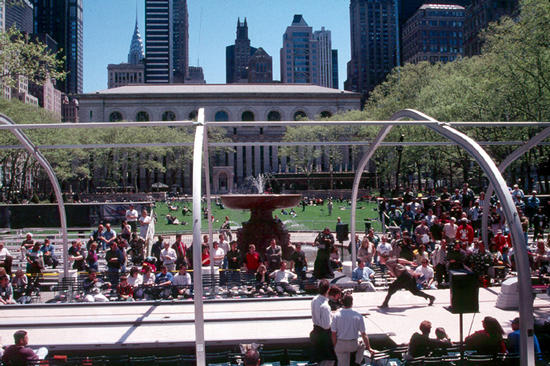
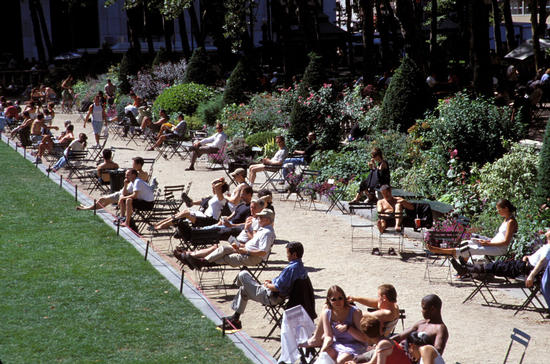
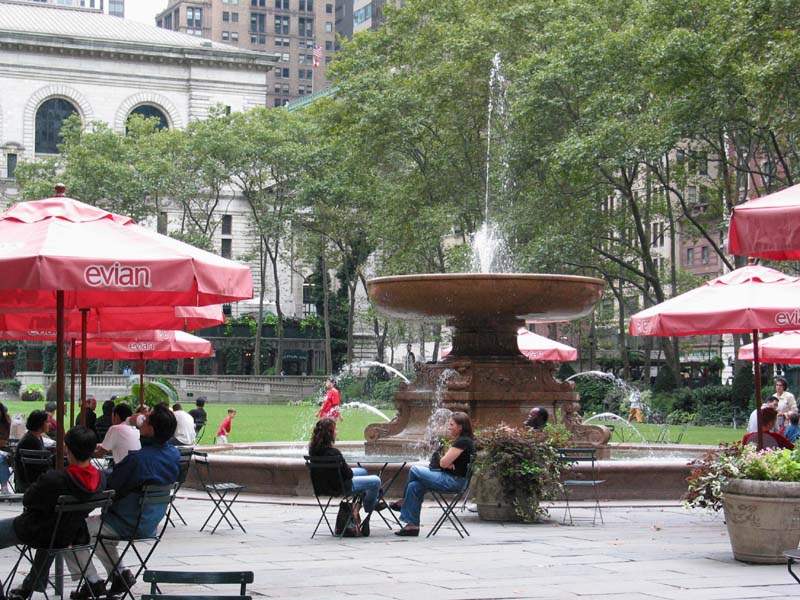
Now as for comparison, I present Bryant Park. Yes, it has the advantage of being in NYC. But, not more than fifteen years ago it was considered an abject failure, a haven for crime and drugs. Now, it is elegant. It has order. It is maintained. I recommend this site at Project for Public Spaces for more info. The key passage:
Bryant Park was rebuilt in 1934 under the direction of Robert Moses, Commissioner of the New York City Parks Department. Because of the stacks of the library located beneath it, The park was raised above the surrounding busy streets and conceived of as an "urban sanctuary." However, this design created isolation - and invited crime. The park grew to become a haven for drug dealing and other negative activities. After analysis by urbanologist William H. Whyte and Project for Public Spaces in 1981 - their report was titled Intimidation or Recreation - a plan for Bryant Park's reconstruction was developed. It addressed issues such as opening the park's constricted entrances and removing hedges along its perimeter so that people could more easily view the interior from the sidewalk...
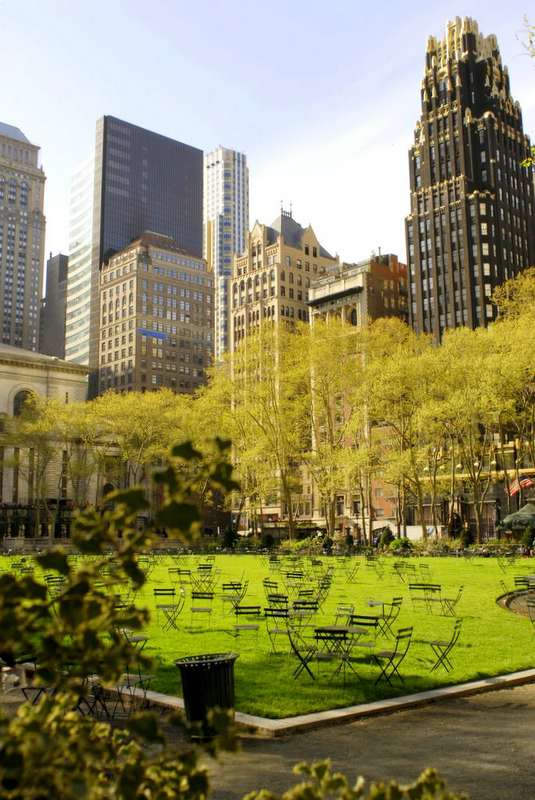
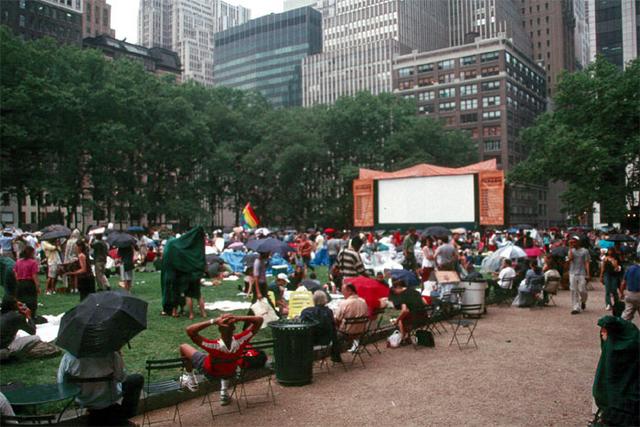


Bryant Park

 The Monday night movies, shown all summer long, are the place to be...even in the rain!
Another of Paul's ideas is to project movies on the giant blank facade of the UNT building facing Main Street Garden.
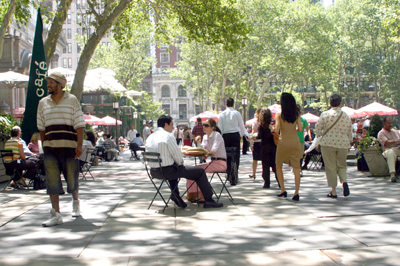
Temporary


http://www.wirednewyork.com/images/fountains/bryant_park_fountain_28sept03.jpg


Sometimes all a park needs to be is some green and a few chairs.