




Showing posts with label Too much parking. Show all posts

Wednesday, September 1, 2010

Never Pick a Fight When You're Severely Outgunned

If you've read this blog for any period of time, you know that it has some enemies: Brueggman, Wendell Cox, Joel Kotkin, and Randall O'Toole. The bone to pick isn't in the disagreement with their opinions, it is rather with the inconsistencies of logic and rhetoric to the points their making. In my estimation, this is the tell tale sign of corruption, and in this case, that means corruption of thought. They represent other interests while pretending to represent the "common man." Only if that common man happens to be the Koch Brothers, et al. If you are a common man, are you worth multiple billions? Want to know how morons get loud microphones in a supposed meritocracy? Well, there is your answer.

With that said, Randall O'Toole decided to take up the case for free parking in response to a New York Times article entitled "Free Parking Comes at a Price" by Tyler Cowen, since they're such staunch free marketeers and libertarians. Oh wait, their is the first case of logical dissonance.

Then came the response to the response, and this is by the parking guru himself, Professor Donald Shoup, who came out with all guns a'blazin':

Before I examine your misunderstanding of what I have written, I will first summarize the three basic parking reforms I recommend in The High Cost of Free Parking: (1) remove off-street parking requirements, (2) charge market prices for on-street parking to achieve about an 85-percent occupancy rate for curb spaces, and (3) return the resulting revenue to pay for public improvements in the metered neighborhoods.

I will quote ten extracts from your post, and comment on each of them.

1. “Shoup’s work is biased by his residency in Los Angeles, the nation’s densest urban area. One way L.A. copes with that density is by requiring builders of offices, shopping malls, and multi-family residences to provide parking. Shoup assumes that every municipality in the country has such parking requirements, even though many do not.” (ed. note: They do love to quote Los Angeles as the densest urban area don't they? A statistic itself that is meaningless because of where they choose to draw the boundary for where to take that measure. Is it dense at the block level? At the neighborhood level? At the City level? Not really. They go with the metropolitan area. Then they'll turn around and use LA as a model for success when that rhetoric suits their nefarious purpose.

Even Houston, which does not have zoning, has minimum parking requirements, and they resemble the parking requirements in almost every other city in the United States. Houston requires 1.25 parking spaces for each efficiency apartment in an apartment house, for example, and 1.333 parking spaces for each one-bedroom apartment. Here is the link to the minimum parking requirements in Houston’s municipal code: http://tiny.cc/iaj35

Does the Antiplanner, who is “dedicated to the sunset of government planning,” really believe that government planners know exactly how many parking spaces to require for every economic activity at every site in every city, no matter how much the required parking spaces may cost and no matter how little drivers may be willing to pay to use them? Does the Antiplanner really support Houston’s minimum parking requirement of 1.333 spaces for each one-bedroom apartment because he believes that Houston’s government planners can accurately predict the “need” for parking at every apartment to one-thousandth of a parking space?
Read the rest of his response here.

Wednesday, August 18, 2010

Back...But Not With My Own Words

Truthfully, I'm a little spent from having written about 5,000 words for the Dallas Morning News, 3,000 for a Magazine column, and another 6,000 for the parking paper in the past 2-3 weeks that I need a bit of a break (and those are all outside of my day job!). So don't mind me if I take the time to quote a passage from Tom Vanderbilt's excellent book on driving, cars, and us, Traffic: Why We Drive and What It Says About Us:
"When the city of Copenhagen was looking to reduce the number of cars entering the central city in favor of bicycles and other modes of transportation, it had a very crafty strategy, according to Steffen Rasmussen of the city's Traffic and Planning Office: Get rid of parking, but without anyone noticing. From 1994 to 2005, Copenhagen cut parking spaces in the city center from 14,000 to 11,500, replacing the spaces with things like parks and bicycle lanes.
As I stated in the parking paper, parking itself is merely a substitution for mobility. If other, perhaps safer, faster, or more enjoyable means of transportation are provided including proximity, then choice will allow a reduction of congestion.

An underpriced commodity, such as parking does two things: 1) it means there is too much parking making for an unpleasant human experience. If I am to invent a word it is anthropofugal. It flings people away. No one wants to be near a parking lot, particularly in Dallas summer heat. They also feel unsafe which is why Baylor floodlights the bejesus out of their surface lots. And 2) it encourages more driving, when we are trying to encourage more DART ridership and implement a new Bike Plan.

Copenhagen understood that parking itself was a resource and that its cheap, easy, or free supply created negative externalities such as increased car congestion, obesity, pollution, and increased citizen expenditures for gas, cars, maintenance, etc. They reduced the supply of parking to increase its value more appropriate to the costs it imposes upon the City.
Over that same time, not accidentally bicycle traffic rose by some 40 percent - a third of people commuting to work now go by bike...
People adapt. Copenhagen was smart. They didn't talk about what they are doing because they learned from earlier battles to remove car traffic from streets. People fret change. Businesses flipped out that they planned on removing traffic from their streets. Now central Copenhagen is as lively and safe a business district as their is in the world.

That number of bicycle commuters is estimated to be pushing 60% of commuters now.

Thursday, July 29, 2010

PARKING REFORM: Replacing Complexity w/ Simplicity

Find preceding sections here:

Part 1
Part 2
Part 3

and Part 4:


The need for Complexity through Simplification

A blanket code cannot effectively adapt to site conditions effectively. In response to this shortcoming, we have created over one-thousand Planned Development Ordinances, meaning each zoning case becomes a lengthy and expensive negotiation for both the private entity and the City. The zoning code for our City must be FOR shared principles towards an improved City and against things mandatory parking minimums that interrupt the natural fabric of a City with wasteful surface parking space. The eventual patterns would be the basic principles and goals through which all more detailed decisions would be filtered. There are no basic principles that limit the destructive effect of parking on urban fabric and economies or guide our city towards increased lovability and vitality.

None of us lives in the future; therefore, we cannot dictate the rules of the City to citizens of Dallas 2050 as many of our antiquated zoning rules have done for us. Our goal should be a new code that shapes the City in a way that in one hundred years, City form will be so lovable and useful to the citizens they will protect what we, the Dallas citizens of today, have created. Furthermore, the code should be flexible and adaptable enough to still apply or be malleable enough to respond to the needs of the time adequately.

It is no longer the 1980s. City building strictly for cars is no longer considered a futuristic utopia. It is costly individually and collectively. Our parking standards in effect require car ownership and the debt that goes with it. Dallas continues to be one of the fastest growing cities in the country and in order to accommodate the influx of people, the City must evolve in a sustainable fashion, and that means making infill development attractive to and profitable for investment.

Accommodate sustainable and creative development forms.

Dallas and its densifying areas cannot compete with suburbia and should not have similar codes. Nor can it compete with the great cities of the world, as Dallas often aspires, with 20th century models, but rather by best representing the 21st century. This does not call for otherworldly futurism, but for appropriate guidance of the market and to allow the new city to represent the outgrowth of the desires and personalities therein. Great cities are defined by their authenticity and this must be the underlying logic for cultivating it.

In other words, we must begin to frame policy to allow for natural demand-oriented corrections to the market, which would ensure maximum flexibility and eschew the tendency for cementing policy that is resistant to the natural change that all cities undergo perpetually.

Now is time to be proactive rather than reactive, to guide what we want our city to be, how we want it to look, how we want it to function, and how we interact within it. The parking code is one of those outdated, formative coding mechanisms that has a profound effect on eventual urban form.

Wednesday, July 28, 2010

PARKING REFORM: Prescriptive Codes vs. Proscriptive

Draft part 3 of infinity...


The need to “overwrite” prescription with proscription.

The lesson is that we also must allow for flexibility during changing times, needs, and technologies driving future city form that we cannot comprehend or predict with any accuracy. In any living system, complexity is a necessity to ensure its survival. More heterogeneous means more resilience. Cities are no different. In many ways, we squelched complexity in favor of uniformity, which was merely a direct response to codes that ensured uniformity and lack of innovation. We are now feeling the pain of those decisions.

In order to climb out of recessionary lulls, like any business, our City needs to best embody the spirit of the times. We need to unleash creativity of the millions of Dallas residents, in order to shape the future of the city toward one common goal of a more livable, more vital, more empowering city for all.

Most of the cities we love from around the world were and continue to be defined by simple patterns. For example, Portofino, Italy had no more complex building codes than certain established priorities such as views to the water. Siena was defined and arranged by physical capabilities of human movement at the time of its development. This led to winding and curving forms in response to geography. Another example is DC, which was designed to preserve the prominence of the democratic institutions housed there. The resulting form is of streets and view corridors organized around the primary monuments and seats of government, as well as height limitations that maintain a pedestrian scale.

The majority of contemporary building and zoning codes are overly prescriptive, in that they predetermine what the end result will be. While to some measure a few of these may be useful still for health and human safety, many should be scrapped in favor of proscription. A prescription is “a rule that defines in detail what to do in a given situation”, a proscription is “a template for defining prescriptive rules, a pattern for a rule,” meaning it is in favor of things, but how to get to that result is up to the determination of the designers, builders, owners in direct response to variable site issues, opportunities, and constraints.

PARKING REFORM: Intro

Draft Part 2 of who knows how many...


INTRODUCTION
In ten years, what will the City of Dallas look like? How about in twenty? Fifty? One hundred? The answer in the near-term is far easier to imagine than far into the future. That unpredictability ought to give us some insight into the process of zoning and coding for the City.

The United Nations defined sustainability as taking care of the needs of present generations without compromising the ability of future generations to meet theirs as well. In many ways, our building and zoning codes should represent a similar logic in order to rectify the mistakes of previous generations to be more accommodating for our needs and more adaptable for the future. They must achieve the goals set forth by the City yet be adaptable to prevent the institutionalization of what might have been one generation’s preferences instilling an inertia at the expense of another’s.

In a period of economic and general transition for people and their cities, now is the time to revisit codes cemented in place for so long and mold the underlying “genetic” codes of cities for the functional urban form we desire. Geographer Richard Florida similarly refers to the present version of these periods of varying degree of trauma as the Great Reset.

Urban Genetics, the underlying code and resultant physical form

Howard Bloom, popular science author and neurobiologist, calls these recessionary lulls the growing pains of shedding one form of living, that which is no longer useful for another new way of being, existing, and often, a yet to be determined one. According to Bloom and countless other urban theorists, our cities are the physical manifestation of our economies, meaning our phenotype, which with an understanding of genetics is directly connected to our genotype, or underlying genetic code. To get the cities we want, we must alter the genetic code of cities.

Our current challenge is unpredictability: what if we rewire the City’s code incorrectly? The worst thing to do is the obvious, to stick with the status quo or the comfortable. If Bloom is to be believed, we do not yet know what the future city will be because it is yet to emerge from the competition to replace the failing version of the existing. However, it is equally bad is to code a potentially incorrect prediction. We need to allow for flexibility and the determination of potential new urban phenotypes to battle it out and determine the optimal direction for our City. Lesson: Don't code to specifics.

Tuesday, July 27, 2010

PARKING REFORM: Executive Summary

(This is a snippet of the overall paper that checks in somewhere around 6,000 words and 11 pages. Putting it out there for crowd-sourced review and another chance to look at it in something other than Word, to give myself fresh eyes, so to speak.)


Part 1
Executive summary

A common solution to parking problems affecting American cities is often to convert to a market-based pricing approach. While this is appropriate in some locations, a strictly market-based approach works when curb parking is underpriced and overcrowded, however when there is plentiful off-street parking, the problem is the very code demanding excessive spaces.

As Professor Donald Shoup of UCLA writes in his paper on cruising, "Cities can therefore eliminate cruising either by charging market prices for curb parking or by requiring enough off-street spaces to reduce the price of off-street parking to zero. The price of curb parking is one of the few policy variables that cities control directly, but almost all American cities have chosen the wrong policy: requiring plentiful off-street parking rather than charge fair market prices for scarce curb parking."

However, rather than only one problem existing in Dallas, it is not that simple. Simply switching all parking to market is not enough. Expecting different results by following past policies or principles is the definition of folly. This paper intends to point out the multitude of negative outcomes for the city produced by the current parking ordinances as well as a suggested road map for guiding revision.

There are two general parking scenarios emerging in Dallas. Using Jan Gehl’s terminology these are the Invaded City or the Abandoned City. An Invaded area is one where demand to be there remains high enough where visitors often search endlessly for free parking and crowd residential neighborhood streets. In Dallas, some of these areas include West Village, Lower Greenville, and Bishop Arts.

Abandoned places are areas where walking and public life has become almost completely nonexistent due to excessive parking. Downtown Dallas was first invaded by automobiles in the 1950s, only to eventually be abandoned due to reactionary measures. Today, much of downtown remains abandoned although Main Street area seems to be on its way back towards invaded. Neither of which is ideal or acceptable.

If thought about thoroughly and amended strategically and creatively, a new parking code will solve both problems. Ultimately, this report suggests the differentiation of regional centers and local centers from the rest of the development code and make special provisions to these overlays for parking and transportation directives associated with the goals and principles of the area as outlined in the Comprehensive Plan.

Thursday, July 1, 2010

Parking Debate

Via Houston Tomorrow, I found this article on parking:
First, remember that the traffic patterns flowing to and from every property are unique, thus the exact parking ‘needs’ for each property cannot be accurately established by any ’standard’ ratio. We already stratify properties into 69 different categories - even if we further broke them down into hundreds of categories there would still be more exceptions than properties that were adequately served by the rule. So as we move forward in search of the best solution for parking in the city, we have to keep in mind that the government does not know how much parking any particular property really needs.

But there is someone who knows exactly how much parking each property in the city requires - the
owner of each property!
While I agree in principle, I think we need to temper the teabaggin' tempest, to which I respond:
What you're basically advocating is shared-parking as a free-market response because establishing parking minimums creates a "dumb" or non-reactive scenario where supply always greatly exceeds demand for parking, hence parking becomes either unduly cheap or completely free.

This is already getting written into PDDs as a defense against mandated oversupply of parking, but what we must also pay attention to is inertia caused by the transportation system. You can say the property owner or the market always knows the right amount of parking for their use, but that market is created by the government and the type of transportation alotted, ie big, wide roads = need for lots of parking. The "market" may still want big parking lots, because "why not?"

Saying the government doesn't play a role is the wrong way to approach this. As parking requirements are an element of zoning (or at least coding in Houston's case), the City has a role in protecting the asset of neighboring properties. If you put a 500-space parking lot next to me, you drop my property value.

Government can steer the inertia in a positive direction by reducing demand for driving and car use by setting parking maximums (based on proximity to alternative modes of transportation perhaps) allowing increased density and walkability (in that surplusses of parking are public health hazard in a number of ways) and allowing market-based pricing for what parking is available so that if you want to park close, you have to pay for it. If not, residents of Texas cities could use the exercise.

No longer subsidizing parking is necessary for allowing Houston and Dallas to adapt to their new "bones" or transportation frameworks that now includes rail and will increasingly lean on a broader hierarchy of distance appropriate transpo, ie bike, streetcar, etc.

Friday, June 25, 2010

Parking in Dallas

Eye Test: Picture 1, picture 2? Picture 1, picture 2?


[DSC01350.JPG]
Danish Park 'n Ride. All transportation needs its infrastructure. Some are less corrosive than others.

I've written extensively on the general nature of parking (here and here), but rarely have looked at it locally (mostly because the effects are felt the same here as anywhere else) beyond documenting the inordinate amount of both surface parking lots and garages in downtown Dallas.

Over at D, Wick Allison takes on the antiquated parking standards designed to make Downtowns compete with suburbs. Of course, we know you can't do sprawl as well as the suburbs, so instead our downtowns sit punch drunk and confused.

On the other hand, I take issue with the idea that the market can sort it out on its own. While that is true over the long-term, the question is, is it worthwhile to fumble around until the market can find the right answer when cities, neighborhoods, communities, families, taxpayers, and property owners are all suffering from the extraneous effects of too much parking?

The City is looking at a complete revision of its parking codes, but from what I have been told, nobody really knows where or how to begin.

My comments here (edited because I can actually see what I'm writing in my own prompt):
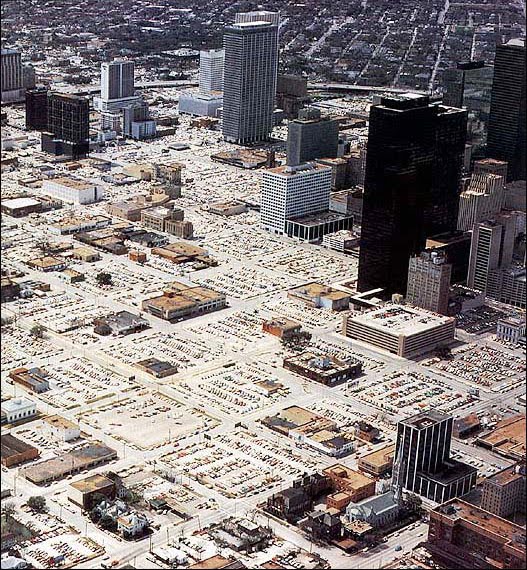
First of all, that 85,000 number is way too low. Dallas has 35,000 surface parking spaces in downtown alone, all of which (or 99% at least) are empty nights and weekends (and too many people falsely think for downtown retail we need more parking - those people don’t know what they’re talking about and are instead spouting conventional wisdom). Furthermore, Professor Donald Shoup of UCLA once calculated there are 4 parking spaces for every car owned in this country. You can quickly see that 85K needs to expand factorially.

What parking minimums establish is a scenario where supply always vastly exceeds demand. Parking by nature is fluid where that demand creates concerted pressure only at certain times of the day, week, or year. We have yet to arrive at a solution that responds to this nature. The only truly successful one is to reduce demand for parking by building walkable urban places where trips by bike, foot, transit or combo of the above reduce the need for parking. We have to rewrite the urban genotype to have the physical phenotype emerge in a way that is valuable, rewarding, sustainable, cost-efficient, and resilient.

The more important question is, how do we appropriately punish a place that has too much parking?

Large seas of parking are disruptive to the necessary interconnected nature of the urban fabric. It is costly to build parking, sometimes as much as 20% of a project's development cost, but for some businesses that is a drop in the bucket. Furthermore, they trigger the very purpose of zoning in the first place, to prevent the erosion of property values of neighboring properties. In the property rights debate, people seem to conveniently ignore the fact that your property is only as strong as what is around you - the very reason for the emergence of NIMBYism and LULUs.

I have worked with numerous hospitals around the country on their urban plans once they realized their land-banking strategies of buying blocks, clearing houses for surface parking, in the event they need to expand buildings/services has created unsafe (perceived or otherwise matters not) situations and a corrosive effect on neighborhoods. I worked on one project (and won a Daniel Burnham AIA award for it) in Springfield, IL where the hospitals literally destroyed the historic neighborhood and local residents wouldn’t put any $ or effort into maintaining their property knowing they would be bought out and house razed next. The result was downward momentum, an entropic cycle of decay and disinvestment. One look no further than Baylor downtown for a local example.

In a way the “market” is slowly, but surely solving the issue as hospitals realize they are at a competitive disadvantage without walkable, safe, vital urban neighborhoods around them. But, is it worth the market fumbling around and tearing apart the bonds of communities? I recommend the book Root Shock with regard to these effects by Mindy Thompson Fullilove.

Is any place really worth spending time in where parking is cheap and easy? Let’s start w/ that as a precept and work from there.

One simple solution is to set up zones, or overlays as Chris Leinberger suggested, where we set parking max’s rather than min’s. Off the top of my head, I think I recall hearing Professor Shoup say that LA’s parking standards (of which Dallas’s are similar) mandate something like 1000% (might even have been 1000x) more parking than San Francisco’s (numbers could be off, but point remains).

I’ve also recommended to someone involved that we ought to put the otherwise useless Comp Plan to work in establishing zones or at least categorizing a hierarchy of proposed density zones to guide the parking standards.

Prof. Shoup is an advocate of Demand-based parking. I think in the long-term we need to get to something similar, however I am not sure it is the most effective solution for Dallas's current situation. In most places around the City, there is no demand and where/when there is, parking is supplied privately.

Places that do have temporary demand load that effect the neighborhoods and business, such as Greenville and Bishop Arts, suffer because they are essentially neighborhood centers that draw from a City-wide base, suggesting that the majority of our neighborhoods are vastly under-served by walkable, clustered neighborhood centers such as these. Supply of walkable places is far less than demand, and the parking code (and zoning in general) is one of the primary reasons. If we had more of these, serving residents within a certain distance, parking would be far less of a problem.

The other thing to identify is where does city generated parking revenue go? Does it go into the general fund and get lost? These revenues should be directed towards localized public improvements. However, all the revenue is sucked up by private entities. So that solution isn't a short-term fix.

Land is so invaluable currently (yet overpriced), that even in a downtown, it is a market-oriented solution to have surface parking lots, which then further undermine land value. Our roads and transportation system, paid for by taxpayers create that market. That is the deeper issue.

I ask the question, since the market can't/won't push out surface lot owners from downtown, do we have the leadership to drive it out?


Tuesday, June 15, 2010

Guest Post: Charlotte Parking Wars

Here in Dallas, we have had a similar problem. Not with a greenway, but parking for DART stations taking up spaces in a shopping center and remaining all day, while the car's owner works in downtown.

A friend writes:
This was on our local news last night. I thought you might enjoy it. We built a greenway(+1 for CLT) in a place where it's mainly accessible by car(-1 for CLT) so people began parking overflow in a shopping plaza. The shopping plaza patrons are mad b/c they can't park in the closest spot to WalMart. The solution being proposed is constructing a new parking lot, just for the greenway(-1 for CLT). By my calculations building this new greenway is going to have a net negative effect on Charlotte. Which to me contradicts the original reason for building the greenway?
Here is the link to the news story:
4-Mile Creek Greenway is an outdoor lovers paradise for hikers, bikers, dog walkers, and people who love to run and have fun. But, the problem is parking at the entrance is limited and many find it convenient to park across Bevington Place at the Shops at Piper Glen which is limited itself. "Sometimes it's just like somebody took all the cars and just stirred them up, it's crazy and can be a nightmare, especially on the weekends." said frequent shopper Nancy Brimberry. Brenda Schuler adds, "it's too compact it's too small and and there's so many accidents in here."
Here is where I think it is important to remember the old Donald Shoup study that there are four surface parking spaces built in this country for every car. Furthermore, the Piper Glen area where this parking war is taking place is very suburban. Recall that the quote above says it is for hikers, bikers, dog walkers, joggers, etc. All of these people are DRIVING to the green space.

In a drive-to-everywhere world, this will ALWAYS be a problem.