Showing posts with label Pseudo-intellectual. Show all posts

Wednesday, October 27, 2010

Don't You Touch That Monopoly

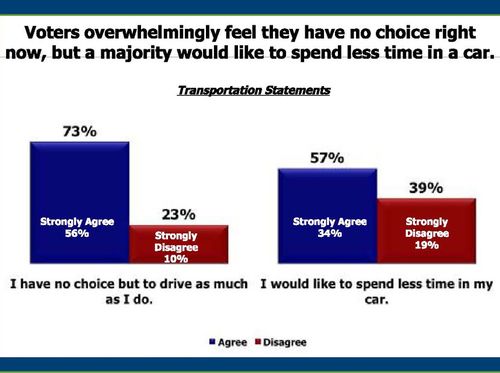
Oh Noez! People want things other than big, dangerous roads. This guy finds that to be BS:
Congestion is by far the most serious issue facing our transportation system. Livability measures not only fail to address congestion, they make it worse. More congestion means that people spend more time stuck in traffic, which means a lot of wasted time and fuel. As vehicular mobility declines, so does real livability.
But my favorite part is this:
The implication is that any infrastructure project that fails to build more roads is latently unpatriotic, because “most Americans prefer to drive”:
'America Haterz! Always tryin' to make America better and safer and cleaner! Monopoly on transportation is as American as apple pie. You don't hate apple pie do you?! DO YOU?! Monopoly was a board game! Do you hate board games?! You'd probably rather kick a can down a dingy alley and pretend it is a soccer ball in some poor country that doesn't have all our freedoms and Escalades!'
---------------------------------
Scribner is from a group called the Competitive Enterprise Institute, which hails one Michelle Malkin as an alum. If that wasn't enough of a black eye, along with American Enterprise Institute are the "think tanks" with the two highest percentages of their budgets attributable to corporate funding. Their corporate donors include Amoco, CSX (a trucking/shipping company), Ford, Exxon Mobil, GM, and Texaco. /Just do thy bidding.

As for private and foundation donors, they include such upstanding, freedom (for-me-and-not-for-you) loving citizens as the Koch brothers and the Scaife family, as in Richard Mellon Scaife. They consistently support such happy friendly industries as coal, pharmaceuticals, and tobacco, once calling "smoking a civic duty." /Too many Mad Men re-runs I suppose.

Oh, they're also among the biggest whores climate change deniers on record.

Monday, June 28, 2010

The Reptilian Brain

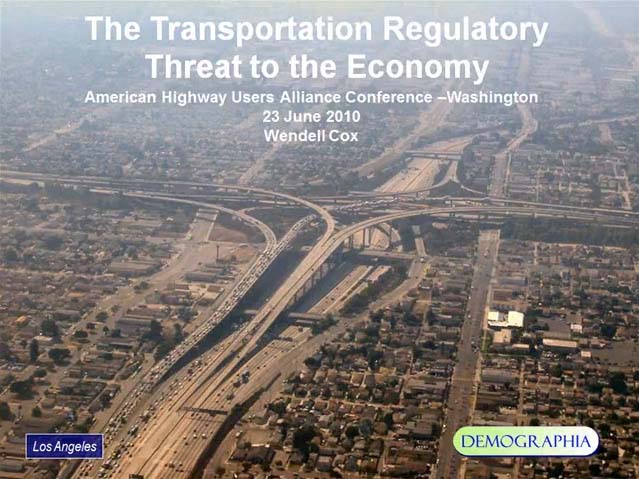
Robert Wilonsky at the Observer knows how to push my buttons with frightening economical efficiency: a two-word email and a link to a reporkulous presentation (with emphasis on the pork) by one Wendell Cox of the Institute for Intellectual Dishonesty.* Next thing I know, I'm dropping everything I'm doing to torture myself through a half hour of blanket statements that are often factually-oriented, but taken without context or deeper understanding that it undermines any credibility Cox might have, yet we accept him as credible anyway because well-heeled interests present him as such.

*Not his real organization, but is there really a difference?

On the other hand, if I have won enough credibility with you dear reader over time, you may be willing to accept my reactionary response to Wendell Cox. That being that he is a shill for the road lobby. Now this is also based in fact, as the directors of the group this presentation was given to The American Highway Users Alliance have documented tax returns representing the interests of Ford, GM, and Toyota. Users is right, but it isn't highways getting used it is all of us, the taxpayers.

Now if I haven't yet earned credibility then in this post I'll go through his presentation point by point to debunk and discredit everything he says.

First thing to know about Cox is that he is the kind of guy who claims he's for "choice" as long as all subsidy goes towards roads and cars and not to any other form of transportation whatsoever. Free marketeer, this guy.


Next, is the graphics. Pretty, in depth, nor subtle, these presentations are crafted by people lacking the least bit of intuitive sense of semiotics. All it takes is the opening picture to elucidate this point. "Boy, that sher is a purdy highway and cityscape... it's all washed out in gray and brown hues of the air, just the way I like to breathe it through my mouth hole."


My favorite part is that, well I would present the exact same picture as a "what not to do." Not only because it looks ridiculous and out of scale, but even if the point is that "highways create mobility," I'm seeing several lanes thoroughly clogged and several others completely unused. Neither, in the ideal scenario of which Cox poses to present. The rest of the presentation sprouts from there with similar shallowness of thought, understanding, and rhetoric that never leaves behind an amateurish capability to handle data, statistics, or reality.

Next, you pick up the voice intonation and the sense that this entire room is filled with crotchety, old white dudes who know only one model for reality. In other words, exactly the kind of guys that would populate such a thing as the American Highway Users Alliance or the kind of organization compelled to embolden "highway USERS" in their websites meta-tags (html geek'd) as some sort of populist cover in the event anyone gets the crazy idea from their rhetoric and positions that they might ya know, not actually represent the common person.

The nice answer to the question of who exactly these guys are is that they represent the financial interests of industries tied to the teet of the federal government, which once again reminds of the Klosterman quote about all technology eventually is bad. This is it. The technology is the car. We overbuilt comparative to its actual usefulness and it is proving difficult to extract it from our lives, not because of need or want, but because of the painful transition of certain jobs. Particularly, the jobs of these guys.

The other side of AHUA is a group posing as libertarian that proudly opposes tolls (not libertarian) and seeks maximum subsidies for highways (not libertarian). Those subsidies mind you, come from the pockets of the average everyday man for whom they masquerade as crusaders. Poor Peter gets robbed once again to fatten the wallet of already wealthy Paul. In other words, they perfectly represent the 20th century economy; the dead skin we, the rest of the country, are busily and painfully trying to molt in favor of a new and improved, repurposed economic phenotype.

I like my hypocrisy marinated overnight with deep, rich notes if for no other reason than an aroma so rich I can taste it whilst pulling up to the valet to park the car that I don't have. How about you?

If I'm to give AHUA and Cox credit, they understand that if they ensure never-ending road construction, this inevitably disperses population so that no other form of transportation works except for private automobile. Then we're held captive to building such infrastructure, supplying inefficient bus service to the working poor, who are also scattered, and subjugated to fluctuations in oil prices based on the whims of foreign cartels. This is painting them in a good light.

They also support domestic drilling any and everywhere as the solution to dealing with foreign dictators and oil markets. Any problems with that recently? I feel like taking a cruise on the Gulf of Mexico and flicking burnt cigarettes that I don't smoke off the bow of a boat with these guys tied to the hull.

Despite its advocacy for the common man and "million of americans and businesses," AHUA has a whopping 145 twitter followers. Grass roots indeed. Fundamentally, this points to the crisis of republican governance (not the party, the form), that this group can be so influential in determination of policy directions and public spending with no popular support to speak of.


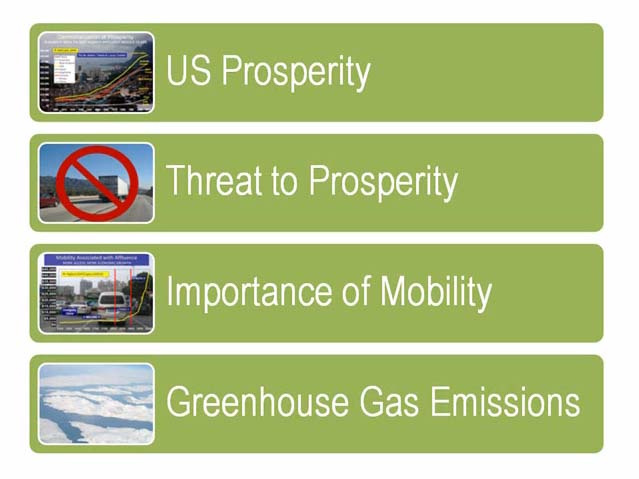
You know it leads to a bad presentation when these bullets say nothing about the actual points of discussion. In fact, I could put together a presentation with the same bullets and say the exact opposite...which, is exactly what I'm going to do here.

Also, notice the re red outline accompanied by words like "threat." These are appeals to the reptilian brain, the most basic, primal, and reactionary. It ignores logic and reasoning and skips straight to instilling fear. Why? Either their actual arguments lack merit or this is literally the way they think. Neither explanation really matters.

Within the presentation, Cox's fundamental point is that of mobility. What they either cleverly and deceitfully do (or ignorantly don't understand) is that transportation policy and funding shifted solely to cars undermines real mobility. Distance, propinquity, and diversity of choice are all elements in the equation of mobility. If someone has to drive to ten different locations scattered across suburbia, find parking in order to accomplish ten different errands and I can handle them within five blocks, who is more mobile? Which is more efficient? Which is more cost effective?

Furthermore, accessibility is another element of mobility. They expect everybody to drive and everybody to own a car. Behind closed doors, I imagine them half-jokingly suggest removing drivers test and age limitations for licensure over cigars and aged brandy. The truth is that the handicapped, elderly, those who can't or don't want to afford cars, and children under 16 have reduced freedom of mobility, and burden others because of it in car-centric environments.

Another pseudo-libertarian, Randall O'Toole suggested a good solution to disaster preparedness in the event of another hurricane Katrina is for the federal government to buy all residents of NOLA cars to evacuate when adequate rail service could have moved thousands every few minutes and avoided the logjam. And O'Toole is actually considered the more serious one!

They are "libertarians" that wanted to subsidize car ownership. This should tell you how committed they are to their principles. This is also the same logic they apply to all other solutions, regrettably.

The rest of the presentation is full of super-duper trustworthy appearing statistics and tables. All of which are little more than broad sweeping generalizations providing no declarative proof of causality between cars/highways and prosperity even though each is passed off as such. Frankly, I think the impoverished state of municipal budgets spread too thinly to the breaking point provides proof that any correlation is one of timing if not outright temporary hallucination.

Post-WW2 prosperity had far more to do with loans to rebuilding nations after WW2, not having to deal with the wake of armies in the millions colliding on our continent and the subsequent rebuilding, and growth fueled by cheap oil following the Nazi version of economic development which was to funnel tax money to highway construction and militarism defense.

I'll give them credit for one thing. They understand the hyper-rational Descartian world where statistics of any kind are roundly accepted without question. In fact, they count on it.


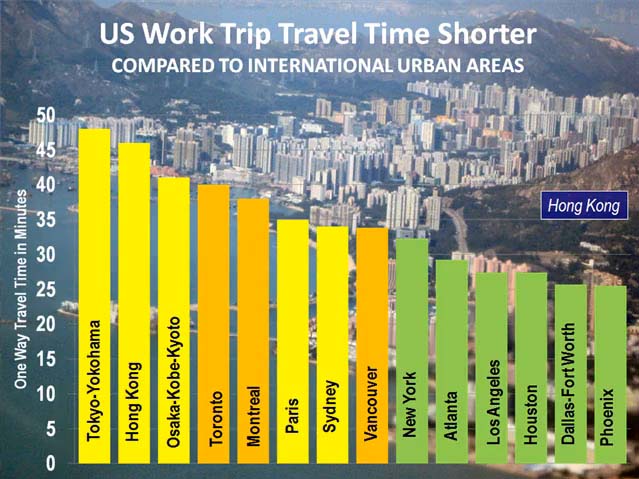
For example: don't ask questions. From this you are to assume that because commutes in PHX and DFW are super short in comparison to the other cities listed that PHX, DFW, and Houston are the cities dreams are made of. OMG, look at NYC. It's almost unamerican! Kill it!

Of course, none of these are sourced. Furthermore, each is an empty statistic taken in a bubble with no context. There is nothing to be said of 1) quality of that trip, 2) productivity of that trip, and 3) externalities of each trip.

For example, if it takes you an hour to commute in Osaka, Paris, or NY but that trip is spent on a comfortable train ride where you can sip an espresso, read the paper, and read/respond to emails, bookended by short, safe, pleasant walks, while millions of others are making similar journeys that don't pollute, kill tens of thousands on the commute (as highways do), and aren't choked up routinely by said accidents creating traffic jams undermining mobility and time savings, which is really better? Cox claims one way is better strictly by the most simple of metrics.

One point I've made over and over again is the fallibility of neo-classical economics which attempts to objectively assess values and work strictly within a system where everything is priced by the market. But, if you ignore the majority of the elements in the equation, those things that either can't be priced aka invaluable or you ignore them, you are being either disingenuous or outright stupid.

http://www.houstonfreeways.com/modern/images/2004-04-11_high_five_aerial/high_five_19_looking_s_along_75_2005-04-11_19_500.jpg
How many schools or textbooks could be afforded with the cost of this? Or, what could you buy or save with what wouldn't have had to be taxed out of your paycheck?

Threat to Prosperity: "There are some who wish to slow if not stop completely the expansion of highways which would increase traffic congestion."

In a way he is right. If we stopped building more highways (which we can't afford or maintain by the way), we would create congestion. Except it would be pedestrian congestion and bicycle congestion, the kind that doesn't have negative externalities like with the automobile version of congestion where you are trapped in a suffocated metal box, with noxious fumes all around you, on a field of concrete and can't go anywhere because you're blocked in by your mortal enemies, every single other person on the road.

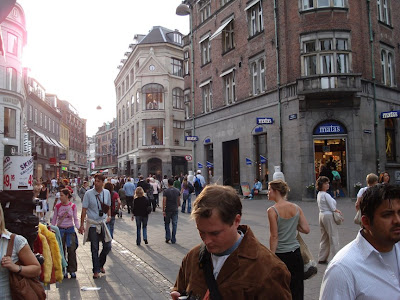
http://2.bp.blogspot.com/_D5kx0bUGx_c/SFrcesEToTI/AAAAAAAAATM/xqBVjBxLr_8/s400/DSC01160.JPG
Positive Congestion

The good kind of congestion only has positive externalities, such as healthy populous that is less of a burden on a healthcare system, increased commerce based on foot traffic, better localization and synergies of real estate clustering, less money spent per capita on infrastructure construction and maintenance, less money shipped overseas in support of our oil habit, and the other people providing that congestion aren't your enemy in a competitive situation, but a cooperative one where the presence of each of you makes the other more safe and their experience more enjoyable. Nobody goes to the highway to people watch.

Legitimate studies, unlike those that Cox uses, show that increased road and highway capacity only temporarily reduces congestion, but ultimately worsens all of the negative outcomes as listed above.


He also likes to play up the big red ghostbusters circle with a line through it, suggesting that we are trying to ban things or control the way people live. It's like they craft these presentations for children...or at least those with the minds of children. In the spirit that we project our own thought processes onto others, it doesn't speak highly for people that treat others as if they have the mind of children does it?


"Contempt for the American Way of Life..."

This also is not a new playbook really. They're anti-american hippy commies!!!! Tired. Yes, the Urban Land Institute, made up predominantly of conservative, buttoned-up real estate developers is really a radical left-wing socialist front group. Next ULI meeting I'm checking for little red books in breast pockets and Che Guevara t-shirts under those black and gray suits.

Actually, any legitimate city planner is perfectly happy to allow any of those things as long as they pay their full cost in a properly competitive environment. We wish to end subsidies which create an unfair competitive balance, particularly to those products and industries with significant negative external byproducts, such as car traffic congestion, obesity, asthma, pollution, runoff/flooding, etc.

These subsidies began in the early 20th century as a response to the squalor industrial cities had become. The are not appropriate for what cities are today and they don't respond to the way cities exist in the prideful hearts and minds of their inhabitants. We want to care for our cities. We want to showcase them. We want them to be great.


Frankly, the rest of this is retreads of similar cherry-picked data that I find it a waste of time to go point by point once the fundamental logic is undermined, obviously every single point is as well. O'Toole, Cox, etc.? They are all dinosaurs fearing extinction. Unfortunately for them, time is cruel to those without useful ideas.

They're hanging around only as the apparatus of the industries entrenched by massive federal subsidy. They like to play pretend libertarian, but they are really only fighting to maintain the free hand outs for their industry. Cox, O'Toole, et al are more than happy to unscrupulously sell their integrity for a cut of that cash money.

They are afraid of change and are backed into a corner by the kind of dramatic sweeping change that only happens because of the calcification of their industries. Evolution happens in two ways: radical and gradual. Gradual is painless. Radical occurs only through collapse. The world they've entrenched crumbled rather than accept and encourage gradual, free- and fair-market adaptation...

And that sudden repurposing shift is proving traumatic to their industries. We would be so kind as to let them die in peace.

Wednesday, May 19, 2010

Architects Can Blither On Aimlessly Too

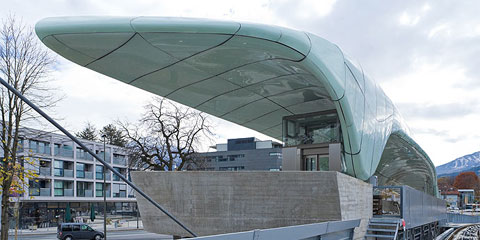
nordpark-cable-railway2.jpg

Heretofore, you are to be made aware that forms like this will sweep across the world like an architectural nerve gas. Suspension of disbelief necessary before proceeding.

These are always fun. You may have read my point-counterpoint responses to literal tools (of the sprawl industry/status quo) like Randall O'Toole before, but there are a strain of architects out there still wandering down dead ends while the rest of us move down the path towards more logical and coherent cities for the people, rather than bestowed upon them.

The following is over at Architects Journal and is written by Patrik Schumacher, an unfortunate soul who still thinks that style matters. Not coincidentally he toils under Zaha Hadid, unabashed fashion designer as far as the city building world is concerned.

In my Parametricist Manifesto of 2008, I first communicated that a new, profound style has been maturing within the avant-garde segment of architecture during the last 10 years.

Red flag: "We're the avant garde. Therefore you are inferior and must listen to us." This is precisely how they see themselves. It is a dying breed as cities move towards crowd-sourcing based placemaking. The idea of the singular genius has failed miserably. Quit reading the Fountainhead. Unless of course, you suffer from insomnia and desperately are in need of a 200-page soliloquy in place of sheep.

The term ‘parametricism’ has since been gathering momentum within architectural discourse and its critical questioning has strengthened it. So far, knowledge of the new style has remained largely confined within architecture, but I suspect news will spread quickly once it is picked up by the mass media. Outside architectural circles, ‘style’ is virtually the only category through which architecture is observed and recognised. A named style needs to be put forward in order to stake its claim to act in the name of architecture.

Holy patronizing Batman. First of all, an unknown word has been strengthened through criticism. Fair enough, we'll take your word for it. And we should, because he knows that once we are touched with the divinity of his understanding of such a profound concept (of something so superficial as style), it will take over the world and all of the great cities of the world will be replaced with the singularity of his vision.

Not to jump too far ahead of myself, but this really highlights the fundamental problem facing architecture: its disconnection from reality. The willful exclusion of the rest of society to work solely within a select peer group and only FOR that select peer group. Where the goal is to get a building on the cover of Architecture Record rather than a place that nourishes and supports its users, the City.

Can we please bring in REX or OMA again to defile our City? These people despise their customers. They look down upon them. This is the death nail of any profession turned insular.

The concept of style deserves to be defended

Does it?

The concept of style has for a long time been losing traction within architectural discourse. To let this concept wither away would only impoverish the discourse, and a powerful asset for communicating architecture to society would be lost. However, the resuscitation of this drained and battered concept requires conceptual reconstruction in terms that are intellectually credible today.

Perhaps its withering should tell you something. People have grown weary of these "style wars" driven by little more than ideology so utterly disconnected from reality. And their cities have suffered for it.

What stands in the way of this is the tendency to regard style as merely a matter of appearance, as well as the related tendency to confuse styles with superficial, short-lived fashions. Although aesthetic appearance matters enormously in architecture and design, neither architecture nor its styles can be reduced to mere matters of appearance. Neither must the phenomenon of styles be assimilated to the phenomenon of fashion.

Even if, at its absolute, very best, style was a direct response to a timely problem; the physical manifestation of a deeper underlying genome resolving some ill. It is still responding to the issues of that particular time. And times change. Therefore, once again IF (big if) "style" is a response to the needs and demands of the day (should-do rather than can-do), then style would have to adapt to changing times. Perpetually changing. Once again, the idea of timeless "style" is moot. And frankly, irresponsible if not intellectually dishonest.

The concept of style must therefore be sharply distinguished and cleansed of these trivialising and distracting connotations. It denotes the unity of the difference between the architectural epochs of gothic, renaissance, baroque, classicism, historicism and modernism. The historical self-consciousness of architecture demands the revitalisation of the concept of style as a profound historical phenomenon that can be projected into the future. For this purpose I have proposed that architectural styles are best understood as design-research programmes, conceived in analogy to the way paradigms frame scientific research programmes.

Fair enough. It has taken us an awfully long time to get to this point in the article hasn't it?

A new style in architecture and design is akin to a new paradigm in science; it redefines the fundamental categories, purposes and methods of a coherent collective endeavour. Innovation in architecture proceeds via the progression of styles so understood. This implies the alternation between periods of cumulative advancement within a style, and revolutionary periods of transition between styles. Styles represent long, sustained cycles of innovation, gathering design-research efforts into a collective movement so that individual efforts are mutually relevant,spurning and enhancing.

I can't disagree with this either. However, before we get started, let us also understand that adopting one style means the rejection of all others. Although changes in style predates this notion, inherent within "style" is the cynical notion of planned obsolescence. The acceleration of the metabolic rate at which one style devours another to a speed that exceeds all and any response to the world around it. To me, suggests that the pushing of any certain style wouldn't be directly responsive to the needs and demands of the people, but rather the selfish, grandiose visions of those pushing it. If you are really responding to an actual need, just say that and the style (as long as it is beautiful or lovable) should speak for itself.

Parametricism offers a credible, sustainable answer to the crisis of modernism that resulted in 25 years of stylistic searching

OK. Prove it, but I'll say right now that I'm skeptical of any outgrowth of an architectural movement based solely on "out-weirding" each other until a personal stake has been claimed on one particular outcome of ideological experimentation.

From the inside, within architecture, the identification of parametricism demarcates and further galvanises a maturing avant-garde movement, and thus might serve to accelerate its progress and potential hegemony as a collective research and development effort. As a piece of retrospective description and interpretation, the announcement of parametricism seems justified after 10 years of consistent, cumulative design research. Prospectively, the announcement of the style should further consolidate the attained achievements and prepare the transition from avant-garde to mainstream hegemony. Parametricism finally offers a credible, sustainable answer to the drawn-out crisis of modernism that resulted in 25 years of stylistic searching.

But if it goes from avant-garde to mainstream will you immediately reject it like any hipster might the mass adoption of any particular meme?

Parametricism is the great new style after modernism

Declarative. I'll give him that. Despite passive sentence after passive sentence within the text.

Post-modernism and deconstructivism were mere transitional episodes, similar to art nouveau and expressionism as transitions from historicism to modernism. The distinction of epochal styles from transitional styles is important. In a period of transition there might emerge a rapid succession of styles, or even a plurality of simultaneous, competing styles. The crisis and demise of modernism lead to a deep and protracted transitional period, but there is no reason to believe that this pluralism cannot be overcome by the hegemony of a new unified style.

This is all very true. Let me guess, that style will be yours...

The potential for such a unification is indeed what we are witnessing.

Oh for F's sake.

Beyond the modernist paradigm of separation and repetition

The modernist order of separation and repetition is being supplanted by the parametricist order of continuous differentiation and intensive correlation. Within the broad new paradigm of parametricism, many subsidiary styles might be expected to enrich and progress the coming epoch of parametricism.

We need a Jules from Pulp Fiction appearance, "ENGLISH M-Fer! DO YOU SPEAK IT?"

Modernism’s crisis does not mean an end to unified styles

Modernism’s crisis and its architectural aftermath has led many critics to believe we can no longer be expected to forge a unified style. Did the profound developmental role of styles in the history of architecture, as evidenced in the gothic-renaissance baroque historicism- modernism sequence, come to an end? Did history come to an end? Or did it fragment into criss-crossing and contradictory trajectories? Are we to celebrate this fragmentation of efforts under the slogan of pluralism?

Aimless rambling. /irritatingly tapping fingers on desk.

Architecture today is world architecture

Every architectural project is immediately exposed and assessed in comparison to all other projects. Global convergences are possible. This does not mean homogenisation and monotony.

Quickly, he comes to the defense of what he must realize is the obvious weakness in his statement towards a hegemony of style somehow not equating to homogeny. Perhaps, sub-consciously aware of a shift back towards regionalism (sourcing local materials and responsive to local climates and cultures) and away from global architecture where you can't tell whether a building (or more importantly place) is in Dubai or Dallas?

It merely implies a consistency of principles,ambitions and values to build upon so that different efforts add up, are relevant to each other and compete constructively with each other, to establish the conditions for progress rather than pursuing contradictory efforts that battle over fundamentals.

True. I could have said the same thing, which is why I often state that style is irrelevant. So that doesn't define a style.

This is the idea of a unified style;

ummmm...

initially as a unified avant-garde design-research programme, and eventually as a unified system of principles, ambitions and values that constitute global best practice.

Ok, but how is that a style rather than a set of objective criteria or a pattern?

The new generation

The consistency of the style as a collective design-research programme depends upon the unfailing adherence to the strictures and impositions of parametricism. The good news is that a whole generation of young architects is already adhering to this.

obey.

Actually, I see a "whole generation" desiring to be more socially responsible and responsive. I think outside of measurable objective criteria found within urbanism, space syntax, et al., that may be all that is necessary. Once again, let style be as adaptable as your rigid notion of adaptability as style (I peaked ahead).

Many theorists - like Charles Jencks, for example - presume that the demise of modernism ushered in an era of stylistic pluralism.

The biological search engine. This is no different than any other field establishing that the status quo is no longer adequately serving the needs of society and like worker bees we all go off in different directions looking for the new patch of honey. Once we found our particular "honey patch" or style, we come back to the swarm and sing and dance about how great it is. We create a competition between them to find the most useful. Eventually, perhaps after a few wrong turns via overly-convincing shysters, we eventually find the most useful. Until that is no longer useful.

I'm getting the sense that we have a worker bee version of a used car salesman here.

Accordingly, the search for a new, unified style is seen as an anachronism. Any style today - so it seems - can only be one among many other simultaneously operating styles, thus adding one more voice to the prevailing cacophony of voices.

What did I just say?

The idea of a pluralism of styles is just one symptom of the more general trivialisation and denigration of the concept of style. I repudiate the complacent acceptance (and even celebration) of the apparent pluralism of styles as a supposed sign of our times. A unified style has many advantages over a condition of stylistic fragmentation.

The need for pluralism, however is the necessary constant testing of the usefulness of any current paradigm. Therefore it is necessary.

Parametricism aims for hegemony and combats all other styles.

What about all that "not homogenous" talk? My way or the highway. We'll be the judge of that. Of course, you don't want us to be. You want YOU to be. Sorry. I'm afraid that isn't how the world works.

While I agree that there are rules for how cities function, how buildings merely look is related specifically to the aesthetic tastes of ever-changing demographics.

Parametricism’s crucial ability to set up continuities and correspondences across diverse and distant elements relies on its principles holding uninterrupted sway. The admixture of a post-modernist, deconstructivist or minimalist design can only disrupt the penetrating and far-reaching parametricist continuity. The reverse does not hold, because there is no equivalent degree of continuity in post-modernist, deconstructivist or minimalist urbanism.In fact, parametricism can take up vernacular, classical, modernist, post-modernist, deconstructivist and minimalist urban conditions, and forge a new network of affiliations and continuities between and beyond any number of urban fragments and conditions.

I have a headache. Please state how. Please. I can just as easily state that I can leap the tallest buildings (even in Dubai).

Preparing for the style war

What are the current styles that must be combated by parametricism? Is there really still some kind of stylistic pluralism, as posited by Jencks?

Well, you have just spent a thousand words stating that there is. At this point, I would presume so.

In fact, post-modernism has disappeared, and the contributions and advances of deconstructivism have been incorporated within parametricism. The mainstream has, in fact, returned to a form of pragmatic modernism with a slightly enriched palette; a form of eclecticism mixing and matching elements from all modernism’s subsidiary styles. The inability of post-modernism and deconstructivism to formulate a new viable paradigm led to the return of modernism in the guise of minimalism as the only consistent, ideologically stringent style that confronts parametricism today.

So now you're telling me that there isn't a preponderance of competing styles? Why did I just read the last thousand words?

The primary confrontation in the struggle for stylistic hegemony is thus between parametricism and minimalism.

Parametricism claims universal validity.

It cannot be dismissed as eccentric signature work that only fits high-brow cultural icons.

Sounds defensive. I'm guessing that it absolutely can.

Parametricism is able to deliver all the components for a high-performance contemporary life process. All moments of contemporary life become uniquely individuated within a continuous, ordered texture.

HOW?!?!

The latest built works from Zaha Hadid Architects are much more than experimental manifesto projects; they succeed as high performance projects in the real world.

Please tell me how Hadid projects can help the affordable, urban housing crisis in this country? Or this dislocative qualities of unlivable cities perpetuated by hostile transportation systems?

The Nordpark Cable Railway stations in Innsbruck are a good example. No other style could have achieved this coincidence of adaptive variation to the different site conditions with genotypical coherence across those phenotypical variants. Parametricism is ready to go mainstream. The style war has begun.

No, it hasn't. It has always been on-going. Often pointlessly.

Patrik Schumacher is a partner at Zaha Hadid Architects

Ahh. Now I see. This, in fact, IS an entire pointless rambling screen masking its true intentions of advertising to the well-to-do and want-to-be intelligentsia. Of course, it is full of as much doo-doo as my doggie after a long night's sleep.

What is parametricism?

Parametricism implies that all architectural elements and complexes are parametrically malleable. This implies a fundamental ontological shift within the basic, constituent elements of architecture. Instead of classical and modern reliance on rigid geometrical figures - rectangles, cubes, cylinders, pyramids and spheres - the new primitives of parametricism are animate geometrical entities - splines, nurbs and subdivs. These are fundamental geometrical building blocks for dynamical systems like ‘hair’, ‘cloth’, ‘blobs’ and ‘metaballs’ that react to ‘attractors’ and can be made to resonate with each other via scripts.

Parametricism aims to organise and articulate the increasing diversity and complexity of social institutions and life processes within the most advanced centre of post-Fordist network society. It aims to establish a complex variegated spatial order, using scripting to differentiate and correlate all elements and subsystems of a design. The goal is to intensify the internal interdependencies within an architectural design, as well as the external affiliations and continuities within complex, urban contexts.

The avoidance of parametricist taboos and adherence to the dogmas delivers complex order for complex social institutions.

Negative principles (taboos)

  • Avoid rigid forms (lack of malleability)
  • Avoid simple repetition (lack of variety)
  • Avoid collage of isolated, unrelated elements (lack of order)
  • Avoid rigid functional stereotypes
  • Avoid segregative functional zoning

Positive principles (dogmas)

  • All forms must be soft
  • All systems must be differentiated (gradients) and interdependent (correlations)
  • All functions are parametric activity scenarios
  • All activities communicate with each other
While I like the general philosophy behind it, the idea of flexibility and adaptability, perhaps we are taking it a little too literally? Can malleable forms provide predictability? While humans need responsiveness, more often than not they can provide that themselves. Because times change at a slower, more adaptable rate than these malleable building forms can and do.

Humans also demand predictability the psychological necessitation for the permanence of more rigid, stable forms. In many ways an empty box, a building as a shell is a more malleable, usable, stable, and adaptable form than these crazy (and crazy expensive) techniques.

Tuesday, April 6, 2010

Not to Further Undermine Kotkin

But, to completely explode Kotkin's obfuscation that sprawl is a construct of popular preference applied large is this nugget from an article about an unimportant rag tag group such as the Center for Disease Control's study of sprawl and its effect on human health, particularly with regards to obesity:

An obscure detail, often communicated by Andres Duany, a founder of the Congress for the New Urbanism, is that low interest mortgages designed to avert a depression at the end of World War II, did not include renovations of existing house stock. A viral response to that federal mortgage incentive program became all new residential subdivisions and in-town neighborhoods, which has experienced two decades of deferred maintenance, were left behind.

Public infrastructure, public policies, banking and mortgage incentives, public zoning and building codes public agency regulations and standards, and recently, Wall Street securitization standards, triggered viral market responses and conspired to create false demand for a product that is rarely the actual market preference.

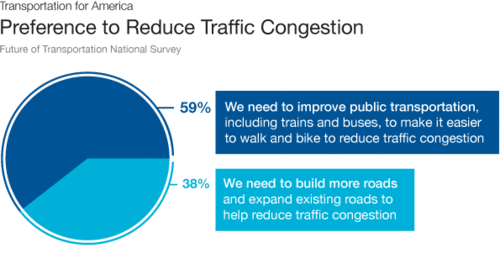
Sprawl was written into the DNA of its own creation, feeding and perpetuating itself. If you don't go in and perform surgery to all of the urban genotypic details from zoning, to lending, to transportation policies, etc. All of which were once in support of public opinion perhaps (although I would argue that we had no idea the monster it would create). Even if it were, it is no longer the dominant public opinion, as Ray LaHood refers to in his blog posting, "It's not my agenda, it is America's."

Poll-Traffic-CongestoinCar

Of course, this once again implies that since Kotkin's logic is so full of dung, that he is little more than the beetle feeding upon it.

Saturday, April 3, 2010

Kotkin: "Nothing, Nothing, Nothing. Wow, What a Terrific Audience."


A gentleman named Joel Kotkin was in town recently as a guest of the local chamber of commerce for a book signing, an overpriced keynote address, and several recent articles about Texas including this one I found in Forbes.

Further, he was interviewed by a cheerleading, sycophantic DMN, which was referenced by a DMN "editor" in a truly bizarre DMN blog posting. Apparently, the DMN was under deadline and didn't have the time to actually analyze what Kotkin writes or says. Kotkin is so far from a "new urbanist" that actual members of the Congress of the New Urbanism were quizzically wondering whether it was an April Fools joke. Distilled, Kotkin promotes new highway construction and rejects transit and does so using the tired boogeyman of big, bad government taking your cars away. So why was he here?

The entire trip comes off as a metaphorical handjob for everyone and anyone that is willing to mindlessly declare Dallas as a world class city despite all evidence to the contrary without any understanding of what actually defines a world class city and how those traits emerge through concerted cultivation and stewardship. Fitting, because Kotkin routinely displays all the writerly hypocrisy of unprincipled, think-tank whorishness.

----------------------------------------------
Don't Mess With Texas
Joel Kotkin, 03.30.10, 12:00 PM ET

One of the most ironic aspects of our putative "Age of Obama" is how little impact it has had on the nation's urban geography. Although the administration remains dominated by boosters from traditional blue state cities--particularly the president's political base of Chicago--the nation's metropolitan growth continues to shift mostly toward a handful of Sunbelt red state metropolitan areas.

During the exposition of any piece whether it is literature, cinema, or even a little Forbes article, the audience is particularly sensitive to hints of where the author is planning on taking us. Nice of Kotkin to warn us immediately that in this piece, like all of his work, he will be cloaking this ideological trope with his trademark phony intellectualism. Real urbanists take great care in both showing and proving that real urbanism is a large umbrella that supports the primary logical tenets of both right and left. Kotkin has a very specific and narrow audience. He is using a tried and true divisive technique to incite the reactionary.
Our Urbanist in Chief may sit in the Oval Office, but Americans continue to vote with their feet for the adopted hometown of widely disdained former President George W. Bush.

Point proven. Kotkin, ignoring that more people in history voted for Obama for presidency nationwide, is clearly pandering. And considering Dallas County went 58-42 in favor of the current president, something is obviously on his mind other than self-determination.
According to the most recent Census estimates, the Dallas and Ft. Worth, Texas, region added 146,000 people between 2008 and 2009--the most of any region in the country--a healthy 2.3% increase.

Other Texas cities also did well. Longtime rival Houston sat in second, with an additional 140,000 residents. Smaller Austin added 50,000--representing a remarkable 3% growth--while San Antonio grew by some 41,000 people.

Where are these people coming from and why? This is standard fare for Kotkin: overly simplistic analysis in order to bend data to his rhetoric. At a time, where people have less choice in the matter, he suggests that people are moving to Dallas specifially for the suburbs. Not sure if you, dear reader, has ever travelled or lived anywhere else, but there are suburbs in every city of the country. People are might be escaping out from under expensive houses where they may or may not be underwater. Perhaps they like warm weather. Also, as we have discussed, Texas has largely avoided huge housing because of regulation in the mortgage market.

The underlying issue is that it is not about suburbs it is about building cities that we can 1) afford and 2)are resilient, in that they remain useful to the economy. What Kotkin espouses is detrimental toward revitalization or to the future of cities. I will now spend the rest of this article stating why...

In contrast, most blue state mega cities--with the exception of Washington, D.C.--grew much more slowly. The New York City region's rate of growth was just one-fifth that of Dallas or Houston, while Los Angeles barely reached one-third the level of the Texas cities.

The other day I was out in downtown for a walk. Whilst playing frogger with my life aka putting our lives at the mercy of Dallas drivers conditioned to punch it first and ask questions later, I exchanged empathic glances with another individual crossing the road in the opposite direction. This person was wearing an "I (heart) New York" t-shirt. Go to any country in the world. Ask the locals about American cities. Ask college grads which cities would they like to live in. The data undermines his entire argument that it is about choice. People are moving to cities for reasons OTHER than choice.
These trends should continue: According to Moody's Economy.com, Texas' big cities are entering economic recovery mode well ahead of almost all the major centers along the East or West Coasts. This represents a continuation of longer-term trends, both before and after the economic crisis. Between 2000 and 2009 New York gained 95,000 jobs while Chicago lost 257,000, Los Angeles over 167,000 and San Francisco some 216,000. Meanwhile, Dallas added nearly 150,000 positions and Houston a hefty 250,000.

If you could draw trend lines to infinity would one city have all the people in the world and every other city would head the way of Detroit? Things are much more cyclical unless you cynically expect all city leaders/citizens to be fully incompetent or dispassionate about the welfare of their particularly city, their home. If he is suggesting that people relocate solely by choice, then wouldn't their be more love, more desire to nurture their home, and cultivate their city?
This leads me to believe that the most dynamic future for America urbanism--and I believe there is one--lies in Texas' growing urban centers. To reshape a city in a sustainable way, you need to have a growing population, a solid and expanding job base and a relatively efficient city administration.

This baseless non-sequitor is disconnected from his entire argument. A sustainable city needs a growing population?! Why? Theoretically, that makes no sense whatsoever. The only way to be sustainable is to grow infinitely. Lest we forget that we live in a world of finite resources: land, capital, capability, oil, water, air, etc.

Kotkin and his ilk lack the ability to decipher what the difference is between "cutting edge" Texan new urbanism and urbanism anywhere else. What they don't understand is that urbanism is an objective framework for local people, materials, customs, and culture to flavor. Successful urban places are defined by commonalities that transcend all boundaries, despite what his mindless pandering will have you believe.

They feel that they are losing control and the people (like the Middle Class for whom Kotkin purports to be the great crusader) are being hoodwinked by some mythical oppressive force. Fortunately, this crowd who is largely underwritten by the sprawl industry and employed as status quo defenders, they seem to have reached bargaining stage of the grieving process:

"okay, you can have your urbanism and your sustainability whatever that is but Portland's version sucks and the disconnected cul-de-sac high-rises of Dallas and Houston are awesome!!! Now I can haz more highwayz plz?"

None of these characteristics apply to places like President Obama's hometown of Chicago, which continues to suffer from the downturn--but you would never know it based on media coverage of the Windy City.

The New Yorker, for example, recently published a lavish tribute to the city and its mayor, Richard Daley. But as long-time Chicago observer Steve Bartin points out, the story missed--or simply ignored--many critical facts. Mistaking Daley's multi-term tenure as proof of effectiveness, it failed to recognize the region's continued loss of jobs, decaying infrastructure, rampant corruption and continued out-migration of the area's beleaguered middle class.

Wow. Job losses during the worst recession in generations during a complete repurposing of the economy, decaying infrastructure when DOTs, cities, and states across the country are overextended if not bankrupt and corruption, those are clearly issues Chicago and Chicago-only is dealing in Kotkin's mind. "It must be because they have mass transit. Or are in a blue state. Whatever disconnected trait I can pull out of context to rouse the rabble."

Kotkin is clearly pandering once again; an attempt to marshal support for a movement to counteract the groundswell of urbanism for business interests or populations that aren't prepared to adapt to a changing world. Luckily for all cities, this will fail because there is no soul. It is an unprincipled and cynical attempt to dam the inevitable waters of progress and history. Things change when people are ready for them and a meme becomes a movement.

Generally speaking, as Urbanophile blogger Aaron Renn points out, the repeated reports of an urban renaissance in older northern cities should be viewed with skepticism. In the Midwest region over the past year the share of population growth enjoyed in core counties--an area usually much larger than the city boundary--actually declined in most major Midwestern metros, including Chicago.

That solves it. Instantly, all things of all cities in blue states are inherently bad. And because that must be true, all things of all cities in red states must be good. This is Kotkin's logic.
Yet urbanists generally have not embraced the remarkable growth in the major Texas metropolitan areas. Only Austin gets some recognition, since, with its hip music scene and more liberal leanings, it's the kind of place high-end journalists might actually find tolerable. The three other big Texas cities have become the Rodney Dangerfields of urban America--largely disdained despite their prodigious growth and increasingly vibrant urban cores.

Austin is liberal. Clearly it must be an outlier, right Joel? There is no other explanation. Here he is playing the victim card once again. More pandering. This is tired and we are only half way through the article. It might as well just replace every stanza with "we're the victim, fear the other, we're the victim, fear the other" with the punctuation characteristically representative of signage in a tea bag really.
Part of the problem stems from the fact that all Texas cities are sprawling, multi-polar regions, with many thriving employment centers. This seems to offend the tender sensibilities of urbanists who crave for the downtown-centric cities of yesteryear and reject the more dispersed model that has emerged in the past few decades.

Yet despite planners' prejudices, places like Houston and Dallas are more than collections of pesky suburban infestations. They are expanding their footprints to the periphery and densifying at the same time.

Apparently, Kotkin magically appeared in Dallas and didn't fly in over the half-constructed neighborhoods ringing the DFW metroplex like the dead leaves hanging precariously from autumn trees.
Of course, like virtually all other regions, Houston and Dallas suffer excess capacity in both office buildings and urban lofts. But the real estate slowdown has not depressed Texans' passion for inner city development. Indeed, over the past decade the central core of Houston--inside the boundaries of the 610 freeway loop--has experienced arguably the widest and most sustained densification in the country.

Once again he shows his inability to distinguish the difference between contributive urbanism and simple, dense development that turns up its nose at context, at the street, at the rest of the city. This is largely a local symptom due to transportation planning and development happening in isolation. It is revealed in the helter skelter nature of its built form in Dallas and Houston.

When I think of bad density with no relation to its street, I immediately think of Lower McKinney, aka LoMac, which are defined by cul-de-sacs: the street defined by curb cuts, drop-offs, and porte cocheres, the parking garage in that residents have no reason to ever walk on a sidewalk and participate in urbanity, and the high-rise nature of the buildings themselves. Vertical cul-de-sacs in that they promote isolation rather than participating in the interconnected singular plane of urbanity.

Buildings (and in this case whole "neighborhoods"*) turn out this way because it is a bad hybrid of conventional and urban. It has the density of "urban", without the form, without the interaction with context. Urban is more than density. In fact, "urban" doesn't even require density. It accommodates density which is driven by desirability. What it requires is interaction between multiple buildings and its underlying transportation network in order to create attractive, resilient places that become desirable.

*I use quotes around neighborhood because does anybody think of LoMac as a neighborhood? No, because there is no relationship from building to building, nor from building to street. Neighborhoods are defined by the web of communication between buildings and streets. That is how things become places. These remain things, and in my estimation, despite being high value currently, will degrade long-term without extraordinary effort.
An analysis of building permit trends by Houston blogger Tory Gattis, for example, found that before the real estate crash, the Texas city was producing more high-density projects on a per-capita basis than the urbanist mecca of Portland. Significantly, as Gattis points out, the impetus for this growth has largely resulted not from planning but from infrastructure investment, job growth and entrepreneurial venturing.

Kotkin shows exactly why he is a dinosaur, a product of and defender of a dying logic. While on the surface, what he says seems to make sense. However, what is planning? Is infrastructural investment not a product of planning? Where is the differentiation between one type of planning and another? He is a supply-sider who believes that all we need is more road building and we can get back to the happy booming housing market of the 90s. Yes, Joel. Lack of road building was the pin that burst the housing bubble.

While infrastructural investment and entrepreneurship is exactly what we need, Kotkin cloaks his true intentions in what seems like a rational conclusion. He is really stating that we need new roads for entrepreneurs aka developers to keep building tract homes at the edge thus "unlocking the value" of the land. What he doesn't seem (or want) to understand is that there is no more market for that product to absorb and the potential value in land at the edge is proven to be overstated. He is showing that he is at odds with the "free market."

This process is also evident in the Dallas area, which has experienced a surge in condo construction near its urban core and some very intriguing "town center" developments, such as the Legacy project in suburban Plano. In Big D, developers generally view densification not as an alternative to suburbia but another critical option needed in a growing region.

Many of those condominium high-rises remain rather empty, because it was delivery of too much product without the demand. It sounds as though it was fueled by the same engine that built homes by the thousands in Las Vegas, in the San Fernando Valley, and condo high rises in Miami. So Joel, is this a local "Texan" phenomenon or a national one?
It's widely understood there that many people move to places like Dallas, whether in closer areas or exurbs, largely to purchase affordable single-family homes. But as the population grows, there remains a strong and growing niche for an intensifying urban core as well.

Kotkin always cites affordable homes as a defining characteristic of city's "on the right path." Detroit has affordable single-family homes. Why aren't people moving there? In Kotkin's rhetoric where context is externalized, swatted off as a pesky gnat, this should be all that matters correct? In the real world, prices are high in areas of high demand. Demand is representative of choice. Once again, everything he bases his arguments is undermined yet again.
Dallas and other Texas cities substitute the narrow notion of "or"--that is cities can grow only if the suburbs are sufficiently strangled--with a more inclusive notion of "and." A bigger, wealthier, more important region will have room for all sorts of grand projects that will provide more density and urban amenities.

Wrong Joel. I don't castigate the suburbs because of any reason that I "want to strangle them," but rather point out the temporal nature of them due to overshoot and their lack of inherent resilience due to their isolation.

While many people think cities are super complex things, they really aren't if you know how to look at them. All cities are emergent fractal patterns of human arrangement. They are the emergent form of economies defined by various cumulative integers defined by magnetic forces: things people want to be near and things they wish to be away from, thereupon overlaid onto a local geography.

The attractors and repellents are somewhat subjective. Where an interstate is important in linking regional economies, a highway within a city and its finely interconnected neighborhoods is considered a repellent force. People don't want to live near or walk along a freeway. The subjectivity lies within their individual willingness to do so.

The tragedy is that we undermine natural city forces by basing our inner-city transportation on roads people don't want to be on or near, but our businesses HAVE to be near for the visibility. This creates a tension between "place" planners and transportation planners and the outcome is an inefficient city that institutionalizes disinvestment. Kotkin's dream world sews the seeds of its own destruction.

This approach can be seen in remarkable plans for developing "an urban forest" along the Trinity River, which runs through much of Dallas. The extent of the project--which includes reforestation, white water rafting and restorations of large natural areas--would provide the Dallas region with 10,000 acres of parkland right in the heart of the region. In comparison, New York City's Central Park, arguably the country's most iconic urban reserve, covers some 800 acres.

Perhaps we are now seeing the point of Kotkin's appearance. Every word until this paragraph was meaningless. While Dallas citizens have shown that they want the Trinity River park, the reaction to the process ever since has been incredibly negative and almost visceral. One, I think, is justified.

They reacted strongly once they realized they have been sold a bill of goods in order to construct another freeway in an effectively broke city, broke state DOT, and are unable to properly maintain or appropriately and intelligently deal with the stress on the current super highway system of overpasses and interchanges. Did I mention that Dallas is in the top five of highway miles per capita?

Call me a cynic here, but I'm guessing Kotkin has been brought in by the Chamber of Commerce to argue for the new tollway. In their limited worldview, new highway construction means new jobs. I say limited, because reality and new studies are revealing highways to be drains rather than engines despite their limited initial spending (which is top down and centralized, by the way. Exactly what any fiscal conservative should be against.) which is why he is a hypocrite and all of his work will ultimately prove meaningless. If the purpose of life is to be eternal and live forever through the work we leave behind, Kotkin is doing a pretty lousy job.

I've come across many a Chambers of Commerce across the country, many of which are badly misguided. They have no understanding about how cities and economic development really work. In fact, they often end up simply as status quo defenders, inhibiting agents against progress. In the end they work to corrupt natural market forces.

If it is completed within 10 years, as now planned, the Trinity River project will not only spawn a great recreational asset, but could revitalize many parts of the city that have languished over the past few decades. It could become a signature landmark in the urban development of 21st-century America.

Wrong. North Oak Cliff is revitalizing in spite of the Trinity. It is happening whether any dirt is moved or not within the levees. It is a grass roots movement led by a community of creatives and organized, educated locals. Furthermore, this is supported by a federal goverment that actually gets it and has proven so in rejecting both Dallas and Fort Worth's initial streetcar tourist traps for one that is founded upon revitalization. Unfortunately for Kotkin, these truisms prove rather inconvenient for his argument.

As we look at the coming decades, this Texan vision may help define a new urban future for a nation that will grow by roughly 100 million people by 2050. To get a glimpse of that future, urbanists and planners need to get beyond their nostalgic quest to recreate the highly centralized 19th-century city. Instead they should hop a plane down to Dallas or Houston, where the outlines of the 21st-century American city are already being created and exuberantly imagined.

Texan vision? He acts as this is some coordinated effort. Wouldn't that be top down planning if it were a singular vision? Rather, what is happening is the citizens of all of the Texan cities are building community and qualitatively improving their cities to build a better quality of life. That is a human need. Not a Texan one. It just happens to be happening here in spite of all the new highways that Kotkin wants us to build.
Joel Kotkin is a distinguished presidential fellow in urban futures at Chapman University. He is also an adjunct fellow at the Legatum Institute in London and serves as executive editor of newgeography.com. He writes the weekly New Geographer column for Forbes. His latest book, The Next Hundred Million: America in 2050, is out now from Penguin Press.

Catty comment: Ever notice how these guys never get jobs at respected Universities? I'm sure they (reflexively)play the victim card once again and those smartypants institutions wrongly marginalize his brilliance.

So what is he actually arguing against? Blue states in general? The President??? Like all of Kotkin's writings and speeches, this article says nothing and it is a discredit to the DMN and Dallas Chamber of Commerce for treating him like someone that matters.

As far as cities go, Dallas is still in its adolescence, historically and consciously. We like to be patted on the head and told we are doing a good job. Hopefully, we all can mature past Kotkin's masturbatory gestures. It takes honesty and real intellectual curiosity. Or perhaps it is only the DMN, the Chamber of Commerce, and traffic planners that need to grow up. The rest of us seem to be doing just fine.