




Showing posts with label Walkability is a tax cut. Show all posts

Wednesday, February 9, 2011

Linkages - Edjamacashun Edishun

Charles Marohn, a transportation engineer who gets it, writes at the New Urban Network about the high costs of busing kids to school:

If I am reading the budget right, we are going to spend $3.4 million in transportation costs this year. That seems in line with the costs reported in the MN2020 report. With a starting teacher in the district making roughly $41,000 in salary and benefits, we could add over 80 new teachers right now if we stopped subsidizing busing. That would be a 20 percent increase in staffing, potentially a game-changing amount.

Here's my proposal: What if we abolished the mandate that schools provide transportation to all students, but required them to still provide it to children that lived on farms (or whose families had careers that required them to live in a remote location)? For all other children, transportation would be provided as a fee-for-service offering. We then subsidize children from poor families (many of whom live close to the old schools anyway).

Besides the fact that it is nearly politically impossible to get people to pay for something they have been receiving for free, what are the objections?

It makes no sense that we continue to abandon neighborhood schools in favor of these remote campuses that require every child to be bused to. The only reason this continues to happen is that we've made transportation a sunk cost — it has to happen anyway — and so the cheapest way to do it is to make it large-scale. In the meantime, the transportation mandate is simply another perverse incentive for people to make lifestyle choices that ultimately have huge, financial costs to society.

At the link, he also discusses the design of the school and the area immediately around it. It's on a highway (or something close to it). No child could walk to it if they wanted and if some parent actually did allow such action, they would immediately get a call from protective services. Likely from somebody on a cellphone driving down said highway before they sideswipe another car because they failed to use a blinker while talking on said phone.

The budget Chuck mentioned above is for one (1) school district. We're about to cut teachers left and right, most disconcerting, in positions where they're needed the most such as special education. What is next? Why even have schools? Wouldn't that be cheaper? Isn't that the defining goal? Just rent some space from giant auditoriums and concert halls and have the one teacher left (the youngest, cheapest, and most inexperienced of course), lecture on all subjects to 1,000 kids at a time.

Or maybe, smaller, more localized schools was actually a better way of caring for and preparing children to be prosperous contributors to society.
-----------------------------------
Next Question: Is Density a necessity for educational achievement?

So, if most American students live in lower density places than their peers in Europe and Asia, could it be possible that this-in part-is a reason for lower performance on science and math tests, which are basically a series of challenges or problems to solve.

Do children in higher density areas encounter informal problem-solving challenges far more frequently than their suburban counterparts and therefore have had more practice, more opportunity to hone their problem-solving skills? The urban challenge may be how to communicate with someone from another country, or how to navigate a Razor scooter down a busy sidewalk, but it’s still a problem to solve. In one recent series of tests, students from rapidly growing and changing Shanghai were tops in the world. Coincidence?

If density matters for economic productivity and innovation productivity, surely it matters for education productivity.

I don't buy the simplicity of the equation, Density + Education = Gold Stars! There are so many fundamental policies that hamper education, i.e. rote memory, teaching to the test, etc., that it couldn't possibly be that simple. But, there are a few contributing factors of certain kinds of density that propel higher achievement.

First of all, that density has, HAS to be a product of desirability. Shoving people into Bed-Stuy, Cabrini Green, Pruitt-Igoe style tenements doesn't equal brain power. However, if a place is desirable, people will move in, including a range of tax brackets, thus increasing tax base.

Furthermore, as mentioned above, density would allow for reduced required transportation costs, allowing some combination of lower property taxes and increased programs for students or better teacher pay. Or all 3, huzzah!

Lastly, increased density would likely mean more walkability (as long as said density is due to said desirability. If it is not, as in say, LoMac part of uptown Dallas where residential towers are set within suburban style spaghetti of dangerous streets, kids would still have to be transported safely from point A to point B. Thus, eliminating the rest of this point, which is...) Increased walkability means increased personal responsibility for adolescents and young adults.

I noticed this living in Rome where middle schoolers were responsible for their own transit (and that of their friends) to/fro school each day. I was struck by how much more mature they seemed than American kids. Call it anecdotal. Call it a hunch. Call it intuitive. I would bet there is a direct correlation to childhood dependence for transportation to virtually everywhere with the delayed emotional and psychological maturation that has led psychologists to suggest that adolescence is no longer 12 to 18 but more like 18 to 35.

Now I'm gonna go play in the snow since I'm not yet grown up.

---------------------------------------


Monday, November 22, 2010

The Blind Nature of Walkscore

I've written ad nauseum about the shortcomings of WalkScore. It is a step in the right direction, but like all statistics, an abstraction. Or in some cases, lies or damned lies. WalkScore even admits where their ratings often go afoul and are working to correct this in beta versions that measure diversity of neighborhood services rather than the mere presence of some/any.

Furthermore, it is a quantitative analysis to express the qualitative, which can't be quantified. Follow my drift? In other words, they express walkability strictly by proximity (which is necessary), but not by quality of the walk. Are there sidewalks? Are they wide enough? Are the buildings constantly changing and engaging to maintain interest and foreshorten the walk? Are cars a threat? Are others around to ensure some measure of common trust and safety?

In a way, it measures the skin to explain bone structure. Not quite accurate or scientific, but better than nothing. And, if anything, it represents a collective shift in priority and awareness that it has caught on at all.

One specific example to even further the disparity between superficial and subcutaneous, Main Street in downtown Dallas is considered the most walkable in all of DFW. Not a stretch, but that it is a 98 out of 100, might be. Is it really as walkable as Center City Philadelphia? Portland? Old town Alexandria, VA? Surely not, but I can accommodate my daily needs here. It is inflated because of the issues mentioned above and it counts tunnel businesses which are mostly only open 11am to 2pm, serving the office population which swells above 150,000 each day from a night time (permanent resident) population of about 5,500.

So I'd like to add two things. First, an email from a friend, occasional blog contributor, and reader:
Just thought it interesting to see Walkscore got metro-wide heat maps now, but still amused to find my old neighborhood scores higher (86) than my new neighborhood (83). Attached pics.

In fact, they made a correction a few months ago that I submitted that accurately made the park much closer than they indicated, boosting the neighborhood up to an 89. I just checked now and that's gone.
Old Neighborhood (86)


New Neighborhood (83)


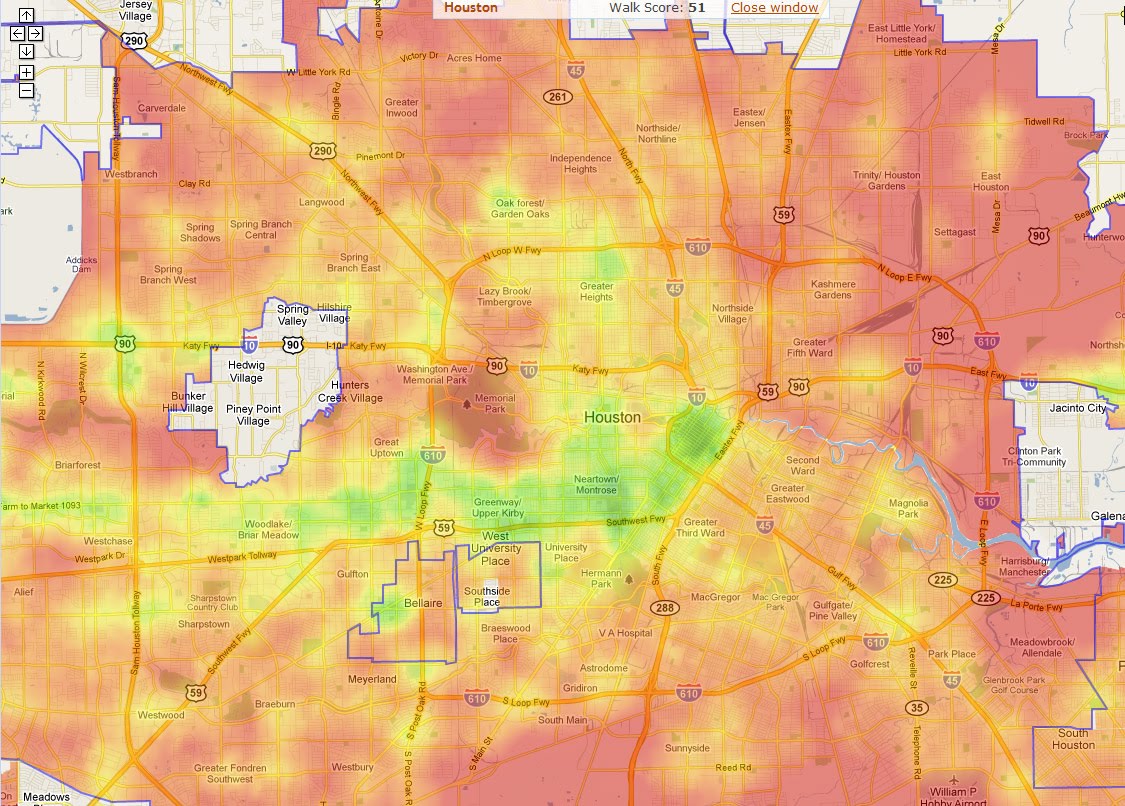
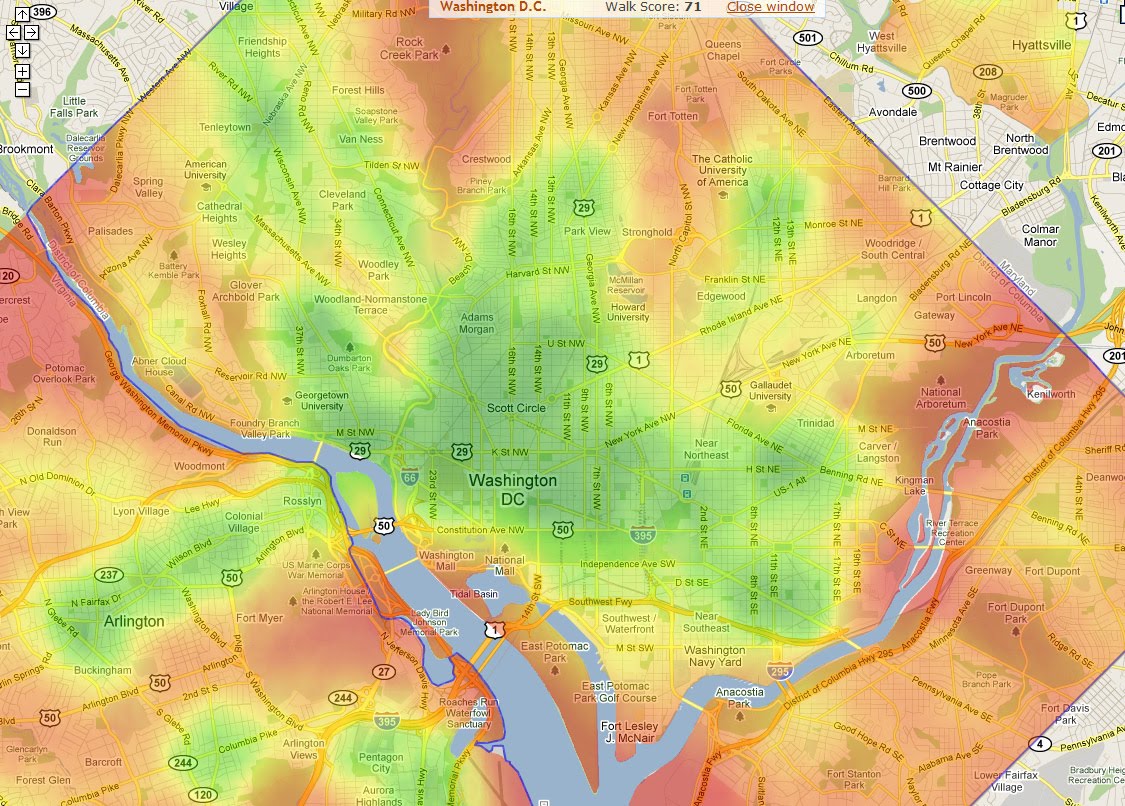
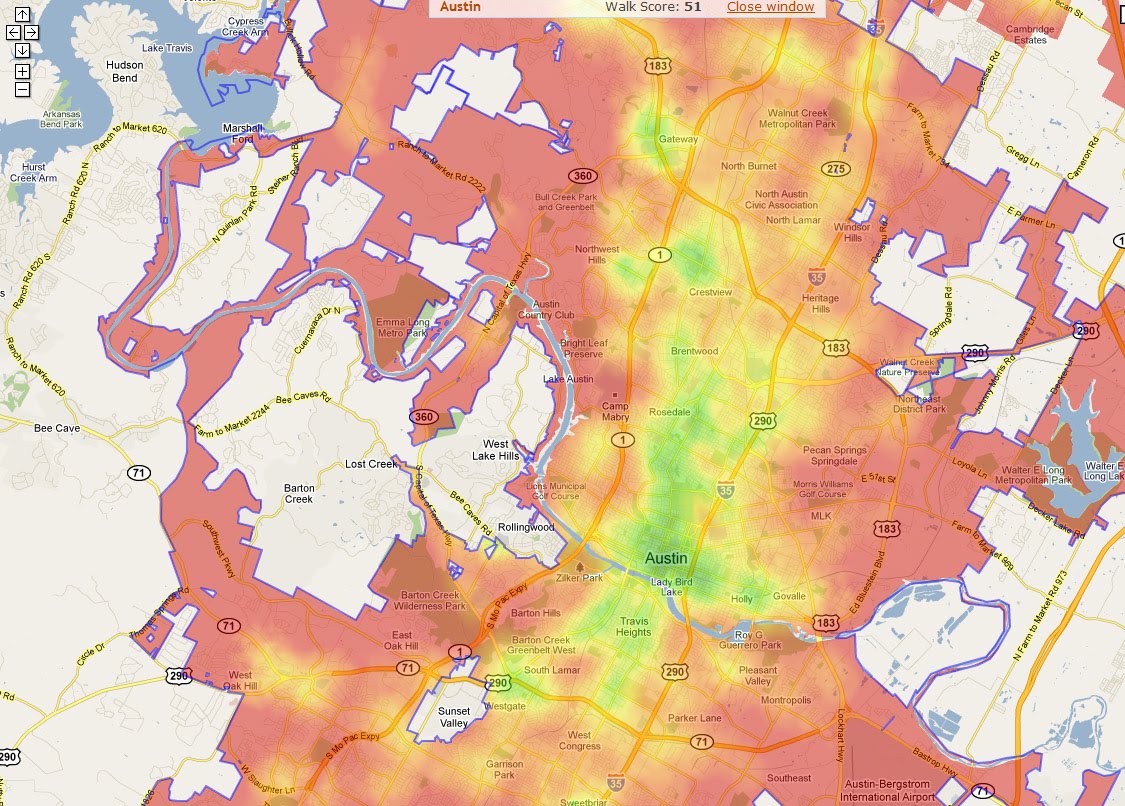
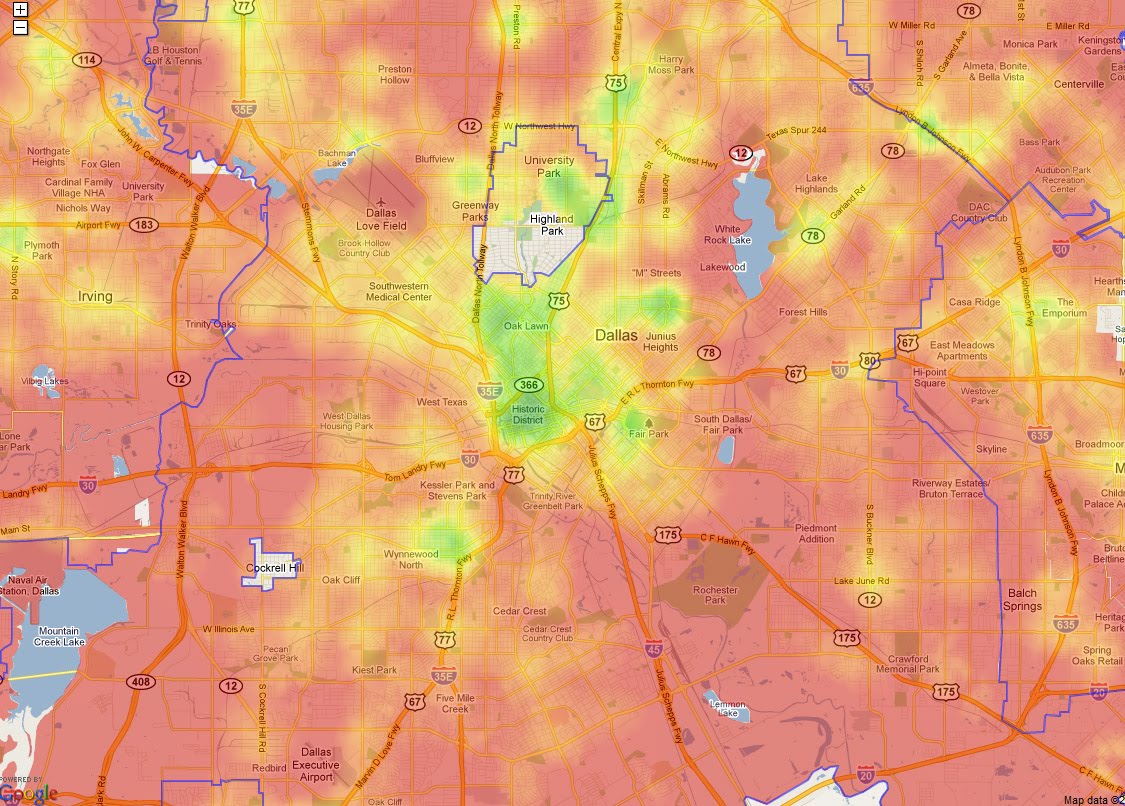
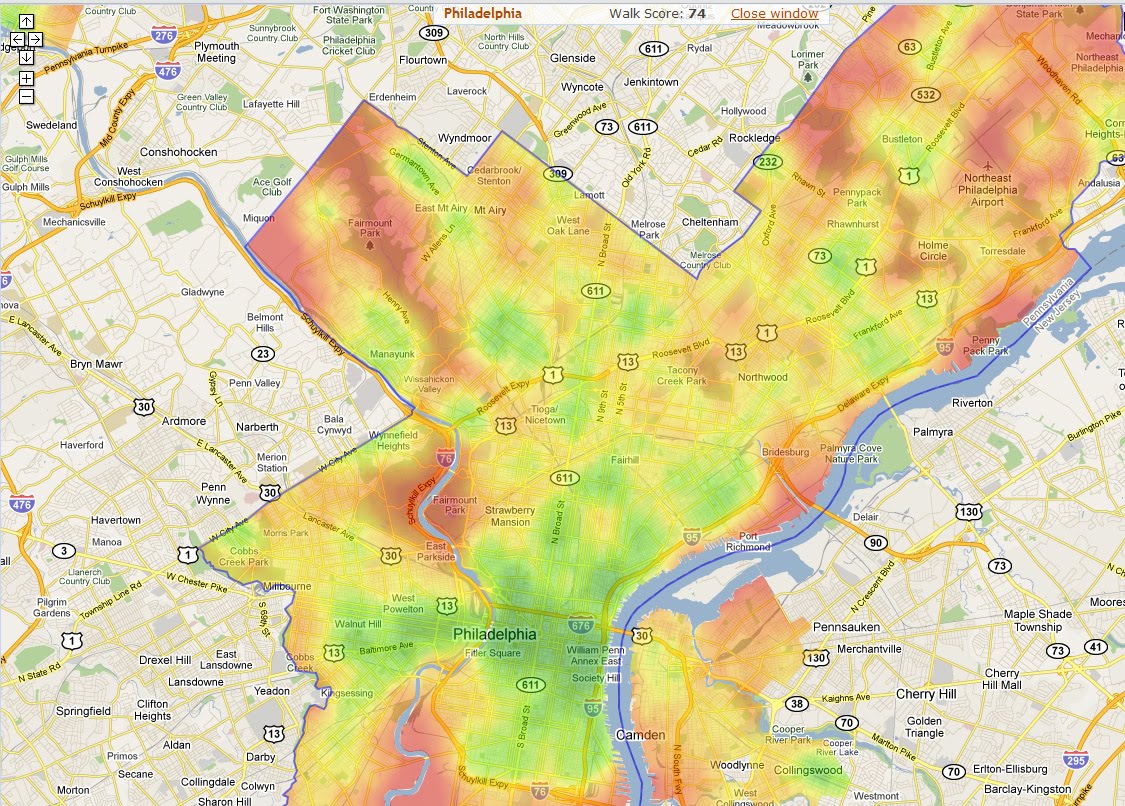
Now that they do have heat maps, let's look at some:


Austin:


Dallas:

You'll notice the green dots as downtown (brightest), with uptown and deep ellum latching on, lakewood, fair park, and bishop arts as some of the others. Striking how poorly Ross Ave corridor ranks particularly in relation to all that is around it. Seems like a great opportunity to stitch several parts of town together...wonder where I got that idea...

Houston:


Philadelphia:


DC:

Monday, October 25, 2010

Inner Growth

Leinberger in the Washington Monthly sums it up that outward expansion, stuffing ourselves with suburban cake, is coming to a merciful end. Time to shape up, qualitatively improve ourselves rather than quantitatively as measured by weight, girth, body fat, etc...cuz if we are our cities, and our cities are our economy, it is loaded up with lard currently. Gooey, gelatinous, wasteful excess baggage that must be shed.

Instead, our only choice is that of health: getting smarter, stronger, healthier, with a more efficient circulatory system (transpo) and greater lung capacity (natural environment). There is no magic pill for that. Only will, dedication, and hard work. Time for all of America to be a contestant on the Biggest Loser...or we could just stick are head in the sands, fingers in our ears, lalalalalalalala can't hear you, and hope the mean world just blows away like the last tornado warning:

In the postwar years, America pushed its built environment outward, beyond the central cities, creating millions of new construction jobs and new markets for cars and appliances—a virtuous cycle of commerce that helped power American prosperity for decades (until, of course, it went too far, leading to the oversupply of exurban development that is acting as deadweight on the current recovery). The coming demographic convergence will push construction inward, accelerating the rehabilitation of cities and forcing existing car-dependent suburbs to develop more compact, walkable, and transit-friendly neighborhoods if they want to keep property values up and attract tomorrow’s homebuyers. All this rebuilding could spur millions of new construction jobs. But more importantly, if done right, with “smart growth” zoning codes that reward energy efficiency, it would create new markets for power-conserving materials and appliances, providing American designers and manufacturers with experience producing the kinds of green products world markets will increasingly want.

In addition to fueling long-term economic growth, the new demand for walkable neighborhoods could provide other benefits. One of the biggest drivers of rising health care costs is the expansion of chronic diseases like obesity, diabetes, and heart disease—conditions exacerbated by the sedentary lifestyles of our car-dependent age. All would be substantially reduced if Americans move into higher-density, transit-friendly neighborhoods in which more walking is built into their daily routine.

Tuesday, June 1, 2010

Reader Mail

This wasn't actually an email, but a comment that I decided not to approve for the comments section but to pull directly out into its own post, because there are some issues within it I would like to address directly. The comment, verbatim:
You seem to imply "talented" people only want to live in neighborhoods of the type that you prefer. I know some pretty smart and talented people who really like their nice houses in the suburbs. They also don't mind driving their expensive cars. As far as "mixed income" neighborhoods go, I can see the benefit for the lower half, but what does someone with money/assets get from living next to a poor person? Uncomfortable is about all...which is why these types of 'hoods are rare.
I see two parts to this that I wish to address. The first is the common one of the "victim," that I somehow (or more often New Urbanism in general) attempt to force people into living a certain way. The second, which I'll get to later, is the issue of xenophobia and "what do rich people get out of living near poor people." In fact, I think both have similar root issues of what can we actually afford and the hidden costs of 20th century urban form.

Now as far as me suggesting any particular preferences of talented people, I don't think I have ever made such a statement. Nor do I really ever discuss "talented" people. However, there does seem to be more and more emerging evidence of the benefits of density or proximity of talent and the educated. But, that isn't the point of this blog. Although Dallas, does severely lag in these categories.

I've always felt that I go out of my way to state that "these types of neighborhoods" presumably referring to walkable urban ones is more about the market and more particularly about the gap between supply and demand. As Chris Leinberger has surveyed and written, 3% of the country lives in walkable urban neighborhood, but as much as 40% would like to but doesn't, often for some reason or another, can't.

The other issue this blog is keen to point out are the barriers pending up that demand and preventing the supplication by the "market" of walkable urbanism. The way our cities look, particularly those of the Sun Belt is often mistaken as being demand driven. However, this is far more attributable to federal, state, and local policies that are horribly outdated if not outright misguided and overly top-down.

These include Euclidean zoning, tax policies, housing ownership incentives, and federal and state transportation policies and funding producing the monotonous suburban landscape. The built form is merely the phenotypical response, an outgrowth of the political genotype. My opinion is that the great reset, or great recession, or however you choose to recall the repurposing our cities and our economies are undergoing is a response to this, a shedding of the failed, the useless, to be cast aside on the scrap heap of history along with dinosaurs, the dodo, and polytheism.

I point to the relatively stable values in walkable communities (of all densities) as well as the successes and popularity of new walkable urban developments as evidence. I would also like to point to a post from earlier this year, entitled The Myth and Necessity of Choice where I specifically discuss the necessity for a range of housing types and take a walk through the town of Torrent, Spain, a suburb of Valencia, where a natural gradient exists from its dense core to its rural edge.

For the economy to rebound, we have to have a greater range of housing types. For the local economy to function more smoothly, we have to reduce the distance cost of transactions. For the City to compete on a regional, national, or international scale moving forward, we need to be attracting the brightest young talent.

And yes, survey after survey has shown that Millennials not only prefer but demand walkable, interesting cities and are willing to locate to cities based on the quality of life in that city and then find a job, not vice versa. If a certain percentage wants a big house and a big car, more power to them. And since there may be a surplus of upwards of 32 million single family houses on the market, they should be able to get a pretty good deal.

This isn't about painting the world based on my preferences OR about your preferences. This is about the meeting an unmet demand and providing a range of choices that respond more directly and effectively to what everybody wants, can afford, and is designed optimally while not limited by what banks are willing to lend to or what is easiest and cheapest for developers to supply, or for cities to regulate.

As for what the rich can get out of living near the poor, let's try this on for size. First, assuming that it is a given that a car-dominated transportation network requires more space than one that is walkable. If we isolate by class, this then ensures the service industry workers for the wealthy areas have to live in areas far from where they work, either shackling them to long commutes by cars that can comprise upwards of 40% of their income. Or, it requires a mass transit system (either rail or bus) that is extremely inefficient and costly within a sparse population. Both systems are excessively costly and all are underwritten by the wealthy.

This is precisely why I came up with the phrase, "walkability is a tax cut." A city's economy is made up by the connections between people, between seller and buyer, and the cost of those connections, if all by car leads to a degraded and bankrupt city.

You even see many very wealthy responding to this by creating servants quarters and having live-in maids, nannies, and what not on their grounds. See Georgetown for the natural market response to this, where there are a range of housing sizes and types including basement apartments, accessory dwelling units, granny flats, apartments to go along with the original estates. See Annapolis for a City that proactively understood the economic benefit and basic humanity of mixed-income and created affordable housing in-town that blended with the adjacent townhomes (I will track down pictures).

There are also the more loosely connected or ethereal externalities of a city segregated by socio-economic class induced by the supposedly desired privacy of the wealthy including increased crime, lack of opportunity, poor schools, and despair. When the poor have a closer connection to the wealthy, where the estate is up on the hill, there is something to aspire towards.

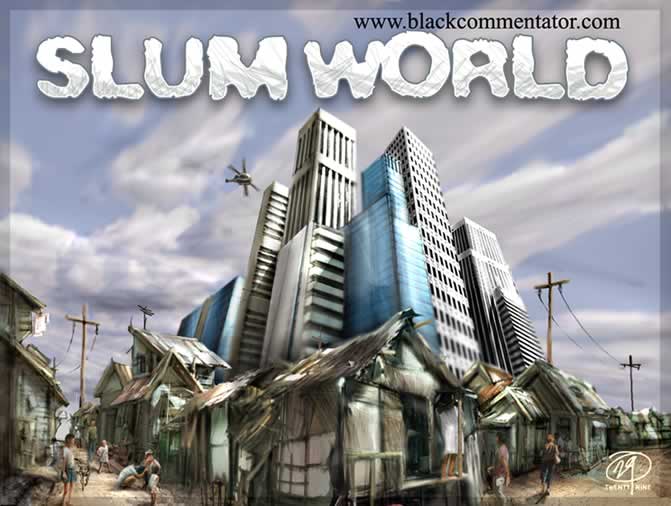
Furthermore, the wealthy estate contributes much of the culture and wealth that enriches the rest of the community, but when withdrawn behind walls the way the wealthy support the city becomes more negative. Those are the cities of the third world, where two economies exist. One, by helicopter and rooftop and behind walls and the other, in crime-ridden squalor. Either way, the wealthy support a city, its culture and economy, why not the way that actually does lift all boats rather than broadening the chasm.

http://www.blackcommentator.com/252/252_images/252_cartoon_slum_world_29_large.jpg

For the City to thrive, we are going to have to take down our walls and our fences and grow back together, and learn to live with one another, restore some faith in our city and its citizens, and design the City in the way that allows that to happen.

Many wealthy may desire privacy and that is fine. But, many also desire to be near the bustling activity of city centers. Once again, it is all about choice and the provision of it. We've just forgotten about a few too many market segments.

Wednesday, May 26, 2010

The Future Is Now


Thanks to Bike Denton for sending me this study on congestion and road narrowing vs. capacity expansion. The thing to take from all of it is that congestion is inevitable. Commerce needs it and frankly, people need it as well. We organize our lives, cities, and economies around predictable convergence points, areas where "traffic" will be the highest. The question then becomes, how do we want that to look, to operate, and then it also becomes what can we afford long-term.

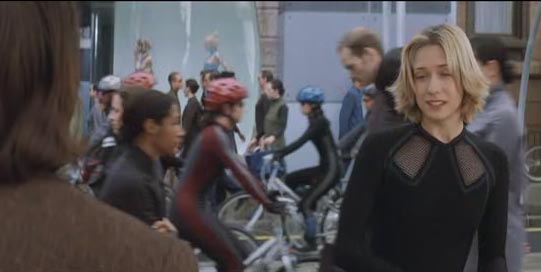
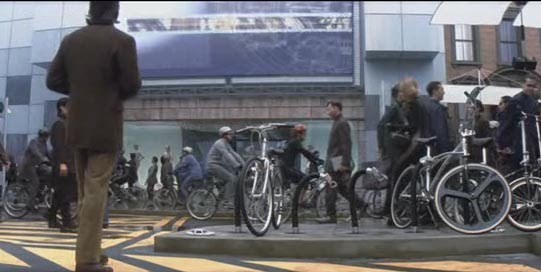
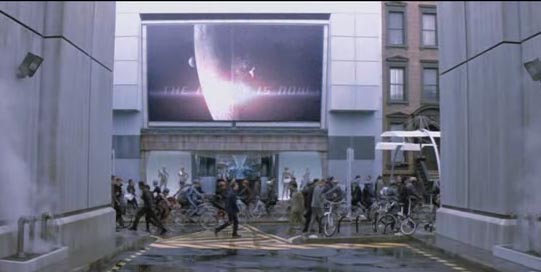
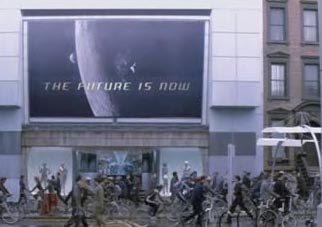
Which reminded me of the movie the Time Machine. A rather droll remake with of all the typical silly futuristic trappings like living on the moon and goofy outfits to let dummies know, "yes, this is set in the future." In a world where we so often mistake highways and cars as progress (towards what goal, I don't know) the filmmakers one interesting visualization was their take on NYC in 2030 where all of the street traffic is by bike or foot. Some stills:


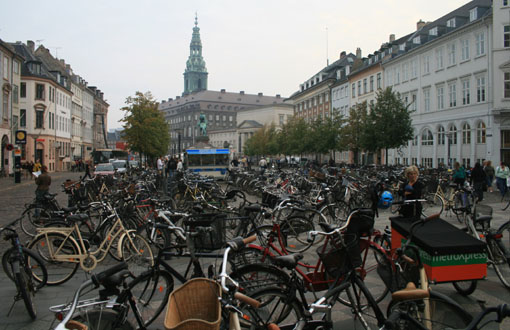
It looks like rush hour. Let's take a look at the rush hour and parking facilities for various forms of dominant transportation:

Pedestrian rush hour:

[IMG_1523.JPG]

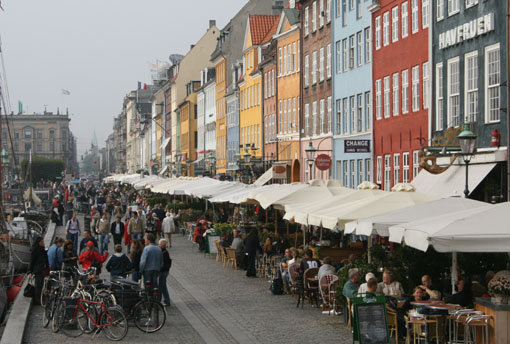
Pedestrian parking:
http://www.streetsblog.org/wp-content/uploads/2006/09a/nyhavn.jpg

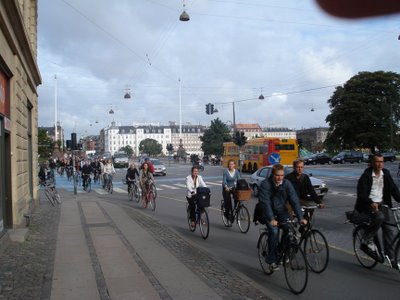
Bicycle rush hour:


Bicycle parking:
http://www.streetsblog.org/wp-content/uploads/2006/10/IMG_0283_bike_parking.jpg

Automobile rush hour:


Automobile parking:


Let's leave the last word to the movie:

Wednesday, May 19, 2010

Photo & Tangentially Related Thought 4 the Day

Bikability is a lifestyle choice that high quality, safe urban places allow. Walkability however, is both a necessity of economic vitality and a human right. By proximity, it ensures and efficient, effective, sustainable local economy. It greases the wheels of urban vitality and the metabolic rate of innovation. By character, safety, and quality of experience, it adds to quality of life and allows anyone's individual ability/desire to participate in the local economy.

With the City of Dallas going through another grueling series of budget hearings, it is important to remember that:

Walkability is a Tax Cut.


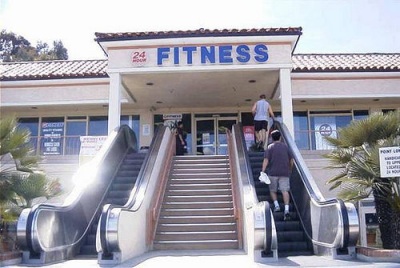
Where this is located in the world geographically, I don't know. My first guess might be Orange County, CA and my second might be Greater Miami/Dade County, FL. On the interwebs however, it can be found at this most righteously excellent blog site of British turned Canuck economist/planner Stephen Rees.

Thursday, April 1, 2010

Thirsty Thursday Linkages

Even though much of urbanism is too complex for current math and understanding, the studies are headed in the right direction. Via Hub and Spokes, a new Brown University Economics study shows that for every freeway a city loses 18% of their population:
I think that zoning and densification are important. But there's no way to make people or firms locate in a densely packed manner without providing the transportation infrastructure to allow them to do it. So you have to have some sort of policy at the metropolitan area-level. And what you can get is local communities imposing costs on everybody else by doing something like imposing big exclusionary zoning right next to the urban core. And that's clearly not economically efficient for the region as a whole- they're obviously trying to protect their housing values. So I think that it's important for regional government to be proactive and realistic with transportation planning.
The key is removing all the barriers that prevent the dense places from showing their real value, the synergy and vibrancy of urbanism. The biggest barrier of which, are the inner city freeways.

And while I think some of his conclusions in the interview are silly, like this one:
Now most households are dual-worker households, which wasn't true back in 1950. Highways have allowed two people living in the same house to commute to different areas each day, so I think there's been a welfare gain from that.
We are one step closer to proving that while highways are important in linking one metropolitan area to another or one economy to another, they are destructive within that city and to its economy. If you build it they will leave. There is nothing better Dallas can for the local economy and downtown than incrementally tearing out the freeways within 635.

It's amazing to me how stupidly we have constructed cities both from a livability and in terms of economic efficiency and functionality. The two are interrelated.
----------------------------------------
In a related note, Phoenix always ranking high on the stupid scale, has arrived at this gem:
The Arizona Department of Transportation and Maricopa Association of Governments are planning $4 billion in work to add capacity to Interstates 10 and 17, add a reliever freeway and improve interchanges in the urban core.

The work, to be paid for from regional Proposition 400 tax money, would introduce new designs to keep traffic flowing freely by segregating short- and long-distance travelers and reducing the need for traffic to weave between lanes. The effort marks a major shift toward reinvesting in the older and most congested parts of the system.

[Bangs head on desk. Leaves it there to type blindly for the rest of this sentence.]

Wow, major shift there. One that should really see some systemic change.

[Pities Phoenix residents.]

[Remembers he deals with the same nonsense.]

[Head returns to desk. This time softly and sullenly.]

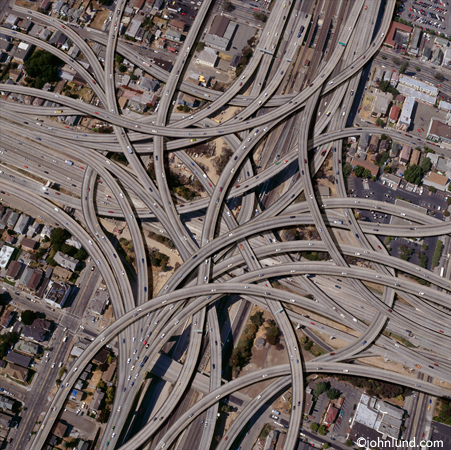
Build more highways, raise more taxes, not have money for maintenance, raise more taxes, drive land value down, have more migration outwards away from this give away to highway lobby "investment," have to build more highways to accommodate sprawling population, raise more taxes, not have money for maintenance, raise more taxes...

Cause:
http://www.johnlund.com/images/JL-interchange__2FG.jpg

Effect:
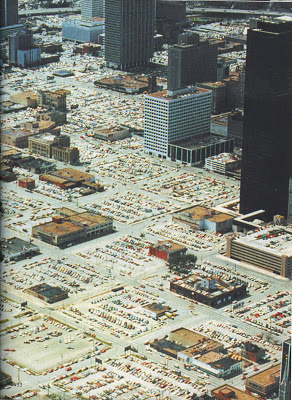
http://2.bp.blogspot.com/_D5kx0bUGx_c/SDGdqXWxsCI/AAAAAAAAAEk/Y1eckZyKDeU/s400/houston.jpg
----------------------------------------
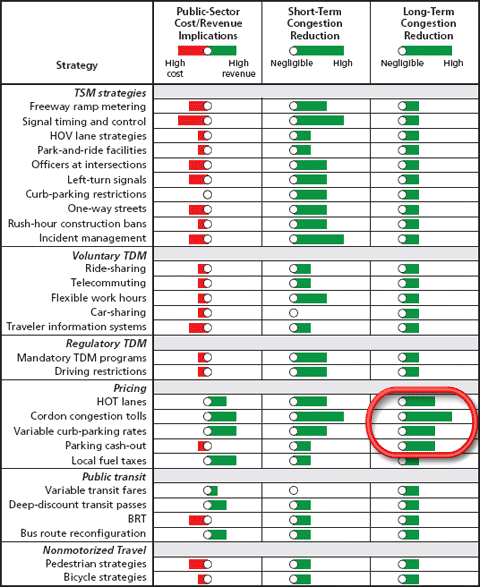
Again however, another study to prove the above is a colossal waste of time and money (unless you are on the receiving end), is this study showing that reducing demand is the best way out of traffic congestion. And ya know what? It GENERATES REVENUE. [Looks sidewise at Phoenix.]

Earlier this year, the RAND Corporation, a nonprofit think tank, put out a report on how to get traffic moving faster. They considered lots of the standard solutions -- improving signal timing, clearing accidents quickly, encouraging telecommuting, and so forth -- and found that many of them could, in fact, provide some temporary congestion relief.

But here's the rub: RAND found that over the long haul, these kinds of solutions simply don't have much effect on congestion. They can briefly get traffic moving faster, but just about every improvement in travel time results in ... more people taking to the road! Over the long haul, apparently, most congestion relief efforts sow the seeds of their own destruction.
Funny how that works. From the actual report:
Longer term increases in the demand for automotive travel resulting from population growth and economic expansion can further undermine a strategy's effectiveness. This is why we often see, for instance, that flow improves for a short while when new lanes are added to a freeway but usually returns to former levels of congestion within just a few years.
chart
That red oval highlights the only solutions that the study's authors believe have any significant potential to fight congestion over the long term. Sadly, RAND also found that the road pricing solutions -- the top two -- face huge political and practical obstacles.
Of course, nobody wants to pay for what they have previously been getting for free. Unfortunately, you have no choice. There are no free lunches and it is time to pay the piper for the monopolization of transportation and corrupt city building methods of the 20th century.

And the longer we wait, the more expensive it is going to be. This, I promise you.


----------------------------------------------
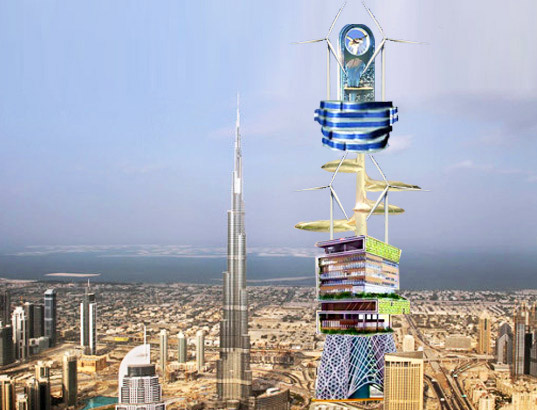
And, finally it takes April Fool's apparently for people to understand greenwashing, architectural absurdity, and real estate overshoot (again, all interrelated and fueled by the pedaling of BS marketing and fake money unlimited budgets):


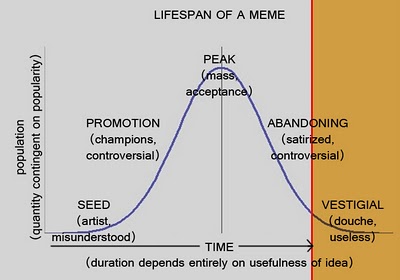
It reminds of this time line, I recently created:


So is it safe to say that we've finally gotten to the Abandoning Stage or the Vestigial considering I compare Dubai and its architecture to the cast of Jersey Shore?

While this onion-like post from Inhabitat is brilliant. It took approximately two April Fool's articles for me to long for tomorrow.
----------------------------------
Lastly, and only because I just had this emailed to me, comes an article from CNN suggesting that the 21st century will be a "new urban" one. The general point is that it isn't about always being bigger. I would add, that while it might not mean bigger, it is about finding the "better." It is a similar difference between new money and old money. The kitsch and the sophistocated. Why a 4,000 sq. ft house in McKinney costs the same as a 1,800 sq. ft house in Hollywood Heights and why the latter will retain value and the former might as well be in Detroit.

Wednesday, February 24, 2010

If You Build It, the True Costs will Come...Eventually

Elana Schor at StreetsblogDC has an article on the budgetary shortfall in funding transportation and the potential solutions for paying for an overextended transportation (read: highway/road network) system:
Of course, Conrad's chart makes one significant assumption: that the gas tax is kept at its current, non-inflation-adjusted level of 18.3 cents per gallon. Increasing that (gas) tax was one of five transportation financing options that he outlined today. 

The others were: levying new charges of vehicle miles traveled (VMT), greater use of tolls, more transfers from the general fund ("which I strongly oppose," he noted), and a revenue-raising option yet to be proposed by Congress. 
Here is the timeline of how we got to this point, as simply as it can be said:

1 - Because of Industrialization, cities were pretty attrocious places to live in the late 19th and early 20th centuries.  Low pay, high pollution/squalor/poverty, and poor sanitation marked many cities American and otherwise.

2 - One solution was to move to the "countryside," aka areas immediately adjacent to cities and streetcars were the way to get to those new areas with "unlocked" real estate value for use intensification, ie new neighborhoods.  These were primarily for the well-to-do, although some company towns were also constructed this way with workforce housing near the factory.

3 - Getting out of the city and land use policies in support became humane.  Legal codifications were constructed unfortunately, without the adaptability to reflect changing conditions (for example Form-Based Code is intended to codify quantifiable urban "regularities" while allowing flexibility and adaptability of use/density).  This is why you see cities like Miami adopt sweeping zoning changes like Miami 21 and NYC rezone 20% of its land in one year, the effort to catch land use regulations with modern times.

4 - Invention and implementation of mass production combined with a burgeoning form of transportation and its marketing promised new freedom of mobility with more affordable cars for the middle class to also get out of cities combined with mass production of single family housing (Levittowns, etc.).  This did nothing to reduce the cost of the infrastructure and its eventual maintenance, which is paid for by taxes.  While initial costs of transportation to the new found living arrangements were often factored into the housing, the long-term maintenance of the infrastructure was not, meaning it was essentially financed on credit.

5 - Skip to today:  diffused, low-density housing created for a dendritic road hierarchy which funnels traffic to primary arterials and highways.  This by nature creates traffic, which is typically treated with the call for more supply.  The more supply of lane-miles to reduce traffic however, is no longer backed by a booming housing market (or one that has actual demand driving it rather than funny money), meaning it has no one to finance it except the the same housing that created the problem. 

This is a reality that every suburbanite must realize. For those who love their house, their neighborhood, and their commute and that is fine, two things:  1) your costs are going to go up (and this has nothing to do with fluctuations in oil/gas prices) because the lack of density can't support the infrastructure at the current per capita, and 2) if you are fiscally conservative, you should be encouraging higher-density walkable neighborhoods for others that may want it but there isn't the supply to meet the demand.  Walkability often means more density and a more balanced housing market (in terms of density) which means less infrastructure per capita.

Promoting walkable urbanism is a more efficient allocation of commonwealth resources.  Walkability is a tax cut.