




Showing posts with label dissenting voices. Show all posts

Friday, December 10, 2010

Your Daily Dissent

Decided to bump this to its own post. A reader dissents to a previous on streetcars:

Reader from Austin M1EK:
I'm one of those naysayers - and the problem is these are being sold as mobility improvements rather than amenities for urban development. We've backed down our plan here in Austin to almost as stupid as Fort Worth's now, because relatively few people are willing to be honest about the fact that a streetcar running in a shared lane is actually even worse than a bus if you care about speed and reliability.

But yeah, if you're a tourist, or have gone voluntarily car-free, a streetcar might be nice. How about if the developers pay for it then, and not just the initial capital cost - but bond out the operating cost as well? In the meantime, transportation funds should go to things that can actually shift mode choice - like light rail.

My response:

legitimate points.

Let me raise others that many don't often think about.

First, I want to mention something I heard last night, that the McKinney Avenue Trolley is up to 300,000 riders per year. And if you've ridden it recently during peak or rush hours, you understand. It is literally packed. Far more so than when I rode it to/from work every day living in uptown 2004-06.

The significance of this suggests a mode share change by the typically younger demographic that lives in uptown, millennials.

Secondly, as we begin to price parking more appropriately, people will be looking for outlets that don't require paying 100/month in parking downtown.

Light rail has an appropriate service length as do modern streetcars. Streetcars can better serve the neighborhoods within 1 to 3 miles with very frequent stops that light rail can provide only 1 or 2 stops at best. These immediately downtown adjacent areas are where the greatest gap between existing and potential lies, aka profit, opportunity, value, and of course, interesting walkable urban neighborhoods.

Lastly, and perhaps most out of the box, is the idea of mobility, shared lanes and traffic calming. The MATA trolley often makes driving on McKinney Avenue a pain in the ass. And that is a good thing. It is harder to speed, thereby making walking along McKinney and crossing it, much safer and more enjoyable (despite the narrowness of sidewalks).

It may hurt long distance mobility, but it increases localized mobility and the interconnection or "tethering" of neighborhoods.

Tuesday, June 1, 2010

Reader Mail

This wasn't actually an email, but a comment that I decided not to approve for the comments section but to pull directly out into its own post, because there are some issues within it I would like to address directly. The comment, verbatim:
You seem to imply "talented" people only want to live in neighborhoods of the type that you prefer. I know some pretty smart and talented people who really like their nice houses in the suburbs. They also don't mind driving their expensive cars. As far as "mixed income" neighborhoods go, I can see the benefit for the lower half, but what does someone with money/assets get from living next to a poor person? Uncomfortable is about all...which is why these types of 'hoods are rare.
I see two parts to this that I wish to address. The first is the common one of the "victim," that I somehow (or more often New Urbanism in general) attempt to force people into living a certain way. The second, which I'll get to later, is the issue of xenophobia and "what do rich people get out of living near poor people." In fact, I think both have similar root issues of what can we actually afford and the hidden costs of 20th century urban form.

Now as far as me suggesting any particular preferences of talented people, I don't think I have ever made such a statement. Nor do I really ever discuss "talented" people. However, there does seem to be more and more emerging evidence of the benefits of density or proximity of talent and the educated. But, that isn't the point of this blog. Although Dallas, does severely lag in these categories.

I've always felt that I go out of my way to state that "these types of neighborhoods" presumably referring to walkable urban ones is more about the market and more particularly about the gap between supply and demand. As Chris Leinberger has surveyed and written, 3% of the country lives in walkable urban neighborhood, but as much as 40% would like to but doesn't, often for some reason or another, can't.

The other issue this blog is keen to point out are the barriers pending up that demand and preventing the supplication by the "market" of walkable urbanism. The way our cities look, particularly those of the Sun Belt is often mistaken as being demand driven. However, this is far more attributable to federal, state, and local policies that are horribly outdated if not outright misguided and overly top-down.

These include Euclidean zoning, tax policies, housing ownership incentives, and federal and state transportation policies and funding producing the monotonous suburban landscape. The built form is merely the phenotypical response, an outgrowth of the political genotype. My opinion is that the great reset, or great recession, or however you choose to recall the repurposing our cities and our economies are undergoing is a response to this, a shedding of the failed, the useless, to be cast aside on the scrap heap of history along with dinosaurs, the dodo, and polytheism.

I point to the relatively stable values in walkable communities (of all densities) as well as the successes and popularity of new walkable urban developments as evidence. I would also like to point to a post from earlier this year, entitled The Myth and Necessity of Choice where I specifically discuss the necessity for a range of housing types and take a walk through the town of Torrent, Spain, a suburb of Valencia, where a natural gradient exists from its dense core to its rural edge.

For the economy to rebound, we have to have a greater range of housing types. For the local economy to function more smoothly, we have to reduce the distance cost of transactions. For the City to compete on a regional, national, or international scale moving forward, we need to be attracting the brightest young talent.

And yes, survey after survey has shown that Millennials not only prefer but demand walkable, interesting cities and are willing to locate to cities based on the quality of life in that city and then find a job, not vice versa. If a certain percentage wants a big house and a big car, more power to them. And since there may be a surplus of upwards of 32 million single family houses on the market, they should be able to get a pretty good deal.

This isn't about painting the world based on my preferences OR about your preferences. This is about the meeting an unmet demand and providing a range of choices that respond more directly and effectively to what everybody wants, can afford, and is designed optimally while not limited by what banks are willing to lend to or what is easiest and cheapest for developers to supply, or for cities to regulate.

As for what the rich can get out of living near the poor, let's try this on for size. First, assuming that it is a given that a car-dominated transportation network requires more space than one that is walkable. If we isolate by class, this then ensures the service industry workers for the wealthy areas have to live in areas far from where they work, either shackling them to long commutes by cars that can comprise upwards of 40% of their income. Or, it requires a mass transit system (either rail or bus) that is extremely inefficient and costly within a sparse population. Both systems are excessively costly and all are underwritten by the wealthy.

This is precisely why I came up with the phrase, "walkability is a tax cut." A city's economy is made up by the connections between people, between seller and buyer, and the cost of those connections, if all by car leads to a degraded and bankrupt city.

You even see many very wealthy responding to this by creating servants quarters and having live-in maids, nannies, and what not on their grounds. See Georgetown for the natural market response to this, where there are a range of housing sizes and types including basement apartments, accessory dwelling units, granny flats, apartments to go along with the original estates. See Annapolis for a City that proactively understood the economic benefit and basic humanity of mixed-income and created affordable housing in-town that blended with the adjacent townhomes (I will track down pictures).

There are also the more loosely connected or ethereal externalities of a city segregated by socio-economic class induced by the supposedly desired privacy of the wealthy including increased crime, lack of opportunity, poor schools, and despair. When the poor have a closer connection to the wealthy, where the estate is up on the hill, there is something to aspire towards.

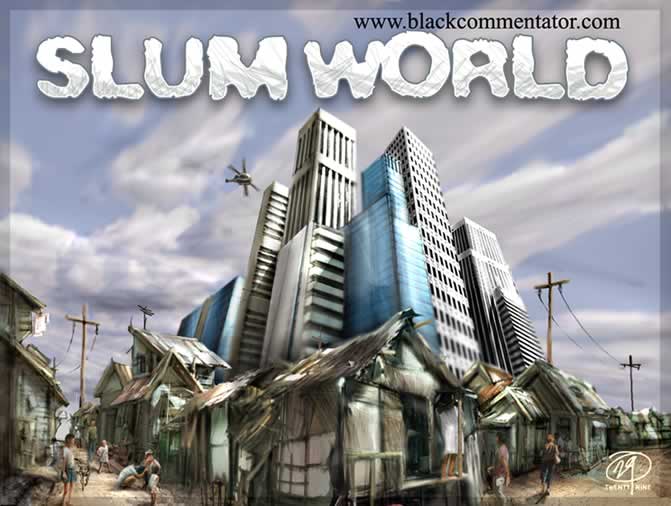
Furthermore, the wealthy estate contributes much of the culture and wealth that enriches the rest of the community, but when withdrawn behind walls the way the wealthy support the city becomes more negative. Those are the cities of the third world, where two economies exist. One, by helicopter and rooftop and behind walls and the other, in crime-ridden squalor. Either way, the wealthy support a city, its culture and economy, why not the way that actually does lift all boats rather than broadening the chasm.

http://www.blackcommentator.com/252/252_images/252_cartoon_slum_world_29_large.jpg

For the City to thrive, we are going to have to take down our walls and our fences and grow back together, and learn to live with one another, restore some faith in our city and its citizens, and design the City in the way that allows that to happen.

Many wealthy may desire privacy and that is fine. But, many also desire to be near the bustling activity of city centers. Once again, it is all about choice and the provision of it. We've just forgotten about a few too many market segments.