





Showing posts with label High Speed Rail. Show all posts

Wednesday, April 18, 2012

The Trouble with & Potentially Potential (sic) of Airports

When I was a kid I used to love planes, airports, and travelling. Once I finished school and went to work, flying once a week or so for work, the joy quickly vanished into a soul-crushing malaise, sitting in generic airport lounges, waiting in lines through security, putting up with crying babies, and the general insufferability of all people seemingly at their worst, during travel, amplified by the stress compounded by airlines under the weight of their own stress and bureaucracy dealing with failed and failing business models.

And its true that many airlines are struggling with a litiny of factors from labor costs to operations and maintenance costs. Except they won't go anywhere. Save for complete collapse of the global economy, we'll need, want, and demand some form of air travel. Having experienced the comfort and convenience of high speed rail, I suspect airlines will eventually focus solely on longer distance travel and a rebirth of trains will cover the regional linkages, simply because trains are more efficient getting you from place to place without the time delays getting to and from the actual hubs (airport vs rail station).

Rail loses this competitiveness once you start getting over 500 miles or so, given current speeds. I actually did the math once (and I'll have to look it up again) and it shows that Dallas to St. Louis is about the cutoff point where you're better off flying than taking a hypothetical high speed train. Nonetheless, Dallas to Austin or Houston, city center to city center in an hour is pretty tempting. And far more comfortable than a plane. Because trains can be as long as they need to be without losing much efficiency.

I can't sleep on flights anymore. I don't know what happened to this former super power. My flight back from London, despite a bit sick (though not really hungover), turned into an opportunity to catch up on some reading. In this case, Greg Lindsay's Aerotropolis, perhaps inspired by Heathrow itself to scroll through my Kindle for Lindsay's book. Despite my trepidation towards John Kasarda's ideas that all cities will be aerotropoli, I found Lindsay's writing excellently measured, perhaps even approaching the subject matter as carefully as I did reading it.
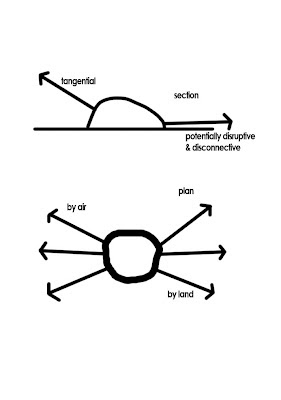
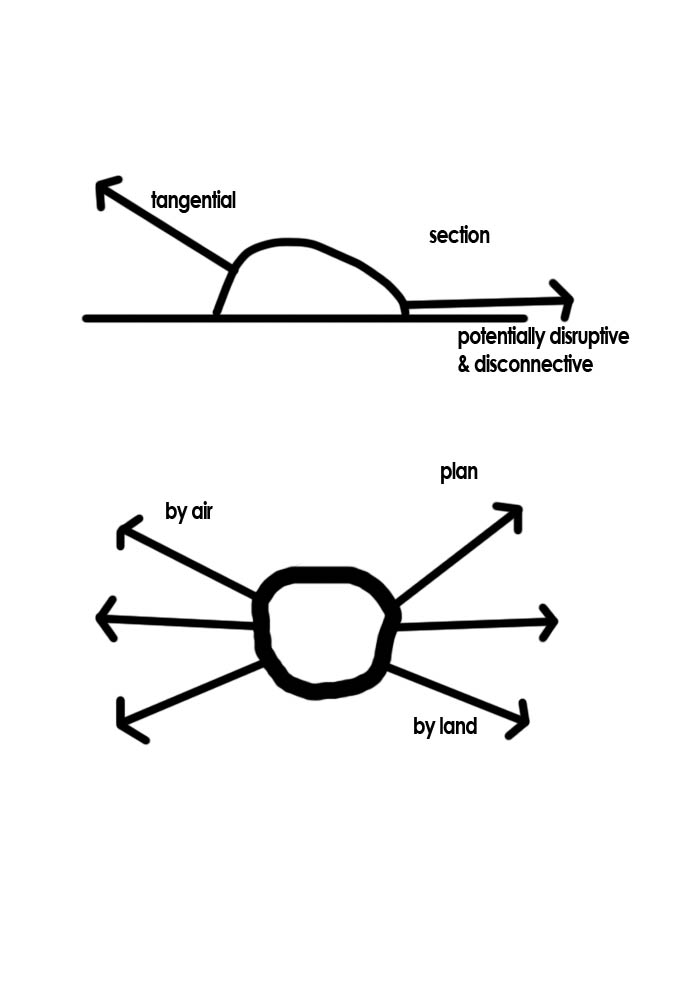
The idea of the aerotropolis is real. Airports are hubs. Value is created by hubs, be there mere intersections, rail stations, or airports. The challenge, like all global/regional hubs is the infrastructure is as much disruptive as it is connective, particularly to local networks.

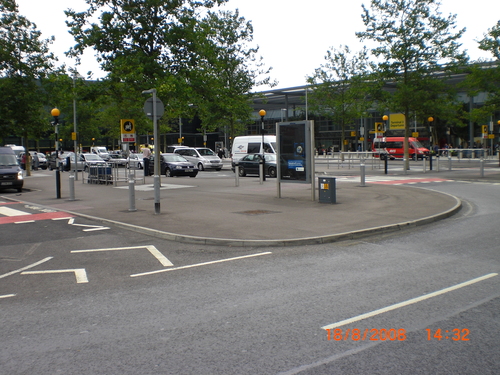
However, reading about the Heathrow controversy, its need to expand, and the general loathing by locals and frequent flyers alike towards the airport, I was struck by a singular moment. The dropoff. Heathrow Terminal 3 drop-off is surprisingly welcoming, a plaza lika space formed by the arms of the terminal.

This is the new T3 departures, 18.8.2008

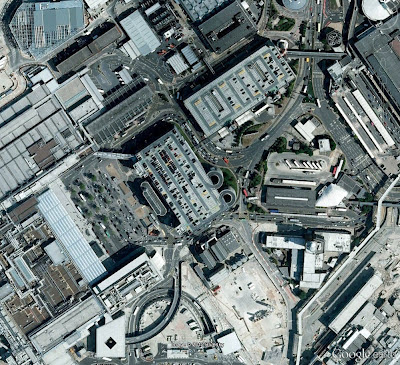
Except that was really the only nice part. Sure, the interiors have been redone to turn the airport into a shopping mall with for-pay wifi stations and the like, but I was most impressed with the drop-off. The real problem is everything surrounding the airport:
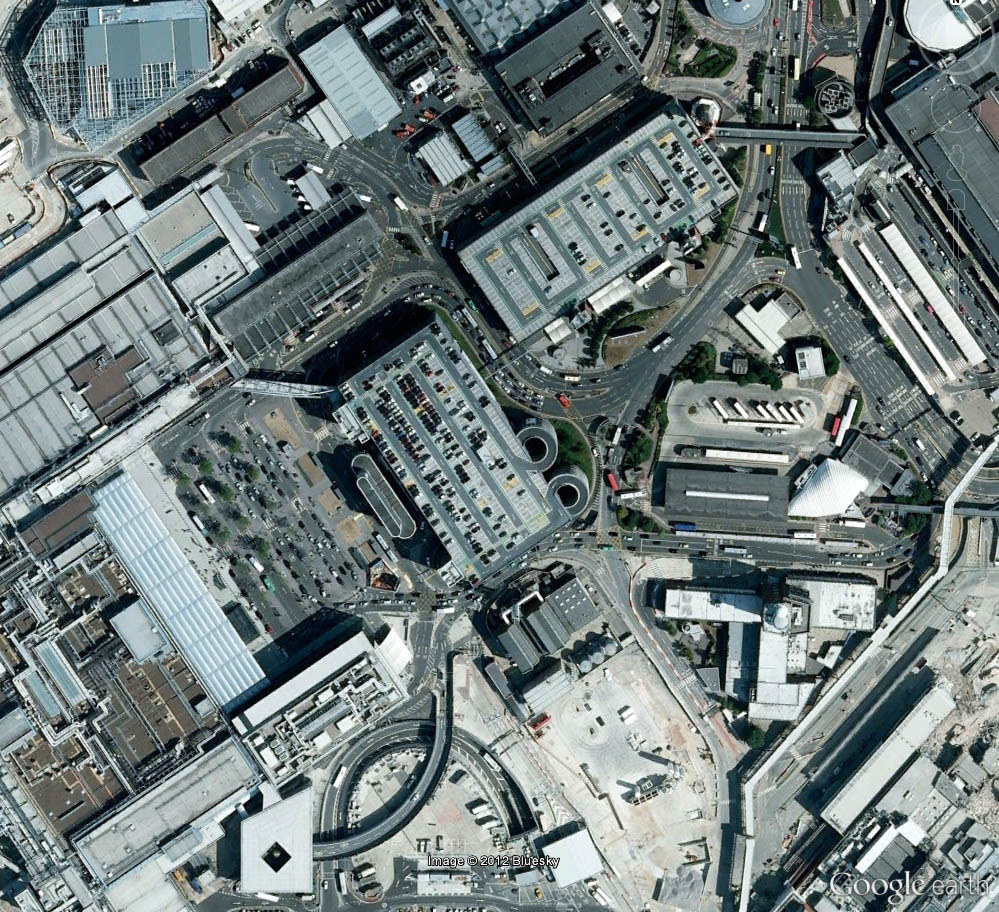

And that's when it hit me. The real problem with airports isn't the flight paths. Though, if you've ever golfed at Bear Creek golf course near DFW, you can smell the jet fuel in the morning. Not so pleasant. And a big portion of land value is about emotion, decreasing dissatisfaction and increasing satisfaction be that through social or economic exchange. I suspect airlines will eventually work out the issue of jet fuel, perhaps even sound, because it is in their financial interest long-term to move away from fossil fuels. I don't even mind the sound of jets taking off and landing. It reminds me of being in a city where things are happening. People are coming and going.

And that's when I realized the bigger issue facing the idea of "aerotropolis," or the city built around, by, and service of the airport. As I've written a number of times, regional/global infrastructure has to be tangential to the local fabric and functions of the city, less those connections become disruptive. It isn't the flight paths that prevent the idea of the aerotropolis, and I don't even really like that term, it's really just about land value responding to interconnected networks, ie city, but the ground connections to/from the airport that are far more disruptive:
Outside of DFW has become this basically:


So the real question becomes, how can we maximize the value of an airport to a city via minimizing the disruption it has upon that city and decreasing "dissatisfaction" through the inconvenience of getting to/from the airport to our actual destinations within the city?

So in this sense, any airport has three primary barriers preventing a maximization of its convenience and value to the city:

1. Flight Paths - as we've discussed, this is already minimal.

2. Land Mass / Security:
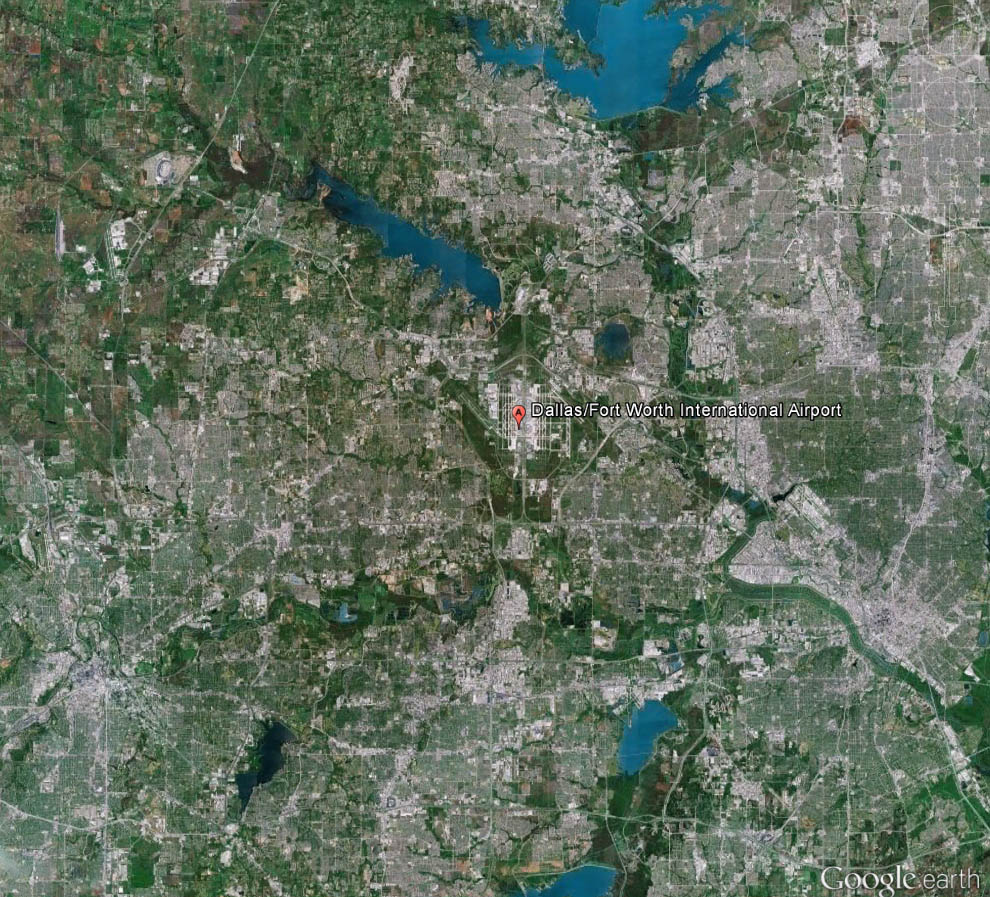
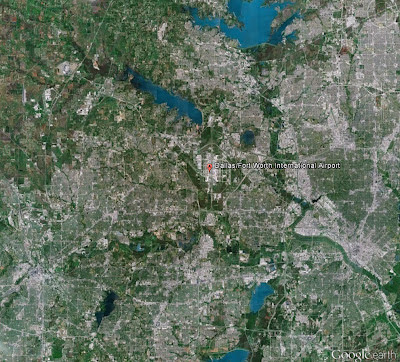
As you can see in any map of the DFW area, DFW airport is more identifiable from satellite than either downtown FW or Dallas. Larger in area too. The massive land mass limits the amount of value that can cluster near the airport.

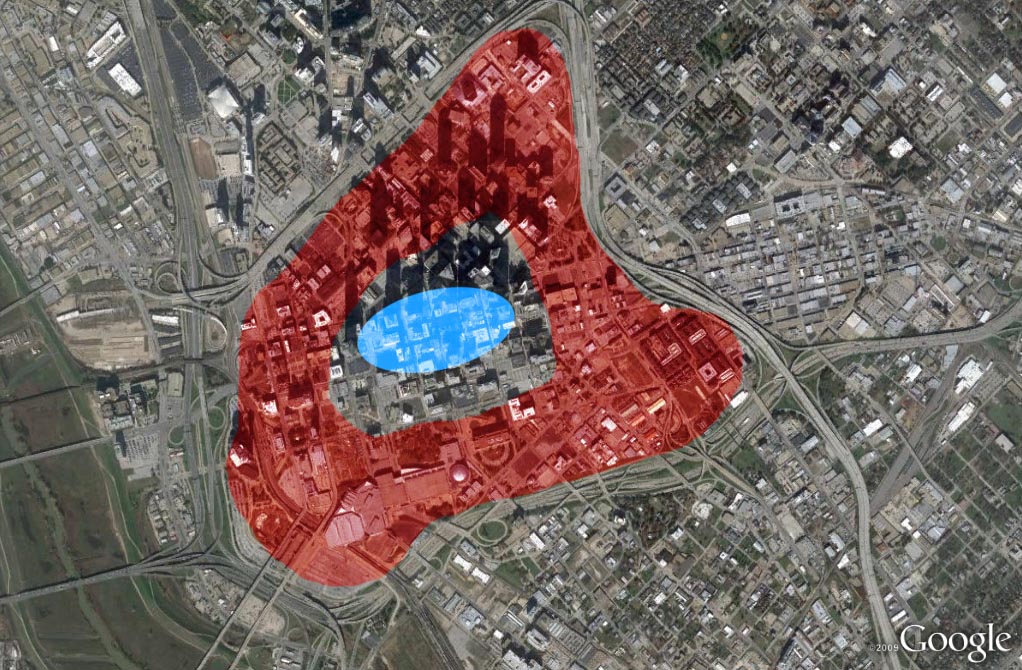
Furthermore, the rigid boundary creates a vast perimeter "border vaccuum," in Jane Jacobs' words. What she intuited by this is that the value is at the center of places and centers are impossible at edges of places. Think of downtown Dallas. The value is on Main Street, not along the perimeter of the highway loop:


And,
3. Disruptive nature of the regional connectivity, mostly car access and infrastructure.

---------------------
The question becomes, can we limit the effect on city fabric of an airports inevitable appetite for land, decrease the regional infrastructural disconnectivity, while maximizing the convenience of the airport?

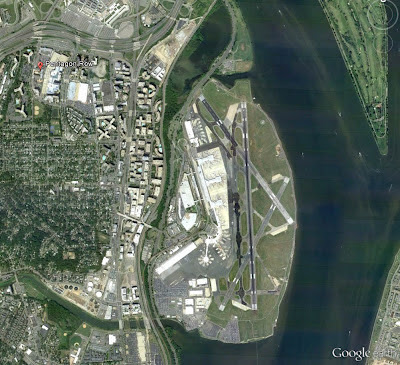
Reagan National in DC is one I'm most familiar with that comes close. The airport is built out into the Potomac on new and otherwise worthless land. In other words, nice and flat space, out on what would otherwise be a barrier itself, the river.
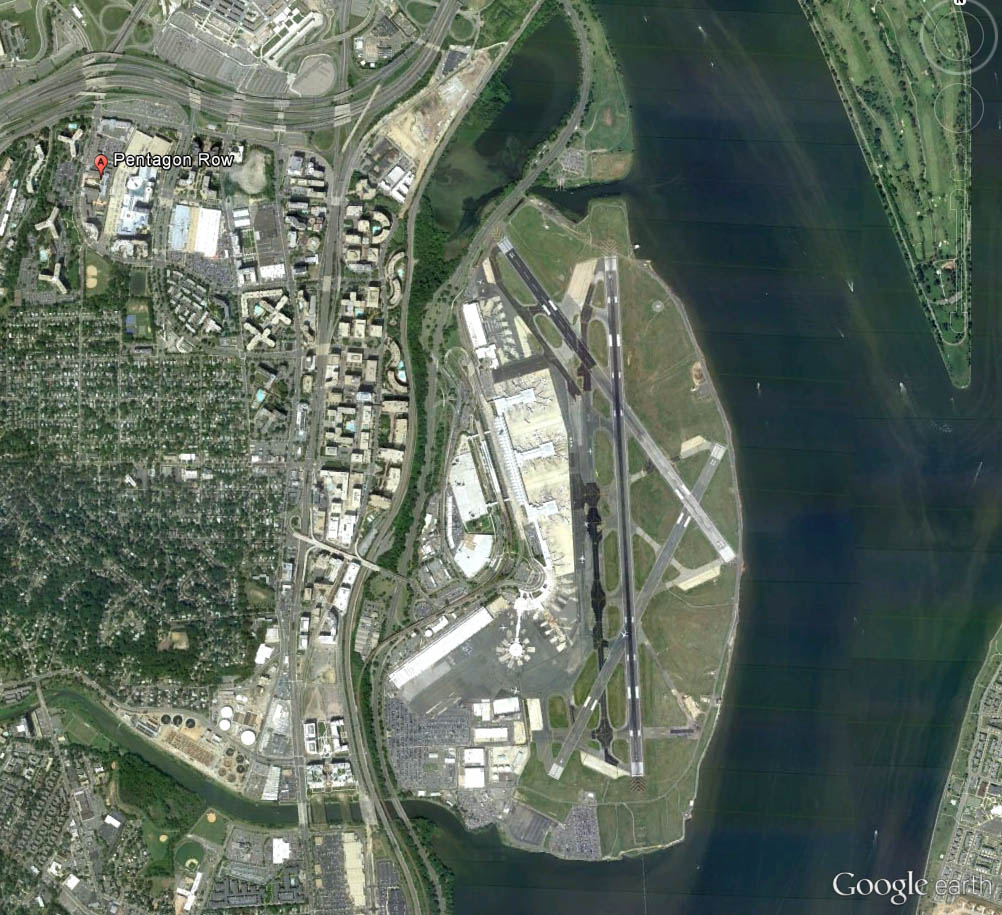
The Arlington, VA/Pentagon City area isn't the world's most urban place, but it is steadily improving, be it in isolated bubbles of pseudo-urbanism fragmented by overly wide/fast roads. What other examples are there like this? LaGuardia too, is set out on the water, but isn't connected by rail and is disconnected by highway. Aerotropolis discusses the project in South Korea, New Songdo, where the airport is built off the coast on an island and the "aerotropolis" is a new city from scratch connected via ferry.

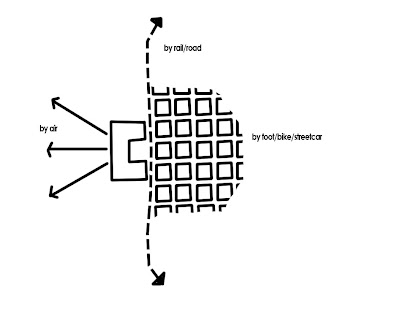
It makes sense, being that it is between Seoul and the airport. However, it isn't immediately adjacent. The question remains, can an airport immediately interface with a city, much the way Reagan does in terms of proximity, but better? Can we apply the welcoming plaza of Heathrow T3, except without the rest of Heathrow's spaghetti and parking garages around it?

Something like this:
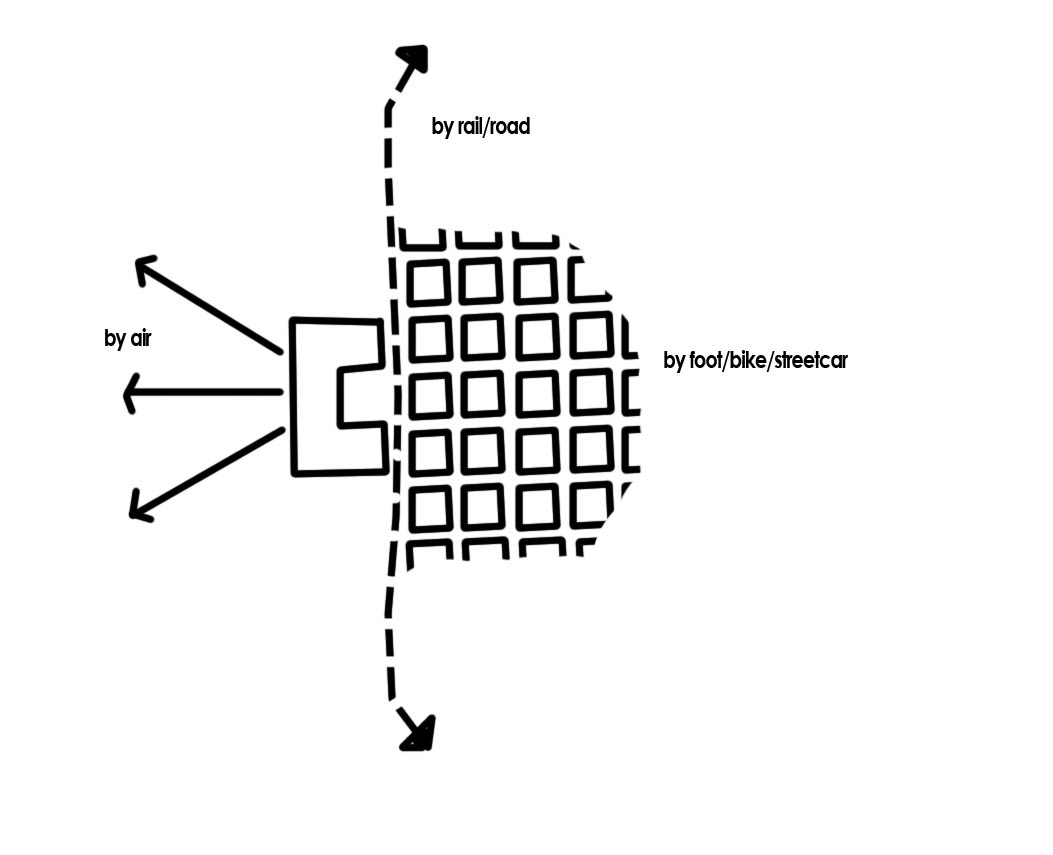
The regional road/rail connection could even be decked to further minimize the disruption and connection. As for our local airports, Love Field is pretty well landlocked, but small and convenient enough that the city is pretty close to the terminals. Except, it is still a mile away. Hardly adjacent. Also, the new DART line has a stop, but it too is nearly a mile away. We can't really infill between without removing runways.

Would there be value to infilling the oodles of land within DFW proper? Quite possibly. Even with the assortment of new rail lines scheduled to deliver people to the airport, none of which will be more convenient than driving (though less costly given parking costs). DFW suffers by being far away. As airports inherently serve regions, its regional infrastructure is quite bad upon its surroundings. Can we then build closer? Can there be express trains to the airport?

There is also the necessary point that all of the surrounding land uses around airports are fairly undesirable. This is at the heart of my early trepidation towards overvaluing land near airports. It is mostly cheap motels, used car lots, and the like. The areas immediately around airports are about as desirable as around many of the train stations in Europe, ie not the nicest parts of town. Is that because of its nature as a hub? Is it because of the logistical network of global economic exchange? Is it because of that border vaccuum effect? I suspect it is all of the above.
In other words, the efforts to build aerotropoli are pure experiments in speculation. However, it is also equally certain that they could be built far better than they are if they follow the simple rules:

1. Minimize disruption to the physical surroundings

and

2. Maximize convenience getting to and from Gates to micro-destinations within the cities themselves.

The best places are always governed by the simplest and most elegant of rules.


Friday, March 2, 2012

Railroaded

I don't have a tumblr. I guess I feel about it like the way I did iPads before I bought one of those. I've got a laptop, an iphone, why do I need the middle ground? Except, the ipad does have its specific functions that it's good at, outperforming either computer or smart phone, which I'm not entirely sure Tumblr does as the middle ground between longer form blogs and short staccato soundbites and rebuttals of twitter.

Anyway, I was up early this morning (unintentionally) and decided to do some reading. The first of which is a report from NYU on the rise of the super commuter, people who work at least 1 or 2 days per week in a different metropolitan area than where they live. Dallas ties Houston for greatest percentage of their workforce commuting in from elsewhere (13%) and is part of 3 of the top 4 connections between cities shifting labor around: Austin to Dallas, Dallas to Houston, and Houston to Dallas. Each of those linkages approaches the total number of people from all metros other than NYC that work in NYC, which is pretty astounding.

All of this got me thinking about High Speed Rail. So I wanted to do some quick calculations to determine where the break is between HSR's advantage over air travel in terms of time saved. The key factor is that for regional trips such as Houston, DFW, Austin travel, majority of the time isn't actually spent between the two but on the way to/fro and at the airports. A flight from Dallas to Austin may only take about an hour but you're spending that much time driving to the airport, standing in security lines, waiting to board, taxiing on the tarmac, etc. Then when you land, you have to deplane, walk seemingly 25 miles through terminals before grabbing a cab or rental car and you're still in the middle of nowhere, miles from the office/hotel destination.

On the flipside, I was in Spain last year riding around on their new AVE high speed rail system, shuttling between Barcelona, Madrid, and Valencia at speeds over 200 mph. It was pretty awesome. Not gonna lie. Not only was it fast and convenient heading from city center to city center, within walking distance of our hotel (or at least metro stop), but it was also measurably more comfortable than plane travel. And by measurably, I'm six foot one and could stretch my legs unlike every coach cabin in the skies.

The first quick calculation I did was comparing a trip to Austin by car, plane, and hypothetical high speed train. I'll be making certain assumptions for vehicle efficiency, etc:

Austin-Dallas round trip:
Distance: 200 miles

By car:
Time one-way - 3 to 3 1/2 hours
Cost: $80
Comfort/Stress level (subjective): low. I hate driving.

By plane:
Time one-way - 1 hour (excluding airport time) 3 hours (including airport time)
Cost: $100
Comfort/Stress level (subjective): low. Planes are cramped. Airports are pretty dreadful. Standing in security lines makes me want to scratch myself until I bleed.

By HSR train:
Time one-way: 1 hr
Cost: This is where it gets a bit tricky. The line doesn't yet exist so who knows what it might be priced at. But the similar distance Valencia-Madrid line runs about $100 each way. So we'll call this $200
Comfort/Stress level (subjective): high. Lap of luxury baby. Sip an espresso on your way to a morning meeting in Austin while reading the newspaper, browsing saved instapaper articles on your ipad with wifi hookup, etc.

It's certainly the priciest of the three, but it's basically first class travel compared to the other options. The other major issue is that a HSR rail station will have a huge benefit on real estate demand in whatever area it is placed. That is, if it isn't placed in the middle of DFW. Unlike regional road and air travel, if existing rail lines/row's can be used the negative impacts of HSR on land values are negligible.

Furthermore, I've found that we (DFW real estate industry) has drastically overvalued potential TOD land. Yes, there is a premium for it. But on much of it the ridership numbers are low and other than the actual station area the rail tracks have a negative impact on overall interconnectivity. Therefore it diminishes potential spatial integration (compare Mockingbird Station versus everything happening up on Yale blvd) and that means reduced land value. "Opposite side of the tracks" had to come from somewhere.

However, given that over 200,000 people are commuting in and out for work between Dallas, Houston, and Austin each week the market capture is potentially MASSIVE. Both in regards to ridership of the hypothetical rail line as well as for the real estate in the area. Again, unless we put it out in the middle of nowhere without taking advantage of potential synergies and existing infrastructure.

Let's say the rail network is able to capture about a one-third of those super commuters weekly trips. Let's say 70,000. The remaining thirds stick to the roads and air. And since they're going both ways that means 140,000 trips. And that's only for business travel. What if we bump that up to 200,000 if we include vacation/personal travel.* And let's say that occurs for 50 weeks out of the year. At $200 per round trip ticket, that comes out to $2 billion in fares per year.

*Side note: Imagine being able to travel down to Austin and catch an 8pm UT basketball game mid-week, leaving at 6 pm and getting back before midnight. At least having that option sounds pretty awesome to me.

Next calculation:

I wanted to figure out where the 'sweet spot' is for High Speed Rail. That is, if we factor in 90 minutes for airport time, at what point does flying start to become quicker than trains? I should add that 90 minutes is rather conservative. And between the more common flight delays (trains are less affected by weather), this number very well could be 120 minutes extra.

I ended up calculating that a 500-mile trip between Dallas and St. Louis (not that any of us would ever want to go there) would take about 3h 20m on HSR. That same flight takes 1hr 35m, but with "airport time" the overall trip is more like 3h 05m. Or, nearly the same. If we add that extra 30m contingency factor for flight delays, it puts 500 miles right around the nexus where plane travel and HSR are competitive in terms of time. Of course, it is still infinitely more comfortable and if time is equal, I'm choosing HSR even at double the cost.

The HSR line between Beijing and Tianjin covers 100 miles in a 30-minute ride. With that, I'd say HSR makes a lot of sense between 100 and 600 miles with the sweet spot being 200-400 or so. Anything less than 100, the trains really only spend about a minute at full "cruising" speed. The rest of the time they're accelerating or decelerating (imperceptibly). And given the infrastructural/upfront costs, what's the point of HSR if you're not spending more time at ludicrous, I mean cruising speed.


Monday, July 27, 2009

Cross Posting

A couple of posts I caught from Daily Kos regarding Istanbul's integration of transportation types and new high speed rail investment in Turkey:

The line that broke ground today is actually the perfect length for a real American example. Imagine if you will, a HSR line between Chicago and Indianapolis (190 miles). Based on the technology being put into place in Turkey today, the trip would take 1 hour and 15 minutes. In fact, the link between these two midwestern cities would probably be less than that since the Ankara-Konya line has a mountain range or two to cross.
That's a shade more than Dallas to Austin (180) and a little less than Dallas to Houston (240). Imagine going from downtown Dallas to downtown Austin in little more than an hour...(sigh).

Tuesday, February 24, 2009

NPR on High Speed Rail

Bear with me as it seems Firefox has developed some screwy formatting issues with regards to pictures...

On the fast track (link).
LaHood has sent Obama a memo outlining a half-dozen rail corridors across the country that could be in line to get some of the high-speed rail money.
Of all the things Obama has to face, this is the one opportunity for a real legacy project, perhaps not greater in significance, but more influential than the trans-continental railroad or Eisenhower's interstates. One that shapes the future of this country and stimulate increased investment in our left behind urban cores.

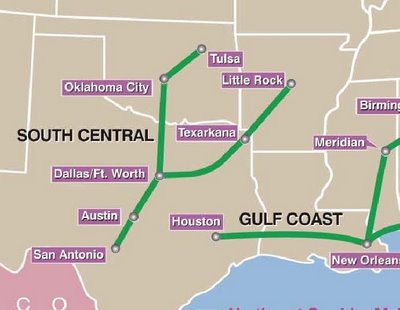
While it is good to see the hometown of Harrisburg, PA get on the list, it is interesting that a Texarkana to Little Rock connection is more important than Dallas to Houston. There is a full size map of the entire country and all lines at the link above. Here is a zoom in locally:


So what this is telling me is that if I could somehow get to Houston, greyhound of the skies or actual greyhound, I could hi-speed train it all the way back to mama's house. With the new green line, I would be able to DART to Love Field, Southwest it to Houston, somehow get to wherever their train station might be and then get on the 1500 mile trek home.

Meh, it would be easier to just fly. How about we focus on the Megalopoli [sic] as I mentioned previously and worry about linking them later (and to second/third tier cities). Bo-Wash, Charlotte-Richmond-Atlanta-RDU, DFW-Houston-Austin-San Antonio - California corridor, etc.

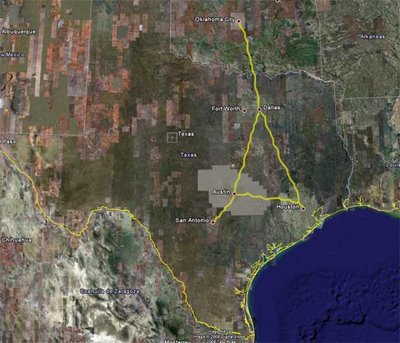
Here was my take from a couple of months back on a full hierarchy of new routes from Hi-speed, to commuter, to streetcar: