




Showing posts with label Deep Sustainability. Show all posts

Wednesday, June 9, 2010

Reading Books So You Don't Have To: The Original Green

The Original Green by: Steve Mouzon


First, I would like to thank Steve Mouzon. He was nice enough (or at least understands viral media) to send me a free review copy of his book The Original Green. Steve is an architect born and raised in a the vernacular of ante-bellum deep South architecture, now residing in walkable South Beach Miami, FL where he also maintains a blog of the same name full of essays, many of which became the foundation of this very book.

I have had the chance in the past to catch some of Steve's presentations where he was still formulating the backbone of what this book is the ultimate accumulation and then distillation. This book is not a road map; a point to point summation of the turns and distances we have to travel to return to building sustainable places. That would be impossible. That would be the equivalent of architects telling us what the world will be like in 2030. Rather than a road map, what Steve is providing are the GPS coordinates for where we got off track, how we did it, and the basis for getting back. The rest is up to us.

His words are not overly doctrinaire. They are also not technical in the least. The book speaks not just to architects, planners, city staffs, or elected officials, but to everyone b/c in Steve's view (and rightly so in my opinion) it is going to take all of us to return to building livable, lovable places to live, love, and learn as a way of life. Great urban places are made over time by the thousands of decisions made daily by the hundreds, thousands or millions of inhabitants, day by day, year by year, molding the grand, well-intentioned visions of architects and planners into something they can actually use.

This isn't so much a how-to guide but a tool for empowering you, me, and everyone else. It is a pattern book, which is the real strength of Steve's talent. He discusses in the book how work in the Caribbean proved difficult in coding a project with the conventional technical jargon of American planners. So he created much more poetic principles and painted them on the walls and fences of the community. Later, he found children who stumbled upon the "graffiti" and turned the stanza into a song, ingraining the positive message.

Where city codes, design guidelines, or CCRs can extend into incredibly detailed and mind-numbing minutiae, Steve distills complicated ideas into simple patterns or principles, the "artifacts" of originally sustainable places. The book is prescriptive rather than proscriptive. There is something empowering to that. Rather than a regulation they are a goal to achieve where if the simple basics are followed would then allow for useful and locally suited manifestations done so in a unique and creative manner.

His principles of sustainable places are those that are:
  • nourishable
  • accessible
  • serviceable
  • and securable
Sustainable buildings are:
  • lovable
  • durable
  • flexible
  • frugal
All of which he elaborates with exquisite simplicity and clarity, a necessity for the large umbrella topic of livable places, since we all have the same basic needs, wants, and desires. The Original Green allows for all of those, but retains the flexibility of choice, in choosing your own adventure based on your own personal priorities.

He also shoots holes in the conventional wisdom of how these artifact principles have been distorted or misinterpreted. For example, he cites the desire for securable places. Not out of the ordinary. Safety and shelter are primary basic needs as described by Abraham Maslow.

In today's anti-urban, unsustainable place, security has come to mean gates, walls, fences and seclusion. However, that desired isolation is exactly the kind of place criminals are looking for. Emergency response times are delayed by the sparse population density. The flashlight of human activity is the best deterrent, always making for the most secure possible place without the diminished quality of a life in seclusion.

One of the other great strengths of this book, is Steve's wonderful photography. He shows many examples of the types of places he is discussing, a helpful accompaniment particularly to the layperson in order to help visualize the types of places he is talking about.

In fact, his photography is so stunning that you almost wish it was a much larger coffee table book. However, it isn't. Rather than being the two things it wants to be: a small handbook and a large glossy, it instead became a regrettable hybrid of the two, a small, but glossy book where my notes washed away and the jacket fell to pieces half way through the first reading. Like many hybrids, now it is neither.

This unfortunate drawback reminds me of another book, Cradle to Cradle, which is essentially an unwitting, esoteric companion piece to The Original Green. That book was entirely synthetic. The goal of which was to create a book that itself was cradle to cradle so that the books pages could become something else at a later date. Unfortunately, publishing technology at the time couldn't quite keep up with the idea but at least it was compatible with the thesis.

With Original Green, I find the quality and character of its publishing to be its biggest drawback. I want to make notes. I want to look at high resolution photos. The book is meant as a stepping stonewhere we build our places and communities as outgrowths of ourselves following the basic principles of original sustainability.

That is what we're supposed to do isn't it? Build upon the foundational principles and make them our own. But I can't make my annotated elaborations within its borders. The book is the spark but we have to fan the flames and keep the idea burning ourselves.

That is the only road to authentic places.

Monday, March 29, 2010

Monday Lunchtime Linkages

Since the earlier post was entirely dedicated to local issues, I need a second one today to link to a couple articles that are more globally oriented or general in nature.

The first, from Metropolis entitled "The High Cost of Convenience," gets at what I feel is one of the great issues we face today: production processes, the recycling of dirty materials, and the painful transition away from planned obsolescence. Rather than selling more and more of the same product, the profit potential of the 21st century will be in closing cradle-to-grave material loops and the discovery of multiple ways of turning waste into profit.

Thwaites designed a toaster not to enjoy warm, crisped bread but rather to comment on waste, production processes, cheap products that never represent their true costs—and to point out that companies aren’t particularly interested in solving those issues. Thwaites’s plastic adviser, Axion Recycling, exists because of WEEE—not some kids’ toy but a piece of European Union legislation, Waste Electrical and Electronic Equipment. Approved in 2003, it requires companies to break down and recycle their castoffs. Its passing heralded the promise of a brave new world in which companies would be responsible for the afterlives of their products. They’d design things differently—fewer parts but more of them interchangeable and easy to break down. It would transform design. “The invisible hand of the market would lead to products that were easier to recycle,” Thwaites remembers thinking.

It didn’t turn out like that. Companies only have to purchase a certificate from a business like Axion proving that they purchased the same amount of recycled material by weight as they’d sold. To recycle a product in the age of WEEE, it is first crushed, with bits like copper and steel extracted, and then sent to Axion for plastic retrieval. But the problem is, Thwaites notes wryly, “There are quite a lot of parts in even something as simple as a toaster.” Extracting them in a pure form is difficult, and there are limits to just how often something can be recycled. Metal, plastic, paper, or cardboard can only can be reused once or twice before it’s got too many impurities. Thwaites knows that toasters are artificially cheap, but no one (not even he) wants to pay more. “Part of the solution is making sure the toasters we buy last longer, and we invest as much ingenuity and money into taking them apart as we do putting them together,” he says.
------------------------
And The Guardian raises another question of the day, that of the design challenge of cities, global urbanization, and standard of living disparity:
The question is this: how do we create cities that are not just containers for tightly-packed populations, but pleasant and equitable places to live? Someone once described the identical high-rises that ring so many capitals as the easyJet of urban living, because they offer everyone affordable access to the city; but they're not what you could call idealistic. The segregation and social polarisation of cities is getting so extreme that a violent future may be inevitable. The UN report has said as much. Now that city-making has become a priority, politicians need to have faith in designers. Because if there's one lesson to be learned from the last quarter of a century, it's that we need to shift our focus away from liberty and the free market, and move towards equality.

Friday, June 26, 2009

Couple Us Designers Wondering We Could Go Family Style on Yer Competition

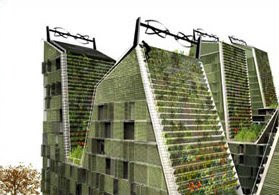
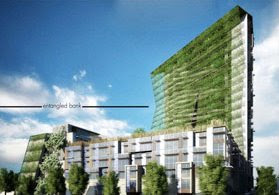
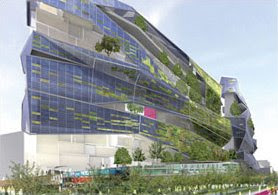
So, we have our winning entries for the Re:Vision Dallas competition. And the results are as predictable, superficial, and cliche as the competition title itself.

Behold:


(Of note: Not one of the three finalists were from Dallas.)

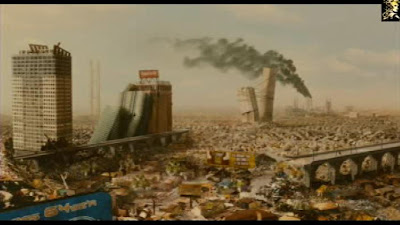
From simply a graphic rendering and architectural standpoint, all of these remind me more of this than anything I would really like to see happen in the city:

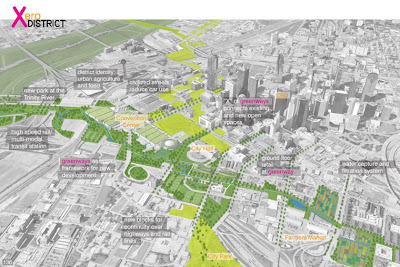
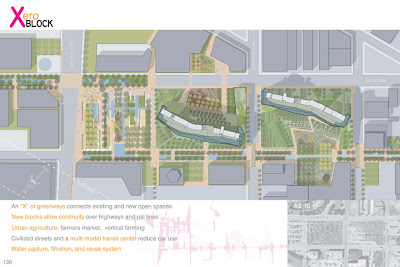
So every team engaged in some serious green washing and green gadget sustainability, which was not to be wholly unexpected. I was actually intrigued at first by this "X" district because a team actually started looking at their site contextually to deal with this site. Until I got a closer look at it. They basically just took the google earth axon view into photoshop and literally added a green connection from the project site to the Trinity River. How novel.
Of course, this would be nice, but they did nothing substantive to address the real issues affecting this site. A green blanket was laid over a fallen city, covering the highways, clover leafs, rail lines and vacant properties so that no one can see its dying eyes. Of course, this is an easy slight of hand with photoshop and a few snappy design catch phrases. No mention or apparently thought was given to how to address all of the grade changes, elevated and sub-grade highways, etc. that provide these impassable barriers.

I advised two groups that competed for this, suggesting to both that the constraints of this site were ALL beyond the boundaries of the actual project, not all of which are physical. No developer would look at this area. It had(has) no context. The freeway has gutted and bombed out both sides of it.

While in the mean time, the country is in deep and transformative recession. Rather than seeing something that addresses in an economically and physically sustainable manner a solution for job losses and failing industries, I still see highways and clover leafs. The two teams I consulted with ended up with solutions looking at how to reuse plain fuselages and the concrete road building industry as structural elements for prefab housing units. Taking one dying industry void of demand and repositioning them into areas of need, in town affordable housing.

Along these lines, I suggested carrying the theme further and restitching the fabric, grid, and parcels, that I-30 ripped to shreds in a methodical, phased, and context sensitive manner. Break down the dying industry of roads and cars, for one of the 21st century, the new American city.

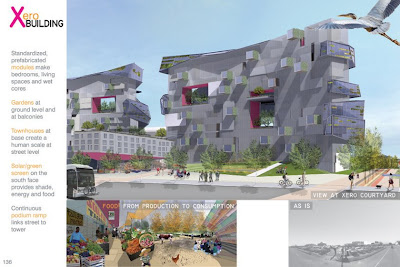
Instead, we get a correlated level of depth and duplicity that puts a blue heron flying across the page:


But how does this building fit within its site you ask?

Towers in the park: We don't want to frame the public realm, those areas critical for vital street life and local commerce, the areas that belong to all of us and make us love and be proud of our cities. We want to make self-referential buildings. In the words of a friend of mine, "IT'S ALLLLLL ME."

Which, in the end, I guess is a fitting eulogy for outside architects embodying globalist architecture where everything is nameless, placeless, and anonymous. It's all on a computer screen.

From the results shown on the website, I felt that "Commonwealth" did the best job of capturing this wholistic view of community healing and rebuilding.

Friday, April 10, 2009

Pro Sports and Carbon Footprints

This line says it all right here doesn't it?
The energy required to operate a sports venue is fairly minor compared with the energy that fans expend in simply getting to a game...
From Slate.

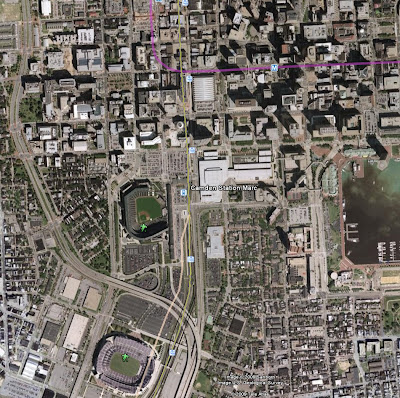
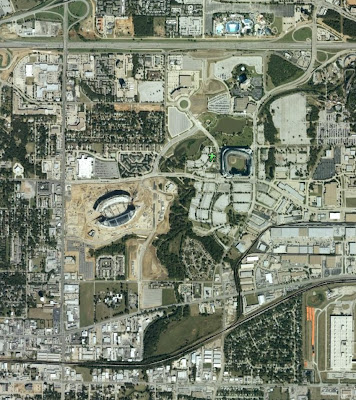
Now let's compare (I would use some Google Earth mapping, but apparently that program is having a hissy fit today):

Oriole Park at Camden Yards, embedded in the heart of downtown Baltimore near the Inner Harbor, and you can walk to, bus to, or train to...


or...

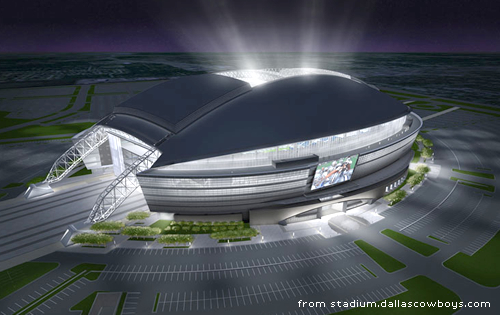
Shiny, happy Jerry World set in beeeeeyooooteeeful Arlington, Texas, home to the largest city in the country with no, ZERO, mass transit. Good luck hosting the Super Bowl, the NBA all-star game, and the Final Four in coming years while everybody stays in Dallas or Fort Worth without any way for these people to get to the venue.


Now, let's say the average fan is traveling the 20 miles from Dallas to the game, for 8 games a year, but we'll say 9 b/c the Cowboys are good at making it to one playoff game, and seats 80,000 people per game (assuming 80,000 people are willing to travel that far, pay for gas, and whatever Jerry Jones is charging for the upper level seats (cuz you ain't getting the lower level ones my friend). 80,000 people travelling each travelling 20 miles, 9x/year = approximately 720,000 gallons of gas.

I know, I know. Not every single fan will be driving solo, but yet again this is Dallas.

Somebody plz tell me how Arlington, and in turn, Dallas will NOT be laughing stocks like Houston and Jacksonville or Jacksonville again when the Super Bowl comes to town?

If you don't feel like clicking the links, here is the criteria ESPN's sports guy used to describe the ideal super bowl setting:

Does this mean Houston should be hosting a Super Bowl? Of course not. It's ridiculous. There should be five trademarks for every Super Bowl experience. This is not negotiable. Here are the five:
  1. Warm weather.
  2. Serviceable stadium.
  3. A downtown that's easy to get around.
  4. Fun things to do at night.
  5. A city that gives you that "Wow, what a city!" feeling.
If you're scoring at home, for Arlington that is: yes, presumably, no, no, GAWD no.

Cameron Sinclair Addresses the Issue of the Day

The Architect's Dilemma: Arch of Excess or Arch of Relevance.

It is really no dilemma at all. It is the difference between those that want their name in Architectural Record and those that want to help humanity. Where we have to be careful is that the last depression gave impetus to toss the City Beautiful movement in favor of a Corbusien idealism that had no empirical basis, but merely an idealogical and philosophical one with little to no fundamental relationship to the actual built form and urbanism. They were all one off buildings much like anything Hadid, Koolhaas, or Ramus do today.

To help us out of this depression, we need more Jane Jacobs and little to no Zaha Hadid. (Although one would think an Iraqi woman would understand some measure of community development, the intricacies of fine-grained urbanism in impoverished cities, and perhaps how to do something relevant on a tight budget. But, maybe she is merely the modern day architectural version of Ayn Rand, a pure unmoderated hyper-reaction to her previous environment):
In the circles of the cultural elite I know I'm stepping on very thin ice. Given that she is the first female Pritzker Prize winner I've been told more than once that 'one cannot criticize her'. While Ms. Hadid has certainly made a lasting impact in the architectural discourse, the physical structures created have been on occasion environmentally unsound, exclusive in nature and at times ethically dubious. They fight for attention, piercing the fabric of the city instead of weaving it into a stronger and more interconnected environment.

The argument was never about starchitect vs. non-starchitect but how we adapt and change as a group of professionals that is dedicated to improving the physical environments that we call life. There is no 'architecture with a big A' there is only architecture and how we practice it matters not just for the state of the world but the survival of the practice.

Monday, April 6, 2009

Hyper-reactionary?


City-Journal has an article up entitled Green Cities, Brown Suburbs with the tagline "To save the planet, build more skyscrapers," by Harvard economist Edward Glaeser who has been cited repeatedly in this blog, most recently here and here, as he and I came to the same conclusion regarding the bailouts. That real growth will come from the bottom and we should be saving our bailouts for real stimulus and that is to stimulate startups and small, more agile businesses, which is where innovation and progress comes from.

Here is what he says regarding how humans should be building:

Similarly, limiting the height or growth of New York City skyscrapers incurs environmental costs. Building more apartments in Gotham will not only make the city more affordable; it will also reduce global warming.

Thoreau was wrong. Living in the country is not the right way to care for the Earth. The best thing that we can do for the planet is build more skyscrapers.

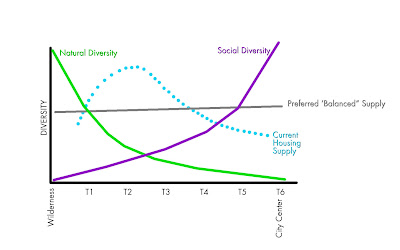
However, I will be disagreeing with him here and at the end of the day, it is really a very simple thesis and the issue is one of semantics. We all know density is one way towards sustainability because of shared resources, effective synergies created via spatial relationships, lower per capita carbon footprint, less VMTs and car dependence, etc. The other is total self-sufficiency from a site standpoint, aka the farm that generates all of its own food and energy on-site. This is the least dense option.

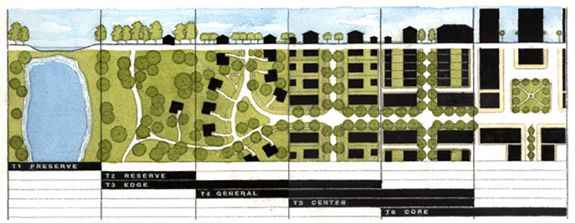
If we take the transect for example, if only to establish a gradation in densities from city core to the most rural of land and development we get the following graph:

[click to see it larger - since it posted so small]

But, at the end of the day, skyscrapers are energy and material intensive. Furthermore, they degrade the public realm, the street life and ambience that makes cities. Vancouver has been able to get around this by creating a lower-story base to sit their towers on, but this doesn't change the fact that the buildings are still importing material from wherever and people to occupy those buildings often from the suburb. (Think about how many people commute into lower manhattan from NJ, CT, and Long Island.)

Here is what I said in a previous post:
Here is the problem. This study takes the Amero-centric view that only through tall buildings can one achieve density. Skyscrapers are not a necessity for density. Paris, Florence, Madrid, Rome, Copenhagen, are wonderfully dense. Now, here are the potential CONS of skyscrapers:

1. Even if a platinu
m-certified tower is constructed, the building is still immensely energy intense in its construction phase.
2. They are materially intense, with materials typically travelling much farther than with low- and mid-rise buildings.

3. Skys
crapers privatize sunlight and views. Then, amazingly when another tower is built next door, the tenants of building 1 flip out that they lost their view...despite doing the exact same thing.
4. Tight-knit, often medieval form urban fabric generates protective microclimate from
weather extremes. Skyscrapers often exacerbate the problem with the intensity of the wind shear and down draft created by the building.
5. Skyscrapers adverse
ly affect the street aka the public realm by 1) removing people from the street and putting them in elevators and 2) overpowering the scale of the space created by the buildings.
6. These buildings tend to be glass and steel. Two energy intensive materials, often not created locally. I like the elegance of glass bui
ldings, but then the issue becomes one of active vs. passive heating and cooling. AND, reflective glass is often pretty ugly.
7. C
OST. They are expensive to build. In summary, I'm not saying that I'm against skyscrapers. I like the pyramidal form of skylines of cities, emblematic of the greater synergies driving up values in the center-city, and thus manifested by taller buildings, aka greater real estate and F.A.R. in those places as a natural result. But, simply calculating that more dense places are greener doesn't say a damn thing and it certainly doesn't necessitate skyscrapers.
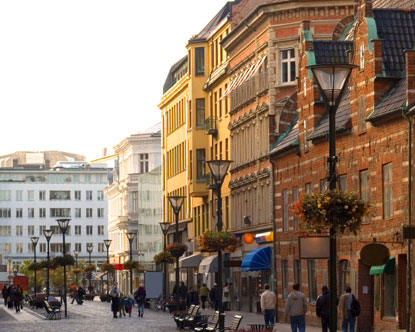
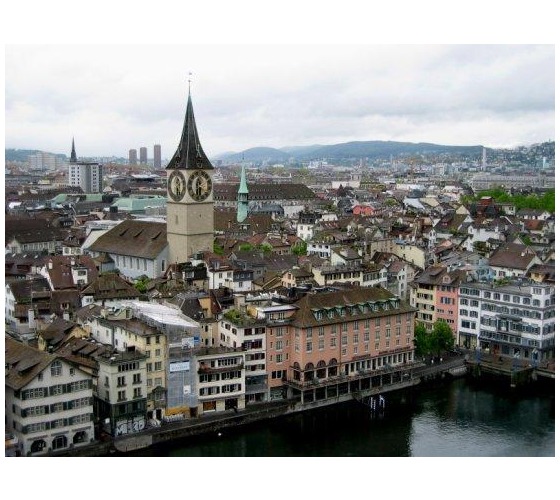
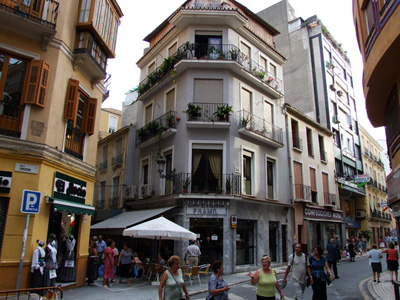
Now, think about the most pleasant cities that you have been in (and I'm not talking favorite b/c that brings into play potential for hedonistic behavior, i.e. Vegas), I mean most pleasant. For me (of cities that I have spent a reasonable enough time there), the list includes:

1. Malmo, Sweden - The cleaner, less busy version of Copenhagen.

2. Siena, Italy - need I say more?


3. Zurich, Switzerland - combination of modern/contemporary and traditional/historical.


4. Verona, Italy/Vicenza, Italy (tie) - if only because I confuse my memories of the two like I do with the Italian and Spanish languages.


5. Malaga, Spain. - something about the palm trees and coast line.


The spaces created by these buildings, AND in turn, the buildings themselves create spaces the citizens love, and revere, and are proud of, and therefore will not allow the natural inclination to densify to ruin their cities. This is the underlying cause of high-rises at the fringe of European cities, a market-driven logic to deliver as much "product," in this case, housing units to an area of high demand. Only that the new product is so undesireable it is relegated to the fringe and over time, relegated to the impoverished, becoming a slum and potentially areas of high volatility and/or crime.

The consistency is that these are all medium-sized cities, not so disconnected from nearby nature, nor overwhelmed by cars and/or people, with low to medium sized buildings but still with much higher density than most (all) American cities because of the compact form of development.

In the States, I would say that D.C. would be very high on the list for similar issues, despite being a much larger city. Of the cities the authors cite, most of the residents aren't living in high-rises, they are in the neighborhoods adjacent to the high-rises which house mostly commercial enterprises.

It is possible to build they type of density that Glaeser is looking for in a way that makes for cities more livable than Hong Kong, that are close to nature, close to food production, and don't house people in vertical filing cabinets, so that they are so disconnected from the ground and the street life that makes cities interesting and vibrant.

Plus, we are just too damned poor and in debt to be building high rises all over the place, when we need cost effective solutions and those will be in the form of three- and four-story buildings that frame streets and public places and provide for a flexibility of use that gives the buildings a much longer life than we would typically allow.

Tuesday, March 24, 2009

Mom, I'm a Lightning Bug!!


Completely off-topic, but noteworthy as we debate how to handle our energy needs in the coming century. I was one-year old and grew up only a few miles from Three Mile Island. [I take that back, I was 5 months-old.]

Harvey Wasserman at the Free Press on the cover-up of TMI's true damage:
research at TMI also uncovered a plague of death and disease among the area's wild animals and farm livestock. Entire bee hives expired immediately after the accident, along with a disappearance of birds, many of whom were found scattered dead on the ground. A rash of malformed pets were born and stillborn, including kittens that could not walk and a dog with no eyes. Reproductive rates among the region's cows and horses plummeted.

Much of this was documented by a three-person investigative team from the Baltimore News-American, which made it clear that the problems could only have been caused by radiation. Statistics from Pennsylvania's Department of Agriculture confirmed the plague, but the state denied its existence, and said that if it did exist, it could not have been caused by TMI.


In the mid-1980s the citizens of the three counties surrounding Three Mile Island voted by a margin of 3:1 to permanently retired TMI Unit One, which had been shut when Unit Two melted. The Reagan Administration trashed the vote and re-opened the reactor, which still operates. Its owners now seek a license renewal.

Thursday, March 12, 2009

Today's Treat: Guest Post

I'm hoping guest posts on a variety of topics that I am incapable of commenting on can become a regular feature of this blog...

With the recent spate of community gardens and the movement away from the English-derived, petty bourgeois need for manicured lawns towards something more useful, I've enlisted a friend and colleague who has started his own garden in the front yard of his young families inner-ring Dallas house:

Take it away Juan Munoz...


Primer:

http://www.eattheview.org/
What's a Garden Worth?

I originally started my garden as a native, albeit urban prairie. I reintroduced native species without the use of chemicals and pesitcides as an antidote to the manicured, unsustainable water hogging turf lawn decorated with imported flowers that feel more at home in England or some rainy European climate. They won't grow here in Texas without a major helping hand from homo sapiens and some petro-chemical based inputs.

Man cannot defeat nature. It's been around a whole hell of a lot longer than us. So I chose to work with it.

Once that was done and the Laissez-faire method of natural lawn decoration reaped its wild and unexpected rewards, what else was there to do? Answer: Grow my own vegetables. My mom did it. My grandmother did it. I want my kid to do it. I want my kid to learn where food really comes from and to learn skills that too many of have us have lost with advanced technology.

I was sick of bland, commercially grown veggies that had no flavor. They come from who knows where. I can't really afford to eat organic veggies because, frankly, they are too expensive. We had a few scares from salmonella outbreaks in tomatoes, spinach and jalepenos. How in the hell am I going to make salsa without tomatoes? Plus, there is a deep satisfaction of growing something you eat. You can taste the love you put into it.

From the native garden, I moved to a container garden of tomatoes and peppers, and the containers proved to be a little dicey in the heat of Texas summers. The pots dried out to quickly and the yield was low. But what little we got from the containers tasted so damn good I was hooked.

It was time to expand and actually build a raised bed garden where my front lawn stood. Part political statement and part necessity due to the sun orientation of my lot, the front yard was where it was going. (I used the orientation part to convince my wife that the front yard was the only place it could go.) She finally warmed up to it once the Romaine lettuce started sprouting up. She will love it more when the tomatoes ripen.

Since the soil in North Texas is generally clay, the initial cost outlay is more than I imagined, though not exceedingly expensive. Instead of digging into the dirt and planting random veggies, I was forced to build raised beds and amend the soil with compost.

Soil is the key. Healthy soil, healthy happy plants. I make my own compost, but the amount I am able to produce and the amount required to start the beds were not even close. Add in the wood to build the raised beds with the cost of the compost/mulches and seeds and some starter plants, I am at around $250. Next year the costs will be substantially lower since I will be starting from seeds mostly and the soil will improve each year with minimal amounts of homemade compost added to the beds .

The garden is only around 75-80SF(It’s at 50 SF as of today)but it is designed to maximize every square foot of space using the block style method of planting. See link here: http://cmg.colostate.edu/gardennotes/713.pdf

For example, in a 3’x3’ space in the bed, I can yield 144 carrots, 36 onions, or 16 heads of lettuce. Using succession planting, i.e., sowings seeds every two weeks, I should have a steady supply of fresh kitchen veggies until the first frost. The initial 250 dollar outlay is comparable to a week and a half’s worth of groceries for me, the wife, and baby Jack. I think it is money well spent, and it’s cheaper than therapy. We will see where it goes, and how much we really get out of the garden.


Monday, January 19, 2009

Of Knowing the Path and Walking the Path

WorldChanging takes on Obama's choice for Transpo Secretary, that is considerably less optimistic (and probably more accurate) than mine:
This one-time wave of funding will do one of two things: it will further entrench a broken system, or it will begin to build a new and better one. In the next six years, we'll either dump hundreds of billions of dollars into highways, roads and bridges or we'll begin to revitalize our communities and transform our economy. Sprawl or urban renaissance? That's ultimately the choice we have.
Boston.com: The End of Bilbao Decade.
All that fever now feels passe. Architecture students, I'm told, are more interested in so-called "green architecture," work that responds to the global crisis of climate and resources, than they are in artistic shape-making. They're interested in urbanism, in the ways buildings gather to shape streets and neighborhoods and public spaces. They research new materials and methods of construction. Increasingly, they're collaborating with students in other fields, instead of hoping to produce a private ego trip.
I'm not sure who "told" the author this, but if it is more than mere speculation, I am imbued by the generation of Millennial architects that "get it."

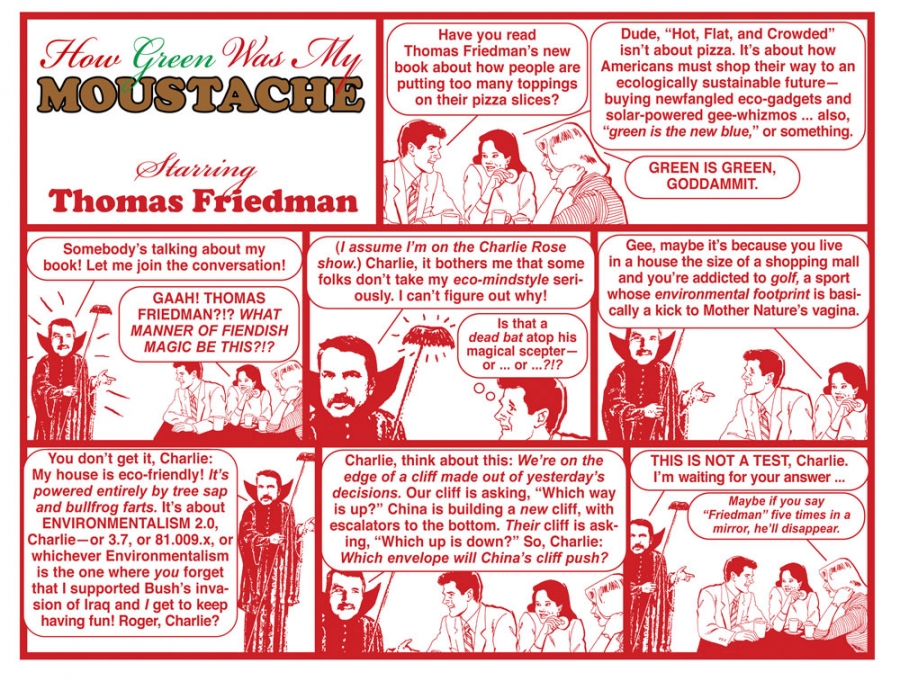
And lastly, I rather enjoyed this critique of the notorious front-runner, Thomas Friedman.

Wednesday, January 7, 2009

FORWARD Article

I hope that I'm not jumping the gun, but here is the rough cut of the article (with some later minor tweaks that occurred after editing...well, just because I was unhappy with a few phrases) that will be published on Jan. 22, 2009 in The AIA National Associates Committee's Quarterly Editorial Online-Journal, found here [Link]:

Full disclosure: I am not an architect. But, I did stay at a Holiday Inn Express last night. Actually, I just work for an architecture firm, in the Urban Design and Planning Group. I am writing because I have shared interests in sustainability and generational studies and believe these topics to be interdependent and intertwined. The point of this article is to discuss how the Millennial Generation will drive the architecture and sustainable urbanism of the 21st century and how the real estate market is failing them and architects and designers must deliver it for them.

Before moving forward with this thesis, it is critical to understand a few things about generational studies. First, generations are cyclical. Characteristics cannot be linearly extrapolated from one generation to the next. Rather, they are mostly reactive to previous generations. Next, there are always outliers and anomalies. The key is to focus on trends and find the statistical mean or center of gravity of the cultural shift.

Now, who exactly is a Millennial? Academics like to assign specific age brackets and birth years to define and identify generations. They bicker over whether they were born in 1977 or ‘82; 1994 or ‘96. I prefer to focus on epochal shifts - moments in history that define them - as people - as a group. So I will define this cohort as individuals graduating college post 9/11 at the oldest extreme and those involved in the historic 2008 presidential election at the youngest. Anecdotally, I have heard too many stories of eleven, twelve, or thirteen year old volunteers. They are active, involved, informed, and the largest generational cohort in American history.

If there is one word to best describe the Millennials, it is that they are communitarians. Millennials are team players, working better in groups than individually. They have redefined the internet’s networking capabilities while maturing along side of it, with the creation of YouTube, Facebook, Flickr, etc. proving the internet would not replace community leading to a world of plugged-in shut-ins, but serve as a tool to build and maintain relationships.

[Common areas and public spaces take precedence when designing for Millennials. Pictured: Addison Circle where each building faces a park. Image courtesy of RTKL.]

Their chosen fashion is about subtlety, details that give a hint of individuality without shock or rebellion. As Nadira Hira writes in Fortune, “this isn't a group you'll catch in flannel. They're all about quiet kitsch - a funky T-shirt under a blazer, artsy jewelry, silly socks - small statements that won't cause trouble. The most important decorations, though, are electronic - iPods, BlackBerrys, laptops - and they're like extra limbs.”

You have heard of Generation Me, say hello to Generation We.

In Millennial Makeover, Morley Winograd and Michael D. Hais describe the two types of realignments -"idealist" and "civic"- that have alternated throughout the nation's history. From pop culture, to fashion, to the historic turnout of 18-29 year old voters this election suggests that Millennials are beginning to come of age; seizing the mantle from the Baby Boomers, defining the collective consciousness.

The tidal shifts are not isolated to politics or pop culture. Our cities, the places that house us, provide platform to live, learn, love, interact, and transact, are also at the tipping point. They are lacking real urbanity. The real estate community is supposed to deliver what the market demands. But, according to Chris Leinberger, only 3% of Americans live in walkable urban communities, while 30% said they would like to join them. That is some serious pent up demand.

Millennials grew up in suburbia; bland environments dependent on others for mobility. They are entering the adulthood seeking lifestyle: vitality, diversity, and community. But, Millennials are not the only ones who will be driving this sea change from suburban to high quality urban environments. Baby Boomers will be retiring by the boat load. Retirement communities in their current form resemble warehouses more than they do the most desirable of retirement “villages”: real communities where retirees can be independent and empowered, such as the Upper East Side and Key West.

[Millennials meeting at a "Third Place." Stock image courtesy of RTKL.]

The paradigmatic issue is that the world constructed between 1950 and 2000 is one of planned obsolescence, of consumption. We have overspent, so retailers (and similarly, homebuilders) over provide products. Combined with a more frugal younger generation, a vast shift in urban form is required; scaling back and relocalizing in conjunction with relocation of the “market” where transactions occur in places that fulfill the social needs of the new generation. Driving to the mall is no longer as convenient (or desirable) as heading to third places: the corner store, the coffee shop, the local pub.

I recall the overly simplistic, undergraduate argument whether Architecture was an art or a science. Certainly, it is both, but art reflects its place in time. Architecture in the 21st century will be as different as the Millennials are from the Boomers. They are doing whatever it takes to get into interesting, urban environs at a time when it is hardly affordable for them. They are moving into “micro” units, taking on roommates, and more willing to live in multi-generational households.

Like society, the architecture profession is at a similar transitional stage as Generation We, the communitarians, and sustainable urbanism struggle to take center stage from the attention seeking, entirely self-referential architecture and high tech gadgetry posing as sustainability as if it is some sort of fleeting fashion, temporarily en vogue. These are postcards, nothing more.

We have to all become less specialized in our individual professions, under one umbrella, each as city builders with a common cause focused on placemaking, which becomes more than series of stills, greater than the sum of its parts. It becomes drama. Only through Architecture of the We, not the Me, can we design and begin to rebuild our cities as stimulating places for the next generation and achieve real sustainability.


Recommended Reading:

Farr, Douglas. 2008. Sustainable Urbanism: Urban Design With Nature. Hoboken, NJ: Wiley.

Greenberg, Eric, and Karl Weber. 2008. Generation We: How Millennial Youth are Taking Over America and Changing Our World Forever. Emeryville, CA: Pachatusan.

Hais, Michael D and Morley Winograd. 2008. Millennial Makeover: MySpace, YouTube, and the Future of American Politics. New Brunswick, NJ: Rutgers University Press.

Hira, Nadira A. “Attracting the twentysomething worker. The baby-boomers' kids are marching into the workplace, and look out: this crop of twentysomethings really is different.” Fortune, May 15, 2007. http://money.cnn.com/magazines/fortune/fortune_archive/2007/05/28/100033934/

Howe, Neil and William Strauss. 1997. The Fourth Turning : an American Prophecy. New York: Broadway Books.

Howe, Neil and William Strauss. 2000. Millennials Rising: The Next Great Generation. New York: Vintage Books.

Leinberger, Christopher. 2008. The Option of Urbanism: Investing in a New American Dream. Washington, DC: Island Press.

Nasser, Haya El. “Less is More in New Housing: Young Renters and Buyers Seek Small Spaces with Big Appeal—and Luxury at a Lower Cost.” USA TODAY, December 5, 2008. http://www.usatoday.com/printedition/news/20081205/tinypads05_st.art.htm

Zogby, John. 2008. The Way We’ll Be: The Zogby Report on the Transformation of the American Dream. New York: Random House.