




Showing posts with label Phony Economic Development. Show all posts

Monday, July 19, 2010

Monday Morning Linkages

Today's links may not have a particular theme, beyond being as diverse in their complexity and range of issues as urbanism itself. Two things that I often focus on are governance/democracy and its various permutations and the transition between old capitalism and new capitalism, as any economy is the single most important dynamic affecting the form and function of our cities.

On to the show:

Derek Powazek citing Yochai Bentler on the revolutionary democratizing agent of the internet and its lamentations:
You know who’s sad about the gatekeepers losing control of the media? Nobody except the gatekeepers. If you care about democracy, thank your lucky stars for the internet, the most open forum for the free exchange of ideas ever invented.

I say: Let’s dance on the graves of the gatekeepers. Let’s build things never before possible. Let’s show what a giant network of brains can really do.

The internet as a single entity and a voice for the rabble isn't the only way this is happening. It's an empowering agent that fosters self-organization and self-customized connections, where we can eliminate the useless and cut out middle men of any economic transaction. There are gatekeepers in all industries and to some extent they are necessary. Language, for example. See the late David Foster Wallace's internal debate* regarding the issue of laissez-faire language evolution and the protectors of a true (potentially arbitrary) protocol of syntax.

Similarly, while gatekeepers can be right or wrong for a field, usually depends on their own abilities, often undermined by the foundations of capitalism as we know (knew?) it. Those same useless, wasteful, or stalling agents in the name of progress. One example, is the music industry, controlled by a few major record labels increasingly turns out more noise and less art, setting up barriers against real talent reaching a broader audience.

While occasionally, against the tide, some musical acts can rise to the top, but they typically need a martyr within that very industry to fall on a sword to give them a chance. The reason the music industry prevents talent from rising as it is naturally wont to do, is that talent can typically write. And writing music means royalties. And royalties mean on-going and perpetual revenue stream.

By cross-platforming between music and television with TV shows like American Idol, the music industry, largely engulfed by gigantic publicly traded companies, is able to build an audience by marketing to the willing masses. The show gives the audience a "stake" in the game by each having their favorite individual, the most popular gets ahead. The most popular will sell the most records because we** feel we have some level of personal connection to that person winning.

The industry, with staff writers on salary and under contract as to not receive royalties, then produces some factory-produced, focus-grouped modern-day elevator music for the all-singing, all-dancing puppet to perform.

It's also all that is wrong with capitalism. More usury and pyramid scheme than facility for talent to garner its true worth.

* Warning: You have to be an uber-nerd to dive into DFW's text.

**Author has never watched a single show of American Idol.

-----------------------------------

While we're on the topic of changing economies, I've recently come across a fellow tweeter (twitterer? twit?) by the name of Umair Haque, who incidentally happens to write for the Harvard Business Review. I was struck first by Haque's tweets which always seem to mirror my own with regards to a profound generational, perceptual, and functional shift in the fundamental operational underpinnings of the economy (like in a good way).

Eventually I started reading his writings at the HBR, including this one on Apple. There are times when you think you can write and then there are times when you have similar thoughts in your head as to the author but only wish you could convey them as clearly and concisely as he does here:

Apple, when you think about it, is a microcosm of the global economy; a tiny but striking representation of both its strengths and its weaknesses. Apple mass produces "product" (with a smattering of services on top), mega-markets it (across mass media), and sells it in your local mall, mostly to developed-world "consumers."

Here are just a few of the downsides: The raw materials Apple uses are toxic to the environment; Apple's Chinese subcontractors have endured a spate of recent suicides; Apple takes advantage of a questionable Chinese exchange rate regime that effectively exports unemployment to the developed world (and subverts the very notion of "free trade"). And it does all this at a lightspeed pace of "innovation," which results in spirals of obsolescence; last year's junk heads, often, to the landfill. Finally, it's questionable whether Apple's products, as beautiful as they are, offer meaningful benefits to people. Are they just the technological equivalent of Jimmy Choos, the kind of stuff that underpins the consumption addiction at the heart of the global economic crisis in the first place?

Apple, to its great credit, strives mightily to minimize each and every one of these downsides. Yet, that it must do so is the very point. How different, as a linchpin of the economy, is Apple from the Ford of 1930, the GM of 1950, the P&G of 1980, or the GE of 1990? In economic terms, not so much: all are built on the same set of institutions: mass production, mega-marketing, "profit," hierarchy, opacity, "innovation." You know the score — and by now, you might just ask yourself: "isn't it time to move past the industrial age already?"

Just shut up and let it breathe, Patrick...

--------------------------------

Der Spiegel interviews Albert Speer, Jr. Yes, but no. Not the Albert Speer known for his overly scaled representations of Romanesque forms for Nazi Germany but his son who has become an accomplished architect himself and says that the slums of the 21st century are being built in Dubai (to which I completely agree, of course for reasons I will get to):

The highlights:

So, fundamentally, buildings such as the Burj Khalifa aren't inventions of the 21st century. Such plans existed earlier, it was just that they weren't feasible technically. Today, we have the means to build such towers. However that doesn't mean it's sensible to build them. It's purely a vanity project.

Overscaled product of dying economy: check.

Perhaps there are enough people in the world who would consider an apartment in such a building to be the cherry on top of their luxurious lifestyle. But this has nothing to do with normalcy or a sustainable lifestyle. When one builds a city -- at least I think so, as a German -- one builds it for the next 200 years rather than the next 10. Take the German city of Freiburg, for example -- the layout of the city is the same as it was in the year 1000. But in Dubai, it is likely that the majority of the buildings there will have to be torn down again before too long

Product of supply-side thinking rather than outgrowth of demand: check.

I am convinced that the slums of the 21st century are, to a certain extent, being built there. Dubai has two sides. On the one hand, it's the Gulf state that doesn't possess any oil but which has nevertheless managed to get its name on the world map within the space of 20 years... Many buildings were built quickly and on the cheap by speculators and are now standing empty.

No foundation for an economy to exist there, other than the epicenter for the black market of the world: check. Eventually, it will become far too seedy for the wealthy that are needed to fill those condos to want to even be there.

One builds cities for people... I believe that Dubai got intoxicated with the idea that everything is possible. The collapse of that system demonstrates that it wasn't the right way to go.

One predictive measure of whether the system of built form and how people interact with it will succeed or fail is Space Syntax, a career's worth of work by a British Professor in the name of adding objective regularities or constants to urban planning and architecture: city building. It is heavy stuff if you want to dive into it, but you can be sure that Dubai and the new portions of car-orientation lack the form where people can predictably and comfortably use the space. In the place of order, Dubai represents an application of American oppulance and profligacy.

We were once wealthy and powerful. Wealth and power then gets associated with the "right way to do things" rather than the actual reasons of that accumulation of wealth and power. Dubai and China are copying what we did wrong and painting a rosy picture of the future economy on top.

Their/Our mistake was in thinking that simply by pending money and siphoning off the circulation of that money somehow created wealth and prosperity. Only through creating and adding value creates wealth and prosperity. Copying the copyers is no way to rebuild our economy.

----------------------------------

And lastly, speaking of pyramid scheme real estate economies, while this only deals with property tax revenue, mixed-use development far and away outpaces single-use suburban development, much of which hasn't fully paid for the infrastructure it requires before it is torn down and land repurposed:

Next, Katz showed the results from retail properties. Here comes surprise No. 1.: Big box stores such as WalMart and Sam’s Club, when analyzed for county property tax revenue per acre, produce barely more than a single family house; maybe $150 to $200 more a year, Katz said. (Think of all those acres of parking lots.) “That hardly seems worth all the heat that elected officials take when they approve such development,” he noted in a related, written presentation.

Among retail properties, the biggest per-acre property tax revenue in his county, almost $22,000 per acre, comes from Southgate Mall, the county’s highest-end commercial property with Macy’s, Dillards and Saks Fifth Avenue department stores. That’s not so surprising.

But here’s the shocker: On a horizontal bar chart Katz showed, you see that zooming to the far right side, outpacing all the retail offerings, even the regional shopping mall, is the revenue from a high-rise mixed-use project in downtown Sarasota. It sits on less than an acre and contributes a hefty $800,000 in tax per acre. (Add in city property taxes and it’s $1.2 million.) “It takes a lot of WalMarts to equal the contribution of that one mixed-use building,” Katz noted.

If not just questioning our development product and form, this should also having us more closely examining our tax policies at a fundamental and philosophical level.




Monday, May 10, 2010

Mission Accomplished...What Hath We Wrought?!

"Keep the Cars Moving"


OBEY.

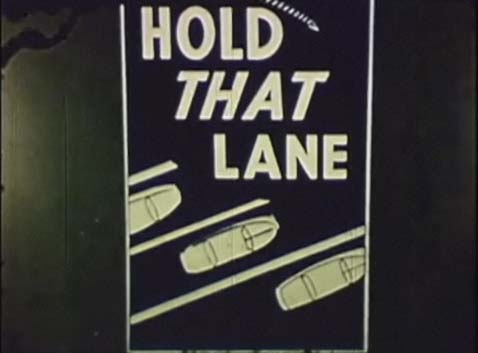
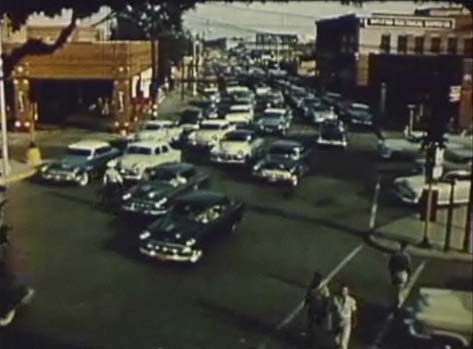
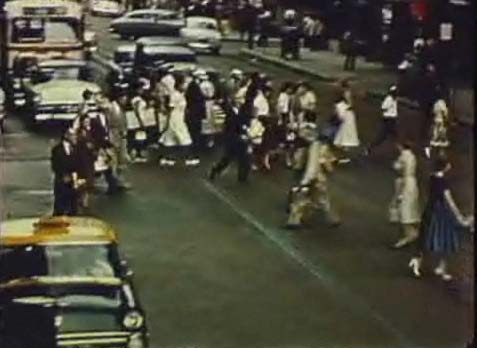
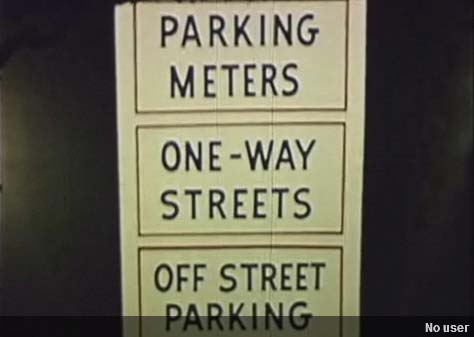
Thanks to Robert Wilonsky at the Observer for alerting me to this video from the 1950's imploring Dallas to move that traffic. It is worth the watch if only for the old video shots of 50's era D-Tex, which are pretty cool. There is no embed code with the video, so you have to go here to watch it, but I'll include some stills with general commentary.


My favorite part of the entire thing is how unaware this video and by extension transportation policy is still to this day of the logical inconsistencies underlying their theology. Got to move that traffic swiftly, BUT DON'T SPEED! Say wha?

So we design roads comfortable enough to drive at uncomfortably fast speeds then devote resources to regulation and enforcement of those streets.


To better understand this video and the policies espoused, it is important to understand the general mindset of the day. At the time, economic productivity was defined by the assembly line. Theoretically it invaded all fields including urban design. However, urban design being that it is complex is antithetical to the assembly line which requires simplicity and a vague, most likely, over-simplified notion of efficiency.


But, our theoretical models suggest we must keep building new lanes to tantalize you with the illusion of choice and that the other lane might always be moving faster than the one you are currently idling along.

So in order to distill the notion of city into simple enough terms that economic productivity theory of the day could work with, the various segments of urbanism were compartmentalized in every way possible: from single-use zoning to transportation policy, which is what we have here. the resultant system is one where each of the specialized professions and their tailored goals are in competition with one another, pulling the city in opposite directions rather than orchestrated and moving in the same direction toward a singular goal. The destination of a great city.

By doing so, they took 10,000 years of accrued awareness and understanding of urbanism and flipped it on its head favoring one-way streets, no on-street parking, road widenings described as dire necessities, and other design mechanisms to ensure that there is no "friction" impeding the efficiency of the conveyer belt of the auto-oriented assembly line. Placemaking and livability be damned.

Unfortunately, friction, convergence, choice are all necessities for cities.

Why? Their stated goal was that it was necessary to make downtown shopping work... uh, how is that working out? This is what happens when you take thousands of years of empirical evidence and throw it out the window in favor of ideological righteousness.


However, the report is right in one sense, traffic is the lifeblood, the pulse of the city. What it gets wrong is that it oversimplifies. It streamlines. It only looks at traffic from the perspective of the car. In actuality, traffic should be thought of as all forms of transit, preferably those with the least cost and greatest efficiency, walking.

The city as an assembly line does not make for more efficient cities. Universal auto-ownership does not make for more democratic cities. Cloverleaves do not make for free markets. It is all mumbo jumbo. Scientific term.

Today, rather than assembly lines and the model of economic development of early 20th century fascist countries (highway building and militarism) guiding urban policy, we are turning to new fields of study which are far more practical to how cities actually work: computing, networking, fractals, complexity, crowd sourcing, behavioralism, empiricism, etc.

For an example of how single minded transportation policy actually undermines the notion of efficient markets, we'll take a quick tour of a few roads around the City.


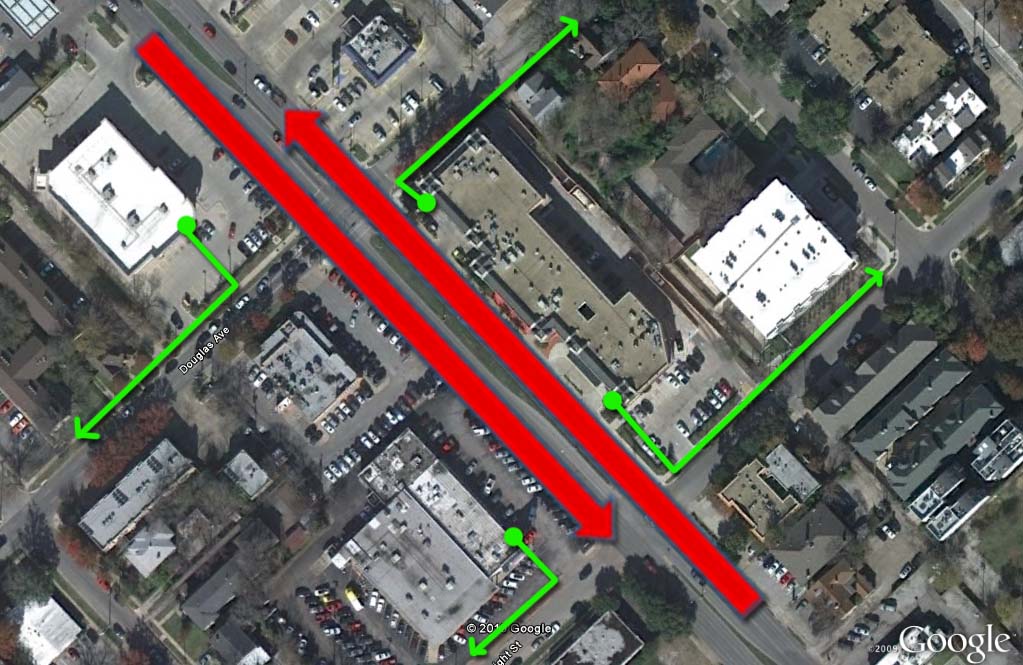
Lemmon Avenue. It is wide. And while it is two way, functionally it operates more as a one-way hybrid with the grass medians. Medians make for chutes, which theoretically help traffic to flow. However, flowing traffic, particularly at a high rate of speed prevents traffic from crossing. That is traffic of all forms, including pedestrians. The best you can hope for here is that some of the residents might walk from the neighborhoods adjacent to the drive-thrus. Because there is no on-street parking, it all has to happen off-street. Because it is off-street, the buildings are set back with parking in front for convenience.


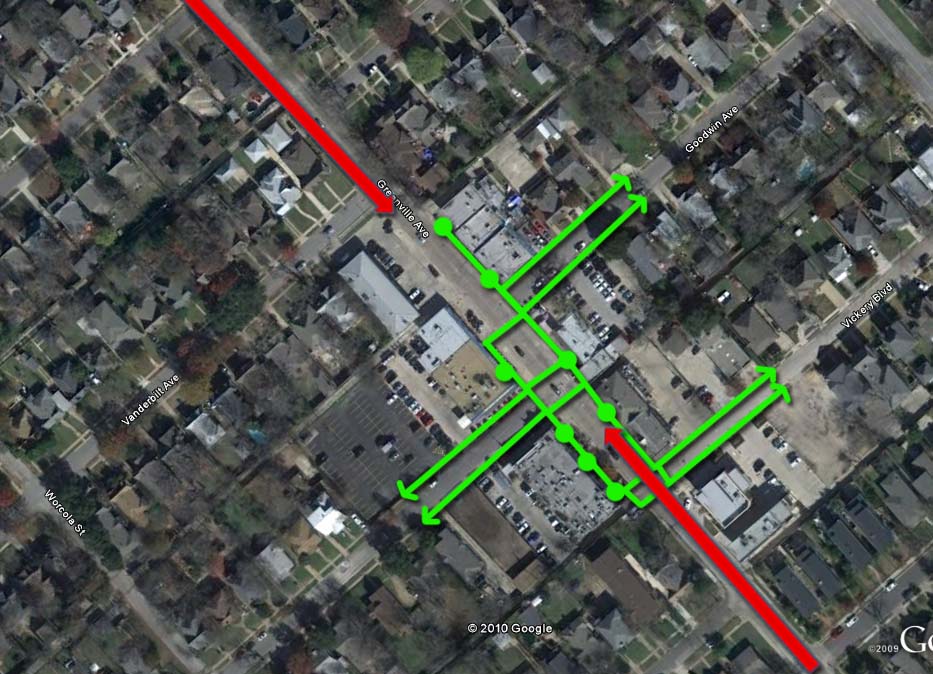
Greenville Ave where Mick's and Hurricane Grill once stood. /Pours liquor.

Greenville is an improvement over Lemmon, but it isn't perfect. The scale of the street allows for a clustering of commercial space all along Greenville rather than the linear "strip" like on Lemmon. There is some parking, but it doesn't define the space nor disconnect it from the neighborhood or the synergistic effects of the adjacent buildings. Some pedestrian crossing can occur because the traffic is slowed enough by the scale of buildings and activity on the sidewalks providing friction. Any higher rate of speed here and the sense of place is destroyed.

Side note: keep this episode of South Park in mind next time you are sitting at the Blue Goose and a Harley rides by, over and over and over again. Braahhh-br-br-br-br-br...


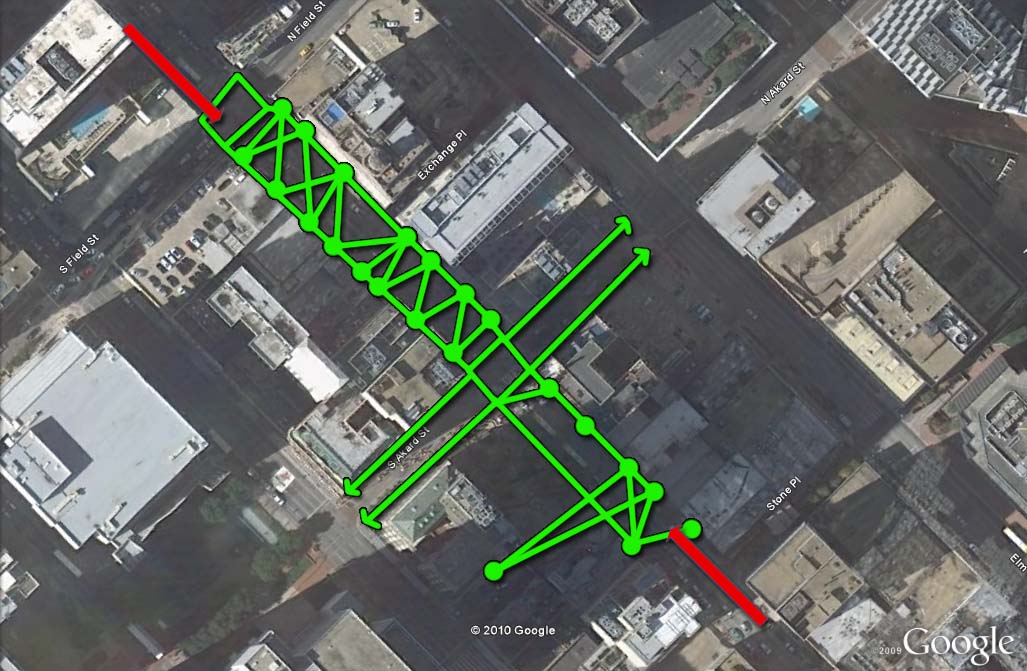
Lastly, the extreme example. The three-block stretch of Main Street. The actual beating heart of downtown Dallas that traffic engineers nearly extinguished. Driving on it is actually a hassle...which allows for closer, more efficient connections to be made. Why? Because the nature of the street favors pedestrianism to the point of jaywalking, all of the connections made between source and destination: office to restaurant, office to office, home to bar, bar to back home (forgot the circuitous, stumbly route).

In this way the strict goal of moving cars undermines the viscosity of connecting people to destinations. Roads become barriers to connectivity, which themselves become undesirable to be in, to live on, or to walk along (or more importantly, across).

Once that occurs, the roads become repellent forces while placemaking and economic efficiency requires magnetic forces, things people want to be around. Why economic efficiency? Because of distance and the cost of energy to traverse that distance, which you, the consumer, bears.

Furthermore, each of the green lines represent (virtually) energy nil interactions compared to the drive-to scenario. Most intra-city destinations are ones that could occur without getting in a car or on a highway. For example, the average Roman citizen can take care of all of their daily needs without a car. Having one is a luxury. You can if you choose and can afford it. On the other hand, in Dallas, you MUST have one.

The delta between energy spent in one scenario vs. the other becomes the cost or tax for every single interaction we have. Every connection, takes car ownership, maintenance, gasoline, and the taxes to cover road construction, maintenance, and eventual widening of roads. All costs externalized onto you. In that our cities are the physical manifestations of our economies, the local economy organized around highways, arterials, and car ownership is the manifestation of a pyramid scheme.

To put it into perspective, the average American drives 12,000 miles/year. While it is difficult to find exact numbers, there is some data suggesting that 75-80% of all trips are less than 5 miles. Without knowing how long the other trips are, or the purpose of these trips, it is difficult distill these numbers down further.

So for simplicity's sake, let's say that with a different, more walkable city form, we could reduce the amount each of us drives by half. That is 6,000 miles saved accomplishing the same amount of trips. Mobility isn't reduced. It is improved via better urban design. 6,000 miles in a car with average mpg of 20, and $3/gallon gas, that comes out to $1,000 per person/per year saved. In a City of 1,000,000 people, that is $1 billion/year still in the local economy.

Of course, this also doesn't count the reduced infrastructure and tax burden necessary to support said excess infrastructure (or the band-aids for those mistakes) or the long-term costs of pollution, health effects, traffic collisions, or reduced productivity due to car-traffic jams, the stroke in a car-oriented economy.

As Mumford says, just make cities for lovers and friends. Ignore car-oriented theology and focus on placemaking. Want to be a world class city, become the most walkable city... it will also stimulate the economy exponentially.

Wednesday, April 7, 2010

Supply Side Cities

http://notthebeastmaster.typepad.com/photos/uncategorized/2008/02/28/sheeeeeeeeeeiiiiiiiiiiiiittt.jpg
"I'll take any M-Fers money, if they givin' it away. Sheeeeeeeeeit." ~Senator Clay Davis

If you build it, no, they will not come.

We've seen these before. The extravagant dreams born out of the dwindling twilight of yet another period of irrational exuberance: pretend urbanism in Las Vegas, or Dallas, or Dallas, megatowers in Dubai, new cities in China, and even green utopias. All of which are in various stages of rigor mortis (not to mention in waterless deserts - red flag!), some even have had the misfortune to not yet even taste life, the idea aborted mid-gestation. Some of which are even so well satirized (and believable due to the overwhelming absurdity of the majority of recent mega-projects) that CNN.com even ask for the name of the architect. The latest news is the indefinite postponement of Masdar City in Abu Dhabi:
The original city plans were a dream for sustainable design nerds, which perhaps should have been the first warning. Walled and carless, it was to have relied on the region's biggest solar farm for power. In answer to the perennial Middle Eastern water problem, Masdar City was designed to house a desalination plant 80 percent more efficient than existing plants, quenching the thirst of 50,000 residents. The most futuristic tidbit -- and a tell-tale sign of an unobtainable urban utopia -- involved an underground network of sensor-driven "podcars."
This project was planned and designed by Norman Foster and Partners and likely had a high end sustainable engineering firm in tow like Buro Happold or Arup. Both of which are very good, but ultimately remain as engineers to are often too busy figuring out whether they can to ever stop and think about whether they should. Of course, that isn't their job.

I wonder how many architects/planners turned down the millions Abu Dhabi was throwing around for what is little more than a conceptual art piece? Zero?

All of the fantasies (some of which were/are very worthwhile pursuits) were applied to a place rather than solutions to real problems as they arrive. Each should be incremental and demand oriented as the population slowly grows - and the test of time is allowed to be applied as populations adapt and adapt to the place. All of which makes the former target for completion of 2016 unbelievably laughable.

The resultant study was really only a fantasy land for concepts that should be intellectually absorbed, tested, and reapplied to existing cities. So in that sense, all of the work on Masdar City was actually a success. Unfortunately, in many minds its ultimate success or failure will still be associated with a certain piece of earth. However, that sandy desert will still and possibly forever lack the necessary raison d'etre.

It is the job of developers to take a piece of property from its current stasis, decipher, realize, and achieve a higher potential and take a cut of the difference as profit. However, we are slowly realizing that one piece of property never exists in isolation and that there exists a mutual interdependence between one piece of property and each building with all things that it maintains a connection to, the more the better. Because of this the ability to turn value out of something from scratch is incredibly limited. Sprawl for example, has largely been a ruse to profit from a falsely constructed and marketed higher value.

One of these connections that is largely not thought about resides in the fourth dimension, backwards in time. Rooted in an accrued history, urbanity (aka value) is built upon a foundation of adaptation and evolution and the millions of decisions made daily by its users. While one might counter that history has to start somewhere, I would say, "yes, that is true. But, we also learn to walk with baby steps before we can run." Urbanity is best built incrementally, allowing users to once again adapt and adapt to it. Thus, the test of time; a test of usefulness and purposing.

The problem for Masdar and the like is that the cost/benefit for these things no longer pencils (into a profit). A certain measure of the startup costs would have to be eaten (by somebody), just to get things up and running. Most important would be the infrastructure to connect this city into nearby and global economies into a mutually supportive/competitive meshwork of the global economy is both cost and time prohibitive. not enough people could possibly locate there to maintain it...

So to make this land more "productive" than the desert on which it currently sits aka to instill purpose, Abu Dhabi was going to build desalinization plant, sustainable research center, world's largest solar plant among other things in hopes of people eventually trickling in for jobs. While this generally would be the right strategy (of course, assuming pop-up cities from scratch were even possible) but the question must then be asked, why here? Why not within or adjacent to an actual city? They could use water, energy, and education/research as well no?

My guess is that like much of what was underlying Dubai, this was another attempt to create fantasy land for the well-to-do rather than a meaningful (and real) place devoid of all the supportive messiness that exists in real cities and real places.

I think this is the ultimate (and at least temporary) undoing of all of the afforementioned projects: an intentional disconnection from places as they exist and from the realities they exist within.


In the end, they will remain nothing more than fantasies with their dreamt of value never able to be fully realized because to exclude the very people who drive the value and create the demand means to exclude vibrancy and interest.

However, I do think that all of the above can be saved, with time, purpose and weaving new interconnectivity with all of the realities each of the projects above tried to pretend didn't exist. All cities old enough to be marked by extensive periods of expansion and contraction are marked with the grafting of additional new forms. Some intentionally discriminate from the surroundings, much like the new developments referred to above. The ones that last and become the most memorable are where the walls, literal and virtual are broken down and the web is repaired.

What do you think, Clay?