Showing posts with label Ask the CarLess Guy. Show all posts

Tuesday, January 4, 2011

Ask CarLess Guy Part 2

An addendum. Reader further asked what is the role of the Texas Donut, the residential building wrapped around a parking garage in all of this. I respond:

I think the Texas Donut is a temporary phenomenon, a bridge between the two realities - of the car-centric and chaotic and the dense, self-organized complexity of real cities. They also serve a purpose in that they have made urbanism fashionable. However, there is a flip-side. While they have been profitable, they have ONLY been profitable as result of public-private partnerships. They are not economically feasible without some form of public assistance. And in my opinion, the primary driver of that increment necessary to make these projects profitable comes in the form of parking provision, which can account for 20% of hard costs in a development. That can be a big number and IMO eats away at the potential of unleashing the private market to solve our need for in-town, affordable and walkable, urban housing.

But since parking is at this point a necessary mandate of inertia due to a century of zoning and transportation decisions producing what we know as "market demand," we can't just remove it altogether, but must slowly and incrementally unwind the need for developers (or taxpayers in partnership deals) to foot this "market-driven" cost. Portland did this rapidly by building centralized public parking facilities throughout their downtown and unbundling parking requirements so that 1)developers did not have to foot the cost and 2)both developer and tenant had choice in where and if they wanted to have parking. This isn't the only solution, just theirs which seems about as quick as possible. Of course, we probably couldn't do it as quickly since we're afraid of walking two blocks in the rain that we don't get and they do.

------
Also, after having lived for 2.5 years in an uptown Tx Donut (2004-06), I found the experience to be a similar compromise. It had density and the neighborhood looked pretty nice, but functionally it still lacked community which has several explanations:

1) the neighborhood was still young in its (re)evolution. State Thomas is now maturing to where retail places can exist as "holes in the wall" and without subsidy, both Livability Indicators. Places like Crooked Tree Coffee House are an outgrowth of the neighborhood demographic/personality. These third places become hubs where community organizes around.

2) the big property developments that are tx donuts are dependent upon the management team sometimes rather than third places. Is Post or Gables doing a good job acting as hubs of community for their residents? I don't know the answer of that today. For the scale of these developments, they certainly play a role in the hierarchy of community organization.

3)user behavior, which can be both created by the building format and ingrained in the user from typical car-centric lifestyles. My experience was that most people parked in the garage, walked to their unit, and never saw the light of day. Having since lived in both Swiss Ave "power property" type of developments and downtown high-rises, I have found much greater sense of community and willingness to acknowledge and engage in what we might call "neighborliness."

Ask the CarLess Guy?

Received this thoughtful question today, and one I've thought about for a long, long time but haven't really written much about specifically or in detail, but the issues are all familiar:
Patrick,

I am a reader of your blog, https://carfreeinbigd.com, and enjoy it greatly. However, I was wondering if you have ever given any thought to, or written about, how modern Apartment complexes play into livability versus how they were constructed in the past.

It seems to me most modern apartment designs are done on a multi acre scale instead of the old style (early to mid 20th century) of a random building or two along a street, relying on that street for parking needs. Modern complexes, with the exception of the Tx Doughnut, seem to be an isolated retracted space shielding themselves from the surrounding neighborhood. Newer complexes like in Uptown seem to be bridging the gap between the classic one off building and the apt community.

In uptown at least this increased walkability and density happened in a positive manner. Larger complexes, aka the village, are more suburban in feel and function. Most folks despite the density in the complexes still use a car to travel to the City Center, from their apt, however, based on the density you would think it's more walkable.

Classic apartments, in Lakewood, or East Dallas, Oak Cliff, ect, provide a nice mixture of income level folks without becoming a "scary Section 8" complex since a building or two by its very nature is so small. It minimizes the potential "scariness "of buying a single family home next to an apt complex. Additionally, they provide a nice mixture of density, without becoming overwhelming the character of the neighborhood. In the long running allowing it to slowly become densier and more walkable.
Anyways, I have rambled with long enough. Thanks for your though provoking post.

Without writing 10,000 words in detail of every little nuance and reasoning for the observed by-product of economic inertia, I try to respond:


Glad to hear from you and you are 100% correct in your assessment of the different development form and format. The deeper question then to ask is why did this shift occur and how did it happen. Then the next step is to determine if some measure of return to that real estate delivery system is 1) feasible and 2) desirable. The reason for the shift has a number of origins: new building standards/codes, Euclidean zoning, as well as financial mechanisms behind what gets approval for loans and what doesn't - which is typically the tail that wags the dog - in that it is a byproduct of the above, but then dictates it thereafter, hence the inertia of the entire real estate delivery system and why we mistakenly think of suburbia as a market demand.

All of these were in some ways a form of market determinism, but the solutions were ham-handed. They went too far and undermined, well, complexity and interconnectedness (interconnectedness produces complexity) if all evidence and Space Syntax are to be believed, which I do. It was like treating cold symptoms with nerve gas. Not sure the details of this metaphor parallel reality, but the hyperbole is intended.

As my next column in D magazine (February issue) will cover, physicists are showing that as cities double in size, they produce efficiencies in outputs. More specifically, this means about 115% increase in output for every doubling in population size. Outputs are data elements. Things we can measure and they can be both good and bad. For example, cities are the greatest invention of wealth generation man has ever created. This is the very reason for their creation along with the increased efficiencies of inputs within cities. Inputs are things like infrastructure, roads, energy, etc etc. Cities use 15% less of these things for every 2x of population.

Wouldn't every business man like this equation? Less upfront cost, more returns (economically, socially, and environmentally profitable).

But along with the benefits of cities, they also produce negative outputs, such as crime, disease and waste/pollution. Industrialization made cities awful, dirty, crime-ridden, smelly, polluted, disease-infested places with plenty o' poverty as well. We failed to innovate in terms of addressing these negative outputs from economic production and in turn, cities became the stigmatized places we still live with today. These actions begot an equal an opposite reaction (and probably overreaction given the state we're at today). We erased the city to erase the negative outputs of city life and also lost all of its benefits. Cheap (and now subsidized) gas/oil prices have only exacerbated/accelerated the process and further entrenched how difficult it will be to shift market sentiment.

Those that studied cities and found the efficiency numbers above, found that Sun Belt cities such as Dallas underperform on both the front and back-end. We are wasteful with our inputs (in that we use a lot of energy and infrastructure per capita) and we get less positive outputs, but because negative outputs are determined by population size, we still have all of the negative issues/outputs, aka crime, disease, pollution. To summarize, Sun Belt cities get all the bad and none of the good of cities. The bad is determined by population size, the good is determined by urban form.

Getting back to the specifics of building form, the reasons for the bigger projects rather than smaller are entirely economic: bigger banks and bigger developers and bigger architecture firms, etc require bigger returns and to get those bigger returns they need big projects that can maximize efficiencies in building practices. At the end of the day however, this only works for short-term financial gain, which is how the financial system is rigged, rather than long-term, continual and sustainable value. ie if a building is built cheaply so that it falls apart and is unlovable in that we let it fall apart, it will just be cast aside in the future. This is the throw-away economy of the 20th century as applied to cities.
Side note: one of these days I want to address the short-term vs long-term economic engines by way of stakeholder vs. shareholder economies.
Waste is a cost (the air we breathe, cost of creating/having landfills, etc etc). Fundamentally, we constructed a broken system. In the natural world, there is no waste. It is all closed loop systems, cradle to cradle, where waste equals profit. We've created the opposite as if it were possible. These outputs, waste, get externalized, ie written off. Somebody else's problem. We're starting to just now bump into those debts the 20th century accrued. Cities become profitable when we don't throw them away every generation and start again. Every building, every stone is reused, repurposed.

Furthermore, since a building might be cheap and ugly, everything around it withdraws or "defends itself" against adjacent ugliness for lack of a better word. This includes streets and the transportation system. It is all connected. Build a great street, say the champs elysees, value and density gather around it, embrace it, and it is financially rewarding to interface directly with it. Therein lies the depth of all of these issues and the bureaucratic entities that defend the status quo (from both a public AND private side). The bigger the entity, the more resistent to change, aka necessary adaptation. From a global perspective, this is why I think there are two types of evolution (whether in design or in natural world): Drastic and painful due to unwillingness, or gradual, incremental, and constant.

I also agree with you that the old way was preferable in that it creates more authentic, true, walkable urbanism - or better yet, functional, efficient urbanism as a platform for human livelihood. It is inherently complex, since it is interconnected (also in the 4th dimension in that it is tied to history, or some tradition, ie years of decisions/thought put forth years and years before - modernism also suffocated all of this thought - a selfish mistake by modernists). Interconnectedness is the primary reason for many chicken/egg dilemmas of urbanism. Also, I think what we call authentic is that it was incremental and demand driven. Much of what we see built today is supply driven, ie the housing bubble/burst. There weren't real demographic shifts calling for an extra 25 million new households, but the financial system (and its mouthpieces) said there was money to be made, so build we did...bigger and bigger, more and more.

I also think that if we can apply modern materials and methods to this process while making it economically viable to do so is probably approaching necessary at this point. So what we have to do is drill deep into the real cavities, the systemic issues and mechanisms producing the cities that we see and feel, and that aren't working for us, change them, so there really is no choice, but to build great cities, buildings, and places. I prefer a system that doesn't outlaw the bad, but rather financially punishes the bad and rewards the good. To do so, we have to be honest with ourselves as to what those cavities are and honestly address them rather than adding some veneers and calling them world class.


Tuesday, July 13, 2010

Where the Texas Observer Puts Me in a Sweltering, Dimly Lit Room of My Own Imagination

http://students.ou.edu/C/Allison.M.Craig-1/interrogationroom6.jpg

Forrest Wilder runs a blog series for the Texas Observer entitled "Forrest for the Trees" where he interviews various guests on issues of environmentalism and sustainability within the Texas scene. I had the pleasure of being lucky #3 where I was asked 5 questions and asked to keep my responses to 1 to 3 paragraphs. I pretended to hear 3 to 5 paragraphs and made poor Forrest the unlucky one having to sift through 1,000 word responses.

Find the full interview here. Too bad the picture wasn't from this weekend. Had a killer mustache rockin':

1) Your blog is somewhat provocatively titled “Walkable DFW - Restoring a City to Walkability.” I’m intrigued by the second part, Restoring a City to Walkability. Are you suggesting that Dallas was once a walkable city? When? And, my Lord, what happened?

Tuesday, March 16, 2010

Ask the Carless Guy, Volume Something or Other

http://content9.flixster.com/question/39/17/44/3917443_std.jpg
How many a-holes do we have on this ship?

I received this email from my college roommate today:
listening to public radio this morning they kept talking about a decline in the amount of new homes being built as a bad sign. isn't this going to happen eventually anyway since the amount of open land gets smaller with every house?
I didn't hear it myself. I'm wondering if this was national public radio, or a local DC show, so that I can look up who the interviewer/interviewees were. That always has to be the first question to ask yourself, "what is this guy's angle?" Without knowing that I can't pinpoint why he might be saying that lack of new housing starts is bad, because...well, what is bad?

Is it bad because he is in the real estate industry and knows no other way to operate his business than the status quo that has utterly failed and bankrupted us? Is it because he's an economist and worried about losing jobs in the housing construction industry? Was it bad that the horse and buggy industry is no longer a thriving job growth industry?

Cars have their place. Single family housing has its place. This is the common misconception of me, typically by those who don't know any better or are so mired in ideology or fear of altering their precious status quo. That I excoriate them because of my own preferences. First, that wouldn't be very professional. Second, and personally, I live by a simple rule: Live the way you want, as long as it doesn't negatively affect others and ensure that others have a similar choice to be able to live they way that they want without negatively affecting others.

Want to stop bailing out banks for bad loans on single family houses people couldn't afford? Want to stop wasting money on overextended infrastructure and unnecessary and poorly planned highways? WALKABILITY IS A TAX CUT.

Unfortunately, we built a structural inertia upon zoning, bank loans, tax incentives, and road construction that carried us WAYYYY past equilibrium for those industries. We are now experiencing the pain of this overshoot, like any druggie experiencing withdrawal. Any institutions we establish have to be flexible and adaptable enough to change when we change and learn as we learn, or else it becomes a starship in ludicrous speed with no breaks.

It is the cause of every recession. The severity of which is determined by how far we went off in one direction and how long it takes until we reverse the inertia. I've been howling about the impending housing doom since 2002, but that apparently was steering the Titanic with flippers and scuba gear whilst hanging onto the rudder. I was just too naive and broke having just graduated from school to know how to wager against it.

So no more housing starts may or may not be a bad thing, but we have to look deeper. Where are those housing starts occurring or not occurring? If they are no longer occurring at the edge, in exurbia, that is a good thing. We can't afford more single family homes at the edge nor the infrastructure to them. All the people who CAN afford to be out there, either already are or they choose not to be.

We KNOW we have at least a surplus of 4 million large lot single family homes. We're pretty sure that banks are sitting on x2 that number to inflate the prices on the previous 4 million. With the ARM resets about to happen this year and next, we might be looking at another x2. Some estimates have a surplus of 22 million by 2025.

Building new houses is insane, at least in the way we've been doing it, on land in exurbia that the highest and best use of is probably agricultural production or nature. The housing industry keeps trying to prop up the myth that everybody needs their single family house in BFE, as some sort of sign of independence or surge in middle class choice or prosperity. All marketing BS. They do so, because it is easy on them. Land is cheap, so they externalize transportation costs on the consumer.

Cities, particularly young cities that know no better are eager for the tax base. That is, until they get the bill to maintain that infrastructure at such a low density. But the unfortunate reality is that you can't unbundle transpo from housing without having a lot of poor people stuck in the middle of nowhere.

If it is because there is no new housing where we badly need it, where it is tied to cheap, effective, optional choice of transportation then it is a bad thing. And we need to loosen up the credit markets for locational efficient housing starts for rental, ownership, and affordable housing. This should be job one at the federal and state level.

The other key is utter and complete overhaul of all state and federal standards for transportation planning and design, land use and zoning, and affordable housing standards. Some of these are already happening. As I have said before, with all of the press that healthcare and bank bailout get, the best thing that any administration has done in thirty years is the effective merger of HUD, EPA, and DOT under one roof, with the exact right person in charge.

This will be the way out of this uber-recession. We just have to make sure we don't cement this particular direction so we can provide some steering or breaking at a later date. Railroads were once as corrupt if not more so than the highway industry is now. It is the nature of the beast.

Tuesday, March 2, 2010

On Retiring Baby Boomers

http://www.wired.com/images_blogs/autopia/images/2008/06/04/older_driver.jpg

I've been lucky enough to have a lot of smart friends. One of whom noticed that I probably haven't talked enough about the demographic group that already HAS changed American cities in profound ways: Baby Boomers. And more specifically, the aging of this population bubble as the first boomers turn 65. The reason for this, is that my readership is comprised of a relatively younger crowd and also that many developer types (and cities) are interested in tapping the Millennial demo. Today I received this note:
Doesn't it seem like the right time to move away from putting ma and pa in a endless network of newly constructed old timer homes and instead developing walkable communities for boomers on fixed incomes where people can be close to services, recreation and community activity? Doesn't that sound pretty much like mixed use community?
Absolutely. I have compared "retirement communities" to warehouses. Much like schools with children we are shelving those that we deem to no longer be "contributing" to society, even though children provide vibrancy and our elders provide experience and wisdom. Because we live in silos where the only calculation that matters is your income, they don't matter in a neo-classical economic world.

Some might say, "but that's what they want", and to that I say that is BS. Why are the Upper East Side and Key West some of the most desirable places to retire? Because they allow senior citizens who may no longer wish to drive or their faculties for driving begins to escape them. Areas with high measure of "propinquity" and option of transportation mode will be important not only for the Millennials (who want to be near their family, if not living in multi-generational homes) but also for the retiring Baby Boomers as well.

Furthermore, for the most part, they are the ones that have much much much more wealth to afford perhaps the brownstone/townhome component of a mixed-use walkable community.

If I know Baby Boomers, they are opinionated and they are individualistic. You try sending them to the warehouse.

http://graphics8.nytimes.com/images/2007/11/11/realestate/11nabe600.1.jpg

Thursday, December 10, 2009

Ask the CarLess Guy Vol. III - Retail and a Homeland Marshall Plan

Recently I have received some questions within the comments section of recent posts, some were aimed at me, and others more general. I began to respond to them in the comments, but realized they might be better off here. Both questions regard retail success, one directed towards the one-way to two-way roads and the other is about chains vs. local retailers.
Question 1 - Reader Himanshu asks:
Philadelphia's downtown has one-way streets yet retail seems to thrive there. Walnut St is a great example. On the other hand, Market Street east of City Hall is two ways and yet suffers mightily. The issue is perhaps more complex than simply one-way vs two-way. I suppose overall street size, something you have discussed on your blog in the past, is also important. Walnut St almost feels like an alley compared to many streets in Dallas!
This is true. And, if memory serves South Street is one-way as well is it not? Either way, it's a very narrow street which is the point you are getting at. First things first though. With cities, complexity always rules the day making it virtually impossible to be both succinct and comprehensive, which is why I'm guessing very few people get cities on a very deep level. I mean, who really wants to read all of Space is the Machine, basically Bill Hillier of Space Syntax's grand 360-page manifesto of his life's work. Or, that everybody OWNS The City Shaped, because it looks so great on the bookshelf but who has actually read it? /Sheepishly raises hand in both cases.

Cities, if you buy the fractal nature of cities theory, which I do, are both infinitely complex, yet remarkably simple because there are so many factors participating and influencing each decision, yet the physical results are remarkably similar the world over. But, you are correct, it is not the ONLY determinant factor, but it is one of the critical ingredients that only help, not hinder.

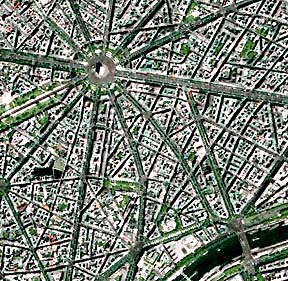
The first thing RETAIL requires is CONVERGENCE, or to put it in the over simplified terms of an over simplified auto-oriented status quo, "access." By nature, a 2-way street will have more "convergence" or passersby than a one-way street and provide the increased locational predictability for the tenant, which I'll discuss later. The future of retail will require the convergence of streets, which one can see quite simply 2-dimensionally in a Baroque layout of streets as opposed to the Grid.

Let's take a look at Paris, DC and NYC as as gradated degrees of each to illustrate this point. First, Paris is one of the most obvious examples of Baroque planning and the creation of very obvious points of 2-D convergence. What this (and convergence) in general does, is that it creates very predictable and obvious points where the most people will be passing by, which is exactly what retail needs.
http://www.fas.org/irp/imint/docs/rst/Sect4/parisSPOT5.jpg

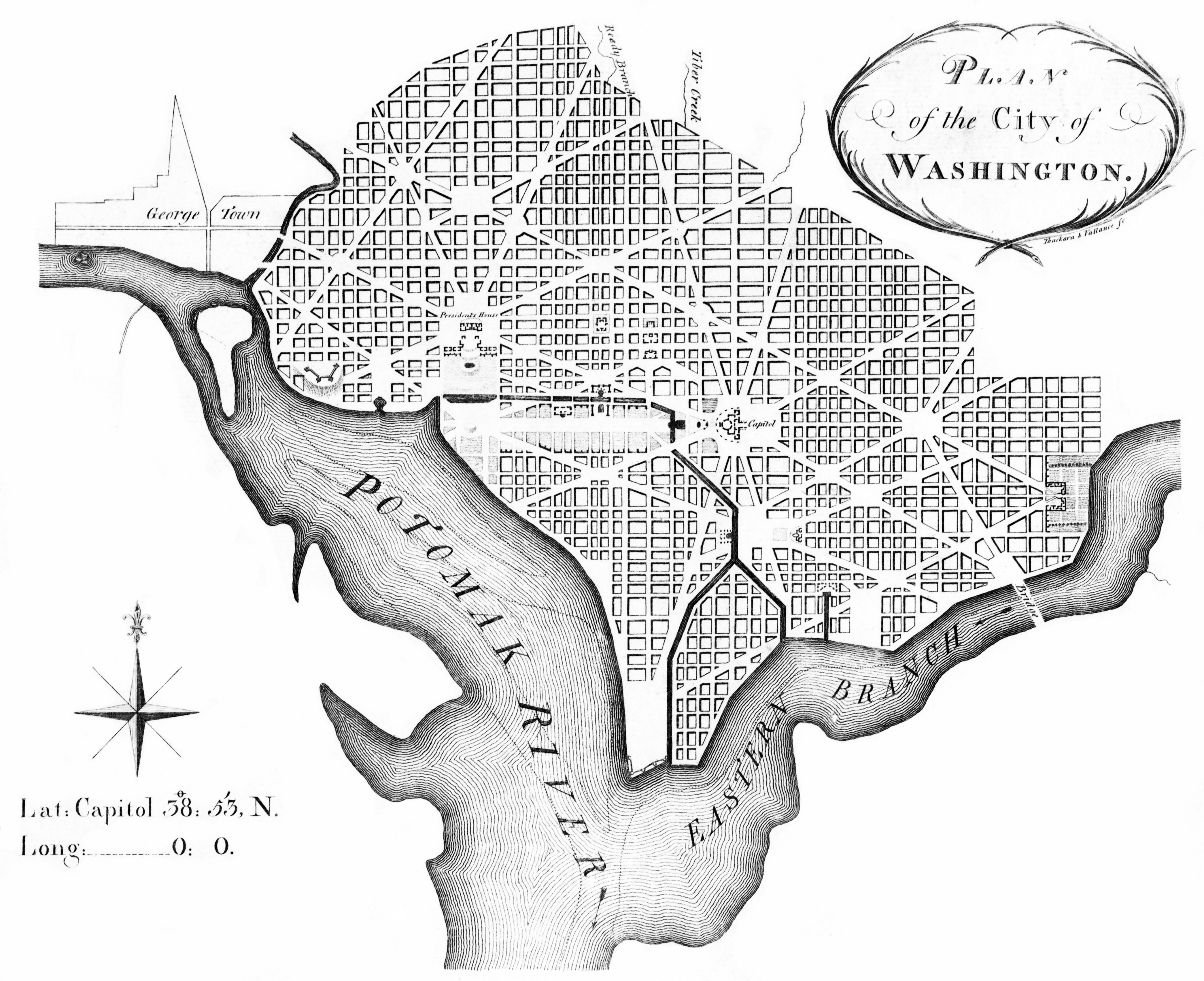
Next, we'll look at DC. Everybody is aware of the L'Enfant plan, but what many may not be aware is that the original L'Enfant plan was much more like Paris than the current iteration. The reason is because Thomas Jefferson favored a grid pattern because of the implied equality (or democratic nature) of each street, whereas Baroque planning creates very strong and clear hierarchies, a caste system of streets if you will, where certain streets will ALWAYS have prominence. The end result is a compromised hybrid where Baroque formality is overlaid upon a grid, kind of like a Republic rather than a pure mob rule Democracy. Rather fitting no?
http://upload.wikimedia.org/wikipedia/commons/7/78/L%27Enfant_plan.jpg

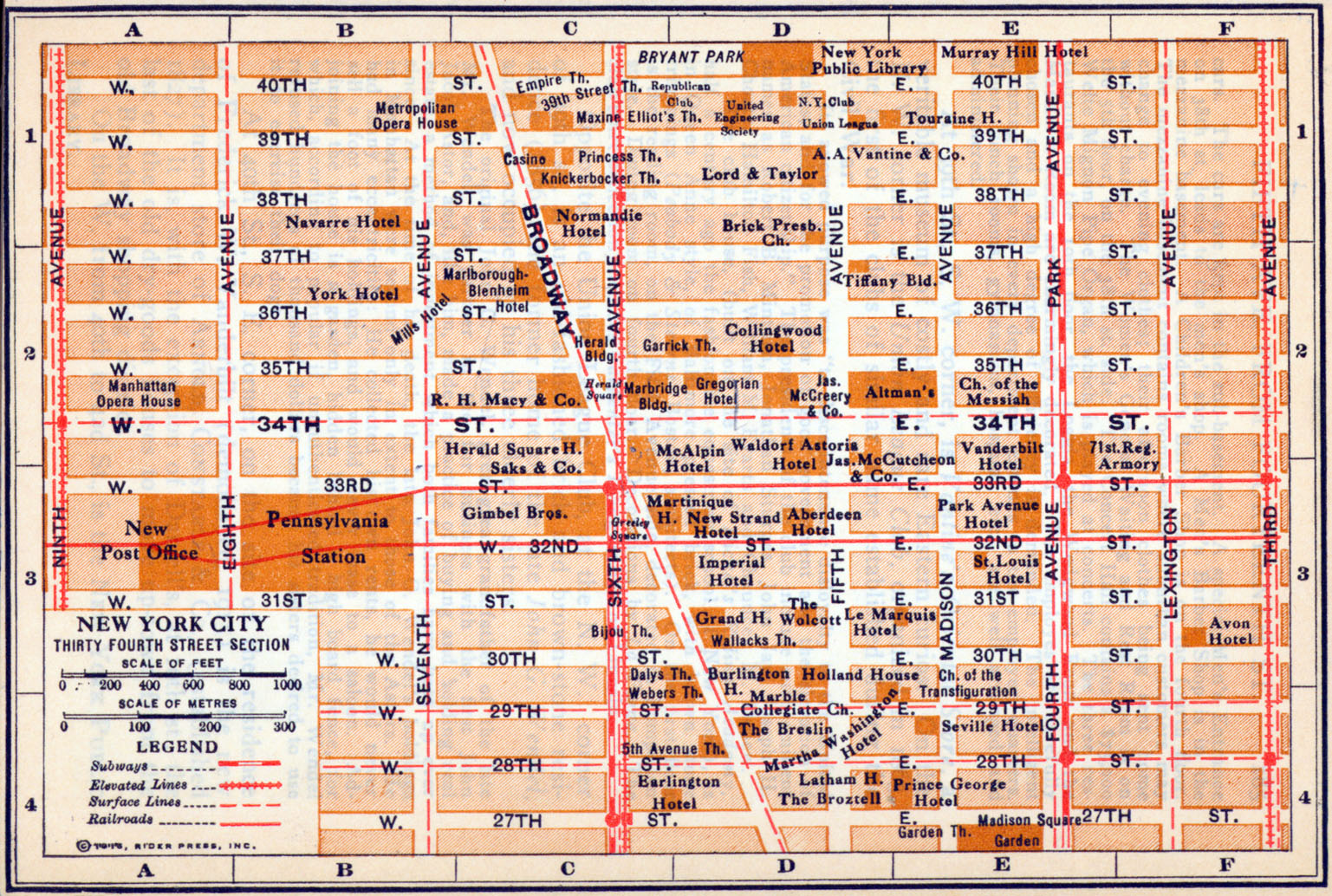
Now lastly, NYC, and more specifically Midtown Manhattan which is predominantly a very rigid grid system, but with one key distinction of course. And that is Broadway. Not coincidentally where it intersects the grid at the most acute angles, it creates the most important spaces in the City, ie the crossroads of the world, Times Square, and very dramatic buildings, like the Flatiron building.
http://lib.utexas.edu/maps/historical/new_york_city_34_street_rider_1916.jpg

SunBelt Cities however, have similar systems except horrendously bastardized versions. In DFW, there is still a grid (mostly b/c the city is relatively flat and for the simplicity of real estate transactions/entitlement), but it is set on an approx. 1-mile square increment and there is a clear hierarchy of streets, ie the dendritic highway/arterial/collector/local system.

While we have talked ad nauseum about the chicken/egg feedback loop of road subsidies and suburban development, the facts on the ground today are that these are all designed STRICTLY for the automobile. And the Sisyphean goal of Level of Service 'A' streets and the supply-side nature of the solution to achieve that goal, have led to increasingly wider streets, which brings me to the next point.

Which is SYNERGY, and the key component to synergy is distance and complementarity of uses. To simplify the point, I'll reiterate what you said about the Walnut street being much narrower than a typical Dallas street. Cross-shopping is a key component in ambience in the creation of a destination of a place. People like getting all their shopping done in one place, but they also prefer doing it on a cool, interesting place composed of a variety of shops and experiences in one area rather than a mall (which is the 20th century version of a shopping street) or the one-stop shopping of a WalMart.

Mall developers and architects (disclosure: I used to work for the architects responsible for probably more malls than any other firm in the world), if they have a redeeming quality is the boiling down dimensionally of the shopping experience. By this, I mean every foot/every inch is understood for how far apart stores should be, how wide the Mall or "shopping street" should be to encourage wandering from one to the other, how far will people walk, or that a constantly deflecting axis makes people walk further as well as continually changing storefronts.

But, in the end, malls were still missing something, which has brought about their demise. And, IMO, this was due to the private, securitized, and "controlled" nature of malls (ya know, beyond the whole drive-in experience of malls).

The interesting irony here is that one-way streets are able to be narrower than a typical two-way street (duh, because it will have half the lanes), which is why Peter Calthorpe often compromises and creates one-way couplets as the key arterials through his plans. He does this to limit the distance to cross the streets and ensure that building uses can still interact with those across the street.

This was a by-product of DOTs only accepting very few and limited formulaic street types and widths. Fortunately, however, that is changing, because streets need to be context-sensitive and we shouldn't have to throw the baby out with the bath water. Narrow, two-way roads will typically be better for retail, and as part of a gridded road system allows for the traffic to be diffused, providing choice to the driver. (Note: this doesn't mean strict rectilinear grid. Intersections per square mile is generally a good guide for street/intersection density.)

The other part of convergence comes into play as well, and I'll call that 3-dimensional convergence. 3-D CONVERGENCE refers to multi-modal transportation and rather than just being in plan view, looking at street networks from above and pinpointing hierachies of cross-streets and intersections, this can be looked at in section. West Village in Dallas is a good example here.

If you looked at this area in section, you would see a subway running below 75, you would see a trolley running on the street, and you would see residential above the shops/restaurants. There is convergence created not just by McKinney/Blackburn/Cole/Lemmon and the exits from 75, but also by the transit stops, as well as residents WALKING down the stairs to the street. This is why West Village/CityPlace as well as (eventually) downtown, will be the primary retail areas within twenty years. As I wrote previously:
They are currently below the LoMac area which is a joke of tangled spaghetti arterials, deep setbacks, narrow sidewalks despite having nearby freeways and the MATA trolley line. This area is exactly the end result when getting the details right is paid zero attention and the only effort is to cynically deliver "product to the market" not places for people. This means that the value of this place is ultimately limited whereas in CityPlace and Downtown, it is infinite.
Lastly, the difference between your examples and nearly all shopping in the SunBelt is the nearby residential baseresidential base, which is the key difference b/w your examples and the majority of Dallas streets, the neighborhood and urban fabric remains largely in tact - which gets me to the next section...
Question 2 - Reader Peter asks
i'm still not all that clear on that 'local businesses vs. chains' study/argument. what is 'economic impact' and why does it matter? and if chains are so bad, then why is chain-hating SF in such bad shape? and what of this 'job growth'? what does that actually mean? anything? does it mean that if we let/encourage the opening of four independent stores instead of one big, box, we'll see more people hired? does that go on indefinitely or is there some equilibrium point?
The first answer is, unfortunately, very little retail, chains or mom and pops, are doing well, which is two-fold. First, we're out of fake money. Living off credit and second mortgages, etc. is over. The other part of that can be positive: we're at a transitional time.

I'm intuiting that "chain-hating SF" is that way, because 1) there is a long history of family-owned business, particularly restaurants in San Francisco. But, the key fact of the matter, is that with locally-owned businesses, a greater percentage of their money is spent within local communities. For example, if I own a shop that purchases widgets and doo-dads to make gadgets, the majority of my purchases (or my personal profits) are spent locally. I'll have to dig up the reports on this, but IIRC the % of revenue spent locally by chains vs. locally owned businesses was something like 40% to 90%. For example, all of WalMarts profits get electronically zapped in the middle of the night to Bentonville, AK, which then get redistributed to shareholders throughout the world.

The other issue is, while WalMart claims to bring in "new jobs," a congressional study released about ten years ago (and I'll have to dig this one up as well), stated that for every two low-paying jobs that WalMart "creates," they are really replacing three higher paying jobs. The math makes intuitive sense if you subtract all that money that gets beamed to Bentonville.

The problems with this are that people will 1) scream, "that's consumer demand," which is true...sometimes. I'm a full believer that WalMart is no monster, but rather a natural byproduct of the world we have constructed. The real question is do we wish to remain working for $5/hr and buying garbage goods in a miserable experience of a store? and 2) that at least for the time being, chains like WalMarts or Targets were necessary "anchors" to allow small, locally owned-businesses to succeed based on that synergy, particularly for downtowns or so the thinking went.

What the WalMarts and Targets of the world need to address, is can they continue their global supply chain business model in an era of $20/gal gasoline? I use $20 only b/c it is the title of a new book. The real point is that with increasing demand for oil (particularly from China, India, and Brazil) and stagnant or decreasing ability to supply at low cost, while oil producing countries are beginning to use more and more of their own oil (for example Mexico is a net importer for the first time EVER), there is no place for oil prices to go but way up.

The last point is that because of road building subsidies and sprawl and all that yadda yadda, we are a country that is spread too thin. Local governments don't have the tax base to support themselves, let alone pay for the upkeep, maintenance and proposed new infrastructure projects. Functioning, sustainable communities require a certain amount of density. Retail requires density as well, and moreso than density, they require locational predictability.

Because the residential base was smeared so thinly across the toasted SunBelt countryside, retail followed, spread as equally thin, meaning many stores than necessary - only chains w bare minimum profit margins AND extreme leverage when it comes to negotiating prices from suppliers - see WalMart, could compete. Mom and Pops 1 can't compete without being embedded in neighborhoods and their costs can be higher b/c they can't buy in mass bulk like chain.

As Lewis Mumford correctly saw in the 1950s we were constructing "anti-cities," and now we are at the point of reckoning for all the worthlessness we have wrought. We are all misplaced and it will take incredible leadership to pull this country into one concerted direction. Fortunately, I have a lot of faith in the Millennials once they fully exert their enormous power over the conflicted dichotomies of baby boomers.

A healthy community (at least for the time-being) will have both chains and locally-owned businesses, b/c chains will be able to pay the highest rents in the prime spots, ie the touristy areas, BUT, mom and pops as I alluded to with holes in the wall, are still viable, because 1) often supported by viral "word of mouth" (or twitter) they provide a better experience for the "consumer" AND they generally provide a higher quality product. Mom and Pops can succeed in dense urban neighborhoods because the consumer has choice. 2) they have a residential base within walking distance...they can be tucked away but still have the "rooftops" to support thier biz

As for job growth, I would be speaking for CoolTown Studios here, but I'm of the opinion that the only place for job growth is from entrepreneurs and startups. Yes, many will fail (especially because in the last ten years we have essentially stripped away all of the safety nets making the entrepreneurial spirit this country was built upon (ie American Dream), all too risky), but many others will succeed b/c so many needs/demands are not being met by the status quo, not to mention all of the talented people possessing innate entrepreneurism, feel so grinded down by the machinery of their corporate institutions.

The key to job growth and economic recovery is in education, job training, and startup businesses combined with a vast relocation and reconstruction of our cities into more dense, walkable, livable interconnected collection of diverse neighborhoods.

Look at it this way, we keep looking at the Stock Market as if it is some kind of indicator of recovery as it slowly inflates with federal subsidies. However, the market is full of Fortune 500 companies that have peaked in the 20th century economy and are receding due to the inherent flaws in corporatism. We're investing money in companies that have no choice but to shrink? When the power of global capital really needs to be put to work on main street rebuilding housing and teaching people how to run a business that could be set in the ground floor of that new building where the growth possibilities, when multiplied thousands or million times over, could borderline on infinite.

As Kunstler put it in Geography of nowhere our cities like Detroit and Dallas look far more like they experienced WW2 than do Dresden and Heidelburg, this may take a level of concerted effort along the lines of a Homeland Marshall Plan for housing construction and walkable infrastructure, but that makes a lot more sense than shoveling money at banks that have already burned us several times does it not?