




Showing posts with label Maslows Hierachy of Needs. Show all posts

Thursday, May 27, 2010

Livability Indicator: Diversity

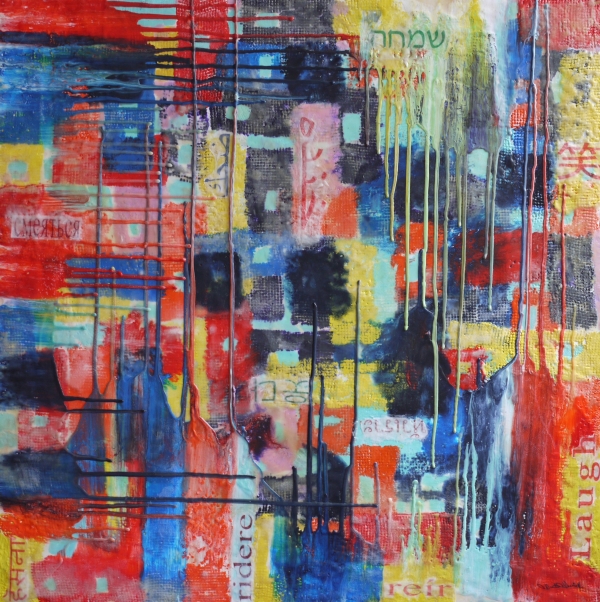
http://fineartamerica.com/images-medium/the-joy-of-diversity-heather-hennick.jpg
Painting by artist Heather Hennick.

I have often heard or read of planners suggesting that areas need diversity as if that quality is something you can will into existence with a magic wand, also known as the architect's magic CAD station pencil. This is most often brought up in regards to revitalizing downtowns or other similar depressed areas. I have always found diversity as a goal for these places to be somewhat patronizing if not paternalistically liberal.

Is diversity absolutely necessary for creating livable places? The short answer is no.

In this post, I will show that diversity is more of a by-product of livability than it is a producer of livable places, which points to it as a very clear indicator of livability (an outcome). While there are certain design measures that can allow for diversity (accessibility, mobility, diversity of housing type), it cannot be willed into existence. However, it does contribute in other ways, which we will also examine.

Therefore, in areas in need of revitalization aka those in need of a greater degree of livability (or desirability), diversity can be a performance measure by which livability is measured. People often mistake revitalization for commerce. But commerce cannot exist sustainably and predictably without people, meaning livability. On the other hand, diversity is an absolute necessity for achieving higher levels of lovability or memorability as it comprises a broader base, the foundation authentic, upon which memorable places are built.

A biologist would say the greater amount of species in an ecosystem (diversity) the more complete the elaboration of life. In terms of cities, this means a broader base and the potential for a higher plane for what a City can be.

A rain forest (home to a greater array of kingdoms, phylums, families, orders, genuses, and speciese) serves as a natural metaphor as the most complete known elaboration of life. Not uncoincidentally, in many ways it provides life to everywhere else on the globe b/c it is such an exporter (resources, oxygen, co2 sink, etc.). A rain forest is the actualized city. These are the global cities bubbling over with culture and new ideas of thinking and being that are then exported to the rest of the world.

However, this also implies that life exists in lesser diverse situations, ie places deemed livable by various species. So how do we find that point and how does it apply closer to home? In Mercer's recently released Global Livable Cities rankings, they aren't ranking global "rain forests," but places where the more basic needs of all are met the best.

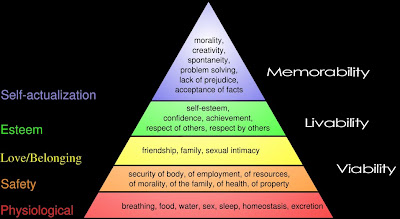
Using Maslow's hierarchy of needs as I am fond of, helps to determine exactly where and how a place might fit within the vague notion of livability. The pyramid is widest at its base where the most amount of people have those needs. We all need food, water, and air to survive. At the top, we don't all need peak experiences of culture to survive. So livability isn't about being "world class." It is about other things.

Because livability is such an elusive concept and one that is difficult to define. The best way is to take the simplest, evidence-based approach. Are people living there? If not, why not? And because Livability can mean different things to different people, are different types of people living there?
Can an individual find a job and afford a residence nearby?

Are senior citizens able to get around? Do they have mobility?

Can children play in the streets or ride their bikes without the constant supervision of helicopter parents or be run over by maniacal valets?

Do women feel threatened or unsafe walking the streets alone or at night? Since women and children typically require a greater degree of safety than say me or Mac from Always Sunny in Philadelphia because we work our glamour muscles, can roundhouse kick and have made a collection of video tapes from Project Badass.

http://teenormous.com/images/t-shirts/www.theshirtalert.com/images-shirts-full-Project-Badass.jpg
Totally.

If the answers to these and many other questions are yes, chances are diversity has been attracted for these various basic needs. Therefore the place is Viable, the foundation of Livability because all of the primal needs are met.
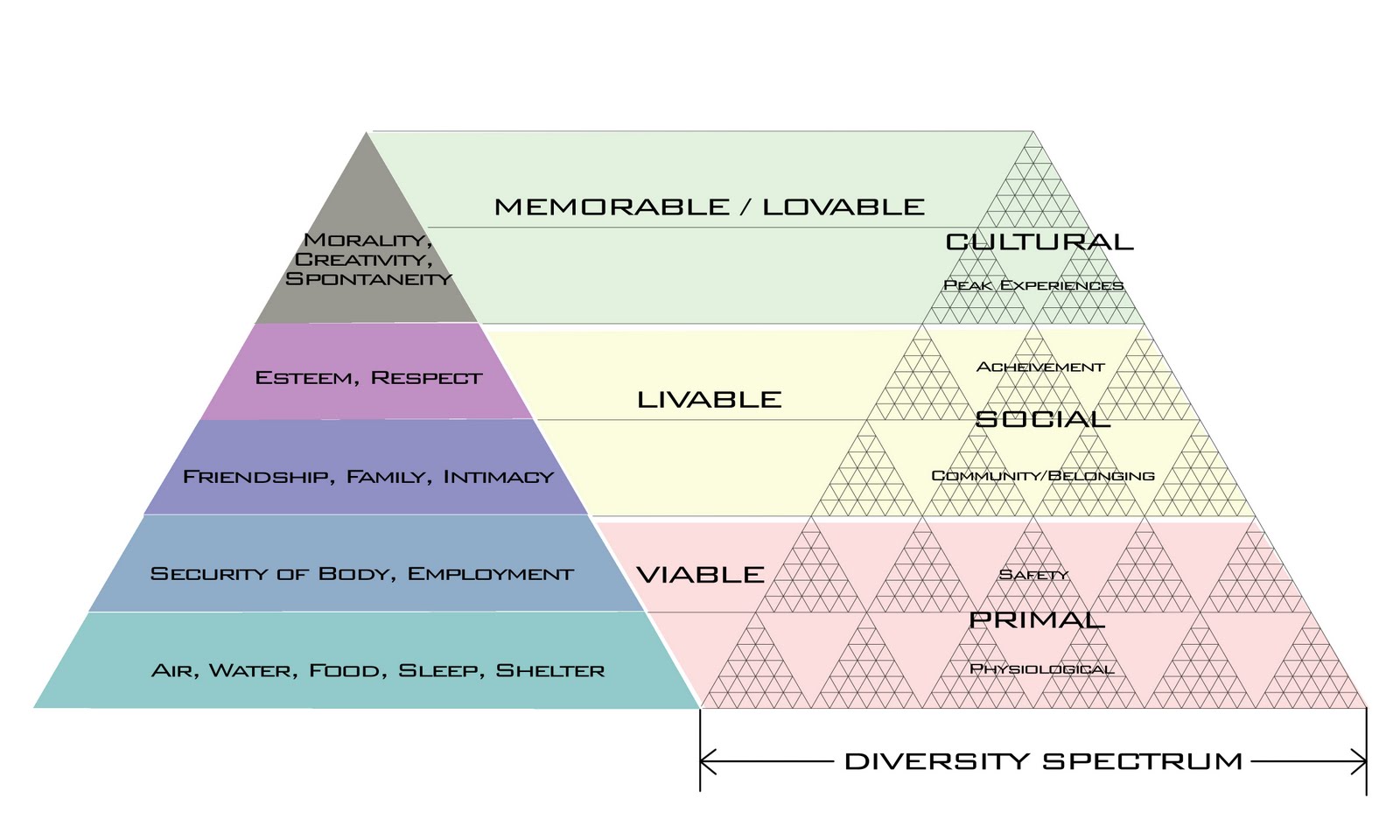
The next question to be asked and answered is what defines diversity? While diversity is often associated with race, it can mean a variety of age, gender, income, cultural heritage, background, etc.

As mentioned earlier, design can allow for certain amount of diversity but there are other mitigating factors at play beyond that of mere urban design. For example, nationality or race tend to congregate in areas for comfort, familiarity, or because of language barriers.

Uptown is a livable place, but is fairly narrow in its social makeup. This is reflected in its elaboration, particularly in its neighborhood services, the outgrowths of the residents. The commercial and social experience is similarly narrow, mostly alcohol induced at the many bars that while they may seem different are all as homogenous as its patrons.

However, uptown remains Livable because of its walkability and density. It achieves Social needs. This might be revealed in comparison to conventional drive-to suburban development where services are even more homogenous (greater reliance on chains).
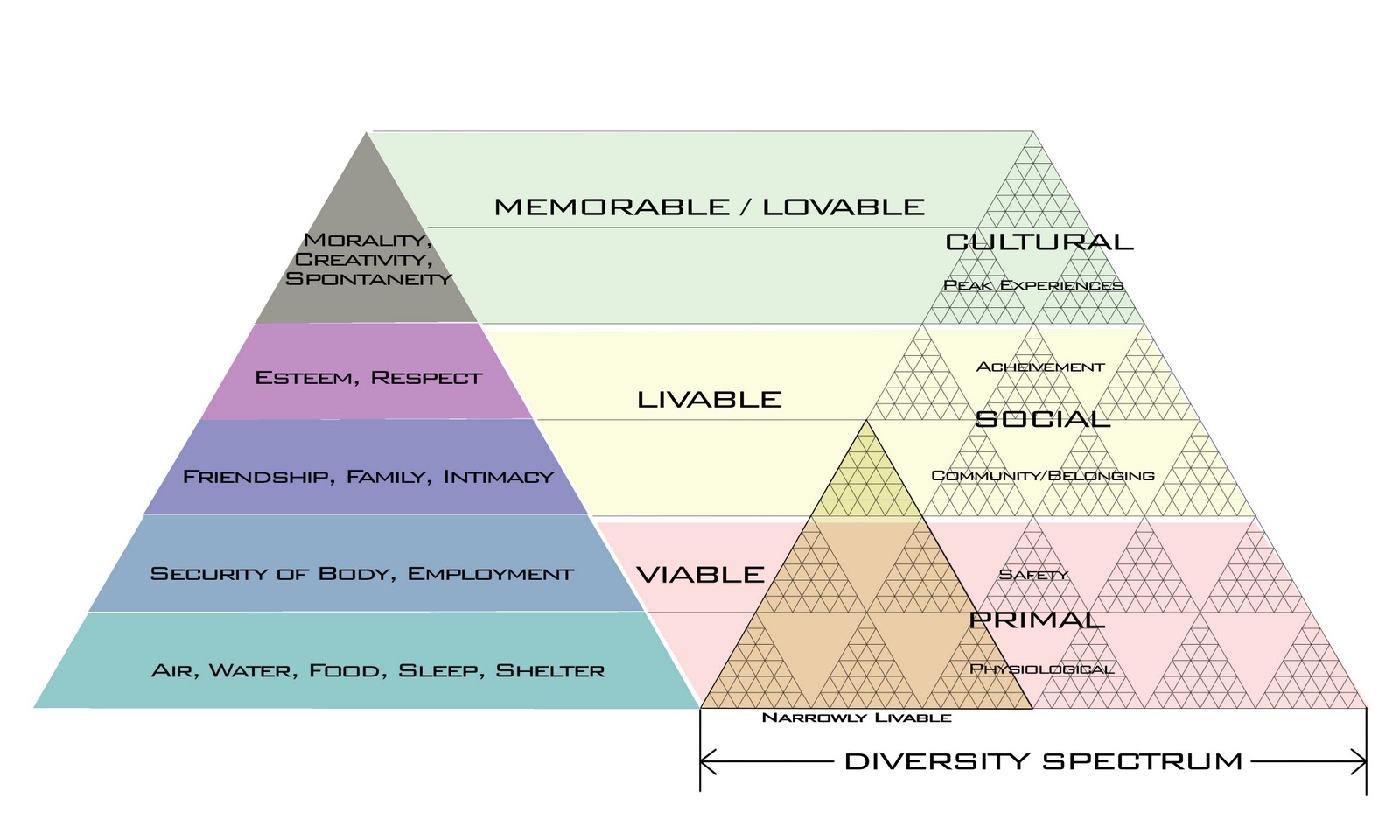
Since only a certain segment of the population are able to satisfy their more basic needs in uptown, shelter and the affordability thereof as the predominant factor, uptown is only livable for a few and the foundation of the neighborhood is quite narrow (at least in its current iteration) and its potential limited.

This can also apply to downtown Dallas. While it is probably more affordable (now that rental prices in downtown are finding their right value), a greater array of income levels are able to live in downtown, but less people find it safe or appealing (for a variety of reasons). So the foundation remains narrower than it needs or should be in order to be as successful as we want.

However, I find it suitable to my needs. Even without a car, I have mobility due to adequate transit and a willingness to erode shoe leather. I can afford space that I like and have a number of bars and restaurants nearby. In my particular subjective criteria, I find it livable.

For example, give me an Indian buffet, a soul food joint, a good sushi house, and a neighborhood bar and I'm a happy man. The proprietors of those establishments should have the ability to be a part of the neighborhood as well if they so choose. But not only the proprietors, but the various generations of their families and their workers should be able to find suitable homes there as well. This further embeds their stake in and stewardship of the community while making it all the more authentic, which I define as unique qualities or character as a direct outgrowth of an area's residents.

I once quipped that the only animals that existed in downtown Dallas were rats, carp, pigeons, and people. We're in good company. That was of course, over 5 years ago and the population has since doubled. You can compare us newcomers to the grackles. To get to the next level, we need our neighborhoods (of which downtown is one) to be a better habitat for more species, more types of people. Whether the diversity follows is irrelevant to livability, but it isn't to making Dallas a more memorable place and competing with the global "rain forests" of the world.

This City produces a preponderance of talent and homemade narcotics. But most of that talent leaves. I'm guessing it leaves because a lack of livability. As a City, we are in the global battle for talent together and our eventual success (or failure) is built on a foundation of livability.
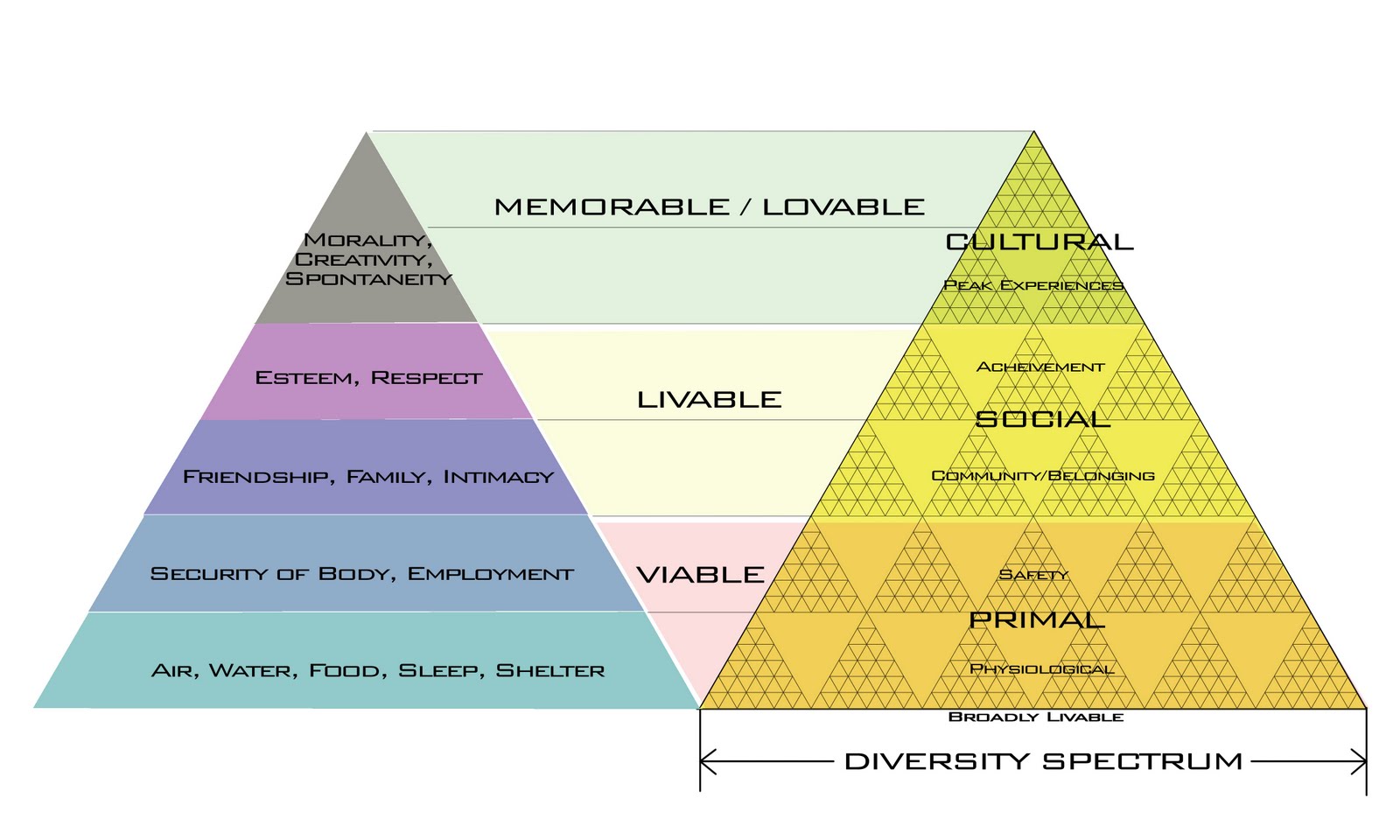

If we want our city and our neighborhoods to be "rain forests" known and mentioned on the global scale, or to move up in the myriad of Livable Cities rankings sure to grow in number, we have to focus all areas on being livable for the greatest range of residents and do so with high quality, creative urban design. Who can then choose to live in the neighborhood that most suits the character for which they are looking. Where they can feel a sense of belonging.

This means ranges of housing types and affordability (shelter). It means access to transit and walkable neighborhoods (mobility). It means clean air, water, and I suppose I should say clean food. It means a free and fair political environment. It means safety through design (CPTED) and enforcement without sacrificing justice. It means fostering diversity and the opportunity for all to contribute what they have to offer the world through livability building a positive feedback loop where diversity uplifts livable systems (attracting diversity) into a more lovable, memorable City.

Wednesday, September 23, 2009

The Foibles and Follies of Chasing Stars


Dallas: Look into the Mirror. It's the voice of reality speaking.

I had been hearing rumors for a couple of months now that Dallas was working on getting the College Football Hall of Fame relocated from hell South Bend, IN as part of the Convention Center and Convention Center Hotel complex. While I never paid too close attention to the story, perhaps either a case of fait accompli or the logical awareness of the worthlessness of the endeavor had prevented any further digging. But, today comes a story from the Atlanta Journal-Constitution that it will soon be announced that the HoF is moving to Atlanta after its lease is up in 2010.

And, the rumors of the Dallas effort are verified:
The possibility of moving the museum has been on the radar of Atlanta and other cities, particularly Dallas — which had the financial backing of billionaire T. Boone Pickens — because attendance has lagged at the South Bend location.
These are probably the two most logical locations in the country for such an institution. Both are somewhat centrally located and the largest cities of their respective geographic power conferences. Both have yearly big regular season games (although Atlanta's game is a kickoff classic/season opener sort of thing pitting ACC vs. SEC teams), bowl games, large airports, football mad areas, and relatively easy access.

Atlanta does have going for it that it has a downtown Athletic complex (which could be a lesson for Dallas - but not TOO big of a lesson), of course, because they were able to bribe their way into garnering had the Olympics. They have a major university (sorry SMU - your bribery is deemed a much more grave violation in this world of arbitrary lawlessness), are at the nexus of two major Athletic conferences (and from experience home to, like, ten billion Big Ten alums), and are nearer the Eastern seaboard and millions and millions more people. Advantage Atlanta (despite its reputation as a horrible sports town - consider that your silver lining Dallas).

While it would have been nice to have the College Football Hall of Fame here (personally I'm a huge college football fan - and in fact, will be catching a plane in less than 24 hours to get to this week's ESPN gameday location), I get a little bit of Schadenfreude out of this news. As I've mentioned recently, the City needs to learn its lesson that you can't buy your way into being an interesting and vibrant city, not with performing arts centers, not with museums, not with Convention Center Hotels, and not with Halls of Fame. Been to Canton or Springfield lately?

The thing is, despite our best efforts, the stars can never be touched (unless you end up falling into the center of one). Even the metaphorical stars we idolize are never quite the superheroes of our internal fables, especially when they're made of wax. But, those same individuals didn't just happen to end up on the walls. They didn't win any lottery (expect perhaps the genetic one). In most cases however, their honors came after years and years of hard work.

Perhaps, for a moment, we need to personify ourselves collectively as one of these college football superheroes to better understand how to reach similar honors or actualization of our goals of being a world class city.

We need to put in the hard work. Invest in ourselves not in accoutrements. All of the highways, the stadiums, the museums, etc. are the facelifts, tummy tucks, boob jobs, gaudy jewelry and caked on makeup as if it were applied by a shotgun of the typical Highland Park housewife you see in the grocery store.

We have yet fixed the inside --we're not that smart and we're not that healthy and sometimes to do so, it takes a hard, honest look in the mirror, to fix the fundamental issues (or in Downtown's case, honestly address the "cavities" and drill them out) to be comfortable with ourselves and proud of who we are and where we stand in the world, a tolerance of outward things occasionally being a little messy or disheveled, because urbanism is messy. It's complex. Like a bowling ball careening down a lane, it is both entirely out of control, but guided towards its goal by expert understanding and skill at the same time. Let's stay out of the gutter.
As we look to the rest of the world, I'm afraid, in a word, we are "frontin'", unwittingly and clownishly acting out as if we're a world class city, blankly staring thru the mirror (whilst thinking of donuts and diamonds) and reciting to ourselves that we are "good enough, smart enough and doggone it, people like me: willing to spend the money on silly ridiculi, but not the investments and hard work that define the underlying DNA of great cities.
Side note: many of these issues deal with crime and education, but the fundamental purview of this blog is urban form and transportation issues. In fact, crime and education are probably THE two most important, both of which are in need of effective short- AND long-term strategies, but I'm of the opinion that some measure of these can be affected thru good urban design which begets investment, which begets pride, which begets love of ourselves, our city.
All of which brings me to a study that came across my inbox today, entitled "How Far, By Which Route, and Why? A Spatial Analysis of Pedestrian Preference" which surveyed people at transit stations in order to determine the factors affecting their decisions. Often planners utilize a rather blunt instrument, the 1/4-mile walk or 5- or 10-minute walk radii for determining areas of walkability.

The factors not conveyed by this arbitrary circle are the most critical. What are you walking past? In a surface parking lot, spaces closest to the Target front door are a premium, solid gold real estate. I'm surprised malls and strip centers haven't found a way to appropriate market rate pricing to the best spaces.

In any "world class" city (which is a funny term, b/c Dallas likes to call its stuff "world class," but is unable to call itself the same), the limit to how far one is willing to walk may only be limited by how far one is physically able. Personally, I can recall numerous times where I collapsed exhausted after full days of walking through Copenhagen, Rome, Madrid, New York, Philly (yes, I included Philly), Milan, etc. etc.

Walkability scales, as well, to much smaller towns and cities like Malmo, SW or even State College, Pa. that are appropriate sizes for their economies, but are considered some of the best in their class, and therefore are destinations (not repellents). But, in terms of size of population (and economy) that previous list, are the Cities we wish to be competing against for 1) the title of world class and 2) future intellectual capital, businesses, trade, etc. i.e. future assets.

Walkability is driven by "stuff," that messiness, or clutter. We are drawn to see more, walk further, because our walk is interesting, enjoyable, and safe from vehicular onslaught or criminal intent. That "stuff" means access. Proximate access to everything from our most basic needs (food, shelter) to greater needs up the "Maslow hierarchy of urban needs" to more advanced and sophistocated needs or even wants (jobs, educations, community, leisure, social interaction, etc.). Once again, it is structural; a city's ability to deliver all of things builds up to a point once it can achieve all of the others. We're skipping steps.


Maslow's Hierarchy of Human Needs - with City "steps" added.

The above is a diagram of Abraham Maslow's Hierarchy of needs climbing sequentially as civilization and personal achievement are able. A city is a mere physical representation of where a collection or community of people (some might call a city) has achieved, or at the least, grants access to achievement for all of its members. Like any pyramid it must obey by structural rules and a foundation must first be built.

Viability in this instance, would mean the purpose for a City to exist in the first place. Historically, communities clustered first for survival. As survival (via shelter and defense in numbers) was acheived, trade became possible which spawned things like markets at crossroads between peoples, spawning all new economies and places. These places lacked order and were in need of such Livable components as Rule of Law or justice system and access to education for personal advancement.

----------------------------

Creating a city singularly defined by the car and its spatial arrangements has allowed for essentially a dual class caste system, divided North and South, a city unwilling to deal with its own "messiness". The line of demarcation seemingly being the Woodall Rogers trench moat Expressway between uptown and downtown, which has only moved southward from about the Mockingbird area since the investments in creating walkability, two of Dallas's best and most livable places: Knox-Henderson and Uptown (State-Thomas/McKinney Ave).

Investing in walkability leads to investment. As I said, walkability means lots of "stuff," which is access. People and businesses want to be near other people and businesses breeding multiplier effects of increased and enhanced feedback loops that spur business, make us address our "messiness" or weaknesses, and guide society like the expert hand of a bowler rolling a 300.

Building strictly for cars allows us to run from ourselves, creating places of disinvestment, our left behind urban cores, creating a voracious entropy that spews people further and further away to places like Wylie and Forney, which sound far away even in the fourth dimension let alone the first two. Hint: its a bad thing when your city repels people.

And there is Dallas, sitting lonesome, teary-eyed, and makeup running, full of freeways and no people, lacking the requisite density or tax base to pay for and support itself, a divorcee rejected by another suitor. A City at the exact moment where we can begin to be honest with ourselves and start fixing what really ails us. Will we?

Invest in the city. Make it livable. Make it walkable. Walkable places are sociopetal. Places that attract people attract investment.

And you know what, beyond all those advantages I listed for Atlanta. One thing I didn't mention is that Atlanta is further along on this path as well. Atlanta has its issues (many or all of which come from similar origins as sun belt cities, but also ones ingrained in the American geography/history (see: Leinberger's favored Quarter)) has current leadership that understands the positive feedback loops of urban form and the inherent problems with two-dimensional zoning and its eventuation into sociofugal car utopia, leaving us empty and shallow.

Atlanta's that girl on the magazine we wished we could be.