




Showing posts with label Downsizing America. Show all posts

Tuesday, April 14, 2009

"The Era of Bling is Coming to a Close"

From Christian Science Monitor:
Cooke & Co. was the Bear Stearns of its time, a pillar of national finance. If it could fail, anyone could, and the US stock market collapsed that awful autumn. The price of real estate, railroads, and other hard assets crashed, too. Banks fell like wheat before a reaper. Deprived of credit, Main Street commerce suffered. Unemployment reached 25 percent in big cities. The Panic of 1873 eventually led to 18,000 business bankruptcies. National production shrank for six years. Yet a new and stronger US economy emerged from the wreckage.
I have to say though, that I disagree with #10 - The Bust of the Boom Towns. As long as we are accepting "growth" as the axiom our society, economy, and standard of success is measured by, the Boom Towns still have the most work to do. Reason 1, why I am here in Texas.

Yes, they boomed. But that economy of growth was a false one in cities such as DFW, PHX, and Vegas. 99% of what was constructed was worthless. In the cities of the Northeast, not much growth is expected, if at all. What growth will occur will be simply putting people back to work with minor deviations in what they are actually doing.

Here, we have the most work ahead of us in terms of overall reorganization of both people AND economies. Much of the economic growth was in Real Estate and it played out on the land with exponential quantitative spatial growth vastly outpacing population growth.

If this City is smart they will get on the ball and set up a streamlined zoning, entitlement, and approval process for mixed-use, mid- to high-density development AT LEAST in set areas, such as Leinberger suggesting that Dallas needs ten 100-acre high density overlays. If they set up these overlays now, the planning work can get started and developers will be ready to build in ten months or two years, whenever the lending purse strings loosen again (or if again means never, then we need to find a new way to finance these things).

We know the market is there and the demand is there. As I wrote here, Millennials are the largest demographic group (aka "market") in American history and they are redefining the world around them through their shear mass, vitality, and collective directed vigor.

It will be a race for Sun Belt cities to not only be "cool" again to compete for talent in an ultra-competitive and mobile knowledge/creative economy (where real economic growth is created thru startups and innovation), but also in order to be relevant. If not for the Real Estate industry fixing its mistakes, I'm not sure what other markets are out there to pull the Sun Belt cities out of a certain prolonged recession.

Friday, April 10, 2009

Downsizing

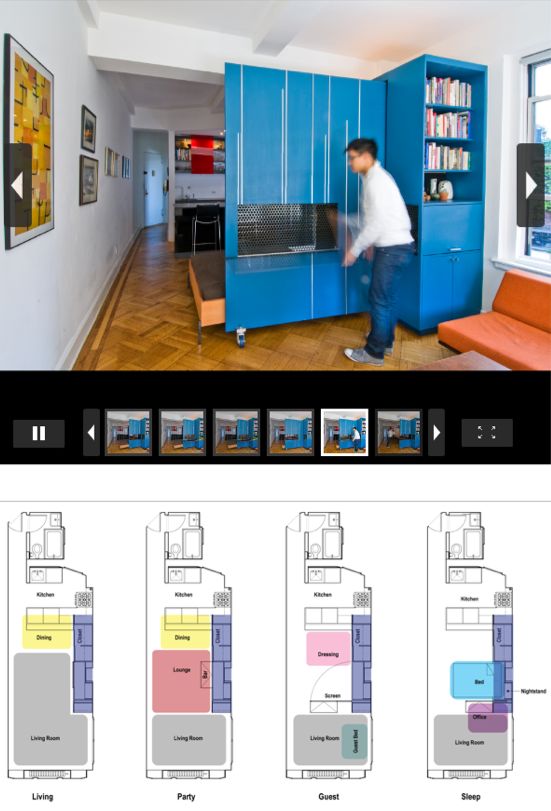
TreeHugger: Small Apartments w/ Big Impact.

Based on my Millennial presentation, we've been doing a lot of work developing a prototype for Millennial housing, a generation that can't afford to live in the City but desire to do so. So how do we make it affordable? Well, one way is to shrink the unit size and maximize spatial efficiency. The residential architects have been taking clues/inspiration from Cruise Liners and First class cabins.

TreeHugger here is focused more on specific unit types, whether it be pre-fab or standardized layout for maximum flexibility. My favorite for immediate practicality and use of the swing out screen and murphy bed:


My WTF moment for, sure you devised a foldout living space, but where the hell am I going to put it, how do other units relate to it, where are the utility hookups, and WHY THE EFF IS IT ALL BLOBBY AND SWIRLY?! Give it up already.

Tuesday, March 3, 2009

Big Box Reuse in Youngstown, OH

color me a fan.

I don't know much about Mayor Jay Williams currently, but I'm interested to learn more. They are doing the right kind of things in "down-sizing" or as their plan calls it, "right-sizing" their city under extraordinary circumstances and dwindling population.

Hell, even cities like Dallas need to downsize despite a growing population.

Monday, March 2, 2009

Another Bad Day on the Market

Let me be the first to say (with thoughts for the other side), that instead of saving dinosaurs, how about we start thinking about saving that money to help startups on the other side of this bottoming that will be smaller, nimble, and more able to meet the needs of the 21st century.

It is time to fossilize the AIGs of the world and hang them their bones up in a museum. We'll dedicate it to decadence and an unrelenting belief system to the religion of greed. As I once heard somebody say, Greed makes for a useful agent in democratic free market economies, but also makes for a horrible master.

Wednesday, February 25, 2009

Next Burst Bubble: Credit Cards?

Along the lines of deciphering where debt that can't be repaid is, Arianna Huffington at HuffPuff suggests Credit Cards are next.

I, for one, am not looking for any bailouts. I paid off all the credit card debt that I had accrued in college while studying abroad and being on three leases at one time (one in school, one where I interned (Atlanta/Orlando successively), and one in Rome. But, if we are going to punish the predatory, when do student loans get looked at?

The rise in tuition over the last twenty years spiked similarly to housing, but proportionately much worse. Obama addressed making college affordable again to those who seek it, which is admirable, but what about those of us that got caught in the cross-fire and are already thru school and saddled with debt?

The Millennial generation is the one spending right now, and perhaps foolishly. What if we didn't have to pay half (or more) of our rent on repaying greedy shitheads that saw college students for suckers?

Oh well. I'll just soldier on. Or as Mayor Carcetti says, "how many bowls of shit do I have to eat from these guys?"

Monday, February 9, 2009

Americans - Whimpering Puppies

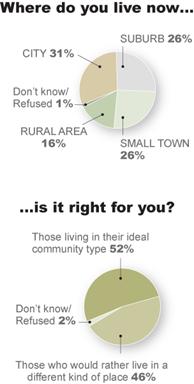
So Pew did some research [HT to McCready for sending me this article] on where people would like to live vs. where they actually do. Since people are stupid, I'll trust Chris Leinberger when he cites the statistic referenced in his latest book that only 3% of people live in walkable urbanism while 30% wish to.

I'm guessing it was a better done poll than merely asking the questions of lay people because we end up with answers like this:


Now let's shrink "Small Town" and "City" to a fraction of these numbers and throw all that into suburbia. I'm confident based on personal experience administering visual preference surveys that this is how Leinberger went about his research...or maybe not, because 30% actually seems low. In every case, the more walkable built version wins in popular vote. 30% seems low to me, but it is still effective b/c of the pent up demand between those two numbers.

The problem is that people don't see the better version. They don't know it exists. The average American is like the puppy on the electrified flooring in the experiment I read about in Psychology class in college (why this has stuck with me so long, I don't know). As animals, we learn to accept a certain environment no matter how shitty which is how markets can become so skewed when there lacks proper choice.
In part one of Seligman and Steve Maier's experiment, three groups of dogs were placed in harnesses. Group One dogs were simply put in the harnesses for a period of time and later released. Groups Two and Three consisted of "yoked pairs." A dog in Group 2 would be intentionally subjected to pain by being given electric shocks, which the dog could end by pressing a lever. A Group 3 dog was wired in parallel with a Group 2 dog, receiving shocks of identical intensity and duration, but his lever didn't stop the electric shocks. To a dog in Group 3, it seemed that the shock ended at random, because it was his paired dog in Group 2 that was causing it to stop. For Group 3 dogs, the shock was apparently "inescapable." Group 1 and Group 2 dogs quickly recovered from the experience, but Group 3 dogs learned to be helpless, and exhibited symptoms similar to chronic clinical depression.
More interestingly (to me) is this statistic:
Americans are all over the map in their views about their ideal community type: 30% say they would most like to live in a small town, 25% in a suburb, 23% in a city and 21% in a rural area.
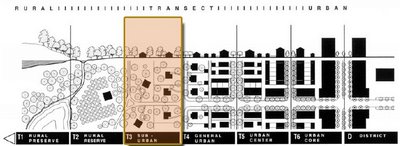
Doesn't seem all over the map to me, seems more like a continuum...or a transect:


But, of course we've only built in the T3: Suburban model, not the full range offering appropriate choice, as seen in this post on Valencia, Spain.

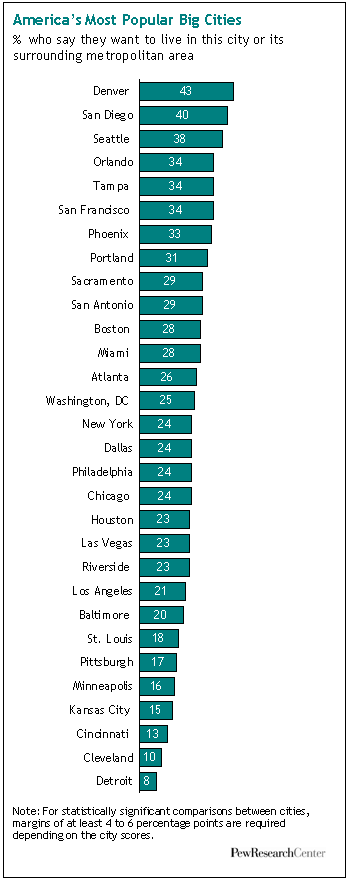
In other news, it is amazing how low these numbers are. Nobody wants to live in the modern American city (in its current form). Maybe we should start looking to Copenhagen, where the people are the happiest (and most well educated) in the world.