






Showing posts with label Travels. Show all posts
Showing posts with label Travels. Show all posts
Wednesday, September 15, 2010
Programming Note
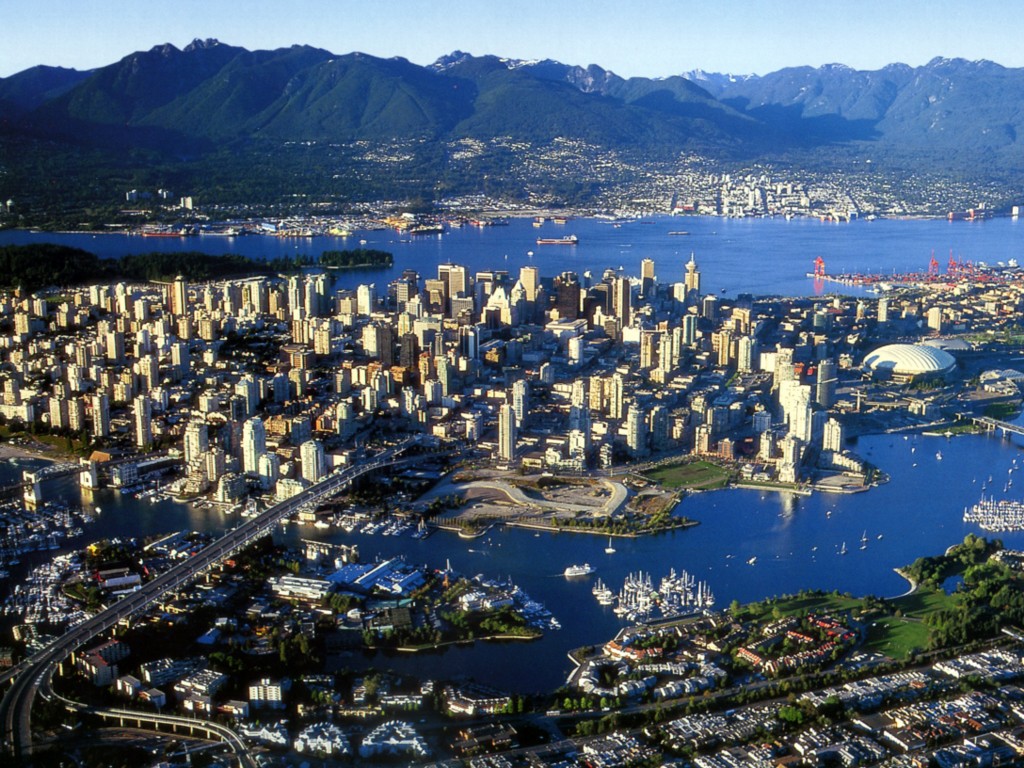
As some readers may know, I'm doing more and more writing for others, like the kind of others that pay, so postings are a bit lighter than usual over here. However, I'm still hoping to get up an extensive review from my recent Seattle --> Vancouver trip in the next few days, if the significant other ever gets me the pictures I took, which are the kind showing pictures and places rather than the annoying kind with camera conscious people posing and baring teeth in an outwardly polite sort of way.


Monday, February 8, 2010
Field Trip: Painting Austin One Admistrative Paintball at a Time

(Not me...or any of the other paintballers)
Yesterday, two friends were pulled over on two separate occasions in two different jurisdictions. One was pulled over in Dallas by the DPD and the other by a state trooper outside of Austin, both for not updating their vehicle registration (one had done so, but it didn't yet show up on the computerized database, so that's on TxDOT).
If you want to know how a city and state, built entirely around the automobile in a manner that is proving to be fiscally (among other ways) unsustainable, priding themselves on low-tax policies will try to make ends meet as they see entirely too much of their budgets devoted to building, maintaining, policing, and regulating jurisdictions too sparsely developed to afford, this is it.
Because of an unwillingness to directly tax what ails them (as it is most likely politically suicidal to be honest and direct with you constituents, whoda thunk?), an overextended infrastructural system, in some manner of increased gasoline taxes, toll roads, VMT taxes, etc. we are all about to experience a whole lotta bureaucratic pain, cost, and inconvenience.
The difference will be (and I believe unsuccessfully) made up through increased fees for things like licensing, registration, insurance and the like, as well as much greater enforcement. But, as we all know, this will be a fruitless and ultimately wasteful endeavor as the real solution is quick action to design the "bones" of our cities correctly, allowing for financially AND environmentally more sustainable communities where choice is availed via improved design at ALL densities by a more livable transportation network.
The future of our cities will be both more affordable and more profitable by the increased connections and productivity a more efficient and more attractive configuration of Texas cities. The key for each will be to not fall too far behind the other cities in this process.
--------------------------------
Note: Once again, I was limited to the tools at hand, so all pictures are at the max quality that an Iphone allows, that being poor.
After a spontaneous trip to a friend's 11-acres in hill country for pre-super bowl paintballing weekend, a compadre and myself took a quick detour through a development known as The Domain to snap some quick pictures of the project/place and, in particular, a building of his design.
Unlike the West 7th post, this will be much lighter on commentary. Why? Because I'm busy that is why. Quit asking questions and take a look at Austin's hottest shopping spot.
Above is the masterplan and if you clicky on it, you can embiggen it to a size more suitable to your preferred visibility. You will notice that the majority of what is built thus far is the portion at the bottom of the map (but western side) highlighted in yellow. Having seen numerous pictures of The Domain before, I was aware of how nice some of the spaces and streets were. However, my first impression, having entered around what seemed like the side and back, but marked by the largest monument (pictured above), was that the area was somewhat disjointed.
Having examined the masterplan for the first time after my visit, my initial assumptions about the place are confirmed: that the primary "main street" mixed-use shopping district is rather disconnected from the overall masterplan and the buildings not immediately associated with what is essentially one of the better lifestyle centers in the country. To be perfectly honest, the main street portion is very well executed from the planning and landscape to the architecture of the mixed-use buildings. I am very concerned, however for how this portion will relate to the rest of the masterplan as it builds out.
----------------------------
I use lifestyle center not to be intentionally pejorative, but rather to point out that it is one more baby step along the path towards real urbanity and an interconnected urban fabric. I say baby step, because under the surface the plan is still guided primarily by drive-to retail logic. After malls, we started building "malls without roofs" which were still entirely internalized with seas of parking circling the perimeter of the built product. Eventually, we created "main streets" allowing cars and parking in the internal space formerly reserved for the shopper on foot. Next, we started cutting cross roads through the development, creating blocks at a more walkable, pedestrian scale, adding convergence, and some more of the messiness that defines urbanity.
At this point, these shopping precincts were still often single-use with parking around the edge. All drive-to developments, with more in common with their cousing the conventional shopping mall than to the real urbanism they masquerade(d) as. This is a natural slow progression given the power of retail tenants and the unwillingness for "experimentation" endemic to most national chains (as if real urbanity was more experimental than our previous fifty year foray into auto-oriented development).
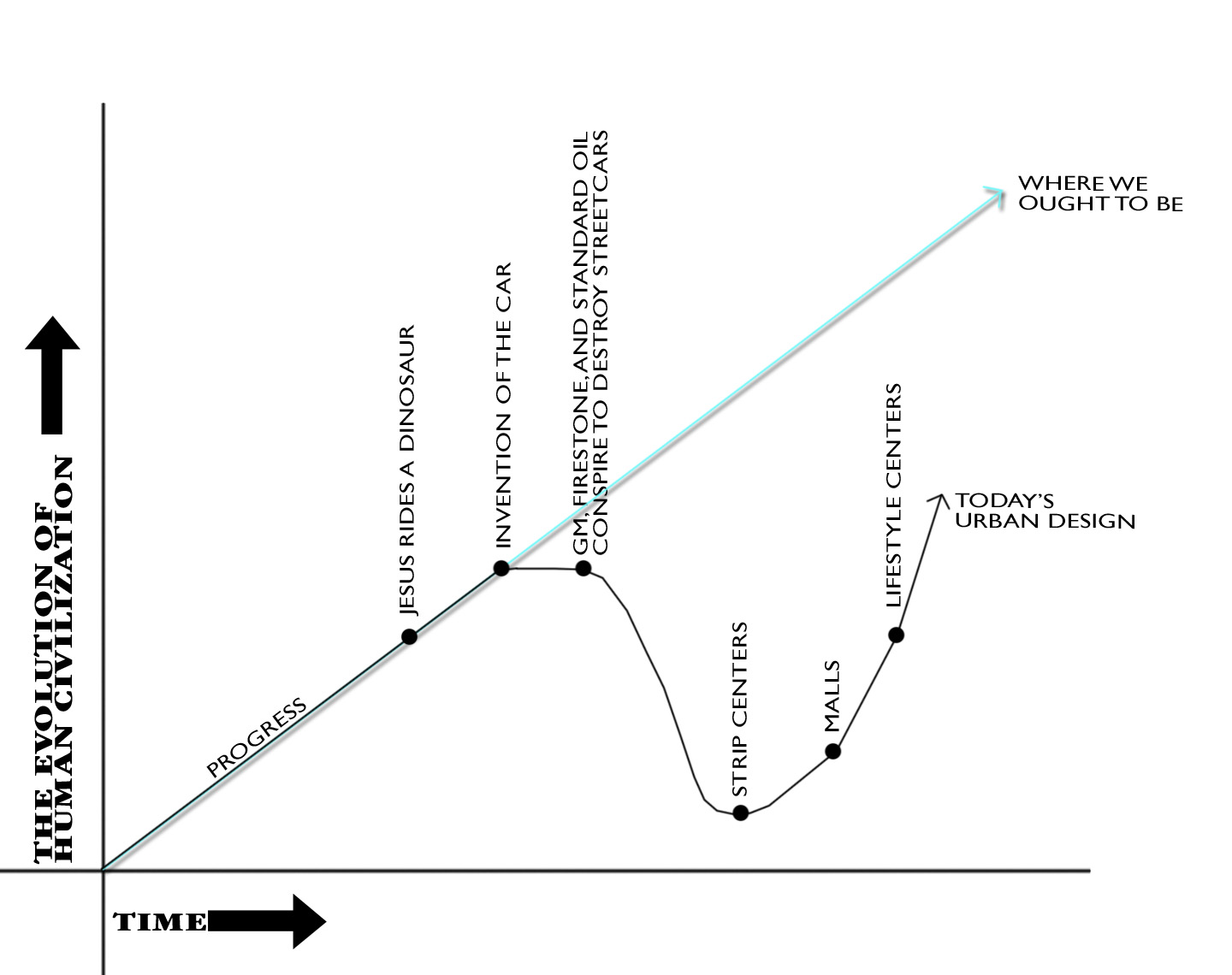
I feel like we're hitting a tipping point towards a return to more authentic urbanism defined by the preference of citizens as well as the failings of the "conventional" retail delivery system of the past fifty years. This design evolution seems to be happening at such a furious pace (even though most building has ceased), that even The Domain is feeling a little aged. I don't mean aged from a detail design standpoint as much as its format.
It has two improvements on the conventional lifestyle centers mentioned above. First, is that it has added a significant residential component above the retail allowing for some 3-D convergence. Second, it connects into existing developments and adjacent fabric better than most allowing for "projects" to feel a little less contrived as they nessle into their surroundings.
With that said, however, after comparing notes between on-site visit and masterplan perusal, I can see a bit of a disconnect forming between the various districts. Understanding fully well, that many future phases of masterplans are little more than placeholders, the "bones," i.e. the block shapes/sizes as defined by the road system are typically pretty fixed. These are also the elements creating what appears to be shaping up as different "places" loosely cobbled together rather than one district defined by complementary sub-districts.
There is too much undefined space. In Space is the Machine, Hillier hypothesizes that undefined public space is THE cause not symptom of disinvestment. In the masterplan, look at all that green. Typically, one might think of green as good. It's open space right? How can we go wrong. It becomes a negative element detracting from the overall place if it is not properly bound and engaged by its surroundings, ie buildings and streets. I see too much of this type of space in the future phases.
While some blocks do relate to each other, others don't creating fissures between what appears like five or six distinct precincts that could have th effect of competing against one another rather than complementing one another, even if significant efforts are made to regulate or dictate the character, uses, and nature of each sub-district. As I'll show below, the first of these fissures is already apparent between the shopping precinct and where the two hotels are located.
Above is the new a-loft hotel. I feel certain that there will be enough cross synergy between the hotel patrons heading into the "main street" and residents to the trendy WXYZ bar in the a-loft lobby that will overcome to some extent the barrier effect caused by the backdoor feel of this street, not too dissimilar to Houston Street adjacent to (behind?) Victory in Dallas.
Many spaces were designed around mature live oaks (not sure if they were relocated or not) which provides for an aged or mature look to many of the people spaces.
Okay, I might have to cut some of this short because blogger apparently defines "improvements" much the way a typical traffic engineer might, making formatting a miserable experience. Below is...hmmm...well, I guess there have to be a few lapses in taste. That is one storefront built at what 3:1 scale?
Above, I enjoyed that topography was used, embraced, not scraped flat, providing some more authenticity to the place as a whole.
Alas, what do we have here? Infant toys! There isn't a much better indicator of the quality of a place than if somebody is willing to raise their child there (particularly if they have the type of disposable income allowing them the choice to live in a place like The Domain). So there we have it, what has been built to date is a success. I'm waiting to see how the rest of the pieces of the puzzle come together. Will they detract from the first phase?
Wednesday, August 19, 2009
Back.
Sorry for the absence. I was in New York, state then city. Where I walked to Central Park, checked out the road closing at Times Square, used a NYC subway restroom, and ate at Bobby Flay's Bar Americain. /becoming a Food Network junkie.
More pictures to come, but for now, here is a Panorama from Central Park:
More pictures to come, but for now, here is a Panorama from Central Park:
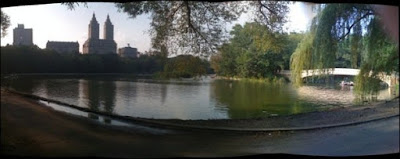
Now, I've been to NYC a dozen times for work trips and various other purposes, but this was my first time ever to Central Park and I was literally amazed how many people occupy every acre of that park. There are probably more people in that park at any one given time than have EVER been in downtown Dallas at once.
I'll write more as I get back into the swing of things, but until then, I'll stop at these walkable/clickable links:
Boston Globe: Roads that are designed to kill.
Most people think we are doing all that can be done to keep our roads safe. They are wrong. Road traffic injuries kill more than a million people a year worldwide, including 40,000 a year in the United States. We will continue to have drivers who are too young or too old, too distracted, or too bold, but we can change our roads so they help protect both drivers and pedestrians.CEOs for Cities on new report regarding increased home values tracking with increased walkability. Walkscore strikes again.
"There are a number of trends that are reshaping the American Dream," said Coletta, "and the value home buyers now place on living close to more daily destinations is one of the most important. Now, planning, zoning and development decisions have to catch up to consumers."
Subscribe to:
Posts (Atom)

 Posts
Posts