




This report comes at a critical moment, as Congress takes up the imminent passage of the next federal transportation bill, which dictates how billions of tax dollars will be spent over coming years. The Benchmarking Report reveals that, in nearly every city and state, pedestrians and bicyclists are disproportionately at risk of being killed, and currently receive less than a fair share of transportation dollars. While 12 percent of trips in the U.S. are by bike or foot, 14 percent of traffic fatalities are bicyclists and pedestrians. Pedestrian and bicycle projects receive less than 2 percent of federal transportation dollars.
“The Benchmarking Report shows that biking and walking are smart solutions to many of our country’s most pressing challenges when it comes to transportation, job creation and health,” Jeffrey Miller, Alliance President/CEO, says.
The report compiles persuasive evidence that bicycle and pedestrian projects create more jobs than highway projects, and provide at least three dollars of benefit for every dollar invested. The report also highlights the health benefits of active transportation, showing that states with the highest rates of bicycling and walking are also among those with the lowest rates of obesity, diabetes, and high blood pressure. “The data points to one conclusion: Investing in biking and walking projects creates jobs, leads to more people biking and walking, and improves safety and public health,” Miller says.
John Pucher, a professor at Rutgers University, emphasizes: “The wide range of environmental, social, and economic benefits of walking and bicycling, so clearly documented in this report, justify greatly increased investment in facilities and programs to encourage more walking and cycling, and to improve the safety of these most sustainable of all transportation modes.”
Showing posts with label Pedestrian Life. Show all posts
Showing posts with label Pedestrian Life. Show all posts
Monday, January 23, 2012
2012 Report: Rankings for Walking/Biking
Alliance for Biking & Walking has published their 2012 report ranking American States and Cities. Their words:
If you just download the media fact sheet, you'll find where Dallas and Fort Worth stand amongst the 51 cities included in the rankings.
For overall levels of walking/biking:
Dallas 49th of 51
FW 51st of 51
OKC is 50th
That's the bottom three. As for the top three: Boston, DC, San Fran in that order.
For fatality rates of pedestrians/bicyclists:
Dallas 49th of 51
FW 51st of 51
Jacksonville is 50th
As for the top 3: Boston, Minneapolis, Omaha in that order
When I have more time, I'll dig into the methodology.


Tuesday, October 20, 2009
Livability Indicator #15 - Jaywalking
Making my way thru Green Metropolis, I've realized two things. The first is that the author David Owen has reached similar conclusions as to some of my previous Livability Indicators, from a similar freakanomics "you wouldn't expect it" sort of way. The other is ones that I've been planning on writing for sometime have also been covered in his book. Boohoo for me and my imagined originality.
So, I'll let him take the start, and I'll add from my own experience:
New Yorkers don't necessarily appreciate the real reasons that walking is such an important element of their daily life. In the late 1990s, Rudolph Giuliani, then the mayor, undertook a campaign to eradicate jaywalking - a major issue for him. Pedestrian barriers were erected near a number of midtown corners, stoplights and pedestrian crosswalks were shifted away from some intersections, and the police were instructed to issue summonses to pedestrians who crossed streets mid-block or against a light. The policy was almost universally ignored, by cops as well as pedestrians, and it was widely ridiculed.This is a key point in general. Make drivers worry about dinging their car or having to spray annoying pedestrian brain matter off the grill of their hummer will make them slow down a bit. When they are channelized and the driver can zone out b/c of engineering for dumb drivers rather than forcing us to be smart and aware is when accidents actually DO happen, in the places where street space is designed for peds/cars to have the least amount of interaction.
The policy was also thoroughly misguided. In Manhattan, creative jaywalking is an environmental positive, because it makes traveling on foot easier: it enables pedestrians to maintain their forward progress when traffic lights are against them, and to gain small navigational advantages by weaving between cars on clogged side streets - and it also keeps drivers on their guard, forcing them to slow down.
The real purpose of anti-jaywalking laws is not to protect pedestrians but to make life easier for drivers. That's why anti-jaywalking rules are enforced (and observed) in Los Angeles, where the cars are entirely in charge.On what planet does it make any sense whatsoever to put in place policies in order to protect a 4,000 lb piece of death-wheeling machinery vs. a human armed with nothing but a pair of tennis shoes, and perhaps a leashed puppy or two?
Rather than banning jaywalking, cities should take steps to enhance and enforce the rights of pedestrians, and to impede cars in areas where traveling on foot is feasible. (One useful step would be to follow New York City's good example and make it illegal for drivers to turn right on red lights).Have you ever noticed how much safer and more polite Dallas drivers are when traffic lights are out, operating as blinking reds and the drivers are left to their own devices, responsible for their own safety. Interesting how they begin to cooperate with other drivers, no? Well, I have noticed.
Similarly, four-way stops are drastically much safer than any other form of regulated intersection. One reason is b/c of reduced speed in areas where stop signs are utilized rather than signals. The other primary contributive factor, is that (although not necessary due to literally written protocol for who goes first at 4-way stops) there is a necessary communication to some extent between the drivers: eye contact, a slow roll to indicate that "I'm moving. Hold back buddy," maybe even a honk or two...or this.
That communication, whether verbal or nonverbal, makes something infinitely more intelligent because there are now feedback loops.
Tightly controlling pedestrians with a view to improving the flow of car traffic just results in more and faster driving, and that makes life even harder and more dangerous for people on foot or on bikes.Not to mention it allows drivers to tune out by funneling them virtually (and sometimes literally) into cattle chutes.
In fact, studies have shown that pedestrians are safer in urban areas where jaywalking is common than they are in urban areas where it is forbidden.Essentially, it's creating some measure of chaos in the streets. Ewwwww, engineers hate chaos. Their theocratic formulas can't dictate, their metrics can't measure. Can. Not. Compute. But, you can via safety statistics, measures of happiness, quality of place and real estate development on the street. For example - when the Champs Elysees went all travel lanes, all of the businesses died. When returned to parallel slip lanes w/ parking and wide sidewalks, it has become some of the most valuable floor space in the world.
To some extent, it is pushing the idea behind the Woonerf, or shared living space. The name comes from the fact that this is more residential in nature, the street as front yard for the residents, where children can play safely in the middle of the street w/ mother's watchful eye peering out the kitchen window. And they can, because the business (visually) of the street, the narrowness of the travel lanes, the lack of definition of the travel lanes (ie there are no 12' wide rights-of-way dictating direction), slows traffic. In sum, it's a free for all. See some pictures here (bottom of the post).
But, that is strictly for less busy streets, what about for the traffic flow worthy of New York streets? Rome has busy streets, with absolutely batshit insane cab drivers. Having lived there long enough to emerse one's self into the culture at some level deeper than tourist, you find out funny idiosyncracies only possible thru thousands of years of evolved urbanism.
One such custom is that it is commonly accepted that if a car were to strike and injure a pedestrian in Italy, the driver is at fault no matter the circumstance and fully responsible for all care necessary. Whether this is real or imaginary (it isn't written anywhere), it is clearly taken root as an effective deterrent. No matter the road, cars will stop for you if you start crossing the road. Be it at a crosswalk without the proper signalled permission or at mid-block.
Corso Vittorio Emanuelle is the actual road, where I would often test the custom, and do the proverbial test of trust: falling blindfolded and seeing if the Roman Customs would catch me in a shielded coccoon of safe pedestrian passage. Why? Well, b/c I crossed it every day and it was probably the busiest road I saw the majority of my days.
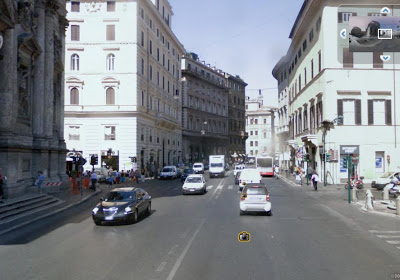
Corso Vittorio Emanuele - This road feels so much smaller, revisiting in Google Earth. Seven years in Texas plays tricks on perception and memory, I suppose.
What's the moral of this story? Power to the people, that's what...and away from the honking machines and you'll see positive returns for your city by way of renewed vitality, caramelized and cooked to a tender medium rare with a side dish of nicely seasoned safety.
Monday, April 6, 2009
Walking is Good. So Says the King.
From Peter King's weekly article on the NFL, which bizarrely includes tidbits from his daily personal life that routinely gets skewered by Kissing Suzy Kolber:
Stayed close to home this week. But I'm finding something interesting about city life. (For those who don't know, my wife and I moved to Boston a month ago, and we're still settling in. Enjoying it a lot so far.) From last Monday morning to Sunday night , I drove my car once, two miles to the Home Depot. That's it. I wonder if I need a car. I suppose I'll need one as time goes on, but I miss nothing about driving. Walking is good.HT: The Daily Sprawl
Tuesday, March 31, 2009
Hooked on Phonics DID NOT Work for Me
"Learn to read asshole! Learn to read!"[Red to emphasize anger]
Yes, that was yelled at me last night as I walked my two mutts to the downtown bark park, which is situated cozily under two freeways. An ever present reminder that at any moment a truck could fall off the highway and crush you. [FYI, I'm not making light of this girl's death. Remember my point is the ridiculousness and the corrosive and destructive nature of these freeways. Consider her collateral damage.]
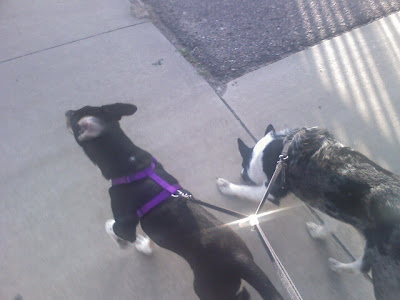
Without further ado, and all due respect to A Tribe Called Quest, here is the scenario. I'm standing at the corner of Jackson and the aptly named Central Expressway intersection as diagrammed below.
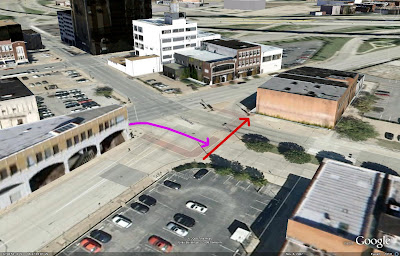
Commerce and Jackson form the 'V' around the very unique Dallas Observer HQ. When that one-way couplet got the green light, I as a pedestrian also got the walk light. So I give the dogs the giddy-up and we start crossing. The moment I step foot off the curb, I notice a car (will not disclose make or model so as to avoid stereotypes) turning right from Commerce to Central Expressway.
Call it some form of inherited female intuition from growing up in a household of females or whatever, but I knew this car was going to cause problems even from 100 feet away. But before I even got to the median, a ridiculously inflated three lanes away, the car reached me at the conflict point as the diagram shows. At this point the little pedestrian man-light had flipped to blinking red hand. Still, my right-of-way. But, not in Dallas.
To this driver's credit, I'm quite amazed at how skillfully he maintained the exact speed at which to appear threatening to me and my dogs and to just miss us by a mere inches. So having enough ingrained "Philly" in me, I immediately turn back with nasty glare in tow about to say something myself to the driver clearly at fault...and a douchebag.
But, he beat me to the punch, leading to the aforementioned profanity...with family in his car no less. But I still don't understand what the hell he wanted me to read??? Were their hidden words in the blinking hand, a subliminal message perhaps? Or, I don't know, perhaps the law which states that pedestrians in the crosswalk have the right-of-way. Nonetheless...
At that point, all I could do was defend myself and say I still had the light. Alas, that means nil in Dallas, a world devoted to the car. Right-of-way, schmite of way. This road is made for drivin'. Out my fuckin' way dog walker.
The problem isn't that Dallasites have some preordained divine right to driving, as if all drivers can operate their administers of death as they please. It is that we have designed and built roads that instill this sense of entitlement.
Now in sane, rational world, who does it make more sense to protect via street design? The dog walker living in downtown AND currently walking in downtown TO the designated downtown dog park?! Or some shit head willing to make a point by driving in an aggressive manner and following it up with aggressive personal behavior. I hope your home gets foreclosed.
Now, here is a map of streets that have zero functional use at their current width or configuration strictly as something beyond car movers, aka escape routes. Because as we know public rights-of-way are largely for two purposes. Transportation and public space to address upon. Downtown streets get an A from engineers for level of service. They get an F for doing their job as downtown streets. These essentially mean roads that are currently too-wide (notice Pearl doesn't make the cut), streets that are one-way (retail fails on one-way streets, FACT), and lastly, roads engineered with turning radii designed for high speed movements:
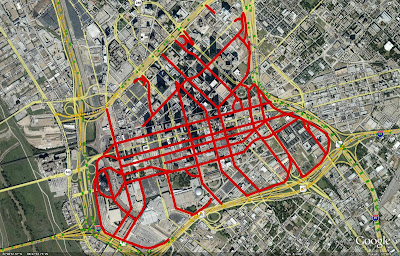
[Not scientific or thorough. Rather reactionary actually.]
Good luck businesses, residents, pedestrians, and developers trying to find good streets to do your business on. Instead, my dogs will do theirs...and I, of course, will clean it up dutifully.
Monday, March 30, 2009
More on the Infamous WalkScore
I've talked about it and it's failings, which the creators happily admit, several times, notably here and here. But now, the Freakonomics guys have found it and begun their analysis:
...nine of the 10 least walkable cities are inland. In most of them, largely unfettered expansion and low densities were possible from the get-go. Boston’s growth was restricted by the presence of the Atlantic Ocean, and San Francisco’s growth was restricted by the Pacific Ocean; Oklahoma City’s growth was restricted by, well, the Atlantic Ocean and the Pacific Ocean.As always, abundance (in this case: land) makes you careless and stupid. But, there are inland cities in Europe that are obviously immensely walkable, so more importantly:
As Peter O. Muller ably chronicles, most of the pedestrian-friendly cities are products of the era of the foot and the hoof, with the steel wheel (i.e. the streetcar) coming along a bit later. Getting around cities in the age of muscle power was a difficult and slow proposition, so activities clung together in space to make travel to, from, and between them feasible. Dense districts were literally built for walking.In the end however, I'm actually quite disappointed in this superficial effort by Freakonomics. The synergies of propinquity deserve a full post-graduate level analysis to really get us as a society to the point where numbers and formulas are actually effective in building smarter and more user-friendly cities (not to mention the reduction in public expenditure based on greater infrastructural efficiency). Because right now, everybody pays attention to formulae and those belong to traffic engineers trying to move steel cages as quickly as possible. Death to whatever carbon-based life-form cross their path.
Tuesday, March 10, 2009
End of the Auto
...and all of those commercials where everybody is so happy driving their new hummer around. Not so coincidentally my own mother was just hit at a light by some maniac going 60 mph. Fortunately, she was ok. But, is this what life is? Sitting around in metal boxes, playing bumper cars, if only to have some human to human contact.
Harvey Wasserman on the end of the era of the automobile:
And all of this BEFORE energy costs really start to cripple this energy-absurdly intense economy. Just wait to some real disruptions in the energy markets. How about we just rid ourselves of these burdens now???
Time Machine with Guy Pearce was a pretty shitty movie, but to this day I still have with me the scene from the near future in NYC where everyone is moving around via bicycle.
More from Wasserman:
Harvey Wasserman on the end of the era of the automobile:
But the larger transition is epic and global, based on a simple structural reality: the passenger car is obsolete. Auto sales have plummeted not merely because of a bad economy, but because the technology no longer makes sense.The fact of the matter is that Car companies are broke because they can't run their business profitably, cities are broke because they over extended infrastructure and the costs to support car culture, people spend roughly 20% of their income to operate and maintain this machinery to get us around, and urban development is crippled by the cost of constructing parking. All barriers to progress.
Franklin Roosevelt took GM over in 1943-5 to make the hardware to beat the Nazis. Barack Obama should now do the same to beat climate chaos.
Make streetcars, not passenger cars.
Hybrids are too little, too late, with problems of their own. Solar-powered electric cars will help phase out the gas guzzlers.
But in the long run, the automobile itself needs to be dismantled and re-cycled, not retooled or rebuilt.
And all of this BEFORE energy costs really start to cripple this energy-absurdly intense economy. Just wait to some real disruptions in the energy markets. How about we just rid ourselves of these burdens now???
Time Machine with Guy Pearce was a pretty shitty movie, but to this day I still have with me the scene from the near future in NYC where everyone is moving around via bicycle.
More from Wasserman:
We need to dig up roads, not build more. We need rails and coaches, bio-diesel buses and self-propelled trolleys, Solartopian super-trains and in-town people movers, not to mention windmills, solar panels, wave generators and geothermal piping.
In America's corporate-conceived “love affair with the automobile,” our first spouse---mass transit---was murdered. Now the unsustainable obsolescence of the private passenger car is collapsing a global financial system built on the illusion of its constant growth.
If the automobile and its attendant freeways continue to metastasize in India, China and Africa as they did in the 20th Century United States, we are doomed.
Friday, March 6, 2009
Friday Morning Links
Majority say Mortgage Plan Unfair.
Majority also didn't read nor understand the plan. Majority of journalists are lazy and under-qualified.
Freakanomics Blog: Planners and Architects weigh in on CarFree NYC.
WTF. Okay, I can live with Sam Staley being included to provide a countervailing voice. But, Randal O'Toole? Has this guy been right on anything?! If you don't feel like reading it, O'Toole takes the patronizing tone that we should all be ready for businesses to fail. IN TIMES SQUARE!
They said the same thing about Copenhagen when they started closing roads. The density and activity is already there. This only enhances the pedestrian experience thus making it more amenable to businesses. Yes, pedestrian malls failed in the States, but only b/c when they were instituted in the 60s, the exodus had already begun.
Oh, and did I mention that O'Toole's backing comes from the money earned by car dominance?
When did the media decide that both voices should always be heard in equal parts no matter how asinine one side or how in the minority that side is? Perhaps we should have a debate like the survey from Flight of the Conchords: Are you Pro-AIDS or Anti-AIDS?
Millennial Survey. Take the time, help out a friend of a friend.
Dallas is 4th most congested city. But, to once again clarify (which this doesn't), there is good congestion and bad congestion. For example, NYC, Chicago, and DC surround Dallas.
Unsustainable Humanity? Does economic growth have to slow to prevent catastrophe? I disagree. The wrong kind of economic growth, based on land consumptive and/or destructive practices has to slow. Qualitative growth: energy efficiency, clean energy, and infill are the markets that can support new growth and expansion. As McDonough says, it's not about being "less bad," it is about building a world where being "more good" means more profit.
Majority also didn't read nor understand the plan. Majority of journalists are lazy and under-qualified.
Freakanomics Blog: Planners and Architects weigh in on CarFree NYC.
WTF. Okay, I can live with Sam Staley being included to provide a countervailing voice. But, Randal O'Toole? Has this guy been right on anything?! If you don't feel like reading it, O'Toole takes the patronizing tone that we should all be ready for businesses to fail. IN TIMES SQUARE!
They said the same thing about Copenhagen when they started closing roads. The density and activity is already there. This only enhances the pedestrian experience thus making it more amenable to businesses. Yes, pedestrian malls failed in the States, but only b/c when they were instituted in the 60s, the exodus had already begun.
Oh, and did I mention that O'Toole's backing comes from the money earned by car dominance?
When did the media decide that both voices should always be heard in equal parts no matter how asinine one side or how in the minority that side is? Perhaps we should have a debate like the survey from Flight of the Conchords: Are you Pro-AIDS or Anti-AIDS?
Millennial Survey. Take the time, help out a friend of a friend.
Dallas is 4th most congested city. But, to once again clarify (which this doesn't), there is good congestion and bad congestion. For example, NYC, Chicago, and DC surround Dallas.
Unsustainable Humanity? Does economic growth have to slow to prevent catastrophe? I disagree. The wrong kind of economic growth, based on land consumptive and/or destructive practices has to slow. Qualitative growth: energy efficiency, clean energy, and infill are the markets that can support new growth and expansion. As McDonough says, it's not about being "less bad," it is about building a world where being "more good" means more profit.
Friday, February 6, 2009
Livability Indicator #12 - Hailing a Cab
"Hey girl...wanna share a cab??"
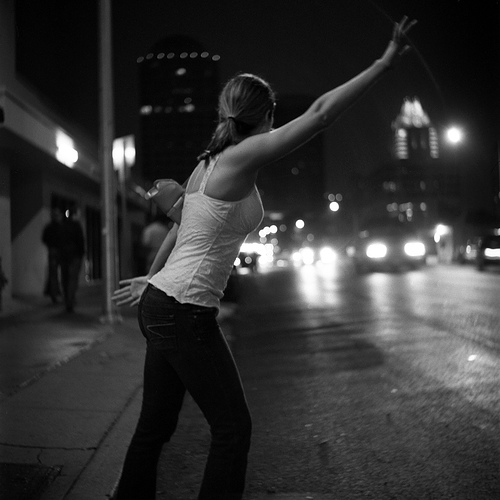
(I'd play guess the city with this one, but I'll ruin the suspense cuz I can. This is Austin as the Frost Tower, blurred and backgrounded suggests, and she probably scored a pedi-cab rather than a taxi cab to be location and culturally specific.)
To be perfectly honest, I didn't think of this one myself, but it was brought up in jest during a meeting today by the inimitable Alex Krieger (ahem, name drop) when we started joking about the ease and/or difficulty of finding cabs in various cities, which he so succinctly put, "a measure of great cities, the ease of finding a cab."
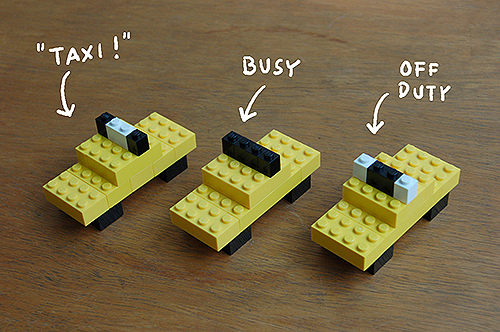
So when starting to think about this a little further, one feels compelled to ask, "where are cabs and why are they there?" In a time where LA and all of its absurdities, in a sort of Rube Goldberg machine of agglomerated decision making, is trying to limit (or not) the locations of cab stands (which admittedly can aid in predictability), contrast this with New York where they are everywhere.
In Dallas, we find them at the airport (where it will run you in the neighborhood of $50-60 w/ tip to go to/from downtown to the airport one-way or vice versa, at the downtown hotels at certain hours, and outside of some of the larger office buildings during the weekday. That is about it, unless you feel like calling yellow cab or cowboy cab and waiting 45 minutes to get picked up (if at all).
Me? I prefer Karaoke Cab, and yes, it is exactly as it sounds with disco ball and everything. I'd publish the number for advertising purposes, but I care not for having my rides delayed b/c of you might be wont to do. You people have cars. Leave the fun, chauffered commutes to the experts. That being me.You haven't lived until you have seen Baby Diego belting out "Like a Virgin" out the windows at 2 in the morning to stunned club-goers.
I take cabs quite a bit these days. Often anywhere between two and five times a month I would guess. Usually I just wander over to the Magnolia or Adolphus Hotels if I'm still downtown and have little trouble, although some more difficult cabbies might be looking for bigger fares than my 1.5 mile trip to the Loon. That all means less drunk driving. Care to compare where more DD occurs, NYC or Dallas?
It also means less need for car ownership. In a place where it is financially viable (if not advantageous) to use other means of transportation than private automobile for mobility, this means less land tied up by all the facilities constructed to support the car: garages, highway, arterials, etc. This is all land (particularly) when dealing with a downtown and its increased land costs, better suited for usable development. Car infrastructure has built-in structural inefficiencies.
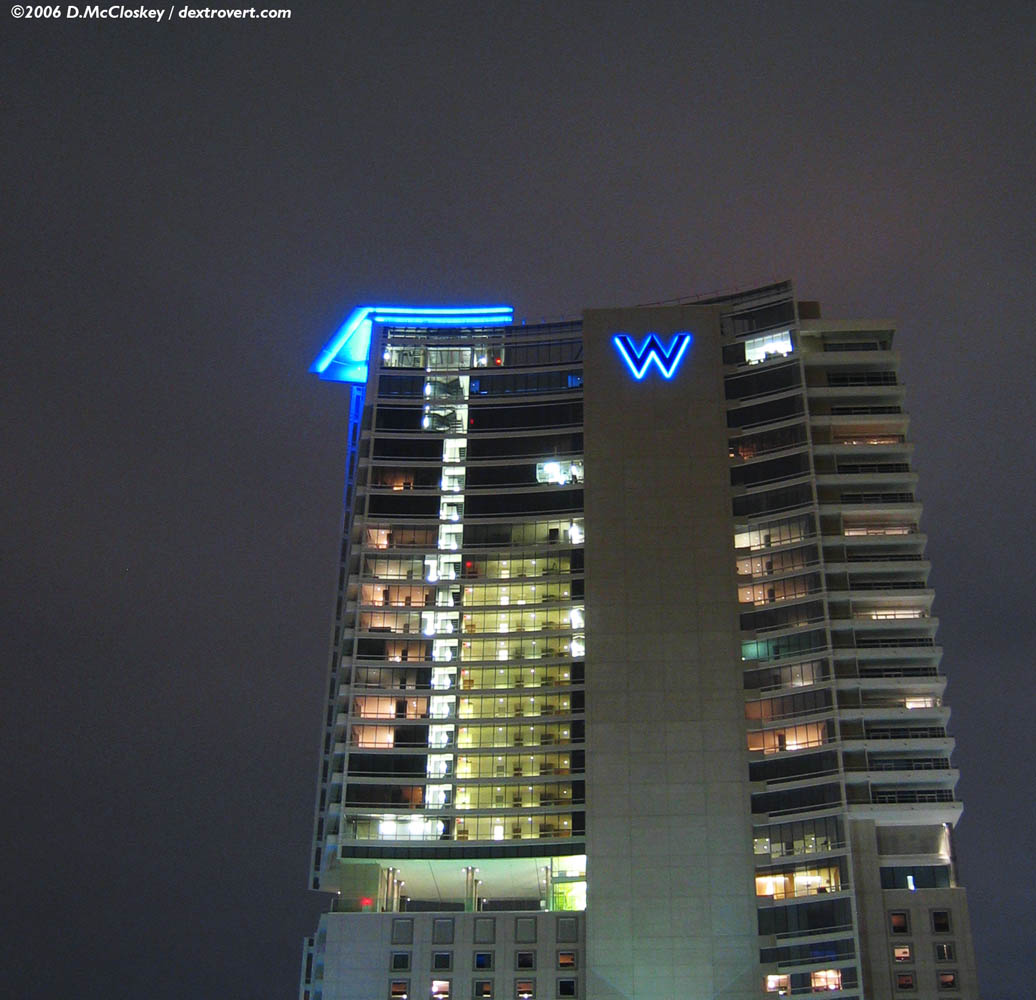
Also, it makes city living more affordable on both ends. The developer can cut cost by building less parking (sometimes as much as 20% of construction budget) and it allows a greater variety of demographics to afford urban living. As Mr. Krieger also put it today, "Vibrant streets aren't populated by the patrons of the W hotel [paraphrased from memory]."
(I'd play guess the city with this one, but I'll ruin the suspense cuz I can. This is Austin as the Frost Tower, blurred and backgrounded suggests, and she probably scored a pedi-cab rather than a taxi cab to be location and culturally specific.)
To be perfectly honest, I didn't think of this one myself, but it was brought up in jest during a meeting today by the inimitable Alex Krieger (ahem, name drop) when we started joking about the ease and/or difficulty of finding cabs in various cities, which he so succinctly put, "a measure of great cities, the ease of finding a cab."
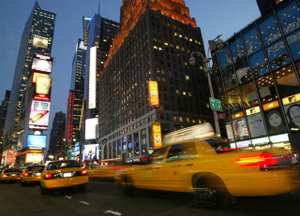
So when starting to think about this a little further, one feels compelled to ask, "where are cabs and why are they there?" In a time where LA and all of its absurdities, in a sort of Rube Goldberg machine of agglomerated decision making, is trying to limit (or not) the locations of cab stands (which admittedly can aid in predictability), contrast this with New York where they are everywhere.
In Dallas, we find them at the airport (where it will run you in the neighborhood of $50-60 w/ tip to go to/from downtown to the airport one-way or vice versa, at the downtown hotels at certain hours, and outside of some of the larger office buildings during the weekday. That is about it, unless you feel like calling yellow cab or cowboy cab and waiting 45 minutes to get picked up (if at all).
Me? I prefer Karaoke Cab, and yes, it is exactly as it sounds with disco ball and everything. I'd publish the number for advertising purposes, but I care not for having my rides delayed b/c of you might be wont to do. You people have cars. Leave the fun, chauffered commutes to the experts. That being me.
I take cabs quite a bit these days. Often anywhere between two and five times a month I would guess. Usually I just wander over to the Magnolia or Adolphus Hotels if I'm still downtown and have little trouble, although some more difficult cabbies might be looking for bigger fares than my 1.5 mile trip to the Loon. That all means less drunk driving. Care to compare where more DD occurs, NYC or Dallas?
It also means less need for car ownership. In a place where it is financially viable (if not advantageous) to use other means of transportation than private automobile for mobility, this means less land tied up by all the facilities constructed to support the car: garages, highway, arterials, etc. This is all land (particularly) when dealing with a downtown and its increased land costs, better suited for usable development. Car infrastructure has built-in structural inefficiencies.
Also, it makes city living more affordable on both ends. The developer can cut cost by building less parking (sometimes as much as 20% of construction budget) and it allows a greater variety of demographics to afford urban living. As Mr. Krieger also put it today, "Vibrant streets aren't populated by the patrons of the W hotel [paraphrased from memory]."
Tuesday, May 13, 2008
Starting out.
The title of this first post could be of its place in time as the initial posting on this website, but more accurately it refers to the newest stage of my life, sans automobile. It's an eerie feeling being entirely liberated from car ownership while virtually encumbered by the perception of immobility.
I am reminded of a quote from Fight Club, a personal favorite movie of mine, "the things you own end up owning you." And in this, we find amongst the interrelated tangle of the issues of today, the real estate market, oil prices, suburban sprawl, and how we got into the mess where rising construction costs hinder expansion of mass transit while falling home values undercut cities' ability to pay for what they can't afford. Fun Times.
I guess somewhere in there is why I'm starting this, partly as a suggestion of a few life passers-by, partly as a free place for expression when those around me tire of listening, and lastly, as a way for me to examine where Dallas stands in its evolution. This is my home (at least for now) and despite all of its flaws and virtues, the city has grown on me. After living, interning, visiting places across the globe, this personal epoch in time finds me here; I might as well catalog it, comment on it, and measure it.
The first measure of a city's health on the journey from Viability-to-Livability-to-Memorability, is whether a city can be lived in however one chooses (I think there is probably a scale of measurement somewhere in there - all of which is to be worked out as I fumble through this thing).
At this moment in time, I felt like testing it out. Can Dallas, one of the most notorious cities for auto-dependency, be lived in free of the shackles of auto-dependency?
It's funny where we end up in our lives. Looking back, I remember as a five-year old teaching myself to draw in perspective, which led me to eventually drawing fantastical cityscapes and skylines or as a teen always imagining myself with a loft in the city much like we saw in 90's sit-coms or the cool penthouses one (me) would always imagine my athletic childhood heroes occupying, thinking someday that would be me.
Well, here I am, drawing not quite as fantastical cities (although I probably could if I ever wanted to work on Chinese projects) and watching, not playing, professional sports (unless pickup bball in the park counts) while still having a loft in the city. And here is the blog. Finally.
So hopefully I work out the kinks and figure out all those fancy shmancy links and pictures and things, so here goes.
I am reminded of a quote from Fight Club, a personal favorite movie of mine, "the things you own end up owning you." And in this, we find amongst the interrelated tangle of the issues of today, the real estate market, oil prices, suburban sprawl, and how we got into the mess where rising construction costs hinder expansion of mass transit while falling home values undercut cities' ability to pay for what they can't afford. Fun Times.
I guess somewhere in there is why I'm starting this, partly as a suggestion of a few life passers-by, partly as a free place for expression when those around me tire of listening, and lastly, as a way for me to examine where Dallas stands in its evolution. This is my home (at least for now) and despite all of its flaws and virtues, the city has grown on me. After living, interning, visiting places across the globe, this personal epoch in time finds me here; I might as well catalog it, comment on it, and measure it.
The first measure of a city's health on the journey from Viability-to-Livability-to-Memorability, is whether a city can be lived in however one chooses (I think there is probably a scale of measurement somewhere in there - all of which is to be worked out as I fumble through this thing).
At this moment in time, I felt like testing it out. Can Dallas, one of the most notorious cities for auto-dependency, be lived in free of the shackles of auto-dependency?
It's funny where we end up in our lives. Looking back, I remember as a five-year old teaching myself to draw in perspective, which led me to eventually drawing fantastical cityscapes and skylines or as a teen always imagining myself with a loft in the city much like we saw in 90's sit-coms or the cool penthouses one (me) would always imagine my athletic childhood heroes occupying, thinking someday that would be me.
Well, here I am, drawing not quite as fantastical cities (although I probably could if I ever wanted to work on Chinese projects) and watching, not playing, professional sports (unless pickup bball in the park counts) while still having a loft in the city. And here is the blog. Finally.
So hopefully I work out the kinks and figure out all those fancy shmancy links and pictures and things, so here goes.
Subscribe to:
Posts (Atom)

 Posts
Posts