





New supply of lanes/roads only creates temporary gains in traffic flow and/or reductions in congestion. However, over the long-term new supply only induces more traffic and reducing demand-side pressures on congestion is THE ONLY way of reducing traffic congestion. This is fact and it is indisputable.
Here is the study:
http://www.grist.org/article/Fighting-congestion-RAND-style/
Furthermore, the real losses are in the auxiliary effects of road widenings and new highways (particular inner city freeways). Those losses are in reduced land value around the freeways, reduced quality of life, and the extraordinary cost of planning, construction, and upkeep of something that is also proven to be a drain not only economically, but in terms of population as well.
http://www.planetizen.com/node/43413
The end result of a less livable city, is the kind of city that people don't want to live in, move away from, creating sparse development patterns and increased budgetary pressures and greater tax burden on fewer and fewer people.
On the other hand, if we focused on creating a more livable city, with less inner city freeways, it would be a reduced tax burden on people and result in increased economic development.
With a broke state, broke cities, and a broke DOT, we should be tearing down freeways within the city limits, restitching the urban fabric (the intelligent neural network of local economies) and selling the regained land off to developers willing to do high quality urban developments with an affordable housing component to meet the exceptional amount of pent up demand for walkable, livable urbanism and in town housing.
Showing posts with label Things Better Than Sitting in Traffic. Show all posts
Showing posts with label Things Better Than Sitting in Traffic. Show all posts
Thursday, April 15, 2010
Sanity. I Like.
The DMN is starting to ask the right questions. Namely, Do More Roads Lead to Less Traffic? I responded in the comments:


Thursday, March 4, 2010
Traffic: Not the Movie.
On a recent recommendation, I "picked up" a copy of the book, Traffic in pixel-ly form for the kindle for Iphone. Do I sound like an AT&T ad?
The author Tom Vanderbilt establishes the thesis early, that our traffic problems and our inability to yet address them is less of a "traffic" problem and more of a human one. We've discussed (perhaps ad nauseum), the inherent difficulties of reducing cities into formula. They are abstractions or reductions which can ONLY be used for rhetorical purposes. The problem lies in the argument. Is it for the good of the city?
The answer is that you have to look behind the statistic at the real question and the proposed solution. Is that something we really want (or can afford). No statistic or calculation on cities is ever holistic enough to provide proper context. Yet we base nearly all decisions on perhaps overly reductive statistics.
We are now equipped with formulae, calculations, and algorithms that create projections with the ultimate determination being a "level of service" grade that is then used to determine how many lanes need to be added to ensure traffic flow. Now, the inherent flaws of supply-side solutions aside (and ignoring the cost implications of building more roads/lanes), in order to ask the real question, we have to take a step back before we end up with something like this:
Does decision-making for strictly traffic purposes make any sense, when the implications are much more drastic than whether traffic flow is at a level of service 'A' or 'B'? How is the quality of life? Is it socially just to exclude all other forms of transit, ie mobility from the street? Is it beautiful (which is the first question of sustainability - is it attractive enough to care about, and then in turn, maintain?)? Is it SAFE? Is it economically effective, meaning 1) can we afford it, and 2) does transportation planning for the car allow for the arrangement of uses in the most efficient manner to ensure a more productive economy?
The answer is that all of these questions are interconnected and the protocol we use for street-determination and design ignores these factors.
Rather, while taking into account all of those issues, we should stop thinking about cars and base our framework for design and decision-making on behavioralism. Rather than theory and formula, how do our road networks actually work in progress? I think by any objective criteria, cost per capita and deaths, injuries, and pollutant counts, or entire methodology for road planning, design, and construction is an abject failure.
Currently in many cities, American ones in particular (and especially in Dallas), all roads lead to highways. Highways are literally the one place where all ages from 16-80 (and younger for passengers), all incomes, all backgrounds, converge and interact. Except that interaction is hardly a compassionate or courteous one. We forget all of our cultural mores for acceptable behavior when somebody is cutting us off to make the exit. Gotta get to work to push that paper on time!
I gave up driving (mostly) and my car (for good) because it was a miserable experience personally. But, that isn't a lifestyle choice that is appropriate or possible for many.
Cars promised freedom. But is that freedom real or imaginary? There is typically only one way to the store or to school or to work. The only real freedom we have is the choice between the perceived faster lane and the lane we currently occupy. Does that help or is that just another extra couple of million that we spent on what was thought to be a luxury, more lanes, more flow, hooray!
I would argue that for the sake of improved city, improved quality of life, AND improved traffic flow that we actually have to limit choice where it is inappropriate, ineffectual, and downright hazardous: the choice of multiple lanes and the fruitless, constant changing of those lanes, despite having no (or limited) choice in route.
Rather, we should replace false choice with increased freedom in areas where the impact is more positive: choice of transportation mode (and the accessibility/provision/and increased safety in all forms of that choice) and the choice of route. Choice of route is only possible with a less dendritic, less hierarchical, gridded system of smaller streets (but more lanes in sum) that is far more resilient to traffic backups.
In the current system, where everyone is funneled to arterials and highways, one accident or backup, is like an aneurysm, not just for the "traffic," but for the entire local economy is countless man-hours are wasted sitting in cars.
Building our way out of "traffic" problems with more lanes or highways only compounds the problem through exorbitant sunk costs, little return, greater "induced" traffic, greater distance between people and their destinations, which is, in turn, an unseen tax on the economy. Furthermore, it is ugly. And they're ain't no savin' ugly.
But, we CAN build our way out of traffic problems by reducing the need to get away from streets and each other. Improved streets that are safe, attractive, and amenable to multiple forms of mobility including bikes, and pedestrians can actually move more people than a conventional street can.
Furthermore, an attractive street is a demand-driver. People want to be near it, as a high quality place, which is necessary for density. Eventually, the distances between people and destinations becomes drastically reduced, as we get more bang for our public buck, and the overall economy gets stronger.
Wednesday, July 8, 2009
Nothing Costs More than Free
A lot of info to digest from both the book Free by Chris Anderson, editor of Wired, which appropriately the book is offered here at the linked site for a similar rate, and this review in the New Yorker of the ideas by Malcolm Gladwell of Blink, Tipping Point, and Outliers fame.
Now, I have to say that I feel like I always disagree with Gladwell's assertions. Something about his logic and my logic just never seem to align. Given those titles mentioned above alludes to the quasi-statistical basis that seems to captivate Gladwell. I see him as a bit of a Bizarro Freakanomics guy, who have a much deeper background in solid statistics.
But, the point is to relate Anderson's message to what it might mean for Cities, and more specifically the organization of cities which are always defined by the transportation systems. Gladwell writes, paraphrasing from Anderson's book (my emphasis in bold):
First of all, the amount of revenue mass transit systems bring in barely cover the costs of operating their own fare collection systems and certainly not their operating budgets. What some cities around the globe have found that the value generated by writing off the cost of fare travel is actually recovered by the overall value that transit creates "around" the system.
A city's job is to create and maintain an environment suitable for commerce and improved quality of life for its citizens. Both original motivations for the creation of cities due to the clustering of people.
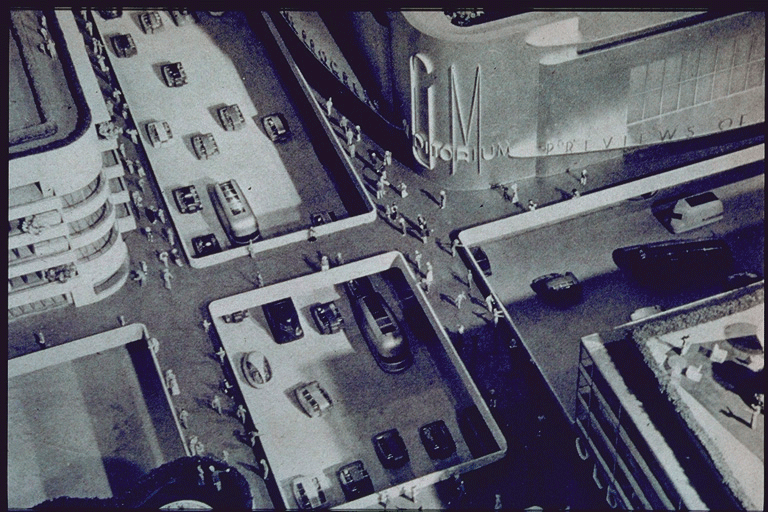
If transit becomes easier and more convenient (and cheaper) to use than car transportation and its auto-oriented development counterpart, the city and people within the city begin to reorganize around the new, dominant form of transportation. Transportation decisions are made by government. We've just been duped into making all the wrong ones in the name of "progress," as generations of individuals grew up with the idea of the Corbusien City, impacted greatly by moments like the New York World's Fair:
Free Transit (and by free I may just mean convenient - as itunes has proven cheap may not be necessary, but EASY absolutely is) would immediately increase ridership which means mobility. And mobility is what lubricates markets, i.e. commerce as well as access to labor/talent and vice versa jobs.
Cars create mobility as well you might argue. The difference is the spatial arrangements of the two. Cars dislocate people while transit concentrates people which is necessary for the "movement economy". The predictability of a certain number of people passing by your business in a given timeframe.
As we have discussed previously, this is the future of retail, locating in areas where the most people pass by. Currently, these are where highways meet arterials, but the public realm is a disaster and effectively is sociofugal. Whereas transit oriented development encourages more pedestrian friendly environments, clustering development into spatial arrangements that encourage vitality, safety, and synergy. All necessities.
Frankly, utilizing "the blink" method, I'm guessing that financially a City would get MORE back from increases real estate value, development and property taxes, as well as the increase in sales tax revenue from this reorganized city.
I'm not trying to take your car away or practice spooky "social engineering" but rather attempting to rearrange and balance our transportation systems for a positive social, environmental, and commercial outcome; so that the private form that is currently a necessity becomes the luxury and vice versa.
We've taken to the car like a junky to a new drug, creating a period of dislocation and isolationism. It's time to enter rehab.
Now, I have to say that I feel like I always disagree with Gladwell's assertions. Something about his logic and my logic just never seem to align. Given those titles mentioned above alludes to the quasi-statistical basis that seems to captivate Gladwell. I see him as a bit of a Bizarro Freakanomics guy, who have a much deeper background in solid statistics.
But, the point is to relate Anderson's message to what it might mean for Cities, and more specifically the organization of cities which are always defined by the transportation systems. Gladwell writes, paraphrasing from Anderson's book (my emphasis in bold):
Since the falling costs of digital technology let you make as much stuff as you want, Anderson argues, and the magic of the word “free” creates instant demand among consumers, then Free (Anderson honors it with a capital) represents an enormous business opportunity. Companies ought to be able to make huge amounts of money “around” the thing being given away—as Google gives away its search and e-mail and makes its money on advertising.If we were to create Fare Free Mass Transit (as MATA Trolley is now is are, and more significantly, car travel) what would be the benefits?
First of all, the amount of revenue mass transit systems bring in barely cover the costs of operating their own fare collection systems and certainly not their operating budgets. What some cities around the globe have found that the value generated by writing off the cost of fare travel is actually recovered by the overall value that transit creates "around" the system.
A city's job is to create and maintain an environment suitable for commerce and improved quality of life for its citizens. Both original motivations for the creation of cities due to the clustering of people.
If transit becomes easier and more convenient (and cheaper) to use than car transportation and its auto-oriented development counterpart, the city and people within the city begin to reorganize around the new, dominant form of transportation. Transportation decisions are made by government. We've just been duped into making all the wrong ones in the name of "progress," as generations of individuals grew up with the idea of the Corbusien City, impacted greatly by moments like the New York World's Fair:
Because the car was technology and technology meant progress, we leapt into a rabbit hole unaware of the repercussions.
If somebody gives you the "that is social engineering" line, respond that all forms of transportation define how cities structure themselves because cities, while we think of them as timeless, are actually rather fluid. The only things that are timeless are those things/places that we love and wish to maintain as "timeless."Free Transit (and by free I may just mean convenient - as itunes has proven cheap may not be necessary, but EASY absolutely is) would immediately increase ridership which means mobility. And mobility is what lubricates markets, i.e. commerce as well as access to labor/talent and vice versa jobs.
Cars create mobility as well you might argue. The difference is the spatial arrangements of the two. Cars dislocate people while transit concentrates people which is necessary for the "movement economy". The predictability of a certain number of people passing by your business in a given timeframe.
As we have discussed previously, this is the future of retail, locating in areas where the most people pass by. Currently, these are where highways meet arterials, but the public realm is a disaster and effectively is sociofugal. Whereas transit oriented development encourages more pedestrian friendly environments, clustering development into spatial arrangements that encourage vitality, safety, and synergy. All necessities.
Frankly, utilizing "the blink" method, I'm guessing that financially a City would get MORE back from increases real estate value, development and property taxes, as well as the increase in sales tax revenue from this reorganized city.
I'm not trying to take your car away or practice spooky "social engineering" but rather attempting to rearrange and balance our transportation systems for a positive social, environmental, and commercial outcome; so that the private form that is currently a necessity becomes the luxury and vice versa.
We've taken to the car like a junky to a new drug, creating a period of dislocation and isolationism. It's time to enter rehab.
Tuesday, March 3, 2009
The Rare Night Time Post
Ouch. My food is too hot.
See the fun you can have in a world built around trains and walkability:
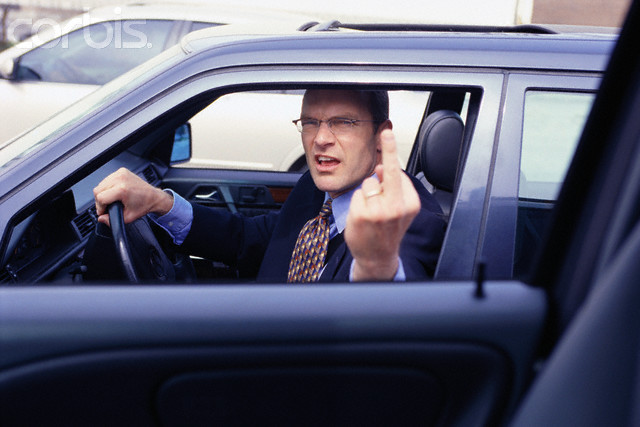
I don't imagine the stand still traffic in the morning rush hour on I's 75, 35, 45, 30 or 20 sharing any people to people moments like this unless it involves this:
See the fun you can have in a world built around trains and walkability:
I don't imagine the stand still traffic in the morning rush hour on I's 75, 35, 45, 30 or 20 sharing any people to people moments like this unless it involves this:
Subscribe to:
Posts (Atom)

 Posts
Posts