






Today, I tweeted something that may sound like it's veering toward the poetic, but the intention is quite real, and that intention is a better understanding of cities.
"The most livable and lovable cities are those that the invisable city aligns best with the physical city."
In his recent book, Ed Glaeser recalls a point that is often made but typically has been ignored and not often cited and recited enough, that the real city is the invisible city. The buildings and roads and everything else we point to and say, "city," are merely the tangible functional tools we've constructed in order to make the city work towards our needs. And those needs are about exchange: of goods, services, skills, ideas, laughs, genes, you name it.
This is what the real city is. The physical city is simply the manifestation of economies around the physical infrastructure to facilitate those connections. There are an infinite number of types of connections. For example, one might be me and my current state of mind and my desired future state of mind. Let's say I'm stressed out. And I want to be less stressed out. Wouldn't it be nice to step out of my house or office and be able to walk down a pleasant street to a nearby park to cool off and maybe just watch the world go by for a bit of time.
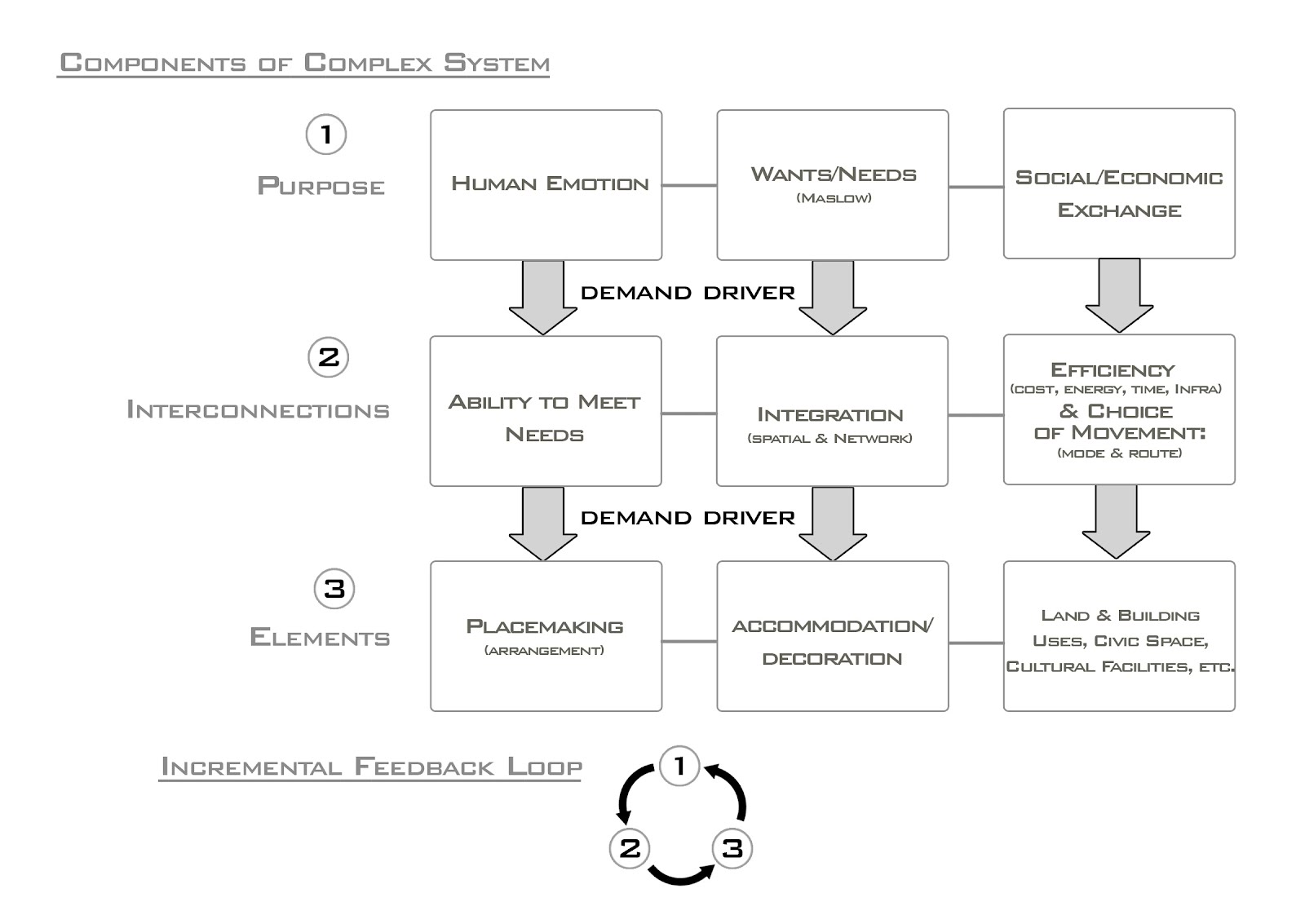
The city is about the efficiency (in terms of cost, infrastructure, time, etc) of us being able to meet our needs. To do so that means creating a means of interconnection, ie integrating various complex networks.
The integration of networks is the release valve of pent-up demand for said exchange.
Integration begets accommodation.
Opportunity then arises after interconnectivity is created. Cities emerge and develop at crossroads. A computer's power is increased once it is plugged into a wall, but then its ability amplifies exponentially once it is networked.
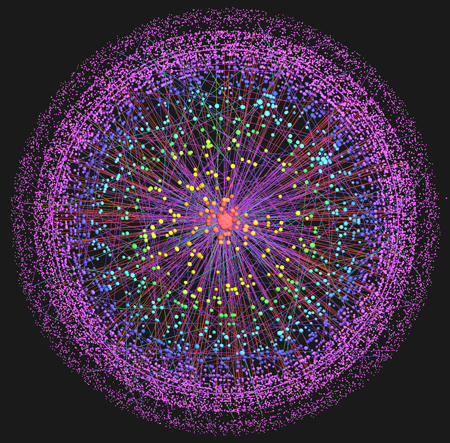
The internet is an example of an invisible city. It facilitates the exchange of many of the same thing the city does: goods, services, money, ideas, culture, etc. It also has sites and designers and developers, but like a city it is about facilitating the experience as directly as possible, whether it is to spend time playing around on something or to quickly buy a good, the directness of the internet (facilitated by speed of connection and hubs of information) eliminates or drastically reduces inefficiency.
One of the many maps of the internet.
The crossing over between the digital and the physical:
We make plans and build our buildings and infrastructural interconnections, but sometimes what is built is not in line with what we need.
The evidence of desire lines, where the physically constructed connection does not match up with our needs:
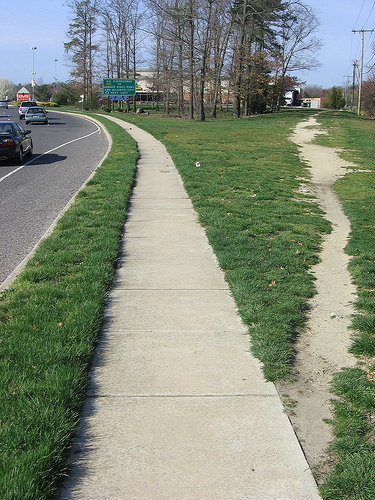
Another example. Here is Rome's evolution from being planned and constructed by an emperor through 2000 years of evolution, the human need for direct connection beats away at that which doesn't align:
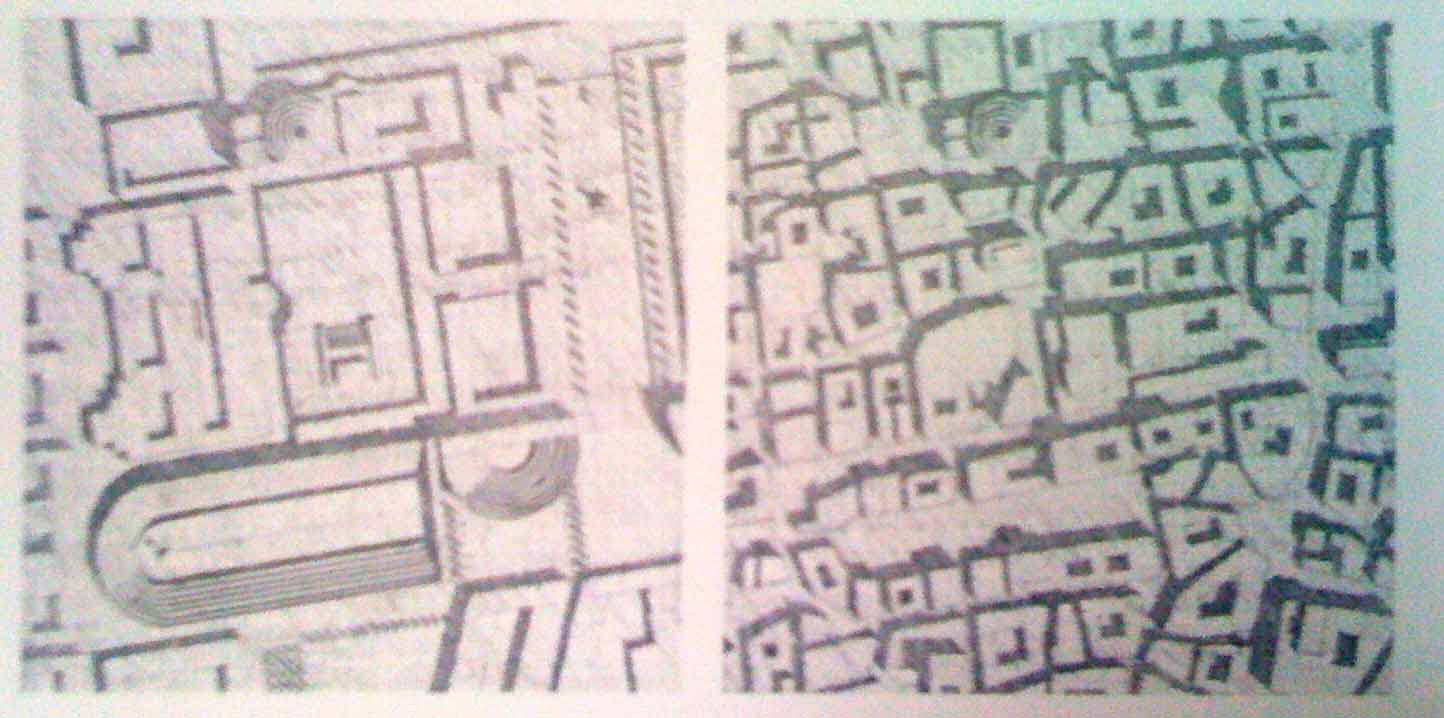
We beat at the city until it serves us better like charged water molecules dissolving a cube of sugar dropped into a glass. We make it more useful, therefore it becomes more livable and lovable. It is now ours. Much the way we feel about historic buildings that are rehabbed and retrofitted for contemporary uses and demands. Or at even a smaller scale, we like movable seating in parks and we adjust it just that little bit to make it ours. The city is ours. And we shaped it in our own little way.
In the city where everything is the same, is that really meeting our individual needs? Is it failing our ability to shape it?
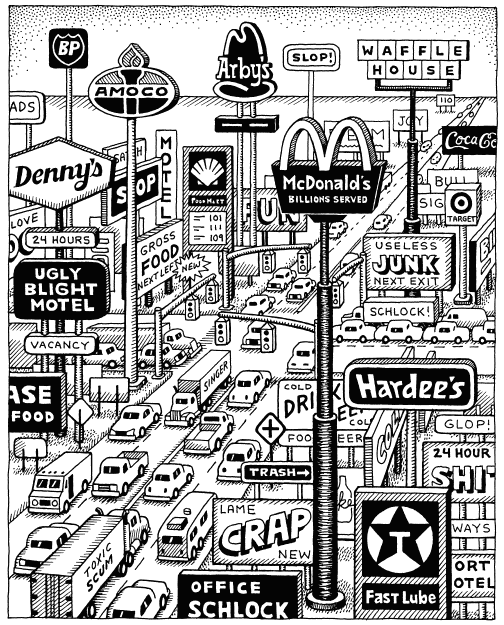
The city has to be a balance of facilities for said exchanges and ways of interconnecting between those meeting points, buildings and roads. Neighborhoods are nested within cities, buildings within neighborhoods, rooms within buildings, all set within a framework of movement.
The attempt at planning "all at a time" is the attempt to minimize the necessary and long-term disruption between Rome of 12 AD and Rome of 2012 AD. Often this ends up being an exercise in 2-dimensional pattern making. However, the 2-dimensional grid is typically constructed for directness of movement and developable efficiency of the nested blocks.
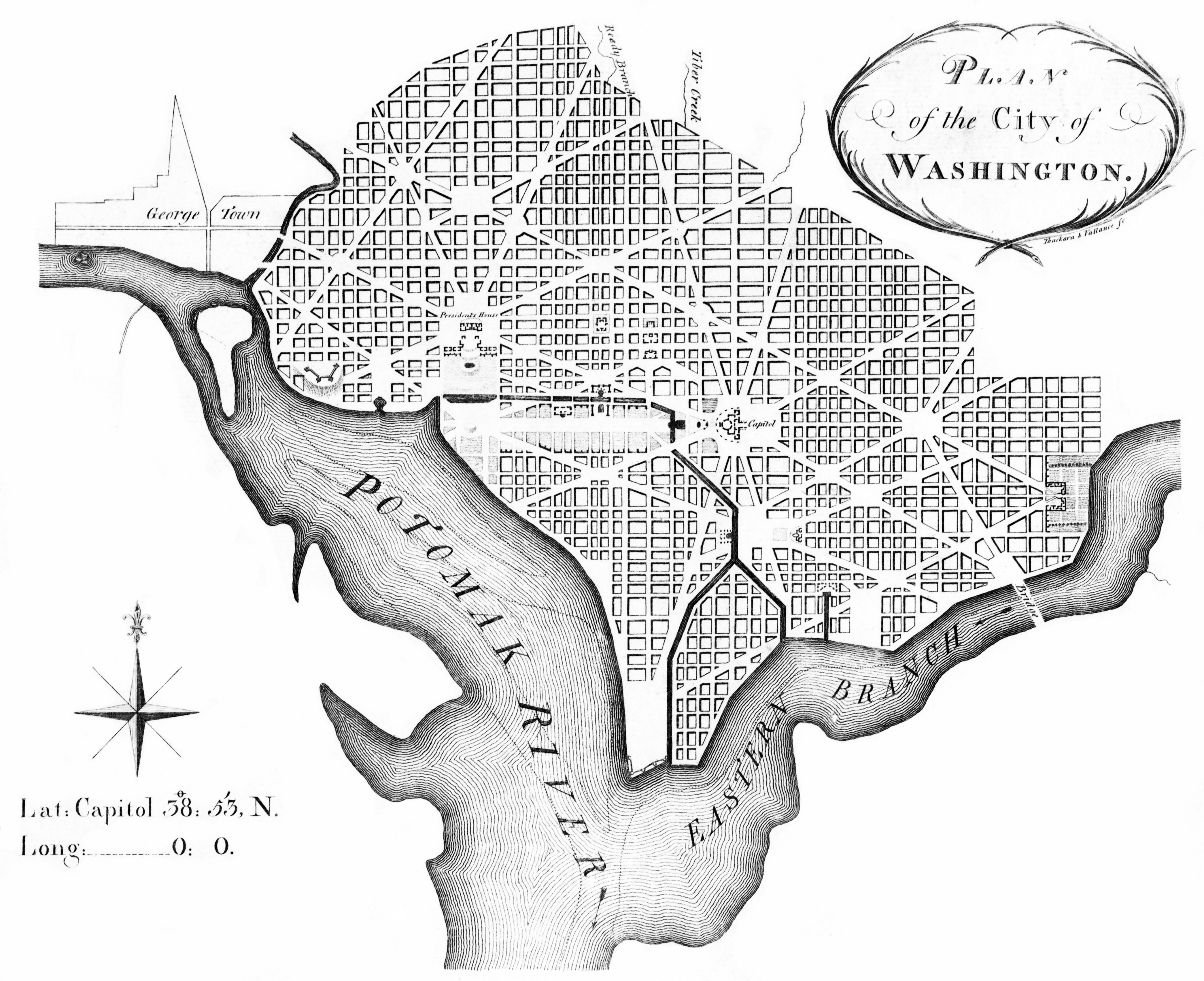
The question becomes, is our infrastructure of movement truly facilitating its need, directness and ability to meet our need with the minimal amount of expense and waste:
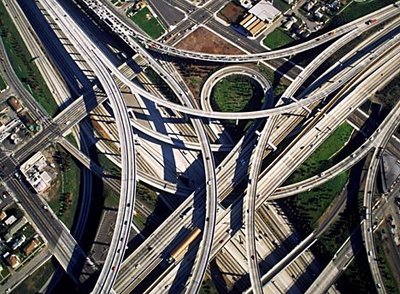
And are we celebrating a bridge because of who it is designed by? Or are we celebrating it because it is a barrier bested in the interlinking of human interaction? And is that bridge the best form of interconnection between a place left behind, with little connectivity?
Value = Demand = Desirability = Degree of Integration.
Degree of Integration = Local connectivity + Global connectivity.
Unfortunately, all too often the physical infrastructure of global connectivity is a net negative, subtracting from local connectivity. They create their own barriers despite trying to link us regionally/globally. Cars and planes and trains may end up being with us forever in some variant form of whatever evolved technology. But the infrastructure subtracts from connectivity except at a few specific points. This is why the best forms of global infrastructure only meet the local tangentially. The access is there, but it doesn't create its own form of disruption to the network. The network is the golden child to be nurtured and cared for, perhaps even worshiped.
This is where the power of the internet is important. It allows us to drastically reduce the amount of infrastructure of global connectivity in order to rebuild local networks.
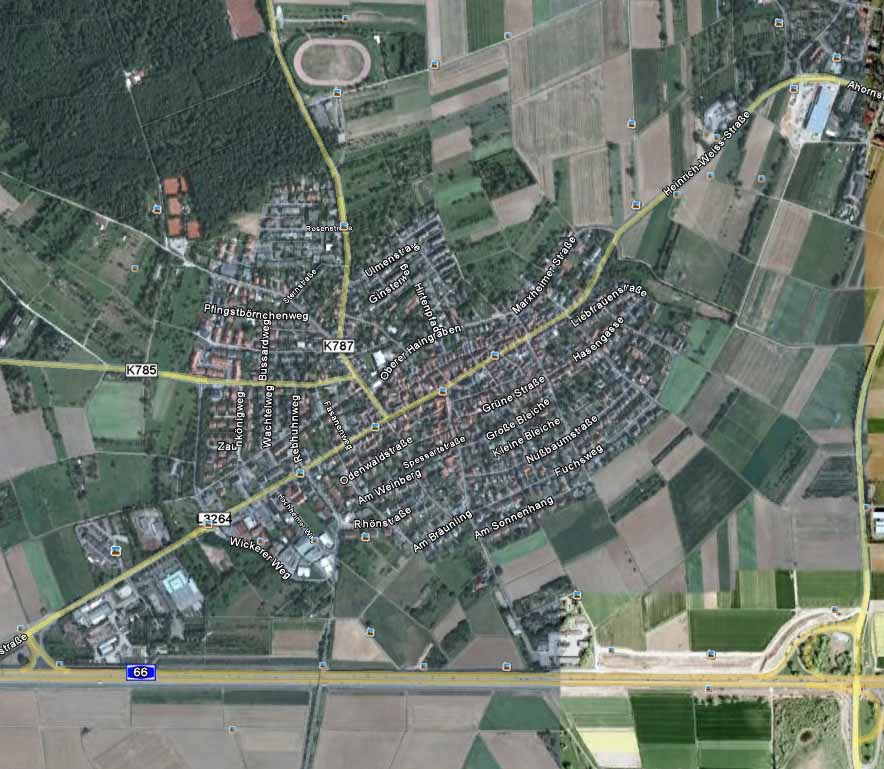
Diedenbergen, Germany. Note that the highway meets the suburb tangentially. Agricultural production is nearby. The structure of the community is intact. Diedenbergen is a suburb of Hofheim. Hofheim is a suburb of Frankfurt. Nests within nests. This is a healthy, interconnected network. Convenience = proximity, they do not conflict as with the illogical and dysfunctional city.



 Posts
Posts