




Showing posts with label The WIRE is the Bestest Show EVAR. Show all posts

Wednesday, April 13, 2011

Straying a Bit Off Topic

For some time I've been contemplating starting a blog about the "100 most profound lines of The Wire," or something to that effect. And if you know me at all beyond the words on this blog, you likely already know that I consider The Wire to be one of the greatest pieces of artwork (across any genre) of our time. As one Washington Post writer stated (paraphrasing), "screw an emmy, it should receive the Nobel prize for literature." Not terribly surprising because the creators (a police beat writer from the B'more Sun and a retired city cop turned public school teacher) employed several novelists on the writing staff (Pelecanos, Price, Lehane).

Today, I received an email from a friend who is rewatching the 5 seasons exclaimed, "why did so and so character have to be killed off." You likely know who I am talking about if you've watched the series. However, he added another comment about Season 3's Hamsterdam, the legalized drug zone, that I want to comment on and bring 'round to how it relates to urban form/evolution:
Hamsterdam is great because like you said, bad things do happen in cities. If you're Catholic, you'd say we're all sinners. We're people. We do bad things. Bad things happen in nice parts of town perhaps just as much as they do in rougher parts, but usually out of sight, out of mind. A high ranking city official once told me about FBI maps that showed the highest crime areas in Dallas on a per $ per capita basis. The deepest, darkest, reddest, roughest area was actually in and around the Park Cities. Best hold your wallet crossing Hillcrest. Yes, white collar crime was included.

Hamsterdam quarantined the bad which was infecting entire areas of the city, which otherwise were home to many good people who had to dodge bullets just to live. In urban terms, it is really no different than some other undesirable use, like a lead smelter, you move it away from all the neighborhoods. You're just being honest in this case about drugs. The war is a lost cause (which is why they make parallels to war in iraq in season 3) and at this point is little more than welfare for those involved. OMG we'd lose jobs! Be honest it is lost, be honest with human nature and inevitability of drug use, and address it appropriately.

As The Wire showed, it was no panacea. The Hamsterdams became truly awful places, but they were localized. They could be policed and health officials could focus efforts as well.

When spread throughout the city, the decay and blight robbed citizens of the only wealth they might have, in the property they pass along through the family, and perhaps on a deeper level, the pursuit of happiness, which perhaps I'm mistaken, but could have sworn was guaranteed in the constitution. The areas then get either condemned or bought by redevelopers or slum lords and the downward cycle continues, or is just moved elsewhere in the Robert Moses manner of treating blight. Raze it, thereby further destroying whatever complex social fabric had previously existed.
As for the prior comment/rhetorical question, spoilers herein:
c'mon. you know the wire. if you like a character too much, he's bound to be killed. It wouldn't be much of a Greek Tragedy otherwise. Even McNulty was effectively "killed" by taking away the only thing he loved doing (thus "saving" him in the religious sense). Even underscoring the point by laying him out on the table.

I just rewatched it with Amanda and picked up something new. They were quite obvious in seasons 4 and 5 about emphasizing the cyclical nature and that the kids were each destined to be one of the adult characters. obviously, michael as omar. dookie as bubbles. Randy as stringer, the business head who gets lost in the system. I never really caught who Namond was going to become.

Then it hit me. Clay effing Davis. Yeah, Namond "made it out" but that doesn't mean everything was all good. He went into debate club. Clay, politician. In season 4, both used the line "I'll take any em-effers money if he givin it away." Namond becomes as big of a problem, if not bigger than any of the other kids... just like the pain in the A that he is at the start of his role.

Us coming to like that Eddie Haskell act of Namond was just a way of the show flipping it on us while we condemn Clay Davis. "How could anybody like that guy?" "What a scumbag!" Well, we fell for it and didn't even realize it. Just turn on the charm. Namond's just getting started taking em effers money.

Sheeeeeeeeeeeeeeeeeeeeeeeeeeeeeeeeeiiiitttt.

Tuesday, April 13, 2010

Not Monday So Much Anymore Linkages

Links and articles of the day that I thought were particularly relevant or interesting for you to peruse and ponder while I realize that Twitter has become my fully customizable morning newspaper:

"Sometimes Life Just Gives You a Moment." ~ Lester Freeman.

I told you that I'm going to start reintroducing The Wire references into as many posts as possible, particularly now with Treme garnering the kind of early buzz that the greatest show in the history of television never got.

With that said, here is my moment. Yesterday, I talked about juxtaposed contrasts in the example of street art as expressed by the community in they way of a guerrilla not-so-hostile takeover of a street into a complete street. Ironically and coincidentally, the DMN covers the polar opposite, the Garland Road plan:
Residents made it clear that they don't want Garland Road widened, but they want it to flow better.
Let me translate: The residents deep down know better, but are resigned to the fact that some "expert" in traffic flow (and nothing else relevant to actual urban design, economic development, or city building) made the call beforehand that this was a site for road widening with a single section and are convinced by his traffic bible and technical jargon.

This is 90s and early 2000s style urban planning and economic development, not unlike the Trinity River Tollway, adding more supply of traffic volume, telling people its going to make their lives better, improve traffic (as we know only temporarily), improve economic development (when we know road widenings do the opposite), then have some anonymous "urban planner" come in and dress it up with some pointless landscaping, sidewalks, and "catalyst projects" aka road side attractions that have to be heavily subsidized by the City in order to make them work and overcome the barriers imposed by the problem they are futilely trying to solve with another problem; the core project, the road widening.

Since the article never actually says, I am being quite liberal with my interpretation, but a little birdie told me a while ago this project was a ruse to widen Garland Road and dress it up with lots of rainbows and unicorns, all costs and no bang for the buck. If it isn't a widening the point still stands that the street section should be context-sensitive and respond to place rather than formula.

On the otherhand, with some cheap and creative efforts, X+ is stimulating bottom-up economic development and readying and otherwise erstwhile area for increased investment from outsiders formerly afraid of crossing the Trinity River with their dollaz.
------------------------------------------
Speaking of Ponzi schemes and suggestive that I've been right all along (or its just another confirmation bias) to avoid the moral hazards of doing work in Dubai and (this time) China, is an article with some of the worst formatting, but best content you'll find:

His 1999 book, Devil Take the Hindmost: A History of Financial Speculation, examined past speculative manias. Perhaps you've read articles comparing the tech boom and 1990s' bull market to tulipmania in 1630s' Holland.

The difference is that Chancellor was making that comparison before the tech bubble burst, some years before Alan Greenspan claimed it was futile trying to predict bubbles at all.

Chancellor's timing may have been fortuitous. To accurately predict something once might mean little. To repeat the feat perhaps means something more.

His next major piece - Crunch time for credit: An enquiry into the state of the credit system in the United States and Great Britain - included this prescient paragraph:

''The growth of credit has created an illusory prosperity while producing profound imbalances in the British and American economies...When credit ceases to grow, the weakened state of these economies will become apparent.''

That report was written in 2005, years before the credit bubble burst. Chalk two up to Chancellor.

Third time lucky?

He's now turned his attention to China, a fertile ground for his fertile mind. Released last week on the GMO website, China's Red Flags is split into two parts.

Crisis checklist

Section one identifies speculative manias and financial crises, offering a checklist for those trying to identify bubbles in advance of their bursting. Chancellor offers 10 criteria for what he calls ''great investment debacles'' over the past 300 years (the report explains each in far more detail);
1. A compelling growth story;
2. A blind faith in the competence of authorities;
3. A general increase in investment;
4. A surge in corruption;
5. Strong growth in money supply;
6. Fixed currency regimes, often producing inappropriately low interest rates;
7. Rampant credit growth;
8. Moral hazard;
9. Precarious financial structures;
10. Rapidly rising property prices;

Although all these criteria need not be present in order for a bubble to be present, you can see where Chancellor's heading: not-so-subtly steering readers towards his own conclusion. In section two he takes each factor and applies it to the case of China.

Invest locally in places that are ripe. Like X+ and Bishop Arts. Of course, then my next piece of advice to residents of Oak Cliff is to be sure to pay attention to any and all zoning cases (particularly Davis Street) and be sure to fight for everything retaining a human/pedestrian scale. Everything between Davis and Jefferson is solid gold right about now and then in 10 to 15 years, look towards the Zang Triangle.

--------------------------------------------

And lastly, and perhaps most importantly is the dual-purpose post from the Guardian supporting the fact that we have to look beyond our borders for news as important to us as THE US MILITARY AND LARGEST GASOLINE CONSUMER IN THE WORLD IS WARNING OF PEAK OIL and major shortages worldwide in 2015. Of course, we'll go all willy nilly about this and do things as stupid as the king of stupid supply-side city thinking, the Detroit Convention Bureau trying to prop up economic development with more supply side factors like increasing their convention center, such as digging through Canadian Tar Sands and widening Garland Road.


Friday, January 16, 2009

In Honor of Two of My Favorite Things

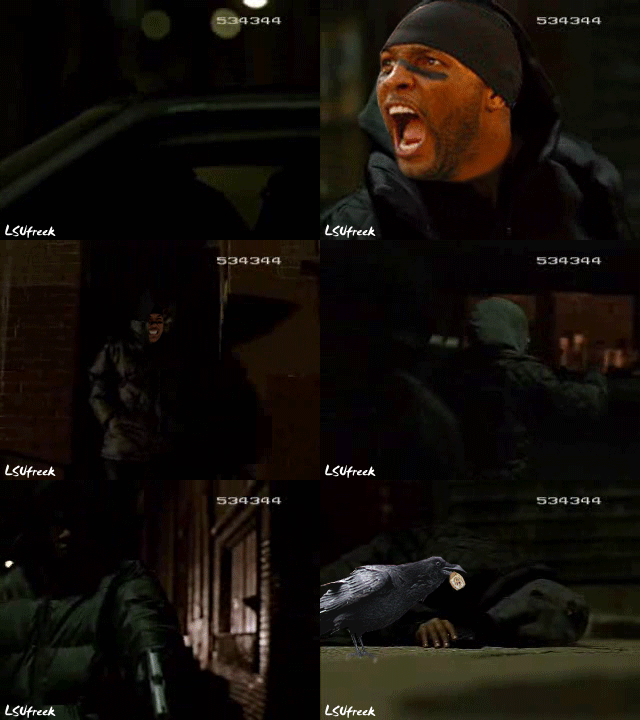
The Wire and Steelers-Ravens for all the marbles.