



Showing posts with label Creative Economies. Show all posts

Wednesday, July 21, 2010

Dallas: The Digital City?

Last night, due to the wondrous interconnective powers of these here interwebs, I was graciously invited by Kevin Walker to take part in The CultureLab's informal round table discussion on Dallas and its ability or lack thereof to become or be considered a Creative Class city; and what might be the necessary barriers, hurdles, or next steps towards that end. The event was hosted in Southside on Lamar, which I must admit, I haven't spent enough time down there, and is pretty cool -- if potentially overscaled and overly internalized as a building.


As the invite shows, the special guest was a gentleman named Micheal (Mike) Pratt, a man who was involved in starting Digital DUMBO and who I didn't know (or think I knew from Adam). I walked in, we immediately recognized each other and pointed, "didn't...I...just..." Yes, in fact, we had just met the past Wednesday at D Magazine/TEDx's "What Are You Working On?" social event.

As it turns out, he's a pretty important dude and now due to familial obligations, he is now ours based here in Dallas. If I was to put a finger on one standout trait of Pratt's, it is that he sees opportunity in chaos, in creating order out of that chaos by way of instilling and then organizing a culture of community. Community (in the very real or more abstract digital notion) is essential for fostering creativity. Collaboration comes from the space between me and you. WE is always smarter than ME.

DUMBO
First, some background on DUMBO. Like many hip urban areas where the name comes from the common shortening of names for people and places (J-Lo, T-Mac, LoDo, SoHo, etc), it is an acronym for Down Under Manhattan Bridge Overpass.

Because it sits in a V beneath the Manhattan and Brooklyn Bridges, it was what the real estate community would consider useless land: under elevated freeways, on the third side and at-grade freeway, and the fourth waterfront. But, this was the East River, long considered the outfall for 19th and 20th century dirty industry's effluent. It also had terrible access. How do you get there, parachute out of a moving vehicle from the bridge above?

All of its built-in undesirability made for cheap land with an existing urban fabric, some old warehouse space. This is New York City where incredible demand can make any and all land valuable. It also had a subway station at its periphery.

In it, creative start-ups found first, cheap space. Presumably through various previous associations that cheap space was then broadcast to creative acquaintances looking for similar, funky loft-type space. Eventually, as they began to agglomerate still under the radar, digital DUMBO came along and provided a digital center of gravity to go with the emerging physical one.

The digital version brought these businesses and the individuals behind them together. People who would otherwise just pass each other on the street or stand nearby waiting for the next F train, were now meeting at events organized by Digital DUMBO, sharing ideas, sharing business cards, and small startups began pooling skills, collaborating on projects that otherwise might have been too big for one or the other.
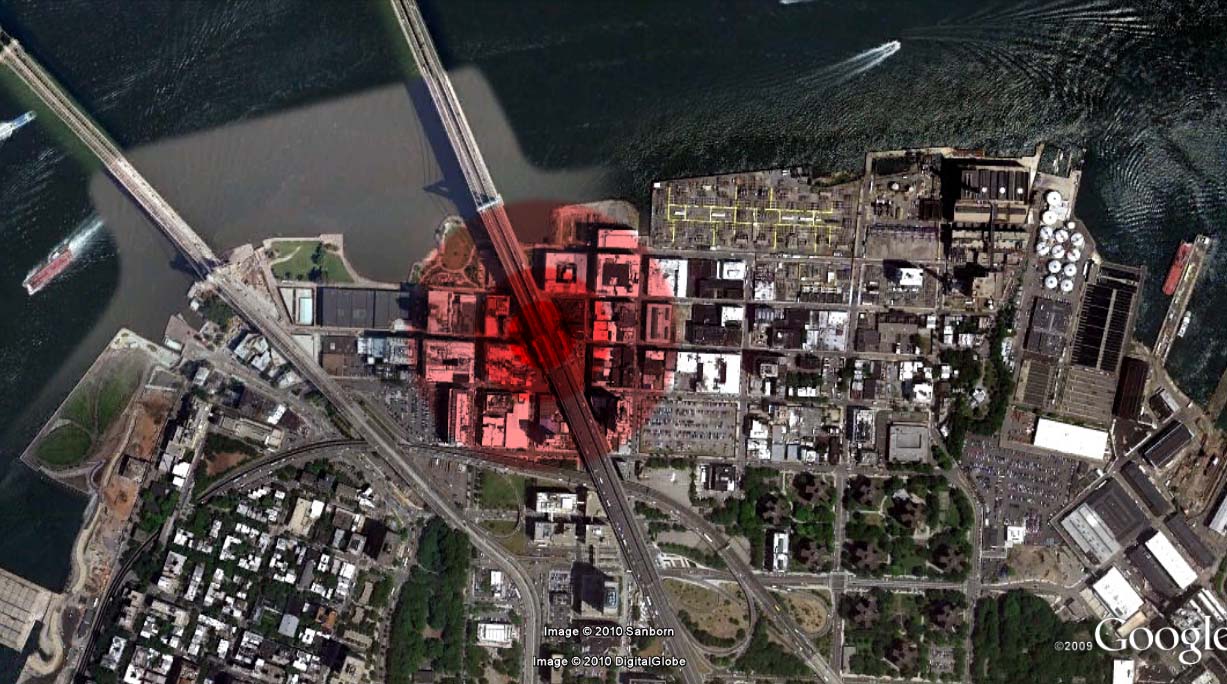

From a physical standpoint, the urban morphology nerd in me, loves the way it appears to exist on an island growing from a singular epicenter.
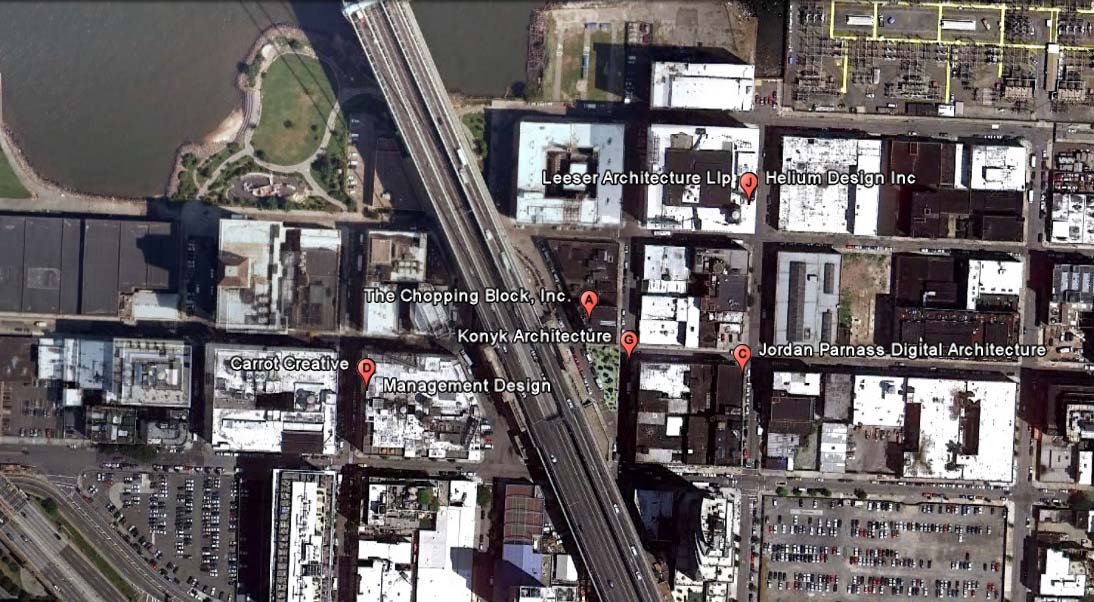

Although much of our dialogue last night revolved around digital media, design and creativity comes in many forms. Type in design into google earth and a number of companies pop-up including building architecture and digital architecture. This isn't the last time I will make that parallel.
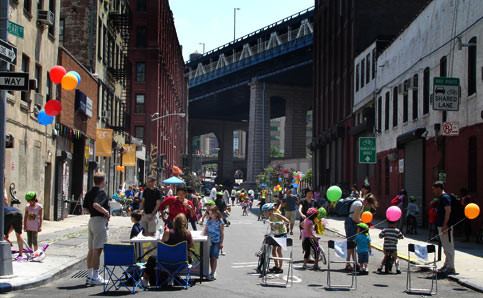
http://susty.com/image/brooklyn-summer-celebration-for-kids-dumbo-wide-shot-pearl-street-triangle-lawn-chairs-balloons-bikes-children-adults-photo.jpg
DUMBO: the physical, made possible by the organizing power of the digital version.

Now on the map, DUMBO like many new hip spots in any city, was first pioneered by creatives looking for little more than cheap space, then colonized by peers, and once a critical mass was apparent, then organized and marketed outwards. Now, even the big firms want to be a part of the digital organization and physically open up shops there.

In a way, it is gentrifying, both the digital and physical community. And that isn't a bad thing. The pain of gentrification stems from our biologically-wired resistance towards rapid change. At its basic level, gentrification means investment. It is only not ok when there is a clean sweep of the old in favor of the new.

Over the course of the history of all cities, every area has at one time "gentrified." Any place that becomes exclusive or static, eventually becomes boring. To resist investment or inclusion of "the other," means to stagnate and ensure a slow strangulated death. On the other hand through gentrification, exclusivity also comes at an increase in price point.

What happens however, is that those original pioneering creatives rise in class as their creation, their collective organization, their neighborhood rises. They can then move on and focus their energies on creating new places or investing in the next generation of young creatives looking for cheap, cool space and the culture of community to match. They're now experienced in How-to and capitalized, ensuring the uplift of various other portions of the city.

In order to retain the spirit of places, places need organizations and leaders as stewards. Physically, they also need protection once an area rises to what we might consider its ultimate, highest and best use. In DUMBOs case it was to become designated a historic place on the national registry in 2007. It is now protected from getting scraped clean in favor of all glimmering waterfront condo high-rises (which may very well form the connection between DUMBO and the rest of Brooklyn ultimately, as DUMBO-driven demand creates the need for more residential space nearby). The demand driver, the sense of place remains.

DALLAS
Dallas is often considered by the Joel Kotkin's of the world as the epitome of the "polycentric city." Last night, creative acquaintances of Kevin's in town from Chicago, NYC, and Tokyo pointed out that they left Dallas because of a lack of livability. Their words, I promise you. A UTD grad student pointed out that you have to be from Dallas to know where to go for virtually anything, there are no centers of gravity with a sense of place, an understood identity, that registers beyond a local level.

The truth of the matter is that Dallas isn't polycentric as much as it is non-centric, it is the placeless anti-city that Mumford warned about with the rise of personal automobility and the extensive infrastructure to support it. While Bishop Arts, Lower Greenville, uptown, Lakewood, Oak Cliff, X+, Deep Ellum, Design District, Cedars, Expo, Fair Park, etc. may register to us locals, what do those names mean to a recent graduate from Stanford, Columbia, or NYU (which surpassed Princeton for the first time ever in applications last year).

These local Dallas spots are all still neighborhood centers. DUMBO now registers nationally. For the City to compete on the national and global scale that it wants to, these are the areas that have to rise to regional and national prominence. They have to start small. They have to find leaders. They have to build communities online that are self-organized, like-minded, and motivated to parallel with the physical communities they want to live in. But, they also have to welcome an increase in density to accommodate the desire to be a part of these clusters.

DO-IT YOURSELF CITY
Dallas is too busy worrying about how to attract creatives when it needs to focus on keeping them first. I'm always amazed by how much talent this city exports, hands over in exchange for nothing, to other cities, considered more interesting, more livable, more amenable to their creative endeavors and desired quality of life.

For a business or a city to compete in the 21st century (or any time period really), it isn't enough to simply do something the best or be the biggest, but best embody the spirit of the times. The 21st century will be known as the anthropocene, or era where people and quality of life come first. Portland and Copenhagen are generating the attention they are because they are not so much winning but the first out of the gate. We have the potential and ambition to surpass them.

What the Non-centric City of Dallas is struggling with from a physical and economic standpoint, is its parallel problem of form and function. Form helps foster function. Dallas is for the most part formless. If the city was the web, imagine an internet with no websites, ways to access them, or everything was pay-walled.

The city and the web are both human constructs, both perhaps modeled after the way our own interconnected brain and bodies work. The City and the internet are two parallel geographies and quite possibly the two greatest advances in human civilization.

They are both facilitators of connections, between people, goods, capital, and ideas. They have the potential to allow us to achieve all of our needs and wants, the emotions that make us human and drive the economy.
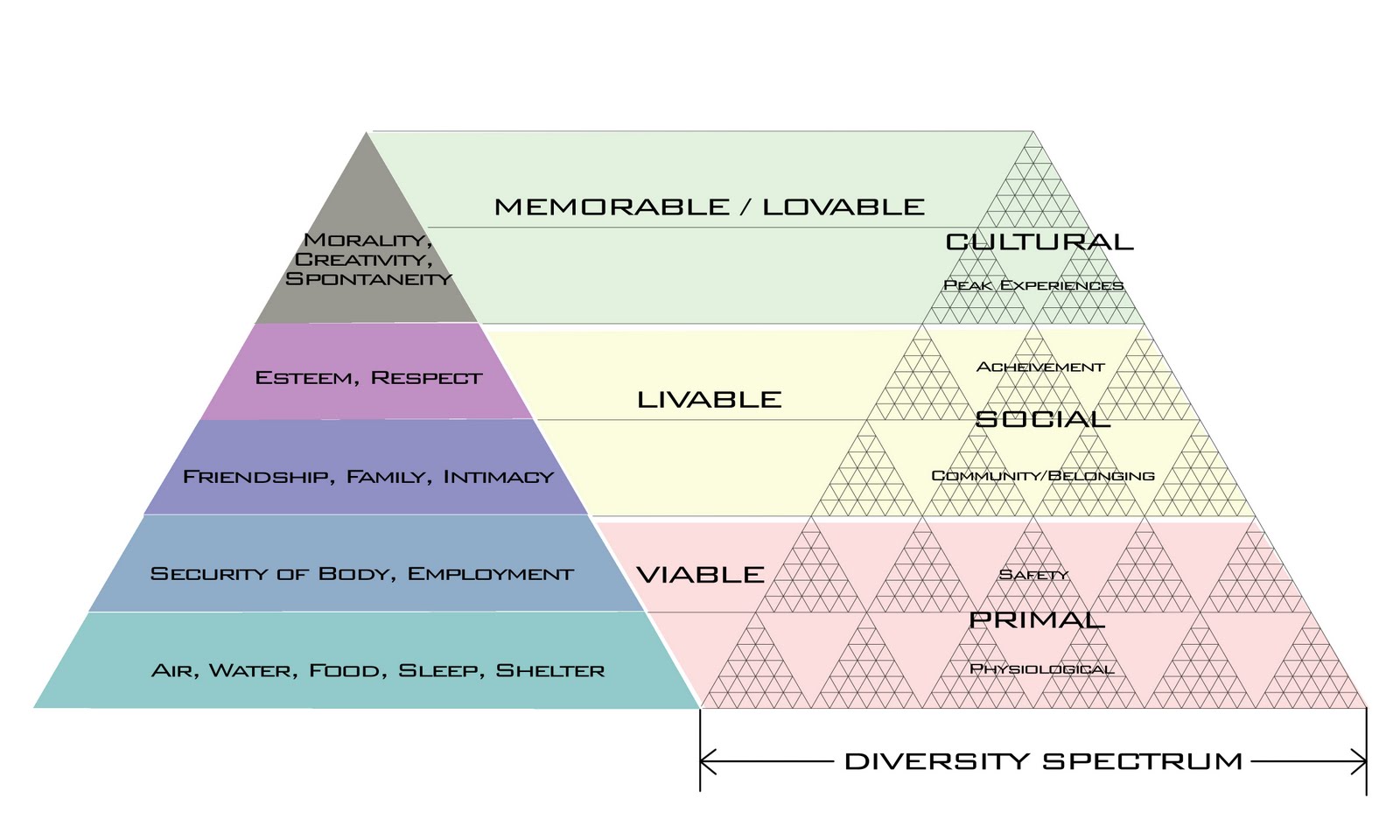
http://2.bp.blogspot.com/_D5kx0bUGx_c/S_v4YDHga8I/AAAAAAAACfc/lLwt_qvXz5Q/s1600/city+pyramid+-+hierarchy+-+diversity.jpg
There is a reason why there is probably far more to learn about cities from Stephen Wolfram than Frank Gehry. One is a true architect just in a digital world, creating communities and facilitating connections, advancing true human possibility, while the other sculpts platinum (a purpose perhaps, but its true transformative value is limited). The parallels don't end there.

Both have hubs, ports, and linkages. Websites are like buildings. The use of the building is like a website's content and they must interface with the stream of movement, the digital transportation between points and destinations. For websites, traffic is critical and they must create clouds of interconnectivity. Buildings must interface with the various forms of transportation and facilitate ease of use.

Both have "sites" that get "developed" according to "codes." Coding which is becoming increasingly open-source, meaning more individual customization and local empowerment. However, our codes for physical cities lags behind. It is still written for the 20th century economy. It is not ever changing and adaptable, but static and antiquated. Imagine if the web was written and interfaced in DOS.


The internet as designed by conventional city code. Your city has you.

From similar simple terminology to the actual read/write nature evolving in both, the 21st century economy will be increasingly defined by 21st century industry, which means 21st century principles, of mass customization, collaboration, and transparency.

The digital geography is the physical geography. The more the lines blur, the better.

Currently the City and many of its future industries are in chaos, scattered all over the City with little interrelationship, or mutual dependence. The City and its potential new industries therefore are less than the sum of its parts. Through organization, clustering, and collaborating they can become more than the sum as many industries that need and want to grow as a driving force of the 21st century economy, one of creativity, collaboration, synergy...of empowerment, are looking for the physical neighborhood mirror.

While the internet was once feared to breed a generation of shut-ins, the opposite has happened. We still yearn for social contact and the internet has become the tool to not only collaborate from distance, but to organize physically and provide the catalyst for change of urban neighborhoods.

Any area of the city needs both a digital and a physical interface, a way to empower the citizens to be a part of a community, to be stewards. It is the cities, the neighborhood organizations, and the leaders (or those that are yet to emerge) that have to facilitate this, that look to organize and recruit the scattered small creative businesses into their potential cluster. To compete in the 21st century, we must foster centers of gravity, of intellectual foment, digitally and geographically.

In many ways, this is exactly what is going on with GoOakCliff, a parallel geography of internet awareness, marketing, and then organizing and empowerment, associated with a specific place, fostering a sense of collective care about neighborhood, about home. These various neighborhood areas have to accept change, and alternative forms of transportation like streetcars in order to support the density that is sure to come, to fulfill the exploding demand for authentic, interesting, vibrant urban locales.

Since many of these organizations don't yet exist, therein lies the opportunity for creative energy. If you're creative, don't leave. Customize your world. Focus your energy here, make a culture of community from scratch, both digitally and physically. Create order out of chaos, form out of the formless, place out of the placeless.

Dallas can't be a great digital mecca without associated great neighborhoods. The people we want to attract aren't ready to flock to Dallas yet. Fortunately, we can create those places, those clusters of innovative activity and expansion of the possible. But business as usual won't get us there.

Like DUMBO, make the city/your neighborhood your creative outlet. This is the self-designed century of collaborative, mass-customization. Take control. Let the Dallas be your canvas.
File:The Squirrels 0017.jpg
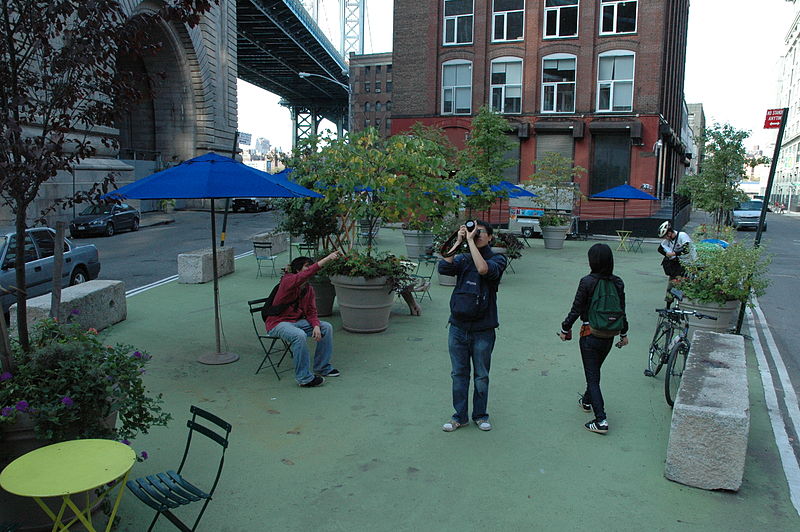
DUMBO's self-made pocket park
Monday, July 12, 2010

Monday Linkages

Showing that the science and democracy of computer networking is a treasure trove of information and understanding for cities, UrbanOmnibus writes of an emerging new kind of participatory, "read-write" urbanism, citing new websites such as FixMyStreet and SeeClickFix as a connecting, feedback medium between users and the managers of places and the associated infrastructure:

But what if we took a single step further out? What if we imagined that the citizen-responsiveness system we’ve designed lives in a dense mesh of active, communicating public objects? Then the framework we’ve already deployed becomes something very different. To use another metaphor from the world of information technology, it begins to look a whole lot like an operating system for cities.

Then we can begin to treat the things we encounter in urban environments as system resources, rather than a mute collection of disarticulated buildings, vehicles, sewers and sidewalks. One prospect that seems fairly straightforward is letting these resources report on their own status. Information about failures would propagate not merely to other objects on the network but reach you and me as well, in terms we can relate to, via the provisions we’ve made for issue-tracking.

Of course, this also implies that those managers and appointed stewards of districts, neighborhoods, and cities must also care enough to WANT direct feedback and interface with the area users.
-----------------------
Kevin Walker, of CultureLab, writing for DallasSouthNews asks whether Dallas can ever attract Creatives:
There is hope however, and it is evident in the budding creative class businesses of the Southside Lofts, the Cedars area, and Deep Ellum. What is needed to make it a bigger magnet of more creative class workers and young urbanites is more attention paid to and active civic promotion of the creative class areas and businesses.
The What is fairly straight-forward, as is the Where. The How is where it gets a little more complex, or at least, with greater potential for apple-cart upsetting. Change can represent a relinquishing of control that might upset various fossilized technocrats closed to not just new ideas, but necessary and proven ones just because they might differ from the familiar.
----------------------
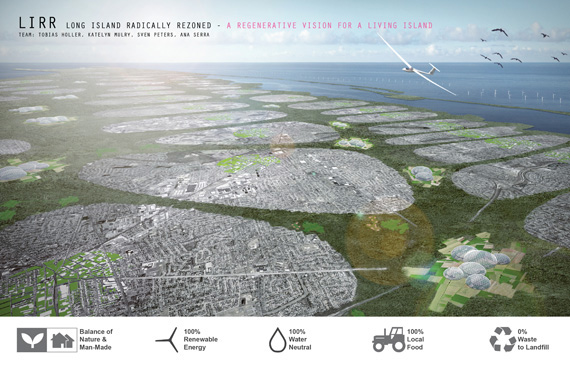
The Long Island Build a Better Burb competition has received all of its submittals. You can see a summary here or check out all of the entries here, where the hosts are inviting crowd-sourced feedback.
The Long Island Index invited architects, urban designers, planners, and students to submit forward-thinking design proposals for capitalizing on the potential of the “underperforming asphalt” found in dozens of downtowns in New York’s Nassau and Suffolk counties. The competition solicited innovative design ideas for retrofitting 8,300 acres in 156 downtowns and train station-adjacent areas on the island. It also invited designers to consider island-wide challenges that could be addressed by their design strategies.
The submissions I have examined thus far range from the practical and market-oriented to the great idea, thoughtful, but completely disconnected from reality, which is sometimes the purpose of competitions, to bend our minds, mine for utility, and then assimilate the other-worldly into the useful march of progress.

Sunday, June 6, 2010

READER FEEDBACK: Dallas Might Be Gaining People But Losing the Creatives

From long-time loyal reader and regular commenter Himanshu gets bumped from the comments section on Diversity as Livability Indicator to the headline cuz, like woah:
Well, you have an uncanny way or writing down things that I have been thinking. After having worked in downtown Dallas for the better part of the past decade, and having seen the areas of downtown and uptown get better, they still don't seem to catch the essense of what I'm looking for in my neighborhood. So, I'm moving to Center City Philadelphia--Society Hill, specifically. I look forward to ditching my car and walking to work and home, walking to all the bars and pubs and grocery stores, enjoying picnic lunches at Washington Square or Rittenhouse Square or Fitler Square, etc. Shopping on Walnut Street and Market Street and Reading Terminal Market. And doing all this in a place that has a sense of place, has livability, and walkability galore. Your old town, I suppose. But I will continue reading your blog from time to time. Keep it up! And perhaps you'll move (back) to Philly sometime in the future...
Unlike some other regular readers, I have never met Himanshu personally (unless I'm unaware). While this blog doesn't get the kind of traffic that generates the kind of traffic to turn it into a giant money maker itself, it does get a loyal following, and an engaged, intelligent one focused on improving Dallas or general urban issues at that.

Over the last few years however, I have seen scores of talented people move away from Dallas to cities like Portland, Seattle, DC, Boston, and New York being the most common destinations. Given that this particular reader has the means to be able to live in and move from downtown Dallas to center city Philadelphia, these are the kinds of people that we don't want to be losing.

When we look at population figures stating that Dallas is gaining people and that the economy is holding steady or adding jobs, they never tell us what kind of jobs or who these new residents are. These are the definition of dumb statistics. Anecdotally, it feels like we are losing talented people and replacing them with people just looking for a job, any job. The difference between what we're gaining and what we're losing is the difference between a steady current economy and a strong future one.

If we are adding jobs, they are mostly towards the status quo businesses and the "Great Reset" (Richard Florida's term) is a repurposing (evolutionary biologist term) of the economy where the genotype (new generations) shed the phenotype (the past economy) in favor of a new and more serviceable one. Point being that the economy, and our cities in turn, will be very different in 20 or 30 years.

Those we seem to be losing on the negative end of the import/export equation are what Richard Florida might refer to as the Creative Class. While people might interpret Florida here suggesting that the term "creative" implies artisans such as musicians or sculptors or what not, my interpretation is that Florida, the demographer, only uses those as a measuring stick. Professions whereby improving the lives of those who have the means and ability to locate where they choose based on Quality of Life of a particular city meeting their particular needs. The more livable the place, the greater number of these types of people's needs will be met there, the more likely they are to relocate there.

These are the people we MUST be attracting and retaining. While I despise Ayn Rand for missing her own point (or being able to temper it within reality) and dreadfully long soliloquies, these people are the true fountainheads. They are the Structure Builders of the pillars of the future economy by which real, sustainable job growth and long-term prosperity can be founded upon.

They are the measuring stick for where our City will be in 20 years in relation to those where they are choosing to relocate. And we are losing them.

Himanshu mentioned Livability. Washington Post writer Neal Pierce discusses it as well today where he expresses frustration at the vague nature of the umbrella term but the necessity of the concept.

I will help him out. Livability, what people are looking for and where they are moving to are places where choice is in abundance; where people can live the way they want without fear of persecution; where people can find quality housing of the size and type suitable to their needs in neighborhoods of the character matching their desires. Multiple modes of transportation are available allowing for the universal access of all to their destinations. Then there are other kinds of access such as, to education for personal advancement and the CHOICE of careers and to healthcare and justice for well-being of body, mind, and soul.

This is precisely why I am driven crazy by "pro-business" policies. There is nothing about them that is about advancing business or the economy, but rather to protect the status quo. But, the status quo doesn't freeze happiness, comfort, rainbows and unicorns in place. You either progress or get left behind and the status quo ensures falling behind. Sometimes this can mean that a country's industry falls behind another or it can mean the country's people fall behind and are stuck with the bill. See: BP.

To bring this closer to home and back to the focus of this blog, I'm reminded of the new Tarrant County College "campus" in downtown Fort Worth (and one of FortWorthology's personal obsessions) where Kevin was told the anti-urban design was "just being realistic" about Fort Worth's car-orientedness. Status-quo. And here I thought, educational institutions were supposed to be thought leaders, shaping the future and the minds thereof.

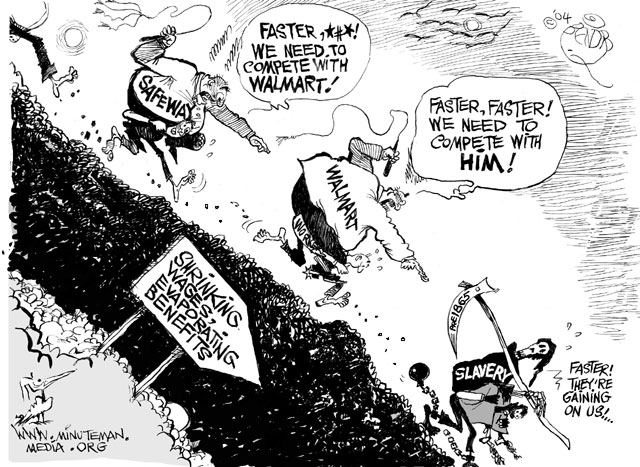
This is the race to the bottom and it is time to start investing in people. It is people that create the economy and our cities not the other way around and our future depends upon it.

http://www.bendib.com/newones/2004/february/small/2-2-Race-to-the-Bottom.jpg

Thursday, April 22, 2010

Highway Dependence Begets Auto-Dependence, What's the Cost?


Well in NYC, the City and its residents save $19 billion annually.

The $19 billion number is a quick, conservative estimate that almost surely understates the savings New Yorkers reap by not driving. The study estimates that, per capita, New Yorkers drive nine miles per day. It then multiplies that figure by the national average cost of operating a vehicle, 40 cents per mile. Compare that total -- how much New Yorkers spend on driving, per capita -- to the national average, and you get $19 billion in savings.

Here's why that's a conservative estimate. The study calculated average VMT rates in New York City by distributing the average daily distance driven in the entire metropolitan region according to the city's vehicle ownership rates. If New York City car owners drive less often than their Suffolk County counterparts, or drive shorter distances when they do -- both reasonable assumptions -- then nine miles per day overshoots the mark. Moreover, the cost of driving is almost certainly higher in New York than it is nationally, due to elevated costs for parking, insurance, and gasoline. In other words, it's likely that New Yorkers save much more than $19 billion.

Cities (and larger entities) spend money on transportation and its infrastructure every single year, no matter the form. If you spend it on the kind that supports high quality dense, urban living that puts more money in the pockets of your citizenry who can then spend their savings how they choose.

You want to know why housing is more expensive there? Reason 1: the Car has less impact on livability, and Reason 2: those savings can then be spent on better housing closer to activity centers, which are always in high demand no matter the age. If economics are driven by emotion, we WANT to be near other people.

Activity hubs are where fame, fortune, and females can be found, which is why Bill Shakespeare moved to the squalor of 16th century London, hardly the paragon of livability compared to modern city standards. Due to advances in industry and sanitation our cities are no longer disease ridden, filthy mires. Imagine how valuable the land will be when we remove all of the other barriers to livability, such as intra-city highways.

I tweeted about this yesterday when reading about some American Dream Coalition. These are the kind of people so intellectually bankrupt that they apparently think the American Revolution, Civil War, and World Wars were fought for the single family home and two-car garage. Of course, none of those things existed.

What they don't understand is that the American Dream is about opportunity which is defined by and had only through CHOICE, fundamental to market economies and capitalism, no? The American Dream Coalition wants to shackle everyone to home mortgages and car payments. Why? Well, because they are made up of car companies, oil and gas companies, the dinosaurs of the real estate industry (ReMAX and Century 21s of the world) and the highway lobby.

In their world, you are coppertop. They want to suck the life out of you and every city they can touch.

I'm going to start the horse and buggy coalition. WE NEED TO BAIL OUT THE HORSE AND BUGGY INDUSTRY! What will happen to those jobs?! Oh sweet despair and dismay! I can't live without you.

Perhaps someday we too can get out of the stone ages of stupidity and begin competing with the global cities who understand a thing about real economic development.

Monday, April 12, 2010

Emergent Urbanism in Oak Cliff


I've been planning a post on graffiti as a livability indicator for a long time, but haven't quite found the exact narrative for which to frame the argument. The general gist would be that like its urban sisters density and gentrification, it comes in various forms: good, bad, destructive, harmless, or helpful. Because their meanings are so broad and contextually driven, these words often end up being code words masking other intent.

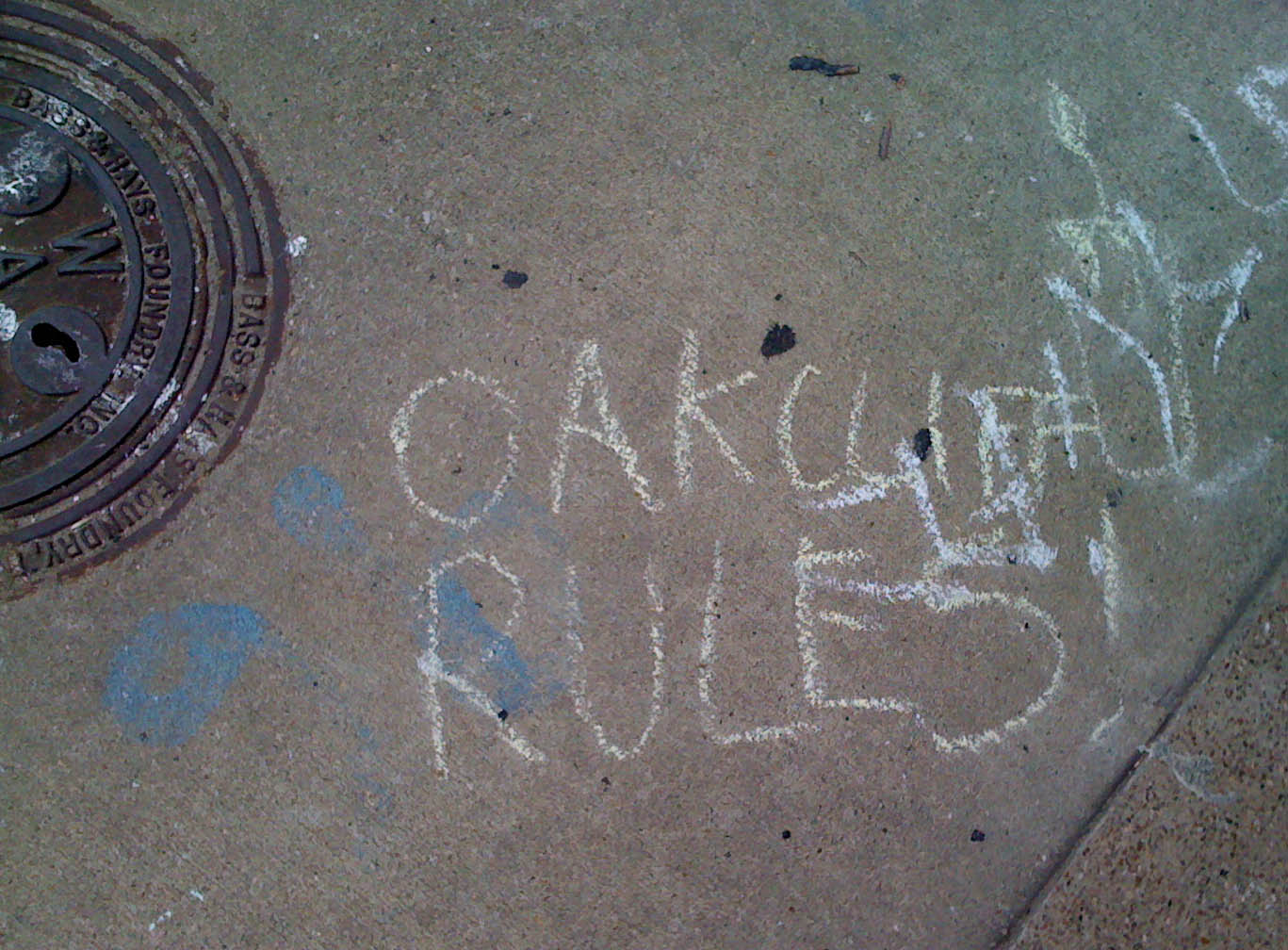
As with the above, sometimes it can be art. Sometimes it can be crude but so illuminating when shown in contrast. The contrast highlighted here is one of mere local sentiment but deeper represents the disconnect between goals and the policies that are failing to see the vision realized, preventing real neighborhood vitality from taking place.

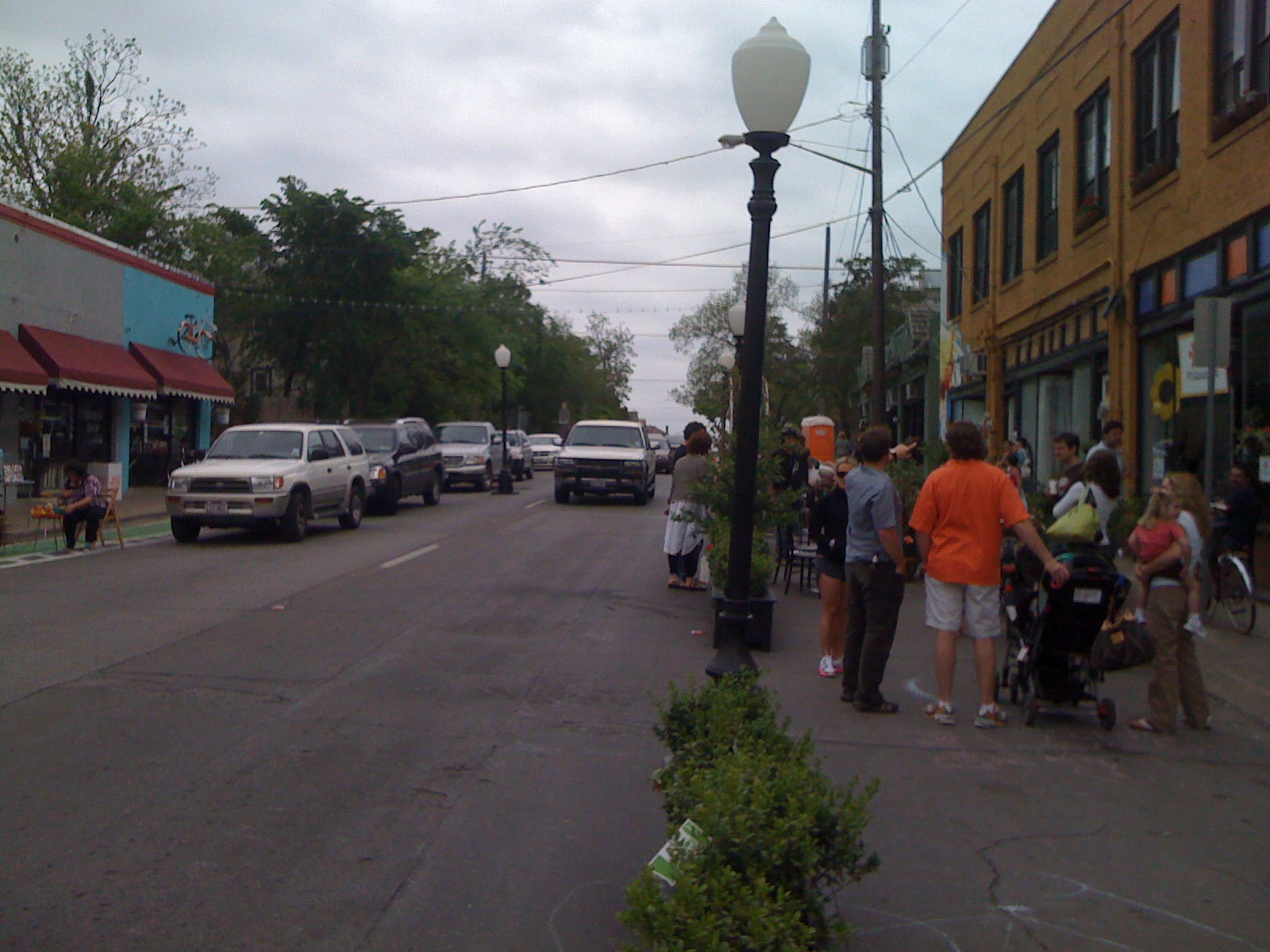
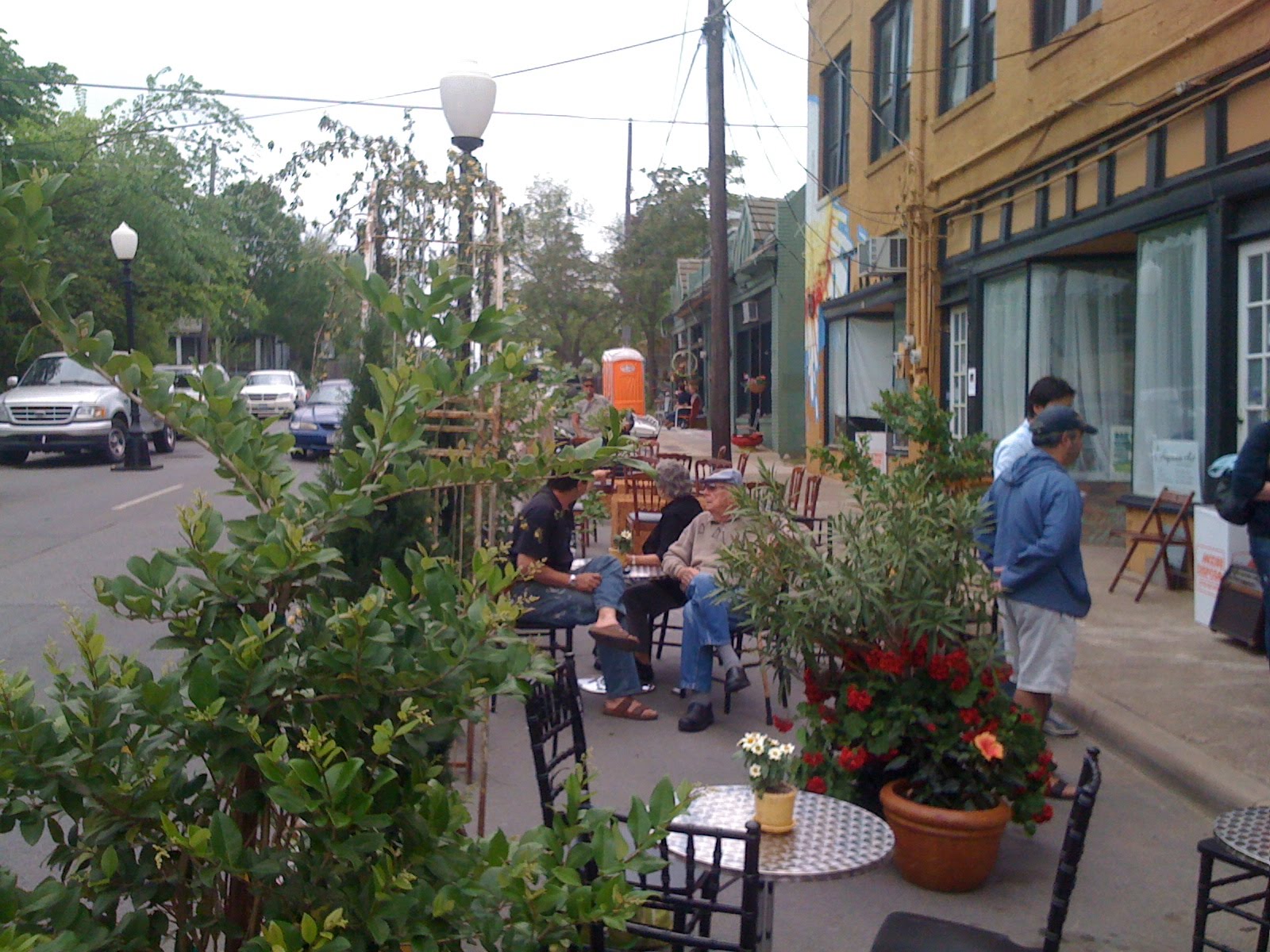
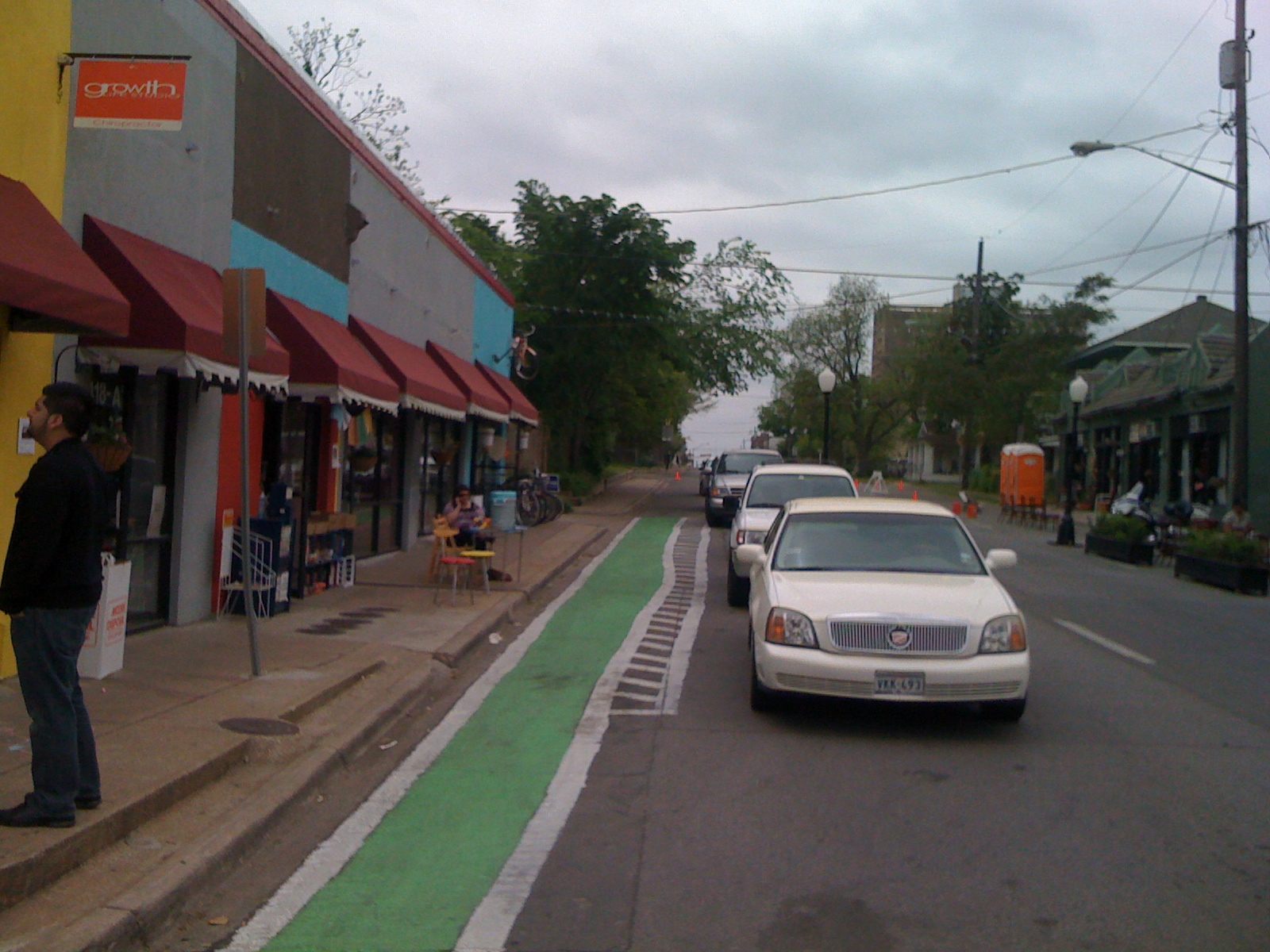
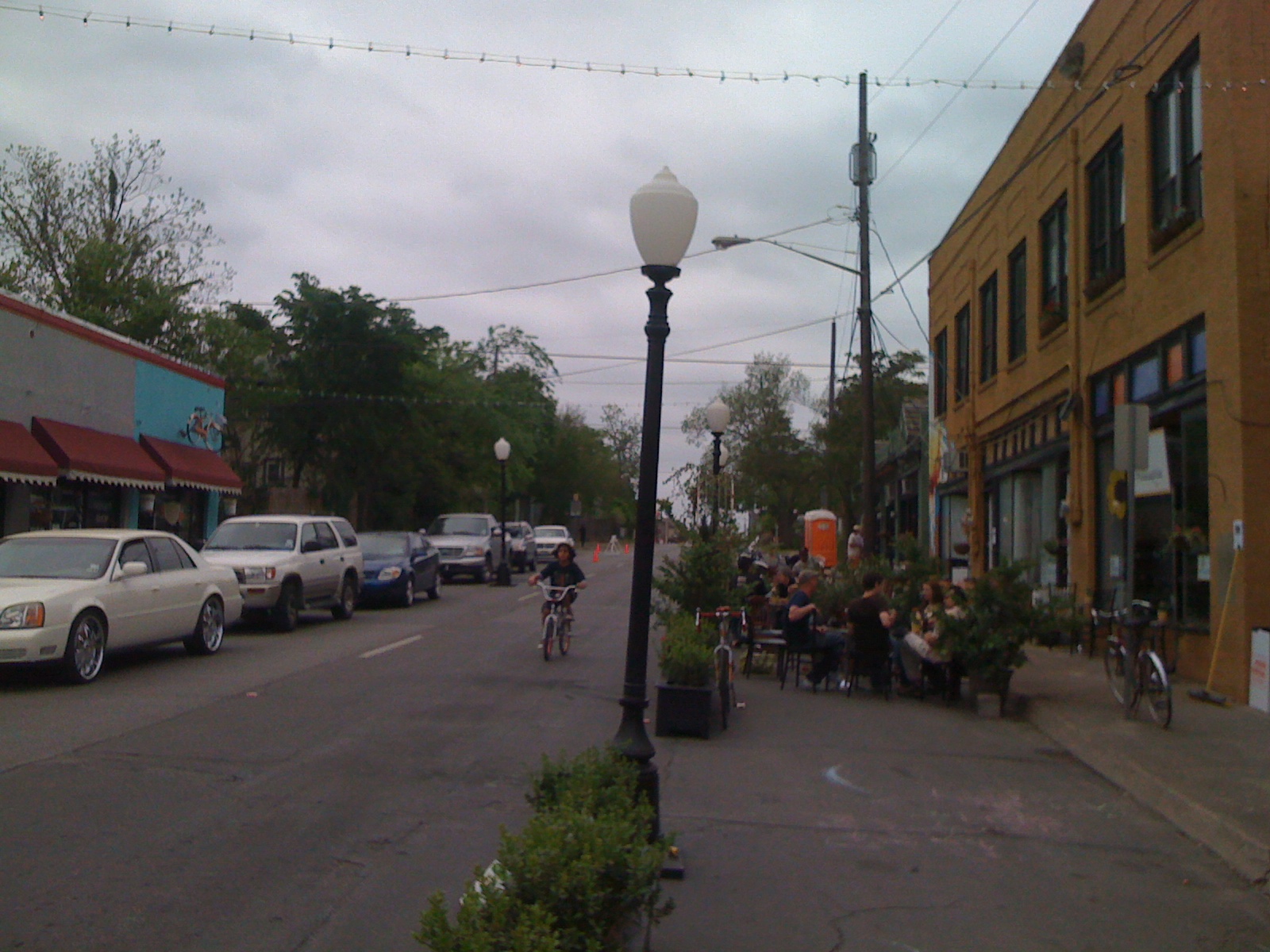
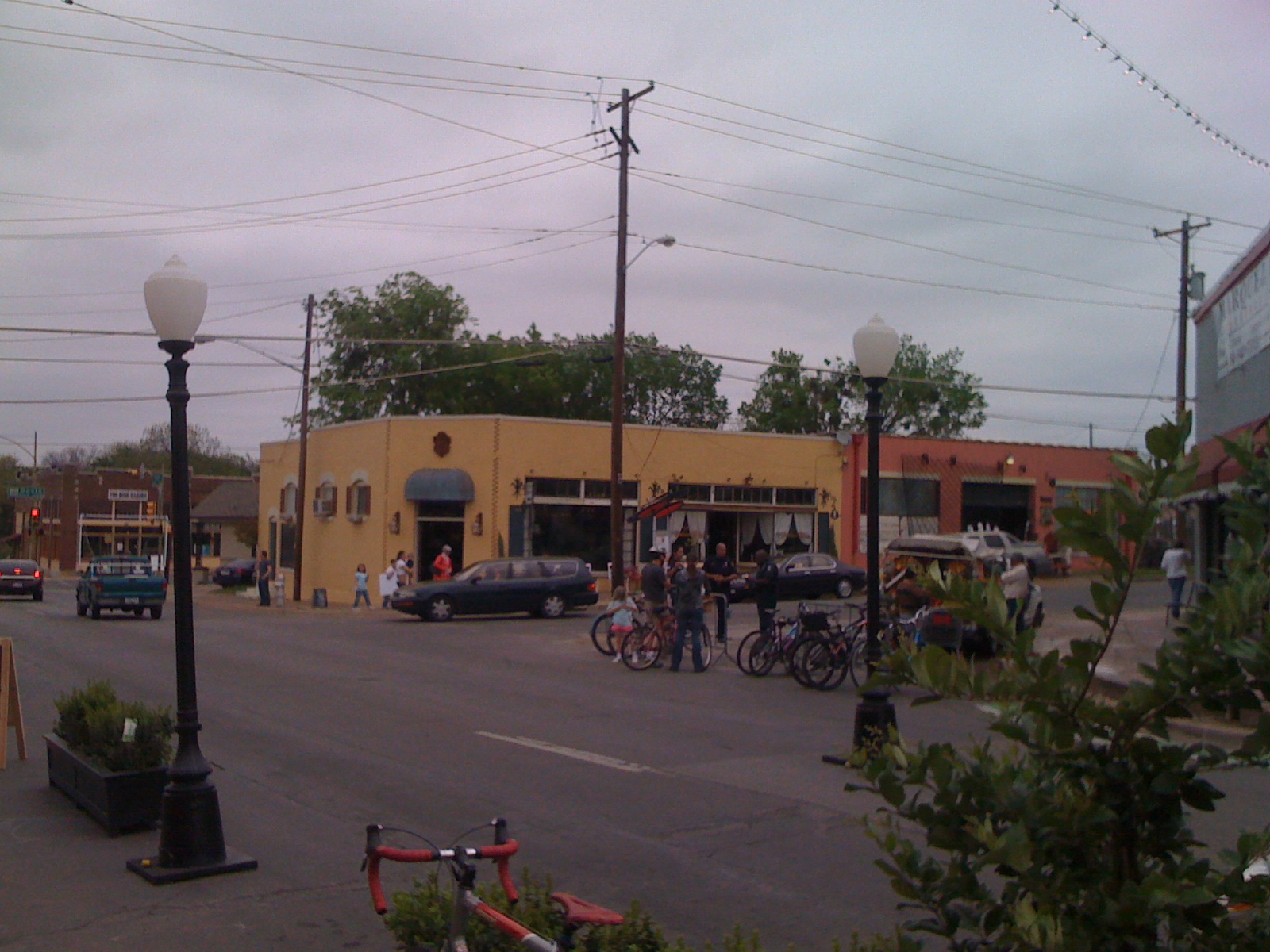
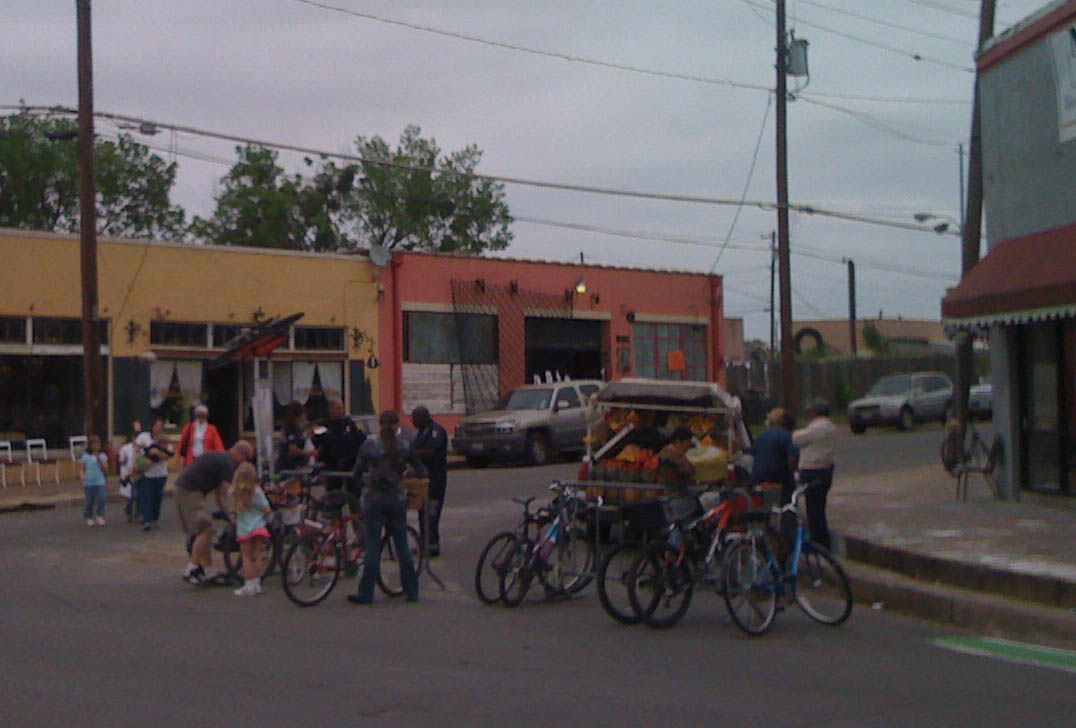
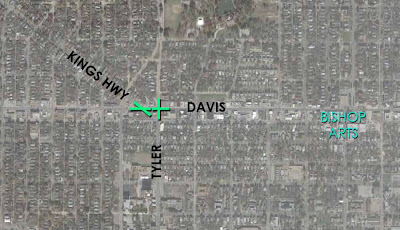
Yesterday, at the invite of Jason Roberts of multiple fames: Bike Friendly Oak Cliff, Build a Better Block Project, and band Happy Bullets, I was able to head down to X+ in Oak Cliff and check out their "citizen's arrest" of an untamed public street. In this case, it was the quasi-guerilla conversion of Tyler Street into a "complete street" that has been getting some publicity in local media circles.

What is a complete street you ask? It is a street that dedicates equal priority to various forms of transportation (or the opposite of) within the right-of-way (or building face to building face). This might include just vehicular travel, parking, sidewalk, and outdoor seating. In busier locations, it could also include various forms of transit such as dedicated bus or other mass transit lines. The purpose is to regain the necessary safety for pedestrian life to occur by limiting the domination of spaces by car travel and the infrastructural design supporting dangerous speeds through places.

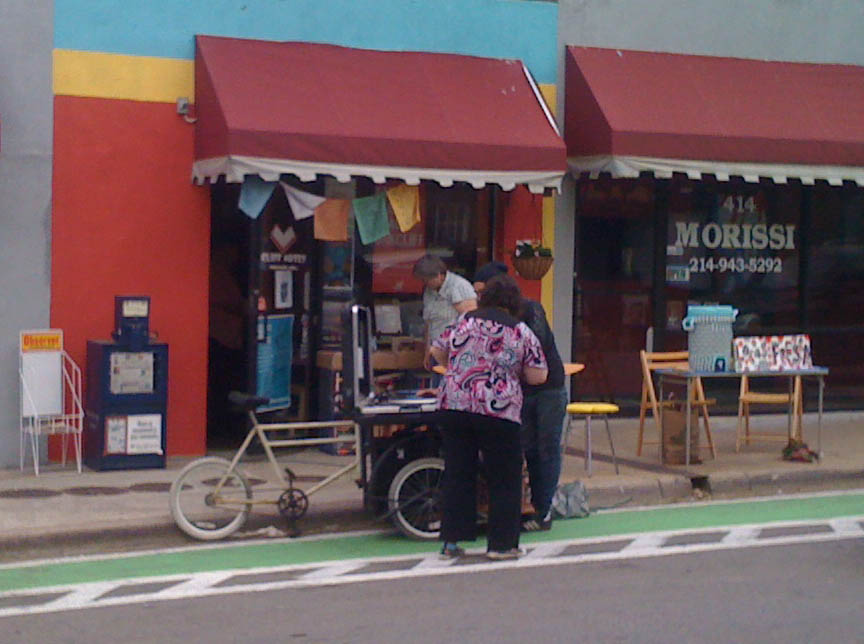
In action, the conversion of just one block of Tyler Street had a profound effect on safety (at least perceived), enjoyment, livability, AND commerce for the local businesses. Jason relayed to me that the local bookstore, Cliff Notes, had their best sales day ever on Saturday, the first day of the staged "complete street."

In conceptual terms, what Roberts and others did was to apply greater differentiation to the street hierarchy. In the traffic planning world, hierarchy is fairly simple. Each street generally gets one classification (arterial, connector, local, etc.) and that is that. The street is generally designed to be the exact same no matter the location or context. What this has done is effectively flip the natural order of things: where the most traffic is, the most density wants to be, and the most activity happens. Our street design was so car-oriented that the streets cutting through neighborhood centers such as this one became repellents rather than attractors; barriers to activity and economic development.

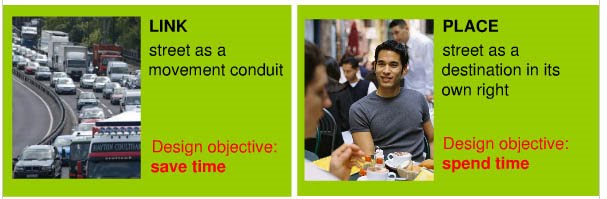
What occurred over the weekend at Tyler Street was the intuitive application of a second (and necessary) metric to street design hierarchy, that of Place. Using a two-dimensional tool for street design is a growing concept in both Australia and in Great Britain, places similarly afflicted by poor street design and transportation planning, but not to the extend here.


(graphic pulled from this presentation by Prof. Peter Jones)

I find it far more effective in appropriating design based on the dual purpose of streets which is the backbone of the report by the same name: Link and Place which details that public rights-of-way can be one or the other, or even both. If both is the goal then certain design elements are critical to allowing link and place to occur simultaneously considering efforts at "saving time" can often be in conflict with the desire to "spend time."

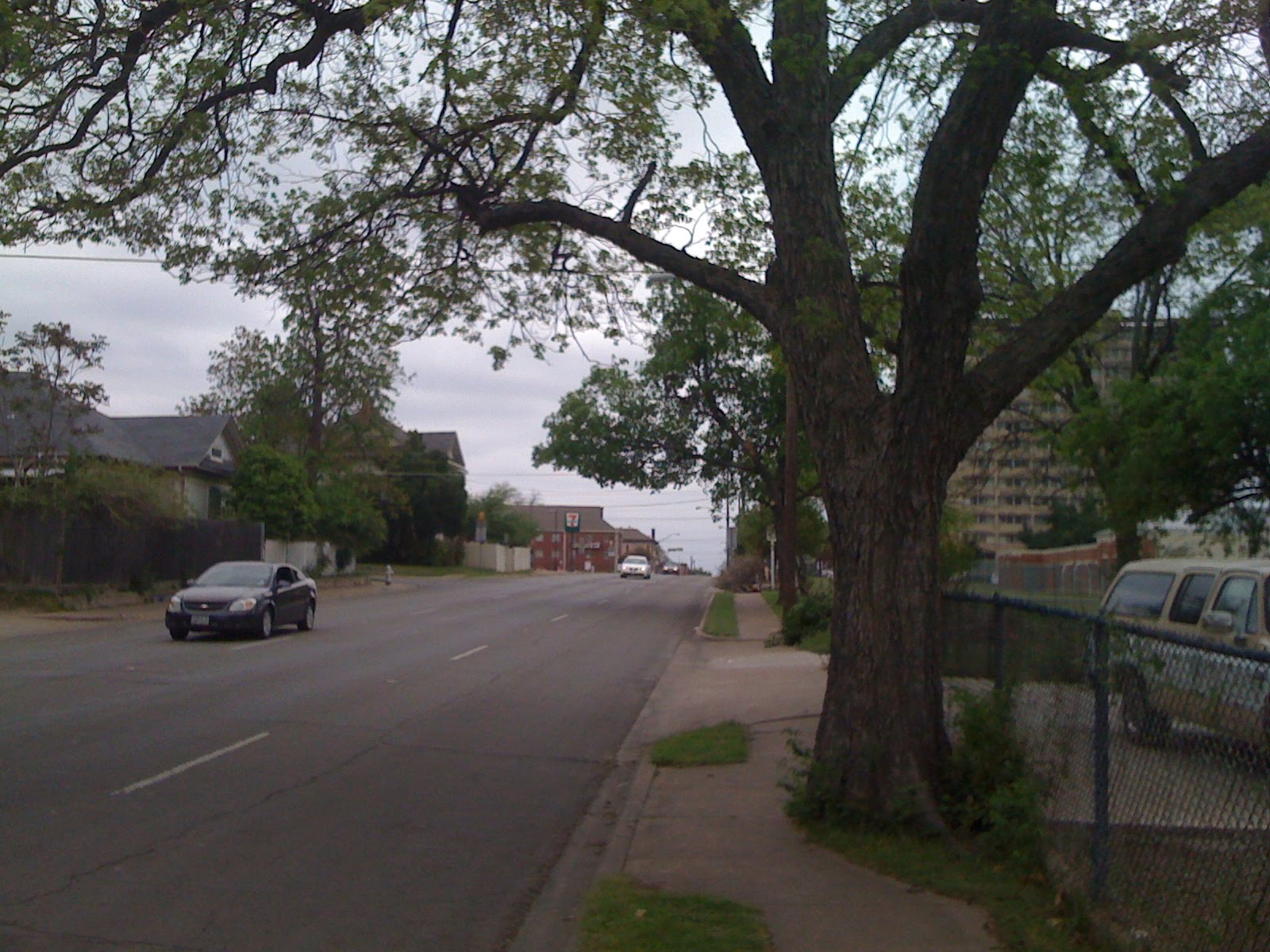
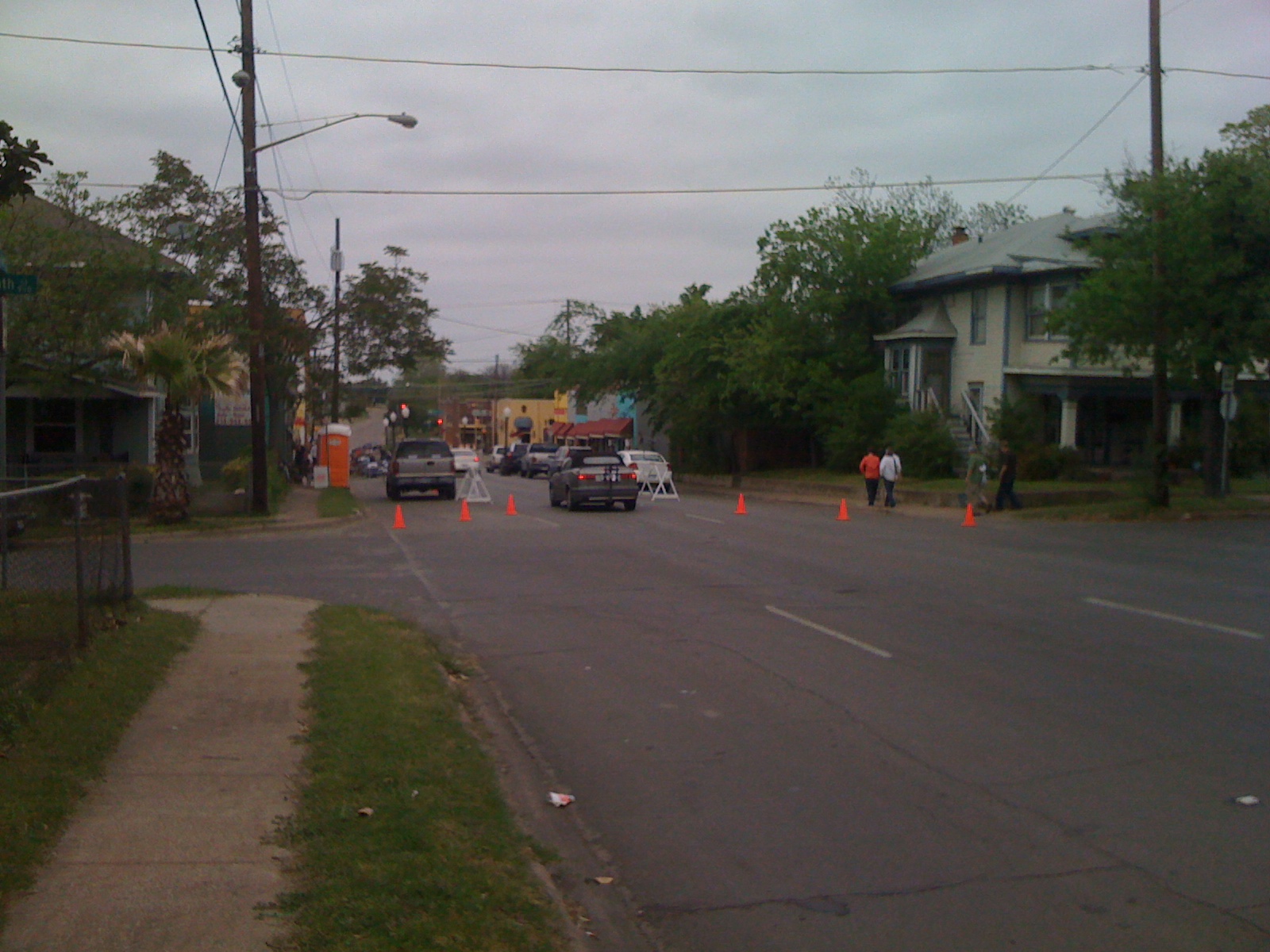
Because the transformation of Tyler Street occurred only on one block the contrast between street as Link and street as Place was striking. See for example this picture looking south along Tyler where the Street remained untouched:


Wide. Narrow, inconsistent sidewalks. No parking except off-street. It isn't a stretch of the imagination for you to take my word for it that these cars were driving in excess of 45 mph despite their static pose for this shot. We know that speed regulation and enforcement is an utter failure of policy and expenditure of resources. Cars and their operators will only drive as safe as the conditions and design of the street allow them to feel comfortable to do so.

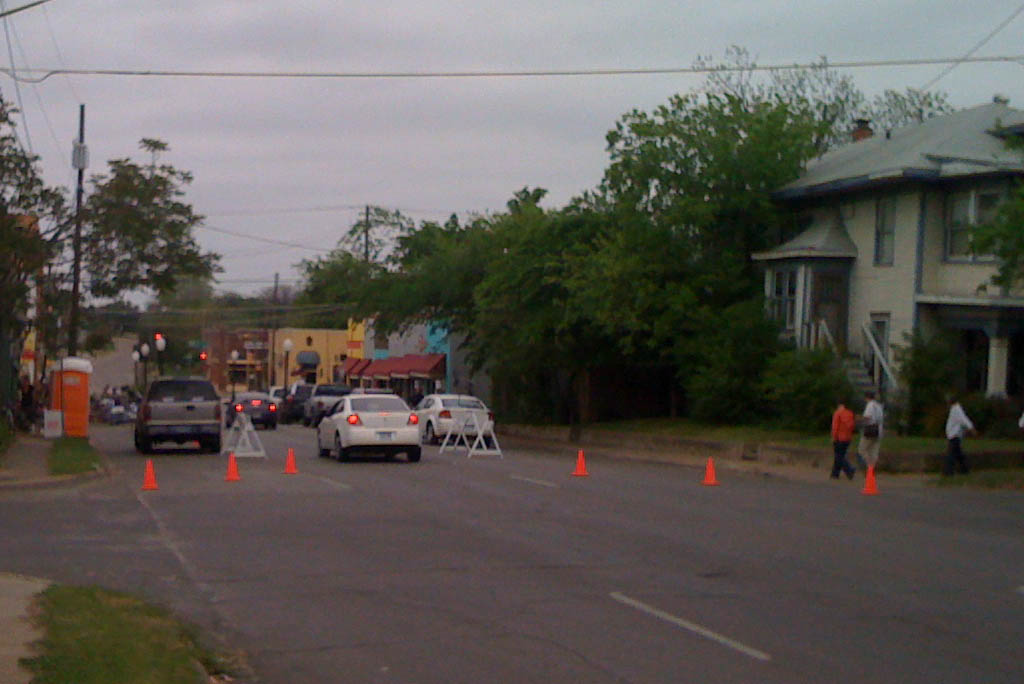
So what happened when these cars hit something out of the ordinary?


Break lights.


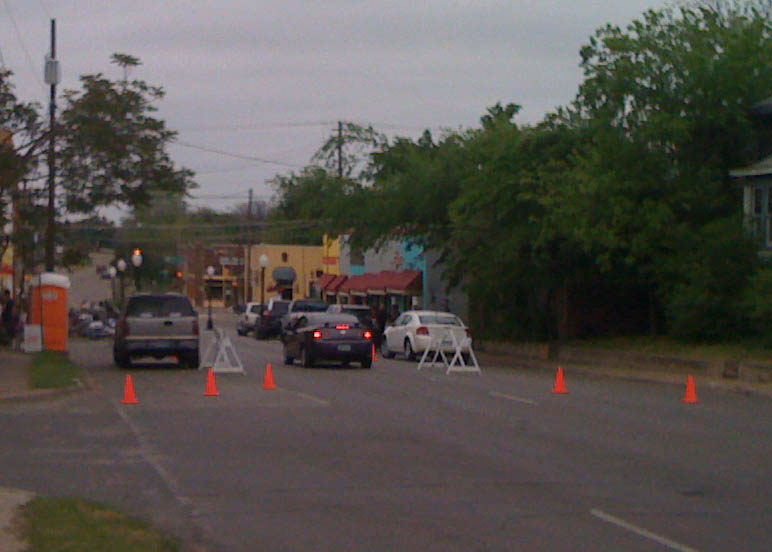
Are those break lights? Sure look like it.


Let's look closer at the third car... yep, those are break lights. In fact, the cars would drive so slowly through the "Better Block" that people felt comfortable enough to "jaywalk" and even blindly cross the street without even looking for oncoming traffic. That's a safe street. The environment ensured it. This delay of possibly an extra 15 seconds of each driver's life was reacted to not with rage but more often of admiration and amazement. One overheard comment, "I wish my street was like this."


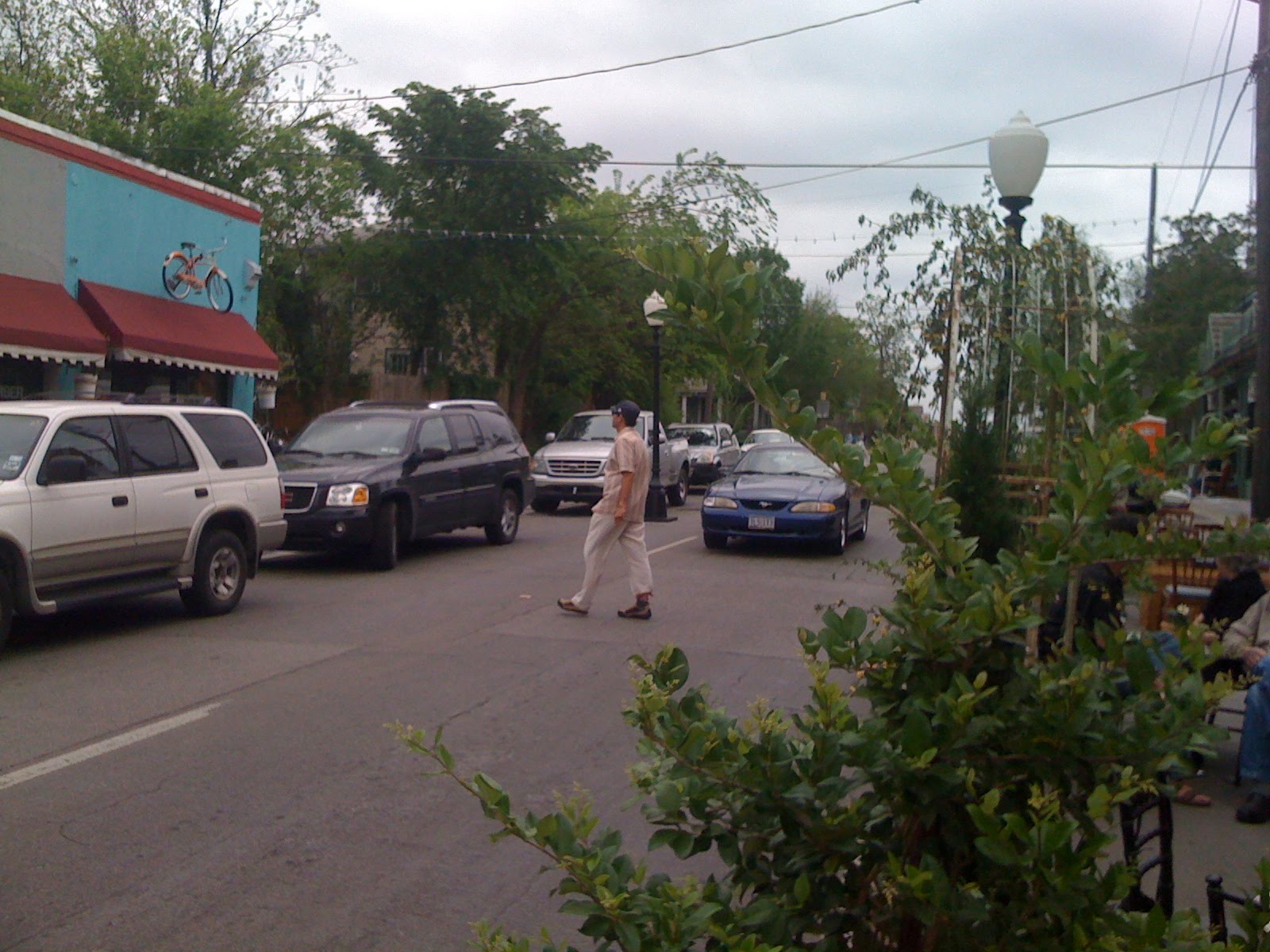
People of all ages showed up to socialize, people watch, and "spend time," representative of "slow" living that allows us to take time and enjoy life and the company of others, differentiating us as humans from the assembly line logic of traffic planning.


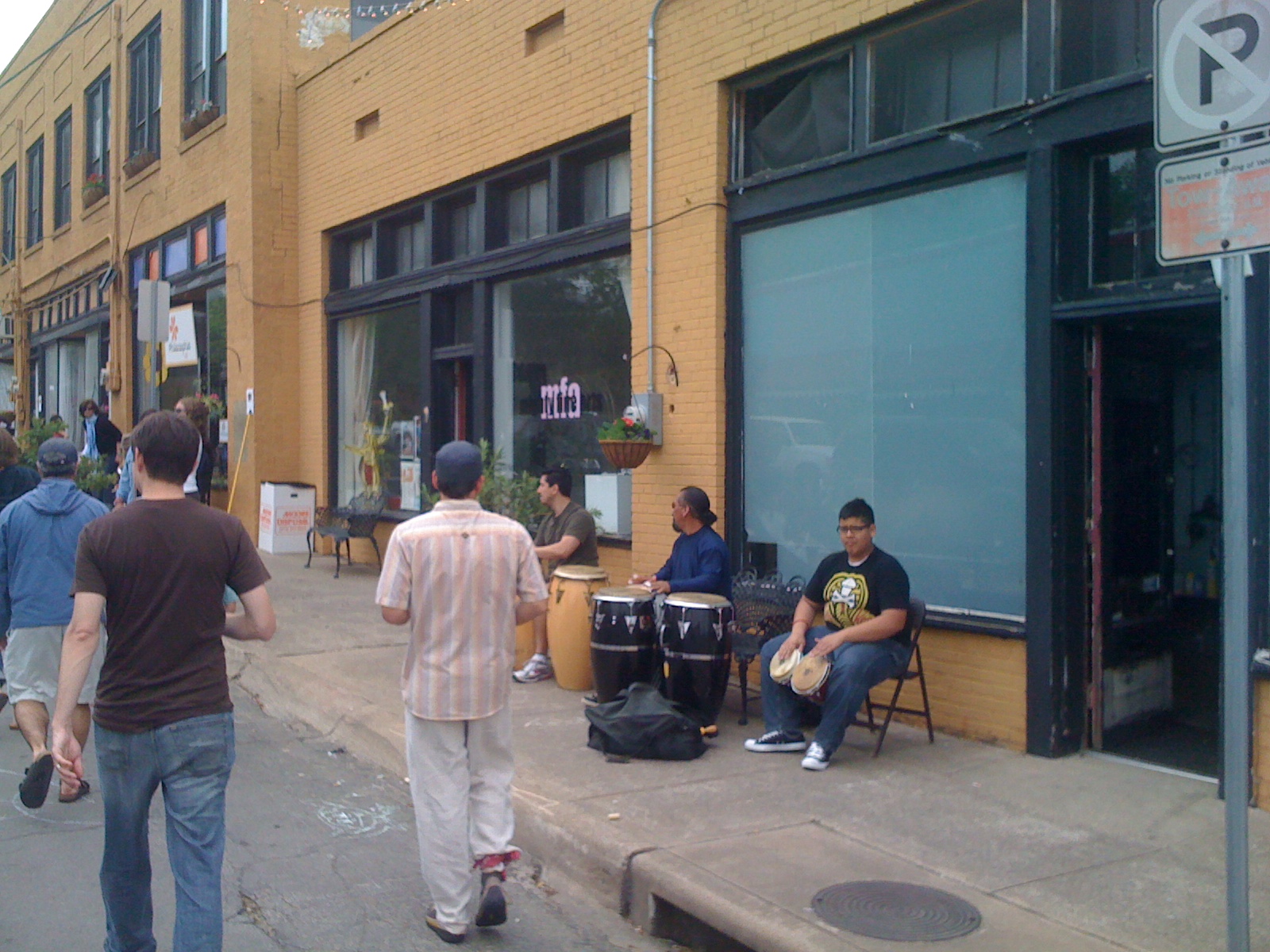
Above: yes, that is a set of turntables on a mounted rig on a bike. Below, adding to the ambience of urbanism, the sensory experience whether it was tastes from the Brownies in a Jar from around the corner, or the sounds of bongos played on the sidewalk, or the smells emanating from the coffee shop, the complete street fostered a participatory environment where businesses, residents, and visitors all took part, whether as performer or passive observer. All enjoyed experiencing the life so missing from so many parts of the City. All prevented by written policy. This was Jason Roberts' point.


Above: the painted bike lane with on-street parking at such a distance to avoid conflict between door openings and bike traffic.


One interesting lesson was that the street had been so effectively narrowed that the bike lane in effect was merely a rhetorical prop, much like the traffic lights. The kid in the above photo felt fully comfortable riding in circles on the street, as did his parents nearby. However, it should be pointed out that the bike lane would increase in efficacy as it lengthens and extends further along the street defining the place for bike traffic as a street morphs in various forms or design sections based on its place within the Link/Place matrix.


It has yet to be listed or defined as a livability indicator, but the presence of bicycles clearly is one that relates to Babies! or AYFs. It is one that is predicated upon safety. At Tyler Street yesterday (and presumably the day before) there were strollers and bicycles a plenty.

Once safety, lowest on the Maslow Hierarchy of Needs, is achieved (when cars, the most deadly of transportation modes, no longer have priority of space) only then can culture be meaningfully introduced. With the right urbanity, the right platform, it occurs naturally through citizen created vitality. Art and Music were both present in a place we could call a real arts district, where more people (and culture) were on each day of the weekend than the named Arts District (which illuminates the challenge of the Dallas Arts District).

This can't just happen anywhere however. As I pointed out to Jason yesterday, these will be most successful in the areas where it is most inconvenient, areas with the most convergence, which naturally form the centers of neighborhoods.

[The sound you just heard was not another stadium implosion, but the brains of ten traffic engineers exploding as their world, their belief system is no longer valid. Their bibles for how to move cars are instantly irrelevant.]

Neighborhoods throughout the city deserve similar experiences, places to go that are within walking distance and spend an afternoon cheap on the wallet but valuable to the soul, with family and old friends, or new ones (hopefully just friends, but for the single folk, perhaps make new families too. Walkable DFW does not sanction polygamy.). However, the transportation system deters this from happening. In our attempt to allow for the most amount of traffic through our neighborhood centers, we eliminated the ability to have the most amount of traffic (foot traffic), and in turn, do the most business.

Will these compete with malls or power centers in terms of sales receipts? No, but neighborhood scaled activity hubs are central to our every day lives. This is real economic development that doesn't take the nonsensical public spending on highways, but rather by eliminating the barriers to real urbanism is what economic development should be all about. As I have said before, intra-city commerce can occur in any form, it is up to us to determine the right transportation network to build and foster the formats which we would prefer.

What the Tyler Complete Street represents:
  1. Citizens taking their streets back. They've paid for them, and are unhappy with the way their streets have been mismanaged and designed in a way that hinders quality of life.
  2. Street behavioralism at work - and its interrelated connection with "place" creation.
  3. And relatedly, the utter failure of traffic and transportation policies and how they relate with city form and urban design.
The last part is the scariest. It gives the most credence to the growing notion that centralized planning is defunct. In some ways it is, but only in the way Frank Gehry and others understand the 20th century version of planning. To say all public/government led planning is failed and that this version is the only ideal version is also false. As I've said before, it is about eliminating the barriers to both economic and community development. In most cases, this means undoing the "planning" of the 20th century: the highway and arterial system.

See New York City where Transportation Commissioner Janette Sadik-Khan is transforming that City with some paint and jersey barriers, redefining the public realm to prioritize pedestrian activity rather than vehicular movement. It is the difference between buying a potted plant and actual gardening. It is about creating the platform, fostering and tending to places to encourage vibrancy rather than attempting to bestow it. And the public sector has the onus on removing the barriers by correcting its mistakes. It will be paid off in spades with a real "World Class City" rather than one that we so often incorrectly label as one.

In many ways, fostering urbanism is about letting go of control. Gardens and ecosystems don't grow optimally with over pruning. A world class city is one that people love. People loved what was happening at X+ yesterday and in Bishop Arts with the Arts Crawl. I know I loved it.

Monday, March 22, 2010

X+


One thing that has always bothered me about large-scale urban developments is the renaming aka rebranding of areas as if by Mickey's magic wand from Fantasia. Areas can't be named by marketese through exhaustive, expensive, (and useless) branding exercises without sounding overly generic, undermining its ability to catch on by achieving ownership of the name by the locals.

Some that have proven successful are often broad, encompassing and either tied to its place geographically (various uptowns, midtowns, etc.) or historically (ie meatpacking districts, etc). In that way, they contribute immediately to the sense of place and the viral nature of the conceptualization of a place within the hive mind of the populace. The culture immediately adopts it as something that makes sense and is attributable to the location and character of the place.

A school of thought exists that artists make the best pioneers into new areas. They are flexible with their needs and are looking for cheap space to colonize and work with and be around other creative types. By moving in and fixing up the rundown, they qualitatively improve an area enough to make it register as a target for possible investment area for developers, and further qualitative improvement.

Those creatives who have since colonized Bishop Arts, making it a location safe for more buttoned-up, risk averse, professional types to invest in homes in areas with unique character, have since moved Westward apparently deeming Bishop Arts too passe now that the yuppies have graduated from uptown/West Village. This new emerging area is deemed by the locals as "X-Plus" or X+ for short.

Bottom-up naming and "place" creation like this has cache. It sticks.

Creatives are the worker bees in search of new honey patches for the colony. Some areas have better honey, better bones for long-term resilience, or neighborhood vitality.

From an urban form standpoint, X+ has many things working in its favor: decent nearby housing stock, interesting historic buildings worthy of stewardship and rebirth, and most critically convergence. The convergent form in this case is even the promethean force in the naming of the very place.

Less importantly, it has two things that are outcomes moreso than they are causes - new streetcar and an overall rezoning plan, but will nevertheless help to participate in the gentrification process inherent and inescapable as all places evolve from urban frontier to vibrant, funky and unique locales into staid, yuppie enclaves.

Don't fight it. Work with it. Nurture it and help shape it. The ever-migrating process is the revitalization of your City.

See more:


Tuesday, April 14, 2009

"The Era of Bling is Coming to a Close"

From Christian Science Monitor:
Cooke & Co. was the Bear Stearns of its time, a pillar of national finance. If it could fail, anyone could, and the US stock market collapsed that awful autumn. The price of real estate, railroads, and other hard assets crashed, too. Banks fell like wheat before a reaper. Deprived of credit, Main Street commerce suffered. Unemployment reached 25 percent in big cities. The Panic of 1873 eventually led to 18,000 business bankruptcies. National production shrank for six years. Yet a new and stronger US economy emerged from the wreckage.
I have to say though, that I disagree with #10 - The Bust of the Boom Towns. As long as we are accepting "growth" as the axiom our society, economy, and standard of success is measured by, the Boom Towns still have the most work to do. Reason 1, why I am here in Texas.

Yes, they boomed. But that economy of growth was a false one in cities such as DFW, PHX, and Vegas. 99% of what was constructed was worthless. In the cities of the Northeast, not much growth is expected, if at all. What growth will occur will be simply putting people back to work with minor deviations in what they are actually doing.

Here, we have the most work ahead of us in terms of overall reorganization of both people AND economies. Much of the economic growth was in Real Estate and it played out on the land with exponential quantitative spatial growth vastly outpacing population growth.

If this City is smart they will get on the ball and set up a streamlined zoning, entitlement, and approval process for mixed-use, mid- to high-density development AT LEAST in set areas, such as Leinberger suggesting that Dallas needs ten 100-acre high density overlays. If they set up these overlays now, the planning work can get started and developers will be ready to build in ten months or two years, whenever the lending purse strings loosen again (or if again means never, then we need to find a new way to finance these things).

We know the market is there and the demand is there. As I wrote here, Millennials are the largest demographic group (aka "market") in American history and they are redefining the world around them through their shear mass, vitality, and collective directed vigor.

It will be a race for Sun Belt cities to not only be "cool" again to compete for talent in an ultra-competitive and mobile knowledge/creative economy (where real economic growth is created thru startups and innovation), but also in order to be relevant. If not for the Real Estate industry fixing its mistakes, I'm not sure what other markets are out there to pull the Sun Belt cities out of a certain prolonged recession.

Tuesday, March 10, 2009

Kraft Food vs. Craft Food

TreeHugger. This table tells the story of what needs to and is happening in more industries than just food production:

FeaturesOld ‘Industrial Food’ EconomyNew ‘Creative Food’ Economy
Prototypical companyKraft - cheese productsCraft/artisanal cheese
Sources of economic powerEconomic power is centralized National/international production, processing and marketing Concentrated farms and control of land, resources and capitalEconomic power is diffused and decentralized from owners or controllers of means of production to individual, highly creative knowledge-workers and extra-firm institutions
Sources of quality and innovationQuality is a measure of added value in highly-processed environments or incremental innovation in packaging and marketing of existing food products (e.g., 27 different kinds of Oreo cookies)Quality is a measure of taste, terroir, and talent of entrepreneurs making new and innovative products
Enterprises’ attitudes towards placeFirm or company located close to traditional production inputs like raw land, and transportation networks. Little relationship between place and product making. Preferences for place are subordinate to traditional company inputs.Traditional production dimension important, but place becomes central to quality food making, marketing and consuming