

Showing posts with label Celebrity Guest Post. Show all posts

Thursday, January 6, 2011

Reader Rant

Published with permission of the emailing author (emphasis in bold is mine). Warning potent levels of profundity herein:

Happy New Year!

Let me begin by saying I have been reading your blog for more than a year now, and found it very useful when preparing for my PhD qualifying exams. I've moved to Dallas a couple of years ago to begin my doctoral work in humanities. Of course, the lady who approved the student visa back in my home country could not help but smile when I told her I am focusing on aesthetic studies in Texas. Anyhow long story short after about 7 years of studying and working in the north-east including NY, Washington, Philly...I ended up here in Dallas. It's been about 2 years and a half since the day I landed.

I never had a car, I never owned a car. I've never had a license, not in the US, not back in Europe. I "survived" Dallas for two years commuting up and down from Plano to Downtown and Irving by bus, train, shuttle, etc. I "survived" the long transfer waiting periods between bus and train. Many times this waiting extended up to two hours in 110 degree heat, because one bus driver decided to talk a bit more on his cell. Other times the bus system seems to work according to what kind of cigarettes a driver smokes. 100s of course burn slower so pose the risk of the passenger not catching his/her connection, menthols however will take one to the transfer point in time. That new function on the DART website that tells you where your bus is makes me laugh in the light of all this. And of course I cannot help but bitterly smile and remember how annoyed I used to get back when I lived in Berlin...annoyed by their perfect public transportation knowing that if the clocks on a train platform would announce a 3.49 minute wait, then it would be 3.49 minute, no more nor less.

I have walked miles, hundreds I might honestly say all around DFW, the last long walk being last week from South Irving downtown. One of my weekly walks now is from White Rock Lake area to Mockingbird Station...plainly put, a distance greater than between Union and Times Square...a totally walkable distance in NY yet made more miserable by all the parking lots and non-spaces in between here in suburbia.
I learned a lot about this city just by walking. I feel I know it better than probably the born and raised here. I know the city because while others were driving by at 40 or 65 mph, I had the time to stop, and look around. I had the time to walk around a corner, a passage, etc. Hard to play the part of a flaneur in Dallas, when there are no people to watch.

I have tried biking around, but since I am not a pro I found it more dangerous than walking. On the other hand while walking for pleasure around White Rock I have encountered dozens of Lance Armstrongs who, with their $3000 bikes, disregard pedestrians completely. Walking around I have also pondered over the absurdity of some biking laws. Why do I have to ride my bike close to the curb, and not on the sidewalk in a residential area when most of the time those sidewalks are completely empty? Yet why around White Rock the mix use lane has turned into a race track, when there are more people walking around than on any street? (ed. note: this gets at my point that cyclists need adequate infrastructure within the street network)

So in the end it wasn't the walking through nowhere, heading nowhere, it wasn't the fact I was waiting in cold or dead heat for a bus that might never come, or the smells on these buses, it's not the fact DART is an expert when it comes to making transfers feel like time spent in limbo, In the end it was the people and their lack of public transportation education. The ones who have no clue how to make use of the whole train car, the ones who piss on the buses, the ones who will threaten to punch you in the face when you ask them to take a step or two forward in the middle of the car where there's plenty of space, etc. It was also the bikers who disregard the pedestrians, and cars alike. (ed. note: we're all animals in a zoo and we behave based on expectations and rules set forth for us, transportation included)

After ten years in the United States and two and a half in Dallas I called it quits. I received my license three weeks ago and am looking forward to close myself in a steel box on wheels to merrily speed up and down the highway. I am ready to feel the American freedom by becoming dependent on oil (ed. note: delicious use of irony). Every day heading to school I am going to repeat to myself that "spending $5000 on a clunker, spending another 2000 on insurance, and hundreds on gas..." (probably my entire scholarship) is part of the "merican dream, of the precious freedom that might be taken from me by officials who want to support public alternatives of transportation.
In other words I will begin playing the part of the mythological stubborn asshole American patriot for a few years until I can make it out of Dallas, until I can return to a city where pedestrians, cars, and bicyclists kinda work organically in peace. (ed. note: see why we're losing people? In car culture, you are not free. People, especially exceptional and talented people, like those getting PhD's want real freedom.)
Off the top of my head: New York since I've been living there. I will of course not begin comparing US cities to European ones.
Hopefully I will survive the car experience, as I will encounter other types of asshole bastards. But it is a new adventure. Yes I already hate driving, I hate not being able to read a book or work on my dissertation on the TRE, and I hate this feeling of emptiness that I was suddenly aware of going up I 75 (also my first time driving by myself on a freeway). I already miss the contact with people on the train, I miss being able to read their worries, or make up stories about them, but I don't miss the fear of potentially getting in an argument, or fight, along with different rotten smells. Here's a suggestion for the DART. Replace all the seats on the buses with plastic ones or thinly draped ones, just like in European buses or trams. Cushioned seats are sponges, they will contain the spit, piss, germs and crap of others. Replace the damn seats and people won't feel like traveling on an outhouse on wheels.

Anyhow I don't know where I am heading with this, oh yes driving. I am looking forward to drive to places I couldn't walk, to drive beyond the red, green, and blue lines. I will lock myself in a gas guzzler, a metal box and experience mindless driving until people here will learn what "public transportation" should be. I once again bitterly smile watching that new Green Line DART commercial on TV, a slice of wishful thinking, of diversity, mix use, happy faces, etc...utopia at its best. Beyond the station names shown, and the extremely fit people getting on the train, there is an emptiness, parking lots, kiss and ride stations, pedestrian ways going nowhere, spaces sometimes too large to be covered by foot and quite limited in attractions.

I'll miss you DART, I'll miss you nonexistent sidewalk, I'll miss you all, characters on the buses. Now I will be the one oddly watching pedestrians crossing the street. Now I will get even fatter. Now I will experience the 'merican dream with doors locked and A/C on. See you all on the freeway heading I guess to a deserted landscape reaching beyond the horizon.

Cheers!
C.
I'm going to focus my comments on the early bolded criticisms of DART from a truly seasoned transit rider.

Mass transit, perhaps like education, can be as good as we want it to be. The question is, do we?

Mass transit aids in creating and augments a functional city. We have a dysfunctional citywhere mass transit is ill-suited and therefore can look like a painful wasted investment... until the city adapts to its new bones, its infrastructure. Of course, those efforts are indeed wasted and undermined by continual propulsion of the insustainable, car culture. I don't mean that to say cars inherently are bad and nor do I declare war on them. I do however declare war on the misguided policies and subsidies that skew both argument and city.

Even with a city not built for mass transit, we could still better integrate bus lines and schedules with trains. Whether this is true or not, it seems there has been little thought put towards buses acting as a feeder/circulator system for DART in an orderly, hierarchical fashion. The argument is surely, "people don't like to transfer." Sometimes the answer is tough sh!t. People also don't like 1)buses and 2)bus systems that are incomprehensible and untimely.

A bus system that does not work in subordination to the train system works against the fixed-alignment rail system. Instead it does two things:
1) It exists and operates catering to a sparse, car-oriented environment. By doing so, just driving seems like a preferable alternative, and

2) because of this, only those that have no other choice but to ride the bus, do so, which carries a certain stigma, further limiting ridership.
I'm not saying make all bus routes circulators, but many should be. There ought to be a hierarchy of routes. The highest order should be BRT or BRT similar, along primary corridors in dedicated lanes that potentially could become placeholders for modern streetcar (or not if the BRT is successful. Caveat: buses must be replaced every 3-5 years. Trains can last decades and decades, defeating the cost effectiveness of buses, especially if the natural gas to power the buses is garnered by firing garbage into the groundwater.). The rest should serve as spokes feeding the train lines which from an urban perspective, can carry more passengers and exist as more important centers (of gravity) - meaning more value.

Making bus routes to function as circulators thereby increasing "convergence" at station areas, thereby making land around stations more valuable, thereby increasing density within walking distance of station areas, thereby increasing ridership. Or is that 1) too logical and 2) too long-term?

Back to my original statement, how useful (successful) do we want the mass transit system that we voted for and spent money on to be? I'm reminded of Seattle mistakenly lumping bond initiatives for transit along with highway expansion in one vote. It failed. I'm reminded of China, pretending to be green, making bicycles illegal and building 40-, 50-, 60- lane roads.

This morning I was reminded of a study where people preferred a 20-minute commute. No more, no less. Long enough to decompress and transition in mindsets between home/work. Short enough as to not be oppressive. I remembered something I said at the Arts District round table event, "we have too much cooperation between cities. We could use a little more competition." Meaning, competition to be more walkable, more enjoyable, more economically functional in the way that cities were invented to facilitate.

Major cities tie the noose around their own neck allowing freeways within their boundaries. Vancouver, once ridiculed as backwards, now revered, never did. Allowing highways within the city is like jamming a straw into your heart to make it easier for the leaches. Those lucky enough to live in some of the excellent North and NE Dallas neighborhoods can have a 20-minute car commute, or they could not. It is entirely dependent upon the state of the highways, choked with suburbanites commuting in. The street network is dendritic, meaning everything funnels to the highways and there is very little choice, option, or adaptability in the system. Every accident or traffic backup, is a stroke to the city's economy.

We want to have our cake and eat it too. We want to tickle our bellies and pretend that cars somehow still = freedom and we're willing to drive off economic (and environmental AND social) cliffs to do so. But this cake is injected with oil. It tastes awful, is probably toxic, costs a boatload, and is the only thing on the menu. Customers keep walking out of the restaurant.

They're heading to others where they have some choice and can eat healthy if they so choose or not. That's the beauty of it, there is choice. New York, Portland, Seattle, Chicago, Boston, D.C., all cities 1) still in U.S., thereby gas prices are still held artificially low, 2) destinations for many many talented individuals, and 3) where you can have a car... or not. It is your choice. And doesn't choice = freedom?


Wednesday, May 26, 2010

GUEST POST: Bicycling in Dallas


Go ahead, drivers. Make my day.

These are fun. Why? Because I don't have to provide all the written content. Thursday afternoon, 5 to 8 pm, at City Hall in downtown Dallas is the Bike Plan open house. Will anything substantive come of this particular session, probably not. But, it is a chance to commiserate with your like-minded peers...and there'll be punch and pie!

------------------------------------
Putting My Hard Hat On and Going to Work.

Yes, I ride my bike. Or, should I say I am the pimple that the city of Dallas drivers can’t seem to rid themselves. I may be a speck in the grand scheme of a City where commuting is an antagonistic affair, but I am certainly the most annoying of all opponents delaying you from that rat race.

It might actually seem feasible to reach a downtown job by bicycle for a resident of the yuppie village region of Uptown Dallas, not more than two miles away. Too long to walk, the trolley is as reliable as its century old parts, and driving just seems ostentatious. It ought to be the perfect distance for what should be a safe, enjoyable ride if in a City that accommodated it.

Well, in the City of Dallas, it isn’t. With the luxury of great weather year round, I began commuting by bike three months ago. The trek is not far. I can see my building from my apartment, but the absurdity of navigating the region on two wheels is far too intimidating for most. As a safe, energy efficient endeavor, it shouldn't be. Alas, we've entitled those pointing and pedaling the much more deadly machines.

People comfortably ride bikes around White Rock Lake and on the Katy Trail, but hardly anyone rides on the street. Why? Because you can’t. Sure, you can physically ride on the street, but good luck. Without a bike lane to be found you are head-to-head with impatient motorists not interested in your safety, but rather, reaching their destination as expediently as the law does or does not allow.


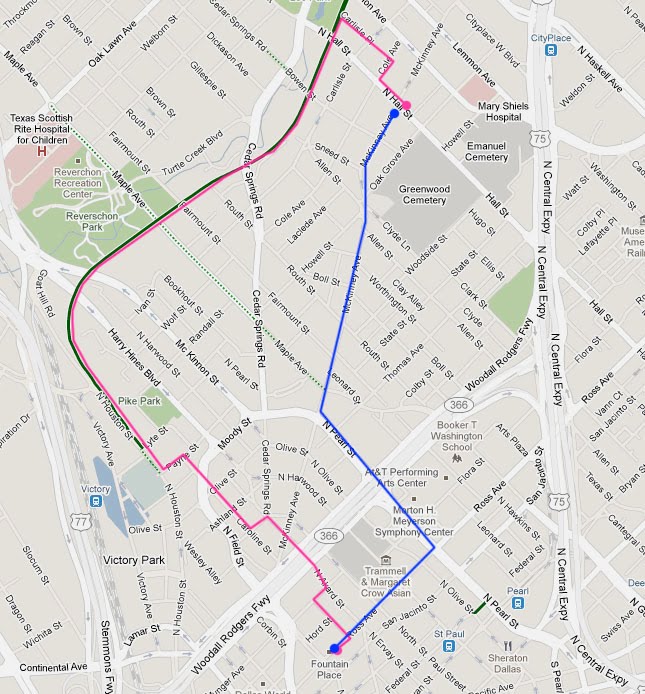
My commute is unable to take the logical, direct route: McKinney Ave, or snake through some side streets that might be more pedestrian friendly. No, my commute begins on the sidewalk to get to the intersection of Hall and Cole, or shall I say, the intersection of bicycle death. After I turn onto Hall, I then weave through a drive-thru bank (without making a deposit or withdrawal mind you) to get to the Katy Trail. Alas, I made it….alive. This is the only enjoyable portion of the commute. The Katy Trail is beautiful to ride alongside other bicyclists, people out for their morning jog, and experience some of the most beautiful green spaces in the city.


ed: Ryan's route vs. the more direct one.

On the roads forget about common courtesy or patience from drivers. Usually the best strategy at intersections is to let every car go first, hoping that the next wave of motorists realizes your turn, but this is risky business. Look out for Sally Sorority in daddy's beamer on her cell phone willing to make you part of the street, or her vehicles grill. Three separate times I have been nearly killed as I perform a basic left turn onto Hall Street, with the right-of-way. Common theme: cell phones. All three motorists have been on their cell phones not paying attention. I could have been a biker, a walker, or a double-decker bus in London. It would matter not. A wreck or manslaughter is in their future. No worries. Daddy will cover it.

Once this portion of the commute is over, the real journey begins as I navigate a sea of parking lots in order to avoid Mark Martin, Tony Stewart, and the late Dale Earnhardt on their way to work. Crossing the highway is always the next obstacle where I stare death straight into its steely grate. Surprisingly, it is not too bad. With a preponderance of lanes, motorists provide bicyclists the right-hand lane. However, I do not doubt for a second that I would be run down for the next changing traffic light.

When my day is up, back to the Texas Motor Speedway we go. The return trip always follows the same route because the only safe section is the Katy Trail no matter how far out of my way it is, which in the afternoon with the sun out is even more enjoyable. There are no safe streets for a bicyclist. Of course not. You are a second class citizen. Perhaps soon we will have to drink out of separate water fountains.

The commuting back and forth is not nearly as bad as the first time one tries it. Like anything else, you get used to it, all of it. You have to accept that this City, not just its inhabitants, its drivers have cast you out. You are undesirable. Even dressed in office attire, as might be the case in any other City in the world, you are lumped into the small niche crowd of hardcore enthusiasts in spandex when all you want to do is get to work.


I suppose it actually is my fault foolishly thinking that biking to work, since it is such a short distance, was a good idea. I mean that bro honking and glaring at me from his Hummer because I properly turned left at the four-way stop, with the right-of-way, is clearly right. Look how important he is, he’s in a car. Duh!

A city shouldn’t have to “get used” to alternative, healthy forms of transportation. This city needs bike lines, a plan for nearby residents to commute safely to downtown, and a real conscience about promoting healthy commuting for a city known for the opposite. I am not Lance Armstrong, but I also don’t want to be that dead squirrel on the pavement.

----------------------------------------
Ryan DiRaimo is a local architect. He wants you to know that he's 6-5, 240 and plays in the NHL, but not for the Stars. Those endeavors might lead you to believe that he would be too busy to maintain a sports blog, a twitter account, AND be a favorite of the lovely ladies of Dallas-Fort Worth Metroplex. He does all of the above. Except for some.

Friday, March 12, 2010

Highway Guest Post Part II

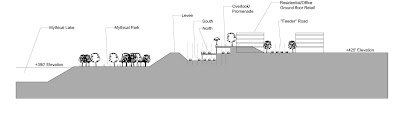
So I screwed up in my graphical representation of Toby's highway reroute plan. I should have showed all of the area around Reunion/Industrial as repositioned development opportunity zones. He has since admonished me and provided the section for the highway along the east/north?...uh, downtown side of the Trinity:

Click to embiggen:

He adds:
The +425' elevation is the grade elevation of Union Station taken all the way past Reunion to the new Highways. As discussed, the lanes on either the North or South Travel lanes that are to the right of the support columns could be "through" lanes that have a variable toll depending on traffic conditions. The other lanes have access to interchanges that get you to I-30 or I-35 as they branch off. The "feeder" road could be a repurposed Industrial Blvd that acts as a feeder to the new highway and gets you access into downtown.
I think at this point, we could also add a pedestrian crossing to the overlook to the Trinity. If we're going to still have highways between downtown and the Trinity, this might be the only way to allow for a realistic connection.

Tuesday, February 23, 2010

Celebrity Shot! - Guest Post

In last night's late posting, I decided to add my two cents to an article that no one could yet see. Presumably because it was over the head of the typical reader to which local major media outlets cater. And therein lies the niche that the blogosphere fills.

Due to popular demand, and without further ado, but with his permission, I present Russ Sikes's article on Dallas the Synthetic City:

Dallas: Syn City
by: Russ Sikes

Perhaps Dallas' identity crisis began with John Neely Bryan muttering to himself “Why build here?” Whatever its origin, 150 years and six million people later, the lack of an evident geographic purpose for the anchor city of this vast conurbation still troubles our psyche, inspiring episodic attempts at self-definition.

Our latest, “Live Large. Think Big” may make a great Chamber of Commerce come-on, and it does impart a sense of the spirit and possibility Dallas offers. But it's more lure than identity.

What IS Dallas really, this city of aspiration, ever in the making? The fact that we ask the question perhaps reveals more than any answer, but at a recent party, I finally heard a moniker that struck a chord: “Dallas, the synthetic city.” Synthetic. Instant ouch. Synthetic suggests man-made, artificial, contrived.

    Man-made. Absent striking topographic features or coastline, most of our regional attractions are indeed constructed, including all area lakes and reservoirs. From our glass and steel business district downtown to glitzy sports arenas like AA Center and Cowboys Stadium; from entertainment clusters at Six Flags, Lone Star Park, or Texas Motor Speedway to vaunted shopping meccas like Neiman-Marcus and Northpark—even to vast, land-locked DFW airport—the celebrated features of this metropolis are thoroughly man-made.

    “Artificial”. Big hair, fast deals and ostentation are part of the Dallas package. “Fake it till you make it” has been a creed among ambitious Dallasites for decades. In physical form, it is evident in the sea of simulacra that blankets the horizon, McMansions and theme restaurants fairly boasting their pretentious inauthenticity. Such traits do not speak of self-acceptance. Quite the opposite, they reek of striving and guile.

    Contrived. Public ice-skating rinks in a land lacking natural ice, “heritage” fairs in subdivisions with saplings still sprouting guy-wires, Connecticut-green lawns whose ruler-sharp edges strike a property line against spare buffalo grass, much of our area is forcibly contrived into being. A Trinity River re-fashioned as lakefront property sporting Calatrava bridges only accentuates this point in exclamation.

Yet for all this, the Synthetic metaphor conveys deeper, more positive connotations too.

To synthesize means to absorb, to infuse what emerges with novel and often superior properties. It implies adaptability and relevance, a capacity for assimilation. Dallas certainly has that...IS that. As case in point, here we were discussing Dallas as synthetic, a couple of immigrants: I, born in Boston, he from North Carolina, at a party hosted by a couple of musicians from Maryland and Georgia respectively, at a home in Plano that only 30 years ago was surely a cotton field.

Dallas synthesizes alright, largely people, and the ideas and vitality they bring. And despite our snarking at its synthetic character for cocktail-hour sport, our real vote is cast with our feet, not our mouths. Many of us who come never leave.

Perhaps it is the flipside of what we mock that attracts us.

Man-made has meant “self-made” to many, and legions here have made something from next to nothing. Texas Instruments, mainstay of the Dallas economy and emblematic of its rise, was among the first to transform raw silicon into high-valued components—a synthetic process if ever there was one. On an individual level, people like Ross Perot and Harold Sammons converted ideas, work and ambition into billion-dollar dynasties. Norman Brinker started restaurants from ideas on napkins. Mary Kay and Ebby Halliday blazed new business trails for women. They and countless others have achieved stupendous success here by synthesizing what was available to them into something more. Chances are that most of us, you and I included, can tout successes made possible through the synthetic potential of this diverse, expanding region.

Where long history and unique geography confer identity, they also constrain it. For its millions of newcomers, the Dallas experience is about transformation. It’s often why we came and what we seek. Our lack of long tethers here can leave an impression of shallowness, but it also leavens our possibilities. Artifice, contrivance and guile, ugly themselves, are perhaps inevitable handmaidens to the restless energy and aspiration that fuel them. It is unsurprising that their stark features shape the bland face of a region like ours, many of whose inhabitants are so newly-arrived, striving en masse to forge new lives.

Synthesis may even prove our salvation, technologically and culturally, elevating “synthetic” from 20th century pejorative to 21st century virtue.

“Sustainability” is said to be key to our future survival, and as Herman Daly explains, true sustainability requires shifting our consumption from finite stocks of resources to self-renewing flows in our midst. This conversion will necessarily involve various synthetic processes. Chief among them is photosynthesis, which makes virtually all other life possible, and provides not only our food, but increasingly our fuel too. Since nearly all of our energy derives ultimately from the sun, some form of photosynthetic bio-mimicry or novel synthetic processes are sure to provide the fulcrum on which a sustainable future rests.

Likewise, cultures develop by synthesizing their endowments: natural, human, financial, technological, to become what they are. But not all do so equally well. A 21st-century of global access favors the truly universal culture. Those that welcome and assimilate newcomers, that fully synthesize their contributions, will prove the most attractive, vibrant, and resilient. This has been key to America’s success generally, and to California’s in particular. As Texas swells into a “super-state”, the Dallas region too can shine among the stars.

Good and bad, wince or smile, an honest identity must ring true. To me, the synthetic city sounds utterly improbable, just like Dallas itself. So live large. Think big. Synthesize the life you want from all that’s available here in Dallasthe Synthetic city.