




Showing posts with label real estate. Show all posts

Tuesday, January 4, 2011

Ask the CarLess Guy?

Received this thoughtful question today, and one I've thought about for a long, long time but haven't really written much about specifically or in detail, but the issues are all familiar:
Patrick,

I am a reader of your blog, https://carfreeinbigd.com, and enjoy it greatly. However, I was wondering if you have ever given any thought to, or written about, how modern Apartment complexes play into livability versus how they were constructed in the past.

It seems to me most modern apartment designs are done on a multi acre scale instead of the old style (early to mid 20th century) of a random building or two along a street, relying on that street for parking needs. Modern complexes, with the exception of the Tx Doughnut, seem to be an isolated retracted space shielding themselves from the surrounding neighborhood. Newer complexes like in Uptown seem to be bridging the gap between the classic one off building and the apt community.

In uptown at least this increased walkability and density happened in a positive manner. Larger complexes, aka the village, are more suburban in feel and function. Most folks despite the density in the complexes still use a car to travel to the City Center, from their apt, however, based on the density you would think it's more walkable.

Classic apartments, in Lakewood, or East Dallas, Oak Cliff, ect, provide a nice mixture of income level folks without becoming a "scary Section 8" complex since a building or two by its very nature is so small. It minimizes the potential "scariness "of buying a single family home next to an apt complex. Additionally, they provide a nice mixture of density, without becoming overwhelming the character of the neighborhood. In the long running allowing it to slowly become densier and more walkable.
Anyways, I have rambled with long enough. Thanks for your though provoking post.

Without writing 10,000 words in detail of every little nuance and reasoning for the observed by-product of economic inertia, I try to respond:


Glad to hear from you and you are 100% correct in your assessment of the different development form and format. The deeper question then to ask is why did this shift occur and how did it happen. Then the next step is to determine if some measure of return to that real estate delivery system is 1) feasible and 2) desirable. The reason for the shift has a number of origins: new building standards/codes, Euclidean zoning, as well as financial mechanisms behind what gets approval for loans and what doesn't - which is typically the tail that wags the dog - in that it is a byproduct of the above, but then dictates it thereafter, hence the inertia of the entire real estate delivery system and why we mistakenly think of suburbia as a market demand.

All of these were in some ways a form of market determinism, but the solutions were ham-handed. They went too far and undermined, well, complexity and interconnectedness (interconnectedness produces complexity) if all evidence and Space Syntax are to be believed, which I do. It was like treating cold symptoms with nerve gas. Not sure the details of this metaphor parallel reality, but the hyperbole is intended.

As my next column in D magazine (February issue) will cover, physicists are showing that as cities double in size, they produce efficiencies in outputs. More specifically, this means about 115% increase in output for every doubling in population size. Outputs are data elements. Things we can measure and they can be both good and bad. For example, cities are the greatest invention of wealth generation man has ever created. This is the very reason for their creation along with the increased efficiencies of inputs within cities. Inputs are things like infrastructure, roads, energy, etc etc. Cities use 15% less of these things for every 2x of population.

Wouldn't every business man like this equation? Less upfront cost, more returns (economically, socially, and environmentally profitable).

But along with the benefits of cities, they also produce negative outputs, such as crime, disease and waste/pollution. Industrialization made cities awful, dirty, crime-ridden, smelly, polluted, disease-infested places with plenty o' poverty as well. We failed to innovate in terms of addressing these negative outputs from economic production and in turn, cities became the stigmatized places we still live with today. These actions begot an equal an opposite reaction (and probably overreaction given the state we're at today). We erased the city to erase the negative outputs of city life and also lost all of its benefits. Cheap (and now subsidized) gas/oil prices have only exacerbated/accelerated the process and further entrenched how difficult it will be to shift market sentiment.

Those that studied cities and found the efficiency numbers above, found that Sun Belt cities such as Dallas underperform on both the front and back-end. We are wasteful with our inputs (in that we use a lot of energy and infrastructure per capita) and we get less positive outputs, but because negative outputs are determined by population size, we still have all of the negative issues/outputs, aka crime, disease, pollution. To summarize, Sun Belt cities get all the bad and none of the good of cities. The bad is determined by population size, the good is determined by urban form.

Getting back to the specifics of building form, the reasons for the bigger projects rather than smaller are entirely economic: bigger banks and bigger developers and bigger architecture firms, etc require bigger returns and to get those bigger returns they need big projects that can maximize efficiencies in building practices. At the end of the day however, this only works for short-term financial gain, which is how the financial system is rigged, rather than long-term, continual and sustainable value. ie if a building is built cheaply so that it falls apart and is unlovable in that we let it fall apart, it will just be cast aside in the future. This is the throw-away economy of the 20th century as applied to cities.
Side note: one of these days I want to address the short-term vs long-term economic engines by way of stakeholder vs. shareholder economies.
Waste is a cost (the air we breathe, cost of creating/having landfills, etc etc). Fundamentally, we constructed a broken system. In the natural world, there is no waste. It is all closed loop systems, cradle to cradle, where waste equals profit. We've created the opposite as if it were possible. These outputs, waste, get externalized, ie written off. Somebody else's problem. We're starting to just now bump into those debts the 20th century accrued. Cities become profitable when we don't throw them away every generation and start again. Every building, every stone is reused, repurposed.

Furthermore, since a building might be cheap and ugly, everything around it withdraws or "defends itself" against adjacent ugliness for lack of a better word. This includes streets and the transportation system. It is all connected. Build a great street, say the champs elysees, value and density gather around it, embrace it, and it is financially rewarding to interface directly with it. Therein lies the depth of all of these issues and the bureaucratic entities that defend the status quo (from both a public AND private side). The bigger the entity, the more resistent to change, aka necessary adaptation. From a global perspective, this is why I think there are two types of evolution (whether in design or in natural world): Drastic and painful due to unwillingness, or gradual, incremental, and constant.

I also agree with you that the old way was preferable in that it creates more authentic, true, walkable urbanism - or better yet, functional, efficient urbanism as a platform for human livelihood. It is inherently complex, since it is interconnected (also in the 4th dimension in that it is tied to history, or some tradition, ie years of decisions/thought put forth years and years before - modernism also suffocated all of this thought - a selfish mistake by modernists). Interconnectedness is the primary reason for many chicken/egg dilemmas of urbanism. Also, I think what we call authentic is that it was incremental and demand driven. Much of what we see built today is supply driven, ie the housing bubble/burst. There weren't real demographic shifts calling for an extra 25 million new households, but the financial system (and its mouthpieces) said there was money to be made, so build we did...bigger and bigger, more and more.

I also think that if we can apply modern materials and methods to this process while making it economically viable to do so is probably approaching necessary at this point. So what we have to do is drill deep into the real cavities, the systemic issues and mechanisms producing the cities that we see and feel, and that aren't working for us, change them, so there really is no choice, but to build great cities, buildings, and places. I prefer a system that doesn't outlaw the bad, but rather financially punishes the bad and rewards the good. To do so, we have to be honest with ourselves as to what those cavities are and honestly address them rather than adding some veneers and calling them world class.


Wednesday, July 7, 2010

Post Holiday Linkages

The New York Times finds that on average urban living costs 18% less than its suburban compadre:
But the one big caveat in all the calculations is private schooling. If the city dwellers decide to send their children to private school — say when their children hit middle-school age — that expense would instantly make the suburbs a bargain.
Which is then supplemented by a senior level person at a brokerage firm who really offers no real analysis or insight beyond application of their own preferences, which makes you wonder what value does this person bring:
“At some point, the benefits of the city are not worth the things you need to give up,” said Jessica Buchman, a senior vice president at Corcoran, a New York real estate brokerage, for instance, when five people have to share one bathroom, or there’s no outside space.
As I've said over and over, it is about choice and meeting market demand. Truly urban places cost high for two primary reasons, the shear economic vitality raising salaries and the demand to be near that energy. If somebody's job (such as Ms. Buchman's) is to hinder or skew market perception or its ability to meet demand, then these are people you should be wary.

Speechless, I type to reiterate. I'm always flabbergasted at real estate professionals and experts who say people want one thing when price as dictated by supply and demand contradicts everything they say. This statement is NOT brought to you by the National Association of Realtors who want to remind you NOW is the BEST time to BUY. Please! Pretty Please! They'll even toss in random sex acts.

---------------segue----------------
Relatedly, two things pulled from the Patrick.net housing bubble mailing list:

Low mortgage rates scream now is NOT the time to buy, and

Yahoo Finance thinks housing could have as much as 50% more to fall.

I've been expecting a double dip for a while now if for no other reason than historical consistency and the human response to bear markets to beat the rush back to bullishness. Once that first wave fails to inspire necessary confidence in the market, back down the well it goes.

This has real world logic to it as well. The first fall could be very well attributed to too much fake money floating around in the system. Less money = less buyers and lower values. The next dip, which we haven't fully seen a correction for yet is the over-abundance of supply in conjunction with being in the wrong areas.

As cities reposition inward, that has to cannibalize from somewhere. That somewhere will be at the edges and areas not well served by transit or of extremely high end homes that will be able to maintain the properties (if they choose to remain secluded -- which is entirely possible if perhaps not probable).

-------------------segue---------------
Wall Street Journal picks up on the market demand for walkability:
A walkable neighborhood doesn't necessarily have to be in the city center. And it doesn't have to be more expensive. Eric Fredericks decided in September that, with the housing tax credit, it made more sense to buy than to keep renting. Planning on kids, he and his wife wanted a three-bedroom house in Sacramento, Calif. "We never considered living in suburbia," he says. But they found a new development in a suburb called Rancho Cordova organized around a main street, with stores and restaurants. Their 2009 house is six inches away from the house next door and a couple of blocks from the town center. It cost $240,000, half what he says he would have paid for a comparable place downtown.
Included if only because I once worked on some strategic planning strategies for Rancho Cordova as a young pup shortly out of school.

The rest of the WSJ article is a kindergartner's guide to the flaws inherent to WalkScore's current valuation methodology. See here for much better analysis.

-----------------------segue------------------
And lastly, Blair Kamin says to keep an open mind about pedestrian malling urban streets:

Clearly, there’s a hunger out there for better public spaces, especially in the city’s neighborhoods. With his ubiquitous median planters Mayor Richard Daley has given us beautiful streets, but the commenters also want livable streets—places where they can gather, socialize, and catch a break from the relentless two-dimensionality of computer screens and mobile phones.

Two contrasting issues with this. Pedestrian malls failed horribly in this country once already. But, it should also be noted why:
  1. Suburbanization had already begun. Policies too numerous to count here shipped people out of cities by the tens of percent of population.
  2. Because of this, density was not high enough to support pedestrian only places
  3. In some cases they were overly ambitious, closing too much down at once
  4. In other cases, transportation policy ensured the pedestrian only areas were isolated by barrier streets of intense automobile movement.
  5. Modernist design was often overly brutal, hard edged, inhuman, and theoretical if not ideological and therefore disconnected from our biological needs, preferences, tendencies, and sensibilities.
With that said, we are moving back towards the cities and temporary closures are proving very successful around the country. We have to be very cautious however, in our implementation of street closings. They should be phased incrementally in conjunction with increasing density and decreasing road capacity for cars. They should also be in areas that are easily accessible and prominent, rather than out of sight, out of mind (which is how some traffic engineers would prefer it). These areas then become dark alleys or "dead cat space." Hardly revitalized.

Tuesday, May 4, 2010

How To: Fail? Temporarily, At Least


Given the notoriety local mega projects around the Metroplex have garnered, and rightly so in many instances (see: here, here, and here), I found a recent article on the perceived failings of a project in almighty Portland to be particularly interesting. Portland has been working on this thing we call "new urbanism" aka old urbanism but ideally without the freeways and more ideally without the phony, nostalgic architecture for much longer than we have. So they tend to get things right more often than Dallas has, but only through trial, error, and a better (or more willful) understanding of transportation policy/planning's implicit effect on urbanism.

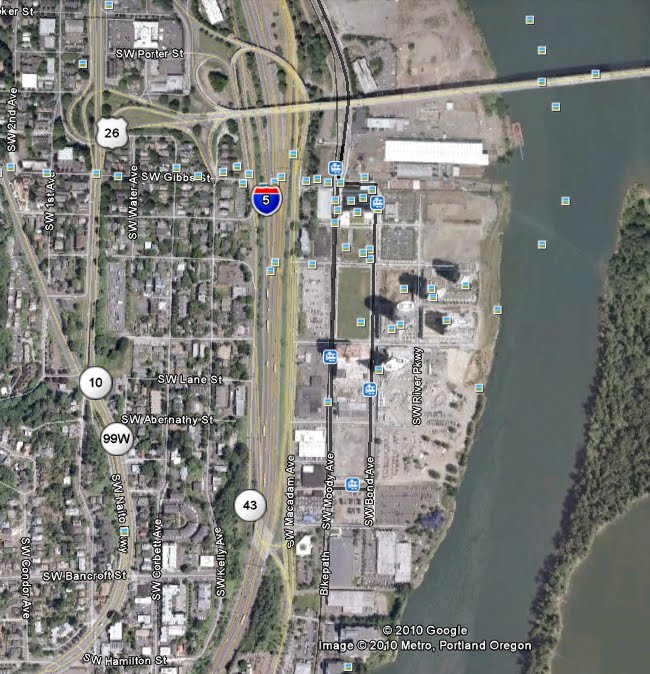
To link to it once again, the article is We Built This City in the Portland Mercury about the South Waterfront in Portland, Oregon. The south waterfront sits somewhat isolated on a peninsula like sliver between the Willamette River and I-5, not unlike Delaware exists in relation to its downtown of Philadelphia.


If the article doesn't get at the primary issue within its body, it at least alludes to it in the title. No, it wasn't built on rock n' roll, but it was built on the faulty logic "that if you build it, they will come" that often torpedoes the best (and most ambitious) of intentions. It was a movie. It makes for a great soundbite, but as far as real estate strategy, if it isn't demand driven, it is likely doomed. Like in Field of Dreams, they built it and only ghosts came.

I like ambition as much as the next guy, but if it isn't tempered either by a deep understanding of urban dynamics (the kind of thing most in real estate either get only by intuition or luck) or extremely patient money, it is doomed to be considered a failure.

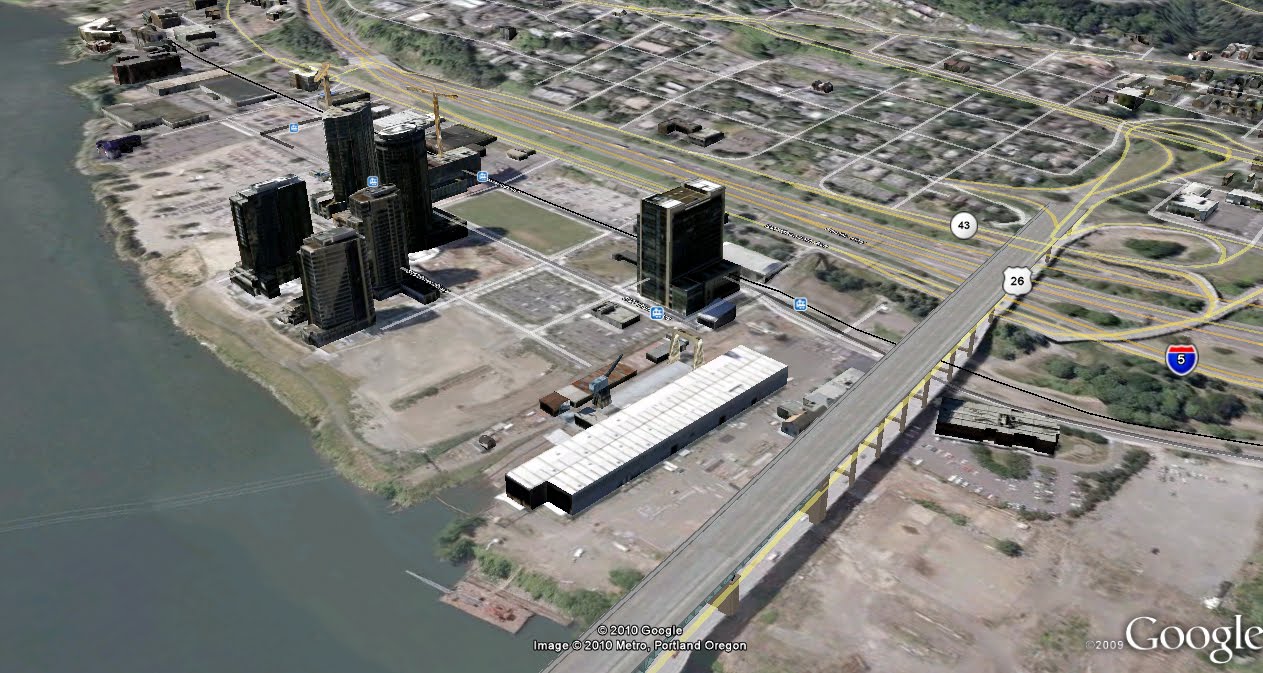
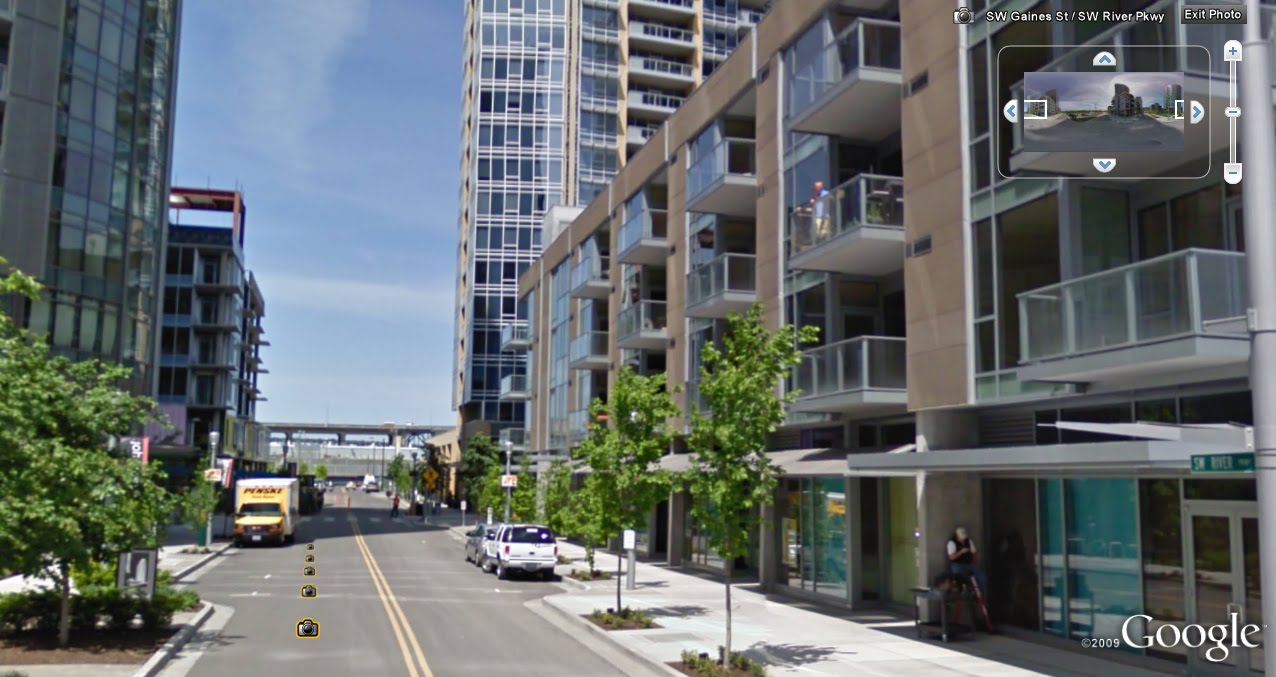
However, much like Las Colinas, the fundamental flaw with the South Portland waterfront is only one of timing and possibly ambition, not in fundamental (or unmanageable) failings in the vision or planning. Unlike Victory and Park Lane Place locally, the South Portland Waterfront got pretty much everything right. It just delivered too much product, too soon, to an overly narrow market segment. It has transit service, a grid of streets, and nigh flawless architecture (from an urban design perspective) that engages the public realm.


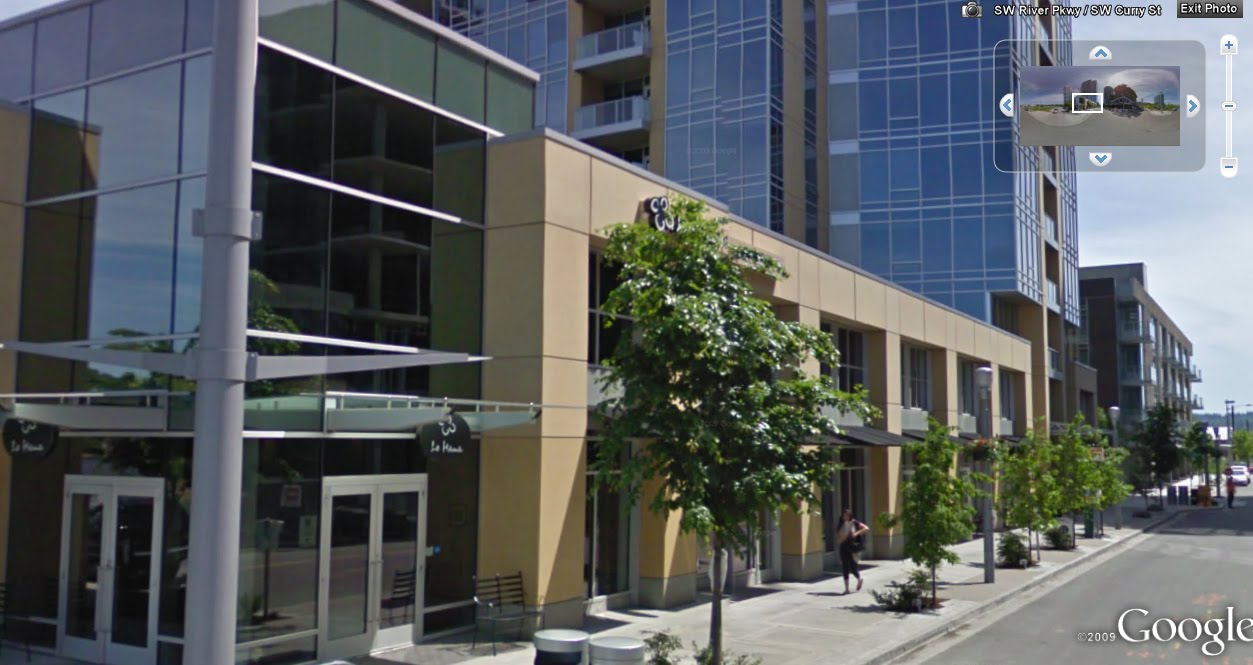
From a design perspective, its failings are of the nitpicking sort: the trees planted were mere saplings, some of the retail spaces are too withdrawn behind thick columns hindering visibility, but most importantly, many of the buildings are overscaled. Not just for the street, but for the market.

On this project in Portland, despite the architects' best efforts to accommodate the density in an engaging, urbane manner, the density and mass still overwhelms. High end "urbanism" often ends up being anything but urban. It is defensive. It doesn't interact with the street. It looks and feels exclusive, which when solated is fine, but when it dominates then it undermines the participatory interaction of urbanity. Portland is more of a middle class city, with middle class sensibility and middle class urbanism.

Its perceived failings are only that it was too ambitious. Market and timing are the flaws. So now it sits empty. But, it won't for long. The plan delivered a supply of only high end condos when that market was saturated. How many rich people are there in the world? Not everybody can purchase a $1 million condo. Other classes want the amenities of urbanism as well, but where is there product choice. The City does have plans for affordable housing in and around the development, none of which has yet to be delivered.

There is a worry of no retail and no grocery stores, but those are both eggs moreso than chickens within urbanism. They will come. As will more chickens, once land, housing, and construction prices find their right value. Particularly if a broader demographic range of residential fills in the blanks, which it will. The developer(s) just went for too much too soon. The scale of development is more befitting of Canary Wharf in London than it is Portland. However, Portland is still a desirable City, particularly for recent and soon-to-be graduates.

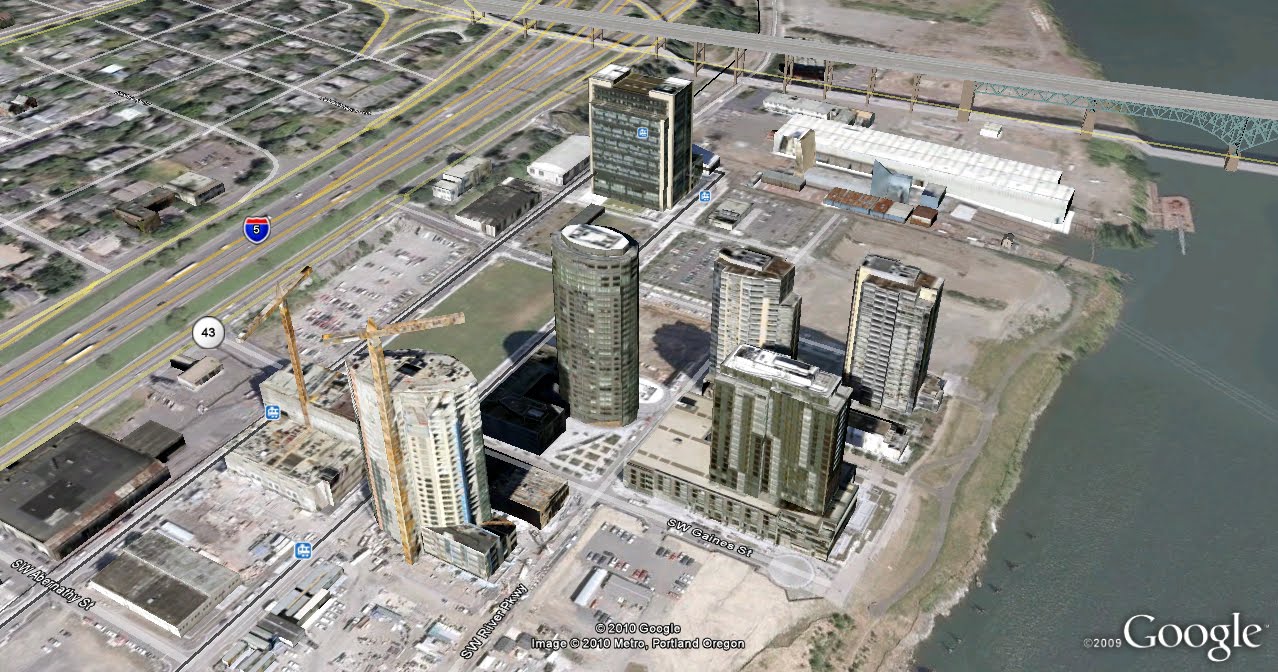
The worry now might only be that the intensity of development overvalues the rest of the land when the remaining development probably wants to be low- to mid-rise. See the remaining voids surrounding the initial phase of development below.


Eventually, it will be successful. Somebody will have to take the loss for when the high end condos get marked down, chopped up, or auctioned off to find where the market really is without the voodoo of a funny money housing bubble world.

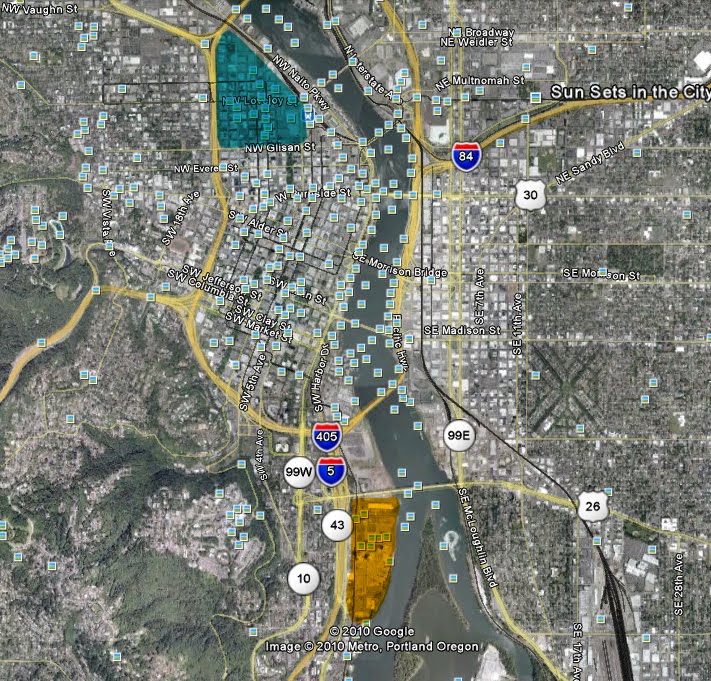
To examine another worry, aka barrier, I want to step back for a moment to the contextual map. See how the South Waterfront has little to no context. It is in effect a cul-de-sac. In fact, the streetcar line even terminates and turns around within the development.

Healthy cities are represented by a typical conical shape to their skylines. They build up to something in the center. The point of highest interaction and desirability. The point(s) with the greatest metabolism in the exchange of goods, services, needs, wants, desires, laughs, and love. Yes, there can (and should) be multiple centers probably within the imposed hierarchy of a locally applied Zipf's law. Centers don't want to be at the end of the road.

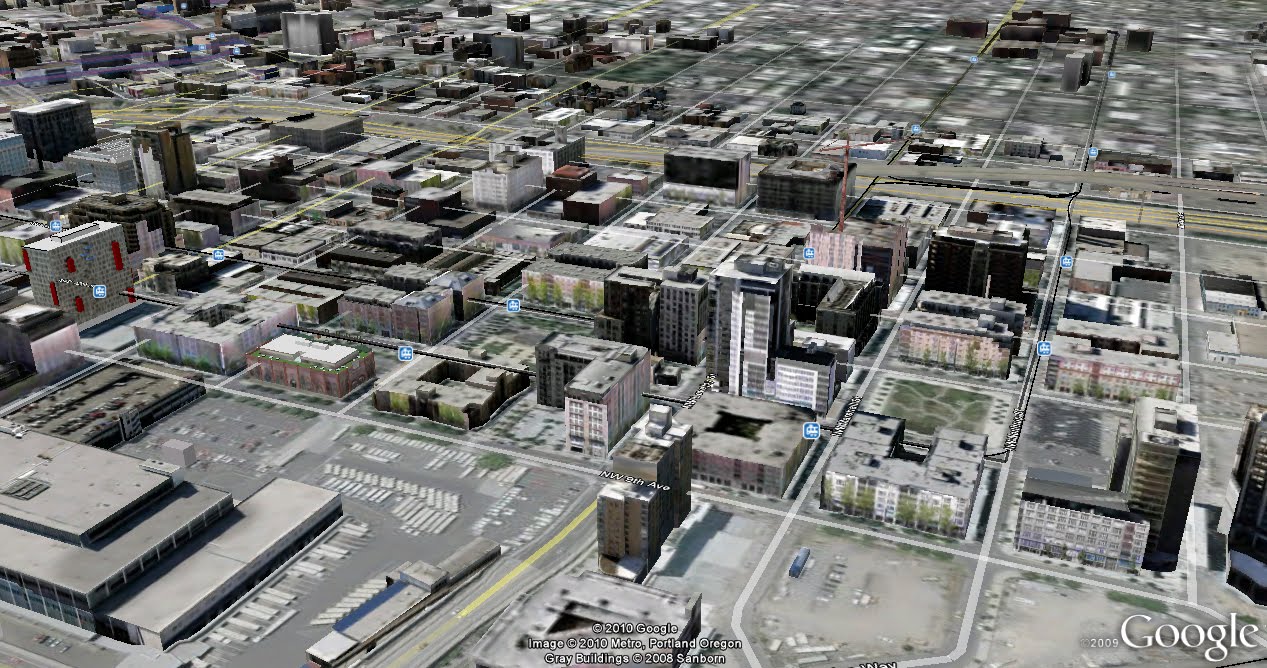
The Pearl District, in aqua, is considered a huge success. Of course, it beat the bursting bubble to the punch and has largely been built out. But it also was right next to downtown and infilled with an appropriate scale. It had more to build upon.


Pearl District.

Just below is the South Waterfront, zoomed in. You can see how it is isolated. There is a possibility that because of the lack of context that it will never fulfill its promise, or saturate its supply (especially not at the prices pro forma'd). But, part of me still thinks that like Las Colinas, 20, 30, or 40 years down the road, its barriers will be removed as values change and as the City grows to a point that it needs Vancouver-style development within its geographic restraints. Cities like Vancouver, Seattle, Portland, Manhattan, and Hong Kong have nowhere to go but up.


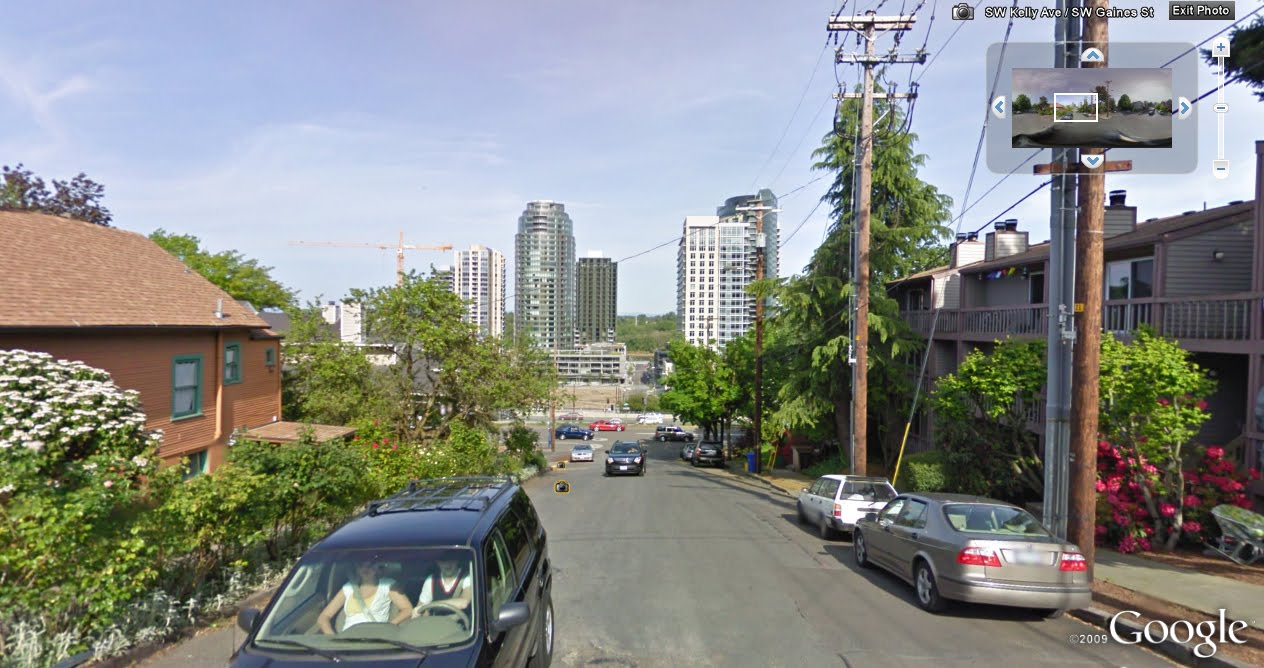
The other issue is the scale of the development across the highway. It is all low-scale, 2- and 3-story single family homes, duplexes, townhomes, and small apartments. There is a disconnect between the two sides of the highway (beyond what the highway already does), that is of scale.

Two adjacent areas so at odds in scale and density are often incompatible. While they can be designed in a way to not negatively affect one another, the lower-scaled area rarely has the density to support the rents and retailers that the high density developers expect. Once again, the purpose of graduated density. Density is attracted to activity. In abstract, activity doesn't happen at the end of virtual cul-de-sacs, it occurs at intersections, at crossroads.


Will Portland's desirability and livability ensure that its population might double? Will the neighborhoods adjacent experience the pressure towards more density? Will I-5 be rerouted in order to stitch the neighborhood with the waterfront? Or at the very least be lowered much like it is through downtown? The only thing for certain is that proper urbanism and a flexible framework will allow such changes and the desirability of Portland will ensure that this particular area achieves livability if not lovability eventually.

Conclusion:
Timing aside, it is probably more density than the site wants to hold, which probably only means losses in the short-term for the investors of those specific buildings. In a much less exaggerated way, it is like me saying I want to build Vancouver in Italy, Texas. I could make it as "livable" as I like, but it has to be viable first. That isn't to say that Portland won't see the kind of influx of population to build that kind of demand, but it may just take a few decades.

In the shorter-term, there is certainly value in the remaining parcels for low- and mid-rise residential for middle income housing and below if the land prices can allow it. I think I would probably also recommend that the ground floor of the remaining buildings be "flex" at most, to allow the retail to properly fill in where it now sits empty and to ensure a concentration of retail as the new neighborhood matures.