




Showing posts with label linkages. Show all posts

Wednesday, April 4, 2012

Wednesday Linkages

This will be the last post until next week. I hop a plane to London tomorrow. Until then, you can catch me tonight as part of the Dallas Morning News Future of West Dallas panel at KERA's studios. Or if you can't make that, give a listen to the latest Urbanology podcast, which you can find on iTunes.

Before I get to the linkages, I got the full tour of Thanks-Giving Square yesterday, which was fun and interesting. They do have a worthy purpose and mission, to bring people of all race and creed together. Unfortunately, problematic design inside and outside of the property have combined to diminish the square's stature, utilization, and ultimately its ability to operate as a gathering point for more than smokers (cigarettes by day, crack at night) and doggy doo.

That's right. As we were on tour looking at all the good things within the Square (including its underlying mission), you couldn't help but notice all the ironwork (railings and drain inlets) that had been stolen for whatever meager change could be garnered for them. Enough to get a hit of crack I suppose. The circle of life was evident as the maintenance man Rick, the guy I dubbed Sisyphus for his tireless work shoving slumping liquid rock back up the hill each day, pointed out a crack pipe along our walk.

The lesson is that illicit activity tends to occur in dark places. Shine the light and it scatters. However, I'm using the word light metaphorically, as in human activity. Visual and physical porosity. Thanksgiving square is dark during the day. You can't very well see in and there isn't much reason to go there unless your dog needs to satisfy its bowel movements and you, the office worker, needs to satisfy your nicotine cravings and your building won't let you smoke anymore by the entrance. But it's darker at night.

I'll be writing much more seriously about Thank-Giving Square in the upcoming weeks. This is a place worth saving. At least, its purpose and its place as what used to be a central crossroads of the city if nothing else.
----------------------
Three pretty fascinating articles which are thought provoking for various reasons and by themselves weave a narrative of three different cities in three different allegoric places headed in three different directions:

First, Medellin, Colombia. You remember it, right? That's where all the drug kingpins took over in the 80's. It's still a warzone, right?

Huh, investing in public transport and public education. Who'da thunk that would work. Empowering the mobility of its citizenry in two distinct but powerful ways. Sounds like cockamie.
----------------------
This is more like it. Baghdad by Starchitect in the 1950's. That'll "save" it. Call up Zaha Hadid.
----------------------
Now, far more interesting is this piece by the NYT on Berlin's airports new and old. Really thought provoking stuff on the nature of Berlin, security, and the modern airport experience. The retired urban planner's quotes are particularly poignant at the end.

"...A city surrounded by storks and wolves..." Sounds almost mythical. As if it belongs in Westeros, or something.

The planner told of the need to build bridges to the outside world. And he's right, that is if Berlin wants to "grow." And if that's what they decide politically, more power to them. And this will have consequences. Such as the replacing of the old beloved airport with a new "shopping mall with some planes attached."

Therein lies two modern and divergent issues: one of security and one of experience. The old airport emphasized convenience but was 1/3rd of the determined necessary size. People could go from home to gate in minutes, conveniently. DFW is not unlike this (just further away).

The new airport wants to funnel you through singular security checkpoints. These are awful (ever been through BWI?). They also want you to spend time there ("live, work, shop, play?"). So they build 5-acre shopping malls inside replete with dreadful food courts.

You know where I'd rather shop and eat and play and live and spend time? Either the city I'm leaving or my destination city. I understand the need to make layover time less intolerable, but give us free wifi and we'd sit on hot coals while plugged into colostomy bags if we have to.

I may rant about the need for relocalization, but airports and plane travel isn't going away. Nor would it be a good thing if it did (though it does badly need to reposition itself). But rather than trying to shake every last coin out of the captive market (is that a pat down or are you taking my wallet?), perhaps it would be a more sustainable business model for airlines and cities to get people to their destination cities as quickly and conveniently as possible.

Ahh, yes. But there isn't a business model within the fractured, fragmented, and broken value-extract institutions. There's no room for value-add on this flight.


Friday, March 30, 2012

Friday Linkages

A couple of possibly disconnected morning thoughts via twitter this morning:

First, was it the Curious Incident of the Dog in Night Time where the protagonist [spoiler alert], an autistic child believed/joked that economists were dolts and mathematicians were the true geniuses? I'm reminded of this as mathematicians and physicists are increasingly turning their gaze to understanding the complexities of the city.

Meanwhile, economists (that I really like) like Matt Yglesias, Edward Glaeser, and Ryan Avent seem obsessed with the idea of skyscrapers as density. As economists do, I suspect they're glossing over, ie externalizing, the negative externalities of skyscrapers, which are highly energy intensive no matter the supposedly green properties. Penguins don't huddle in low and compact groups to avoid weather extremes for sh1ts and giggles.

So I posted this simplification as well:
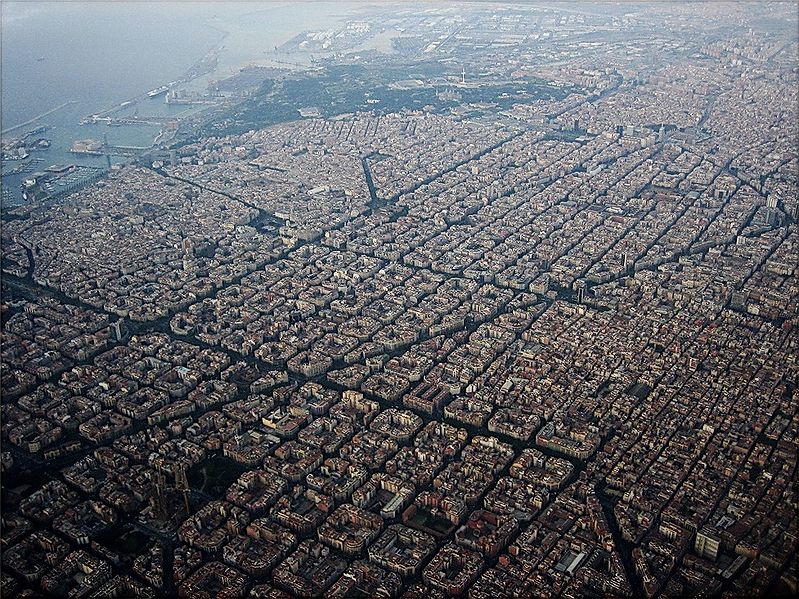
New York City (five boroughs) population/square mile: 27,000
Barcelona: 42,000

If we want to cherry pick Manhattan and its 71,000 ppl/sq. mi.
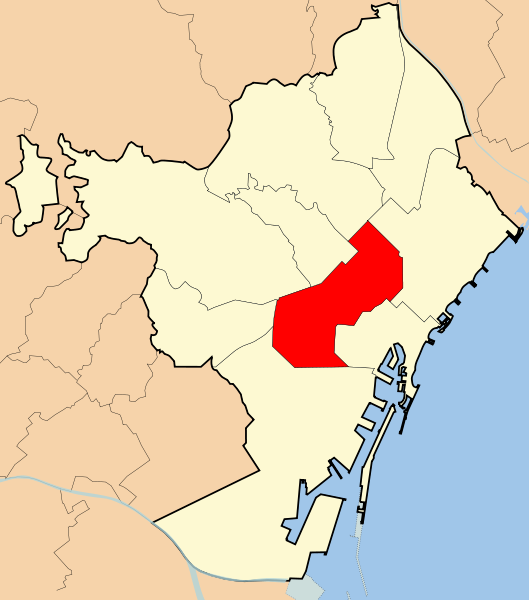
Then we can cherry pick the high end, centralized equivalent L'Eixample: 92,000

Barcelona only has a few buildings over 10-12 stories, mostly concentrated along the beach, tourist oriented.

If you're wondering how awful L'Eixample must be being so dense, you should know that it is the highest value area of the city. Where most of the corporations locate and old money locals reside. Diagonal, the equivalent of Broadway, cuts a (what else?) diagonal swath through the city. The street that all others connect to. The crossroads of Barcelona.

File:Eixample aire.jpg

File:Barcelona districte II.svg

People often think of the medieval Barcelona, near Las Ramblas as the center, but it isn't. Not the center for locals, but the center for tourists rather. Diagonal is the true heart of the city as it as expanded away from the coast to the mountains, much like Manhattan and Broadway is the epicenter of New York.

Furthermore, skyscrapers may add "density" (perhaps theoretically since many of Manhattan's are empty at night), but they also disconnect from the street, which is where the metabolism of a city is made visible. The complexity. Instead, it is shuttled up and down within internalized elevator shafts as we once again attempt to avoid the street. "Everything is right here where you need it!" On the 13th floor.

-------------------------
Ok, maybe relatedly. Time to recycle a two-year old post on Museum Tower now that it is almost finished and apparently frying the sculptures in the Nasher Sculpture Center. Sure, it's sleek. Don't confuse my argument. People often distort criticisms pointed as specifics as deriding every aspect, particularly those aspects that people like. Such as the shimmering glass tower. Yes, it's sleek. It's also the least important aspect. And that's what we're wrongly focused on with most new projects, the irrelevant.

I don't get: 1) the economics and how this is a good investment of the police and fire pensions and 2) the "green" aspects. Perhaps, glass towers that concentrate solar and wind loads aren't the best solution to the local Dallas climate. To combat the solar load, the glass is made reflective. Thus, frying everything outside of the building. At least the building is convex rather than concave and not causing severe burns like that hotel in City Center in Las Vegas. This is not uncommon for reflective surfaces acting ignorantly and belligerent in urban environs where we must all get along. The Disney Concert Hall in LA had to be coated in non-reflective material as its titanium cladding raised ambient temperatures on surrounding condo buildings 15 degrees.

Of course, putting a building inside a highway exit cloverleaf isn't a great idea and they did that anyway. As Homer Simpson would say, S M R T.
----------

Lastly, what's the Mega Millions lotto up to, $600 million? Maybe the city of Dallas can play a few numbers. I take that back. We'd end up spending it on 14 giant ferris wheels. One for each city council district.

Wednesday, November 2, 2011

Wednesday Linkages Derides Incompetence

Part 3 of the DFW plaza post coming soon, but first, the news of the day, but just after this new draft logo:

Austin is cracking down on jaywalking. Because THAT is the right way to go about it (slidewhistle). It is not in anyway a complete dereliction, dismissal, and abdication of responsibility to create a safe public realm, especially in transportation. Pedestrians are a menace to society and a real pain to clean their innards from the grill of my car.

The best part, THE BEST part, and by the best I mean the most tragic and incompetent is the comparison of the two maps on that link. The first shows where the ticketing is occuring, primarily in central areas, downtown, South Congress, and near the UT campus. Ya know, the kind of places where pedestrianization can and should be encouraged on top of the inevitability of it anyway.

Then look at the second map, where pedestrians have been killed. Scattered, on arterials and low pedestrian areas. Of course, we're talking about the epicenter of TxDOT and road lobbying. So if we can just demonize the pedestrian and force everyone into cars, even those that can't afford it, then we can get back to building roads and lining pockets from the siphoning of taxpayer money. As if there was any threat to this particular march of folly anyway.

Seriously, everyone involved in this policy at the City of Austin should be fired immediately. But who am I to say? Just someone that understands that increased pedestrianization is safer for everyone, better for business, and makes for a more sustainable/affordable city that also maintains more citizen money within the local economy I suppose.
------------------------
In related news, a NASA engineer, perhaps bored with reduced responsibilities after the gutting of NASA posts for Greater Greater Washington the costs on both road and rail subsidies and finds the combo of indirect and direct costs of road subsidy is greater than that of rail subsidy. This also takes not into account either long-term maintenance costs of crumbling road infrastructure due to the nature of it as a decentralizing agent, nor the returns on these various subsidies (road case)/investment (rail case) by way of more dense development. One centralizes and aggregates, the other decentralizes and cannibalizes. This is how it works folks.
------------------------
Lastly, if you wanted to know where the cutting edge was in urban design, it is here. It also just so happens to be the cutting edge in the study of the life sciences. Mehaffy and Salingaros are disciples/proteges of Chris Alexander and have since picked up his proliferation. The future of thought is happening at this nexus between life sciences, computing, and urbanism. And you wonder why I use so many metaphors of computer science, biology, ecology, etc.?? A quote:

In natural systems, this kind of bottom-up evolution turns out to be essential for the creation of sustainability. There is reason to think this is no less essential in urban systems. In fact, our work persuades us that any urban configuration that has not evolved — has not been computed step-by-step using adaptive adjustments — is probably dysfunctional and unsustainable. It will have to be propped up by enormous and unsustainable energy and resource expenditures. Examples include regularly-spaced high-rise buildings in a Le Corbusier type of pattern (i.e. “towers in the park”) as well as suburban sprawl of cookie-cutter houses. These are both template-based models imposed from above, and they do not manifest an efficiently optimized self-organized pattern of the kind we are describing.

Point being, urbanism is not about the imposition of arbitrary and abstract forms dreamt by Corbusier, et al. In fact, it is ENTIRELY about providing the framework for life to exist on its own. And that comes from proper transportation systems, the interconnectivity and interaction between development and said transportation system, and building positive supply-demand feedback loops through demand-side implementation. Interconnectivity = opportunity = desirability = demand = density. This stuff doesn't need a rocket science to quantify it...errr, maybe it does (see: above).


Monday, July 11, 2011

Monday Not-Morning Linkages

...to waste away your afternoon:

First, comes this little story from recently visited Spain. Murcia, Spain to be exact, where the city is offering lifetime transit passes to any citizen who trades in their automobile. Rather interesting. Murcia is no small city with over 400,000 citizens and generically Spanish (if that is such a thing) with a medieval core centralized on a river, nearby agricultural base, relatively dense 'suburban' pueblos, and of course rampant sprawl and overbuilding wrought from the past decade of funny money, i.e. lots of new malls, highways, arterial roads and roundabouts, stadiums, and half-built sub-divisions.

Every Spanish city I've been to is also confronting a similar dilemma of how to accommodate the Spaniards' own love of cars with the great platform of civilization that are our (in this case their) cities. This is a rather unique approach to the problem while still maintaining a standard modicum of mobility that all cities are liable to do. It is in the city's best interest to ensure/allow for maximum mobility so that all citizens are availed the opportunity of participating in the local economy, the very point of cities and why they perpetuate. Here in the states we mandate parking minimums because for the most part don't allow for choice in transportation mode.

--------------------------------------
A recently found blog, The Urban Country, writing from Toronto I do believe where a number of great urbanist blogs have emerged, partly I suppose in response to the culture clash on-going between cars, their autophiles, and those who may be bicyclists or may just wish to have a certain amount of freedom of choice in their chosen mode of transportation and some measure of safety guaranteed through proper transportation design, writes about our backwards approach to road safety. See. I told you there was conflict a-brewin' in Toronto.

No, our solution is to slap helmets on vulnerable road users, tell pedestrians to wear brighter clothes, tell cyclists to always have two hands on the handlebars, enforce cyclists rolling through empty intersections, rip out bike infrastructure, and fail to hold drivers accountable for their actions.

We need drastic changes if we're going to make cycling more comfortable for newcomers.

Thankfully "cycling in numbers" can have a positive effect on safety even without good infrastructure. Drivers are much more cautious on roads where we see lots of cyclists.

---------------------------------

Perhaps most interestingly, Los Angeles is going to begin shutting down the 405 freeway in one of the biggest experimentations in traffic reduction. Actually, they're intermittently closing it in order to construct more "improvements," whatever that word possibly means these days where anything is an improvement and not an improvement at the same time, but a mere longer meandering down the same dead end.

Predictably, everyone who's anyone online went apey. Saying it will be the worst thing ever, Carmageddon, completely ignorant of the fact that their warnings/hysteria show how the internet, our interconnectivity of information, will begin replacing car trips and vehicle miles travelled. The warnings will allow people to plan their days differently, take different routes, or not make the trips they don't have to by car if deemed unnecessary or superfluous.

I already know what will happen. The first day of closing, things will be pretty hairy, but the online hysteria /slash/ message-spreading will help to alleviate and prepare the city for that. Afterwards, not only will traffic find other routes, but the overall number of cars on the road will reduce as drivers either: carpool, find other modes, find other routes, don't drive, or shop/work online from home.

Making driving more difficult means less drivers on the road. This is an inalienable fact. The bigger concern is the fact than any particular road, route, or form of transportation is so depended upon (nearly 300,000 cars per day) that an entire city could shut down, highlighting the fragility of the entire system. What happens if there were to someday be any disruptions in oil supply or gas hits $6 per gallon (i.e. the next cheapest country for buying gas)?

Monday, May 16, 2011

Monday Linkages

First thing first. I spent much of this past weekend buzzing about various parts of Fort Worth that I hadn't yet explored before. Previously I had spent a decent amount of time in and around downtown, the West 7th development, TCU, and the Cultural District and that was about it. As part of various wedding events and the logistics of me getting to certain places without a car invariably led me to places I had not yet been, like meeting up with Kevin of Fortworthology for coffee/tea at the new local coffee house on Magnolia (Avoca) before I headed to wedding party rehearsal.

It pains me to say it, but Fort Worth has much better bones left in tact than do we here at the bigger brother (sister? What sex would Dallas be if we were to anthropomorphize?) Magnolia Ave is like Bishop Arts but like 5x of it, including the active, engaged young professionals that have bought into the neighborhood to the south. It surely is only a matter of time until the broken fabric to the north, between Magnolia and downtown is redeveloped.

In another part of town, much of North Main Street between downtown and the stockyards was surprisingly intact as well. Only the remaining fabric seemed to oscillate from one side of the street to the other, rarely mirroring proper form on both sides of the street. On the other hand, North Main was proud home to this byoot (sic):


It might just be the single ugliest building I've ever laid eyes on. So they also have that on us.
-------------------------------
Elsewhere on the interwebs:

A bill in the TX house could use your help. It is about Complete Streets and would require any city using state or federal money to make the street complete. Of course, this wouldn't effect highway dollars, which would be pretty killer to tie those two things together since they, when running through urbanized parts of the city, are very much to blame.
--------------------------

Michael Pollan, author of such indispensible books as Omnivore's Dilemma and In Defense of Food (you likely might know him from Food, Inc. as well), wrote a column over 20(!) years ago against the American front yard/lawn. It is all the more relevant today:
Americans like Olmsted and Scott did not invent the lawn; lawns had been popular in England since Tudor times. But in England, lawns were usually found only on estates; the Americans democratized them, cutting the vast manorial greenswards into quarter-acre slices everyone could afford. Also, the English never considered the lawn an end in itself: it served as a setting for lawn games and as a backdrop for flowerbeds and trees. Scott subordinated all other elements of the landscape to the lawn; flowers were permissible, but only on the periphery of the grass: “Let your lawn be your home’s velvet robe, and your flowers its not too promiscuous decoration.”
Of course, also by democratizing the "estate yard," you're also bringing it down to levels incapable of maintaining it to a certain standard (which inevitably led to nigh-fascistic homeowners association strictures). Like so:

via Old Urbanist. In the words of Lloyd Christmas, "Austria?...beeyoooootiful."
------------------------

Old Urbanist walks through a comparison of European suburbs and American suburbs illustrating the (obvious) difference, but also spelling out that there really is no value to the front lawn (unless you're growing something on it. And even then, it might as well be more contiguous and in the back for a number of reasons including that it is inefficient to have distance between the conduit of movement (the road) and the interface with the use (building front door).
------------------------------

I figured Freakanomics was mostly discredited by now, and maybe that detracts from this column, where they delve into Malcolm Gladwell-level quasi-depth (that being very little) about freeway removal actually helping traffic. Freakanomics does have a role to play however, in that their entire value is pointing out essentially the inaccuracies inherent of hyper-specialized fields that become so adept at doing one thing very well, that they fail to take into accout spin-off and/or auxiliary effects of their work.

Similarly and ironically, this is not in anyway addressed in this particular column. They're stuck simply in the "moving traffic" realm, not in the overall impact of "moving traffic" on possibly more important things like more economically and environmentally efficient and effective ways of making the exact same connections. Predictably, transportation planners and engineers jump into the fray and further discredit their entire profession by not getting it AT ALL. So I felt compelled to weigh into the comments:

Lol. “traffic demand models.” the ones that are rigged to conclude more supply is always necessary? Like or don’t like this article because it supports or contradicts your assumptions, pick up Traffic by Tom Vanderbilt for a deeper view of the issues.

What happened in the cases cited above as well as in Seoul and Milwaukee which removed a freeway b/c they couldn’t afford to maintain it (expect far more of that around the country), resulted in improved overall connectivity and spatial integration as freeways are about regional to regional connectivity, undermining local connectivity, the backbone of cities.

Furthermore, what occurs is a form of “import replacement.” more things are done locally, now that a freeway is removed, a place becomes safer and more desirable, thus denser and more valuable.

Think about these examples as well. Pompidous widened the car travel lanes essentially from building face to building face. It pushed out all the pedestrians and all the businesses died. Since the mid 90s, Paris has systematically been replacing the travel/parking lanes of Champs Elysees along the side with increased pedestrian space. It’s now some of the most valuable real
estate in the world.

When Copenhagen began removing cars and parking spaces all of the businesses objected. They’re doing better than ever today because people want to be there.

And lastly, it is important clarify the difference between intracity and intercity freeways. The intercity are important in linking regional economies. The intra are destructive and disrupt local economies. This is why Eisenhower was appalled when cities and states bastardized his interstate system and ran amok with them.

People liked hitting "dislike" on my post ("OMG that disrupts my worldview!! How dare you!"). I would be perfectly happy to debate any and everyone on this issue. Because I know it better than they do. But they know how to move cars. Of course, none bothered to engage in my bait of a comment.

Instead, they decided to further discredit their profession to the point that soon it will surely prove worthless and thus extinct when they juxtapose statements like, "I'm a professional" and "efficiency is a staple of sustainability." Oh yeah professor? Sort of like your work making some road super-efficient getting from point A to point B some distance away actually prevents fare more efficient (in both time and energy) of say...those Fort Worth South residents bicycling to their various needs and wants on Magnolia?

Seriously. Just retire. You're doing more harm than good. But that could describe large chunks of the entire economy. We've got loads of rebooting to do.


Monday, April 25, 2011

Monday Morning Linkages

Straight away to the bidness...

NYC is like, "bruh, how come there are so many cars clogging up our streets? We built all of these garages to keep them off the street and everything." And then sanity is restored:

That parking minimums are in place near New York City’s subway stations is “madness,” said Walter Hook, executive director of the Institute for Transportation and Development Policy.

In most European cities, he said, parking minimums have been replaced with parking maximums that keep developers “to those levels of parking which the traffic system can bear.” In many downtowns, he continued, there is a hard cap on the total amount of parking. “You can’t actually add a single unit of off-street parking unless you take out a parking space from the street,” Hook explained.

Simple point made, simply: If you make all/any aspects of driving cheap and/or easy, people will generally do just that. If you don't want so many cars, don't make driving so cheap/easy, which includes both finding and paying for parking spaces.

Across Europe, cities have come to understand that oversupply or subsidy of parking leads to too much driving. The effect is considerable. In Vienna, for example, when the city began to charge for on-street parking, the number of vehicle kilometers traveled plummeted from 10 million annually to 3 million.
Hit the link for all of the other approaches/figures, including this gem from the British government no less:
in the words of the British government, to “promote sustainable transport choices, reduce the land-take of development, enable schemes to fit into central urban sites, promote linked-trips and access to development for those without use of a car, and to tackle congestion.”
--------------------------

In response to this weekend's Earth Day festival in the Arts District comes a sobering reminder about the bees:
The reality is a bit less romantic. The honey bees responsible for pollinating major U.S. crops are loaded on trucks, wrapped in plastic and driven hundreds if not thousands of miles to where they are needed. They are often fed high fructose corn syrup to give them the energy to accomplish their Herculean tasks. Think of it: Feeding corn syrup to a honey bee. That, surely, is nature turned on her head.
There we have our answer. The bees are disappearing because they're on a diet of corn syrup. Likely sitting in their dens watching Big Brother and washing it all down with a gallon of Brawndo. South Carolina, wassup?! /machine gun fire.

I add this because I was struck by all the displays of green buildings, green cars, green parks, and green doo-dads. But there was also little to no mention or understanding of the system between these things, as if they're each museum exhibits. Nevermind how we get between our green roofed mixed-use enclave and the Trinity River Park in our fully electric automobile that comes from coal power and rides on endless tethers of braided strands of concrete. Or that recycling is an incredibly dirty process that with each cycle downgrades the product being recycled while exhuming some of the dirty petrochemicals into the air. Until we understand (and address) the material and nutrient flows of our products (and our cities -- how we move about and give life to our cities), all of our efforts and one day a year celebrations are just bee sanctuaries.

-------------------------------------------
San Francisco has begun putting together a cluster of pop-up shops in parking lots out of...shipping containers. Who'da thunk it. No idea how the economics of this thing are working, but in a more temperate climate of SF, surely the structures require less modification than they would here:
Vacant lots in the middle of cities are spurring all kinds of temporary uses, from guerrilla gardens to public art. And one of the most interesting experiments is happening in San Francisco, with a project that is the first of its kind in the US. In the Hayes Valley neighborhood, two blocks at the end of Octavia Boulevard are being transformed into a festive combination dubbed Proxy, a temporary grouping of restaurants, retail shops, and outdoor gathering spaces. The mini-cluster is designed to give way to other permanent developments in a few years.
Provisional urbanism. There it is. I'd love to get information on who the landowner is, I'm assuming somebody purchased the parking lot to develop, but is holding off until a better lending climate, how much they're charging the businesses for rental space, etc. etc. I love the idea, as I've suggested it several times, but I'm starting to wonder if that better building climate 1)shows up, or 2) do people like the provisional aspect so much that it becomes permanent? If that is the case, I would recommend designing it provisionally too, so that it doesn't look 'too finished.' It's a fine line, because you also don't want to scare people away.


Tuesday, April 19, 2011

Links o' the Day

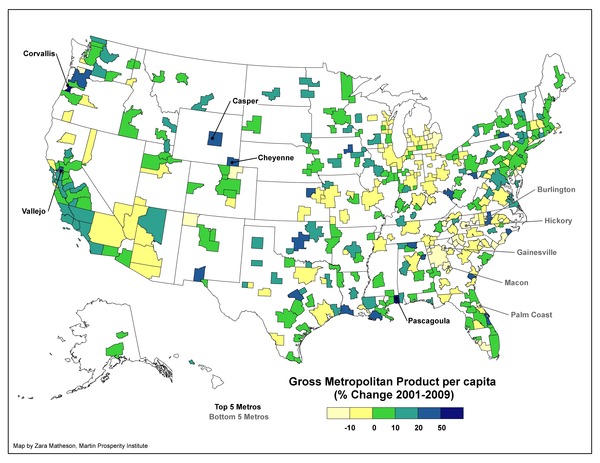
First, Richard Florida slaps his forehead as the Wall Street Journal & Forbes (Kotkin) confuse population growth in the sun belt over the completely skewed 2000-2010 census w/ actual economic growth.
The south and the west may be winning the demographic race, but America's economic winners are the places that have improved their productivity--something which doesn't turn on the sheer numbers of workers they have on tap, but rather on how skilled and innovative they are.
The infographic that matters:

GMP_Florida.jpg


Yikes. Dallas, Atlanta, Houston growth model not looking so hot now is it? Just wait another 10 or 20 years if those cities don't get their act together.
--------------------------------------
The economist starts w/ Reihan Salam's take that just maybe had we not invested in Hitler's cool invention of highways, our cities might be a little taller, walkable, and more efficient w/ a much less bloated central government. Salam is a free-market conservative who supports walkable urbanism. The economist waffles:
But the lesson is clear. Highway construction generated some positive effects and some negative effects. We tend to focus on the positive effects and remark on how constrained the economy might have been without a highway boom. But absent a highway boom something would have been built and markets would have optimised to that something. It's not clear that the savings from highways are so substantial that the American economy is clearly better off as a result of the system's construction. Highways obviously had a large effect as an idea, and they made direct contributions to the economy as a construction enterprise, but the net addition to growth through trade is uncertain, and probably much smaller than most people assume.
This entire debate of whether highways were thumbs up or thumbs down misses the entire point. You can't even HAVE the debate without distinguishing inter-city and intra-city freeways. Even Eisenhower knew that, which is why he was disgusted with the highway building run amok when it began tearing up neighborhoods through cities.

To keep it simple, since that is apparently the way the Economist likes its debates (America too), inter-city freeways, those connecting regional economies, i.e. Houston area to Dallas area, were a good positive investment, helping to link the country together. Intra-city freeways were a convenient way to "solve" the problems of the industrial city by plowing them away /thumbs in ears. /palms over eyes. Funny how it only magnified the issues.
That doesn't mean that infrastructure isn't worth building. New infrastructure will quite often yield real cost reductions, and my assessment is that many new projects, particularly those along corridors that are already busy and congested, would probably produce benefits. I suspect that the potential benefits would be clearer if roadways were kept free of congestion via tolls; toll revenues along some well-traveled routes would meet or exceed the cost of construction of new infrastructure capacity.
Do you write just to write?
--------------------------------------
Streetsblog and the Transport politic say, "woah, wait a minute" to suburban commuter rail enthusiasm. As Jonah Freemark writes:

The results have in general not been impressive. As Jeff Wood catalogued last week on The Overhead Wire, these investments have yielded very limited ridership — especially on a per-mile basis. Nevertheless, cities continue to make plans to focus their spending on them: Kansas City announced in 2009 that it was considering a 150-mile commuter network; late last year, Indianapolis suggested its primary rail investment would be in a commuter line to its northeast suburbs.

Except in the older cities (which have legacy commuter rail systems for the most part), the downtown job base has been falling off as a percentage of the metropolitan area’s total employment for decades. The rise of non-traditional working patterns that rely on Third Places and home offices mean fewer people need to get into central business districts for the same amount of work to be done. In most places, the center city simply isn’t a big enough attraction to require shuttling people to it from distant locales via big, heavy diesel trains running a few times a day. Indeed, in many cities, that work could probably be better done with a few express buses.

What this forgets to understand is that built form takes at least a generation to adapt to its new bones, transportation infrastructure. Urban Design must be always understood in 4-dimensions (5, if you consider my theories of centers of gravity applying to cities AND that in the physical world gravity is the 5th dimension -- which is usually just scientific short-hand). The bet by transit agencies is that the value of the land around the stations will rise and thus densify and help to cover some of their costs/investment while providing new ridership. It remains to be seen whether that will come true.

But, of course providing transit to low density areas doesn't work. That doesn't mean those low density areas don't need it eventually in order to survive in a world that is "place-centric," i.e. generic one-note suburbs need centers of gravity. And two, home prices will likely remain low/affordable in far flung suburbs, but in a world of rising gas prices transportation costs will continue to rise. Wouldn't that suggest that the leaders of those suburbs are right to protect their communities by participating in regional rail projects? Without them, some entire suburbs might completely fade away by 2050.


Monday, February 28, 2011

Monday Morning Letters to the Editor

YouPlusMedia has put together a video about the tunnel system in downtown Dallas. They want to start generating a dialog on a variety of issues regarding downtown and do so through the use of visual media. I was asked for input on the tunnels and I will post my response shortly. But first, watch the video and be sure to pay attention to how we so wholeheartedly believed [insert architect/urban planner's name here] Vincent Ponte. You can even get a copy of his brilliantly titled report at Amazon, "Ultramodern underground Dallas: Vincent Ponte's pedestrian-way as systematic solution to the declining downtown."

This precedes my forthcoming report, Dallas: Super Happy Fun Time Town! Let this be a lesson next time we buy everything some urban planner/architect (of which I am one) says. Usually, they have no bloody clue either and are really just pushing some subjective fantasy as alternative reality onto others. They're expert salesmen. Only now are we beginning to cobble together objective measures for what makes for great, vibrant, livable places

Now for the video:
-----------------------------------------
The following are two emails I received over the weekend that I thought I might share. The opinions are the authors and some of the noticeable editing is mine to conceal any identities:

Dear Mr Kennedy,

I lived in Dallas after graduating from Southwestern Medical School in [date redacted]. Six years ago I moved to Chicago. Chicago is a bustling, beautiful city. I felt immediately at home there. In Dallas I always longed for something but could never put my finger on it. In your article you beautifully said what I felt all along (I'm not sure which article he's referring to here).

I believe, however, that there are forces arrayed against Dallas following your call to action. [The powers that be] are too satisfied [with the status quo]. Change frightens them. They are too pleased with the way things are to be troubled by the inherent, albeit temporary, discomfort of change.

I enjoyed your piece. If you really want to live in a city like you describe you best pack up and follow me.

Cheers

---------------------------------------------------------------------
In timely and coincidental fashion, Wilonsky at the Observer posts this article about Dallas's priorities:

Critics suggest that Dallas's larger-than-life image may be shrinking for another reason. They say that officials' lack of investment in public schools, streets, parks and pools -- the real-world priorities outside the city's highbrow Arts District, with its cultural monuments designed by the hottest "starchitects" (Norman Foster, Rem Koolhaas, I. M. Pei, Renzo Piano) and soon-to-be sky-high Santiago Calatrava "signature" bridges -- is sending white families and middle-class minorities moving to the suburbs.

----------------------------------------------------------------------
And lastly, an email about the WalMart and Fort Worth Avenue development group (which I haven't yet weighed in on, but will). Once again, these opinions are not my own, but the dialog is one worth having:

What should outrage us is not so much Wal-Mart’s apparent disregard for what Jason calls “a pedestrian form,” but instead the Fort Worth Avenue Development Group’s blatant disregard for the residents of the Colorado Place apartments. When the apartments were torn down (at the urging of the Fort Worth Avenue Development Group), Scott Griggs (of the Fort Worth Avenue Development Group) declared that it marked a “great opportunity to bring something new.” Many people would like to think that the “something new” only involves walkability, organic grocery stores, and coffee shops, but in fact the “something new” unfortunately also involves the replacement of working class black and brown people with affluent white people who “read the New York Times.”

We should be less interested in an appeal to what Jason calls the “thousands of years” of history that have supposedly “proven” the “pedestrian model” than in an appeal to the twentieth-century history of Fort Worth Avenue. The cheap motels and apartments on Fort Worth Avenue (like Colorado Place) may be what some call “eyesores,” and they may not make us feel like we’re living in Portland, but they have also made possible the social and economic mobility of immigrants and working class people in Dallas. Or at least they have functioned as affordable places for people to live.

Dallas has a long history of so-called urban development that involves displacing working class people of color to make room for playgrounds for people who “read the New York Times” (for example, the West Village). If this is the same vision of the Fort Worth Avenue Development Group-and it is-they should start being honest about it, and stop pretending that it’s somehow part of a progressive community politics, which it just isn’t. (Remember their opposition last year to the Cliff Manor zoning issue.) A progressive community politics would be less interested in what Jason calls the “right” to “walk” to coffee shops, and more interested in people’s right to live where they currently live and have equal access city services which are rightfully theirs (such as pools, policing, and public transportation).


Friday, February 11, 2011

Linkages with the Quickness

Shh, don't tell anybody I'm taking a quick break...

First, wouldn't you like to know that TxDOT is now 50% more efficient! Or at least the environmental review process is getting a kick in the ol' expedite. Check the slideshow for the gobblety-gook:


This would be nice, say if it was only say, for road diets, complete streets, and downgrading of streets. Instead, here comes a road widening "improvement" coming right up your alley. But hey, the Nazis were praised for their efficiency as well. Let pernicious forms of efficiency be damned.
-----------------------------------------

Wilonsky at the Observer links to a study that makes you wonder if it was even necessary when 75% of respondents have "no impression." On the other hand, that IS about as fitting a description for insert anti-city here Arlington as one can imagine. How do you have an impression of nothingness? Do you like nothingness? Do you have a favorable or unfavorable opinion of nothingness? If nothingness were to kick a puppy would you have a more or less favorable opinion of nothingness? If nothingness had a baby out of wedlock and then punched that baby repeatedly would you be more or less likely to vote for nothingness?

Keep in mind that I have no problem with suburbs, in their truest, functional form, which is why I reference Valencia, Spain so often. Their suburbs are perfect in my opinion: 1) Linked to each other and the primary body (Valencia), 2) possess a variety of transportation options, 3) are walkable, organized around the train station, 4) are isolated from "anti-bodies" or LULUs (Locally Undesirable Land Uses, i.e. heavy industry, highways), 5) have a range of housing choices with a clear, organized hierarchy based on desirability, centrality, and transit options (interrelated), 6) set within a backdrop of local agriculture for resilient, predictable food production.

There is a critical difference between functional suburbs and sprawl. Sprawl (anti-city) is disconnected and centerless. Connectivity and hierarchy of centers are the foundation for all networks (your brain, these here interwebs, cities, etc.). Without those two things, a place is dysfunctional. It might as well not exist...which means, if it doesn't find those things, it WON'T exist. Sounds crazy to say (since we live day-to-day and cities exist century by century), but this is a fundamental fact of cities throughout history.
-------------------------------
Lastly, I like Ed Glaeser. We agree on a lot of things. In fact, sometimes I feel like he gets his ideas from my blog (which he surely doesn't - but he has a knack for writing about things I've already written about. Of course, the flipside could be said for me and Jonah Lehrer when he writes about cities.).

Eddie money has a new book out today, which I will pick up as soon as possible. A couple of tangent trips:


* The user review of his book at the Amazon link above is hilarious. I'll paraphrase. "I really like the first two parts of the book where he's being all fiscally conservative and criticizing all the ways cities went wrong with zoning and all that big gub'ment hoogily moogily! Then that final act isn't worthy my toilet paper! How dare he criticize conservative policy as well! What a jerk! He really upset the confirmation bias I had going with the first two sections! Me and confirmation bias were going steady for a while there. But I dumped it like a sack of potatoes. Burn this book!"

* Second, an excerpted study of his new book that David Brooks references in his latest column blows the doors off of any relevance Joel Kotkin ever had:

This is a point Edward Glaeser fleshes out in his terrific new book, “Triumph of the City.” Glaeser points out that far from withering in the age of instant global information flows, cities have only become more important.

That’s because humans communicate best when they are physically brought together. Two University of Michigan researchers brought groups of people together face to face and asked them to play a difficult cooperation game. Then they organized other groups and had them communicate electronically. The face-to-face groups thrived. The electronic groups fractured and struggled.

Kotkin believes that telecommuting will allow us all to work from home and live how we want. And since we all want to live exactly how he wants, suburbs will live forever. The logic is that easy (or ridiculous). I, of course, counter that certain policies prevent us from all living truly how we want and skew the market. And these policies must be rewritten or scrapped to allow for greater choice in both housing and transportation.

Unfortunately for Kotkin's relevance and book sales, the science (and any personal empirical evidence) shows that working with and being around other people is far more productive than me and you interacting through these two screens and satellites.

The internet evolved into social media, not because it allows us to be further apart, but it allows us to be closer together. We are now better connected globally, sharing information and knowledge, but web 2.0 evolved to help us connect face-to-face, and generate real productivity/creativity/etc.


* Lastly, here is where I disagree with Glaeser in his appeal to more (and better!) skyscrapers as a panacea. Better sounds cool right? The only problem is that vertical sprawl is also problematic. One, for financial reasons. Know of many new high-rises doing well financially? These high-rises often deliver too much product at one-time for the market to absorb and adapt to, trusting our reptilian instinct for new shiny things to pay off the debts.

I think Glaeser might be suffering from his own version of availability/confirmation bias as a New Yorker/Bostonian. His personal bane is historic preservation. Smaller buildings are pending up demand preventing from more supply arriving in the form of replacement high-rises. Couldn't those lower-scaled historic buildings have more value than just their F.A.R. (floor area ratio)? Couldn't they be part of the reason why their is so much demand and value we find in those cities? Isn't their some extra value in connecting with the past via flexible, adaptable buildings that each generation repurposes (without completely tearing down and rebuilding) to suit their needs?

The global nature of the internet creates certain local discontinuities. Does his paean to skyscrapers make sense outside of NYC where land is cheap and demand is low (for now) like in Dallas? What about for the local geography? If Dallas were built to its climate (sunny and windy) would we have all of these glass(!) high-rises that take on heat (requiring greater cooling) reflect heat like a magnifying glass frying the people ants down below, and catch and then redirect the wind down to the sidewalk?

Furthermore, when he calls for high-rises to deliver density, what they end up doing is removing density from the street. First, high-rises either loom over the street forebodingly, they create windshear and a blustery environment at street level, and they block the sun from the street and surrounding buildings.

Second, they foundation of these buildings must be so large and the infrastructure (such as parking garages or all the transportation to bring people from all over a region to this singular point) that it breaks down the desirability of the public space around it because the blocks are too big or the density of movement in and out of this one object is too great to allow for more lingering.

Third, stacking so many people 100-stories into the air (assuming the building has 24-usefulness, meaning a mix of uses) creates demand for services up closer to where the people are. If there are 10,000 people above the 50th floor, there will likely need to be public amenities such as a food court or vertical gardens at various levels, further pulling people off the street level and removing a level of predictability for commercial businesses dependent upon the movement economy. The High Line works in NYC (and perhaps ONLY NYC) for precisely this 3-dimensional density.

High-rises often don't create real density, but an adolescent, clichéd view of density, an illusion of density as skyscrapers (and too many of them) create a repellent experience. It lacks nuance. So I ask you, which is a better version of density? Rome and Paris? Or Shanghai, Dubai, and Hong Kong? (The base of the Burj Dubai is about a 1/4-mile around. Its super block is over a mile around and its super, super-block (which includes a mall) is over 3-miles in circumference. I rest my case.)

When I think of New York and Vancouver, two cities often lauded for their skyscrapers, the best spaces and most successful areas are often of a lower-scale than we typically imagine those cities. See my post on visiting Vancouver for more about this.

Tuesday, November 30, 2010

Tuesday Linkages

The first article today is an interesting one from SmartPlanet about our cognitive maps and getting lost in buildings. They go on to blame architects who have incredibly advanced understanding of space in three-dimensions:

What they found:

  • People navigate differently. Some use contextual clues — “Make a right at the stairwell” — and some use cardinal directions to find their way.
  • Cognitive maps are prone to bias, and can distort reality. Culture and gender are factors.
  • The design of a building exacerbates these effects, thanks to identical-looking corridors, short lines of sight and asymmetrical floor layouts.

The more difficult the building, the more a person must rely on their (imperfect, incomplete) cognitive map.

Take the award-winning Seattle Central Library: the first five levels of the library defy expectations and are all different — so different, in fact, that the outside walls don’t always line up. Sight lines could help ease the shock, but the library’s long escalators skip floors, making it difficult to see where they begin and end.

Interestingly, the researchers says that architects have such strong spatial skills — they make three-dimensional space from two-dimensional blueprints, of course — that they may fail at imagining their design from the perspective of someone with poor spatial skills.

What they are saying is that architects are increasingly pushing the limits of how to comprehend and think about space in 3-dimensions. You might call this innovation. You also might call this selfish. Are they the end user of this space? Often not. The end users typically don't appreciate the mental gymnastics it takes to make a Seattle Public Library or a Denver Art Museum. Dummies. They deserve the vertigo.

I cite these two buildings specifically because I have visited the Seattle Public Library. It was loud and uncomfortable, exactly what you want from a reading room. I'm not typically afraid of heights or have trouble intuiting spatial relationships and suggested pathways. I felt like this building was going to collapse and I wanted out of it as quickly as possible. As for the DAM, many people have left claiming feelings of nausea. One can't say if it was the odd angles of the buildings spaces and corridors, canted for Libeskind's self-gratification or the art within.

Contrast this with the architects and designers in Renaissance times that wanted to understand human proportion, scale, and awareness of space. The designs reflect it.

Design for people. Not other architects or Architectural Record.
----------------------------------------
In what might as well be called Pravda, an online journal called "Gensler On" interviews, you guessed it, a Gensler principal about Gensler type of projects, big ones. In this case, it comes off as some sort of cheerleading for times of yore when money flowed like wine into skyscrapers that remarkably no one moved into and banks were healthy and raking in cash and not failing all over the world because of faulty supply driven investments. Run-on, I does it.

The actual article is called, Can Super Tall Buildings Be Green?, which could make for a perfectly fine article if you wanted to argue something beyond "tall is dense" and "tall is aspirational." I'd quote it, but there is really nothing of substance there and I find it hard to believe this was written in this century let alone this decade rather than 1995 or 2005, which the rationale mirrors.

First, tall is dense, yes. But tall can be another form of sprawl. By sending people further up into the sky, that creates demand for services to follow them upward. For example, a 100-story tower will have cafes or coffee shops or "sky gardens" and different things every 20-floors or so. Amazing, we like things close to us.

He undermines his own argument suggesting super tall is necessary for street life and that he's from NYC. The best parts of NYC and Vancouver are not the skyscrapers. It is the street life between the smaller buildings, that don't dominate the sunlight, necessary for actual street life and just plain life, such as trees.

Second, the tall is aspirational argument is another form of quantitative growth that got us into this economic morass. Quantitative growth took on two forms of real estate, outward growth (sprawl - Vegas, Phoenix) and upward growth (Miami Condo towers, Dubai), or even the rare outward and upward like Chinese pop-up cities. All of which are supply-side. There was little to no real demand, which is why they 1) attracted speculation and 2) are now empty.

Furthermore, the entire market was rather nefarious, not just because of the banks handiwork, but because of all of the corrupt 3rd world money finding its way into American, London, Indian, and Chinese real estate. Dirty money and imaginary money is no way to run an economy or build a city.

Your architecture firm, staffed and structured to work on these kinds of projects, has a very short future in its current iteration. I've never thought of Gensler as thought leaders on cities, ever, but that won't stop them from telling you they are and cheerleading for a return to the boom decade of the noughties.

Some day banks will wisen up and start investing only in projects that improve quality of place and are based in real, demand-driven fundamentals. It is in their financial interest to do so.
----------------------------------------
To end on two happy notes, we'll shift to places focused on qualitative growth, or the improvement of their cities:

The Irish Times visits Freiburg, Germany looking for lessons:

Prof Kevin Leyden, an American now based at NUI Galway’s Centre for Innovation and Structural Change, was struck by how hard Freiburg has “worked and planned to be energy-efficient and carbon-conscious as well as creating real neighbourhoods with a sense of place. There is also a commitment to green space, playgrounds and local shops”. Dr Daseking, who has been Freiburg’s chief planner for 27 years, said the “breaking point” came in the early 1980s when the city council decided that big shopping malls on the outskirts would be “zoned out”. As a result, smaller shops had the chance to survive and “people get their daily requirements by walking or cycling, not driving”.

One of the stupid things Dublin did, and Freiburg didn’t do, was to get rid of its trams.

As a result, the city’s tramlines - running from north to south and east to west, with the main station as the network’s hub - were extended to serve new “fingers” of development stretching out in all four directions - including new suburbs like Vauban and Riesefeld.

Housing is socially mixed, with rich and poor living in close proximity, on remarkably quiet streets devoid of through-traffic. Children play in green areas or quite safely on the streets. “By building like this, you can influence the use of cars,” Dr Daseking said. “Freiburg has only 440 cars per 1,000 in population, but in Vauban it’s only 85 per 1,000”.

And the ten most walkable cities from Frommers via the Infrastructurist:
1. Florence
2. Paris
3. Dubrovnik
4. New York City
5. Vancouver
6. Munich
7. Edinburgh
8. Boston
9. Melbourne
10. Sydney
Since it is from Frommers, guessing it is geared to bigger, more tourist destinations. The key to walkability is proximity, density of network (moreso than density of people), which means density of movement corridors, the type of movement corridors that allow for density of networks (grids vs. dendritic highway/arterial), and quality of spaces (streets, sidewalks, plazas, public spaces).


Monday, November 15, 2010

Monday Morning Linkages: Fit to be Slaughtered

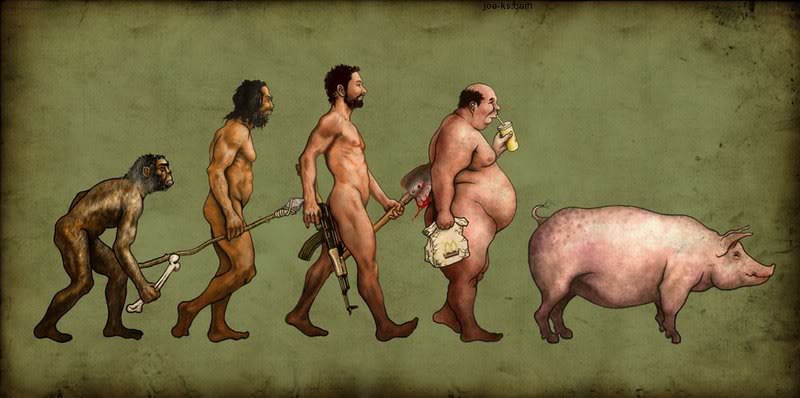
But first, a funny picture:


On to the show:

Kunstler laments the willingness of MSM to play a conscious part (if you consider Pinocchio conscious) in the self-deception America seems addicted to, much like anything rhyming with "sass." In this particular case, we're referring to gas. "OMG gas! Gimme gimme gimme!" We're like cookie monster crossed with a crack addict. The critical message:
It seems to me that the chief mass delusion associated with this touted "bonanza" is that Americans would supposedly be able to shift to driving cars that run on natural gas. I believe they will be hugely disappointed. Between the cost of fracking production (and its poor economics), gearing up the manufacture of a new type universal car engine, and installing the infrastructure for methane gas fill-ups - not to mention the supply operation by either new pipelines or trucks carrying liquefied methane gas, we will discover that a.) America lacks the capital, and b.) that households will be too broke to change out the entire US car fleet.
----------------------------
Philadelphia, the place that I still have a draft of my most recent visit unfinished yet eventually (hopefully) destined for publishing on this blog, is working on a city-wide pedestrian plan. The particulars:
One Center City example: The intersection of John F. Kennedy Boulevard and 15th Street. “The major issue for pedestrians at this intersection is conflicts with turning vehicles; specifically, vehicles turning right from 15th onto JFK Boulevard,” the report states. “The width of both streets allows vehicles to maintain higher speeds when turning, and motorists and bicyclists often fail to yield the right of way to pedestrians.”

Suggested fixes include changing the walk signal so that pedestrians get to start crossing JFK Boulevard before cars traveling on 15th Street can proceed through the intersection; installing an additional pedestrian island on 15th Street and reinforcing the message that drivers should take pains not to get stuck in the intersection when the signal changes with an education campaign and street pavement markings.

The plan also recommends five different ways for streets to accommodate cyclists. There are several kinds of bike lanes, including separate lanes on either side of a two-way street; contra-flow lanes which allow bikes to travel in both directions on streets in which cars go one-way only; climbing bike lanes which offer a separate lane for bikes in the uphill direction but a shared bike and vehicle lane going downhill; and bicycle-friendly streets where cars and bikes share the street, but there is not enough space for vehicles to pass bicycles.

The first phase of the plan calls for adding about 60 miles of bike-only lanes to Philadelphia's 200 + miles, Schaaf said.

The goal, she said, is the creation of “complete streets” - streets that serve motor vehicles, bicyclists and pedestrians equally well.
This isn't feel good stuff. This is real economic development at work, the unwinding of barriers to cheap, efficient connections between people, places, goods, and services without requiring: a car loan, a mortgage w/ two-car garage, a tune-up, car insurance, a weekly (or daily) fill up at the pump, the taxes to support all of the roads, health insurance for the inevitability of traffic collisions, etc. etc.
--------------------------
A lengthy (and thorough) book review discussing the battle between cars and people for our public spaces (lofty rhetoric (war on... battle over...! I engage in it):
The automobile industry thus tried, for a time, to work with these other groups to ameliorate the problems created by the increasing number of automobiles. However, the industry soon realized that no such collaboration is possible because these other groups consider cars to be either intrinsically unsafe because of their speed, or intrinsically inefficient because of the space they occupy. In 1923, a slump in the sales led to fears that the market for automobiles might have peaked, and urban congestion and traffic safety were cited as reasons. To increase sales, motordom began a campaign to spread the message that speed can be safe, and that walking out of turn could be just as reckless.
Author Richard Price, speaking on a DVD of one of The Wire seasons, once said "God is no second rate novelist." History, you can't beat it/Why I love it.
--------------------------------------
StreetsBlog has a two part post up on retrofitting suburbia, it first references the book by the same name, which is mostly pretty pictures, wishful thinking, and a design exercise than what it needs to be, an in depth analysis and conclusions as to how to leverage investment towards those pretty pictures. The second half of the post, gets to the point:
In his latest post, Walker describes how municipalities can get a jump on livability by tackling one of the trademarks of suburban America: the commercial arterial street. Because these roads have a tendency to be relatively straight as well as local destination points, they could easily be adapted to suit public transit by carving out space for transit users, pedestrians and cyclists, he says. But it’s important to move quickly, because once thoroughfares are congested, it’s difficult to find space for modes beside the private car, even as traffic conditions demand them.
Change the form and function of streets and intersections and you provide the incentive to change the form of buildings.