I am a professional Urban Planner and Designer. I treat this as my thought laboratory exploring how bionomics relate to self-organizing, emergent urbanism.
As a professional urban designer and partner of the Planning and Design Firm Space Between Design Studio, I am a trained urbanist who specializes in creating walkable urban developments and analyzing existing places to find the barriers preventing livable, walkable urbanism. I can be reached at patrick [at] spacebtw.com
If you've read this blog for any period of time, you know that it has some enemies: Brueggman, Wendell Cox, Joel Kotkin, and Randall O'Toole. The bone to pick isn't in the disagreement with their opinions, it is rather with the inconsistencies of logic and rhetoric to the points their making. In my estimation, this is the tell tale sign of corruption, and in this case, that means corruption of thought. They represent other interests while pretending to represent the "common man." Only if that common man happens to be the Koch Brothers, et al. If you are a common man, are you worth multiple billions? Want to know how morons get loud microphones in a supposed meritocracy? Well, there is your answer.
With that said, Randall O'Toole decided to take up the case for free parking in response to a New York Times article entitled "Free Parking Comes at a Price" by Tyler Cowen, since they're such staunch free marketeers and libertarians. Oh wait, their is the first case of logical dissonance.
Then came the response to the response, and this is by the parking guru himself, Professor Donald Shoup, who came out with all guns a'blazin':
Before I examine your misunderstanding of what I have written, I will first summarize the three basic parking reforms I recommend in The High Cost of Free Parking: (1) remove off-street parking requirements, (2) charge market prices for on-street parking to achieve about an 85-percent occupancy rate for curb spaces, and (3) return the resulting revenue to pay for public improvements in the metered neighborhoods.
I will quote ten extracts from your post, and comment on each of them.
1. “Shoup’s work is biased by his residency in Los Angeles, the nation’s densest urban area. One way L.A. copes with that density is by requiring builders of offices, shopping malls, and multi-family residences to provide parking. Shoup assumes that every municipality in the country has such parking requirements, even though many do not.” (ed. note: They do love to quote Los Angeles as the densest urban area don't they? A statistic itself that is meaningless because of where they choose to draw the boundary for where to take that measure. Is it dense at the block level? At the neighborhood level? At the City level? Not really. They go with the metropolitan area. Then they'll turn around and use LA as a model for success when that rhetoric suits their nefarious purpose.
Even Houston, which does not have zoning, has minimum parking requirements, and they resemble the parking requirements in almost every other city in the United States. Houston requires 1.25 parking spaces for each efficiency apartment in an apartment house, for example, and 1.333 parking spaces for each one-bedroom apartment. Here is the link to the minimum parking requirements in Houston’s municipal code: http://tiny.cc/iaj35
Does the Antiplanner, who is “dedicated to the sunset of government planning,” really believe that government planners know exactly how many parking spaces to require for every economic activity at every site in every city, no matter how much the required parking spaces may cost and no matter how little drivers may be willing to pay to use them? Does the Antiplanner really support Houston’s minimum parking requirement of 1.333 spaces for each one-bedroom apartment because he believes that Houston’s government planners can accurately predict the “need” for parking at every apartment to one-thousandth of a parking space?
Greg Lindsay of Fast Company covered a debate between Chris Leinberger (urbanist) and Joel Kotkin (suburban partisan) held by the Forum on Urban Design in Manhattan. They threw some statistics at each other, but ultimately Kotkin was reduced to his tired old crutches:
that suburbia was actually driven by the invisible hand of the market, willfully ignorant of the invisible arm government played in pushing over-suburbia along; and
and that delivering functional and aesthetic urbanism to a wishful pent-up market is somehow social engineering or manipulation.
What he fails to recognize is that planning today no longer represents the large-scaled version of 20th century, he so rails against. Of course, we won't allow the truth of a changing world affect his personal biases.
If suburbia was actually market-oriented, why is it the same everywhere? To answer my own rhetorical question, it is because it is not market-oriented, but built out of the same underlying genetic code of suburbia. The same parking formulae, the same single-use zoning, the same traffic impact analyses, etc. All of which constructed based on suburban models, thus producing more suburbia. Being disconnected from reality is why it has failed us.
People are different. We have different needs, wants, and preferences, and a market-responsive city would reflect those various emotional desires and the degrees to which segments of the population value them.
I do agree with him in one aspect however, that the future of urbanism is in cities like Dallas, but not for the reason he thinks. He believes that the future somehow lies within the current iteration of Plano:
Kotkin believes the next hundred million Americans will largely eschew “superstar” cities such as New York, Boston, San Francisco and the west side of Los Angeles because of housing costs. They'll opt instead to live in "cities of aspiration," such as Dallas, Houston, Charlotte and Atlanta. His America in 2050 looks a lot like the Dallas suburb of Plano, Texas, which has the highest household median income and the highest percentage of residents with college degrees of any American city with more than 250,000 inhabitants.
He is wrong, not with the Where, but the What and the Why. The future of American Cities lies within the Metroplex because of the disconnect between a very high potential and that very same existing format Kotkin believes is the future.
Dallas represents the future as we reconstruct a city that can keep the talent it exports and even begin importing some. It is the future because of the gap between ambition and reality. Only listening to Kotkin and his ilk is what keeps us from getting there.
His claim here illustrates his own bias. He sees the world through his frame and projects that as reality on all others. He wants market manipulation and social engineering. Whether it makes him money for consultancy or out of mere (and logically deficient) contrarianism, I don't know.
He likes suburbia so we must all live in it. We're just trying to offer choice, allow users to define their own lives, and make cities work to their utmost potential in delivering all of our emotional needs and wants, efficiently, effectively, and elegantly.
Robert Wilonsky at the Observer knows how to push my buttons with frightening economical efficiency: a two-word email and a link to a reporkulous presentation (with emphasis on the pork) by one Wendell Cox of the Institute for Intellectual Dishonesty.* Next thing I know, I'm dropping everything I'm doing to torture myself through a half hour of blanket statements that are often factually-oriented, but taken without context or deeper understanding that it undermines any credibility Cox might have, yet we accept him as credible anyway because well-heeled interests present him as such.
*Not his real organization, but is there really a difference?
On the other hand, if I have won enough credibility with you dear reader over time, you may be willing to accept my reactionary response to Wendell Cox. That being that he is a shill for the road lobby. Now this is also based in fact, as the directors of the group this presentation was given to The American Highway Users Alliance have documented tax returns representing the interests of Ford, GM, and Toyota. Users is right, but it isn't highways getting used it is all of us, the taxpayers.
Now if I haven't yet earned credibility then in this post I'll go through his presentation point by point to debunk and discredit everything he says.
First thing to know about Cox is that he is the kind of guy who claims he's for "choice" as long as all subsidy goes towards roads and cars and not to any other form of transportation whatsoever. Free marketeer, this guy.
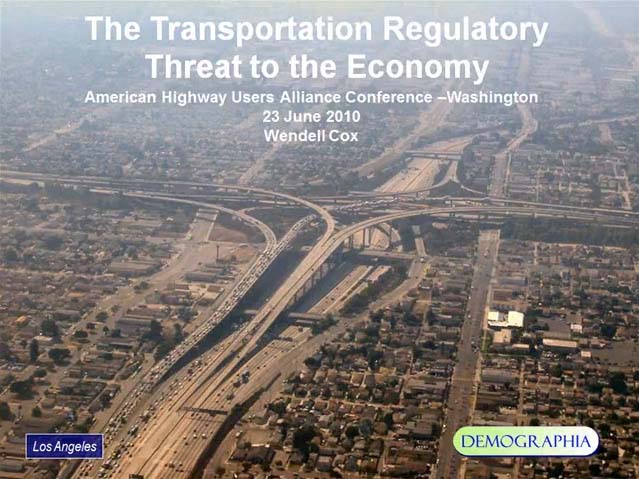
Next, is the graphics. Pretty, in depth, nor subtle, these presentations are crafted by people lacking the least bit of intuitive sense of semiotics. All it takes is the opening picture to elucidate this point. "Boy, that sher is a purdy highway and cityscape... it's all washed out in gray and brown hues of the air, just the way I like to breathe it through my mouth hole."
My favorite part is that, well I would present the exact same picture as a "what not to do." Not only because it looks ridiculous and out of scale, but even if the point is that "highways create mobility," I'm seeing several lanes thoroughly clogged and several others completely unused. Neither, in the ideal scenario of which Cox poses to present. The rest of the presentation sprouts from there with similar shallowness of thought, understanding, and rhetoric that never leaves behind an amateurish capability to handle data, statistics, or reality.
Next, you pick up the voice intonation and the sense that this entire room is filled with crotchety, old white dudes who know only one model for reality. In other words, exactly the kind of guys that would populate such a thing as the American Highway Users Alliance or the kind of organization compelled to embolden "highway USERS" in their websites meta-tags (html geek'd) as some sort of populist cover in the event anyone gets the crazy idea from their rhetoric and positions that they might ya know, not actually represent the common person.
The nice answer to the question of who exactly these guys are is that they represent the financial interests of industries tied to the teet of the federal government, which once again reminds of the Klosterman quote about all technology eventually is bad. This is it. The technology is the car. We overbuilt comparative to its actual usefulness and it is proving difficult to extract it from our lives, not because of need or want, but because of the painful transition of certain jobs. Particularly, the jobs of these guys.
The other side of AHUA is a group posing as libertarian that proudly opposes tolls (not libertarian) and seeks maximum subsidies for highways (not libertarian). Those subsidies mind you, come from the pockets of the average everyday man for whom they masquerade as crusaders. Poor Peter gets robbed once again to fatten the wallet of already wealthy Paul. In other words, they perfectly represent the 20th century economy; the dead skin we, the rest of the country, are busily and painfully trying to molt in favor of a new and improved, repurposed economic phenotype.
I like my hypocrisy marinated overnight with deep, rich notes if for no other reason than an aroma so rich I can taste it whilst pulling up to the valet to park the car that I don't have. How about you?
If I'm to give AHUA and Cox credit, they understand that if they ensure never-ending road construction, this inevitably disperses population so that no other form of transportation works except for private automobile. Then we're held captive to building such infrastructure, supplying inefficient bus service to the working poor, who are also scattered, and subjugated to fluctuations in oil prices based on the whims of foreign cartels. This is painting them in a good light.
They also support domestic drilling any and everywhere as the solution to dealing with foreign dictators and oil markets. Any problems with that recently? I feel like taking a cruise on the Gulf of Mexico and flicking burnt cigarettes that I don't smoke off the bow of a boat with these guys tied to the hull.
Despite its advocacy for the common man and "million of americans and businesses," AHUA has a whopping 145 twitter followers. Grass roots indeed. Fundamentally, this points to the crisis of republican governance (not the party, the form), that this group can be so influential in determination of policy directions and public spending with no popular support to speak of.
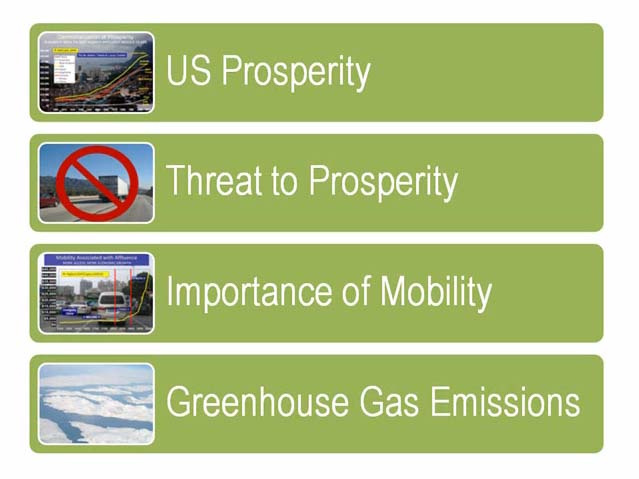
You know it leads to a bad presentation when these bullets say nothing about the actual points of discussion. In fact, I could put together a presentation with the same bullets and say the exact opposite...which, is exactly what I'm going to do here.
Also, notice the re red outline accompanied by words like "threat." These are appeals to the reptilian brain, the most basic, primal, and reactionary. It ignores logic and reasoning and skips straight to instilling fear. Why? Either their actual arguments lack merit or this is literally the way they think. Neither explanation really matters.
Within the presentation, Cox's fundamental point is that of mobility. What they either cleverly and deceitfully do (or ignorantly don't understand) is that transportation policy and funding shifted solely to cars undermines real mobility. Distance, propinquity, and diversity of choice are all elements in the equation of mobility. If someone has to drive to ten different locations scattered across suburbia, find parking in order to accomplish ten different errands and I can handle them within five blocks, who is more mobile? Which is more efficient? Which is more cost effective?
Furthermore, accessibility is another element of mobility. They expect everybody to drive and everybody to own a car. Behind closed doors, I imagine them half-jokingly suggest removing drivers test and age limitations for licensure over cigars and aged brandy. The truth is that the handicapped, elderly, those who can't or don't want to afford cars, and children under 16 have reduced freedom of mobility, and burden others because of it in car-centric environments.
Another pseudo-libertarian, Randall O'Toole suggested a good solution to disaster preparedness in the event of another hurricane Katrina is for the federal government to buy all residents of NOLA cars to evacuate when adequate rail service could have moved thousands every few minutes and avoided the logjam. And O'Toole is actually considered the more serious one!
They are "libertarians" that wanted to subsidize car ownership. This should tell you how committed they are to their principles. This is also the same logic they apply to all other solutions, regrettably.
The rest of the presentation is full of super-duper trustworthy appearing statistics and tables. All of which are little more than broad sweeping generalizations providing no declarative proof of causality between cars/highways and prosperity even though each is passed off as such. Frankly, I think the impoverished state of municipal budgets spread too thinly to the breaking point provides proof that any correlation is one of timing if not outright temporary hallucination.
Post-WW2 prosperity had far more to do with loans to rebuilding nations after WW2, not having to deal with the wake of armies in the millions colliding on our continent and the subsequent rebuilding, and growth fueled by cheap oil following the Nazi version of economic development which was to funnel tax money to highway construction and militarism defense. I'll give them credit for one thing. They understand the hyper-rational Descartian world where statistics of any kind are roundly accepted without question. In fact, they count on it.
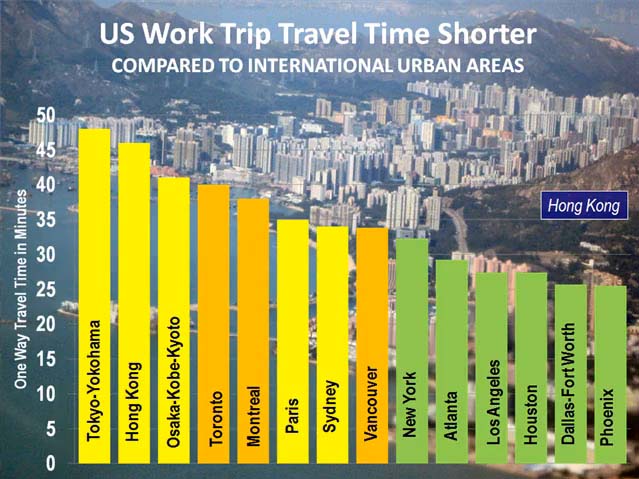
For example: don't ask questions. From this you are to assume that because commutes in PHX and DFW are super short in comparison to the other cities listed that PHX, DFW, and Houston are the cities dreams are made of. OMG, look at NYC. It's almost unamerican! Kill it!
Of course, none of these are sourced. Furthermore, each is an empty statistic taken in a bubble with no context. There is nothing to be said of 1) quality of that trip, 2) productivity of that trip, and 3) externalities of each trip.
For example, if it takes you an hour to commute in Osaka, Paris, or NY but that trip is spent on a comfortable train ride where you can sip an espresso, read the paper, and read/respond to emails, bookended by short, safe, pleasant walks, while millions of others are making similar journeys that don't pollute, kill tens of thousands on the commute (as highways do), and aren't choked up routinely by said accidents creating traffic jams undermining mobility and time savings, which is really better? Cox claims one way is better strictly by the most simple of metrics.
One point I've made over and over again is the fallibility of neo-classical economics which attempts to objectively assess values and work strictly within a system where everything is priced by the market. But, if you ignore the majority of the elements in the equation, those things that either can't be priced aka invaluable or you ignore them, you are being either disingenuous or outright stupid.
How many schools or textbooks could be afforded with the cost of this? Or, what could you buy or save with what wouldn't have had to be taxed out of your paycheck?
Threat to Prosperity: "There are some who wish to slow if not stop completely the expansion of highways which would increase traffic congestion."
In a way he is right. If we stopped building more highways (which we can't afford or maintain by the way), we would create congestion. Except it would be pedestrian congestion and bicycle congestion, the kind that doesn't have negative externalities like with the automobile version of congestion where you are trapped in a suffocated metal box, with noxious fumes all around you, on a field of concrete and can't go anywhere because you're blocked in by your mortal enemies, every single other person on the road.
Positive Congestion
The good kind of congestion only has positive externalities, such as healthy populous that is less of a burden on a healthcare system, increased commerce based on foot traffic, better localization and synergies of real estate clustering, less money spent per capita on infrastructure construction and maintenance, less money shipped overseas in support of our oil habit, and the other people providing that congestion aren't your enemy in a competitive situation, but a cooperative one where the presence of each of you makes the other more safe and their experience more enjoyable. Nobody goes to the highway to people watch.
Legitimate studies, unlike those that Cox uses, show that increased road and highway capacity only temporarily reduces congestion, but ultimately worsens all of the negative outcomes as listed above.
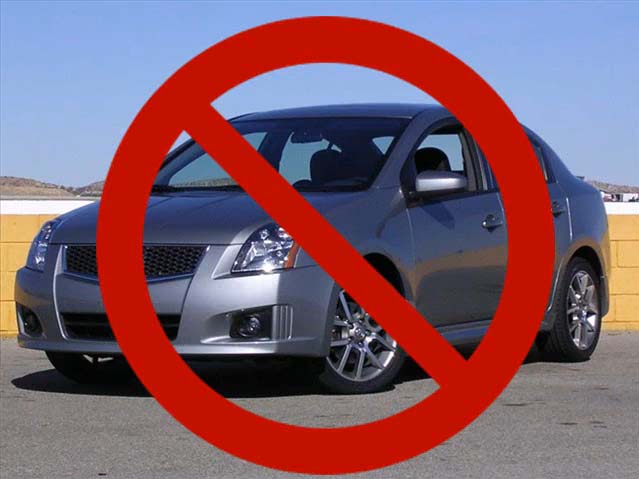
He also likes to play up the big red ghostbusters circle with a line through it, suggesting that we are trying to ban things or control the way people live. It's like they craft these presentations for children...or at least those with the minds of children. In the spirit that we project our own thought processes onto others, it doesn't speak highly for people that treat others as if they have the mind of children does it?
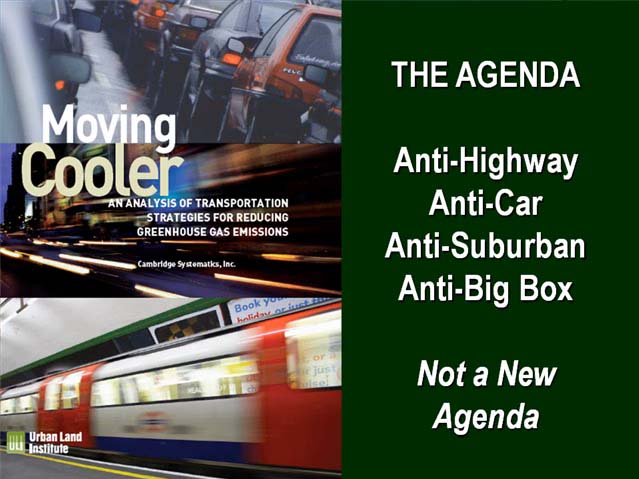
"Contempt for the American Way of Life..."
This also is not a new playbook really. They're anti-american hippy commies!!!! Tired. Yes, the Urban Land Institute, made up predominantly of conservative, buttoned-up real estate developers is really a radical left-wing socialist front group. Next ULI meeting I'm checking for little red books in breast pockets and Che Guevara t-shirts under those black and gray suits.
Actually, any legitimate city planner is perfectly happy to allow any of those things as long as they pay their full cost in a properly competitive environment. We wish to end subsidies which create an unfair competitive balance, particularly to those products and industries with significant negative external byproducts, such as car traffic congestion, obesity, asthma, pollution, runoff/flooding, etc.
These subsidies began in the early 20th century as a response to the squalor industrial cities had become. The are not appropriate for what cities are today and they don't respond to the way cities exist in the prideful hearts and minds of their inhabitants. We want to care for our cities. We want to showcase them. We want them to be great.
Frankly, the rest of this is retreads of similar cherry-picked data that I find it a waste of time to go point by point once the fundamental logic is undermined, obviously every single point is as well. O'Toole, Cox, etc.? They are all dinosaurs fearing extinction. Unfortunately for them, time is cruel to those without useful ideas.
They're hanging around only as the apparatus of the industries entrenched by massive federal subsidy. They like to play pretend libertarian, but they are really only fighting to maintain the free hand outs for their industry. Cox, O'Toole, et al are more than happy to unscrupulously sell their integrity for a cut of that cash money.
They are afraid of change and are backed into a corner by the kind of dramatic sweeping change that only happens because of the calcification of their industries. Evolution happens in two ways: radical and gradual. Gradual is painless. Radical occurs only through collapse. The world they've entrenched crumbled rather than accept and encourage gradual, free- and fair-market adaptation...
And that sudden repurposing shift is proving traumatic to their industries. We would be so kind as to let them die in peace.
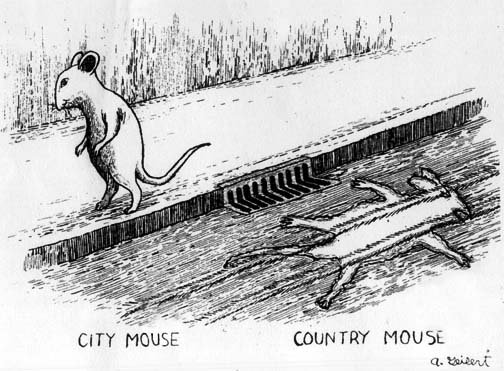
I once joked that the only things that could live in downtown Dallas were rats, pigeons, and cockroaches. It didn't say much for their human neighbors, of which I became one...and paid much higher rent than I have anywhere else in the City. But more on that in a moment.
It turns out the City's real sewer rats mostly only find their light of day in comments sections of the nearest thing to a pure democracy, the web, making a strong case for the Hamiltonian Federalists of time immemorial. And as a Jeffersonian myself, it kills me to say that.
So in the extremely harmless, limited article about me in the Dallas Morning News turns up this comment*:
Non-conformist nut cases like these need a full cranial exam. Grow up, get a job, and drop this frivolous sustainability fad while you are still young.
*Acknowledgement - If it was done ironically it is brilliant.
Since I have no other avenue or recourse and refuse to ignore blatant ignorance this may not jive with the Southern passive aggression-passing-as-hospitality for which too many have preyed upon and you may be used to, but that isn't the way I was raised. I learned long ago to call out ignorance.
I believe in shining the flashlight on the rats because only fungus thrives in the dark anonymity of the internet. Or similarly, giving them a wider audience in which to make themselves a fool. Here is your audience, anonymous one. You're famous. And cast aside. No one cares. But, we should all live exactly like you right? How very Texan of you.
I could talk about studying overseas or being on the fast track at an international corporation. But that is the past. Or currently having quit said architecture firm to focus on local DFW issues, own my own company, and generate multiple revenue streams because I foresaw the end of the 20th century economy to which you cling.
But this isn't about me. This is about you. You, anonymous internet person. You represent the City. You have earned it. You represent the City of Fear. The one behind the locked doors, behind the gated community, afraid of "the other," xenophobe.
You are everything that holds this City back. Nothing inhibits the search engine of progress like ignorance and intolerance. And lucky for us, those that want this City to succeed, you are dying.
You are a coward, Linus. The kind of person who requires the comforting blanky of the status quo. Knowing you are not different, seeking the acceptance of others. But what is different is changing every day. And it is changing without you Sisyphus.
You are the same guy who yells "get a car, faggot" at cyclists and drives away comfortably knowing everybody else, just like you is in a car and a comfortable distance away to ensure your anonymity and self-assured cowardice. And no I won't censor myself. You said it, anonymous ignorant fool. Why should I help to hide you?
So lithely you reach deep into your quiver of cleverness and utilize your one and only tool to perpetuate ignorance as you fearfully watch others surpass you. Afraid of the changing world, you denigrate those that dare live as they choose. Shun them. Please tell me if you are Atlas and can stop the world from spinning. That would be truly newsworthy.
I moved here because I saw opportunity. I saw a City falsely built and doomed to impending rapid change with little leadership, understanding, or direction. I saw a City built by and for people like you. And yes, I want to capitalize on that. I want to make a career of building a better place. How dare I. How very communist of me.
As for the "fad" of sustainability, how about we let the market decide, no? Moneyed investors pay me money and follow my ideas for reducing the cost of inputs and increased the value of outputs in the economic equation and how that relates to cities. Surely that idea sounds ephemeral if only contradicted by the perpetuation of deep and thorough understanding of cities.
If there is any meaning in life, it is the desire to be eternal. Through body impossible, positive ideas can live forever. The tragedy of the Conformity Enforcer mirrors the role you play. You slow progress enough for the dullards to keep up, but then ultimately negativity is pushed aside in favor of problem solving and positivity. You die and accomplished nothing. An ephemeral city is made of ephemeral people.
You are not smart enough to see the future economy. And that is the burden for the rest of us, to drag the ignorant into the future.
Here's your mirror and microphone to begin burying yourself, 20th century City.
If we want to build a great city, we need more of the timeless and less of you.
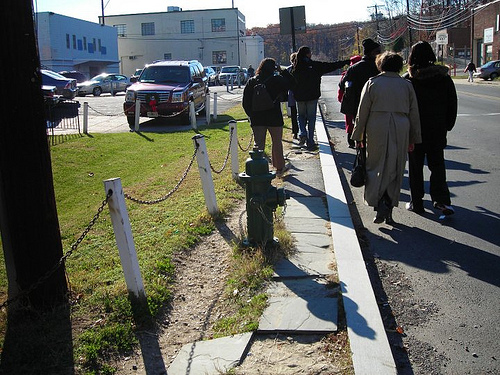
Kaid Benfield at NRDC shows the evidence of people wanting to walk, despite having no facilities to do so in this photo-essay:
It is the cheapest form of travel and the cheapest to accommodate and probably withholds the most positive externalities of any form of transportation. Yet, we ignore it.
Relatedly, in How to be Stupid volume I:
What this dipshit doesn't seem to understand is that transportation form begets a certain built form. Build transportation to facilitate closer interaction between source and destination and all of a sudden, "slow forms" of transportation aren't so slow. Yes, cars can move faster than people can walk or bike. You are a super genius to figure that out. Now, can you drive to the grocery store and back as fast as I can walk to my grocery store in a walkable urban setting? Figure out the costs of that.
In How to Be Stupid Vol Deuce:
Somebody gave a green light to emerging architecture firms to envision cities of 2030. The results are predictable. Words like "disaster" and "future" are porn for architects who then engage in intellectual masturbation. Or they just regurgitate what they saw in a Phillip K. Dick on-screen adaptation. The Economist apparently understands cities better than architects. See this last paragraph:
But perhaps the whole exercise is misconceived. Cities are perfect examples of the sorts of system that emerge from unplanned preferences even as they seem to demand large-scale planning. The question is whether the patterns of that emergence can be shaped by changing the objects of desire, or whether it is necessary to change the desire itself. If the former, then experts in beautiful buildings and sleek aluminium have a chance. If the latter, the question becomes a whole lot harder.
Bonus points to that writer.
Greater Greater Washington interviewed a favorite of this blog, Chris Leinberger, who dutifully pounds O'Toole and Kotkin:
“O’Toole mistakenly thinks we are seeing the free market at work today in drivable su-urban development…as does David Brooks, Joel Kotkin (who I have recently and will again debate…next time in NYC next month) and others. It is a massively subsidized system today that has engaged in the largest social engineering experiment in US history.
If the subsidies would be taken away and we were given a CHOICE in how to get around and how to live, you would see a very big difference in what land use patterns would look like. How do I know this: The huge price premiums in walkable urban places vs drivable sub-urban…that is the market telling us something profound.”
But but but...those subsidies fund Kotkin and O'Toole's way of life. Keep that gusher flowing like the Deepwater Horizon. If you are part of the problem and profit from maintaining the unsustainable, the bankrupt status quo, you are an enemy of this blog.
"Sometimes life just gives you a moment." ~ Lester Freeman. What? I've use that quote before? Shut it.
I just came across this literally, extraordinarily, not-from-this-planet-are-you-Vincent articles. You know you have found the death rattle of suburban sprawl when its voice boxes have resorted to shrill hysterics such as "Obama is going to take your house and your car, run you, your kids, and your dog over with said car and then light the house on fire." Just think, if we had a pure libertarian system, we could even then watch a fire engine drive right on by, because you subscribed to the wrong private emergency/fire department. What a world.
Okay. First of all, is the Tulsa Beacon a legitimate newspaper? Probably not, since the real news source in Tulsa is the Tulsa World. Their website looks to be straight out of the quality reminiscent of white supremacist, militia groups...aka militants, aka terrorists.
So it isn't a surprise that one of the "leading" morons in stupidity, I mean, defense of highway construction, "growth" for the sake of growth like cancer type of development, Randall O'Toole is striking out to thorny rose bush branch to a similar demographic that might take up arms against such horrifying things, like children being able to walk to school, city schools having enough tax base and density to support themselves, LOWER TAXES because of reduced infrastructure per capita, etc etc.
First, a warning. I despise these people. Not because I disagree with them. I'm happy to engage in debate with intellectually honest people with whom I may disagree. People like O'Toole are absolute scum and prepare yourself for an article filled with scorn and complete lack of respect. Furthermore, since we know that the Tulsa Beacon is a rag unworthy of serious response, this will not be terribly serious.
Let's go through the article shall we, because OH MAN is it a doozy:
PlaniTulsa threatens American freedoms
EEEEEK! Take up arms!!! My career is threatened!!!
Randal O’Toole, a scholar from the CATO Institute, said PlaniTulsa looks a lot like what Portland, Oregon did beginning 20 years ago when it embraced New Urbanism.
And that should worry people in Tulsa.
Get out the pitchforks!!!
O’Toole spoke Saturday in Tulsa as part of a forum sponsored by OK-SAFE. A former professor at Yale University, O’Toole has written several books, including Gridlock: Why We’re Stuck in Traffic and What to Do About It.
Why what else? More Highways!!!! That is the proven solution, amiright? /High fives self. Winks at well-heeled representatives of the highway construction industry.
“I want to talk about the American dream,” O’Toole said. “To own a home, start a business, to have mobility and own property. ‘Smart growth’ is a threat to the American Dream. That’s what PlaniTulsa is all about.”
Yes. That is the American Dream you rubes. George Washington didn't lead his band of Oompa Loompas across the chocolate river Styx so people could have the right to live without a car or without a home mortgage.How dare we want actual choice in our lives. OBEY. REMAIN MISERABLY STUCK IN TRAFFIC BECAUSE MY WALLET DEPENDS ON IT WHILE I MISREPRESENT CONCEPTS LIKE MOBILITY.
The average person in American (sic) travels 19,000 miles a year and 85 percent of that is by automobile, O’Toole said. “They (the Obama Administration) are trying to coerce people out of their cars.”
Well. Point proven Randy. Everybody is in cars. That's clear choice in the market place right? That doesn't have anything to do with a bloated Federal Transportation Budget that allocates $40 billion to highway funding, would it? You see any of that loot per chance, Randy? Keep fooling everyone that this is "market forces" at work.
Let's look at it another way. If every American drives 19,000 miles per year, that equates to cool (approximated) $855 billion dollars spent by Americans every year for gasoline, let alone oil, general maintenance, car payments, insurance, various other losses due to collisions, taxes dedicated to road construction and maintenance, as well as various externalized long-term costs such as pollution. That's $855 billion we could have in our savings accounts to put towards college educations or all those new houses you want us to buy. See any of that money, Randy?
O’Toole said Obama wants to raise gasoline taxes to fund light rail systems all over the country. Through extensive study, O’Toole showed that city after city that has invested in light rail has lost millions if not billions in inefficiency.
That's clearly inefficiency. Fixed alignment public transit that has been proven throughout the country to leverage around a billion $ in private investment in and around transit lines for every $100 million spent. By the way, that is private investmentseeking profit. Public builds infrastructure. Public spending on infrastructure guides the private market. Invisible hand, invisible arm, Randy. Learn how cities work. Or maybe you don't want to and simply want to rabble rouse.
At this point, o'TOOLe might as well just say, "did I mention to you that the President is black?"
In January, Transportation Secretary Ray LaHood ended cost-effectiveness rules for federal transit grants - in essence saying he was willing to fund rail projects no matter how much money they waste.
No mention that those "cost effectiveness" rules were specifically designed to undercut the legs from transit as they intentionally ignored all the spinoff benefits of transit. Those rules basically asked, "does it immediately reduce traffic?" To which the answer is always and only that highway capacity and only road supply was the way to alleviate congestion. Of course, as we know that only is true in the short-term and that transit is far more (and only) effective in the long-term when the city can adapt to its new "bones."
Who sounds more logical AND truly conservative, o'TOOLe or Lewis Mumford:
"The purpose of transportation is to bring people and goods to places where they are needed, and to concentrate the greatest variety of goods and people within that limited area, in order to widen the possibility of choice without making it necessary to travel. A good transportation system minimizes unnecessary transportation; and in any event, it offers change of speed and mode to fit a diversity of human purposes."
Dallas invested $550 million in light rail and the cost per year per passenger is $12,250 - enough to buy every passenger a car of their own and eliminate light rail, O’Toole said. In Austin, Texas, the bus system was operating in the black and had $200 million in the bank when it started a commuter train system.
“Then they went broke, using up the entire reserve,” O’Toole said. “The director resigned in disgrace.”
Yes, DOTs aren't broke are they? Nor are cities and suburbs because they have spread the tax base too thin across an overextended infrastructure.
Proponents, like Tulsa City Councilor Rick Westcott, argue that they just want to offer people a choice.
O’Toole said flying costs 14 cents a passenger mile. A bus costs 15 cents a passenger mile and a car costs 15 cents a mile. Amtrak, the heavily subsidized passenger rail service, costs 60 cents a mile and high-speed rail costs more than 75 cents a mile.
More intentionally ignoring the spinoff or externalized costs. So you are saying, people shouldn't have a choice? American Dream at work. Airlines are all profitable as well right, Randy?
A ticket from Orlando to Tampa in Florida (86 miles) costs $50 on high-speed rail but $20 on a Greyhound bus.
HAHAHAHAHAHAHAHAHAHAHAHAHAH. Lemme hop on a greyhound bus. Those are pleasant trips. You know what, let's get rid of first class on planes as well because no one should pay for comfort or quality of experience. American Dream. Or Dreaming Americana.
If high-speed rail is offered between Tulsa and Oklahoma City, the ticket would cost four times the price of a bus ticket and save only about 20 minutes.
The chance of high speed rail linking Tulsa and OKC any time soon is remote. Why even bring it up. Well, he's rabble rousing. THEY TOOK ARE JOBS!!!! (sic) High speed rail is intended to link regional economies in a way that regional airlines have proven incapable, ie Dallas/Houston/Austin. San Fran to LA.
O’Toole said American freedoms are already dwindling in terms of property rights.
Comin' to get ya'. Boogie man. Boogity boogity boo.
And he wants to take away choice, freedom of mobility, housing options, living arrangements, etc. Buckle in kids, you ain't leavin' that car.
Urban planners in Oregon place restrictions on building new homes in rural areas, including: the site had to have at least 80 acres and it had to be a farm that earns at least $40,000-80,000 a year. Only 100 homes were built in the first year of those restrictions.
That was a conservative Republican Governor who implemented that AND the people of Oregon support it. That's called representative democracy. Do these people sit around and worry about a domino effect? Are they going to call Mayor Bloomberg, Ho Chi Minh now?
O’Toole said the new urbanists want people to build up, not out.
No. We want to diversify markets. We want people real choice. We want those who like walkable urbanism to have the opportunity to live in places like that. We want efficient, lovable, and sustainable cities. We want markets that don't impinge on the rights of others. We want lower taxes and less infrastructure and implicit waste.
“If my house burned down, I wouldn’t be allowed to rebuild it,” O’Toole said. “I would have to build an apartment.
First of all that is a lie dependent only upon local building/zoning codes. Now you know how all urban projects feel with antiquated zoning that, oh by the way creates nothing but the homogeneity of sprawl. Zoning. That's all choice right? I thought everybody chose to live in sprawl, right Randy?
“Most Americans want to live in a single family home. Smart Growth will make housing unaffordable.”
Wrong. Unless most Americans is about 30-40%. 3% currently live in walkable urbanism and 30% desire it. That looks like pent up demand the market would like to meet if only it weren't for the barriers of zoning, highways, tax incentives in favor of sprawl.
He said the new urban planners think big residential yards are “a waste of land.” They want people to live in apartments on small lots.
Jumpin Jeezus on a Dinosaur, his schtick is monotonous. I don't want anything. But I KNOW that land always finds its true value. Hence, the precipitous drop in housing values in suburban and exurban areas resulting in everyone owing more than what their house is worth. American Nightmare.
O’Toole said people who already own a home should be okay but their children will be forced by economics to live in high-density housing in overcrowded downtowns.
And they will be forced to wear outward insignias signifying their race and religion. Or is that only Arizona. As a liberaltarian, there was once a time when I foolishly thought Cato was a worthwhile conservative thinktank to balance out my own opinions and thought processes. Until I started reading them. I love how they use Thomas Jefferson as their poster boy. You'd think they might actually read him, however.
In Portland, the population is loaded with couples without children. Families with children live all around Portland where the land use restrictions don’t exist. The City of Portland told one church that wanted to expand that it must be closed on Saturdays, it could have only five weddings or funerals a year and its parking would be limited, O’Toole said.
They're probably all gay too!!!!1111!!!!ONE!!!!!
The Portland light rail system cost $3 billion - more than 30 times the original forecast.
Interesting to take initial projections from the 70's and apply costs for expansion in the 90's and 2000's. Inflation is a funny thing. Too complex for anybody in this audience to question I feel certain.
O’Toole said cities are using TIF districts to subsidize light rail systems. Under a TIF, a private company is forgiven taxes to encourage development.
They're they go. Just givin' away yer money. Even though, that has nothing to do with TIFs whatsoever.
“TIF district fees are just subsidies for contractors,” O’Toole said. “The main winners are downtown property owners.”
He said light rail is “good for some ‘businesses.’”
“Light rail sends crime everywhere it goes,” O’Toole said.
HAHAHAHAHAHAHAHA. Yep. The old Highland Park, "I don't want no stinkin' light rail, them people will steal my TV on ride home on the DART with it." Where do we mention that the FBI file on per $/Crime maps point directly to Highland Park??? Of course, leaching off the primary "host" city is also not yet a crime.
Another argument against densification is that America is filled with open spaces, O’Toole said. Ninety-six percent of Oklahoma is open space.
Wow. This is the kind of twisted logic and meaningless nonsense I don't think I good dream up in the most chemically altered of states.
“We have a tremendous amount of open rural space,” O’Toole said.
And every inch of it should be paved and dotted with with two-car garages.
Rail service is “1930s’ technology” in the 21st Century, O’Toole said.
The cities in 1930s were full of high speed bullet trains that traveled at 350 mph and modern streetcar that could load the physically disabled and ride whisper quiet and without a hint of pollution.
“The rail networks are all big losers,” he said.
You know what else is, the auto industry.
Randy Bright, a Tulsa architect
and another opportunist...
who specializes in churches, said, “New Urbanism is a movement that is sweeping the nation.”
Like communism. Red Scare, everybody under your desks!!!!!
Bright, who writes a weekly column for the Tulsa Beacon, warned that New Urbanism brings “dire consequences for churches.”
The gay, black, nazis are coming to get you.
New Urbanism, which was born out of environmentalism,
Oh noes. Hippies too! Those people we hated back in the 70s. And perhaps they're witches too. Do they float?
has form-based codes whose goal is to “densify populations and confine growth.”
And turn you all into food. Soilent Green is people.
This strategy inevitably leads to land shortages, higher land costs and limiting of the growth of churches, Bright said. In fact, where New Urbanism has been tried, parking for churches has been curtailed and the search for land to expand has resulted in a bidding war.
Lulz. Higher land costs has nothing to do with desirability does it. Those certainly aren't market forces at work. Everybody in New York City, San Francisco, Paris, London, Copenhagen, etc. is FORCED to live there. Who in their right mind would actually get up and move to one of those cities where you could make fame and fortune?
Bright said he has a series of discussions with a national proponent of New Urbanism who finally admitted she was “opposed to mega churches” and called big churches “profoundly anti-civic.”
How dare they.
“Our churches don’t understand the problems,” Bright said.
Cuz the gay, black, nazi, hippies are gonna burn down yer churches!!!
But, to completely explode Kotkin's obfuscation that sprawl is a construct of popular preference applied large is this nugget from an article about an unimportant rag tag group such as the Center for Disease Control's study of sprawl and its effect on human health, particularly with regards to obesity:
An obscure detail, often communicated by Andres Duany, a founder of the Congress for the New Urbanism, is that low interest mortgages designed to avert a depression at the end of World War II, did not include renovations of existing house stock. A viral response to that federal mortgage incentive program became all new residential subdivisions and in-town neighborhoods, which has experienced two decades of deferred maintenance, were left behind.
Public infrastructure, public policies, banking and mortgage incentives, public zoning and building codes public agency regulations and standards, and recently, Wall Street securitization standards, triggered viral market responses and conspired to create false demand for a product that is rarely the actual market preference.
Sprawl was written into the DNA of its own creation, feeding and perpetuating itself. If you don't go in and perform surgery to all of the urban genotypic details from zoning, to lending, to transportation policies, etc. All of which were once in support of public opinion perhaps (although I would argue that we had no idea the monster it would create). Even if it were, it is no longer the dominant public opinion, as Ray LaHood refers to in his blog posting, "It's not my agenda, it is America's."
Of course, this once again implies that since Kotkin's logic is so full of dung, that he is little more than the beetle feeding upon it.
A gentleman named Joel Kotkin was in town recently as a guest of the local chamber of commerce for a book signing, an overpriced keynote address, and several recent articles about Texas including this one I found in Forbes.
Further, he was interviewed by a cheerleading, sycophantic DMN, which was referenced by a DMN "editor" in a truly bizarre DMN blog posting. Apparently, the DMN was under deadline and didn't have the time to actually analyze what Kotkin writes or says. Kotkin is so far from a "new urbanist" that actual members of the Congress of the New Urbanism were quizzically wondering whether it was an April Fools joke. Distilled, Kotkin promotes new highway construction and rejects transit and does so using the tired boogeyman of big, bad government taking your cars away. So why was he here?
The entire trip comes off as a metaphorical handjob for everyone and anyone that is willing to mindlessly declare Dallas as a world class city despite all evidence to the contrary without any understanding of what actually defines a world class city and how those traits emerge through concerted cultivation and stewardship. Fitting, because Kotkin routinely displays all the writerly hypocrisy of unprincipled, think-tank whorishness.
---------------------------------------------- Don't Mess With Texas Joel Kotkin, 03.30.10, 12:00 PM ET
One of the most ironic aspects of our putative "Age of Obama" is how little impact it has had on the nation's urban geography. Although the administration remains dominated by boosters from traditional blue state cities--particularly the president's political base of Chicago--the nation's metropolitan growth continues to shift mostly toward a handful of Sunbelt red state metropolitan areas.
During the exposition of any piece whether it is literature, cinema, or even a little Forbes article, the audience is particularly sensitive to hints of where the author is planning on taking us. Nice of Kotkin to warn us immediately that in this piece, like all of his work, he will be cloaking this ideological trope with his trademark phony intellectualism. Real urbanists take great care in both showing and proving that real urbanism is a large umbrella that supports the primary logical tenets of both right and left. Kotkin has a very specific and narrow audience. He is using a tried and true divisive technique to incite the reactionary.
Our Urbanist in Chief may sit in the Oval Office, but Americans continue to vote with their feet for the adopted hometown of widely disdained former President George W. Bush.
Point proven. Kotkin, ignoring that more people in history voted for Obama for presidency nationwide, is clearly pandering. And considering Dallas County went 58-42 in favor of the current president, something is obviously on his mind other than self-determination.
According to the most recent Census estimates, the Dallas and Ft. Worth, Texas, region added 146,000 people between 2008 and 2009--the most of any region in the country--a healthy 2.3% increase.
Other Texas cities also did well. Longtime rival Houston sat in second, with an additional 140,000 residents. Smaller Austin added 50,000--representing a remarkable 3% growth--while San Antonio grew by some 41,000 people.
Where are these people coming from and why? This is standard fare for Kotkin: overly simplistic analysis in order to bend data to his rhetoric. At a time, where people have less choice in the matter, he suggests that people are moving to Dallas specifially for the suburbs. Not sure if you, dear reader, has ever travelled or lived anywhere else, but there are suburbs in every city of the country. People are might be escaping out from under expensive houses where they may or may not be underwater. Perhaps they like warm weather. Also, as we have discussed, Texas has largely avoided huge housing because of regulation in the mortgage market.
The underlying issue is that it is not about suburbs it is about building cities that we can 1) afford and 2)are resilient, in that they remain useful to the economy. What Kotkin espouses is detrimental toward revitalization or to the future of cities. I will now spend the rest of this article stating why...
In contrast, most blue state mega cities--with the exception of Washington, D.C.--grew much more slowly. The New York City region's rate of growth was just one-fifth that of Dallas or Houston, while Los Angeles barely reached one-third the level of the Texas cities.
The other day I was out in downtown for a walk. Whilst playing frogger with my life aka putting our lives at the mercy of Dallas drivers conditioned to punch it first and ask questions later, I exchanged empathic glances with another individual crossing the road in the opposite direction. This person was wearing an "I (heart) New York" t-shirt. Go to any country in the world. Ask the locals about American cities. Ask college grads which cities would they like to live in. The data undermines his entire argument that it is about choice. People are moving to cities for reasons OTHER than choice.
These trends should continue: According to Moody's Economy.com, Texas' big cities are entering economic recovery mode well ahead of almost all the major centers along the East or West Coasts. This represents a continuation of longer-term trends, both before and after the economic crisis. Between 2000 and 2009 New York gained 95,000 jobs while Chicago lost 257,000, Los Angeles over 167,000 and San Francisco some 216,000. Meanwhile, Dallas added nearly 150,000 positions and Houston a hefty 250,000.
If you could draw trend lines to infinity would one city have all the people in the world and every other city would head the way of Detroit? Things are much more cyclical unless you cynically expect all city leaders/citizens to be fully incompetent or dispassionate about the welfare of their particularly city, their home. If he is suggesting that people relocate solely by choice, then wouldn't their be more love, more desire to nurture their home, and cultivate their city?
This leads me to believe that the most dynamic future for America urbanism--and I believe there is one--lies in Texas' growing urban centers. To reshape a city in a sustainable way, you need to have a growing population, a solid and expanding job base and a relatively efficient city administration.
This baseless non-sequitor is disconnected from his entire argument. A sustainable city needs a growing population?! Why? Theoretically, that makes no sense whatsoever. The only way to be sustainable is to grow infinitely. Lest we forget that we live in a world of finite resources: land, capital, capability, oil, water, air, etc.
Kotkin and his ilk lack the ability to decipher what the difference is between "cutting edge" Texan new urbanism and urbanism anywhere else. What they don't understand is that urbanism is an objective framework for local people, materials, customs, and culture to flavor. Successful urban places are defined by commonalities that transcend all boundaries, despite what his mindless pandering will have you believe.
They feel that they are losing control and the people (like the Middle Class for whom Kotkin purports to be the great crusader) are being hoodwinked by some mythical oppressive force. Fortunately, this crowd who is largely underwritten by the sprawl industry and employed as status quo defenders, they seem to have reached bargaining stage of the grieving process:
"okay, you can have your urbanism and your sustainability whatever that is but Portland's version sucks and the disconnected cul-de-sac high-rises of Dallas and Houston are awesome!!!Now I can haz more highwayz plz?"
None of these characteristics apply to places like President Obama's hometown of Chicago, which continues to suffer from the downturn--but you would never know it based on media coverage of the Windy City.
The New Yorker, for example, recently published a lavish tribute to the city and its mayor, Richard Daley. But as long-time Chicago observer Steve Bartin points out, the story missed--or simply ignored--many critical facts. Mistaking Daley's multi-term tenure as proof of effectiveness, it failed to recognize the region's continued loss of jobs, decaying infrastructure, rampant corruption and continued out-migration of the area's beleaguered middle class.
Wow. Job losses during the worst recession in generations during a complete repurposing of the economy, decaying infrastructure when DOTs, cities, and states across the country are overextended if not bankrupt and corruption, those are clearly issues Chicago and Chicago-only is dealing in Kotkin's mind."It must be because they have mass transit. Or are in a blue state. Whatever disconnected trait I can pull out of context to rouse the rabble."
Kotkin is clearly pandering once again; an attempt to marshal support for a movement to counteract the groundswell of urbanism for business interests or populations that aren't prepared to adapt to a changing world. Luckily for all cities, this will fail because there is no soul. It is an unprincipled and cynical attempt to dam the inevitable waters of progress and history. Things change when people are ready for them and a meme becomes a movement.
Generally speaking, as Urbanophile blogger Aaron Renn points out, the repeated reports of an urban renaissance in older northern cities should be viewed with skepticism. In the Midwest region over the past year the share of population growth enjoyed in core counties--an area usually much larger than the city boundary--actually declined in most major Midwestern metros, including Chicago.
That solves it. Instantly, all things of all cities in blue states are inherently bad. And because that must be true, all things of all cities in red states must be good. This is Kotkin's logic.
Yet urbanists generally have not embraced the remarkable growth in the major Texas metropolitan areas. Only Austin gets some recognition, since, with its hip music scene and more liberal leanings, it's the kind of place high-end journalists might actually find tolerable. The three other big Texas cities have become the Rodney Dangerfields of urban America--largely disdained despite their prodigious growth and increasingly vibrant urban cores.
Austin is liberal. Clearly it must be an outlier, right Joel? There is no other explanation. Here he is playing the victim card once again. More pandering. This is tired and we are only half way through the article. It might as well just replace every stanza with "we're the victim, fear the other, we're the victim, fear the other" with the punctuation characteristically representative of signage in a tea bag really.
Part of the problem stems from the fact that all Texas cities are sprawling, multi-polar regions, with many thriving employment centers. This seems to offend the tender sensibilities of urbanists who crave for the downtown-centric cities of yesteryear and reject the more dispersed model that has emerged in the past few decades.
Yet despite planners' prejudices, places like Houston and Dallas are more than collections of pesky suburban infestations. They are expanding their footprints to the periphery and densifying at the same time.
Apparently, Kotkin magically appeared in Dallas and didn't fly in over the half-constructed neighborhoods ringing the DFW metroplex like the dead leaves hanging precariously from autumn trees.
Of course, like virtually all other regions, Houston and Dallas suffer excess capacity in both office buildings and urban lofts. But the real estate slowdown has not depressed Texans' passion for inner city development. Indeed, over the past decade the central core of Houston--inside the boundaries of the 610 freeway loop--has experienced arguably the widest and most sustained densification in the country.
Once again he shows his inability to distinguish the difference between contributive urbanism and simple, dense development that turns up its nose at context, at the street, at the rest of the city. This is largely a local symptom due to transportation planning and development happening in isolation. It is revealed in the helter skelter nature of its built form in Dallas and Houston.
When I think of bad density with no relation to its street, I immediately think of Lower McKinney, aka LoMac, which are defined by cul-de-sacs: the street defined by curb cuts, drop-offs, and porte cocheres, the parking garage in that residents have no reason to ever walk on a sidewalk and participate in urbanity, and the high-rise nature of the buildings themselves. Vertical cul-de-sacs in that they promote isolation rather than participating in the interconnected singular plane of urbanity.
Buildings (and in this case whole "neighborhoods"*) turn out this way because it is a bad hybrid of conventional and urban. It has the density of "urban", without the form, without the interaction with context. Urban is more than density. In fact, "urban" doesn't even require density. It accommodates density which is driven by desirability. What it requires is interaction between multiple buildings and its underlying transportation network in order to create attractive, resilient places that become desirable.
*I use quotes around neighborhood because does anybody think of LoMac as a neighborhood? No, because there is no relationship from building to building, nor from building to street. Neighborhoods are defined by the web of communication between buildings and streets. That is how things become places. These remain things, and in my estimation, despite being high value currently, will degrade long-term without extraordinary effort.
An analysis of building permit trends by Houston blogger Tory Gattis, for example, found that before the real estate crash, the Texas city was producing more high-density projects on a per-capita basis than the urbanist mecca of Portland. Significantly, as Gattis points out, the impetus for this growth has largely resulted not from planning but from infrastructure investment, job growth and entrepreneurial venturing.
Kotkin shows exactly why he is a dinosaur, a product of and defender of a dying logic. While on the surface, what he says seems to make sense. However, what is planning? Is infrastructural investment not a product of planning? Where is the differentiation between one type of planning and another? He is a supply-sider who believes that all we need is more road building and we can get back to the happy booming housing market of the 90s. Yes, Joel. Lack of road building was the pin that burst the housing bubble.
While infrastructural investment and entrepreneurship is exactly what we need, Kotkin cloaks his true intentions in what seems like a rational conclusion. He is really stating that we need new roads for entrepreneurs aka developers to keep building tract homes at the edge thus "unlocking the value" of the land. What he doesn't seem (or want) to understand is that there is no more market for that product to absorb and the potential value in land at the edge is proven to be overstated. He is showing that he is at odds with the "free market."
This process is also evident in the Dallas area, which has experienced a surge in condo construction near its urban core and some very intriguing "town center" developments, such as the Legacy project in suburban Plano. In Big D, developers generally view densification not as an alternative to suburbia but another critical option needed in a growing region.
Many of those condominium high-rises remain rather empty, because it was delivery of too much product without the demand. It sounds as though it was fueled by the same engine that built homes by the thousands in Las Vegas, in the San Fernando Valley, and condo high rises in Miami. So Joel, is this a local "Texan" phenomenon or a national one?
It's widely understood there that many people move to places like Dallas, whether in closer areas or exurbs, largely to purchase affordable single-family homes. But as the population grows, there remains a strong and growing niche for an intensifying urban core as well.
Kotkin always cites affordable homes as a defining characteristic of city's "on the right path." Detroit has affordable single-family homes. Why aren't people moving there? In Kotkin's rhetoric where context is externalized, swatted off as a pesky gnat, this should be all that matters correct? In the real world, prices are high in areas of high demand. Demand is representative of choice. Once again, everything he bases his arguments is undermined yet again.
Dallas and other Texas cities substitute the narrow notion of "or"--that is cities can grow only if the suburbs are sufficiently strangled--with a more inclusive notion of "and." A bigger, wealthier, more important region will have room for all sorts of grand projects that will provide more density and urban amenities.
Wrong Joel. I don't castigate the suburbs because of any reason that I "want to strangle them," but rather point out the temporal nature of them due to overshoot and their lack of inherent resilience due to their isolation.
While many people think cities are super complex things, they really aren't if you know how to look at them. All cities are emergent fractal patterns of human arrangement. They are the emergent form of economies defined by various cumulative integers defined by magnetic forces: things people want to be near and things they wish to be away from, thereupon overlaid onto a local geography.
The attractors and repellents are somewhat subjective. Where an interstate is important in linking regional economies, a highway within a city and its finely interconnected neighborhoods is considered a repellent force. People don't want to live near or walk along a freeway. The subjectivity lies within their individual willingness to do so.
The tragedy is that we undermine natural city forces by basing our inner-city transportation on roads people don't want to be on or near, but our businesses HAVE to be near for the visibility. This creates a tension between "place" planners and transportation planners and the outcome is an inefficient city that institutionalizes disinvestment. Kotkin's dream world sews the seeds of its own destruction.
This approach can be seen in remarkable plans for developing "an urban forest" along the Trinity River, which runs through much of Dallas. The extent of the project--which includes reforestation, white water rafting and restorations of large natural areas--would provide the Dallas region with 10,000 acres of parkland right in the heart of the region. In comparison, New York City's Central Park, arguably the country's most iconic urban reserve, covers some 800 acres.
Perhaps we are now seeing the point of Kotkin's appearance. Every word until this paragraph was meaningless. While Dallas citizens have shown that they want the Trinity River park, the reaction to the process ever since has been incredibly negative and almost visceral. One, I think, is justified.
They reacted strongly once they realized they have been sold a bill of goods in order to construct another freeway in an effectively broke city, broke state DOT, and are unable to properly maintain or appropriately and intelligently deal with the stress on the current super highway system of overpasses and interchanges. Did I mention that Dallas is in the top five of highway miles per capita?
Call me a cynic here, but I'm guessing Kotkin has been brought in by the Chamber of Commerce to argue for the new tollway. In their limited worldview, new highway construction means new jobs. I say limited, because reality and new studies are revealing highways to be drains rather than engines despite their limited initial spending (which is top down and centralized, by the way. Exactly what any fiscal conservative should be against.) which is why he is a hypocrite and all of his work will ultimately prove meaningless. If the purpose of life is to be eternal and live forever through the work we leave behind, Kotkin is doing a pretty lousy job.
I've come across many a Chambers of Commerce across the country, many of which are badly misguided. They have no understanding about how cities and economic development really work. In fact, they often end up simply as status quo defenders, inhibiting agents against progress. In the end they work to corrupt natural market forces.
If it is completed within 10 years, as now planned, the Trinity River project will not only spawn a great recreational asset, but could revitalize many parts of the city that have languished over the past few decades. It could become a signature landmark in the urban development of 21st-century America.
Wrong. North Oak Cliff is revitalizing in spite of the Trinity. It is happening whether any dirt is moved or not within the levees. It is a grass roots movement led by a community of creatives and organized, educated locals. Furthermore, this is supported by a federal goverment that actually gets it and has proven so in rejecting both Dallas and Fort Worth's initial streetcar tourist traps for one that is founded upon revitalization. Unfortunately for Kotkin, these truisms prove rather inconvenient for his argument.
As we look at the coming decades, this Texan vision may help define a new urban future for a nation that will grow by roughly 100 million people by 2050. To get a glimpse of that future, urbanists and planners need to get beyond their nostalgic quest to recreate the highly centralized 19th-century city. Instead they should hop a plane down to Dallas or Houston, where the outlines of the 21st-century American city are already being created and exuberantly imagined.
Texan vision? He acts as this is some coordinated effort. Wouldn't that be top down planning if it were a singular vision? Rather, what is happening is the citizens of all of the Texan cities are building community and qualitatively improving their cities to build a better quality of life. That is a human need. Not a Texan one. It just happens to be happening here in spite of all the new highways that Kotkin wants us to build.
Joel Kotkin is a distinguished presidential fellow in urban futures at Chapman University. He is also an adjunct fellow at the Legatum Institute in London and serves as executive editor of newgeography.com. He writes the weekly New Geographer column for Forbes.His latest book, The Next Hundred Million: America in 2050, is out now from Penguin Press.
Catty comment: Ever notice how these guys never get jobs at respected Universities? I'm sure they (reflexively)play the victim card once again and those smartypants institutions wrongly marginalize his brilliance.
So what is he actually arguing against? Blue states in general? The President??? Like all of Kotkin's writings and speeches, this article says nothing and it is a discredit to the DMN and Dallas Chamber of Commerce for treating him like someone that matters.
As far as cities go, Dallas is still in its adolescence, historically and consciously. We like to be patted on the head and told we are doing a good job. Hopefully, we all can mature past Kotkin's masturbatory gestures. It takes honesty and real intellectual curiosity. Or perhaps it is only the DMN, the Chamber of Commerce, and traffic planners that need to grow up. The rest of us seem to be doing just fine.
I love the idea of Democracy, how can you go wrong, right? It can even be a bumper sticker: Self-rule? It's cool!
In a world defined and shaped by memes and movements, there will always be a reductive competition of ideas, with the strongest surviving the test of time for the appropriate duration of their strength. People are merely conveyors and carriers of ideas. With enough support, it becomes a meme and certain people become the predominant agents of that idea, the representative. This applied hierarchy of competition and cooperation allows for a necessary reduction in memes, movements, or directions, without which, there would be no order.
Therefore, democracy in its purest form is somewhat of a biological impossibility (at least in our current evolutionary iteration), as it goes against nature, which will always nominate the better of two ideas, not both. History is essentially, the written documentation of the competitive lasting power and usefulness of various ideas or memes.
It has been said that the internet is democratic. It provides a potential medium for voice, knowledge, and access to an increasing number of individuals. What it really is, like any agents of democratization, is really an accelerant in the consumption and digestion of ideas in competition. Eventually, it is easy to see who deserves voice and who doesn't, as their message is eventually forgotten to the roadside of history. This is the kind of littering that I can believe in.
This applies to design as well. While input is critical, if you let every Joe Schmo and Jill Rabble dictate the details of a design, the design "representative" is no longer an expert, but an organizer, facilitator and arranger, attempting to wrestle with, and apply, some order to chaos. This is my theory of what happened to Main Street Garden. Of course, as most people miss in my post, I imply that since the "Urban Genotype," is in place, ultimately the place will prove a success no matter its current, malleable "phenotype."
------------------------------------
All of what I have just written, is in fact prelude to this article by Joel Kotkin suggesting that Phoenix, a Sun Belt city, should "put away its dreams of Gotham." One might think, that there would be some intellectual merit to this point. Is he suggesting that Phoenix apply time-tested principles of urbanism to its own local geography, climate, and material? No. In fact, Kotkin suggests that Phoenix strive to be more like Houston, the dreamland of pseudo-freemarketeers despite nothing being free-market about government sponsored highway construction, the ultimate dictator of Sun Belt city form.
What Houston has, like Phoenix he points out, is multiple centers and that New York is one big mass of shit apparently. What he doesn't or refuses to understand is that New York, like every other city in the world, is an amalgamation of an arrayed hierarchy of centers. Physically, the city is its defined by its metropolitan area first, of which Manhattan, Newark, Brooklyn, Queens, etc are all various elements, competing, collaborating, cooperating, and interacting and support local, regional, national, and international economies.
Within Manhattan, for example, there are then hundreds of centers that vary in scale from the neighborhood center, to regional centers, to Times Square, the crossroads of the world, which might be considered a national or international center.
The way these centers are organized physically and hierarchically (size/draw or magnetism), as well as interrelate, are defined by geographical elements (bodies of water), infrastructure (type of transportation system), and quality of place.
Historically, what people call the organic nature of classical and medieval cities, are really the amalgamation of different "centers." For Kotkin to say, Phoenix should be like Houston because it has multiple "centers" is ignorant of urban dynamics, perhaps willfully. The difference is the type and design of the infrastructure and transportation system of cities. Sun Belt cities are defined nearly entirely by the highway, and thus the distance between centers.
My guess is this distance (defined by highways) is what makes "centers" more differentiated and understandable for a mind that lacks an intuitive understanding of subtlety and distinction like Kotkin's. Unfortunately, that distance is the increment of every economic transaction that is crippling our economy: driving to a store, kids bussing to school rather than walking, lack of community, building new (empty) exurban neighborhoods, construction of highways thinking that supply is the way out of congestion. All of these things are coming out of the wrong end of the digestion system of history.
Or, perhaps he's just the paid mouthpiece for a highway lobby and road/auto industry that knows it is fighting a losing battle in the annals of human progress that has deemed their industry irrelevant for the 21st century city.
I feel certain that the citizens of Phoenix will eventually determine the most appropriate way to shape their city better than any advice that Kotkin can give them.
"The American love affair with the car...it's an awful lot like Stockholm Syndrome." ~ Me. In the Sixties the philosopher Ivan Illich showed that the amount of energy invested into cars and road infrastructure would be sufficient to cover the distance by foot - and in a considerably more beautiful and peaceful environment.












 Posts
Posts