




Showing posts with label IntraCity Highways vs InterCity Highways. Show all posts

Thursday, January 13, 2011

The City Makes the Man

FYI - this draft has been sitting in my edit posts unpublished for 11 months. Time to bring it to the light of day:

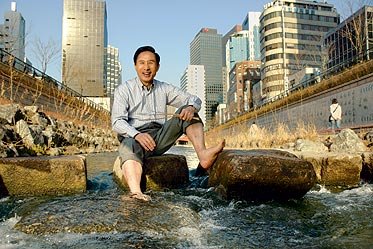
It is amazing what can happen when you listen to the people. In one case, the former mayor of Seoul, South Korea made his career pretty much entirely by making his city more livable for its citizens. That's the kind of popularity that carries mayors into presidencies, as it did for Lee Myung-Bak, now the President of South Korea.

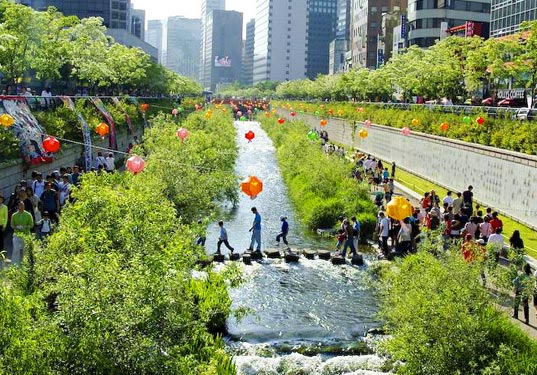
The two biggest legacies he left Seoul with after he left for, uh Seoul, were the Seoul Forest, a large urban park on land that was rendered rather useless by overbuilding of roads/highways and the Cheonggyecheon, a stream-turned freeway-returned to public park and accessible water course. This is what I want to focus on, because 1) it is close to my heart, and 2) it is much more far-reaching in its positive effect on the city and the former mayor's legacy.

Like many cities, Seoul originated on the calm waters of a crosswords of pathway and waterway. As the city grew substantially over the next millennia, they reached a decision point, maintain the waters under the principles of feng shui and use it like a toilet or relocate it to allow for the growing population. Naturally (we all poop right?), they chose the latter. The clear water stream became the not-so clean water.
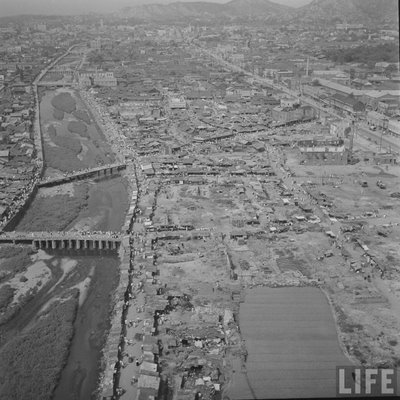


It was gross, or at least, I'm sure it was as any river used for human effluent might be. When the way towards a happily ever after future was found (cars/highways), the Koreans naturally covered up the stream forever to be entombed in what else, an elevated freeway through the heart of Seoul. In the 70's, the new highway was hailed as a monument to progress, Seoul was keeping up with the West, all of whom were leaving behind poor backwoods Vancouver, which wasn't building any freeways. Losers. Let's all laugh at what a backwoods town Vancouver will be in the 21st century. snicker snicker.
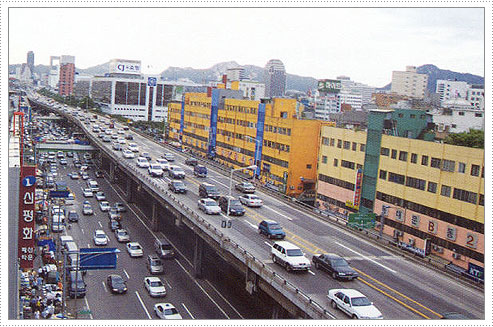
Cheonggye freeway in downtown Seoul
Image from Preservenet.

Shockingly, this had its own consequences, i.e. ripping apart the vulnerable, formal and informal connective tissues that make up cities and all of the implicit advantages this connectivity brings. I've often used the brain as a metaphor for cities and vice versa. Reading the miraculous recovery of Gabrielle Giffords, I came across this:
"But it also damages neurons that don't lie directly in its path, because it is trailed by a pressure wave that transfers the energy of the bullet into the surrounding brain tissue.
In brains, like in freely accessible cities, everywhere is connected to everywhere, however some parts are farther and more difficult to connect than others. Within organic, self-organizing cities, there usually is a reason for this. A bullet (or highway) slicing through it severs the complexity of the millions of potential connections for the prioritization of only point A to only point B.

Noise and congestion created by car traffic had deteriorated quality of life, polluted the air. Congestion is not necessarily a bad thing. Just when it means car congestion, which usually has no recourse to get out of it. Pedestrians are more nimble and can simply leave a crowded pedestrian zone. Cars, you're stuck on that freeway, idling your time, car and spewing dollars, carbon monoxide into the thin air.

Along came Myung-Bak, a wonderkid, a CEO (of Hyundai) by the age of 35 decided to run for Mayor of Seoul on a platform of removing the freeway and restoring the city to its people. The larger metaphor here, is that we no longer need the reactionary impulses towards industrialization's dirtying of cities. Cities can be clean and safe these days, so why run from the problems (and the inherent, associated advantages of cities) you abandoned?

Myung-Bak was swept into office aloft this populist wave. However, as with all new ideas and/or counters to the status quo and conventional wisdom, the idea of removing a freeway "vital to business" or whatever was treated with skepticism. Probably a similar skepticism that doubted Copenhagen going car-free for much of its central city. Lesson 1: this is natural. Business is ALWAYS acutely adapted to status quo (as it should be - if not, it would likely fail). It generally is allergic to change unless the benefits of that change are immediately understood.

The new mayor's plan faced all of the same arguments, "omg traffic! businesses will die...and omg traffic!!" Any new idea requires incredible leadership and initiative armed with foresight.

To ensure success, Seoul set performance goals albeit entirely unrealistic ones - 50% reduction in private vehicle usage. It doesn't really matter if they hit that goal, but it gives them the stars in hopes they hit the moon. Adding road capacity has never worked in addressing traffic congestion, so they sought to reduce demand.

I have seen project costs ranging from $200 million to $600 million, presumably dependent upon what is actually counted. While that seems like quite a bit for something that adds through subtraction, the economic impact has been substantial, around $2 billion in private investment since construction completed in 2005. That's good public investment, leveraging public capital for increased private capital AND improving quality of life while doing so. It is easy to see how it this happens when you factor in all of the property that is 1) tied up as freeway ROW, and 2) all of the auxiliary and adjacent properties that are negatively affected by freeways.

The spin-off effects didn't stop there, as the New York Times wrote in 2007:
"The man chosen as South Korea’s next president in Wednesday’s election owes much of his victory to a wildly successful project he completed as this city’s mayor: the restoration in 2005 of a paved-over, four-mile stream in downtown Seoul, over which an ugly highway had been built during the growth-at-all-cost 1970s. The new stream became a Central Park-like gathering place here, tapped into a growing national emphasis on quality of life and immediately made the mayor, Lee Myung-bak, a top presidential contender."
Fundamentally, what tearing out the freeway did, was restore all of the neurons that exist within a complex, functional urban center. In contrast, the efforts to revitalize downtown Dallas, more resemble trying to win the Olympic biathlon while missing every single target and having to ski 20 repetitive penalty laps. It's amazing how magic bullets never seem to hit the target. I'll advise the USOC.

Freeways reduce intersection density, which operates as a substitute for network density. As Bill Hillier is showing with his studies of London, that there is a direct relationship between property values and connectivity in systems (even if it isn't immediately bared out, eventually it will be). To counteract the negative impact of freeways because we falsely assume we would lose connectivity without them, we too often settle for weak compromises like "emerald necklaces" which is little more than greening up areas no one goes to nor wants to be in. We're expending costs to overcome costs, trying to make four left turns just to go straight because there is a road block rather than removing the road block.

Image from Korea Times: Some columns were retained as monuments.

Another issue to be addressed is the notion of freeways as city walls. In some ways, that is correct as they are barriers to connectivity, but the effects of the analogy are misplaced. City walls forced dense development, a coerced sociopetality. You had to stay within them to ensure safety. Highways are sociofugal. They fling people away directly (because you can drive fast and travel far distances) and indirectly (as in, who would ever want to live on one?).

Removing the freeway takes a repellent force and creates an attractor, a center of gravity, a necessity for downtowns. Today, 90,000 pedestrians go to the new park in the center of Seoul, each day. 50 million have visited the new riverfront park in five years. It has become the center of Seoul, and by extension all of South Korea. Any city in the history of the world is polycentric, in that there are many centers of commerce and activity, that organize hierarchically based on access and popularity. Like any system, they both compete and cooperate.

However, the downtowns in the Sun Belt have been competitively knocked down several pegs, in a flatter, less hierarchical competition with suburban highway office parks. The result is reduced competitive advantage of urbanism, of interconnectivity that, as physicist Geoffrey West has shown is an increase in economic development by 115% for every doubling of population size. Sun Belt cities do poorly by these metrics precisely because of their disconnection. They have all of the problems associated with big city population but none of the advantages.

For a city to function, like a brain, intelligently, it has to be intensely interconnected so that the "cells" can communicate more intelligently, efficiently, and adaptively producing a more resilient system. The cells are the buildings and freely moving in and out of them is functionally reduced every time you have to get on a freeway and drive several exits. While highways are important connections on a macro level from city to city, within cities they are a barrier to this higher level of interconnectivity.

The modern city is no longer defined by high speeds and freeways. That TomorrowLand fantasy turns out to be Never Never Land. As is the course of human events, we eventually learn from our mistakes, usually after all other avenues are exhausted. High speed auto traffic is fine between cities but not within them. However, the attempt to increase speeds rarely ends up actually doing so. As the Jevon's paradox suggests when applied to cars/driving/mobility, making driving easier increases the amount of drivers thereby making it more difficult. The future cities, the cities competing for global talent are focusing on livability. Tearing out inner-city freeways is the profitable solution, as Seoul has proven. The only thing freeways make more livable is someplace else.

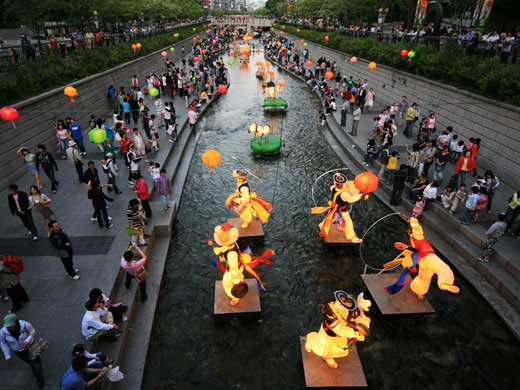
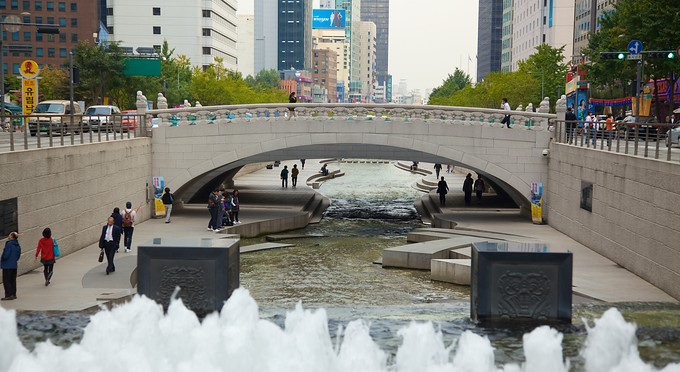
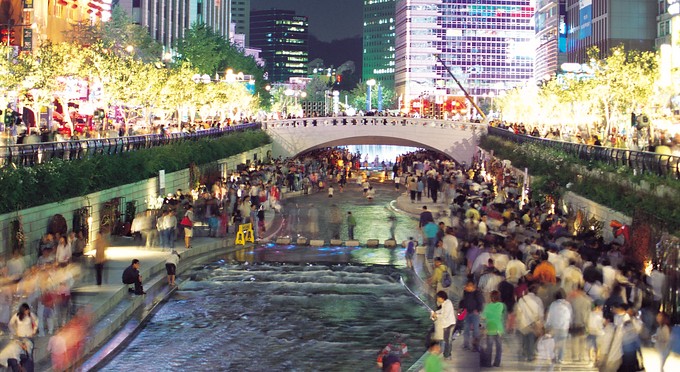
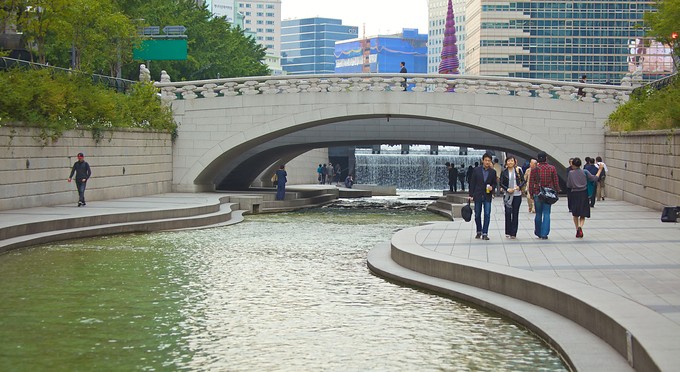
Now, more pictures of the Chonggyecheon:
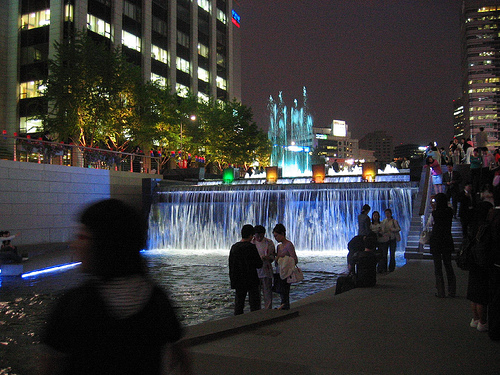


Cheonggyecheon Stream

Cheonggyecheon Stream

Monday, July 26, 2010

Monday Morning Linkages Says Get That Freeway Off My Lawn

New Orleans and St. Louis are ready to start getting serious about intra-city freeway removal. Why? Because hitting rock bottom and exhausting all other hopeful yet feeble and misguided attempts towards revitalization have failed and shocker! it turns out that winding back the very siphons of vitality:

First, New Orleans and the I-70 expressway:


A small fraction of drivers — less than 20 percent — use the Claiborne Expressway as a through route between the east and west portions of the region and beyond. With most through traffic using I-610, the Claiborne I-10’s “use does not match the intended function of an interstate highway,” concludes the report.
Point being that it is mostly used as a local route and a freeway is hardly the best design for local connections. As I've said, freeways are 1) a LULU or locally undesirable land use and should remain outside of the neighborhood fabric, and 2) are only economically beneficial in linking metropolitan economies, ie Houston Metro to the DFW Metroplex, but are disadvantageous within the actual cities themselves, as St. Louis blogger points out here:
Two adjacent high-density neighborhoods will be richer than either could be alone because businesses at the edge of each neighborhood will be enriched by pedestrian traffic from the other. Driving a freeway through the middle of a healthy urban neighborhood not only destroys thousands of homes, it rips apart tightly integrated neighborhoods. Pedestrians rarely walk across freeways, so businesses near a new freeway are immediately deprived of half their customers. Similarly, residents near a new freeway lose access to half the businesses near them. The area along the freeway becomes what Jacobs calls a “border vaccuum” and goes into a kind of death spiral: because it contains little pedestrian traffic, businesses there don’t succeed. And because there are no interesting businesses there, even fewer people go there, which hurts the sales of businesses further from the freeway. The harms from such a freeway extends for blocks on either side.
We saw freeways in Germany during and after the war and thought, by golly those are a great idea! Military and highway spending did wonders for bringing Weimar Germany out of its deep, deep depression, we can do the same! And then went overboard and never stopped spending looking for what ultimately turned out to be increasingly damaging ways to insert freeways into the daily lives of all of us. It made a few people very wealthy and they are not eagerly awaiting this turning tide of popular perception.

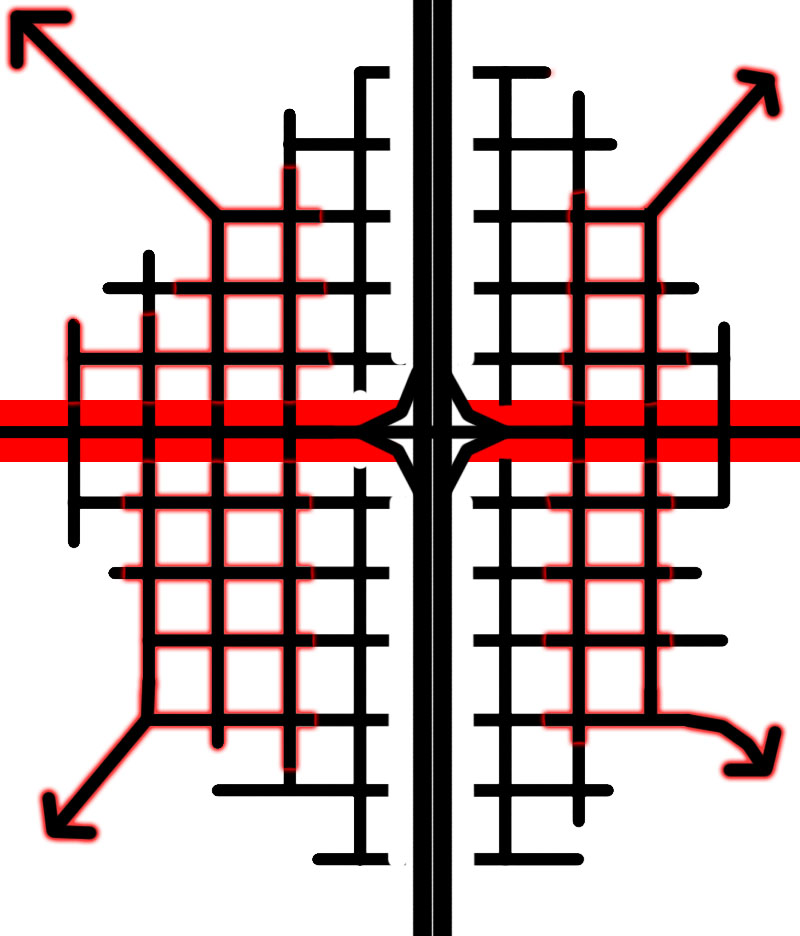
Let's go through this diagrammatically, shall we:


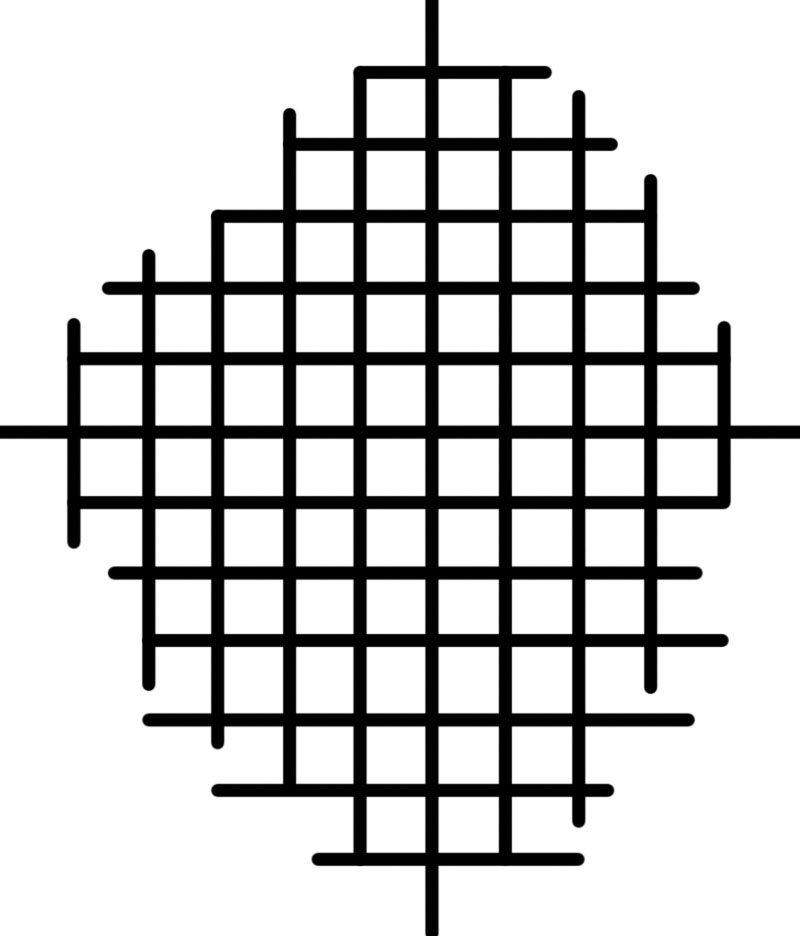
First, we have a typical American gridiron city laid out for real estate simplicity and flat midwestern geography.


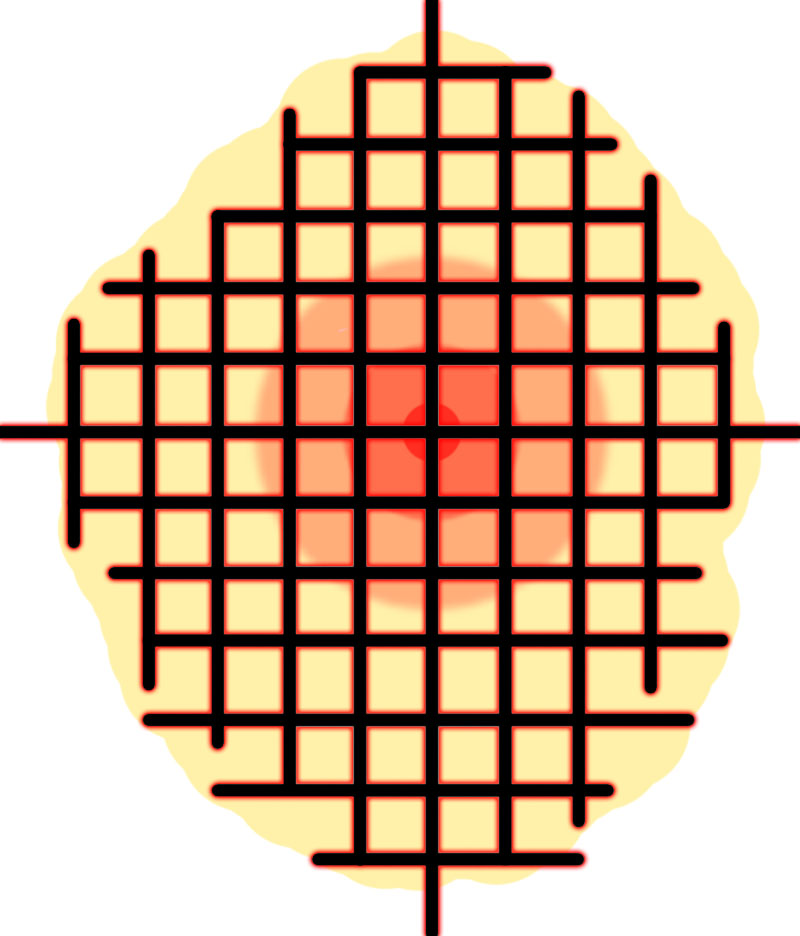
The center of gravity forms at the crossroads, the main and main intersection. Businesses and density can reliably locate along these main streets. The density, in a livable, fully functioning city is merely the byproduct of desirability and there is an accurate and direct relationship between the two.


Since the entire network is interconnected, like an electricity grid, the entire system is "energized" or alive.


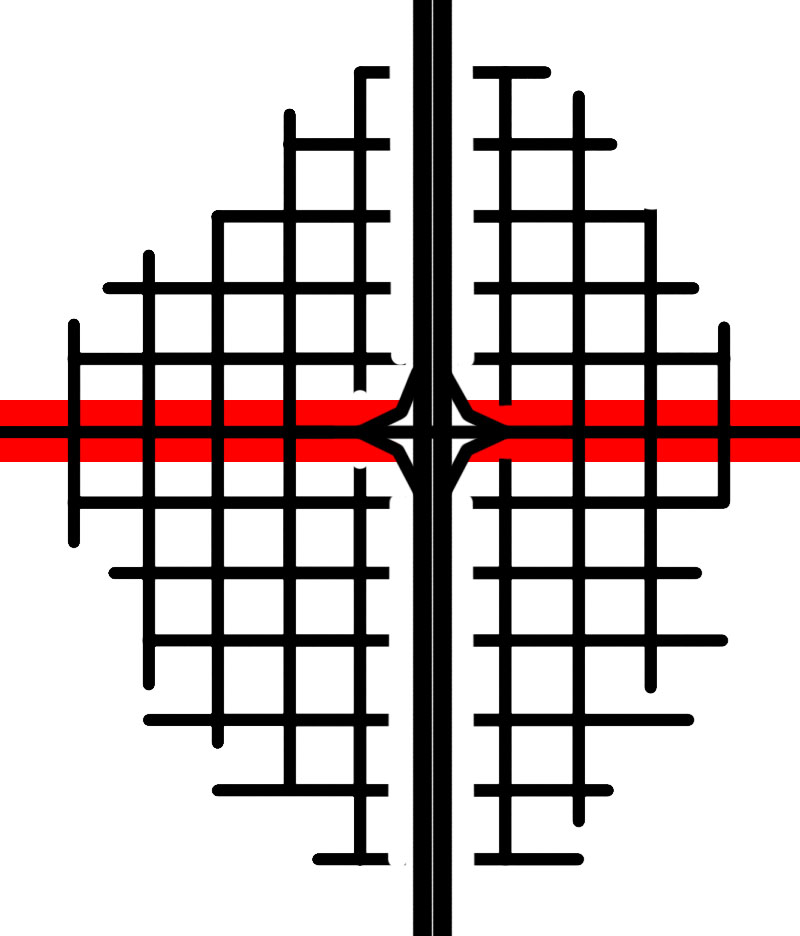
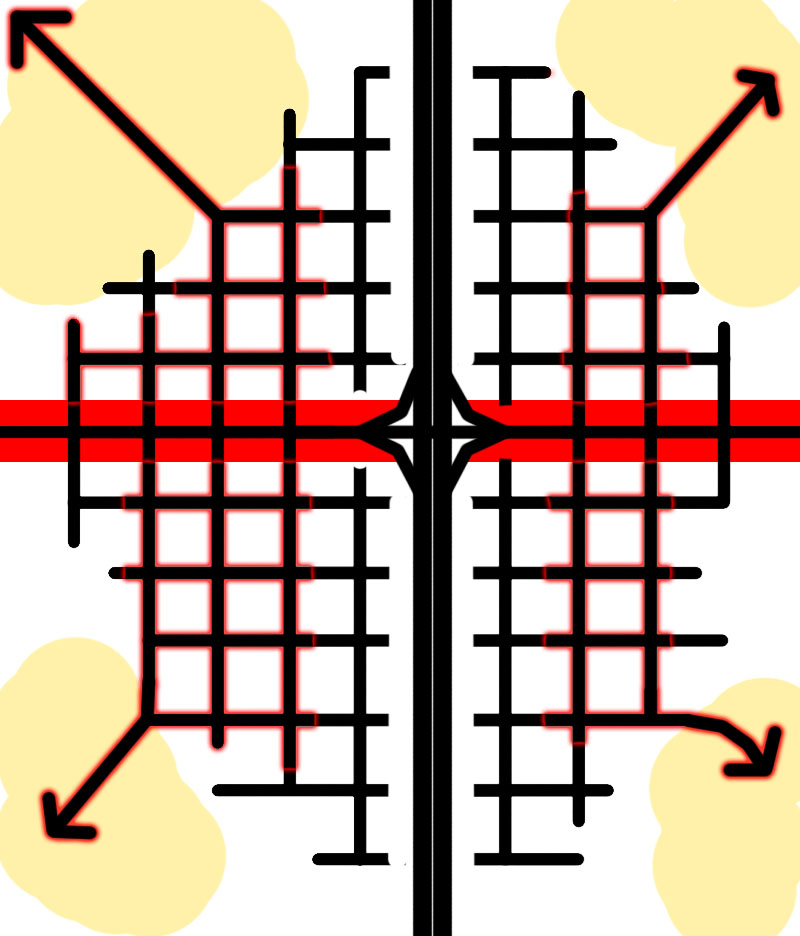
Now we cut a highway through it for the sake of "interconnection" or jobs or just spending money for the sake of circulating it. We're not generating any real value because assuming this connection is necessary, it could still happen to the periphery of the city like any other LULU.

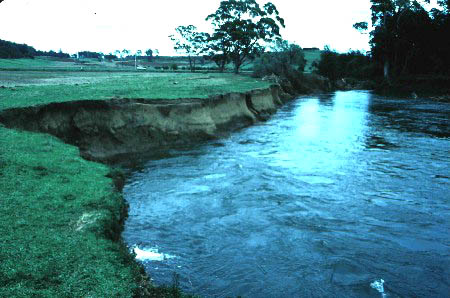
The red bar is essentially the "port" system for the amount of cars delivered along a dendritic, overly-hierarchical road system, aka parking. This becomes your typical strip retail area. Think of this like a natural stream and ecosystem that all of a sudden is exposed to a new runoff and drainage source. The shear volume erodes the stream banks and slowly but surely kills the ecosystem.

http://soer.justice.tas.gov.au/2003/image/108/p-water_erosion-stream-m.jpg


Where the full connected system once energized the entire network, now we only have pockets of connections. One part of town no longer plays a part in strengthening another. They are left to whither away. Durability of the entire network is diminished.


Because desirability is now diminished, people flee. Like in the streambank, life decides "hey, I can find a better, possible life somewhere else." Residents moves outward to further isolated and disconnected pockets that have very little embedded predictable retention of value or durability. Similarly, businesses try to locate for predictable customer base, but that proves impossible as the target location is always moving further and further out as more roads are constructed, and new shopping centers pop up each decade, also further out.

The end result is "anti-city" or places that are worth less than the sum of parts. Our cities and individual properties need to be part of an interconnected larger system in order to be greater than that sum of parts.
---------------------------------
Lastly, and relatedly:

Walkable, bikable neighborhoods reduce risk of death 19%. From the lead researcher himself:
Lead researcher, James Woodcock said, "This research confirms that is not just exercising hard that is good for you but even moderate everyday activities, like walking and cycling, can have major health benefits. Just walking to the shops or walking the children to school can lengthen your life -- as well as bringing other benefits for well-being and the environment."
But dude, I can't cross that highway without playing a very real game of frogger with my life. And kids live so far from their schools they now must be bussed from all over creation. More negative external outgrowths of anti-city inertia. Now about those school budgets...

Wednesday, June 2, 2010

Highways Didn't Kill Small Towns. People Did.


I came across a tweet yesterday by Richardson blogger Mark Steger that I want to address because it is both right and wrong. And because it displays a common misconception of the conventional wisdom. Here is the tweet that may or may not have been in response to one of my twitter rants:
Travel old Route 66 today and see all the towns that died when the Interstate bypassed them. Then you'll know why cities don't cut the cord.
I shouldn't complain that blaming highway bypasses for the death of small towns because for a long time I believed the same thing...until I started to think about it yesterday. Mark is right that the highway bypass killed those small towns, but wrong that it is still relevant today, at least to big cities.

I would argue that the highway bypasses didn't kill towns as much as they were probably already doomed to some extent. Our remorse is little more than nostalgia.

The old highways, before the super highways, were the single lifeline of a 20th century small town. Each turned into the "Main Street" as it passed through town. Before that towns sprung up all over the country along railroad lines linking the country from coast to coast. This dates back to antiquity where trading posts emerged at cross roads between settlements.

The difference between then and now is that the world is different. It is hyper mobile and getting moreso every day. We are no longer connected by one umbilical cord whether it be a railroad or an interstate. It is the human urge to connect and technology is making it possible to do so in a dozen ways including via (see what I did there?) the internet, they way you are reading these very words.

The internet also hasn't proven to be the death of cities or human interaction as many once feared. In fact, the opposite has occurred where we have shaped the internet into web 2.0 or social media making human interactions and community building all the more efficient. We've created cities and we've created the web to facilitate human interaction and INTRA-city highways are a barrier to that. Unless of course this is your kind of human interaction:


I say INTRAcity highways because INTERcity highways DO serve an important function in linking regional economies, ie Dallas to Houston. But, they also should just provide an option, much like you can fly or hopefully in the future take high speed rail from downtown Dallas to downtown Houston. We like that idea because it facilitates connections from where people are and commerce happens, the cores of cities. However, highways within cities tear apart the urban fabric, are a centrifugal force of entropy, and damage local economies.

A certain segment of the population wants human interaction, wants to be near other people. Highways prevent that and only serve those that don't. As I tweeted, they are the lifeline of the suburbs and ironically, removing them would be the best thing for brittle suburban communities dependent upon them as they leech from the core. In order to survive the next century, suburban communities will have to be able to stand alone.

Those small towns don't compare to today's modern megalopolitan economies. Today's cities are highly interconnected, highly mobile places where freeways actually make it more difficult to make our daily face to face interactions that comprise cities.

The blame we lay upon the bypasses is that they killed Main Street. Main street businesses packed up shop and moved out to the interchange in the form of big box. But people had already left. Retail follows rooftops and everybody moved outside of the towns or the cities because of debt-fueled, tax incentivized policies towards consumption of new land, new houses.

Except all of that is as ephemeral as the leaves on the trees. We have 6x as much retail per capita as does the most heavily retailed European country. All of that excess retail is going to fade away and re-cluster around population centers in order to survive. All of those homes and buildings built to last twenty years and made of little more than paper mache are going to turn to dust. We won't be replacing them with more of the same. The sun belt cities you see today, will never be seen again. We can no longer afford them and we're seeing the effect.

Our intra-city highways are a giant land bank that broke states and broke cities are sitting upon. Irony = that which bankrupted us is the biggest asset we have in restoring our wealth and prosperity.

This won't happen all at once. It would be too traumatic. Humans adapt, but we can only do so at our pace, which is why it is necessary to slowly, but incrementally implement change for the betterment of cities and the facilitation of human interaction and human need. The same much of Copenhagen didn't go car-free overnight, we will start with easy wins, narrowing highways and their interchanges. Replacing cloverleaves with development opportunities.

People will likely be fearful of the idea. In Copenhagen, local businesses yelped when change began. Businesses, as well as people, are conditioned by their context. They generally hate change. Status quo is comfortable. We're used to it.

But we need real mobility, a choice of mobility. Highways dominate our life. You can't get anywhere without them, which is precisely why losing them seems frightening. We need to replace our highway commute to work with a train ride where we CAN text or email without endangering lives. Our drive to the store with walk down a peaceful, tree-lined street; the school bus system that bankrupts our schools with an empowering bike ride.

Cities are built upon connections and the great ones have the quickest, the most expedient, the most efficient, and the most nourishing, the healthiest. Intra-city highways are the opposite of all of those.

Don't be scared. In fact, be a leader.

Friday, April 23, 2010

This Month's D


I encourage you all to go out and buy this month's issue of D Magazine. They have to pay for their fancy new digs in walkable downtown Dallas.

So don't go to this link about the development at Park Lane Place where I am quoted thusly:
He says a development like this one needs to do two things to succeed. “It has to be so well-designed, so lovable that the citizenry will always care for it and ensure that it endures,” he says. “The other is, it has to tie into the rest of the city, the adjacent properties, neighborhoods, street network, and transportation framework so that the improvement, stewardship, and resilience are mutually ensured. I’m not sure Park Lane successfully accomplishes either. I think the underlying logic defining Park Lane—that of convenience—undermines certainly the latter and possibly the former, as the experience is ultimately degraded by the disconnection, no matter the level of detailed design.”
And especially go buy it because of the Op-Ed by publisher Wick Allison at this link you don't want to click where Wick hops on the bandwagon to demand Mr. Leppert, Tear Down This Freeway:
Those neighborhoods—and Fair Park—are too valuable to neglect any longer. The city’s next bond election should include the funds necessary to tear down about 3 miles of I-30, from its interchange with Central Expressway to Samuell Boulevard. HNTB estimated the costs at about $200 million. The benefits are incalculable but real. These neighborhoods now contribute a disproportionately low rate to the city’s tax rolls. By restoring East Dallas as a middle-class community and by stimulating the return of the black middle class to Fair Park, the city will see a huge return on a relatively small investment of $20 million a year for 10 years. The pressure is there. People want to move into the city, close to downtown. All Dallas needs to do is remove the single biggest impediment to its own urban growth.
Exactly. As we shift from expansion to contraction, "growth" will be found in the qualitative improvement within the City. In this age of what I call "urban introspection." Since the highways are a barrier to that effort, they are therefore a hindrance on economic growth. Do we really want that as we dig out from under a recession?

The $200 million number seems like a lot. But, like any responsible investor (as the City should be with its infrastructure and urban "acupuncture" or in some cases neighborhood difibrillator), we should demand a return on investment. Trinity River Plan is nice. The Woodall Rogers Deck Park is as well. But nothing, and I mean NOTHING, will generate the return on investment as tearing out freeways. Whether it is I-30 or the downtown loop, there is billions in private investment pent up by the Dallas intra-city highways.

Just look what Seoul, South Korea did with $200 million. Before. After.


What I like about this picture is that bodies of water, like highways, can also act as barriers, as edges. The design shows how it can be a seam, stitching the City back together. It represents the repair of a long and degraded history for this particular body of water that was once, quite literally, used as Seoul's sewer. The first logical solution of course, was to cap and cover it with a freeway, an express lane into a modern economy.

Fortunately, they have since realized how cities and economies really work. Oh, and it has been so successful that the Mayor who was elected ON this idea, executed it, and then became so popular as to become President of South Korea. I know I feel better that the lunatic to the North is balanced by the intelligence of his southern counterpart.

Economic Development is Urban Design. Urban Design is Economic Development.

I don't mean to be harsh, but if you are in the profession of economic development, you either need to be thinking about removing intracity highways (with a CAN DO attitude!) or find yourself a new job...because my beer mug is going to need a fillin'.

-30- and I'm out. Peace.

/drops mic
-------------------
Post Script: For everything I've ever written on taking out freeways, peep this link.

Friday, April 16, 2010

What World Class Cities Do

Do we want to keep up or continue self-delusions and pat ourselves on the back?

What World Class Cities don't do: they don't build new intra-city highways (as opposed to inter-city highways which are important in connecting regional economies). In fact, they learn from their mistakes and are all systematically removing them, restoring the neural network of local economies and instilling increased livability. Continuing the metaphor, if your economy is reliant on intra-city highways, every traffic jam (often caused by "accidents"), in effect, is like a cerebrovascular accident, aka a stroke.

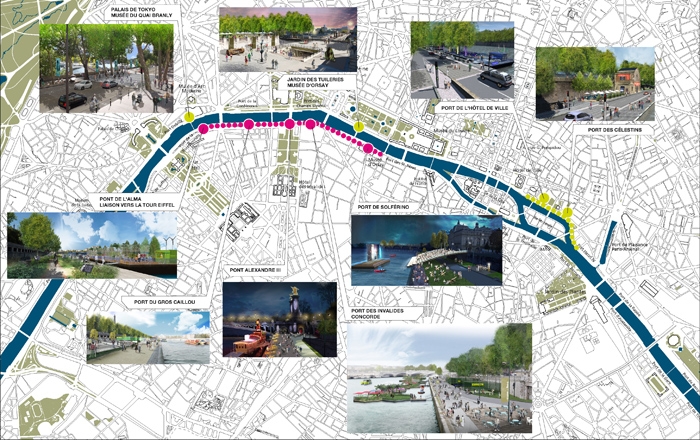
Carte de voies sur Berges

Here is the translation of a French article about the Parisian mayor's most recent plans to upgrade his City's livability.
Reclaiming the banks of the Seine

On April 14th, 2010, Bertrand Delanoe unveiled the proposed redevelopment of embankment roads. The mayor of Paris offers a different treatment of both sides. Specifically, the left bank will be closed to vehicular traffic for more than 2 km of Solferino in Alma. The right bank, this "expressway" will be transformed into a Parisian boulevard, modern and harmonious, with red lights, allowing the coexistence of pedestrians, motorized traffic and cars. For Mayor Delanoe it represents the continuation of "evolving towards the use of beauty and pleasure of living". Discover the future embankment roads and join the citizens' forum by offering your ideas for management and use of these new places.

"To allow Paris to find his relationship to the river"
(ed: Hey, we've got a river with zero relationship to the City...)

"If we realize this ambition, it will really change Paris. We must continue in the second term, to change practices, practices with a little something pleasurable, the side of beauty and enjoyment of life" said Bertrand Delanoe. He recalled that he had long wished that Paris "found its relationship with its river." This should be done within two years.

The idea is to continue to reduce car use and decrease pollution. "This is not to punish but to reduce traffic and provide an opportunity for happiness".

Bertrand Delanoe discussed the dissociation of the Left Bank and Right Bank projects: "We are seeing much less traffic on the left bank than the right bank." Completely close down the banks of the right bank could cause "congestion of Paris which will strip the project of its viability. The additional traffic associated with the closure of the left bank would however be absorbed by the high platforms.

In total it is 15 hectares, of which 4 acres will be fully provided to users without cars. Organized around several points, including culture, sport and nature, these new banks should also leave room for night life.

For magic, stands at Solferino, which descend to the river, with a clear view on the Grand, the Petit Palais and the Louvre. "
(ed: I would love to provide a better translation here, but I have no idea what the intent is here.)

The mayor stressed that these areas would evolve over time with use and needs: "we will install a basketball court for two years and turn it into lawn bowling(?) if necessary.

The first deputy Anne Hidalgo, who will lead this major project of urban development, stressed the public input that will accompany these developments: "The citizen forum online paris.fr must be a forum for discussion and ideas. We do not want to exclude the main users, including families, youth, seniors.

The reconstitution of low platforms on the right bank

A redevelopment of the wharf right bank, which is currently an urban freeway, reducing them to speed through the establishment of at least 5 traffic between the Pont de Jena and the Pont de Sully, by reducing the width of pavements and restating public space, which will facilitate access to the waterfront and reappropriation by the Parisians;

Closure to traffic of the dock bottom left bank, between the Musée d'Orsay and the Pont de l'Alma, will allow the installation of year-round activities accessible to all.

This configuration has been studied as well as many other scenarios, the services of the Directorate of Roads and travel to the City of Paris. Similarly, budget planning and operation has been unveiled and is available on Paris.fr.

"The new embankment roads and delaying traffic: where, when, how?

A first discussion will be presented to the Council of Paris in July 2010, to present the design principles and allow launch various feasibility studies. By June, the exchange will be held with district mayors and the communities along the metropolitan dimension to the project is affirmed.

In his part of Paris, the project will be implemented within two years: developments on both sides will be made and delivered later in the summer of 2012.