




Showing posts with label emergence. Show all posts

Tuesday, June 7, 2011

Ping Pong in the Park

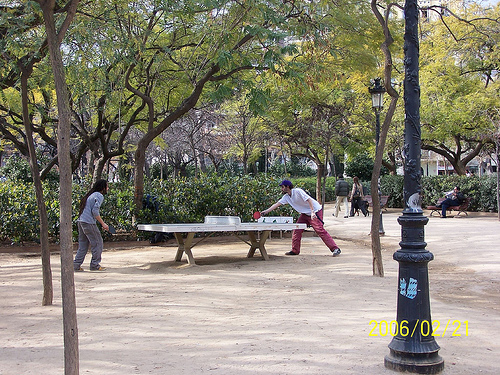
I pulled this off the web, but it just so happens to be taken from the park outside Sagrada Familia, Gaudi's church I happened to visit last week. See my pic here:
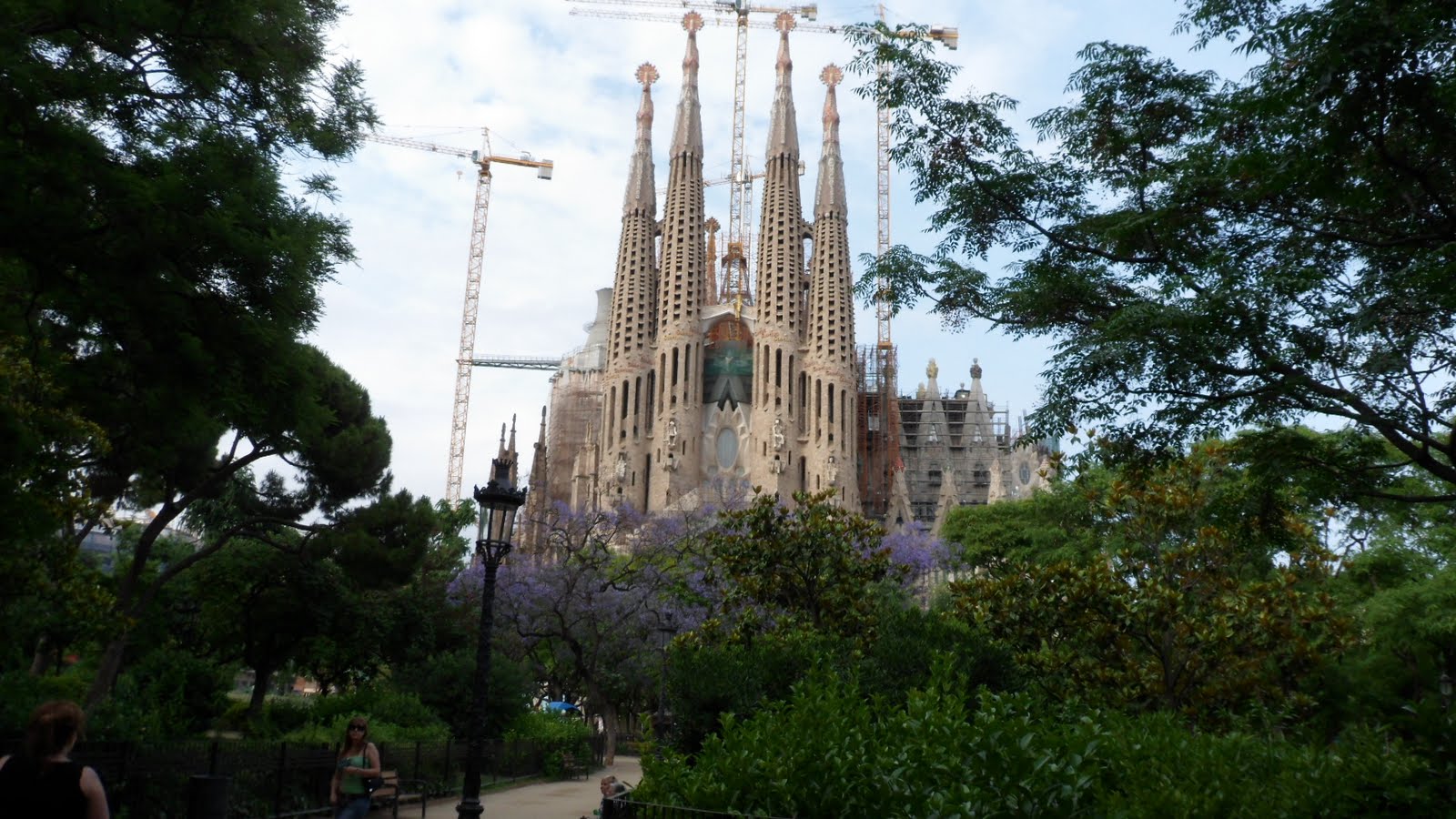
This, I did take.

The reason for the post is actually my morning visit today to Main Street Gardens in downtown Dallas. On the wooden cafe platform, where more tables and chairs once sat was a new ping pong table. Playing on it was a white collar bro with (presumably) his 5-year old (or so) son before it got too excruciatingly hot in the sun-baked park.

It was pretty cool to see and a great example of the concept of emergence in cities, perhaps the key discovery in the understanding of underlying dynamics of city forms, processes, and morphology - the way a city molts and shape-shifts and adapts. Emergence tracks back (a very short time period) to people like Michael Batty, Bill Hillier, Nikos Salingaros, Chris Alexander, and all the way back to Jane Jacobs, considered the godmother of the concept who actually didn't really spell it out, but inspired the study and elaboration. Much of it also tracks with mathematicians like Benoit Mandelbrot.

But even before Jacobs, people like Patrick Geddes et al were making the connection between cities and ecosystems. So it has been a long process to get where we are today. Funny enough, as the awareness has grown, the application of it has gone in the opposite direction as we've gutted our cities into completely dysfunctional places.

(**edit: I decided I should come back in and rewrite this section to summarize emergence rather than gloss over it and tell you to look it up somewhere else)

Emergence is what happens when numerous single entities or organisms acting in their own particular interests or following their own impulses (typically guided by a simple set of rules), result in orderly patterns of the super organism the entire group comprises. It is the same idea as a fractal. One example of a fractal is water trying to find its own level makes for incredibly intricate series of streams, lakes, and oceans. One example I just read of emergence was the stadium wave. Without the broader lens, one individual in a stadium is just standing up and sitting down, but when perceived as part of a group an identifiable pattern appears.

The concept helps to explain why what planning used to think of as disorganized, unplanned historic cities (seemingly) are actually quite ordered, but followed simple localized rules. It also helps to explain why centralized planning (especially when it comes to the application of transportation) tends to create disorder.

The key is understanding how emergence happens and effects our daily life. How did that ping pong table get out there and why, when I see it, say "cool." And what is the broader context of why there?/why now? What are all the steps in the timeline for someone to add a layer to the place? Why didn't somebody add a ping pong table in Victory for example?

First, emergence needs location. You've heard it before "Location Location Location." Come to think of it, I have no idea the history/etymology of the phrase, but it is still important today, at least in understanding the difference between functional (where location matters and the correlative value is relatively predictable) and dysfunctionl (where location has been replaced by "if you build it they will come" nonsense that applies to decentralized places).

As I've written before, Main Street Garden is in the right place for two reasons. One, because of its adjacent location to the successes of Main Street, sufficiently buffered from the negative effects of the freeways, the park allows for incremental expansion of a 3-block stretch into a four block stretch. This is far easier to do than create a sense of place that doesn't build off something, that is part of something rather than trying to create something entirely new without the existing critical mass.

The second is for its place within the movement network, the framework of the transportation grid. Although this has been somewhat minimized with the tragic decision to cut-off Harwood entering the city from uptown. It is still in a key location, but it was short-sighted to close Harwood. Helps one park to spite another.

Then, since the idea of the park is in the right place, then the platform has to be provided. The park has to be financed and constructed. Anything that happens afterward, if it is successful in cultivating ownership, the park will be a platform for adaptation and expression of the locals, the users. The key to cultivating ownership is typically directly connected to location and proximity (centrality), aka once again what is outside of the park is far more important to the success of a park than what is actually IN the park. How do I get there? How far is it from me (wherever I might be coming from)? Will other people be there, since fundamentally it is a place of gathering?

Who added the ping pong table? It is irrelevant. Who cares. What matters is that the park is shape-shifting. Adapting due to the individual actions of its numerous agents, including just the regular users. That is emergence. Cities are the amalgam of millions of numerous actions often acting independently. Somebody said, "I would like a ping pong table here." And there it appears.

It may come. It may go. But you know a place has come alive when it becomes the result of numerous actors, a superorganism comprised of the actions of individual organisms. It starts to have a life of its own. Constantly adapting to and adapted by its surroundings.

So who is really responsible? Well, to know that you have to follow the process beginning with the initial inspiration for the idea of the park being in the right place for it to work. All else afterwards is just facilitation (which is also important). The history of the park, as I've detailed before actually traces to the many many many efforts to revitalize the Mercantile Building which sat empty for nearly two decades. During one of those efforts, somebody suggested, "hey this part of town is harsh, sharp, abrupt and needs soften. It needs a place to breathe. Why not leverage the building's value with proximity to a new park?"

So fifteen years ago, the plan was elaborated to remove some of the buildings nearby to create a new park (however this version also removed the Statler Hilton to make a two block park, which admittedly would have been a mistake). Unfortunately, the numbers for various whatever reasons didn't work out and the Merc ended up sitting for another ten years and change.

The kernel of the idea for Main Street Gardens (which at the time was called "Commerce Gardens" -- an ironic spin on Dallas's reputation and acknowledgement of the second block) actually came from my current business partner. I was still in high school.


Tuesday, January 4, 2011

Ask the CarLess Guy?

Received this thoughtful question today, and one I've thought about for a long, long time but haven't really written much about specifically or in detail, but the issues are all familiar:
Patrick,

I am a reader of your blog, https://carfreeinbigd.com, and enjoy it greatly. However, I was wondering if you have ever given any thought to, or written about, how modern Apartment complexes play into livability versus how they were constructed in the past.

It seems to me most modern apartment designs are done on a multi acre scale instead of the old style (early to mid 20th century) of a random building or two along a street, relying on that street for parking needs. Modern complexes, with the exception of the Tx Doughnut, seem to be an isolated retracted space shielding themselves from the surrounding neighborhood. Newer complexes like in Uptown seem to be bridging the gap between the classic one off building and the apt community.

In uptown at least this increased walkability and density happened in a positive manner. Larger complexes, aka the village, are more suburban in feel and function. Most folks despite the density in the complexes still use a car to travel to the City Center, from their apt, however, based on the density you would think it's more walkable.

Classic apartments, in Lakewood, or East Dallas, Oak Cliff, ect, provide a nice mixture of income level folks without becoming a "scary Section 8" complex since a building or two by its very nature is so small. It minimizes the potential "scariness "of buying a single family home next to an apt complex. Additionally, they provide a nice mixture of density, without becoming overwhelming the character of the neighborhood. In the long running allowing it to slowly become densier and more walkable.
Anyways, I have rambled with long enough. Thanks for your though provoking post.

Without writing 10,000 words in detail of every little nuance and reasoning for the observed by-product of economic inertia, I try to respond:


Glad to hear from you and you are 100% correct in your assessment of the different development form and format. The deeper question then to ask is why did this shift occur and how did it happen. Then the next step is to determine if some measure of return to that real estate delivery system is 1) feasible and 2) desirable. The reason for the shift has a number of origins: new building standards/codes, Euclidean zoning, as well as financial mechanisms behind what gets approval for loans and what doesn't - which is typically the tail that wags the dog - in that it is a byproduct of the above, but then dictates it thereafter, hence the inertia of the entire real estate delivery system and why we mistakenly think of suburbia as a market demand.

All of these were in some ways a form of market determinism, but the solutions were ham-handed. They went too far and undermined, well, complexity and interconnectedness (interconnectedness produces complexity) if all evidence and Space Syntax are to be believed, which I do. It was like treating cold symptoms with nerve gas. Not sure the details of this metaphor parallel reality, but the hyperbole is intended.

As my next column in D magazine (February issue) will cover, physicists are showing that as cities double in size, they produce efficiencies in outputs. More specifically, this means about 115% increase in output for every doubling in population size. Outputs are data elements. Things we can measure and they can be both good and bad. For example, cities are the greatest invention of wealth generation man has ever created. This is the very reason for their creation along with the increased efficiencies of inputs within cities. Inputs are things like infrastructure, roads, energy, etc etc. Cities use 15% less of these things for every 2x of population.

Wouldn't every business man like this equation? Less upfront cost, more returns (economically, socially, and environmentally profitable).

But along with the benefits of cities, they also produce negative outputs, such as crime, disease and waste/pollution. Industrialization made cities awful, dirty, crime-ridden, smelly, polluted, disease-infested places with plenty o' poverty as well. We failed to innovate in terms of addressing these negative outputs from economic production and in turn, cities became the stigmatized places we still live with today. These actions begot an equal an opposite reaction (and probably overreaction given the state we're at today). We erased the city to erase the negative outputs of city life and also lost all of its benefits. Cheap (and now subsidized) gas/oil prices have only exacerbated/accelerated the process and further entrenched how difficult it will be to shift market sentiment.

Those that studied cities and found the efficiency numbers above, found that Sun Belt cities such as Dallas underperform on both the front and back-end. We are wasteful with our inputs (in that we use a lot of energy and infrastructure per capita) and we get less positive outputs, but because negative outputs are determined by population size, we still have all of the negative issues/outputs, aka crime, disease, pollution. To summarize, Sun Belt cities get all the bad and none of the good of cities. The bad is determined by population size, the good is determined by urban form.

Getting back to the specifics of building form, the reasons for the bigger projects rather than smaller are entirely economic: bigger banks and bigger developers and bigger architecture firms, etc require bigger returns and to get those bigger returns they need big projects that can maximize efficiencies in building practices. At the end of the day however, this only works for short-term financial gain, which is how the financial system is rigged, rather than long-term, continual and sustainable value. ie if a building is built cheaply so that it falls apart and is unlovable in that we let it fall apart, it will just be cast aside in the future. This is the throw-away economy of the 20th century as applied to cities.
Side note: one of these days I want to address the short-term vs long-term economic engines by way of stakeholder vs. shareholder economies.
Waste is a cost (the air we breathe, cost of creating/having landfills, etc etc). Fundamentally, we constructed a broken system. In the natural world, there is no waste. It is all closed loop systems, cradle to cradle, where waste equals profit. We've created the opposite as if it were possible. These outputs, waste, get externalized, ie written off. Somebody else's problem. We're starting to just now bump into those debts the 20th century accrued. Cities become profitable when we don't throw them away every generation and start again. Every building, every stone is reused, repurposed.

Furthermore, since a building might be cheap and ugly, everything around it withdraws or "defends itself" against adjacent ugliness for lack of a better word. This includes streets and the transportation system. It is all connected. Build a great street, say the champs elysees, value and density gather around it, embrace it, and it is financially rewarding to interface directly with it. Therein lies the depth of all of these issues and the bureaucratic entities that defend the status quo (from both a public AND private side). The bigger the entity, the more resistent to change, aka necessary adaptation. From a global perspective, this is why I think there are two types of evolution (whether in design or in natural world): Drastic and painful due to unwillingness, or gradual, incremental, and constant.

I also agree with you that the old way was preferable in that it creates more authentic, true, walkable urbanism - or better yet, functional, efficient urbanism as a platform for human livelihood. It is inherently complex, since it is interconnected (also in the 4th dimension in that it is tied to history, or some tradition, ie years of decisions/thought put forth years and years before - modernism also suffocated all of this thought - a selfish mistake by modernists). Interconnectedness is the primary reason for many chicken/egg dilemmas of urbanism. Also, I think what we call authentic is that it was incremental and demand driven. Much of what we see built today is supply driven, ie the housing bubble/burst. There weren't real demographic shifts calling for an extra 25 million new households, but the financial system (and its mouthpieces) said there was money to be made, so build we did...bigger and bigger, more and more.

I also think that if we can apply modern materials and methods to this process while making it economically viable to do so is probably approaching necessary at this point. So what we have to do is drill deep into the real cavities, the systemic issues and mechanisms producing the cities that we see and feel, and that aren't working for us, change them, so there really is no choice, but to build great cities, buildings, and places. I prefer a system that doesn't outlaw the bad, but rather financially punishes the bad and rewards the good. To do so, we have to be honest with ourselves as to what those cavities are and honestly address them rather than adding some veneers and calling them world class.