




Showing posts with label Sprawl. Show all posts

Monday, April 19, 2010

Monday Linkages

Some fun reading today (okay, maybe only for urban morphologist nerds like myself) while I get to play "I told you so" before unpacking my mittens and winter coat for this weather:

First, Next American City takes on Witold Rybczynski's recent broad-brush painting that all centralized planning is faulty:
Rybczynski goes on to defend the private sector’s efficacy when it comes to urban development efforts, but he omits the private sector’s failure from the dark days of the 1960’s. Blockbusting—the practice of scaring middle-class whites into thinking their home prices would plummet when people of color moved into their neighborhood, then buying the home from them at a low price, and selling it to minority buyers for an inflated price—was instrumental in the ghettoization of many American cities in the postwar years. Blockbusting at times took advantage of Great Society mortgage programs, but was ultimately a free market phenomenon. This was what the private sector did in declining neighborhoods: it expedited their decline for a quick buck. Careless federal urban policy and racial distrust created the incentives, and the free market delivered the coup de grace. This, in essence, is the problem with giving the private sector too much control over urban planning: public benefit is not at the top of their list of priorities.
This is what I had to say in reaction to first reading Rybczynski's Slate piece:

"Rybczynski is simply being reactionary here. We still need centralized planning to UNDO all of the mistakes centralized planning created. Government entities will be the only ones able to tear down intracity freeways and it will take cooperation of all levels of government to do so. Our cities will all be the better for it. This I promise you."
----------------------------------------

Not unrelatedly, a super-sweet haircut courtesy of Project for Public Spaces uses the recent rescinding of the Athens Charter in Greece to say something similar:
Economic experts believe this action will boost the sluggish global economy. Scrapping outdated zoning codes will spark a construction boom of corner groceries, pubs, ice cream parlors, coffee shops, hardware stores and small-scale office buildings in neighborhoods around the world.
Here is what I said last week and not to brag, but more poetically and (rare for me) concise:

"The tragedy of 20th century city planning is the task of the 21st."
---------------------------------------------
WorldChanging on the Life Cycle of Concrete:
In addition to its contribution to climate change, concrete production generates substantial amounts of waste. In China, it is responsible for more than 40 percent of industrial dust emissions. The dust can be recycled into the production process, but the U.S. Environmental Protection Agency warns that the highly acidic substance could pose "toxicological problems, human tissue burns...corrosion in pipes, and objectionable taste in drinking water" if released into the air or water...

Alternatives emerged this past year that may redefine the future of concrete. Competing U.S. and British inventors claim they have developed cement production methods that generate zero greenhouse gas emissions and capture emissions released as the cement hardens. If true, their discoveries could become the pillars of a sustainable future.
------------------------------------------
The Baltimore Sun reviews their City's new rubber tire urban circulator and mercifully not their owner-crippled baseball team (yes, I'm bitter). Short article but with several good insights:
But surely even a Tea Partier would have to approve of the circulator, which funnels parking taxes to a bus that helps you avoid paying parking taxes...

It was quite well-ridden the day I decided to test it out — there were commuters heading to or from work, workers from the University of Maryland, Baltimore campus or biotech park grabbing lunch at Harborplace, tourists from Harbor East or downtown hotels heading to the Baltimore and Ohio Railroad Museum and other attractions along the line.

Riding it is much more akin to being on a tourist coach, with cushy seats and a smooth ride, rather than a groaning, exhaust-spewing city bus. (The circulator buses are eco-friendly hybrids.) Not much waiting on the street, since they come about every 10 minutes, or to get on board since there's no fumbling for the exact change.

I actually felt a little guilty not paying anything, like I'd jumped the turnstile. Instead, we passengers were a rolling band of freeloaders. One woman told me she was saving $20 a day on parking at her job. Parking should be expensive, and public transit cheap — you want to discourage driving, particularly downtown — but should it be free?

Kendrick says in this case, yes. "It's not that one dollar or two dollars is a lot of money," he said of charging for the circulator. "But it's a psychological barrier."
-------------------------------------------
Steve Mouzon at his personal blog Original Green discusses the similarities between Sprawl and Cancer:
Disease occurs in a living urbanism just as it does in living creatures. Parts of a city designed by specialists rather than generalists usually act as disease agents to a living urbanism because specialists usually create things for very narrow purposes rather than for the general welfare of the city.
Assembly Line
Streets designed by transportation engineers are a classic example of a specialist’s solution because they have a single purpose: getting as many cars as quickly as possible from point A to point B.
By creating connections like this, they are really creating barriers. Or, perhaps to continue with the metaphor, those "connections" become the straw that draws the life from the healthy organism to the cancer.
But in doing so, they make no contribution to the overall health of the city: It doesn’t matter if the zooming traffic makes the street a terrifying place to walk, or if nobody in their right mind would even think of shopping there because those things weren’t part of the engineer’s program.
The logic of barriers becomes ingrained in all things, and the end product, sprawl is the aggregation of things that have no relation, no communication with any of its surroundings, besides leaching off the healthy organism.
A specialist, you see, is someone who knows more and more about less and less until they know absolutely everything about only one thing.
The lamentable decline of liberal arts studies.
------------------------------------

Thursday, April 8, 2010

Kotkin Makes Sh!t Up or He Cites Those That Do

Statistics. In the wrong hands they can be dangerous. Fortunately, we have good people like Rob Steuteville of the New Urban News to debunk a statistic that Kotkin uses in his paperweight made of stacked and cut printed paper and then more recently picked up and ran with directly into a wall by David Brooks:
David Brooks’s column in The New York Times April 5, “Relax, We’ll Be Fine,” is a hopeful and thoughtful review of Joel Kotkin’s book, The Next Hundred Million. That is what I thought until I came to the following statement, which Brooks apparently picked up from Kotkin: “For every 10 percent reduction in population density, the odds that people will join a local club rise by 15 percent.”
Steuteville then digs in:
If you read the 2006 study (at the source of the statistic), “Social Interaction and Urban Sprawl,” and look at the numbers, you find that going from Boston to a typical suburb does not net a statistical difference in social interaction of any kind.

Brueckner didn’t find any actual decrease in social interaction or activity related to lower-density locations. What difference he did find, however, was favorable to cities. Yes, the typical person in a city was found to have slightly more social interaction than residents in low-density areas.

But Brueckner also assumed bias in the population. He stipulated, with no apparent research to back it up, and no capacity to observe this bias, that people in cities are of a type that is more prone to social interaction. He put in an equation to counteract this supposed bias, which he called an “unobservable propensity.” In other words, he placed a theoretical thumb on the scales.

Using that method, of course, I could prove anything — that reduction in smoking could reduce your chances of getting cancer, for example.
He then counters with a more recent and at least seemingly more objective study:
Podobnik compared a new community that has a new urbanist design — Orenco Station — to both a conventional suburb and two older city neighborhoods in a longitudinal study. Orenco Station is considerably denser than the conventional suburb, and more carefully designed to encourage walking and facilitate social interaction. People in Orenco Station report that they participate in group activities at nearly double the rate of all of the comparison neighborhoods.

More importantly, perhaps, the Orenco Station residents reported participating in higher-quality activities. In the conventional suburb and the city neighborhoods, the activities were mostly neighborhood watch and homeowners association meetings. In Orenco Station, residents cited book clubs, group dinners, and other informal neighborhood activities. To me, food and literature sound more fulfilling than looking for crime and property violations.

Other studies have come to similar conclusions, including 2009 research that compared new urban developments in Canada to conventional suburban communities. Just like Orenco Station, these new urban Canadian neighborhoods have higher density and are designed with a mix of uses, pedestrian-friendly streets, and appealing public gathering spaces. Surveys in other new urban communities such as Kentlands in Gaithersburg, Maryland, and Celebration in Kissimmee, Florida, have also indicated strong social ties.

None of these studies have shown precisely why new urban places have relatively strong connections among residents — only that this pattern exists. The simplest explanation is that the new urban design, intended to foster social ties, is working. It could also be that people who want to have more social ties choose to live in places that are designed with that goal in mind. Both factors are probably at work.

Lesson: don't believe everything you read. Even this: Joel Kotkin was not born on this Earth and was actually a direct descendant of Xenu sent here to perpetuate the malignant terra firma melanoma of sprawl and destroy the world.


Monday, March 15, 2010

Conservatives Against Sprawl

It is starting to pick up steam, as our endless ranting apparently has now apparently migrated rearward from the explicit memory of our collective frontal lobe to the implicit regions of the hemisphere. Personally, I think this is one issue that can be agreed upon by both right and left, possibly for differing reasons, and we can certainly disagree on the best way out of the mess. Here is E.D. Kain at True/Slant citing Kunstler and requesting Andrew Sullivan take up the mantle (which he has in the past):
Sprawl is a result of massive statist interventions into our culture and society, and its symptoms are equally enormous. Everything that conservatism has historically stood for is undermined by sprawl. It is not only the physical manifestation of our decline, it is a poison which continues to contribute to that decline. Its repercussions can be felt in our discourse, in our speech, in our way of thinking. This is not merely a matter of aesthetically pleasing communities, but of communities which allow individuals to be a part of the whole. I doubt this is sustainable, this suburban maze - in any way: fiscally, socially, spiritually. It is, as James Howard Kunstler called it, “a peculiar blip in human experience.”
I can't disagree with anything he states. He doesn't really offer any solutions, but that really isn't his job. Frankly, he gets at the fundamental and logical disconnect in the modern conservative mind that peripherally suggests limited government then gleefully spends on highway projects, forming an endless rhetorical loop that people want their house an hour from their job and the road that caused that to be the only choice must be expanded to allow for "free choice."

Perhaps this tipping point suggests a potential coalescence of common purpose, which will be the only way out of this mess.

Tuesday, September 8, 2009

What Else Could You Ever Need


One wonders, do real estate agents realize how full of shit they are? Do their subtle ticks and facial expressions give way to some physical manifestation of a deep seeded subconscious understanding that they are agents of all that is wrong and unholy?

Emergent Urbanism has a review of a movie I watched about two years ago, at a time when I actually thought it to be NOT a mockumentary. The full trailer:

Wednesday, April 1, 2009

You Talkin' to Me?

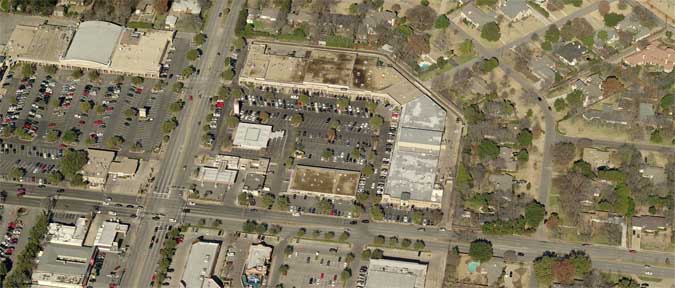
Well, this writer from the local Dallas magazine The Advocate interviewed me regarding what to do with a typical Dallas neighborhood center, particularly in this case the Preston-Royal intersection:
In Kennedy’s vision, you won’t need a car because you’ll live in the center or nearby. And if you don’t need a car, the center won’t need as much parking, not only lowering construction costs, but making room for amenities like parks. And if people spend time on the street — walking, window shopping, eating lunch in the park — the center becomes a more desirable place to live.
Hey, that's me! And below is an aerial bird's eye of the site, although I approached the interview as hypothetical as the exercise was:


To clarify, that doesn't mean the car is a thing of the past. What it means is densifying these neighborhood centers that are fast becoming obsolete, improving the experience of the retail and the quality of life for the neighborhoods adjacent that this center now provides all of the life support systems for.

After skimming the article, it doesn't appear that any of my talk of transit made the dialog. The first thing I mentioned in the interview, was that with $100 mill and entitlements to this site, I would take half of the loot and then run a two-mile modern street car along Royal Lane between the tollway and 75/DART red line station at either Walnut Hill or Lovers Lane. Which is sort of a prerequisite before ditching the car entirely, making the entire above statement sound stupid without.

I still prefer what I wrote about it retail and this site here in Rise and Shine Old Retail:
This exact same phenomenon is occurring currently with malls. The biggest and best are densifying with residential and office uses, accessing public transit, and adding amenitized, outdoor public spaces. They are becoming both more people friendly AND more business friendly. Those less fortunate (if you happen to sympathize with the plight of a particular mall) are finding life as something else, if not being scraped altogether.

This "pruning" will leave blighted "gray fields." In Dallas, this pretty much means the retail clusters that are organized on the original 1-mile super-grid, with single family neighborhoods in between will have to find a new manner of existence.

Tuesday, March 17, 2009

Double Whammy

So in the past week, the crumbling economy structured roughly around policies based in the Pleistocene Era has eliminated my Mother's job and in the Super Happy Motoring world she was stopped at a red light and plowed into by a driver going 60 mph. Luckily, she only sustained minor injuries, but in one of those not-so-ironic, not-so-unexpected collisions (pun intended) between the related worlds of economy and cars, the driver was uninsured to top it all off.

The question everyone needs to ask when they get mired in ideological debates and mundane issues is, "is there a better world out there?" And, "how do we get there?"

But first, put down your Ayn Rand. It was too boring anyway.

Wednesday, March 11, 2009

Prepare for Higher Taxes...

...or, if your community, town, borough, township, etc. out in Generica, i.e. suburbia lacks the will or ability to pass higher tax rates, prepare to get nickle and dimed on every little fee, registration, parking meters, wherever they can hide little costs to meet the overwhelming costs of overextended infrastructure.

I can't tell you how many typical "conservative" communities, i.e. the ones that allowed conventional suburban developers and strip centers run amok over their city, that I have worked in that are so under water just for upkeep and maintenance of their current infrastructure. These communities often, ironically, end up having some of the highest tax rates to accommodate the land raping that has been done.

Suburbs simply lack the density to pay for themselves and it's time to start paying the piper:

Florida prepares for higher taxes despite dropping property values:

Monday, March 9, 2009

Speaking of Timely

Newsweek on "The Last Shopping Mall" - sounds a bit Mad Max-ish, no?


...and jumpin' jeezus on a dinosaur is it perfectly and as appropriately ugly as the circumstances and motivations to build the thing.

"Xanadu is the epic discretionary story," says Davidowitz. "It's the epicenter of 'not needed.' How can you have this when the consumer is completely decimated? It's already one of the world's biggest nightmares."

Quote for the Day


The necessary melt down of the 2oth century phony economic model of quantitative growth; of robbing peter to pay paul; of buying other debt, bundling it, repackaging it, charging a fee to do all that and calling that economic development; is making a house cleaning of the conventional, the generic, the suburban, and ultimately the worthless.
The roof, the roof, the roof is on fire. We don't need no water, let the mother fucker burn. Burn mother fucker. Burn.
Yes, it is painful. Yes, I am finally feeling the effects too. But mostly through others. I strongly recommend everybody reposition themselves for the future.

To quote another song, this time by TOOL:
This is necessary...

Monday, March 2, 2009

Once Again: Told You So

Robert Greenwald and his company Brave New Films is advertising his new documentary Fighting for our Homes. The email announcement I received in advance of this included this lit
"We were trained to mislead borrowers," says a mortgage broker in Orange County, California. "There were people who were club promoters or even drug dealers that found out it was more profitable to run a mortgage shop than to do whatever they were doing."
Ahh, the full manifestation of a society built on something for nothing. I mentioned this phenomenon from a personally anecdotal standpoint long ago on these here blog pages:

Realtors are to Drug Dealers as...

It has occurred to me that Mr. Greenwald and Greg Palast represent the future of investigative journalism since the mainstream press has let us all down with the censorship of corporate tyranny.

Wednesday, February 25, 2009

Friday, February 20, 2009

LaHood to Consider VMT Tax

In my younger and more disconnected from reality days of yore, I would have supported this (link):
Transportation Secretary Ray LaHood says he wants to consider taxing motorists based on how many miles they drive rather than how much gasoline they burn — an idea that has angered drivers in some states where it has been proposed.
However, in a world of "drive til you qualify" which has forced moderate and low income families far into the nether reaches of sprawling cities, we would be once again forcing them to foot the bill for the mistakes of the power brokers and decision makers.

This can work in Portland, NYC, DC, San Fran as a means to disincentivize living at the edge. However, not many of those cities are exactly affordable inside the loops or near transit, exactly the types of places the lower and moderate income need to be to save on transpo costs.

In Dallas, everybody drives (except me!). Do we want to punish them for the world they didn't create? Or should we focus our efforts (spurred by cash flow from toll roads - which I do support for similar but less drastic measures than the VMT tax) on qualitative growth, infill around transit stations, new modern streetcar lines, and making the city more livable - thus creating a better option for people to choose.

Matthew Iglesias at ThinkProgress also questions the logic:
So I’m not sold. When it comes to pricing driving-related activities, it makes sense to charge people from things that actually impose costs on others—burning gasoline, and taking up space on crowded roads—not the mere act of driving.
Or, we could be like Detroit:


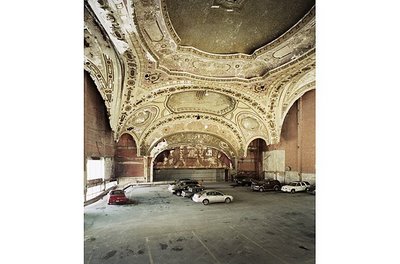
Which we tried...but fortunately, we saved our current office space, the Republic Bank building from being turned into a parking garage itself:


Tuesday, February 10, 2009

Pres. Obama: "Sprawl is Dead"

Said today at an appearance in Ft. Myers, FL:

http://cspan.org/Watch/watch.aspx?MediaId=HP-A-15317

"We get a D in infrastructure all across the country. We saw what happened in Minneapolis. A bridge collapsed and resulted in tragedy. And not only do we need to rebuild our roads and our bridges, our dams and our levees, but we also have to plan for the future...this is the same example of turning crises into opportunity. This should be a wake up call for us. You go to Shanghai, China right now and they've go high speed rail that puts our railroads to shame. They've got ports that are state of the art. Their airports, compared the airports we've got, you go to Beijing Airport and you compare that to Miami Airport (laughter, scattered applause). Now look, this is America (applause). We always had the best infrastructure, we were always willing to invest in the future. Governor Chris mentioned Abraham Lincoln, in the middle of the Civil War, in the midst of all this danger and peril, what did he do? He helped move the intercontinental railroad. He helped to start land grant colleges. He understood that even when you are in the middle of crises, youve got to keep your eye on the future, so transportation, when it is not fixing our old transportation systems, it is also imagining new transportation systems. Id like to see high speed rail, where it can be constructed. Id like for us to invest in mass transit, because potentially thats energy efficient. I think people are a lot more open now to thinking regionally. The days when we were just building sprawl forever, those days are over. I think that Republicans, Democrats, that that is not a smart way to design communities, so that we should be using this money to help spur this kind of innovative thinking when it comes to transportation, thatll make a big difference."

Monday, February 9, 2009

Americans - Whimpering Puppies

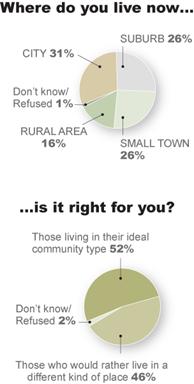
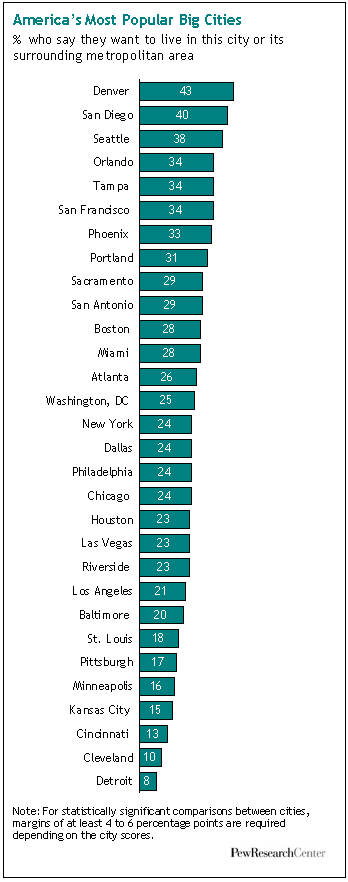
So Pew did some research [HT to McCready for sending me this article] on where people would like to live vs. where they actually do. Since people are stupid, I'll trust Chris Leinberger when he cites the statistic referenced in his latest book that only 3% of people live in walkable urbanism while 30% wish to.

I'm guessing it was a better done poll than merely asking the questions of lay people because we end up with answers like this:


Now let's shrink "Small Town" and "City" to a fraction of these numbers and throw all that into suburbia. I'm confident based on personal experience administering visual preference surveys that this is how Leinberger went about his research...or maybe not, because 30% actually seems low. In every case, the more walkable built version wins in popular vote. 30% seems low to me, but it is still effective b/c of the pent up demand between those two numbers.

The problem is that people don't see the better version. They don't know it exists. The average American is like the puppy on the electrified flooring in the experiment I read about in Psychology class in college (why this has stuck with me so long, I don't know). As animals, we learn to accept a certain environment no matter how shitty which is how markets can become so skewed when there lacks proper choice.
In part one of Seligman and Steve Maier's experiment, three groups of dogs were placed in harnesses. Group One dogs were simply put in the harnesses for a period of time and later released. Groups Two and Three consisted of "yoked pairs." A dog in Group 2 would be intentionally subjected to pain by being given electric shocks, which the dog could end by pressing a lever. A Group 3 dog was wired in parallel with a Group 2 dog, receiving shocks of identical intensity and duration, but his lever didn't stop the electric shocks. To a dog in Group 3, it seemed that the shock ended at random, because it was his paired dog in Group 2 that was causing it to stop. For Group 3 dogs, the shock was apparently "inescapable." Group 1 and Group 2 dogs quickly recovered from the experience, but Group 3 dogs learned to be helpless, and exhibited symptoms similar to chronic clinical depression.
More interestingly (to me) is this statistic:
Americans are all over the map in their views about their ideal community type: 30% say they would most like to live in a small town, 25% in a suburb, 23% in a city and 21% in a rural area.
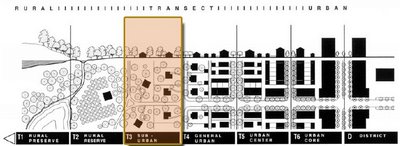
Doesn't seem all over the map to me, seems more like a continuum...or a transect:


But, of course we've only built in the T3: Suburban model, not the full range offering appropriate choice, as seen in this post on Valencia, Spain.

In other news, it is amazing how low these numbers are. Nobody wants to live in the modern American city (in its current form). Maybe we should start looking to Copenhagen, where the people are the happiest (and most well educated) in the world.

Wednesday, February 4, 2009

Links

Pretty sure I posted part 1 of this "Saving the Suburbs" series in the NYT blog, but here is part 2.

I have to admit, I didn't find anything of real substance in part 2. Here is my comment referencing the super happy save the world suburb (of like twenty houses in car-friendly Austin):

The Sol project is as net energy zero as the cars are that access the development. Not to say there is anything particular wrong with that, but to say this particular project in a sea of tract houses doesn’t actually prove anybody right or wrong.

The real issue is that American cities grew in size/land area, but not in the requisite population, i.e. they didn’t grow organically, aggregating new development with all the services and community infrastructure to be successful in addition to existing development. Rather, we robbed Peter to pay Paul, leaving our downtowns and cities to rot while we all moved into suburban neighborhoods that were principally bankrupt and were only about delivering product to the market place, not making real places with lasting value, socially, environmentally, or ecologically.

See my post on Valencia, ESP for a city and suburbs that work and grew organically to do so:

http://carfreeinbigd.blogspot.com/2008/06/valencia-spain.html

The primary issue is that there is an appropriate choice for housing types and living environments and that is represented by the current city form in Valencia. In the US, you generally have one place to live, trapped on your cul-de-sac and behind the wheel.

I’m sure the car, road building, oil/gas industries love having a captive market.
Link to a new website that catalogs Freeway Teardowns. But, the real gem is this article pasted on the site, from Induced Demand to Reduced Demand, which is exactly the issue incapsulated into one neat and tidy heading.
This is what transportation planners call "induced demand." Building freeways encourages people to drive longer distances: in the short run, people begin to drive to regional malls rather than local stores, and in the longer run, they move to lower density neighborhoods where they have to drive further for all their trips.
The convenience of driving has become our [and its] own worst enemy.

Road construction, in the attempt to alleviate the pressure further spreads people out and thus creates its own demand to fill the newly created supply, so we're back to square one...only amplified. The real answer is demand side solutions that reduce the need for trips and driving for every facet of life. As my post yesterday suggests, our happiness and well-being depends upon it.

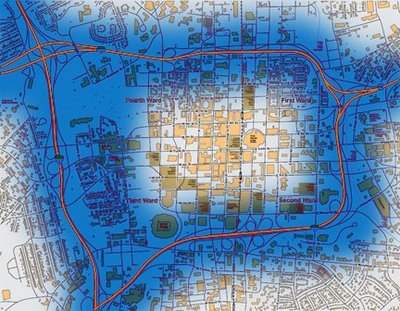
If you're tired of me b!tching about the highway problem affecting downtown Dallas, move to Charlotte...no, wait a minute. Don't do that. Check this figure ground of downtown Charlotte and how it has essentially been wiped out except for the very center that is in itself buffered by distance and an eroding urban fabric (much like the four blocks of Main Street that work in Dallas):