




Showing posts with label Bankrupting America. Show all posts

Friday, May 28, 2010

Linkages

Get ready for the dreaded double-dip. $3 trillion in commercial real estate is about to go [poof]:
Why do you think banks have stopped lending in this arena? The market is completely saturated with vacant real estate. Commercial real estate either has a market or sits empty. At least with residential real estate if you drop prices low enough you will get buyers. With CRE if you built a complex with no foot traffic you can’t give the stuff away. The loan is only one aspect of costs. You have utilities and other fixed overhead. The fact that banks have pulled back from this market tells us no good deals are coming to the table.
How's that sprawl working out for you? I've always loved the idea of business park. Not loved as in liked, but loved as in amused that people thought they might work. Banks lose. :(
------------------------------
Charles Hugh Smith discusses that the root of the housing problem hasn't been solved and reminds that housing ownership is really "ownership." You're still paying off debt. The banks own the house. Banks Win! :)
------------------------------
Zero Hedge splashes cold water on people foolish, naive, or gullible enough to believe realtors who say "now is the time to buy!" Of course, they do. Their livelihood depends upon you buying. Except:

There are 140 million personal residences in the US. Today, there are 26 million homes either directly or indirectly for sale...Another 8 million mortgage owners are late on their payments and are on the verge of foreclosure, bringing the total overhang to 34 million homes.

Now, let’s look at the buy side. There are 35 million who are underwater on their mortgages and aren’t buying homes anytime soon, nor are the 35 million unemployed and underemployed. That knocks out 50% of the potential buyers.

Here is where it gets really interesting. There are 80 million baby boomers retiring at the rate of 10,000 a day. Assuming that they downsize over time from an average 2,500 sq ft. home to a 1,000 sq. ft. condo, and eventually to a 100 sq. ft. assisted living facility, the total shrinkage in demand is 4.3 billion sq.ft. per year, or 1.7 million average sized homes. That amounts to a shrinkage of aggregate demand for a city the size of San Francisco, every year. You can argue that the following Gen-Xer’s are going to take up the slack, but there are only 65 million of them with a much lower standard of living than their parents.

Ohhhh, frowny face. Banks lose. :(

Perhaps banks should be hiring urban experts to understand where true and lasting value is...
--------------------------------
Now, to the fun stuff...

Wired has an awesome article on NYC droppin' the mathematics upside your head to deal with traffic. NYC (smartly) compiles just about every form of data imaginable; a painful reminder of just how far behind Dallas is. This was evident when New York Mag put together their neighborhood livability rankings based heavily upon various publicly available statistics the City has compiled. Dallas, nor the metro, has anything close to it.
-------------------------------
Lastly, Laurence Aurbach at Ped Shed links to a new study suggesting that intersection density is the single most critical factor for determining walkability, much moreso than density or diversity. I could have told them that. This was actually livability indicator #8. Perhaps, I should change the name.
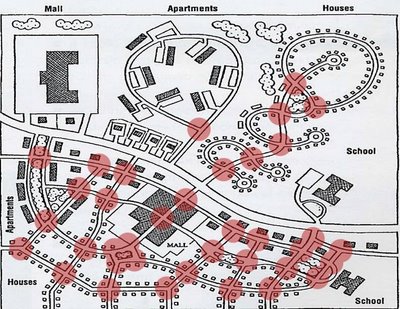


Furthermore, Density is merely the response to desirability and walkable urban form is what accommodates a range of densities based on demand. Diversity, well that is simply a by-product of livability, which has at its root mobility where walkability is still the best mode with the most positive and least negative externalities.

Like all 'alpha' studies, I find the simple measure of intersections per square area, while helpful, overly abstract. In one instance, they seem to be saying that two-way intersections are better for walkability than four-way because they lead to denser intersections. What about dense network of four-way intersections?

This goes beyond walkability and more toward the "neural network" and interconnectivity of the grid in general, but as we all know a four-way intersection generates traffic from 4-directions rather than 2 creating a higher degree of traffic (by foot or car) which retailers need, which in turn can (dependent upon design) generate more foot traffic.

This study could get "smarter," in my opinion if instead of merely counting intersections it assigned a rating system to each of those intersections. In a way measuring node density (or quality thereof) rather than just intersection density and the node rankings would be based on two factors off the top of my head:

1) amount of directions intersecting the intersection, ie a four-way is better than a two-way (distance of which is mitigated by the density calc) and then;

2) a professional subjective factor of quality of pedestrian experience.

This is actually something that I have been thinking about formulating for some time, I just haven't had the time to get around to it yet. I know an academician is probably loathe to apply some subjective criteria, but what is the point of being a professional if you can't add your expertise to an equation that by nature would always be a blunt abstraction.

Monday, July 6, 2009

Make No Little Plans

As Chicago prepares to party like it's 1909, celebrating the 100th anniversary of the Burnham Plan of Chicago, the WSJ covers it here:
The plan advises: “The city which brings about the best conditions of life becomes the most prosperous.” London’s citizens, it warns, who rejected the 1666 plan proposed by the great Christopher Wren, put their own “perverse self-interests” first and cost the city “millions upon millions in money to repair in part the errors which might have been avoided so easily, besides years of inconvenience and loss due to congestion of ­traffic.”

Some of us even have Burnham awards... cough cough.
Take note Dallas, a City of equal ambition but lacking any direction, forces tugging it every which way. Now quoting from John Norquist's Wealth of Cities:

"...if urban proximity and its efficiencies end because government policy spreads population and markets randomly over the landscape, then the wealth produced in cities dissipates."

Business and improved quality of life in cities are not mutually exclusive. In fact, as cities are the only entity NOT created by political act, as they are evolved from mere aggregations of people facing similar hardships looking for safety and eventually became bubbling cauldrons of cultural foment.

So in this way, they transcend boundaries and are organic constructs. Cities are products of economic activity and as I quoted Mumford here,
"The purpose of transportation is to bring people and goods to places where they are needed, and to concentrate the greatest variety of goods and people within that limited area, in order to widen the possibility of choice without making it necessary to travel. A good transportation system minimizes unnecessary transportation; and in any event, it offers change of speed and mode to fit a diversity of human purposes."

As Norquist goes on to say, this ease of transport, of goods reaching markets, of synergies formed by proximity, create frictionless markets. The idea behind highways was to aid in this movement however, highways, in actuality and ironically, have dispersed us to the point where markets (and our cities) have broken down, becoming so fractured with barely a pulse.

Productivity and synergy are lost as we actually infused increased "friction" between markets that include the cost of construction and maintenance of these highways, the distance between producers and markets, the cost of personal automobility and the energy to get between two places (read: fluctuating and unpredictability of gas prices), and "externalized" costs that somebody has to pay for eventually including pollution, decline of real estate prices, obesity, healthcare and health impacts of collisions, etc.

Highways started as a means of linking cities and aiding in intercity commerce. But the monster has grown beyond its cage into a construction for the sake of construction industry, lacking purpose, a snake swallowing its own tail. They are important in linking city perimeter to city perimeter, but never should have been constructed within city limits, allowing for highway friendly business and logistics uses towards the edge of the city which are often associated with blight, ie nobody wants to be near them.

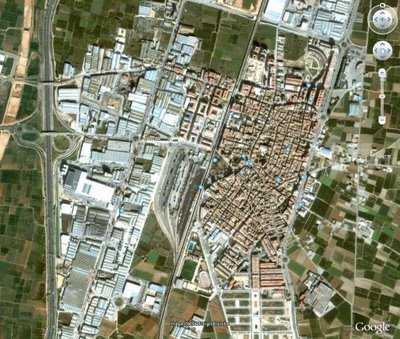
See my post on Valencia, Spain and the image of a suburb of Valencia shown below:


Moving from West to East (or Left to right), you see highway, industrial/shipping/freight uses, then the train station for passenger and freight, then the remainder of the town full of little blue dots. These dots in a previous iteration of Google Earth indicated images uploaded into google earth. I classify these also as indicators of health because they are indicative of places people love enough to photograph and share with the rest of the world. (Also, note that the highways and industrial uses encroach very little into the actual city of Valencia.)

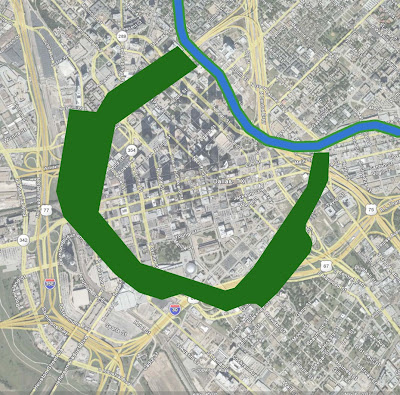
See the affect the inner loop has on the City of Dallas. Nothing wants to be near the freeways. Note: the only successful piece of urbanism in downtown Dallas is the four-block stretch of Main Street fully buffered by a cocoon of the city from the impact of the freeway.

We should start tearing these out as I suggest similar to the ringstrasse in Vienna. It's good for business.


(Ringstrasse overlaid onto Dallas)
While this is no small plan, it is not something that can be done overnight. As Jan Gehl suggests, these things must be done incrementally. It has taken Copenhagen 45 years of slowly removing cars from the streets and returning them to the people. Now the city is filled with that most precious of urban health indicators, babies.

Step 1 should be about reducing the immediate affect of the highways by taking out all clover leafs in the downtown area, as Vancouver has begun to do here. Thus, making the highways here context-sensitive, meaning responsive and sensitive to their immediate surroundings. There are no one-size fits all solutions as TxDOT will thrust their standards upon cities.

Removing clover leafs and replacing the off-ramp system with more city-friendly "urbanized" streets that hug the highways like frontage roads diminishes the negative impact of the high speed ramping by forcing slower traffic onto the frontage roads. These frontage roads should look and act like urban streets with parking, sidewalks, street trees, etc. Furthmore, by eliminating the space eating cloverleafs, this effort begins to open up land for development that the City in cooperation with the state can turn over as part of a redevelopment RFP for areas adjacent to highways.

Thursday, July 2, 2009

Quote for the Day

Being Millennial to the extreme right now: reading and highlighting a book, The Wealth of Cities by John Norquist; checking email from the Iphone; posting to the blog; and having a beer and lunch at a neighborhood bar, or "third place."


Extracted from said book, 'Mark I. Gelfand in A Nation of Cities,
"The Democratic mayor of Richmond told the meeting (ed. note: at the 1935 United States Council of Mayors meeting discussing how to deal with the depression) that if municipalities would simply learn to live within their incomes, all their problems would disappear."
Apropos, given the post/discussion on municipal budgets lately.

Wednesday, March 11, 2009

Prepare for Higher Taxes...

...or, if your community, town, borough, township, etc. out in Generica, i.e. suburbia lacks the will or ability to pass higher tax rates, prepare to get nickle and dimed on every little fee, registration, parking meters, wherever they can hide little costs to meet the overwhelming costs of overextended infrastructure.

I can't tell you how many typical "conservative" communities, i.e. the ones that allowed conventional suburban developers and strip centers run amok over their city, that I have worked in that are so under water just for upkeep and maintenance of their current infrastructure. These communities often, ironically, end up having some of the highest tax rates to accommodate the land raping that has been done.

Suburbs simply lack the density to pay for themselves and it's time to start paying the piper:

Florida prepares for higher taxes despite dropping property values: