




This report comes at a critical moment, as Congress takes up the imminent passage of the next federal transportation bill, which dictates how billions of tax dollars will be spent over coming years. The Benchmarking Report reveals that, in nearly every city and state, pedestrians and bicyclists are disproportionately at risk of being killed, and currently receive less than a fair share of transportation dollars. While 12 percent of trips in the U.S. are by bike or foot, 14 percent of traffic fatalities are bicyclists and pedestrians. Pedestrian and bicycle projects receive less than 2 percent of federal transportation dollars.
“The Benchmarking Report shows that biking and walking are smart solutions to many of our country’s most pressing challenges when it comes to transportation, job creation and health,” Jeffrey Miller, Alliance President/CEO, says.
The report compiles persuasive evidence that bicycle and pedestrian projects create more jobs than highway projects, and provide at least three dollars of benefit for every dollar invested. The report also highlights the health benefits of active transportation, showing that states with the highest rates of bicycling and walking are also among those with the lowest rates of obesity, diabetes, and high blood pressure. “The data points to one conclusion: Investing in biking and walking projects creates jobs, leads to more people biking and walking, and improves safety and public health,” Miller says.
John Pucher, a professor at Rutgers University, emphasizes: “The wide range of environmental, social, and economic benefits of walking and bicycling, so clearly documented in this report, justify greatly increased investment in facilities and programs to encourage more walking and cycling, and to improve the safety of these most sustainable of all transportation modes.”
Showing posts with label bicycle culture. Show all posts
Showing posts with label bicycle culture. Show all posts
Monday, January 23, 2012
2012 Report: Rankings for Walking/Biking
Alliance for Biking & Walking has published their 2012 report ranking American States and Cities. Their words:
If you just download the media fact sheet, you'll find where Dallas and Fort Worth stand amongst the 51 cities included in the rankings.
For overall levels of walking/biking:
Dallas 49th of 51
FW 51st of 51
OKC is 50th
That's the bottom three. As for the top three: Boston, DC, San Fran in that order.
For fatality rates of pedestrians/bicyclists:
Dallas 49th of 51
FW 51st of 51
Jacksonville is 50th
As for the top 3: Boston, Minneapolis, Omaha in that order
When I have more time, I'll dig into the methodology.


Monday, August 9, 2010
Not Spending the Money that Doesn't Have to Be Spent
Bicycle commuting in European capital cities, from the Financial Times:
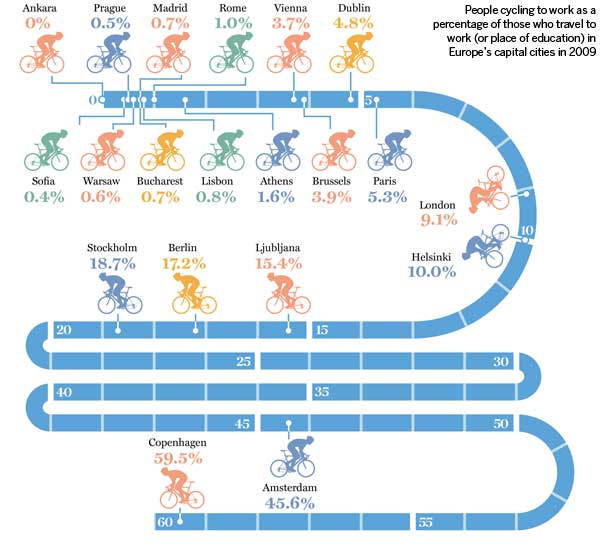
Imagine how much money Copenhagen saves for its people and the City itself with that extraordinary number of nearly 60% commuters on bikes. The same daily economic connections are being made, generating wealth, but at a fraction of the cost for infrastructure and energy due to less intensive means. If you were running a city like a business, wouldn't you want the same revenue at a fraction of the costs?
Imagine how much money Copenhagen saves for its people and the City itself with that extraordinary number of nearly 60% commuters on bikes. The same daily economic connections are being made, generating wealth, but at a fraction of the cost for infrastructure and energy due to less intensive means. If you were running a city like a business, wouldn't you want the same revenue at a fraction of the costs?
Friday, May 28, 2010
DALLAS BIKE PLAN OPEN HOUSE - A REVIEW
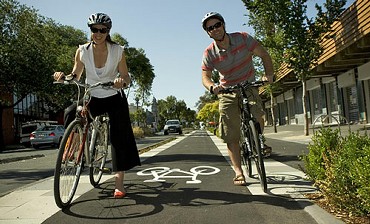
Last night I was able to attend the Dallas Bike Plan open house at City Hall for what was a standing room only house in the Council Chambers. At first that seems impressive until you think that a City of over 1 million only has about 200 people or so attending a public hearing. /200 is an estimate. I have no idea how many people the council chambers holds.
Having run a number of similar public workshops and open houses, I was well aware of what to expect. These things are always feel good moments for those running them. Why? Because everyone responsible for getting a particular study/proposal moving forward have a conception in their own mind of what the result could/should/or would be. The arguments are yet to be had when those various visions begin to intersect or compete. The challenge is always marshaling the various powers that be into one cohesive direction.
Since I don't feel like organizing this into one cohesive narrative (and at this point it probably shouldn't be until the plan gets some actual vision to it), I'll leave you with the good and the bad from the evening:
THE GOOD:
The Mayor and the councilmembers who showed up, some of whom even stuck around until the end. This effort definitely seems to have their full support and the Mayor gets an A+ from me for acknowledging that this is one step towards densification and a more sustainable, prosperous City.
THE BAD:
The excruciating half hour of acknowledgements, back-patting, and self-congratulatory remarks before the presentation even started. I understand that some credit is due for steering the tremendous inertia of car-oriented commuting in the right direction, but let's not count our chickens before their hatched. Will you stand up to transpo or DOT when they shrilly scream, "OMG, we won't hit level of service A if you remove that lane of traffic! We have arbitrary formulas that prove it!!!!11" Hmm?
THE GOOD:
Toole Design. We hired the right people. I was very impressed when they stressed that this wasn't a trails plan. We have trails and we have plans to connect them. This is a roads plan for bicycle lanes and cyclist safety.
THE BAD:
Don't limit or censor yourself already Toole. More than a few times they showed a few examples of road treatments prioritizing the safety of cyclists and/or pedestrians over car movement where the setting was either foreign or the solution was deemed too radical for Dallas. Already. Push the envelope. Have no fear. We need a broad range of context-appropriate solutions to deal with our road network appropriately. When Dallas gets behind something it gets behind it all the way. Just look at our road and highway system. World class!!!
THE GOOD:
The crowd as mentioned before was enthusiastic, engaged, and well...there.
THE BAD:
I would guess at least 90% are the hardcore enthusiasts that bike already. The plan isn't about them (although their safety is a part of it as well), although their enthusiasm is what made it happen in the first place and what have to sustain in order to carry it through to realization.
While education is an important part of safety, this isn't about bringing all cyclists up to your level of expertise in navigating Dallas traffic. This is about winding Dallas traffic down while simultaneously supplying the accommodations so that everyone else that wasn't there, or doesn't currently bike because they are intimidated can feel safe cycling to work or wherever rather than using their car, the petrol to power that car, and the space to park that car.
THE GOOD:
Toole showed images of a number of concepts that I whole-heartily encourage, including:
- Sign Pollution - Signs are ugly and litter the landscape/streetscape. Signage should always be supplementary and good design and wayfinding should be largely intuitive. Otherwise, it just isn't a good design and signage is what is used to cover up those faults. I loved the painted bicyclist on the stone paver. Yes, plz.
- Back-in Angled Parking - I was around this concept when it was first created while I interned with traffic calming gurus Walter Kulash and Ian Lockwood. Those two probably had as much of an impact on my understanding of cities as anybody. Lesson: no matter your field, it is always good to work with experts in other fields and it is your job to find the tangential relationship.
- Bike Green Lights at traffic signals. I like that they give at least equal priority to cyclists as a mode of traffic on the streets. My idealistic vision would be that they aren't necessary however.
- Trail/Road Crossings - These are important and as Toole pointed out, sometimes the right-of-way is given to drivers and the yield to cyclists, sometimes vice versa. This is critical though, because our reflexive solution is always changing planes by way of bridges. Stupid.
- I like the idea of protected bike lanes uphill and shared lanes with cars downhill. We're not exactly Seattle, but this was a good idea for how to smartly design when you only have a few feet to play with.
- Routine Accommodation - Much of this work can be done with simple restriping or repaving which occurs every few years anyway as part of the ordinary transpo budget ameliorating worries of increased cost. Of course, I say we just rip up all of the macadam and expose the brick under so many of our streets.
I saw a lot of mention of street sections, but as Toole pointed out the biggest conflict point, where accidents occur most often, is at intersections. Two things to this:
- Sections are important, but too often a road gets one section and that section is then extruded for whatever length of the street. The section should vary based on context. For example, much of our city is based on 1-mile square arterial grid. The intersections are where neighborhood retail has clustered in the form of strip centers. These areas need to densify. The intersections are the nodes of place and changing the road section here should be different than the road section between it and the next node 1-mile away. This area between is the 'link' and should be designed as such.
- I will be most interested to see if there are recommendations for intersections drawn in plan, or from above. Too many of our intersections are designed with curb radii that are too large allowing for "rolling stops" or cars to roll right thru stop signs or red lights when turning right. In the future cyclists very well might be there. I believe the idea of "cycle boxes" is meant to address this by putting cyclists' stopping point out in front of cars where they are then moved further back from the intersection to ensure sight of the cyclists who are at greater risk of personal injury.
I want measurable goals. In fact, this City needs measurable outcomes. For example, Copenhagen established a goal that they want 0, that is ZERO traffic fatalities in a year. That is a clear, measurable outcome. In that way, we have something to weigh policy and approach. We get too driven by ideology that we lack the ability to go back and determine what worked or what didn't. The lack of these is why we as a city tend to spin in circles like a spastic canine rather than in one concerted, positive direction (ya know other than council districts as vassal fiefdoms).
What those are yet I don't know (the goals board was always too crowded so I couldn't tell how specific they got), let's let Toole arrive at those but here might be some examples:
- By xxxx year, Dallas will have the greatest percentage of bicycle commuters to work of any city in the country over 250,000 people; or
- By xxxx year, Dallas will have the highest percentage of bicycle/pedestrian/non-automobile commuters in the country per capita.
- By xxxx year, Dallas will have more protected bike lanes than any other city in the country.
- By xxxx year, Dallas will have removed more lanes of car-only traffic than any other country.
- By xxxx year, areas within 3-5 miles (logical bicycle commuting distance) Dallas has densified its core at a greater rate than any other City in the country.
Remember Sammy Jankis, ya effing quacks.

Wednesday, May 26, 2010
GUEST POST: Bicycling in Dallas
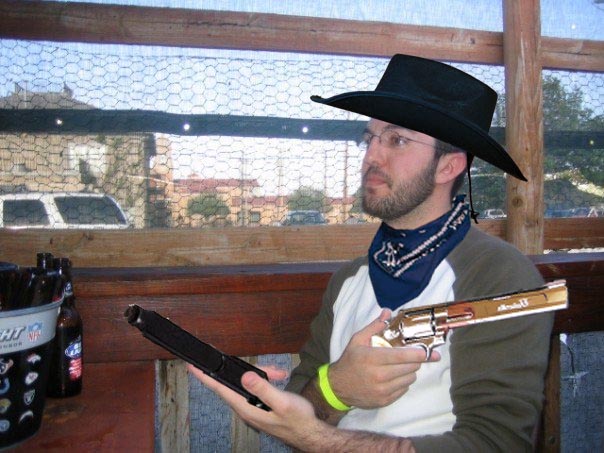
Go ahead, drivers. Make my day.
These are fun. Why? Because I don't have to provide all the written content. Thursday afternoon, 5 to 8 pm, at City Hall in downtown Dallas is the Bike Plan open house. Will anything substantive come of this particular session, probably not. But, it is a chance to commiserate with your like-minded peers...and there'll be punch and pie!
------------------------------------
Putting My Hard Hat On and Going to Work.
Yes, I ride my bike. Or, should I say I am the pimple that the city of Dallas drivers can’t seem to rid themselves. I may be a speck in the grand scheme of a City where commuting is an antagonistic affair, but I am certainly the most annoying of all opponents delaying you from that rat race.
It might actually seem feasible to reach a downtown job by bicycle for a resident of the yuppie village region of Uptown Dallas, not more than two miles away. Too long to walk, the trolley is as reliable as its century old parts, and driving just seems ostentatious. It ought to be the perfect distance for what should be a safe, enjoyable ride if in a City that accommodated it.
Well, in the City of Dallas, it isn’t. With the luxury of great weather year round, I began commuting by bike three months ago. The trek is not far. I can see my building from my apartment, but the absurdity of navigating the region on two wheels is far too intimidating for most. As a safe, energy efficient endeavor, it shouldn't be. Alas, we've entitled those pointing and pedaling the much more deadly machines.
People comfortably ride bikes around White Rock Lake and on the Katy Trail, but hardly anyone rides on the street. Why? Because you can’t. Sure, you can physically ride on the street, but good luck. Without a bike lane to be found you are head-to-head with impatient motorists not interested in your safety, but rather, reaching their destination as expediently as the law does or does not allow.
My commute is unable to take the logical, direct route: McKinney Ave, or snake through some side streets that might be more pedestrian friendly. No, my commute begins on the sidewalk to get to the intersection of Hall and Cole, or shall I say, the intersection of bicycle death. After I turn onto Hall, I then weave through a drive-thru bank (without making a deposit or withdrawal mind you) to get to the Katy Trail. Alas, I made it….alive. This is the only enjoyable portion of the commute. The Katy Trail is beautiful to ride alongside other bicyclists, people out for their morning jog, and experience some of the most beautiful green spaces in the city.
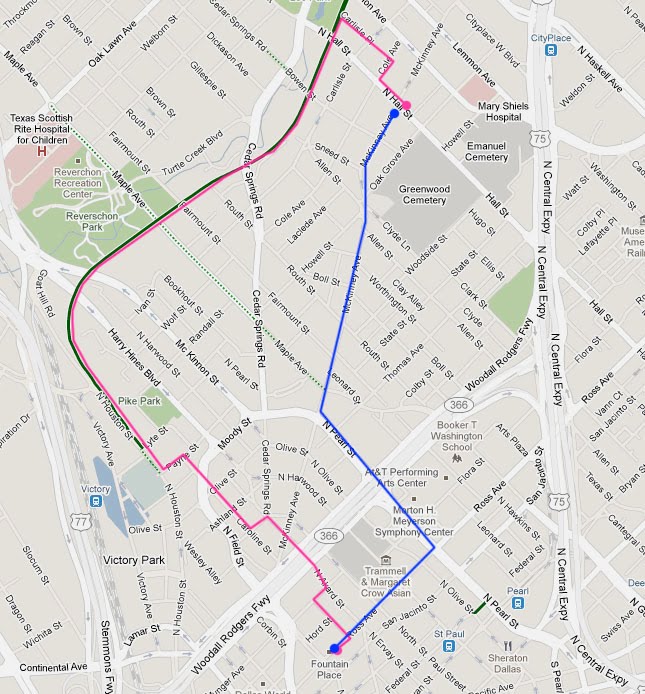
ed: Ryan's route vs. the more direct one.
On the roads forget about common courtesy or patience from drivers. Usually the best strategy at intersections is to let every car go first, hoping that the next wave of motorists realizes your turn, but this is risky business. Look out for Sally Sorority in daddy's beamer on her cell phone willing to make you part of the street, or her vehicles grill. Three separate times I have been nearly killed as I perform a basic left turn onto Hall Street, with the right-of-way. Common theme: cell phones. All three motorists have been on their cell phones not paying attention. I could have been a biker, a walker, or a double-decker bus in London. It would matter not. A wreck or manslaughter is in their future. No worries. Daddy will cover it.
Once this portion of the commute is over, the real journey begins as I navigate a sea of parking lots in order to avoid Mark Martin, Tony Stewart, and the late Dale Earnhardt on their way to work. Crossing the highway is always the next obstacle where I stare death straight into its steely grate. Surprisingly, it is not too bad. With a preponderance of lanes, motorists provide bicyclists the right-hand lane. However, I do not doubt for a second that I would be run down for the next changing traffic light.
When my day is up, back to the Texas Motor Speedway we go. The return trip always follows the same route because the only safe section is the Katy Trail no matter how far out of my way it is, which in the afternoon with the sun out is even more enjoyable. There are no safe streets for a bicyclist. Of course not. You are a second class citizen. Perhaps soon we will have to drink out of separate water fountains.
The commuting back and forth is not nearly as bad as the first time one tries it. Like anything else, you get used to it, all of it. You have to accept that this City, not just its inhabitants, its drivers have cast you out. You are undesirable. Even dressed in office attire, as might be the case in any other City in the world, you are lumped into the small niche crowd of hardcore enthusiasts in spandex when all you want to do is get to work.
I suppose it actually is my fault foolishly thinking that biking to work, since it is such a short distance, was a good idea. I mean that bro honking and glaring at me from his Hummer because I properly turned left at the four-way stop, with the right-of-way, is clearly right. Look how important he is, he’s in a car. Duh!
A city shouldn’t have to “get used” to alternative, healthy forms of transportation. This city needs bike lines, a plan for nearby residents to commute safely to downtown, and a real conscience about promoting healthy commuting for a city known for the opposite. I am not Lance Armstrong, but I also don’t want to be that dead squirrel on the pavement.
----------------------------------------
Ryan DiRaimo is a local architect. He wants you to know that he's 6-5, 240 and plays in the NHL, but not for the Stars. Those endeavors might lead you to believe that he would be too busy to maintain a sports blog, a twitter account, AND be a favorite of the lovely ladies of Dallas-Fort Worth Metroplex. He does all of the above. Except for some.
The Future Is Now
Thanks to Bike Denton for sending me this study on congestion and road narrowing vs. capacity expansion. The thing to take from all of it is that congestion is inevitable. Commerce needs it and frankly, people need it as well. We organize our lives, cities, and economies around predictable convergence points, areas where "traffic" will be the highest. The question then becomes, how do we want that to look, to operate, and then it also becomes what can we afford long-term.
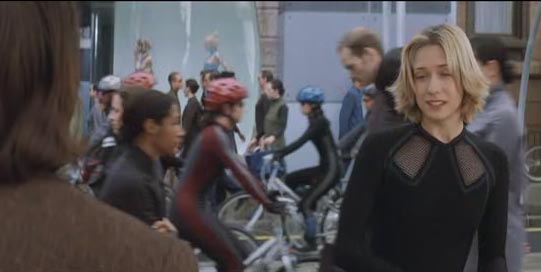
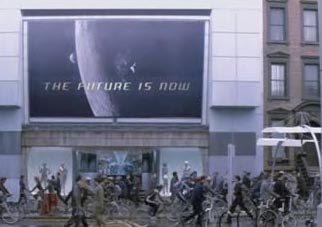
Which reminded me of the movie the Time Machine. A rather droll remake with of all the typical silly futuristic trappings like living on the moon and goofy outfits to let dummies know, "yes, this is set in the future." In a world where we so often mistake highways and cars as progress (towards what goal, I don't know) the filmmakers one interesting visualization was their take on NYC in 2030 where all of the street traffic is by bike or foot. Some stills:
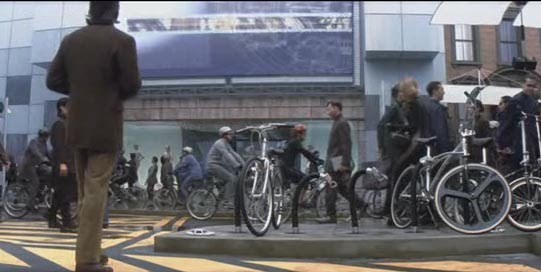
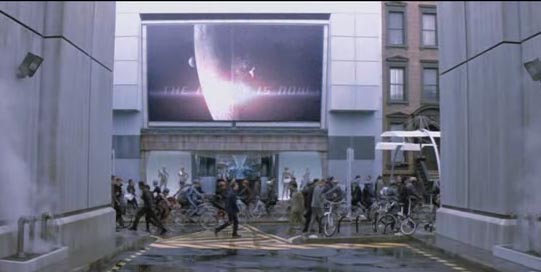
It looks like rush hour. Let's take a look at the rush hour and parking facilities for various forms of dominant transportation:
Pedestrian rush hour:
![[IMG_1523.JPG]](../../_D5kx0bUGx_c/SFrct4PDoYI/AAAAAAAAATc/JS9cXQtUA9E/s1600/IMG_1523.JPG)
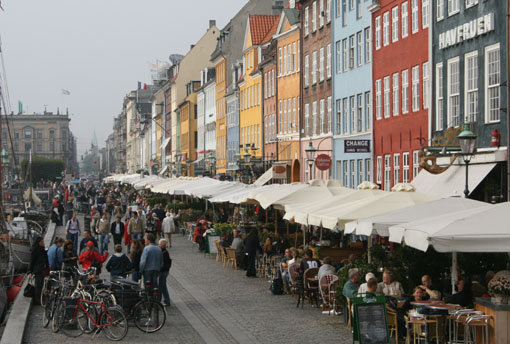
Pedestrian parking:
Bicycle rush hour:
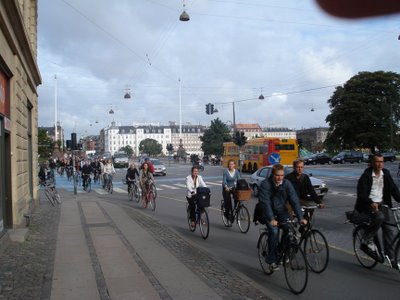
Bicycle parking:
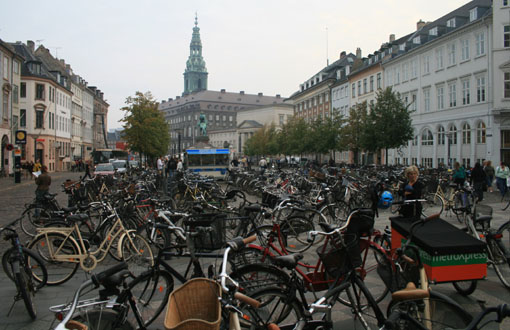
Automobile rush hour:
Automobile parking:
Let's leave the last word to the movie:
Wednesday, May 5, 2010
Pic 4 The Day
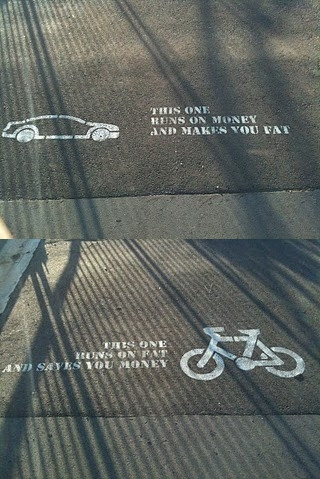
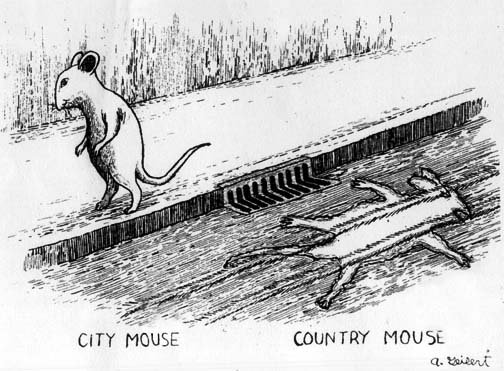
Emblematic of the societal backlash against the hegemony of car culture and life spent
This also reminds of an old post citing the recent trend in Japan that going/being CarFree was emerging as a status symbol. Know freedom.
Subscribe to:
Posts (Atom)

 Posts
Posts